lock CHEVROLET CORVETTE 2010 6.G User Guide
[x] Cancel search | Manufacturer: CHEVROLET, Model Year: 2010, Model line: CORVETTE, Model: CHEVROLET CORVETTE 2010 6.GPages: 472, PDF Size: 11.44 MB
Page 36 of 472
Front Seats
Manual Seats
{WARNING:
You can lose control of the vehicle if you try to
adjust a manual driver's seat while the vehicle is
moving. The sudden movement could startle and
confuse you, or make you push a pedal when you
do not want to. Adjust the driver's seat only when
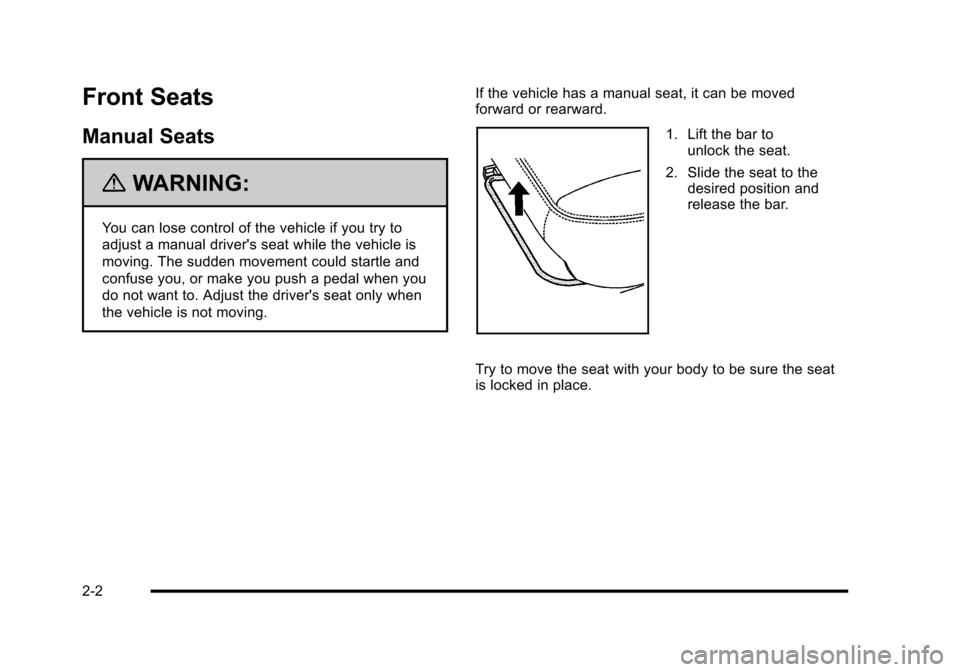
the vehicle is not moving. If the vehicle has a manual seat, it can be moved
forward or rearward.
1. Lift the bar to
unlock the seat.
2. Slide the seat to the desired position and
release the bar.
Try to move the seat with your body to be sure the seat
is locked in place.
2-2
Page 40 of 472
Reclining Seatbacks
{WARNING:
You can lose control of the vehicle if you try to
adjust a manual driver's seat while the vehicle is
moving. The sudden movement could startle and
confuse you, or make you push a pedal when you
do not want to. Adjust the driver's seat only when
the vehicle is not moving.
{WARNING:
If either seatback is not locked, it could move
forward in a sudden stop or crash. That could
cause injury to the person sitting there. Always
push and pull on the seatbacks to be sure they
are locked.
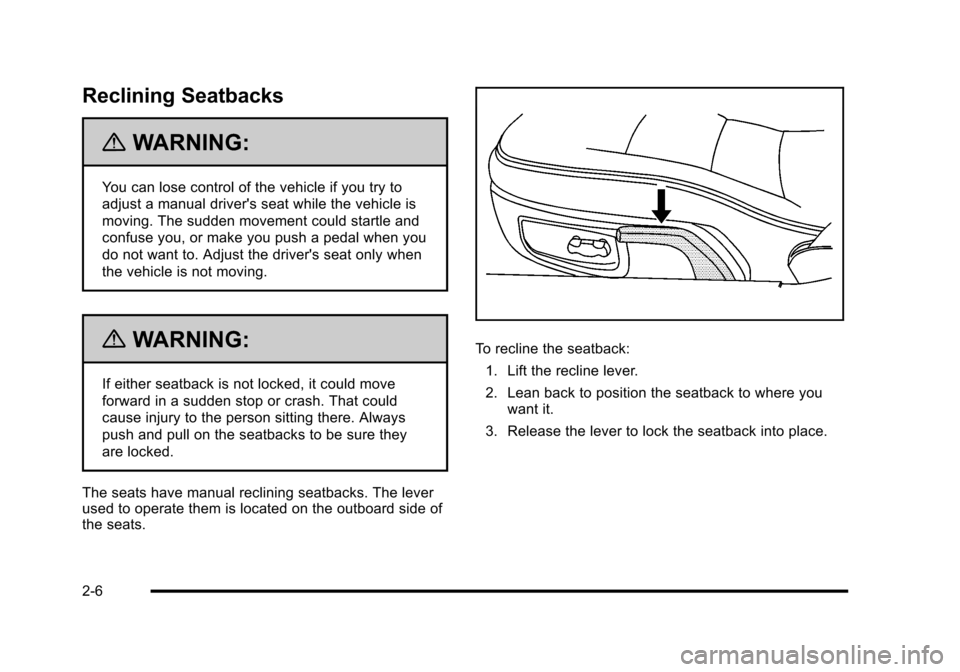
The seats have manual reclining seatbacks. The lever
used to operate them is located on the outboard side of
the seats.
To recline the seatback: 1. Lift the recline lever.
2. Lean back to position the seatback to where you want it.
3. Release the lever to lock the seatback into place.
2-6
Page 42 of 472
Seatback Latches
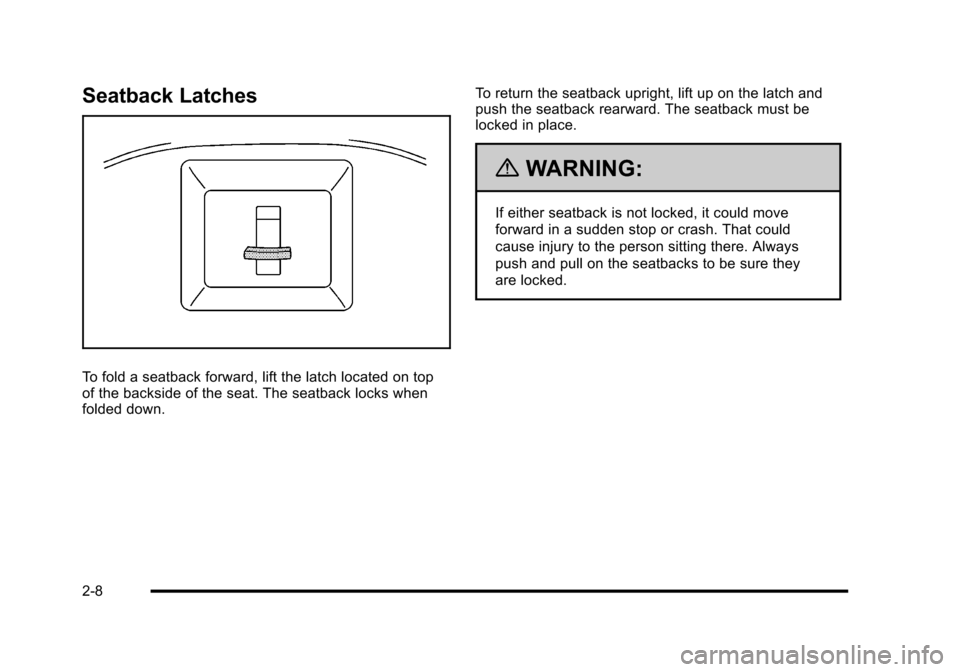
To fold a seatback forward, lift the latch located on top
of the backside of the seat. The seatback locks when
folded down. To return the seatback upright, lift up on the latch and
push the seatback rearward. The seatback must be
locked in place.
{WARNING:
If either seatback is not locked, it could move
forward in a sudden stop or crash. That could
cause injury to the person sitting there. Always
push and pull on the seatbacks to be sure they
are locked.
2-8
Page 49 of 472
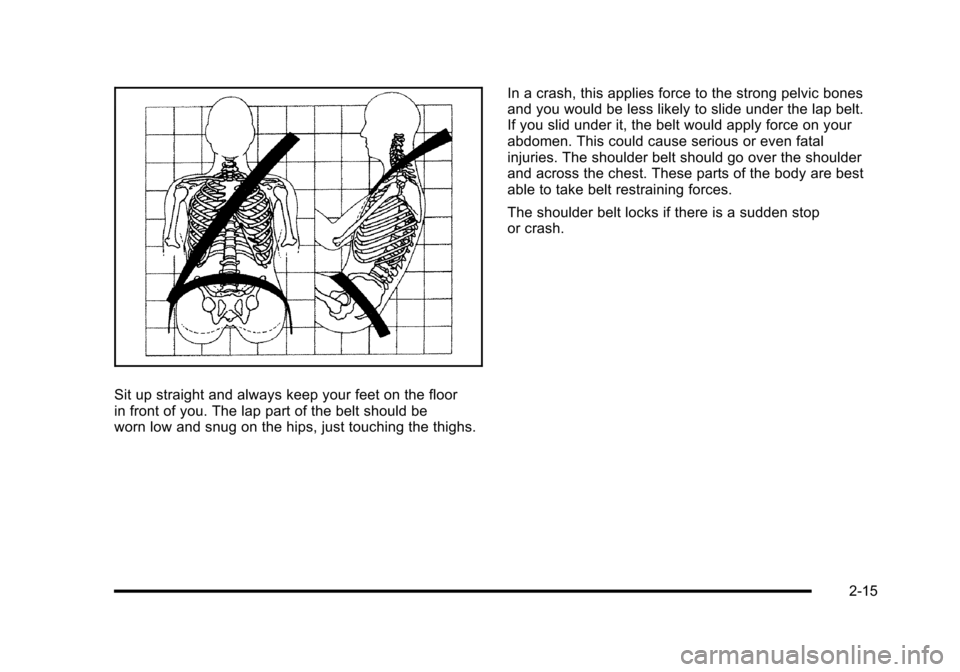
Sit up straight and always keep your feet on the floor
in front of you. The lap part of the belt should be
worn low and snug on the hips, just touching the thighs. In a crash, this applies force to the strong pelvic bones
and you would be less likely to slide under the lap belt.
If you slid under it, the belt would apply force on your
abdomen. This could cause serious or even fatal
injuries. The shoulder belt should go over the shoulder
and across the chest. These parts of the body are best
able to take belt restraining forces.
The shoulder belt locks if there is a sudden stop
or crash.
2-15
Page 57 of 472
Lap-Shoulder Belt
All seating positions in the vehicle have a
lap-shoulder belt.
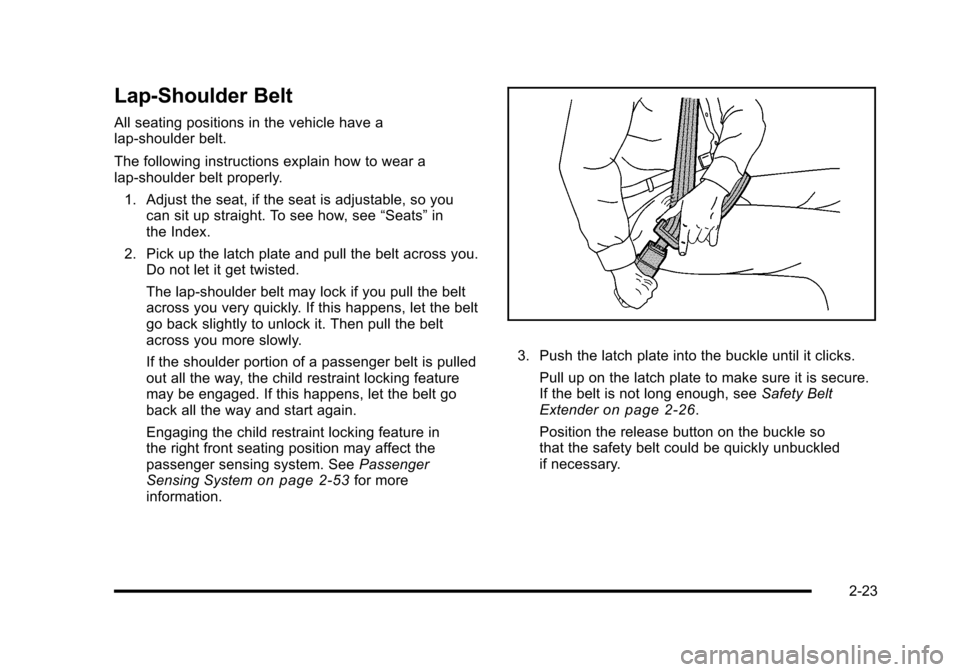
The following instructions explain how to wear a
lap-shoulder belt properly. 1. Adjust the seat, if the seat is adjustable, so you can sit up straight. To see how, see “Seats”in
the Index.
2. Pick up the latch plate and pull the belt across you. Do not let it get twisted.
The lap-shoulder belt may lock if you pull the belt
across you very quickly. If this happens, let the belt
go back slightly to unlock it. Then pull the belt
across you more slowly.
If the shoulder portion of a passenger belt is pulled
out all the way, the child restraint locking feature
may be engaged. If this happens, let the belt go
back all the way and start again.
Engaging the child restraint locking feature in
the right front seating position may affect the
passenger sensing system. See Passenger
Sensing System
on page 2‑53for more
information.
3. Push the latch plate into the buckle until it clicks.
Pull up on the latch plate to make sure it is secure.
If the belt is not long enough, see Safety Belt
Extender
on page 2‑26.
Position the release button on the buckle so
that the safety belt could be quickly unbuckled
if necessary.
2-23
Page 76 of 472
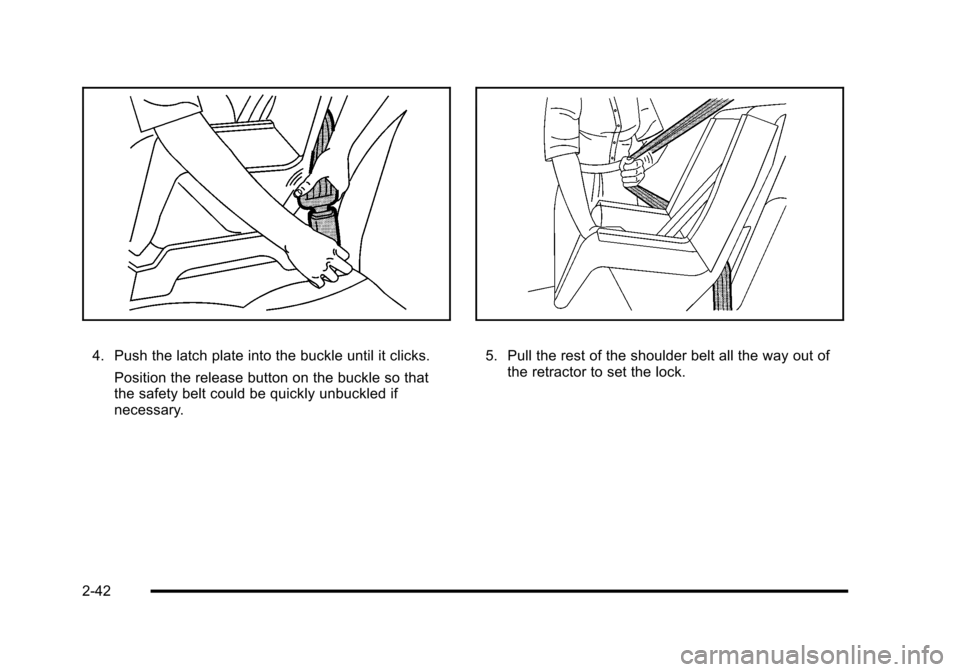
4. Push the latch plate into the buckle until it clicks. Position the release button on the buckle so that
the safety belt could be quickly unbuckled if
necessary. 5. Pull the rest of the shoulder belt all the way out of the retractor to set the lock.
2-42
Page 81 of 472
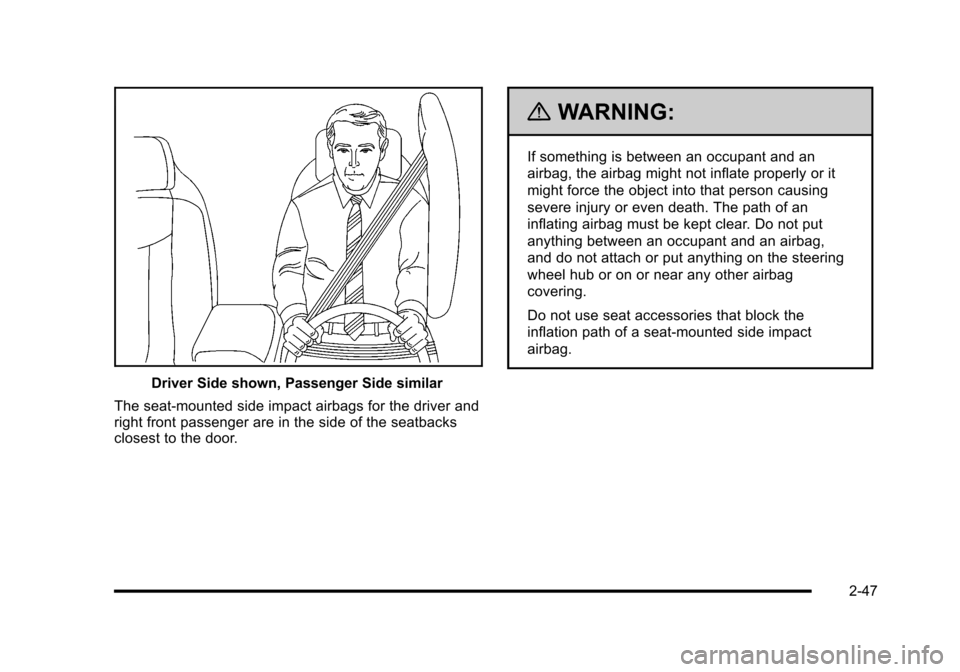
Driver Side shown, Passenger Side similar
The seat-mounted side impact airbags for the driver and
right front passenger are in the side of the seatbacks
closest to the door.
{WARNING:
If something is between an occupant and an
airbag, the airbag might not inflate properly or it
might force the object into that person causing
severe injury or even death. The path of an
inflating airbag must be kept clear. Do not put
anything between an occupant and an airbag,
and do not attach or put anything on the steering
wheel hub or on or near any other airbag
covering.
Do not use seat accessories that block the
inflation path of a seat-mounted side impact
airbag.
2-47
Page 85 of 472
What Will You See After an Airbag
Inflates?
After the frontal and seat-mounted side impact airbags
inflate, they quickly deflate, so quickly that some people
may not even realize the airbags inflated. Some
components of the airbag module may be hot for
several minutes. For location of the airbag modules,
see What Makes an Airbag Inflate? on page 2‑50.
The parts of the airbag that come into contact with you
may be warm, but not too hot to touch. There may be
some smoke and dust coming from the vents in the
deflated airbags. Airbag inflation does not prevent the
driver from seeing out of the windshield or being able
to steer the vehicle, nor does it prevent people from
leaving the vehicle.
{WARNING:
When an airbag inflates, there may be dust in the
air. This dust could cause breathing problems for
people with a history of asthma or other breathing
trouble. To avoid this, everyone in the vehicle
should get out as soon as it is safe to do so.
If you have breathing problems but cannot get out
of the vehicle after an airbag inflates, then get
fresh air by opening a window or a door. If you
experience breathing problems following an airbag
deployment, you should seek medical attention.
The vehicle has a feature that may automatically unlock
the doors, turn the interior lamps on, turn on the hazard
warning flashers, and shut off the fuel system after the
2-51
Page 86 of 472
airbags inflate. You can lock the doors, turn the interior
lamps off, and turn the hazard warning flashers off by
using the controls for those features.
{WARNING:
A crash severe enough to inflate the airbags may
have also damaged important functions in the
vehicle, such as the fuel system, brake and
steering systems, etc. Even if the vehicle appears
to be drivable after a moderate crash, there may
be concealed damage that could make it difficult
to safely operate the vehicle.
Use caution if you should attempt to restart the
engine after a crash has occurred. In many crashes severe enough to inflate the airbag,
windshields are broken by vehicle deformation.
Additional windshield breakage may also occur from
the right front passenger airbag.
.Airbags are designed to inflate only once. After an
airbag inflates, you will need some new parts for
the airbag system. If you do not get them, the
airbag system will not be there to help protect you
in another crash. A new system will include airbag
modules and possibly other parts. The service
manual for your vehicle covers the need to replace
other parts.
.The vehicle has a crash sensing and diagnostic
module which records information after a crash.
See
Vehicle Data Recording and Privacy
on
page 8‑18and Event Data Recorderson
page 8‑18.
.Let only qualified technicians work on the airbag
system. Improper service can mean that the airbag
system will not work properly. See your dealer/
retailer for service.
2-52
Page 91 of 472
If this happens, use the following steps to allow the
system to detect that person and enable the right front
passenger frontal airbag and seat-mounted side impact
airbag: 1. Turn the vehicle off.
2. Remove any additional material from the seat, such as blankets, cushions, seat covers, seat
heaters, or seat massagers.
3. Place the seatback in the fully upright position.
4. Have the person sit upright in the seat, centered on the seat cushion, with legs comfortably
extended.
5. Restart the vehicle and have the person remain in this position for two to three minutes after the on
indicator is lit.Additional Factors Affecting System
Operation
Safety belts help keep the passenger in position on the
seat during vehicle maneuvers and braking, which helps
the passenger sensing system maintain the passenger
airbag status. See “Safety Belts”and“Child Restraints”
in the Index for additional information about the
importance of proper restraint use.
If the shoulder portion of the belt is pulled out all the
way, the child restraint locking feature will be engaged.
This may unintentionally cause the passenger sensing
system to turn the airbag(s) off for some adult size
occupants. If this happens, let the belt go back all the
way and start again.
2-57