ABS CHEVROLET CORVETTE 2011 6.G User Guide
[x] Cancel search | Manufacturer: CHEVROLET, Model Year: 2011, Model line: CORVETTE, Model: CHEVROLET CORVETTE 2011 6.GPages: 428, PDF Size: 6.63 MB
Page 264 of 428
Black plate (34,1)Chevrolet Corvette Owner Manual - 2011
9-34 Driving and Operating
Downshifting
(Manual Transmission)
Do not downshift into the gear
shown below at a speed greater
than shown in the table:1 (First) 80 km/h (50 mph)
2 (Second) 119 km/h (74 mph)
3 (Third) 163 km/h
(101 mph)
4 (Fourth) 209 km/h
(130 mph)
Notice: If you skip more than one
gear when you downshift, or if
you race the engine when you
release the clutch pedal while
downshifting, you could damage
the engine, clutch, driveshaft or
the transmission. Do not skip
gears or race the engine when
downshifting. The six-speed transmission has
a spring that centers the shift
lever near 3 (Third) and 4 (Fourth).
This spring helps you know which
gear you are in when you are
shifting. Be careful when shifting
from 1 (First) to 2 (Second) or
downshifting from 6 (Sixth) to
5 (Fifth). The spring will try to pull
the shift lever toward 4 (Fourth) and
3 (Third). Make sure you move the
lever into 2 (Second) or 5 (Fifth).
If you let the shift lever move in the
direction of the pulling, you may end
up shifting from 1 (First) to 4 (Fourth)
or from 6 (Sixth) to 3 (Third).
Brakes
Antilock Brake
System (ABS)
This vehicle has the Antilock
Brake System (ABS), an advanced
electronic braking system that helps
prevent a braking skid.
When the engine is started and
the vehicle begins to drive away,
ABS checks itself. A momentary
motor or clicking noise might be
heard while this test is going on,
and it might even be noticed that
the brake pedal moves a little.
This is normal.
If there is a problem with ABS, this
warning light stays on. See
Antilock
Brake System (ABS) Warning Light
on page 5‑22.
Page 265 of 428
Black plate (35,1)Chevrolet Corvette Owner Manual - 2011
Driving and Operating 9-35
If driving safely on a wet road
and it becomes necessary to slam
on the brakes and continue braking
to avoid a sudden obstacle, a
computer senses that the wheels
are slowing down. If one of the
wheels is about to stop rolling,
the computer will separately work
the brakes at each wheel.
ABS can change the brake pressure
to each wheel, as required, faster
than any driver could. This can help
the driver steer around the obstacle
while braking hard.
As the brakes are applied, the
computer keeps receiving updates
on wheel speed and controls
braking pressure accordingly.
Remember: ABS does not change
the time needed to get a foot up to
the brake pedal or always decreasestopping distance. If you get too
close to the vehicle in front of you,
there will not be enough time to
apply the brakes if that vehicle
suddenly slows or stops. Always
leave enough room up ahead to
stop, even with ABS.
Using ABS
Do not pump the brakes. Just hold
the brake pedal down firmly and let
ABS work. You might hear the ABS
pump or motor operating and feel
the brake pedal pulsate, but this is
normal.
Braking in Emergencies
ABS allows the driver to steer and
brake at the same time. In many
emergencies, steering can help
more than even the very best
braking.
Parking Brake
The parking brake lever is located to
the right of the center console.
To set the parking brake, hold the
brake pedal down. Pull the parking
brake lever up. If the ignition is on,
the brake system warning light will
come on.
To release the parking brake, hold
the brake pedal down. Then push
the release button in as you move
the parking brake lever all the
way down.
Notice:
Driving with the parking
brake on can overheat the brake
system and cause premature
wear or damage to brake system
parts. Make sure that the parking
brake is fully released and the
brake warning light is off before
driving.
Page 266 of 428
Black plate (36,1)Chevrolet Corvette Owner Manual - 2011
9-36 Driving and Operating
Brake Assist
This vehicle has a brake assist
feature designed to assist the
driver in stopping or decreasing
vehicle speed in emergency driving
conditions. This feature uses the
stability system hydraulic brake
control module to supplement
the power brake system under
conditions where the driver has
quickly and forcefully applied the
brake pedal in an attempt to quickly
stop or slow down the vehicle.
The stability system hydraulic brake
control module increases brake
pressure at each corner of the
vehicle until the ABS activates.
Minor brake pedal pulsation or
pedal movement during this time
is normal and the driver should
continue to apply the brake pedal
as the driving situation dictates.
The brake assist feature will
automatically disengage when
the brake pedal is released or
brake pedal pressure is quickly
decreased.
Ride Control Systems
Traction Control
System (TCS)
The vehicle has a Traction Control
System (TCS) that limits wheel spin.
This is especially useful in slippery
road conditions. The system
operates only if it senses that the
rear wheels are spinning too much
or are beginning to lose traction.
When this happens, the system
works the rear brakes and reduces
engine power (by closing the throttle
and managing engine spark) to limit
wheel spin.
The TRACTION SYSTEM ACTIVE
message displays on the Driver
Information Center (DIC) when TCS
is limiting wheel spin. SeeRide
Control System Messages on
page 5‑44. The system may be
heard or felt while it is working,
but this is normal. If cruise control is being used when
TCS begins to limit wheel spin, the
cruise control will automatically
disengage. Cruise control may be
reengaged when road conditions
allow. See
Cruise Control on
page 9‑44.
The SERVICE TRACTION SYSTEM
message and the TCS warning light
will come on if there is a problem
with TCS. See Ride Control System
Messages on page 5‑44.
When this light and the SERVICE
TRACTION SYSTEM message
are on, the system will not limit
wheel spin. Adjust your driving
accordingly.
Page 313 of 428
Black plate (29,1)Chevrolet Corvette Owner Manual - 2011
Vehicle Care 10-29
Cooling System
(Intercooler)
The 6.2L LS9 supercharged
V8 engine has an intercooler
cooling system. SeeEngine
Compartment Overview on
page 10‑10 for location of the
intercooler.
The intercooler cooling system has
a special procedure for draining
and adding coolant. Because this
procedure is difficult, see the dealer
for service if the intercooler is low
on coolant. The procedure can also
be found in the service manual.
To purchase a service manual,
see Service Publications Ordering
Information on page 13‑15.
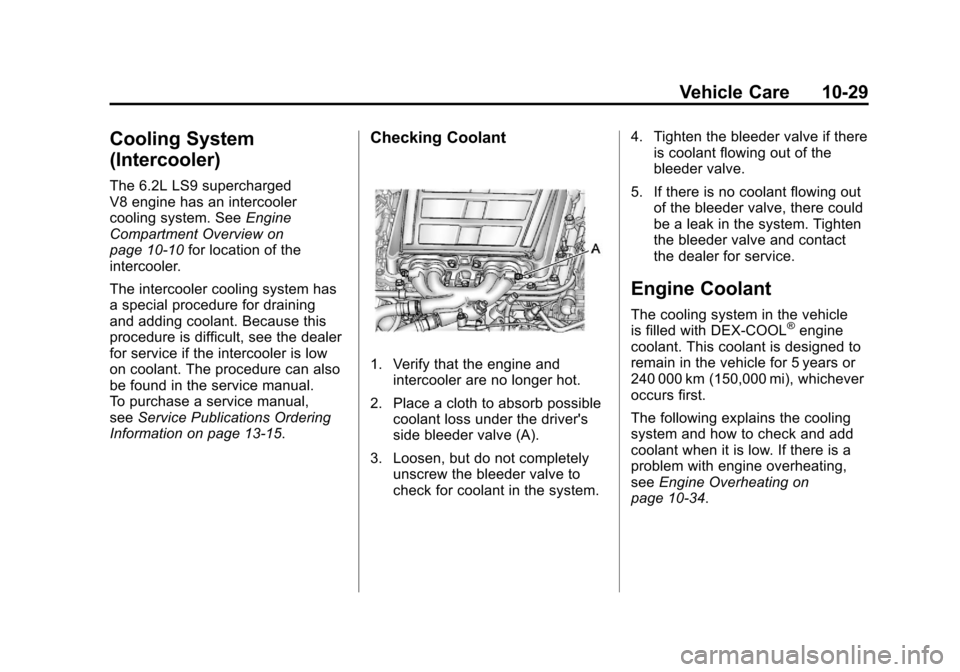
Checking Coolant
1. Verify that the engine and intercooler are no longer hot.
2. Place a cloth to absorb possible coolant loss under the driver's
side bleeder valve (A).
3. Loosen, but do not completely unscrew the bleeder valve to
check for coolant in the system. 4. Tighten the bleeder valve if there
is coolant flowing out of the
bleeder valve.
5. If there is no coolant flowing out of the bleeder valve, there could
be a leak in the system. Tighten
the bleeder valve and contact
the dealer for service.
Engine Coolant
The cooling system in the vehicle
is filled with DEX-COOL®engine
coolant. This coolant is designed to
remain in the vehicle for 5 years or
240 000 km (150,000 mi), whichever
occurs first.
The following explains the cooling
system and how to check and add
coolant when it is low. If there is a
problem with engine overheating,
see Engine Overheating on
page 10‑34.
Page 333 of 428
Black plate (49,1)Chevrolet Corvette Owner Manual - 2011
Vehicle Care 10-49
Headlamps, Front Turn
Signal and Parking
Lamps
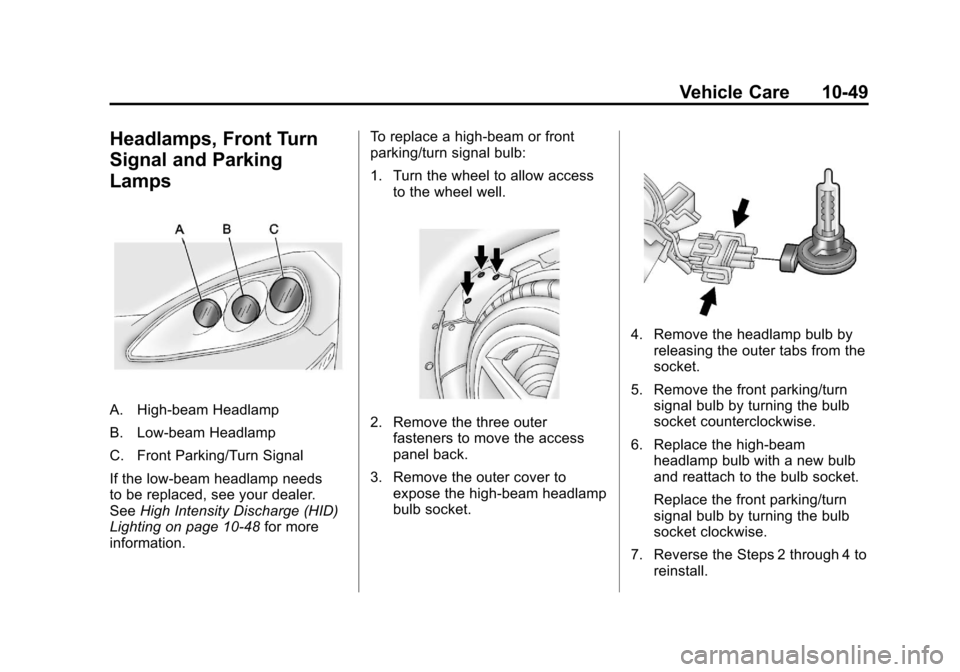
A. High-beam Headlamp
B. Low-beam Headlamp
C. Front Parking/Turn Signal
If the low-beam headlamp needs
to be replaced, see your dealer.
SeeHigh Intensity Discharge (HID)
Lighting on page 10‑48 for more
information. To replace a high-beam or front
parking/turn signal bulb:
1. Turn the wheel to allow access
to the wheel well.2. Remove the three outerfasteners to move the access
panel back.
3. Remove the outer cover to expose the high-beam headlamp
bulb socket.
4. Remove the headlamp bulb byreleasing the outer tabs from the
socket.
5. Remove the front parking/turn signal bulb by turning the bulb
socket counterclockwise.
6. Replace the high-beam headlamp bulb with a new bulb
and reattach to the bulb socket.
Replace the front parking/turn
signal bulb by turning the bulb
socket clockwise.
7. Reverse the Steps 2 through 4 to reinstall.
Page 334 of 428
Black plate (50,1)Chevrolet Corvette Owner Manual - 2011
10-50 Vehicle Care
Taillamps, Turn Signal,
and Stoplamps
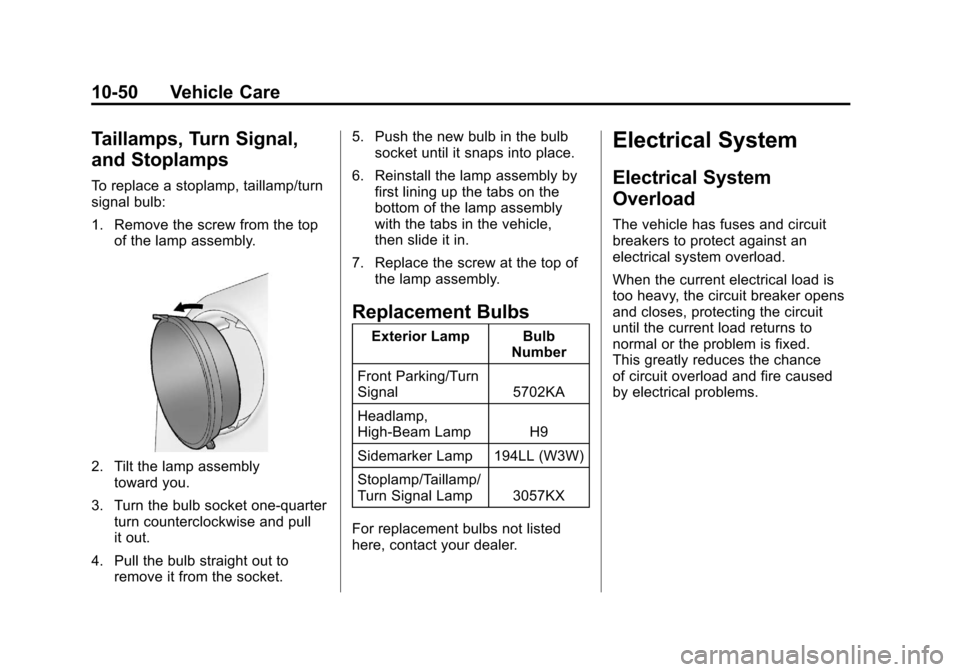
To replace a stoplamp, taillamp/turn
signal bulb:
1. Remove the screw from the topof the lamp assembly.
2. Tilt the lamp assemblytoward you.
3. Turn the bulb socket one-quarter turn counterclockwise and pull
it out.
4. Pull the bulb straight out to remove it from the socket. 5. Push the new bulb in the bulb
socket until it snaps into place.
6. Reinstall the lamp assembly by first lining up the tabs on the
bottom of the lamp assembly
with the tabs in the vehicle,
then slide it in.
7. Replace the screw at the top of the lamp assembly.
Replacement Bulbs
Exterior Lamp Bulb Number
Front Parking/Turn
Signal 5702KA
Headlamp,
High‐Beam Lamp H9
Sidemarker Lamp 194LL (W3W)
Stoplamp/Taillamp/
Turn Signal Lamp 3057KX
For replacement bulbs not listed
here, contact your dealer.
Electrical System
Electrical System
Overload
The vehicle has fuses and circuit
breakers to protect against an
electrical system overload.
When the current electrical load is
too heavy, the circuit breaker opens
and closes, protecting the circuit
until the current load returns to
normal or the problem is fixed.
This greatly reduces the chance
of circuit overload and fire caused
by electrical problems.
Page 336 of 428
Black plate (52,1)Chevrolet Corvette Owner Manual - 2011
10-52 Vehicle Care
Engine Compartment
Fuse Block
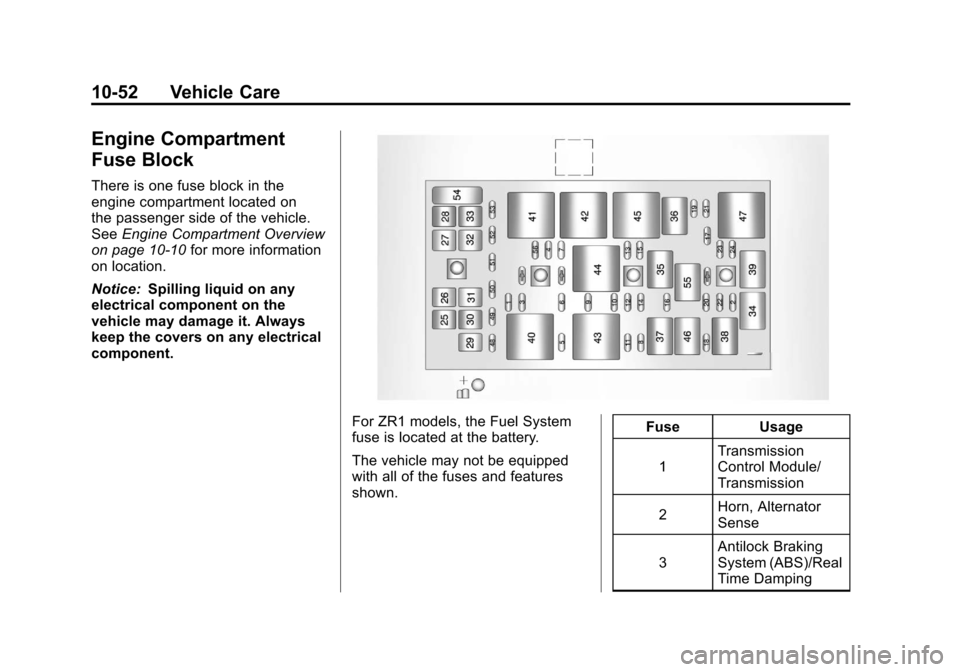
There is one fuse block in the
engine compartment located on
the passenger side of the vehicle.
SeeEngine Compartment Overview
on page 10‑10 for more information
on location.
Notice: Spilling liquid on any
electrical component on the
vehicle may damage it. Always
keep the covers on any electrical
component.
For ZR1 models, the Fuel System
fuse is located at the battery.
The vehicle may not be equipped
with all of the fuses and features
shown. Fuse Usage
1 Transmission
Control Module/
Transmission
2 Horn, Alternator
Sense
3 Antilock Braking
System (ABS)/Real
Time Damping
Page 375 of 428
Black plate (91,1)Chevrolet Corvette Owner Manual - 2011
Vehicle Care 10-91
Do not clean the vehicle using:
.A knife or any other sharp object
to remove a soil from any interior
surface.
.A stiff brush. It can cause
damage to the vehicle's interior
surfaces.
.Heavy pressure or aggressive
rubbing with a cleaning cloth.
Use of heavy pressure can
damage the interior and does
not improve the effectiveness
of soil removal.
.Laundry detergents or
dishwashing soaps with
degreasers can leave residue
that streaks and attracts dirt.
For liquid cleaners, about
20 drops per gallon (3.78 L) of
water is a good guide. Use only
mild, neutral-pH soaps.
.Too much cleaner that saturates
the upholstery.
.Organic solvents such as
naptha, alcohol, etc. that can
damage the vehicle's interior.
Fabric/Carpet
Use a vacuum cleaner with a soft
brush attachment frequently to
remove dust and loose dirt.
A canister vacuum with a beater bar
in the nozzle may only be used on
floor carpet and carpeted floor mats.
For any soil, always try to remove it
first with plain water or club soda.
Before cleaning, gently remove as
much of the soil as possible using
one of the following techniques:
.For liquids: gently blot the
remaining soil with a paper
towel. Allow the soil to absorb
into the paper towel until no
more can be removed.
.For solid dry soils: remove as
much as possible and then
vacuum.
To clean:
1. Saturate a lint-free, clean white cloth with water or club soda.
2. Wring the cloth to remove excess moisture. 3. Start on the outside edge of the
soil and gently rub toward the
center. Continue cleaning, using
a clean area of the cloth each
time it becomes soiled.
4. Continue to gently rub the soiled area until the cleaning cloth
remains clean.
5. If the soil is not completely removed, use a mild soap
solution and repeat the cleaning
process that was used with plain
water.
If any of the soil remains, a
commercial fabric cleaner or spot
lifter may be necessary. When a
commercial upholstery cleaner or
spot lifter is to be used, test a small
hidden area for colorfastness first.
If the locally cleaned area gives any
impression that a ring formation may
result, clean the entire surface.
After the cleaning process has been
completed, a paper towel can be
used to blot excess moisture from
the fabric or carpet.
Page 417 of 428

Black plate (1,1)Chevrolet Corvette Owner Manual - 2011
INDEX i-1
A
Accessories andModifications . . . . . . . . . . . . . . . . . 10-4
Accessory Power . . . . . . . . . . . . . . 9-21
Active Handling System . . . . . . . 9-37
Active Handling System Light . . . . . . . . . . . . . . . . . . . . . . . . . 5-23
Add-On Electrical Equipment . . . . . . . . . . . . . . . . . . . 9-54
Adding Equipment to the Airbag-Equipped Vehicle . . . . . 3-35
Adjustments Lumbar, Front Seats . . . . . . . . . . . 3-6
Air Cleaner/Filter, Engine . . . . . 10-24
Air Dam, Front . . . . . . . . . . . . . . . . . 9-19
Air Filter, Passenger Compartment . . . . . . . . . . . . . . . . . 8-7
Air Vents . . . . . . . . . . . . . . . . . . . . . . . 8-6
Airbag System Check . . . . . . . . . . . . . . . . . . . . . . . . 3-36
How Does an Airbag
Restrain? . . . . . . . . . . . . . . . . . . . 3-28
Passenger Sensing System . . . . . . . . . . . . . . . . . . . . . . 3-30
What Makes an Airbag
Inflate? . . . . . . . . . . . . . . . . . . . . . . 3-27 Airbag System (cont.)
What Will You See After
an Airbag Inflates? . . . . . . . . . . 3-28
When Should an Airbag
Inflate? . . . . . . . . . . . . . . . . . . . . . . 3-26
Where Are the Airbags? . . . . . . 3-24
Airbags Adding Equipment to theVehicle . . . . . . . . . . . . . . . . . . . . . . 3-35
Passenger Status Indicator . . . 5-17
Readiness Light . . . . . . . . . . . . . . 5-16
Servicing Airbag-Equipped Vehicles . . . . . . . . . . . . . . . . . . . . . 3-34
System Check . . . . . . . . . . . . . . . . 3-22
Alarm System Anti-Theft . . . . . . . . . . . . . . . . . . . . . 2-12
AM-FM Radio . . . . . . . . . . . . . . . . . . . 7-5
Antenna Satellite Radio . . . . . . . . . . . . . . . . 7-11
Anti-Theft Alarm System . . . . . . . . . . . . . . . . 2-12
Alarm System Messages . . . . . 5-50
Antilock Brake
System (ABS) . . . . . . . . . . . . . . . . 9-34
Warning Light . . . . . . . . . . . . . . . . . 5-22 Appearance Care
Exterior . . . . . . . . . . . . . . . . . . . . . 10-86
Interior . . . . . . . . . . . . . . . . . . . . . . 10-90
Ashtrays . . . . . . . . . . . . . . . . . . . . . . . . 5-8
Assistance Program, Roadside . . . . . . . . . . . . . . 13-8, 13-10
Audio Players . . . . . . . . . . . . . . . . . 7-11
CD . . . . . . . . . . . . . . . . . . . . . . . . . . . 7-11
Audio System Diversity Antenna System . . . . 7-11
Radio Reception . . . . . . . . . . . . . . 7-10
Theft-Deterrent Feature . . . . . . . . 7-2
Automatic Dimming Mirrors . . . . . . . . . . . . . . 2-16
Door Locks . . . . . . . . . . . . . . . . . . . 2-10
Automatic Transmission . . . . . . . 9-28
Fluid . . . . . . . . . . . . . . . . . . . . . . . . 10-23
Manual Mode . . . . . . . . . . . . . . . . . 9-29
Automatic Transmission Shift Lock Control
Function Check . . . . . . . . . . . . . 10-45
Auxiliary Devices . . . . . . . . . . . . . . 7-17
Axle, Rear . . . . . . . . . . . . . . . . . . . . 10-44
Page 422 of 428

Black plate (6,1)Chevrolet Corvette Owner Manual - 2011
i-6 INDEX
I
Ignition Positions . . . . . . . . . . . . . . 9-20
Immobilizer . . . . . . . . . . . . . . . . . . . . 2-14
Infants and Young Children,Restraints . . . . . . . . . . . . . . . . . . . . 3-39
Instrument Cluster . . . . . . . . . . . . . . 5-9
Introduction . . . . . . . . . . . . . . . . . . .iii, 7-1
J
Jump Starting . . . . . . . . . . . . . . . . . 10-82
K
Key and Lock Messages . . . . . . . 5-42
Keyless Entry Remote (RKE) System . . . . . . . . 2-3
Keyless Entry System . . . . . . . . . . 2-3
Keys . . . . . . . . . . . . . . . . . . . . . . . . . . . . 2-2
L
Labeling, Tire Sidewall . . . . . . . . 10-61
Lamp Messages . . . . . . . . . . . . . . . 5-44
Lamps Courtesy . . . . . . . . . . . . . . . . . . . . . . . 6-6
Daytime Running (DRL) . . . . . . . 6-2
Exterior Controls . . . . . . . . . . . . . . . 6-1
Exterior Lamps OffReminder . . . . . . . . . . . . . . . . . . . . 6-2
Exterior Lighting Battery Saver . . . . . . . . . . . . . . . . . . . . . . . . 6-7
Headlamps, Front Turn Signal and Parking
Lamps . . . . . . . . . . . . . . . . . . . . 10-49
Malfunction Indicator . . . . . . . . . 5-18
On Reminder . . . . . . . . . . . . . . . . . 5-25
Reading . . . . . . . . . . . . . . . . . . . . . . . 6-6
Lap-Shoulder Belt . . . . . . . . . . . . . 3-18 LATCH System
Replacing Parts After a
Crash . . . . . . . . . . . . . . . . . . . . . . . 3-48
Latch, Lower Anchors and Tethers for
Children . . . . . . . . . . . . . . . . 3-43, 3-44
Latches, Seatback . . . . . . . . . . . . . . 3-8
Lifting the Vehicle, Tires . . . . . . . 10-5
Lighter, Cigarette . . . . . . . . . . . . . . . 5-7
Lighting Entry/Exit . . . . . . . . . . . . . . . . . . . . . . 6-6
Illumination Control . . . . . . . . . . . . 6-5
Lights Active Handling System . . . . . . 5-23
Airbag Readiness . . . . . . . . . . . . . 5-16
Antilock Brake System(ABS) Warning . . . . . . . . . . . . . . 5-22
Flash-to-Pass . . . . . . . . . . . . . . . . . . 6-2