steering CHEVROLET DYNASTY 1993 Service Manual
[x] Cancel search | Manufacturer: CHEVROLET, Model Year: 1993, Model line: DYNASTY, Model: CHEVROLET DYNASTY 1993Pages: 2438, PDF Size: 74.98 MB
Page 1939 of 2438
With Serpentine Belts; Run engine until warm (5
min.) and note any belt chirp. If chirp exists, move
pulley outward approximately 0.5 mm (0.020 in.). If
noise increases, press on 1.0mm (0.040 in.). Be careful
that pulley does not contact mounting bolts.
SAGINAW T/C STYLE PUMP
REMOVE
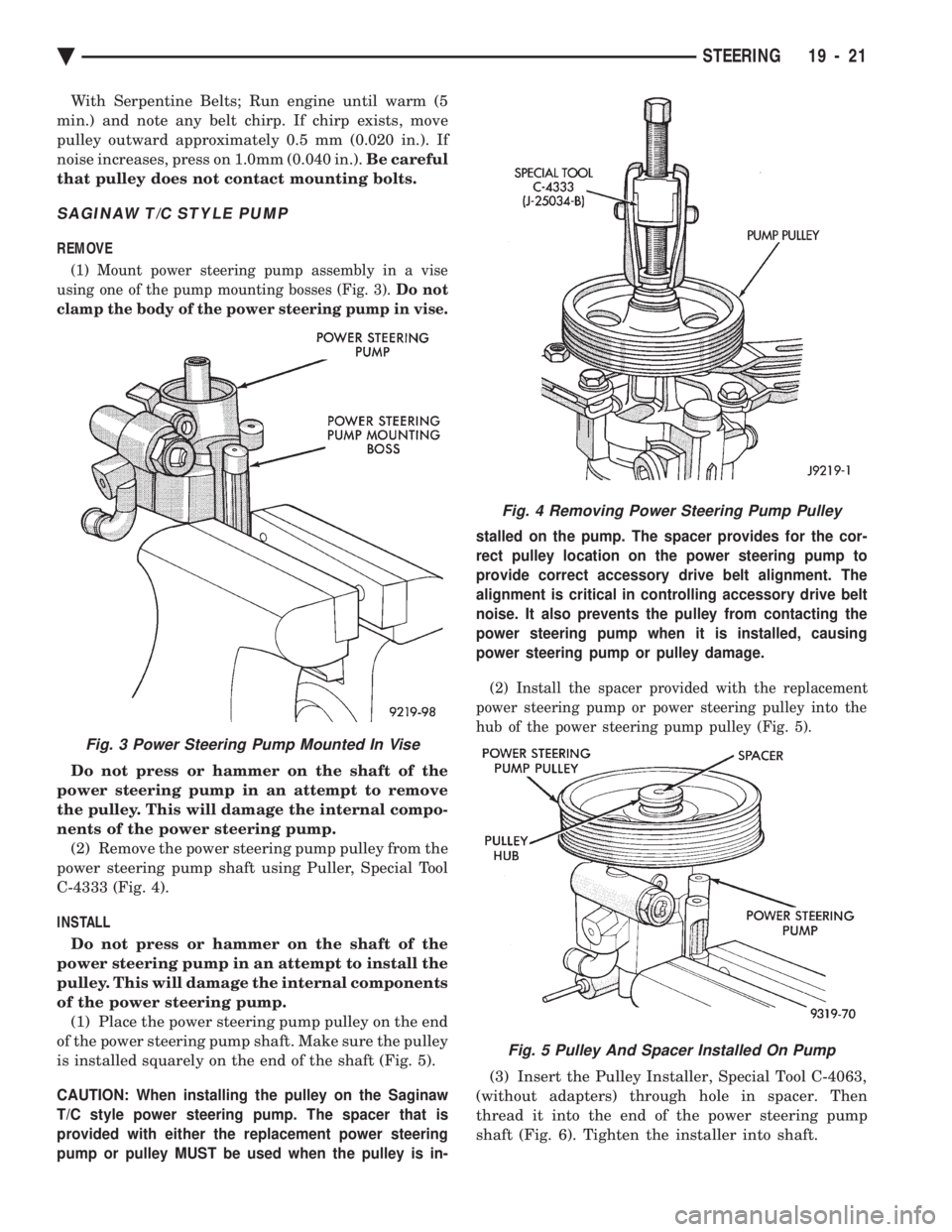
(1) Mount power steering pump assembly in a vise
using one of the pump mounting bosses (Fig. 3). Do not
clamp the body of the power steering pump in vise.
Do not press or hammer on the shaft of the
power steering pump in an attempt to remove
the pulley. This will damage the internal compo-
nents of the power steering pump. (2) Remove the power steering pump pulley from the
power steering pump shaft using Puller, Special Tool
C-4333 (Fig. 4).
INSTALL
Do not press or hammer on the shaft of the
power steering pump in an attempt to install the
pulley. This will damage the internal components
of the power steering pump. (1) Place the power steering pump pulley on the end
of the power steering pump shaft. Make sure the pulley
is installed squarely on the end of the shaft (Fig. 5).
CAUTION: When installing the pulley on the Saginaw
T/C style power steering pump. The spacer that is
provided with either the replacement power steering
pump or pulley MUST be used when the pulley is in- stalled on the pump. The spacer provides for the cor-
rect pulley location on the power steering pump to
provide correct accessory drive belt alignment. The
alignment is critical in controlling accessory drive belt
noise. It also prevents the pulley from contacting the
power steering pump when it is installed, causing
power steering pump or pulley damage.
(2) Install the spacer provided with the replacement
power steering pump or power steering pulley into the
hub of the power steering pump pulley (Fig. 5).
(3) Insert the Pulley Installer, Special Tool C-4063,
(without adapters) through hole in spacer. Then
thread it into the end of the power steering pump
shaft (Fig. 6). Tighten the installer into shaft.
Fig. 4 Removing Power Steering Pump Pulley
Fig. 5 Pulley And Spacer Installed On Pump
Fig. 3 Power Steering Pump Mounted In Vise
Ä STEERING 19 - 21
Page 1940 of 2438
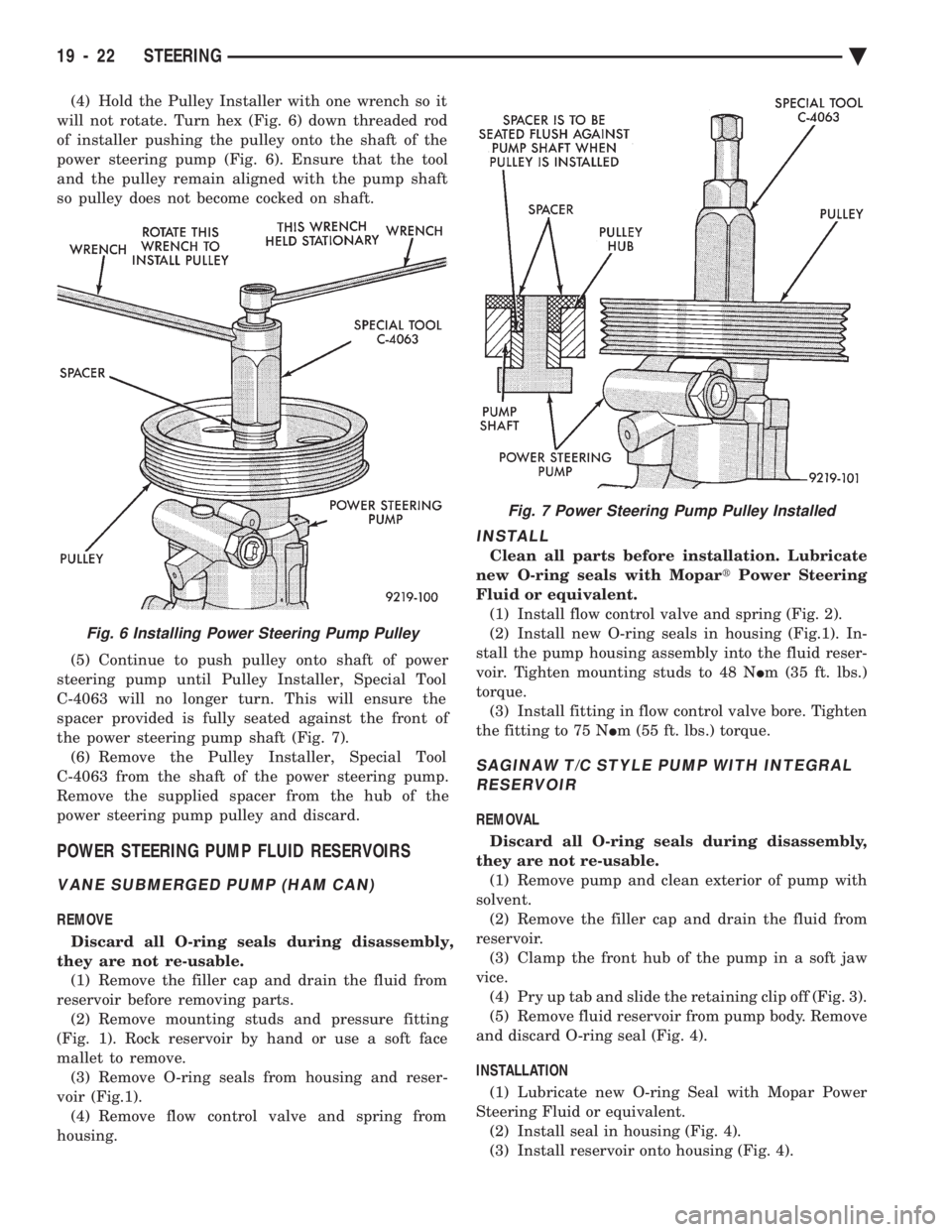
(4) Hold the Pulley Installer with one wrench so it
will not rotate. Turn hex (Fig. 6) down threaded rod
of installer pushing the pulley onto the shaft of the
power steering pump (Fig. 6). Ensure that the tool
and the pulley remain aligned with the pump shaft
so pulley does not become cocked on shaft.
(5) Continue to push pulley onto shaft of power
steering pump until Pulley Installer, Special Tool
C-4063 will no longer turn. This will ensure the
spacer provided is fully seated against the front of
the power steering pump shaft (Fig. 7). (6) Remove the Pulley Installer, Special Tool
C-4063 from the shaft of the power steering pump.
Remove the supplied spacer from the hub of the
power steering pump pulley and discard.
POWER STEERING PUMP FLUID RESERVOIRS
VANE SUBMERGED PUMP (HAM CAN)
REMOVE
Discard all O-ring seals during disassembly,
they are not re-usable. (1) Remove the filler cap and drain the fluid from
reservoir before removing parts. (2) Remove mounting studs and pressure fitting
(Fig. 1). Rock reservoir by hand or use a soft face
mallet to remove. (3) Remove O-ring seals from housing and reser-
voir (Fig.1). (4) Remove flow control valve and spring from
housing.
INSTALL
Clean all parts before installation. Lubricate
new O-ring seals with Mopar tPower Steering
Fluid or equivalent. (1) Install flow control valve and spring (Fig. 2).
(2) Install new O-ring seals in housing (Fig.1). In-
stall the pump housing assembly into the fluid reser-
voir. Tighten mounting studs to 48 N Im (35 ft. lbs.)
torque. (3) Install fitting in flow control valve bore. Tighten
the fitting to 75 N Im (55 ft. lbs.) torque.
SAGINAW T/C STYLE PUMP WITH INTEGRAL
RESERVOIR
REMOVAL
Discard all O-ring seals during disassembly,
they are not re-usable. (1) Remove pump and clean exterior of pump with
solvent. (2) Remove the filler cap and drain the fluid from
reservoir. (3) Clamp the front hub of the pump in a soft jaw
vice. (4) Pry up tab and slide the retaining clip off (Fig. 3).
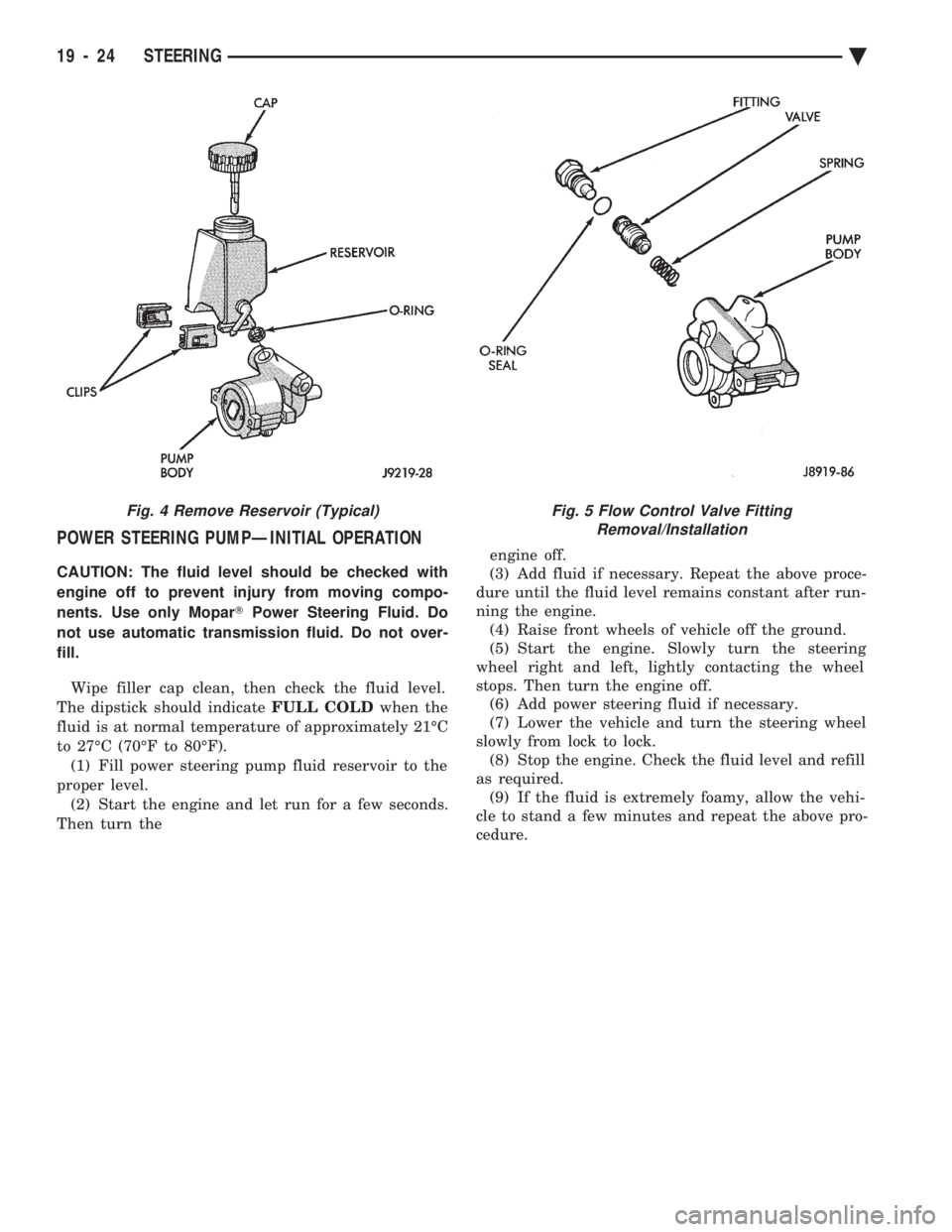
(5) Remove fluid reservoir from pump body. Remove
and discard O-ring seal (Fig. 4).
INSTALLATION
(1) Lubricate new O-ring Seal with Mopar Power
Steering Fluid or equivalent. (2) Install seal in housing (Fig. 4).
(3) Install reservoir onto housing (Fig. 4).
Fig. 6 Installing Power Steering Pump Pulley
Fig. 7 Power Steering Pump Pulley Installed
19 - 22 STEERING Ä
Page 1941 of 2438
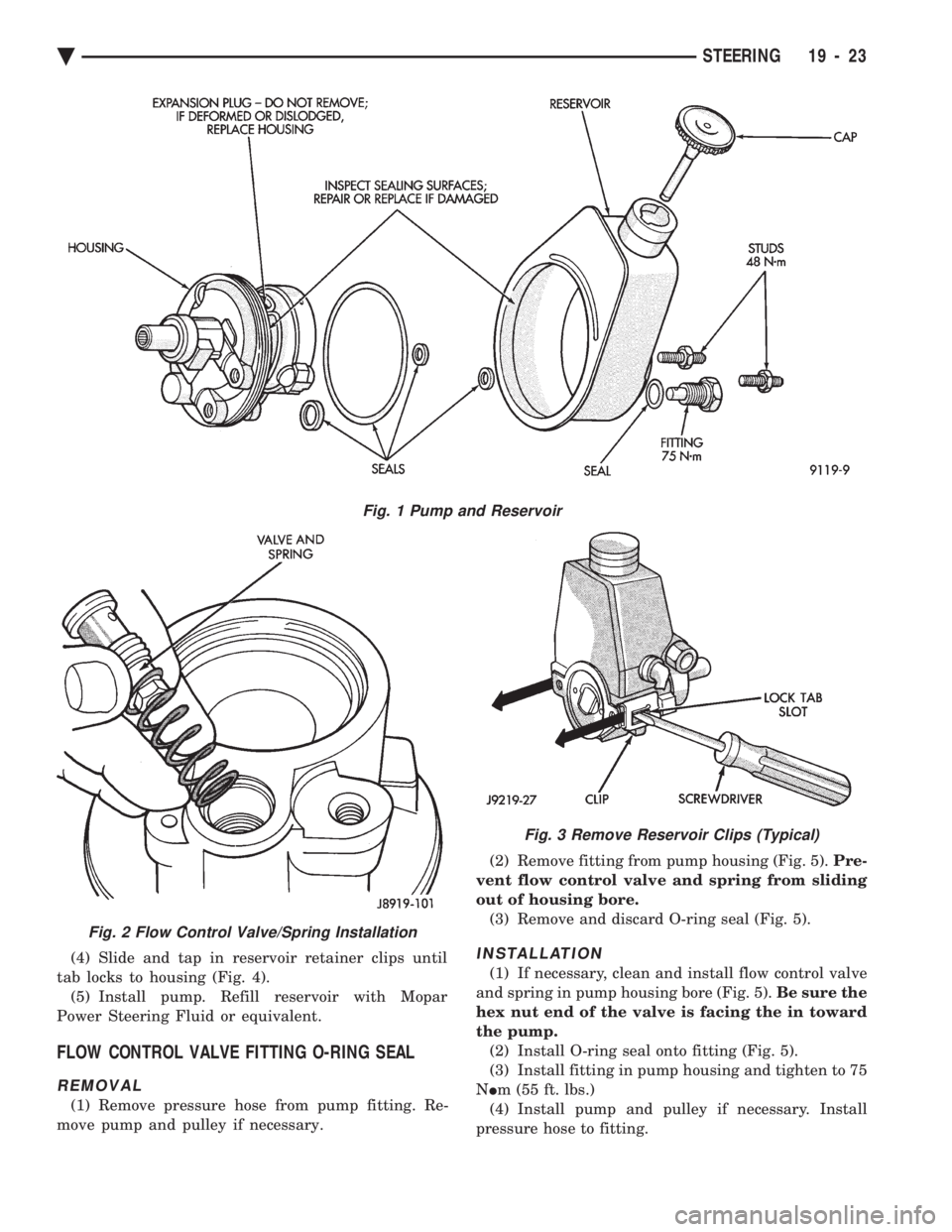
(4) Slide and tap in reservoir retainer clips until
tab locks to housing (Fig. 4). (5) Install pump. Refill reservoir with Mopar
Power Steering Fluid or equivalent.
FLOW CONTROL VALVE FITTING O-RING SEAL
REMOVAL
(1) Remove pressure hose from pump fitting. Re-
move pump and pulley if necessary. (2) Remove fitting from pump housing (Fig. 5).
Pre-
vent flow control valve and spring from sliding
out of housing bore. (3) Remove and discard O-ring seal (Fig. 5).
INSTALLATION
(1) If necessary, clean and install flow control valve
and spring in pump housing bore (Fig. 5). Be sure the
hex nut end of the valve is facing the in toward
the pump. (2) Install O-ring seal onto fitting (Fig. 5).
(3) Install fitting in pump housing and tighten to 75
N Im (55 ft. lbs.)
(4) Install pump and pulley if necessary. Install
pressure hose to fitting.
Fig. 1 Pump and Reservoir
Fig. 2 Flow Control Valve/Spring Installation
Fig. 3 Remove Reservoir Clips (Typical)
Ä STEERING 19 - 23
Page 1942 of 2438
POWER STEERING PUMPÐINITIAL OPERATION
CAUTION: The fluid level should be checked with
engine off to prevent injury from moving compo-
nents. Use only Mopar TPower Steering Fluid. Do
not use automatic transmission fluid. Do not over-
fill.
Wipe filler cap clean, then check the fluid level.
The dipstick should indicate FULL COLDwhen the
fluid is at normal temperature of approximately 21ÉC
to 27ÉC (70ÉF to 80ÉF). (1) Fill power steering pump fluid reservoir to the
proper level. (2) Start the engine and let run for a few seconds.
Then turn the engine off.
(3) Add fluid if necessary. Repeat the above proce-
dure until the fluid level remains constant after run-
ning the engine. (4) Raise front wheels of vehicle off the ground.
(5) Start the engine. Slowly turn the steering
wheel right and left, lightly contacting the wheel
stops. Then turn the engine off. (6) Add power steering fluid if necessary.
(7) Lower the vehicle and turn the steering wheel
slowly from lock to lock. (8) Stop the engine. Check the fluid level and refill
as required. (9) If the fluid is extremely foamy, allow the vehi-
cle to stand a few minutes and repeat the above pro-
cedure.
Fig. 4 Remove Reservoir (Typical)Fig. 5 Flow Control Valve Fitting Removal/Installation
19 - 24 STEERING Ä
Page 1943 of 2438
POWER STEERING GEAR INDEX
page page
General Information ....................... 25
Outer Tie Rod ........................... 27 Steering Gear Service
..................... 25
GENERAL INFORMATION
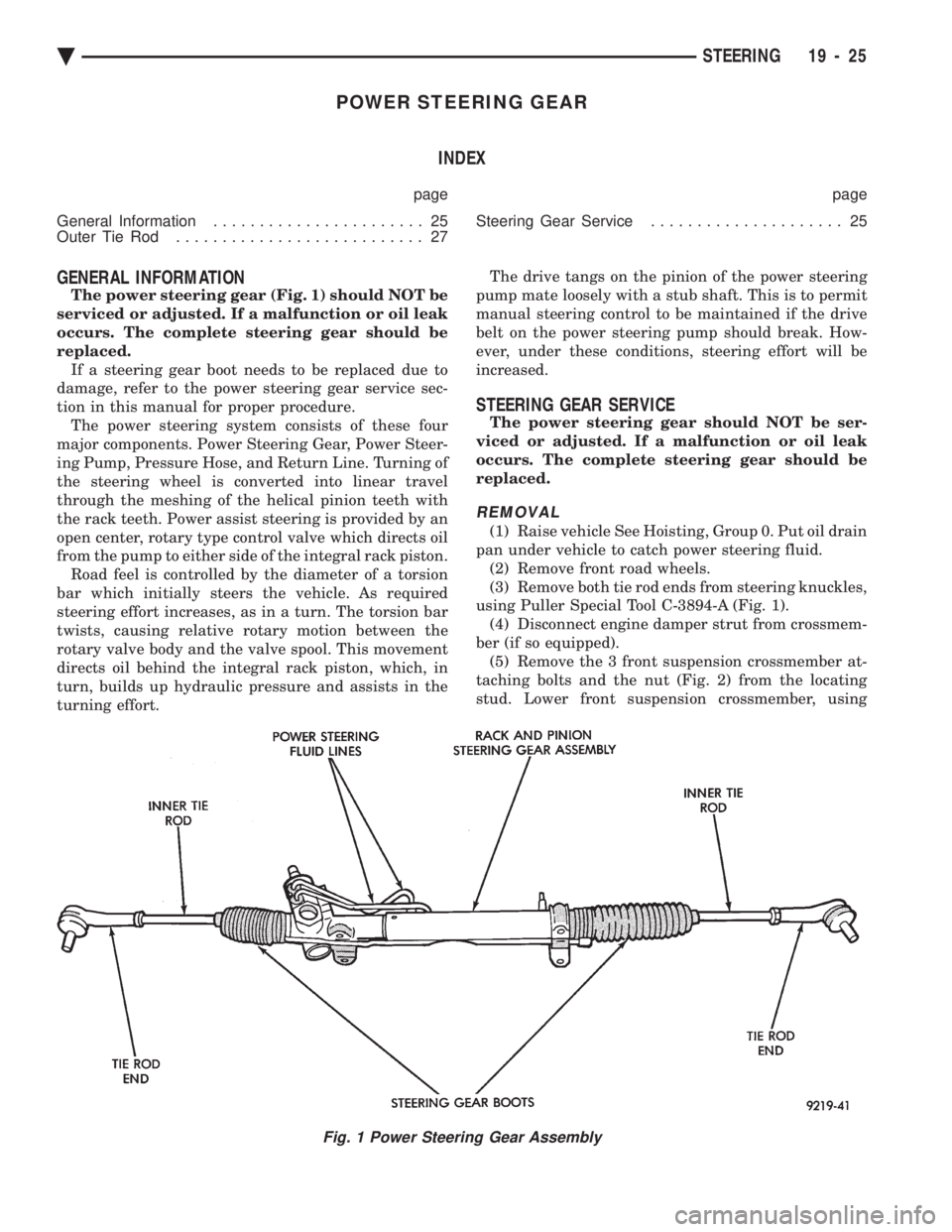
The power steering gear (Fig. 1) should NOT be
serviced or adjusted. If a malfunction or oil leak
occurs. The complete steering gear should be
replaced. If a steering gear boot needs to be replaced due to
damage, refer to the power steering gear service sec-
tion in this manual for proper procedure. The power steering system consists of these four
major components. Power Steering Gear, Power Steer-
ing Pump, Pressure Hose, and Return Line. Turning of
the steering wheel is converted into linear travel
through the meshing of the helical pinion teeth with
the rack teeth. Power assist steering is provided by an
open center, rotary type control valve which directs oil
from the pump to either side of the integral rack piston. Road feel is controlled by the diameter of a torsion
bar which initially steers the vehicle. As required
steering effort increases, as in a turn. The torsion bar
twists, causing relative rotary motion between the
rotary valve body and the valve spool. This movement
directs oil behind the integral rack piston, which, in
turn, builds up hydraulic pressure and assists in the
turning effort. The drive tangs on the pinion of the power steering
pump mate loosely with a stub shaft. This is to permit
manual steering control to be maintained if the drive
belt on the power steering pump should break. How-
ever, under these conditions, steering effort will be
increased.
STEERING GEAR SERVICE
The power steering gear should NOT be ser-
viced or adjusted. If a malfunction or oil leak
occurs. The complete steering gear should be
replaced.
REMOVAL
(1) Raise vehicle See Hoisting, Group 0. Put oil drain
pan under vehicle to catch power steering fluid. (2) Remove front road wheels.
(3) Remove both tie rod ends from steering knuckles,
using Puller Special Tool C-3894-A (Fig. 1). (4) Disconnect engine damper strut from crossmem-
ber (if so equipped). (5) Remove the 3 front suspension crossmember at-
taching bolts and the nut (Fig. 2) from the locating
stud. Lower front suspension crossmember, using
Fig. 1 Power Steering Gear Assembly
Ä STEERING 19 - 25
Page 1944 of 2438
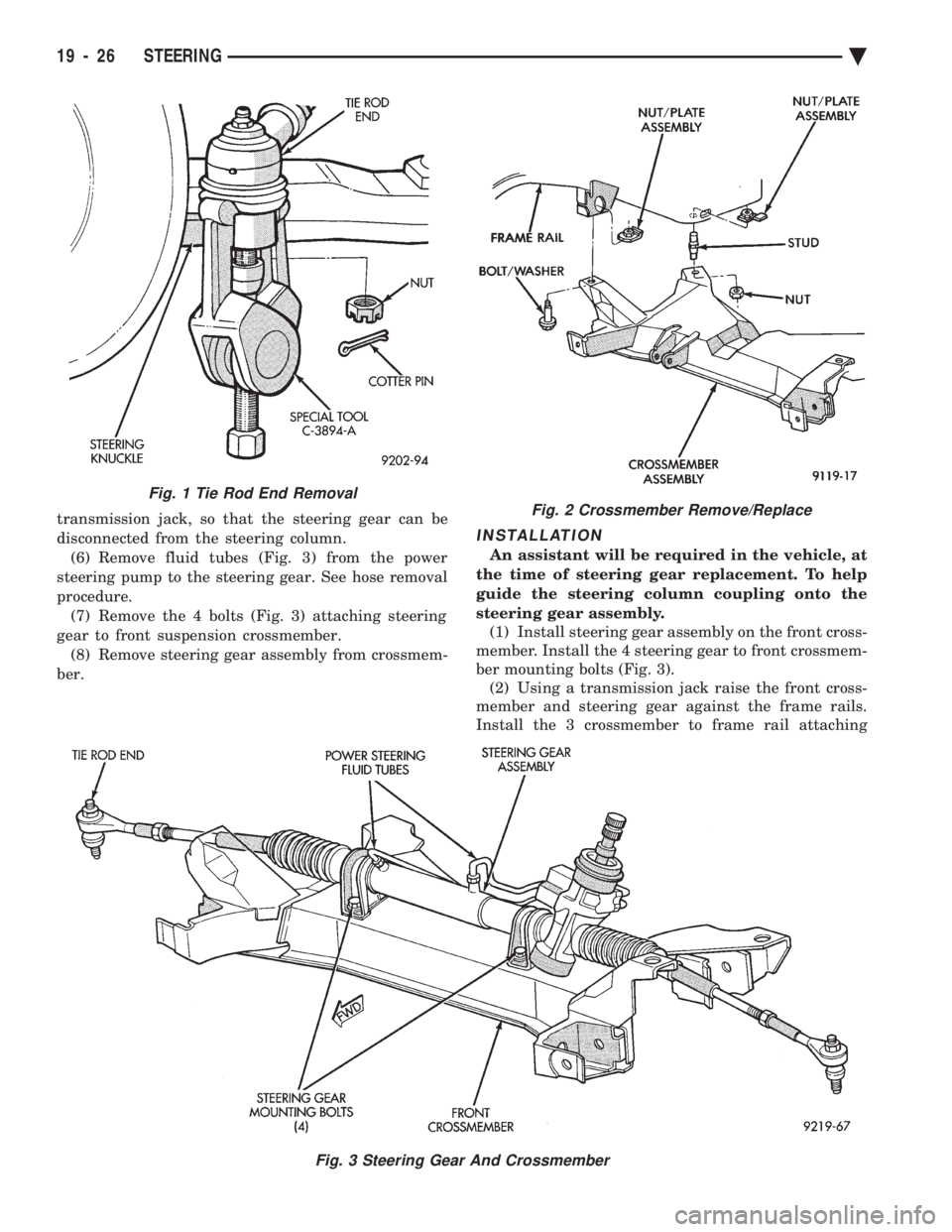
transmission jack, so that the steering gear can be
disconnected from the steering column.(6) Remove fluid tubes (Fig. 3) from the power
steering pump to the steering gear. See hose removal
procedure. (7) Remove the 4 bolts (Fig. 3) attaching steering
gear to front suspension crossmember. (8) Remove steering gear assembly from crossmem-
ber.
INSTALLATION
An assistant will be required in the vehicle, at
the time of steering gear replacement. To help
guide the steering column coupling onto the
steering gear assembly. (1) Install steering gear assembly on the front cross-
member. Install the 4 steering gear to front crossmem-
ber mounting bolts (Fig. 3). (2) Using a transmission jack raise the front cross-
member and steering gear against the frame rails.
Install the 3 crossmember to frame rail attaching
Fig. 2 Crossmember Remove/Replace
Fig. 3 Steering Gear And Crossmember
Fig. 1 Tie Rod End Removal
19 - 26 STEERING Ä
Page 1945 of 2438
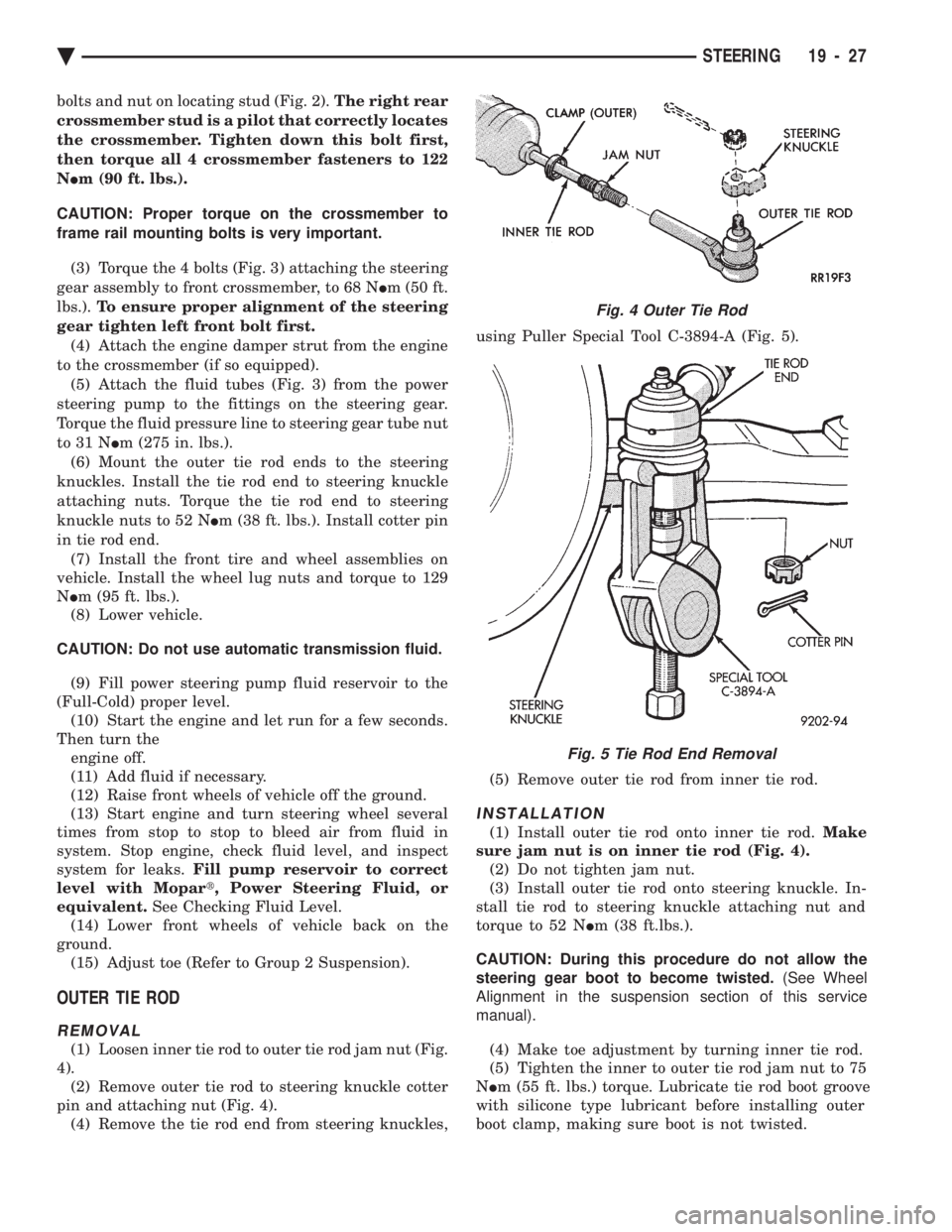
bolts and nut on locating stud (Fig. 2). The right rear
crossmember stud is a pilot that correctly locates
the crossmember. Tighten down this bolt first,
then torque all 4 crossmember fasteners to 122
N Im (90 ft. lbs.).
CAUTION: Proper torque on the crossmember to
frame rail mounting bolts is very important.
(3) Torque the 4 bolts (Fig. 3) attaching the steering
gear assembly to front crossmember, to 68 N Im (50 ft.
lbs.). To ensure proper alignment of the steering
gear tighten left front bolt first. (4) Attach the engine damper strut from the engine
to the crossmember (if so equipped). (5) Attach the fluid tubes (Fig. 3) from the power
steering pump to the fittings on the steering gear.
Torque the fluid pressure line to steering gear tube nut
to 31 N Im (275 in. lbs.).
(6) Mount the outer tie rod ends to the steering
knuckles. Install the tie rod end to steering knuckle
attaching nuts. Torque the tie rod end to steering
knuckle nuts to 52 N Im (38 ft. lbs.). Install cotter pin
in tie rod end. (7) Install the front tire and wheel assemblies on
vehicle. Install the wheel lug nuts and torque to 129
N Im (95 ft. lbs.).
(8) Lower vehicle.
CAUTION: Do not use automatic transmission fluid. (9) Fill power steering pump fluid reservoir to the
(Full-Cold) proper level. (10) Start the engine and let run for a few seconds.
Then turn the engine off.
(11) Add fluid if necessary.
(12) Raise front wheels of vehicle off the ground.
(13) Start engine and turn steering wheel several
times from stop to stop to bleed air from fluid in
system. Stop engine, check fluid level, and inspect
system for leaks. Fill pump reservoir to correct
level with Mopar t, Power Steering Fluid, or
equivalent. See Checking Fluid Level.
(14) Lower front wheels of vehicle back on the
ground. (15) Adjust toe (Refer to Group 2 Suspension).
OUTER TIE ROD
REMOVAL
(1) Loosen inner tie rod to outer tie rod jam nut (Fig.
4). (2) Remove outer tie rod to steering knuckle cotter
pin and attaching nut (Fig. 4). (4) Remove the tie rod end from steering knuckles, using Puller Special Tool C-3894-A (Fig. 5).
(5) Remove outer tie rod from inner tie rod.
INSTALLATION
(1) Install outer tie rod onto inner tie rod. Make
sure jam nut is on inner tie rod (Fig. 4). (2) Do not tighten jam nut.
(3) Install outer tie rod onto steering knuckle. In-
stall tie rod to steering knuckle attaching nut and
torque to 52 N Im (38 ft.lbs.).
CAUTION: During this procedure do not allow the
steering gear boot to become twisted. (See Wheel
Alignment in the suspension section of this service
manual).
(4) Make toe adjustment by turning inner tie rod.
(5) Tighten the inner to outer tie rod jam nut to 75
N Im (55 ft. lbs.) torque. Lubricate tie rod boot groove
with silicone type lubricant before installing outer
boot clamp, making sure boot is not twisted.
Fig. 4 Outer Tie Rod
Fig. 5 Tie Rod End Removal
Ä STEERING 19 - 27
Page 1946 of 2438
ACUSTAR STANDARD AND TILT STEERING COLUMN INDEX
page page
General Information ....................... 28
Ignition Switch Service .................... 34 Steering Column Component Service
......... 34
Steering Column Service Procedures .......... 30
GENERAL INFORMATION
WARNING: THE AIR BAG SYSTEM IS A SENSITIVE,
COMPLEX ELECTRO-MECHANICAL UNIT. BEFORE
ATTEMPTING TO DIAGNOSE, REMOVE OR IN-
STALL THE AIR BAG SYSTEM COMPONENTS YOU
MUST FIRST DISCONNECT AND ISOLATE THE
BATTERY NEGATIVE (GROUND) CABLE. FAILURE
TO DO SO COULD RESULT IN ACCIDENTAL DE-
PLOYMENT OF THE AIR BAG AND POSSIBLE PER-
SONAL INJURY. THE FASTENERS, SCREWS, AND BOLTS, ORIGI-
NALLY USED FOR THE AIR BAG COMPONENTS,
HAVE SPECIAL COATINGS AND ARE SPECIFI- CALLY DESIGNED FOR THE AIR BAG SYSTEM.
THEY MUST NEVER BE REPLACED WITH ANY
SUBSTITUTES. ANYTIME A NEW FASTENER IS
NEEDED, REPLACE WITH THE CORRECT FASTEN-
ERS PROVIDED IN THE SERVICE PACKAGE OR
FASTENERS LISTED IN THE PARTS BOOKS. BEFORE SERVICING A STEERING COLUMN
EQUIPPED WITH AN AIR BAG, REFER TO GROUP
8M, ELECTRICAL FOR PROPER AND SAFE SER-
VICE PROCEDURES.
Safety goggles should be worn at all times
when working on steering columns.
19 - 28 STEERING Ä
Page 1947 of 2438
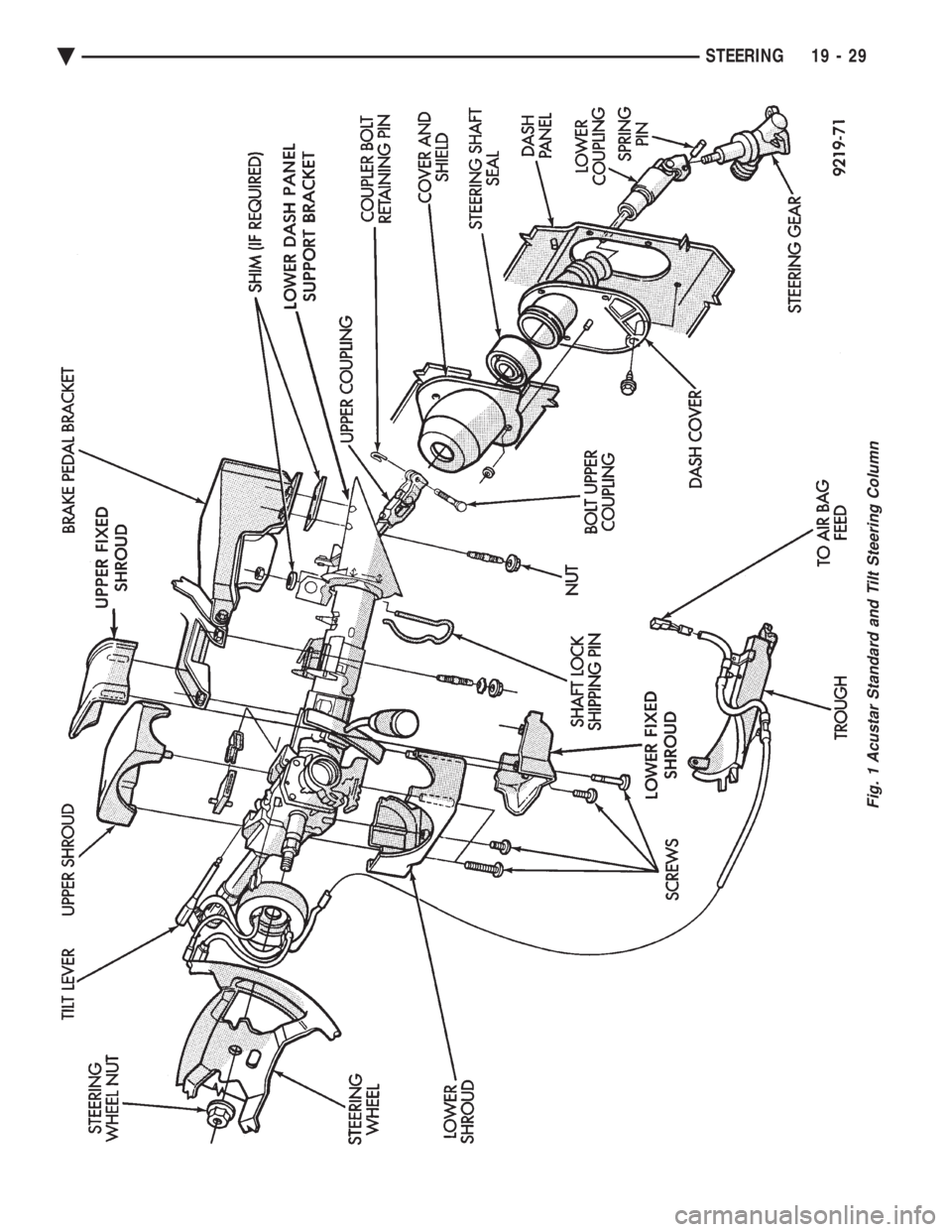
Fig. 1 Acustar Standard and Tilt Steering Column
Ä STEERING 19 - 29
Page 1948 of 2438
The Acustar tilt and standard column (Fig. 1) has
been designed to be serviced as an assembly; less wir-
ing, switches, shrouds, steering wheel, etc. Also, most
steering column components can be serviced without re-
moving the steering column from the vehicle.
CAUTION: Disconnect negative (ground) cable from
battery, before servicing any column component.
CAUTION: Do not attempt to remove the pivot pins
to disassemble the tilting mechanism. Damage will
occur.
STEERING COLUMN SERVICE PROCEDURES
To service the steering wheel and its components
or the air bag, refer to Group 8M, Restraint Systems.
Follow all WARNINGS. To service the switches, refer to the appropriate
section of Group 8, Electrical.
To replace the steering column assembly, refer to the
steering column removal procedure. For location of com-
ponents referred to in the procedure see (Fig. 1).
WARNING: BEFORE BEGINNING ANY AIR BAG
SYSTEM COMPONENT INSTALLATION OR RE-
MOVAL PROCEDURES. REMOVE AND ISOLATE
THE NEGATIVE (-) BATTERY CABLE (GROUND)
FROM THE VEHICLE BATTERY. THIS IS THE ONLY
SURE WAY TO DISABLE THE AIR BAG SYSTEM.
FAILURE TO DO THIS COULD RESULT IN ACCI-
DENTAL AIR BAG DEPLOYMENT AND POSSIBLE
PERSONAL INJURY.
STEERING COLUMN REMOVAL
(1) Make sure the front wheels of the vehicle are
in the straight ahead position.
(2) Disconnect the negative (ground) cable from
the battery and isolate cable. (3) For vehicles equipped with a column shift. Dis-
connect the transmission shift cable from the steer-
ing column by prying it out of the grommet in the
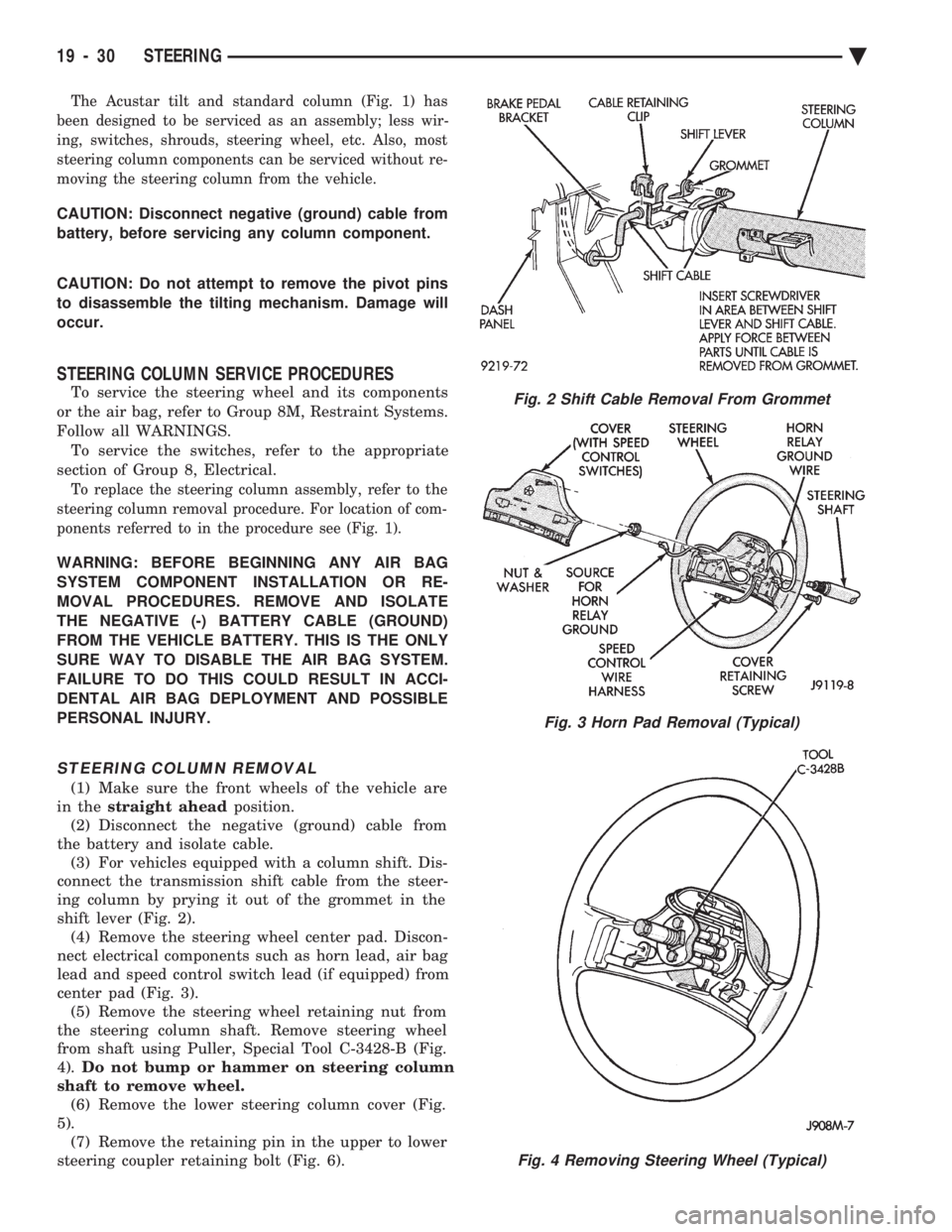
shift lever (Fig. 2). (4) Remove the steering wheel center pad. Discon-
nect electrical components such as horn lead, air bag
lead and speed control switch lead (if equipped) from
center pad (Fig. 3). (5) Remove the steering wheel retaining nut from
the steering column shaft. Remove steering wheel
from shaft using Puller, Special Tool C-3428-B (Fig.
4). Do not bump or hammer on steering column
shaft to remove wheel. (6) Remove the lower steering column cover (Fig.
5). (7) Remove the retaining pin in the upper to lower
steering coupler retaining bolt (Fig. 6).
Fig. 2 Shift Cable Removal From Grommet
Fig. 3 Horn Pad Removal (Typical)
Fig. 4 Removing Steering Wheel (Typical)
19 - 30 STEERING Ä