boot CHEVROLET DYNASTY 1993 User Guide
[x] Cancel search | Manufacturer: CHEVROLET, Model Year: 1993, Model line: DYNASTY, Model: CHEVROLET DYNASTY 1993Pages: 2438, PDF Size: 74.98 MB
Page 92 of 2438
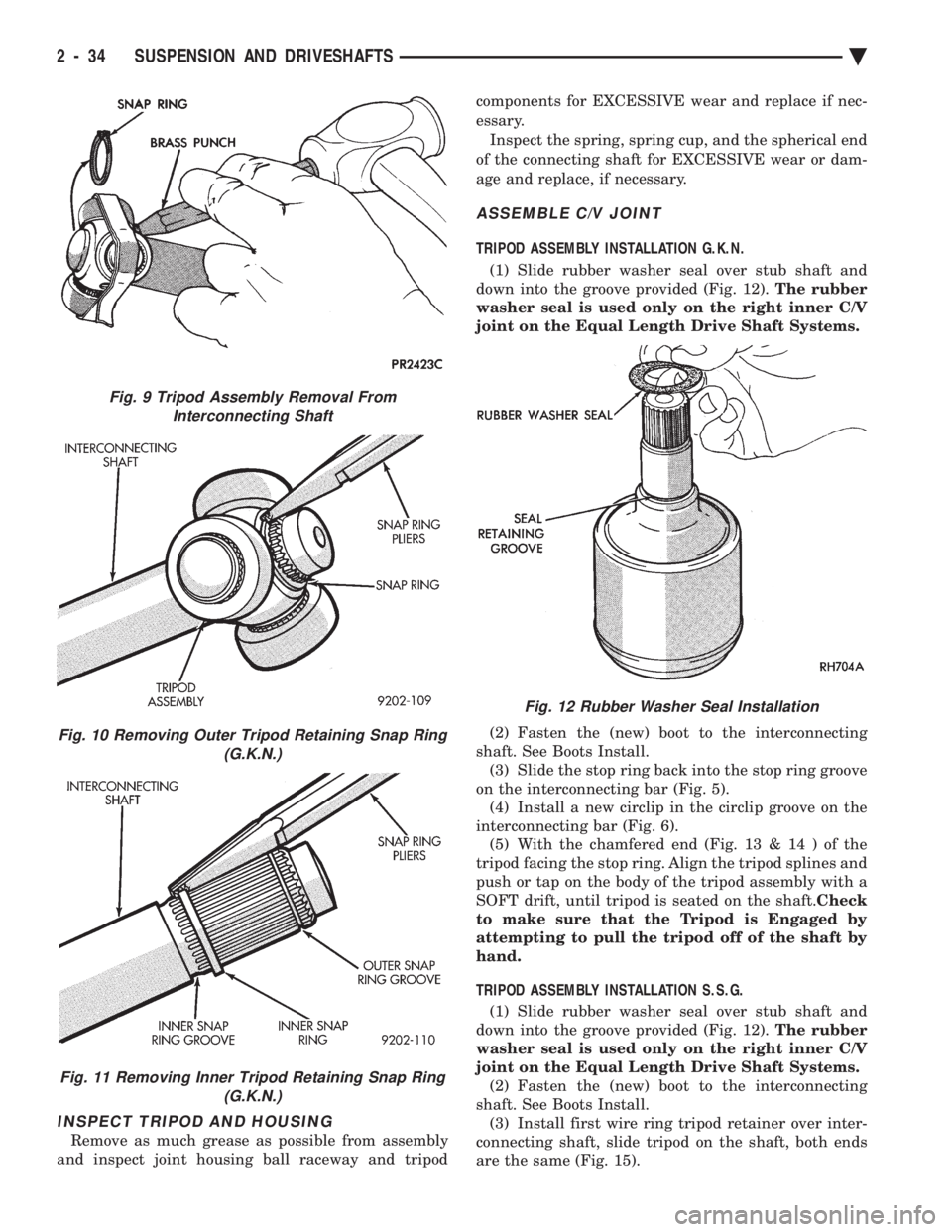
INSPECT TRIPOD AND HOUSING
Remove as much grease as possible from assembly
and inspect joint housing ball raceway and tripod components for EXCESSIVE wear and replace if nec-
essary.
Inspect the spring, spring cup, and the spherical end
of the connecting shaft for EXCESSIVE wear or dam-
age and replace, if necessary.
ASSEMBLE C/V JOINT
TRIPOD ASSEMBLY INSTALLATION G.K.N.
(1) Slide rubber washer seal over stub shaft and
down into the groove provided (Fig. 12). The rubber
washer seal is used only on the right inner C/V
joint on the Equal Length Drive Shaft Systems.
(2) Fasten the (new) boot to the interconnecting
shaft. See Boots Install. (3) Slide the stop ring back into the stop ring groove
on the interconnecting bar (Fig. 5). (4) Install a new circlip in the circlip groove on the
interconnecting bar (Fig. 6). (5) With the chamfered end (Fig. 13 & 14 ) of the
tripod facing the stop ring. Align the tripod splines and
push or tap on the body of the tripod assembly with a
SOFT drift, until tripod is seated on the shaft. Check
to make sure that the Tripod is Engaged by
attempting to pull the tripod off of the shaft by
hand.
TRIPOD ASSEMBLY INSTALLATION S.S.G. (1) Slide rubber washer seal over stub shaft and
down into the groove provided (Fig. 12). The rubber
washer seal is used only on the right inner C/V
joint on the Equal Length Drive Shaft Systems. (2) Fasten the (new) boot to the interconnecting
shaft. See Boots Install. (3) Install first wire ring tripod retainer over inter-
connecting shaft, slide tripod on the shaft, both ends
are the same (Fig. 15).
Fig. 9 Tripod Assembly Removal From Interconnecting Shaft
Fig. 10 Removing Outer Tripod Retaining Snap Ring (G.K.N.)
Fig. 11 Removing Inner Tripod Retaining Snap Ring(G.K.N.)
Fig. 12 Rubber Washer Seal Installation
2 - 34 SUSPENSION AND DRIVESHAFTS Ä
Page 93 of 2438
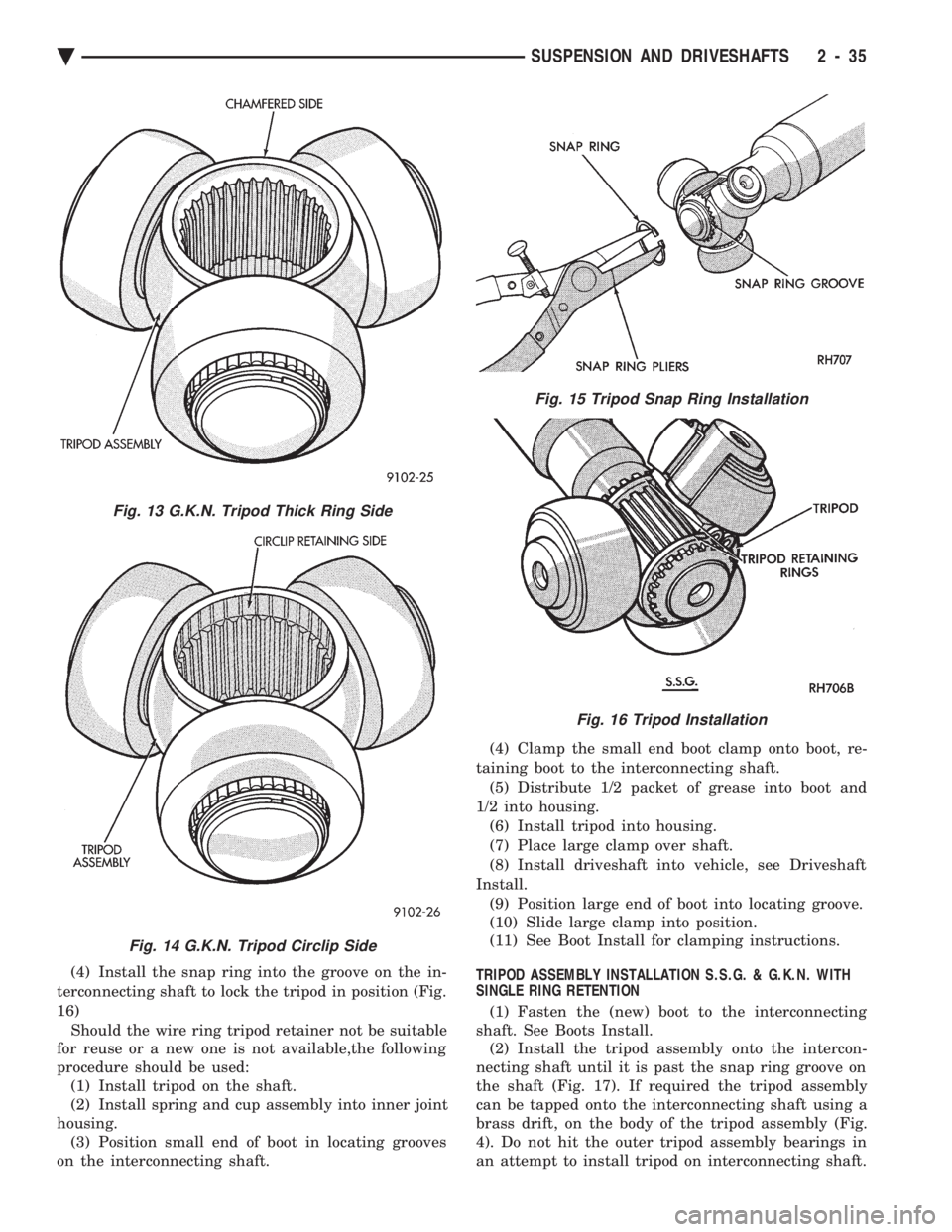
(4) Install the snap ring into the groove on the in-
terconnecting shaft to lock the tripod in position (Fig.
16) Should the wire ring tripod retainer not be suitable
for reuse or a new one is not available,the following
procedure should be used: (1) Install tripod on the shaft.
(2) Install spring and cup assembly into inner joint
housing. (3) Position small end of boot in locating grooves
on the interconnecting shaft. (4) Clamp the small end boot clamp onto boot, re-
taining boot to the interconnecting shaft. (5) Distribute 1/2 packet of grease into boot and
1/2 into housing. (6) Install tripod into housing.
(7) Place large clamp over shaft.
(8) Install driveshaft into vehicle, see Driveshaft
Install. (9) Position large end of boot into locating groove.
(10) Slide large clamp into position.
(11) See Boot Install for clamping instructions.
TRIPOD ASSEMBLY INSTALLATION S.S.G. & G.K.N. WITH
SINGLE RING RETENTION
(1) Fasten the (new) boot to the interconnecting
shaft. See Boots Install. (2) Install the tripod assembly onto the intercon-
necting shaft until it is past the snap ring groove on
the shaft (Fig. 17). If required the tripod assembly
can be tapped onto the interconnecting shaft using a
brass drift, on the body of the tripod assembly (Fig.
4). Do not hit the outer tripod assembly bearings in
an attempt to install tripod on interconnecting shaft.
Fig. 13 G.K.N. Tripod Thick Ring Side
Fig. 14 G.K.N. Tripod Circlip Side
Fig. 15 Tripod Snap Ring Installation
Fig. 16 Tripod Installation
Ä SUSPENSION AND DRIVESHAFTS 2 - 35
Page 94 of 2438
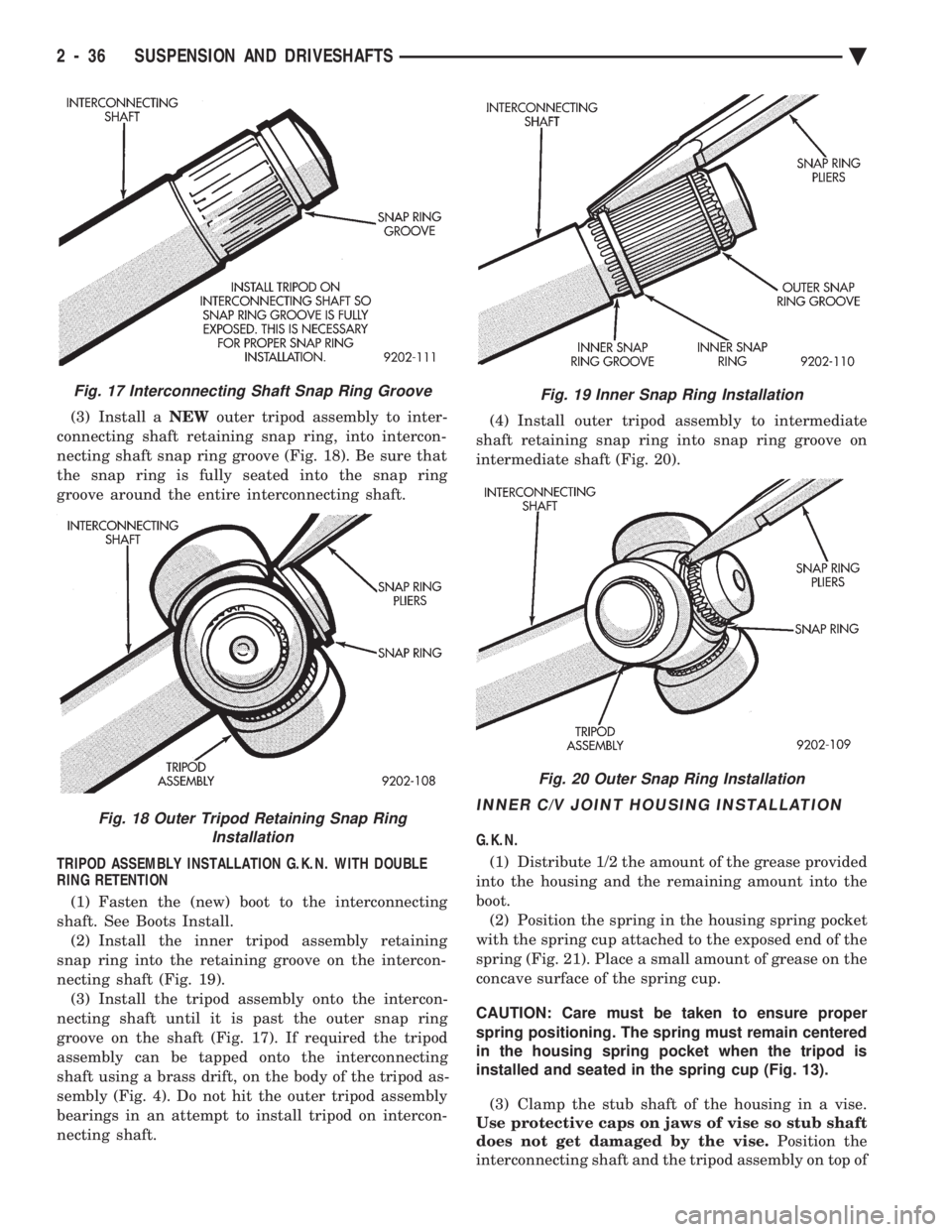
(3) Install a NEWouter tripod assembly to inter-
connecting shaft retaining snap ring, into intercon-
necting shaft snap ring groove (Fig. 18). Be sure that
the snap ring is fully seated into the snap ring
groove around the entire interconnecting shaft.
TRIPOD ASSEMBLY INSTALLATION G.K.N. WITH DOUBLE
RING RETENTION
(1) Fasten the (new) boot to the interconnecting
shaft. See Boots Install. (2) Install the inner tripod assembly retaining
snap ring into the retaining groove on the intercon-
necting shaft (Fig. 19). (3) Install the tripod assembly onto the intercon-
necting shaft until it is past the outer snap ring
groove on the shaft (Fig. 17). If required the tripod
assembly can be tapped onto the interconnecting
shaft using a brass drift, on the body of the tripod as-
sembly (Fig. 4). Do not hit the outer tripod assembly
bearings in an attempt to install tripod on intercon-
necting shaft. (4) Install outer tripod assembly to intermediate
shaft retaining snap ring into snap ring groove on
intermediate shaft (Fig. 20).
INNER C/V JOINT HOUSING INSTALLATION
G.K.N.
(1) Distribute 1/2 the amount of the grease provided
into the housing and the remaining amount into the
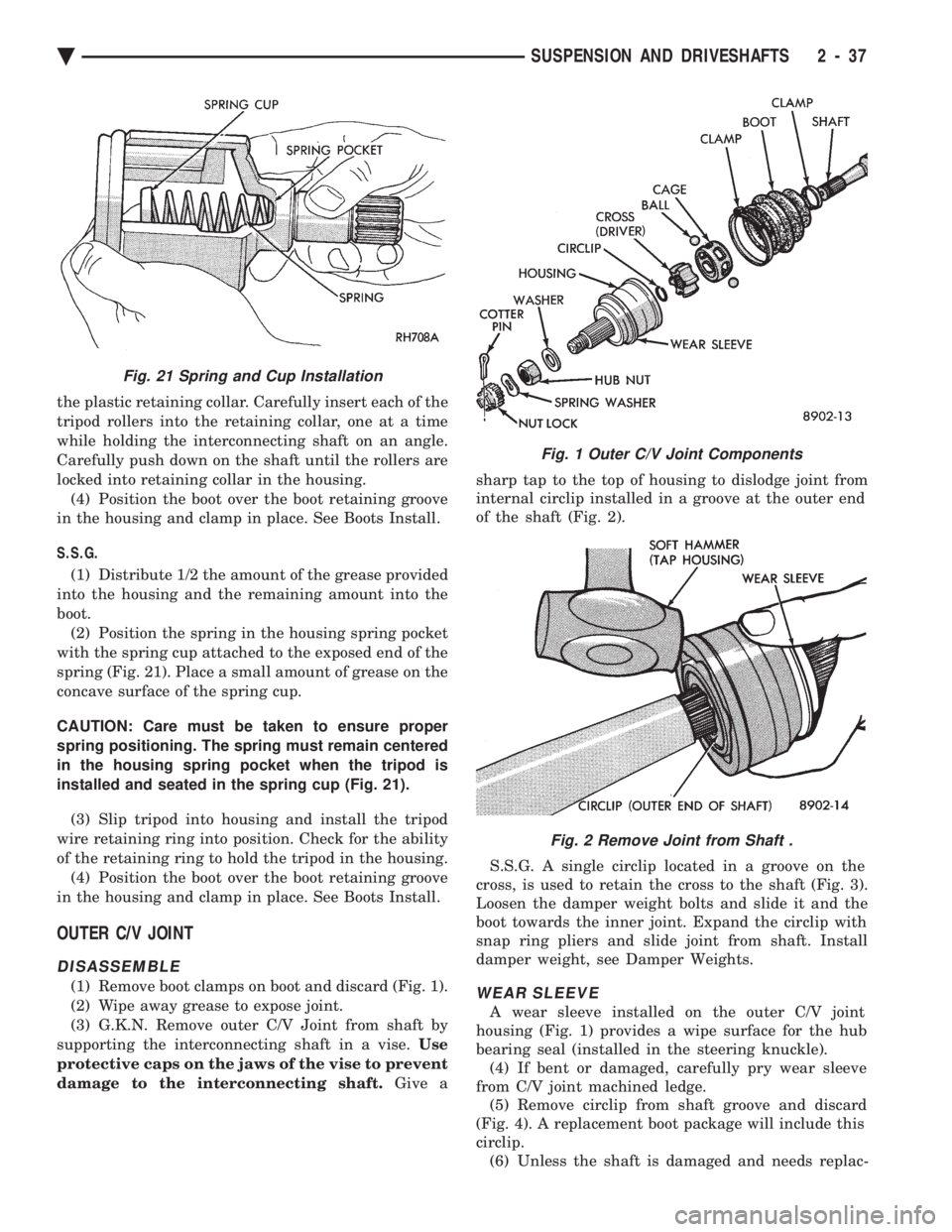
boot. (2) Position the spring in the housing spring pocket
with the spring cup attached to the exposed end of the
spring (Fig. 21). Place a small amount of grease on the
concave surface of the spring cup.
CAUTION: Care must be taken to ensure proper
spring positioning. The spring must remain centered
in the housing spring pocket when the tripod is
installed and seated in the spring cup (Fig. 13).
(3) Clamp the stub shaft of the housing in a vise.
Use protective caps on jaws of vise so stub shaft
does not get damaged by the vise. Position the
interconnecting shaft and the tripod assembly on top of
Fig. 17 Interconnecting Shaft Snap Ring Groove
Fig. 18 Outer Tripod Retaining Snap Ring Installation
Fig. 19 Inner Snap Ring Installation
Fig. 20 Outer Snap Ring Installation
2 - 36 SUSPENSION AND DRIVESHAFTS Ä
Page 95 of 2438
the plastic retaining collar. Carefully insert each of the
tripod rollers into the retaining collar, one at a time
while holding the interconnecting shaft on an angle.
Carefully push down on the shaft until the rollers are
locked into retaining collar in the housing.(4) Position the boot over the boot retaining groove
in the housing and clamp in place. See Boots Install.
S.S.G.
(1) Distribute 1/2 the amount of the grease provided
into the housing and the remaining amount into the
boot. (2) Position the spring in the housing spring pocket
with the spring cup attached to the exposed end of the
spring (Fig. 21). Place a small amount of grease on the
concave surface of the spring cup.
CAUTION: Care must be taken to ensure proper
spring positioning. The spring must remain centered
in the housing spring pocket when the tripod is
installed and seated in the spring cup (Fig. 21).
(3) Slip tripod into housing and install the tripod
wire retaining ring into position. Check for the ability
of the retaining ring to hold the tripod in the housing. (4) Position the boot over the boot retaining groove
in the housing and clamp in place. See Boots Install.
OUTER C/V JOINT
DISASSEMBLE
(1) Remove boot clamps on boot and discard (Fig. 1).
(2) Wipe away grease to expose joint.
(3) G.K.N. Remove outer C/V Joint from shaft by
supporting the interconnecting shaft in a vise. Use
protective caps on the jaws of the vise to prevent
damage to the interconnecting shaft. Give a sharp tap to the top of housing to dislodge joint from
internal circlip installed in a groove at the outer end
of the shaft (Fig. 2).
S.S.G. A single circlip located in a groove on the
cross, is used to retain the cross to the shaft (Fig. 3).
Loosen the damper weight bolts and slide it and the
boot towards the inner joint. Expand the circlip with
snap ring pliers and slide joint from shaft. Install
damper weight, see Damper Weights.WEAR SLEEVE
A wear sleeve installed on the outer C/V joint
housing (Fig. 1) provides a wipe surface for the hub
bearing seal (installed in the steering knuckle). (4) If bent or damaged, carefully pry wear sleeve
from C/V joint machined ledge. (5) Remove circlip from shaft groove and discard
(Fig. 4). A replacement boot package will include this
circlip. (6) Unless the shaft is damaged and needs replac-
Fig. 1 Outer C/V Joint Components
Fig. 2 Remove Joint from Shaft .
Fig. 21 Spring and Cup Installation
Ä SUSPENSION AND DRIVESHAFTS 2 - 37
Page 96 of 2438
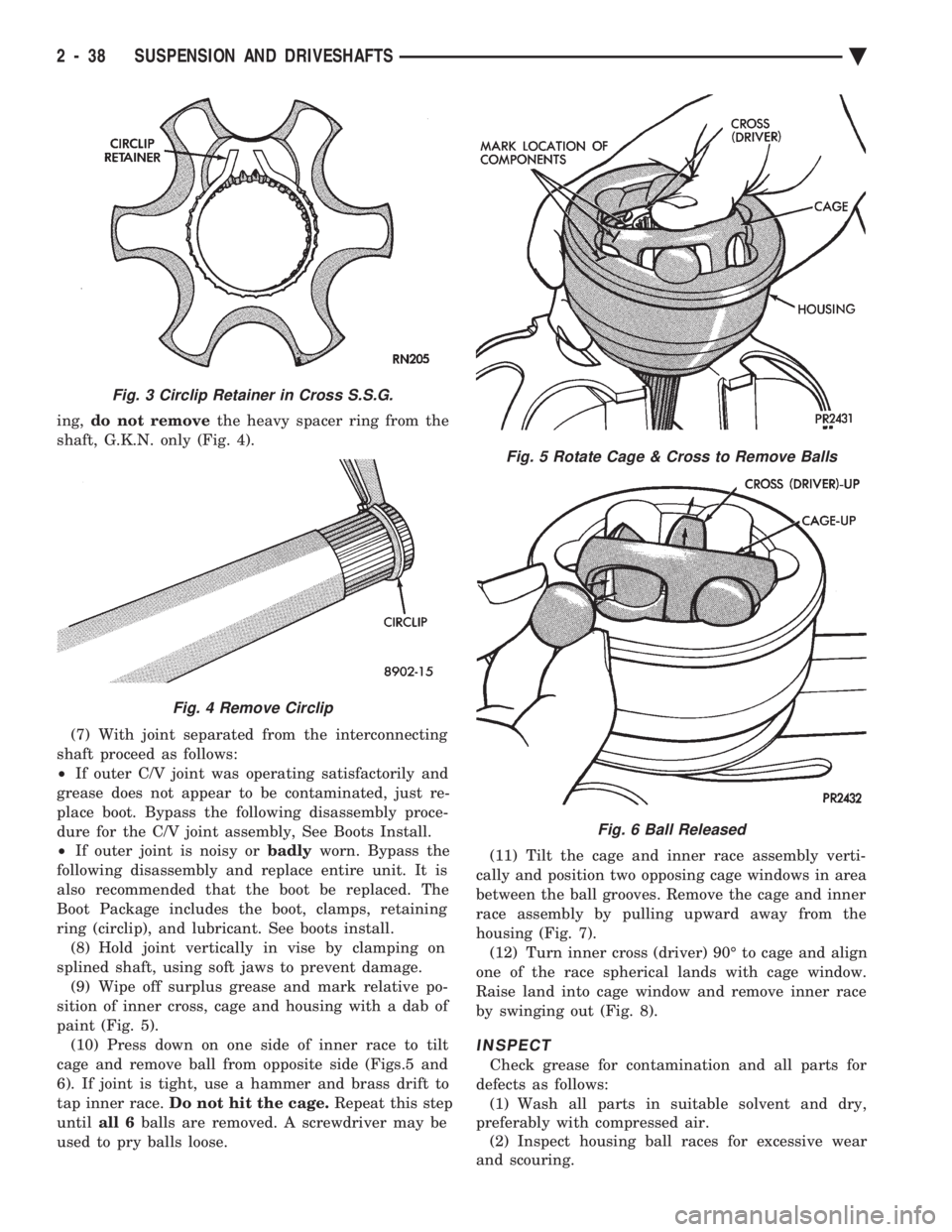
ing, do not remove the heavy spacer ring from the
shaft, G.K.N. only (Fig. 4).
(7) With joint separated from the interconnecting
shaft proceed as follows:
² If outer C/V joint was operating satisfactorily and
grease does not appear to be contaminated, just re-
place boot. Bypass the following disassembly proce-
dure for the C/V joint assembly, See Boots Install.
² If outer joint is noisy or badlyworn. Bypass the
following disassembly and replace entire unit. It is
also recommended that the boot be replaced. The
Boot Package includes the boot, clamps, retaining
ring (circlip), and lubricant. See boots install. (8) Hold joint vertically in vise by clamping on
splined shaft, using soft jaws to prevent damage. (9) Wipe off surplus grease and mark relative po-
sition of inner cross, cage and housing with a dab of
paint (Fig. 5). (10) Press down on one side of inner race to tilt
cage and remove ball from opposite side (Figs.5 and
6). If joint is tight, use a hammer and brass drift to
tap inner race. Do not hit the cage. Repeat this step
until all 6 balls are removed. A screwdriver may be
used to pry balls loose. (11) Tilt the cage and inner race assembly verti-
cally and position two opposing cage windows in area
between the ball grooves. Remove the cage and inner
race assembly by pulling upward away from the
housing (Fig. 7). (12) Turn inner cross (driver) 90É to cage and align
one of the race spherical lands with cage window.
Raise land into cage window and remove inner race
by swinging out (Fig. 8).
INSPECT
Check grease for contamination and all parts for
defects as follows: (1) Wash all parts in suitable solvent and dry,
preferably with compressed air. (2) Inspect housing ball races for excessive wear
and scouring.
Fig. 3 Circlip Retainer in Cross S.S.G.
Fig. 4 Remove Circlip
Fig. 5 Rotate Cage & Cross to Remove Balls
Fig. 6 Ball Released
2 - 38 SUSPENSION AND DRIVESHAFTS Ä
Page 98 of 2438
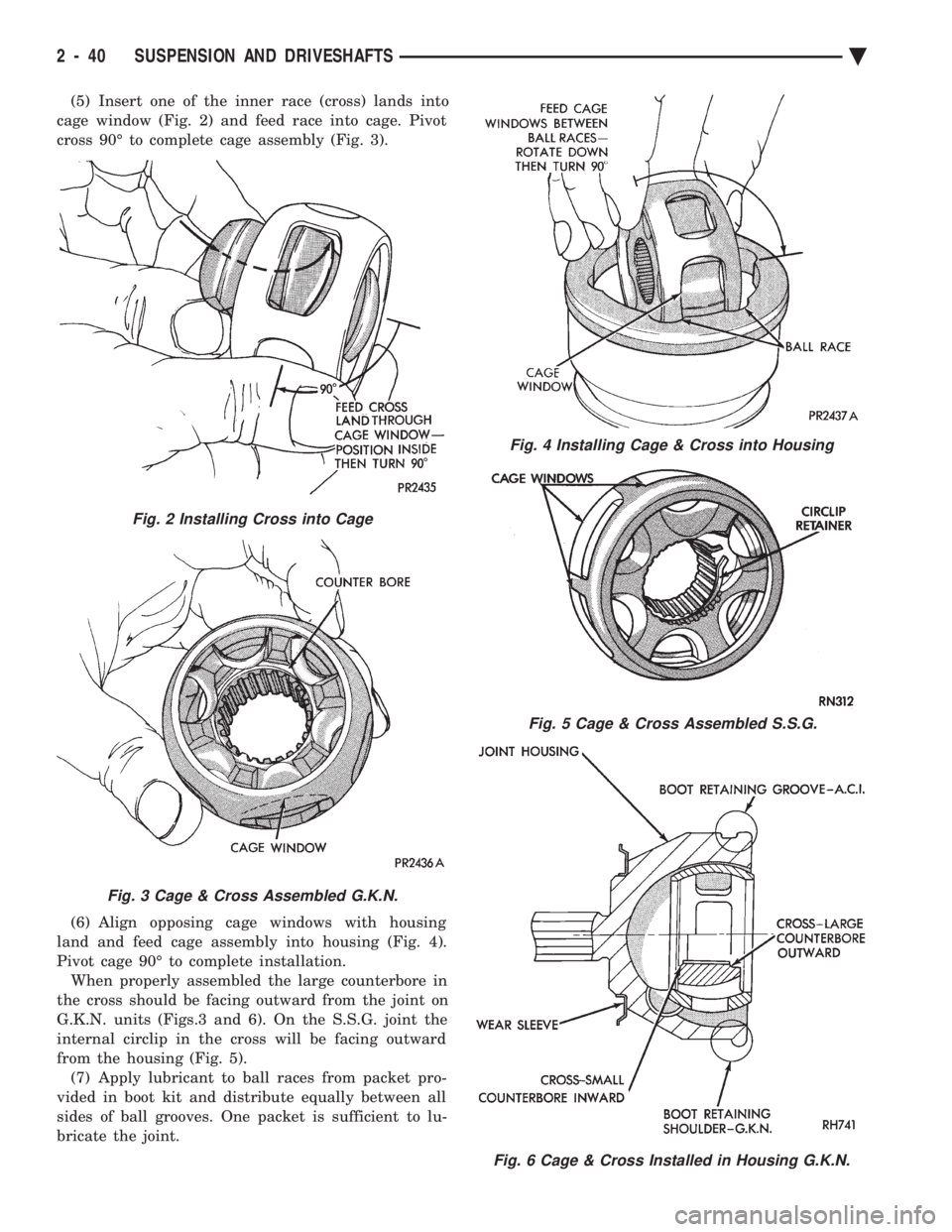
(5) Insert one of the inner race (cross) lands into
cage window (Fig. 2) and feed race into cage. Pivot
cross 90É to complete cage assembly (Fig. 3).
(6) Align opposing cage windows with housing
land and feed cage assembly into housing (Fig. 4).
Pivot cage 90É to complete installation. When properly assembled the large counterbore in
the cross should be facing outward from the joint on
G.K.N. units (Figs.3 and 6). On the S.S.G. joint the
internal circlip in the cross will be facing outward
from the housing (Fig. 5). (7) Apply lubricant to ball races from packet pro-
vided in boot kit and distribute equally between all
sides of ball grooves. One packet is sufficient to lu-
bricate the joint.
Fig. 4 Installing Cage & Cross into Housing
Fig. 5 Cage & Cross Assembled S.S.G.
Fig. 6 Cage & Cross Installed in Housing G.K.N.
Fig. 2 Installing Cross into Cage
Fig. 3 Cage & Cross Assembled G.K.N.
2 - 40 SUSPENSION AND DRIVESHAFTS Ä
Page 99 of 2438
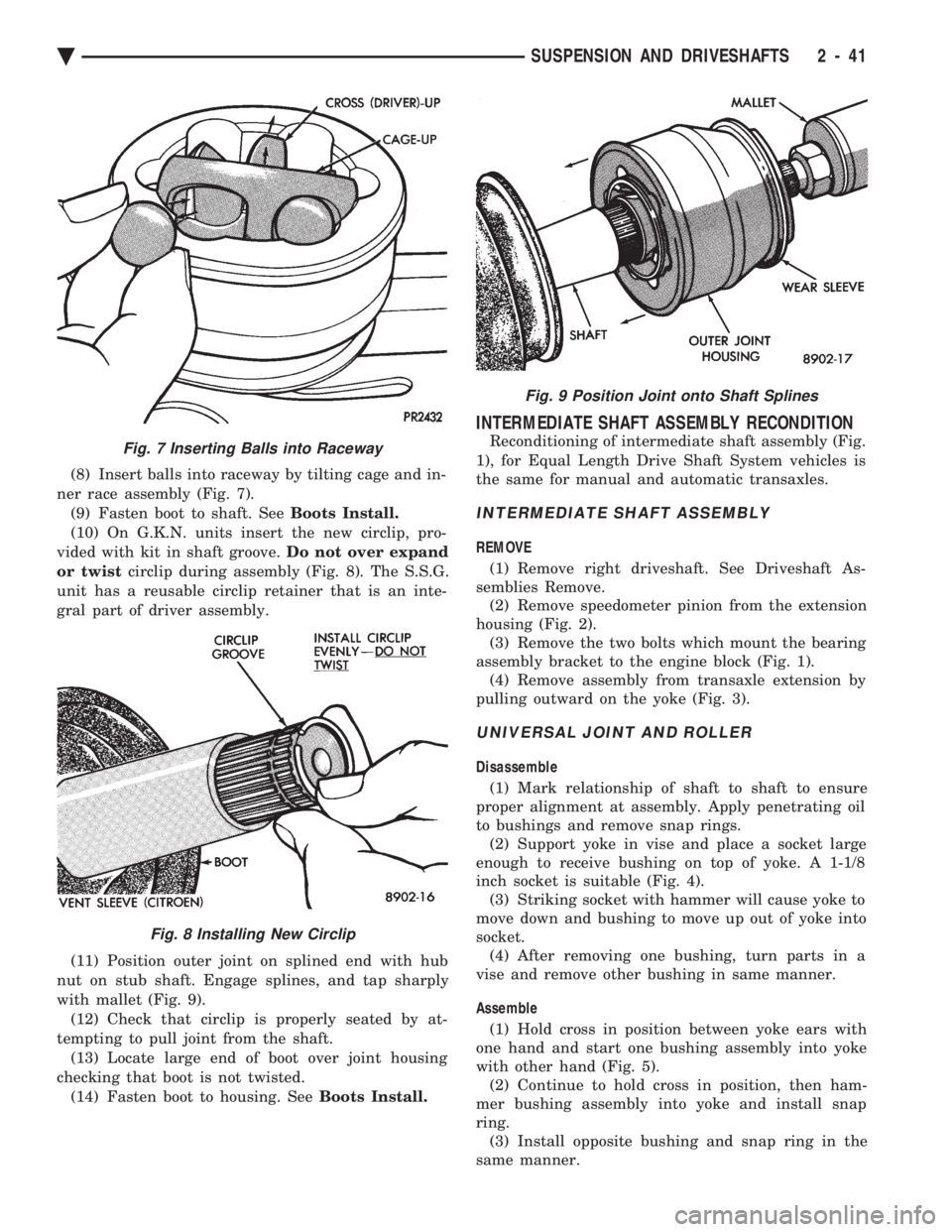
(8) Insert balls into raceway by tilting cage and in-
ner race assembly (Fig. 7). (9) Fasten boot to shaft. See Boots Install.
(10) On G.K.N. units insert the new circlip, pro-
vided with kit in shaft groove. Do not over expand
or twist circlip during assembly (Fig. 8). The S.S.G.
unit has a reusable circlip retainer that is an inte-
gral part of driver assembly.
(11) Position outer joint on splined end with hub
nut on stub shaft. Engage splines, and tap sharply
with mallet (Fig. 9). (12) Check that circlip is properly seated by at-
tempting to pull joint from the shaft. (13) Locate large end of boot over joint housing
checking that boot is not twisted. (14) Fasten boot to housing. See Boots Install.
INTERMEDIATE SHAFT ASSEMBLY RECONDITION
Reconditioning of intermediate shaft assembly (Fig.
1), for Equal Length Drive Shaft System vehicles is
the same for manual and automatic transaxles.
INTERMEDIATE SHAFT ASSEMBLY
REMOVE
(1) Remove right driveshaft. See Driveshaft As-
semblies Remove. (2) Remove speedometer pinion from the extension
housing (Fig. 2). (3) Remove the two bolts which mount the bearing
assembly bracket to the engine block (Fig. 1). (4) Remove assembly from transaxle extension by
pulling outward on the yoke (Fig. 3).
UNIVERSAL JOINT AND ROLLER
Disassemble
(1) Mark relationship of shaft to shaft to ensure
proper alignment at assembly. Apply penetrating oil
to bushings and remove snap rings. (2) Support yoke in vise and place a socket large
enough to receive bushing on top of yoke. A 1-1/8
inch socket is suitable (Fig. 4). (3) Striking socket with hammer will cause yoke to
move down and bushing to move up out of yoke into
socket. (4) After removing one bushing, turn parts in a
vise and remove other bushing in same manner.
Assemble (1) Hold cross in position between yoke ears with
one hand and start one bushing assembly into yoke
with other hand (Fig. 5). (2) Continue to hold cross in position, then ham-
mer bushing assembly into yoke and install snap
ring. (3) Install opposite bushing and snap ring in the
same manner.
Fig. 7 Inserting Balls into Raceway
Fig. 8 Installing New Circlip
Fig. 9 Position Joint onto Shaft Splines
Ä SUSPENSION AND DRIVESHAFTS 2 - 41
Page 102 of 2438
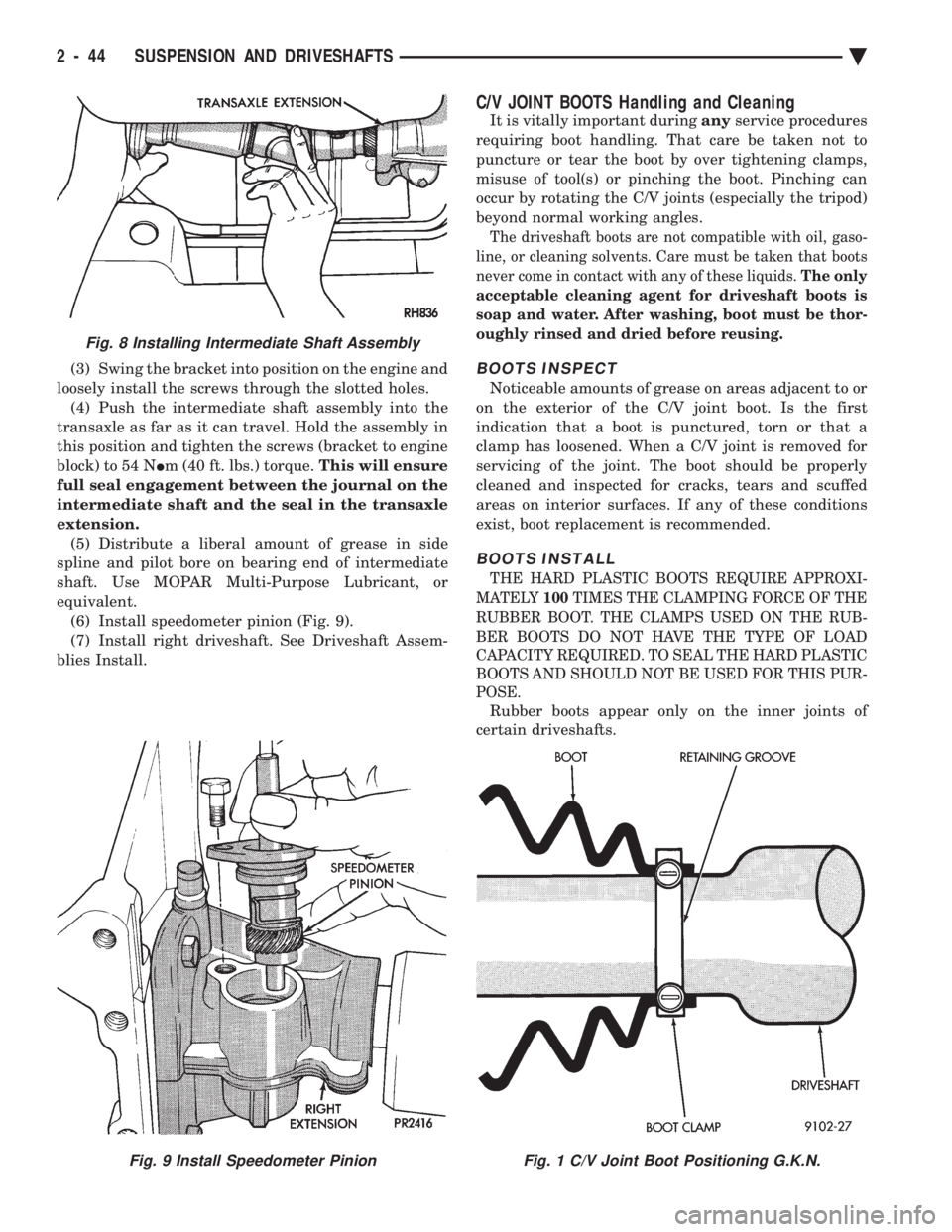
(3) Swing the bracket into position on the engine and
loosely install the screws through the slotted holes. (4) Push the intermediate shaft assembly into the
transaxle as far as it can travel. Hold the assembly in
this position and tighten the screws (bracket to engine
block) to 54 N Im (40 ft. lbs.) torque. This will ensure
full seal engagement between the journal on the
intermediate shaft and the seal in the transaxle
extension. (5) Distribute a liberal amount of grease in side
spline and pilot bore on bearing end of intermediate
shaft. Use MOPAR Multi-Purpose Lubricant, or
equivalent. (6) Install speedometer pinion (Fig. 9).
(7) Install right driveshaft. See Driveshaft Assem-
blies Install.
C/V JOINT BOOTS Handling and Cleaning
It is vitally important during anyservice procedures
requiring boot handling. That care be taken not to
puncture or tear the boot by over tightening clamps,
misuse of tool(s) or pinching the boot. Pinching can
occur by rotating the C/V joints (especially the tripod)
beyond normal working angles.
The driveshaft boots are not compatible with oil, gaso-
line, or cleaning solvents. Care must be taken that boots
never come in contact with any of these liquids. The only
acceptable cleaning agent for driveshaft boots is
soap and water. After washing, boot must be thor-
oughly rinsed and dried before reusing.
BOOTS INSPECT
Noticeable amounts of grease on areas adjacent to or
on the exterior of the C/V joint boot. Is the first
indication that a boot is punctured, torn or that a
clamp has loosened. When a C/V joint is removed for
servicing of the joint. The boot should be properly
cleaned and inspected for cracks, tears and scuffed
areas on interior surfaces. If any of these conditions
exist, boot replacement is recommended.
BOOTS INSTALL
THE HARD PLASTIC BOOTS REQUIRE APPROXI-
MATELY 100TIMES THE CLAMPING FORCE OF THE
RUBBER BOOT. THE CLAMPS USED ON THE RUB-
BER BOOTS DO NOT HAVE THE TYPE OF LOAD
CAPACITY REQUIRED. TO SEAL THE HARD PLASTIC
BOOTS AND SHOULD NOT BE USED FOR THIS PUR-
POSE.
Rubber boots appear only on the inner joints of
certain driveshafts.
Fig. 9 Install Speedometer PinionFig. 1 C/V Joint Boot Positioning G.K.N.
Fig. 8 Installing Intermediate Shaft Assembly
2 - 44 SUSPENSION AND DRIVESHAFTS Ä
Page 103 of 2438
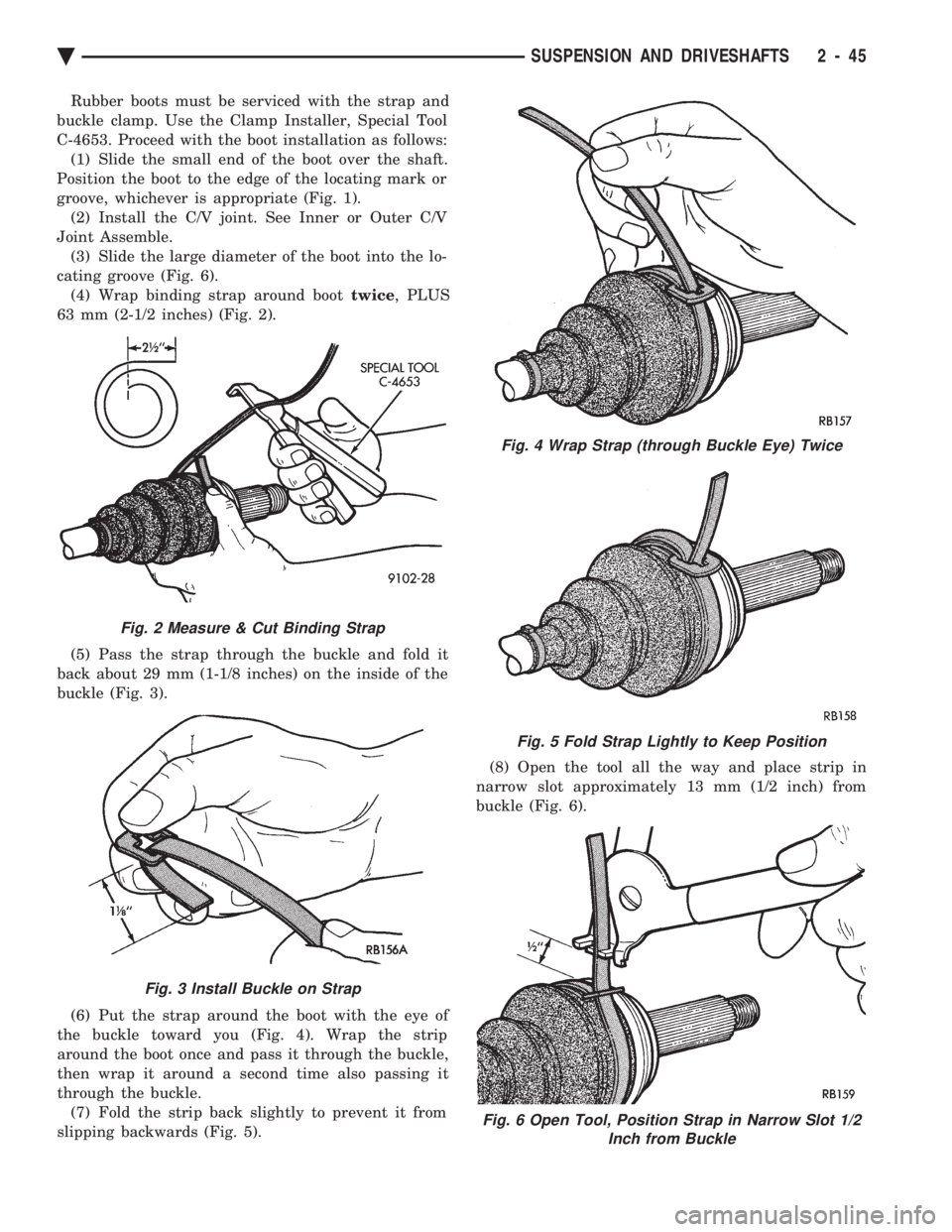
Rubber boots must be serviced with the strap and
buckle clamp. Use the Clamp Installer, Special Tool
C-4653. Proceed with the boot installation as follows: (1) Slide the small end of the boot over the shaft.
Position the boot to the edge of the locating mark or
groove, whichever is appropriate (Fig. 1). (2) Install the C/V joint. See Inner or Outer C/V
Joint Assemble. (3) Slide the large diameter of the boot into the lo-
cating groove (Fig. 6). (4) Wrap binding strap around boot twice, PLUS
63 mm (2-1/2 inches) (Fig. 2).
(5) Pass the strap through the buckle and fold it
back about 29 mm (1-1/8 inches) on the inside of the
buckle (Fig. 3).
(6) Put the strap around the boot with the eye of
the buckle toward you (Fig. 4). Wrap the strip
around the boot once and pass it through the buckle,
then wrap it around a second time also passing it
through the buckle. (7) Fold the strip back slightly to prevent it from
slipping backwards (Fig. 5). (8) Open the tool all the way and place strip in
narrow slot approximately 13 mm (1/2 inch) from
buckle (Fig. 6).
Fig. 2 Measure & Cut Binding Strap
Fig. 3 Install Buckle on Strap
Fig. 4 Wrap Strap (through Buckle Eye) Twice
Fig. 5 Fold Strap Lightly to Keep Position
Fig. 6 Open Tool, Position Strap in Narrow Slot 1/2 Inch from Buckle
Ä SUSPENSION AND DRIVESHAFTS 2 - 45
Page 105 of 2438
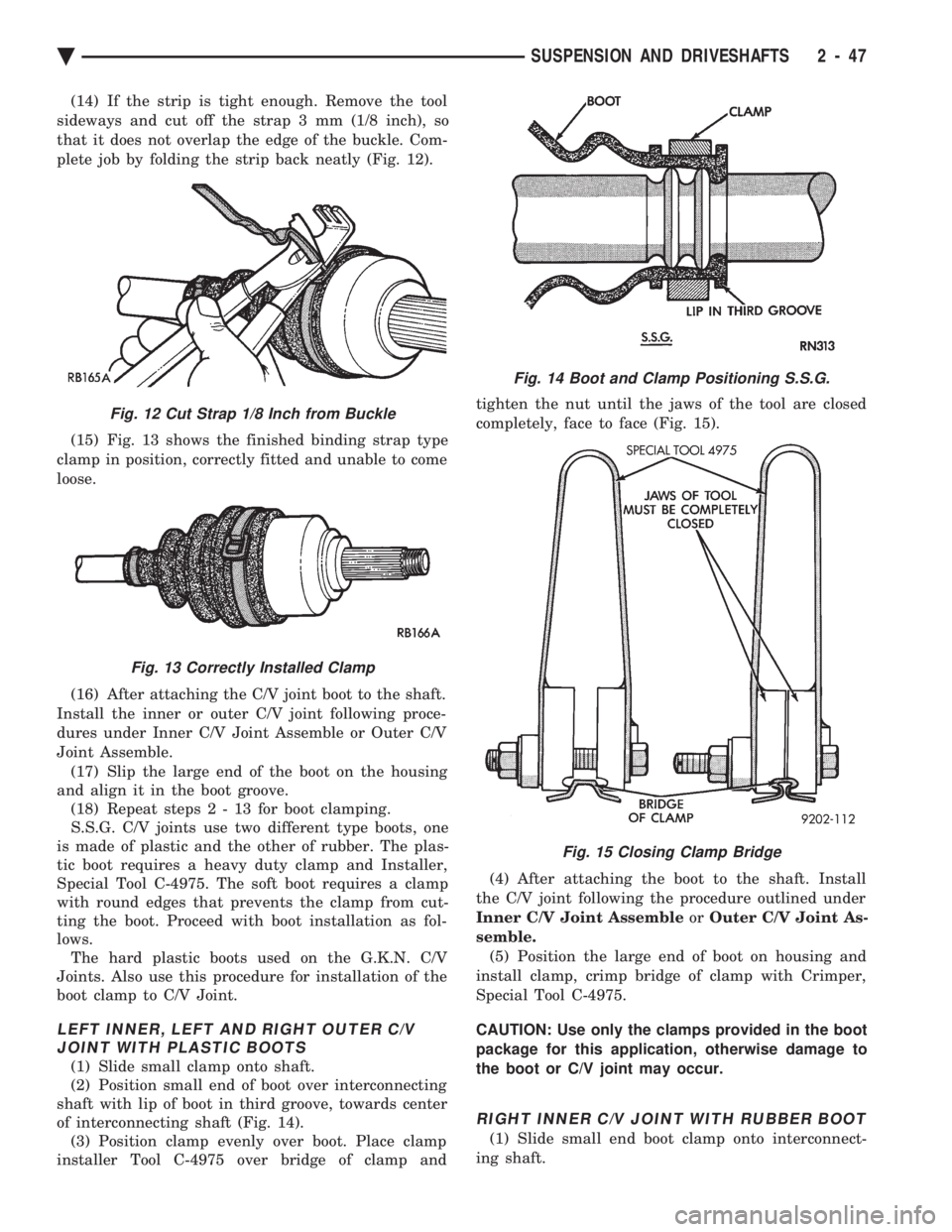
(14) If the strip is tight enough. Remove the tool
sideways and cut off the strap 3 mm (1/8 inch), so
that it does not overlap the edge of the buckle. Com-
plete job by folding the strip back neatly (Fig. 12).
(15) Fig. 13 shows the finished binding strap type
clamp in position, correctly fitted and unable to come
loose.
(16) After attaching the C/V joint boot to the shaft.
Install the inner or outer C/V joint following proce-
dures under Inner C/V Joint Assemble or Outer C/V
Joint Assemble. (17) Slip the large end of the boot on the housing
and align it in the boot groove. (18) Repeat step s2-13forboot clamping.
S.S.G. C/V joints use two different type boots, one
is made of plastic and the other of rubber. The plas-
tic boot requires a heavy duty clamp and Installer,
Special Tool C-4975. The soft boot requires a clamp
with round edges that prevents the clamp from cut-
ting the boot. Proceed with boot installation as fol-
lows. The hard plastic boots used on the G.K.N. C/V
Joints. Also use this procedure for installation of the
boot clamp to C/V Joint.
LEFT INNER, LEFT AND RIGHT OUTER C/V JOINT WITH PLASTIC BOOTS
(1) Slide small clamp onto shaft.
(2) Position small end of boot over interconnecting
shaft with lip of boot in third groove, towards center
of interconnecting shaft (Fig. 14). (3) Position clamp evenly over boot. Place clamp
installer Tool C-4975 over bridge of clamp and tighten the nut until the jaws of the tool are closed
completely, face to face (Fig. 15).
(4) After attaching the boot to the shaft. Install
the C/V joint following the procedure outlined under
Inner C/V Joint Assemble orOuter C/V Joint As-
semble. (5) Position the large end of boot on housing and
install clamp, crimp bridge of clamp with Crimper,
Special Tool C-4975.
CAUTION: Use only the clamps provided in the boot
package for this application, otherwise damage to
the boot or C/V joint may occur.
RIGHT INNER C/V JOINT WITH RUBBER BOOT
(1) Slide small end boot clamp onto interconnect-
ing shaft.
Fig. 12 Cut Strap 1/8 Inch from Buckle
Fig. 13 Correctly Installed Clamp
Fig. 14 Boot and Clamp Positioning S.S.G.
Fig. 15 Closing Clamp Bridge
Ä SUSPENSION AND DRIVESHAFTS 2 - 47