belt CHEVROLET EXPRESS CARGO VAN 2017 1.G Workshop Manual
[x] Cancel search | Manufacturer: CHEVROLET, Model Year: 2017, Model line: EXPRESS CARGO VAN, Model: CHEVROLET EXPRESS CARGO VAN 2017 1.GPages: 346, PDF Size: 6.54 MB
Page 258 of 346
Chevrolet Express Owner Manual (GMNA-Localizing-U.S./Canada/Mexico-9967827) - 2017 - crc - 5/2/16
Vehicle Care 257
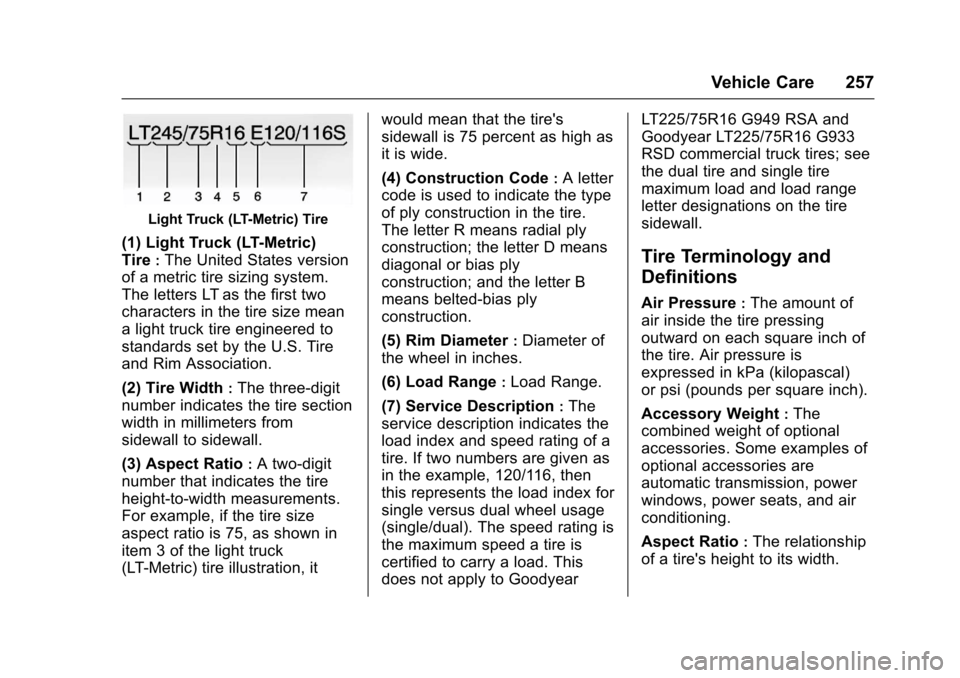
Light Truck (LT-Metric) Tire
(1) Light Truck (LT-Metric)
Tire:The United States version
of a metric tire sizing system.
The letters LT as the first two
characters in the tire size mean
alighttrucktireengineeredto
standards set by the U.S. Tire
and Rim Association.
(2) Tire Width:The three-digit
number indicates the tire section
width in millimeters from
sidewall to sidewall.
(3) Aspect Ratio:Atwo-digit
number that indicates the tire
height-to-width measurements.
For example, if the tire size
aspect ratio is 75, as shown in
item 3 of the light truck
(LT-Metric) tire illustration, it
would mean that the tire's
sidewall is 75 percent as high as
it is wide.
(4) Construction Code:Aletter
code is used to indicate the type
of ply construction in the tire.
The letter R means radial ply
construction; the letter D means
diagonal or bias ply
construction; and the letter B
means belted-bias ply
construction.
(5) Rim Diameter:Diameter of
the wheel in inches.
(6) Load Range:Load Range.
(7) Service Description:The
service description indicates the
load index and speed rating of a
tire. If two numbers are given as
in the example, 120/116, then
this represents the load index for
single versus dual wheel usage
(single/dual). The speed rating is
the maximum speed a tire is
certified to carry a load. This
does not apply to Goodyear
LT 2 2 5 / 7 5 R 1 6 G 9 4 9 R S A a n d
Goodyear LT225/75R16 G933
RSD commercial truck tires; see
the dual tire and single tire
maximum load and load range
letter designations on the tire
sidewall.
Tire Terminology and
Definitions
Air Pressure:The amount of
air inside the tire pressing
outward on each square inch of
the tire. Air pressure is
expressed in kPa (kilopascal)
or psi (pounds per square inch).
Accessory Weight:The
combined weight of optional
accessories. Some examples of
optional accessories are
automatic transmission, power
windows, power seats, and air
conditioning.
Aspect Ratio:The relationship
of a tire's height to its width.
Page 259 of 346
Chevrolet Express Owner Manual (GMNA-Localizing-U.S./Canada/Mexico-9967827) - 2017 - crc - 5/2/16
258 Vehicle Care
Belt:Arubbercoatedlayerof
cords between the plies and the
tread. Cords may be made from
steel or other reinforcing
materials.
Bead:The tire bead contains
steel wires wrapped by steel
cords that hold the tire onto
the rim.
Bias Ply Tire:Apneumatictire
in which the plies are laid at
alternate angles less than
90 degrees to the centerline of
the tread.
Cold Tire Pressure:The
amount of air pressure in a tire,
measured in kPa (kilopascal)
or psi (pounds per square inch)
before a tire has built up heat
from driving. SeeTire
Pressure0260.
Curb Weight:The weight of a
motor vehicle with standard and
optional equipment including the
maximum capacity of fuel, oil,
and coolant, but without
passengers and cargo.
DOT Markings:Acodemolded
into the sidewall of a tire
signifying that the tire is in
compliance with the U.S.
Department of Transportation
(DOT) Motor Vehicle Safety
Standards. The DOT code
includes the Tire Identification
Number (TIN), an alphanumeric
designator which can also
identify the tire manufacturer,
production plant, brand, and
date of production.
GVWR:Gross Vehicle Weight
Rating. SeeVehicle Load
Limits0171.
GAWR FRT:Gross Axle Weight
Rating for the front axle. See
Vehicle Load Limits0171.
GAWR RR:Gross Axle Weight
Rating for the rear axle. See
Vehicle Load Limits0171.
Intended Outboard Sidewall:
The side of an asymmetrical tire
that must always face outward
when mounted on a vehicle.
Kilopascal (kPa):The metric
unit for air pressure.
Light Truck (LT-Metric) Tire:A
tire used on light duty trucks and
some multipurpose passenger
vehicles.
Load Index:An assigned
number ranging from 1 to 279
that corresponds to the load
carrying capacity of a tire.
Maximum Inflation Pressure:
The maximum air pressure to
which a cold tire can be inflated.
The maximum air pressure is
molded onto the sidewall.
Maximum Load Rating:The
load rating for a tire at the
maximum permissible inflation
pressure for that tire.
Page 296 of 346
Chevrolet Express Owner Manual (GMNA-Localizing-U.S./Canada/Mexico-9967827) - 2017 - crc - 5/2/16
Vehicle Care 295
Caution (Continued)
the appearance and feel of
leather or soft trim, and are not
recommended.
Do not use cleaners that increasegloss, especially on the instrumentpanel. Reflected glare can decreasevisibility through the windshieldunder certain conditions.
Caution
Use of air fresheners may cause
permanent damage to plastics
and painted surfaces. If an air
freshener comes in contact with
any plastic or painted surface in
the vehicle, blot immediately and
clean with a soft cloth dampened
with a mild soap solution.
Damage caused by air fresheners
would not be covered by the
vehicle warranty.
Care of Safety Belts
Keep belts clean and dry.
{Warning
Do not bleach or dye safety belt
webbing. It may severely weaken
the webbing. In a crash, they
might not be able to provide
adequate protection. Clean and
rinse safety belt webbing only
with mild soap and lukewarm
water. Allow the webbing to dry.
Floor Mats
{Warning
If a floor mat is the wrong size or
is not properly installed, it can
interfere with the pedals.
Interference with the pedals can
cause unintended acceleration
and/or increased stopping
distance which can cause a crash
and injury. Make sure the floor
mat does not interfere with the
pedals.
Use the following guidelines forproper floor mat usage.
.The original equipment floormats were designed for thevehicle. If the floor mats needreplacing, it is recommendedthat GM certified floor mats bepurchased. Non-GM floor matsmay not fit properly and mayinterfere with the pedals. Alwayscheck that the floor mats do notinterfere with the pedals.
.Use the floor mat with thecorrect side up. Do not turnit over.
.Do not place anything on top ofthe driver side floor mat.
.Use only a single floor mat onthe driver side.
.Do not place one floor mat ontop of another.
Page 301 of 346
Chevrolet Express Owner Manual (GMNA-Localizing-U.S./Canada/Mexico-9967827) - 2017 - crc - 5/2/16
300 Service and Maintenance
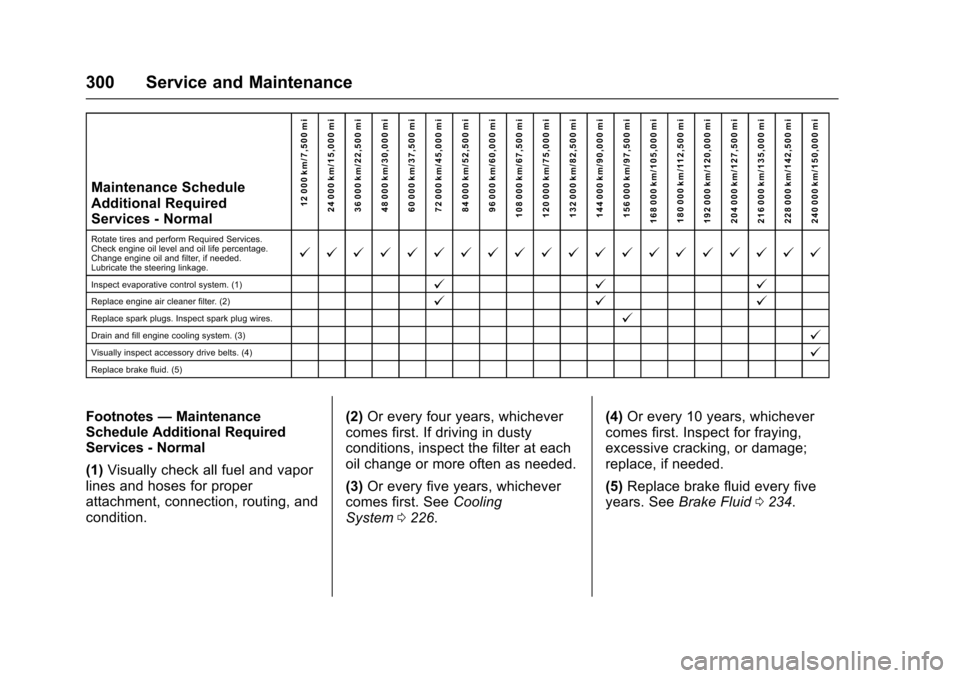
Maintenance ScheduleAdditional RequiredServices - Normal
12 000 km/7,500 mi24 000 km/15,000 mi36 000 km/22,500 mi48 000 km/30,000 mi60 000 km/37,500 mi72 000 km/45,000 mi84 000 km/52,500 mi96 000 km/60,000 mi108 000 km/67,500 mi120 000 km/75,000 mi132 000 km/82,500 mi144 000 km/90,000 mi156 000 km/97,500 mi168 000 km/105,000 mi180 000 km/112,500 mi192 000 km/120,000 mi204 000 km/127,500 mi216 000 km/135,000 mi228 000 km/142,500 mi240 000 km/150,000 mi
Rotate tires and perform Required Services.Check engine oil level and oil life percentage.Change engine oil and filter, if needed.Lubricate the steering linkage.@@@@@@@@@@@@@@@@@@@@
Inspect evaporative control system. (1)@@@
Replace engine air cleaner filter. (2)@@@
Replace spark plugs. Inspect spark plug wires.@
Drain and fill engine cooling system. (3)@
Visually inspect accessory drive belts. (4)@
Replace brake fluid. (5)
Footnotes—MaintenanceSchedule Additional RequiredServices - Normal
(1)Visually check all fuel and vaporlines and hoses for properattachment, connection, routing, andcondition.
(2)Or every four years, whichevercomes first. If driving in dustyconditions, inspect the filter at eachoil change or more often as needed.
(3)Or every five years, whichevercomes first. SeeCoolingSystem0226.
(4)Or every 10 years, whichevercomes first. Inspect for fraying,excessive cracking, or damage;replace, if needed.
(5)Replace brake fluid every fiveyears. SeeBrake Fluid0234.
Page 302 of 346
Chevrolet Express Owner Manual (GMNA-Localizing-U.S./Canada/Mexico-9967827) - 2017 - crc - 5/2/16
Service and Maintenance 301
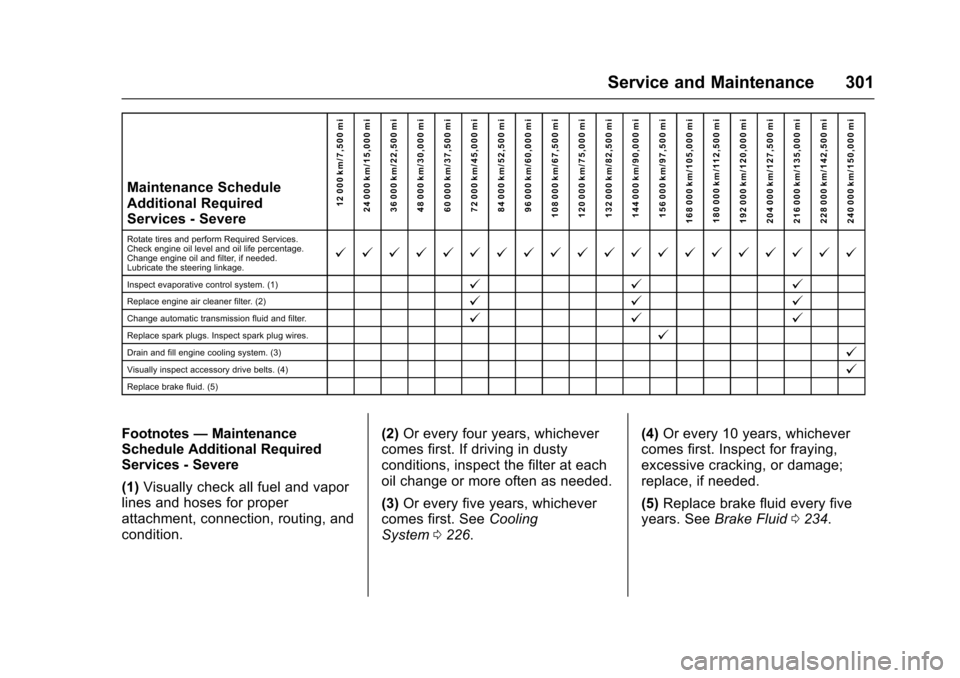
Maintenance ScheduleAdditional RequiredServices - Severe
12 000 km/7,500 mi24 000 km/15,000 mi36 000 km/22,500 mi48 000 km/30,000 mi60 000 km/37,500 mi72 000 km/45,000 mi84 000 km/52,500 mi96 000 km/60,000 mi108 000 km/67,500 mi120 000 km/75,000 mi132 000 km/82,500 mi144 000 km/90,000 mi156 000 km/97,500 mi168 000 km/105,000 mi180 000 km/112,500 mi192 000 km/120,000 mi204 000 km/127,500 mi216 000 km/135,000 mi228 000 km/142,500 mi240 000 km/150,000 mi
Rotate tires and perform Required Services.Check engine oil level and oil life percentage.Change engine oil and filter, if needed.Lubricate the steering linkage.@@@@@@@@@@@@@@@@@@@@
Inspect evaporative control system. (1)@@@
Replace engine air cleaner filter. (2)@@@
Change automatic transmission fluid and filter.@@@
Replace spark plugs. Inspect spark plug wires.@
Drain and fill engine cooling system. (3)@
Visually inspect accessory drive belts. (4)@
Replace brake fluid. (5)
Footnotes—MaintenanceSchedule Additional RequiredServices - Severe
(1)Visually check all fuel and vaporlines and hoses for properattachment, connection, routing, andcondition.
(2)Or every four years, whichevercomes first. If driving in dustyconditions, inspect the filter at eachoil change or more often as needed.
(3)Or every five years, whichevercomes first. SeeCoolingSystem0226.
(4)Or every 10 years, whichevercomes first. Inspect for fraying,excessive cracking, or damage;replace, if needed.
(5)Replace brake fluid every fiveyears. SeeBrake Fluid0234.
Page 303 of 346
Chevrolet Express Owner Manual (GMNA-Localizing-U.S./Canada/Mexico-9967827) - 2017 - crc - 5/2/16
302 Service and Maintenance
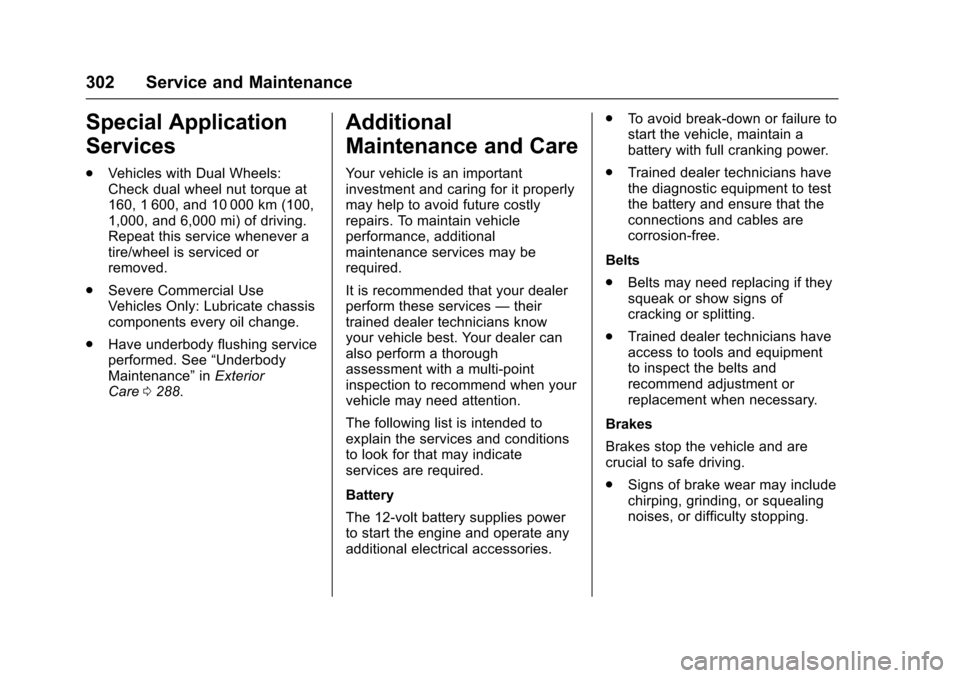
Special Application
Services
.Vehicles with Dual Wheels:Check dual wheel nut torque at160, 1 600, and 10 000 km (100,1,000, and 6,000 mi) of driving.Repeat this service whenever atire/wheel is serviced orremoved.
.Severe Commercial UseVehicles Only: Lubricate chassiscomponents every oil change.
.Have underbody flushing serviceperformed. See“UnderbodyMaintenance”inExteriorCare0288.
Additional
Maintenance and Care
Yo u r v e h i c l e i s a n i m p o r t a n tinvestment and caring for it properlymay help to avoid future costlyrepairs. To maintain vehicleperformance, additionalmaintenance services may berequired.
It is recommended that your dealerperform these services—theirtrained dealer technicians knowyour vehicle best. Your dealer canalso perform a thoroughassessment with a multi-pointinspection to recommend when yourvehicle may need attention.
The following list is intended toexplain the services and conditionsto look for that may indicateservices are required.
Battery
The 12-volt battery supplies powerto start the engine and operate anyadditional electrical accessories.
.To a v o i d b r e a k - d o w n o r f a i l u r e t ostart the vehicle, maintain abattery with full cranking power.
.Trained dealer technicians havethe diagnostic equipment to testthe battery and ensure that theconnections and cables arecorrosion-free.
Belts
.Belts may need replacing if theysqueak or show signs ofcracking or splitting.
.Trained dealer technicians haveaccess to tools and equipmentto inspect the belts andrecommend adjustment orreplacement when necessary.
Brakes
Brakes stop the vehicle and arecrucial to safe driving.
.Signs of brake wear may includechirping, grinding, or squealingnoises, or difficulty stopping.
Page 309 of 346
Chevrolet Express Owner Manual (GMNA-Localizing-U.S./Canada/Mexico-9967827) - 2017 - crc - 5/2/16
308 Technical Data
Technical Data
Vehicle Identification
Vehicle IdentificationNumber (VIN) . . . . . . . . . . . . . . . 308Service Parts IdentificationLabel . . . . . . . . . . . . . . . . . . . . . . . . 308
Vehicle Data
Capacities andSpecifications . . . . . . . . . . . . . . . 309Engine Drive Belt Routing . . . . 311
Vehicle Identification
Vehicle Identification
Number (VIN)
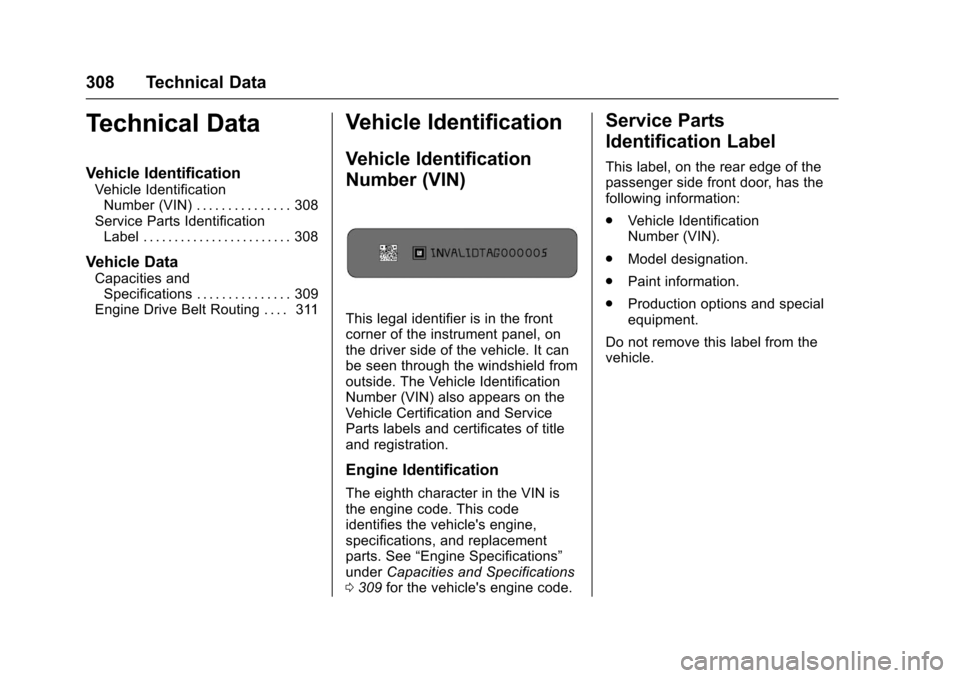
This legal identifier is in the frontcorner of the instrument panel, onthe driver side of the vehicle. It canbe seen through the windshield fromoutside. The Vehicle IdentificationNumber (VIN) also appears on theVehicle Certification and ServiceParts labels and certificates of titleand registration.
Engine Identification
The eighth character in the VIN isthe engine code. This codeidentifies the vehicle's engine,specifications, and replacementparts. See“Engine Specifications”underCapacities and Specifications0309for the vehicle's engine code.
Service Parts
Identification Label
This label, on the rear edge of thepassenger side front door, has thefollowing information:
.Vehicle IdentificationNumber (VIN).
.Model designation.
.Paint information.
.Production options and specialequipment.
Do not remove this label from thevehicle.
Page 312 of 346
Chevrolet Express Owner Manual (GMNA-Localizing-U.S./Canada/Mexico-9967827) - 2017 - crc - 5/2/16
Technical Data 311
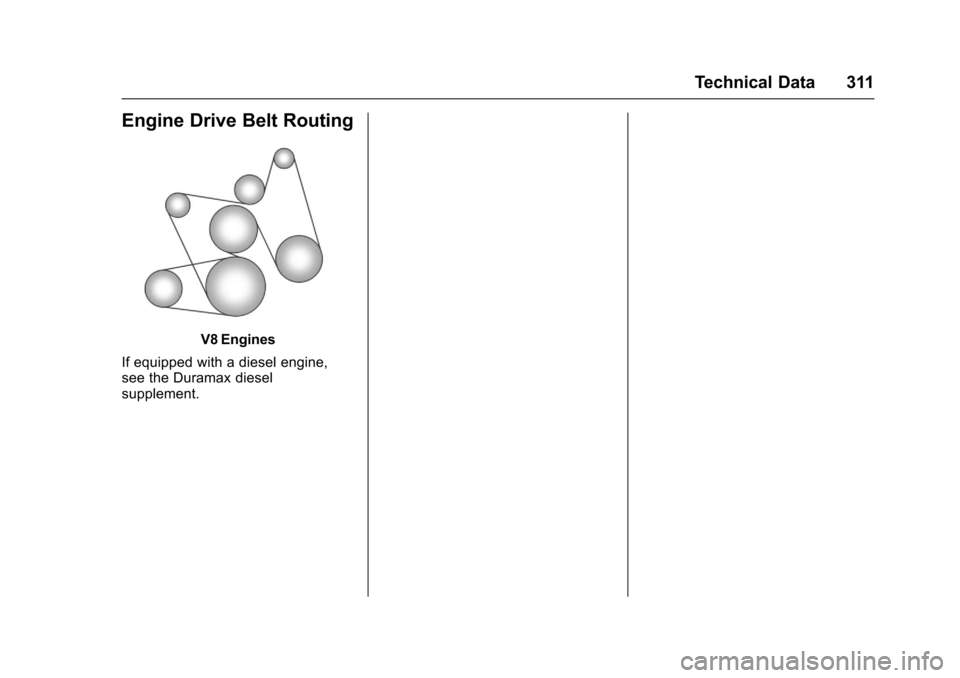
Engine Drive Belt Routing
V8 Engines
If equipped with a diesel engine,see the Duramax dieselsupplement.
Page 325 of 346
Chevrolet Express Owner Manual (GMNA-Localizing-U.S./Canada/Mexico-9967827) - 2017 - crc - 5/2/16
324 Customer Information
Vehicle Data
Recording and
Privacy
The vehicle has a number ofcomputers that record informationabout the vehicle’sperformanceandhow it is driven. For example, thevehicle uses computer modules tomonitor and control engine andtransmission performance, tomonitor the conditions for airbagdeployment and deploy them in acrash, and, if equipped, to provideantilock braking to help the drivercontrol the vehicle. These modulesmay store data to help the dealertechnician service the vehicle.Some modules may also store dataabout how the vehicle is operated,such as rate of fuel consumption oraverage speed. These modules mayretain personal preferences, such asradio presets, seat positions, andtemperature settings.
Event Data Recorders
This vehicle is equipped with anevent data recorder (EDR). Themain purpose of an EDR is torecord, in certain crash or nearcrash-like situations, such as an airbag deployment or hitting a roadobstacle, data that will assist inunderstanding how a vehicle’ssystems performed. The EDR isdesigned to record data related tovehicle dynamics and safetysystems for a short period of time,typically 30 seconds or less. TheEDR in this vehicle is designed torecord such data as:
.How various systems in yourvehicle were operating;
.Whether or not the driver andpassenger safety belts werebuckled/fastened;
.How far (if at all) the driver wasdepressing the accelerator and/or brake pedal; and,
.How fast the vehicle wastraveling.
These data can help provide abetter understanding of thecircumstances in which crashes andinjuries occur.
Note
EDR data are recorded by yourvehicle only if a non-trivial crashsituation occurs; no data arerecorded by the EDR under normaldriving conditions and no personaldata (e.g., name, gender, age, andcrash location) are recorded.However, other parties, such as lawenforcement, could combine theEDR data with the type ofpersonally identifying data routinelyacquired during a crashinvestigation.
To r e a d d a t a r e c o r d e d b y a n E D R ,special equipment is required, andaccess to the vehicle or the EDR isneeded. In addition to the vehiclemanufacturer, other parties, such aslaw enforcement, that have thespecial equipment, can read theinformation if they have access tothe vehicle or the EDR.
Page 339 of 346

Chevrolet Express Owner Manual (GMNA-Localizing-U.S./Canada/Mexico-9967827) - 2017 - crc - 5/2/16
338 Index
Climate Control Systems (cont'd)
Air Conditioning . . . . . . . . . . . . . . 158
Heating . . . . . . . . . . . . . . . . . . . . . . . 158
Rear . . . . . . . . . . . . . . . . . . . . . . . . . . 161
Rear Heating System . . . . . . . . . 160
Clock . . . . . . . . . . . . . . . . . . . . . . . . . . . . 92
Cluster, Instrument . . . . . . . . . . . . . . 95
Collision Damage Repair . . . . . . . 319
Compartments
Storage . . . . . . . . . . . . . . . . . . . . . . . . . 85
Compass . . . . . . . . . . . . . . . . . . . . . . . . 90
Messages . . . . . . . . . . . . . . . . . . . . .113
Connections
OnStar®...................... 328
Control
Traction and Electronic
Stability . . . . . . . . . . . . . . . . . . . . . 190
Control of a Vehicle . . . . . . . . . . . . . 166
Convex Mirrors . . . . . . . . . . . . . . . . . . 35
Coolant
Engine . . . . . . . . . . . . . . . . . . . . . . . . 227
Engine Temperature Gauge . . . . 98
Cooling System . . . . . . . . . . . . . . . . . 226
Engine Messages . . . . . . . . . . . . .113
Courtesy Transportation
Program . . . . . . . . . . . . . . . . . . . . . . . 318
Cruise Control . . . . . . . . . . . . . . . . . . 192
Light . . . . . . . . . . . . . . . . . . . . . . . . . . 107
Customer Assistance . . . . . . . . . . . 315
Offices . . . . . . . . . . . . . . . . . . . . . . . . 314
Te x t Te l e p h o n e ( T T Y )
Users . . . . . . . . . . . . . . . . . . . . . . . 315
Customer Information
Service Publications
Ordering Information . . . . . . . . 321
Customer Satisfaction
Procedure . . . . . . . . . . . . . . . . . . . . . 312
D
Damage Repair, Collision . . . . . . . 319
Danger, Warning, and Caution . . . . 3
Data Collection
Infotainment System . . . . . . . . . . 325
OnStar . . . . . . . . . . . . . . . . . . . . . . . 325
Data Recorders, Event . . . . . . . . . 324
Daytime Running
Lamps (DRL) . . . . . . . . . . . . . . . . . . 126
Defensive Driving . . . . . . . . . . . . . . . 165
Delayed Locking . . . . . . . . . . . . . . . . . 29
Devices
Auxiliary . . . . . . . . . . . . . . . . . . . . . . 146
Diagnostics
OnStar®...................... 330
Distracted Driving . . . . . . . . . . . . . . . 165
Dome Lamps . . . . . . . . . . . . . . . . . . . 129
Door
Ajar Messages . . . . . . . . . . . . . . . .113
Door (cont'd)
Cargo Door Relocking . . . . . . . . . . 29
Delayed Locking . . . . . . . . . . . . . . . . 29
Locks . . . . . . . . . . . . . . . . . . . . . . . . . . . 28
Power Locks . . . . . . . . . . . . . . . . . . . . 29
Rear Doors . . . . . . . . . . . . . . . . . . . . . 32
Side . . . . . . . . . . . . . . . . . . . . . . . . . . . . 31
Sliding . . . . . . . . . . . . . . . . . . . . . . . . . . 32
Drive Belt Routing, Engine . . . . . . 311
Driver Information
Center (DIC) . . . . . . . . . . . . . . . . . . 108
Driving
Characteristics and
To w i n g T i p s . . . . . . . . . . . . . . . . . 2 0 2
Defensive . . . . . . . . . . . . . . . . . . . . . 165
Drunk . . . . . . . . . . . . . . . . . . . . . . . . . 166
For Better Fuel Economy . . . . . . . 22
Hill and Mountain Roads . . . . . . 169
If the Vehicle is Stuck . . . . . . . . . 171
Loss of Control . . . . . . . . . . . . . . . 167
Off-Road Recovery . . . . . . . . . . . 167
Vehicle Load Limits . . . . . . . . . . . 171
Wet Roads . . . . . . . . . . . . . . . . . . . 168
Winter . . . . . . . . . . . . . . . . . . . . . . . . 169
Dual Tire
Rotation . . . . . . . . . . . . . . . . . . . . . . 266