recommended oil CHEVROLET HHR 2011 1.G User Guide
[x] Cancel search | Manufacturer: CHEVROLET, Model Year: 2011, Model line: HHR, Model: CHEVROLET HHR 2011 1.GPages: 430, PDF Size: 4.57 MB
Page 298 of 430
Black plate (22,1)Chevrolet HHR Owner Manual - 2011
Manual Transmission Fluid
It is not necessary to check the manual transmission
fluid level. A transmission fluid leak is the only reason
for fluid loss. If a leak occurs, take the vehicle to a
dealer for service. Have it repaired as soon as possible.
You may also have the fluid level checked by your
dealer when the oil is changed. SeeRecommended
Fluids and Lubricants
on page 7‑8for the proper fluid
to use.
Hydraulic Clutch
The hydraulic clutch linkage in your vehicle is
self-adjusting. This system does not have its own
reservoir. It receives fluid from the brake master cylinder
reservoir.
See Brakes
on page 6‑30for more information.
Cooling System
The cooling system allows the engine to maintain the
correct working temperature.
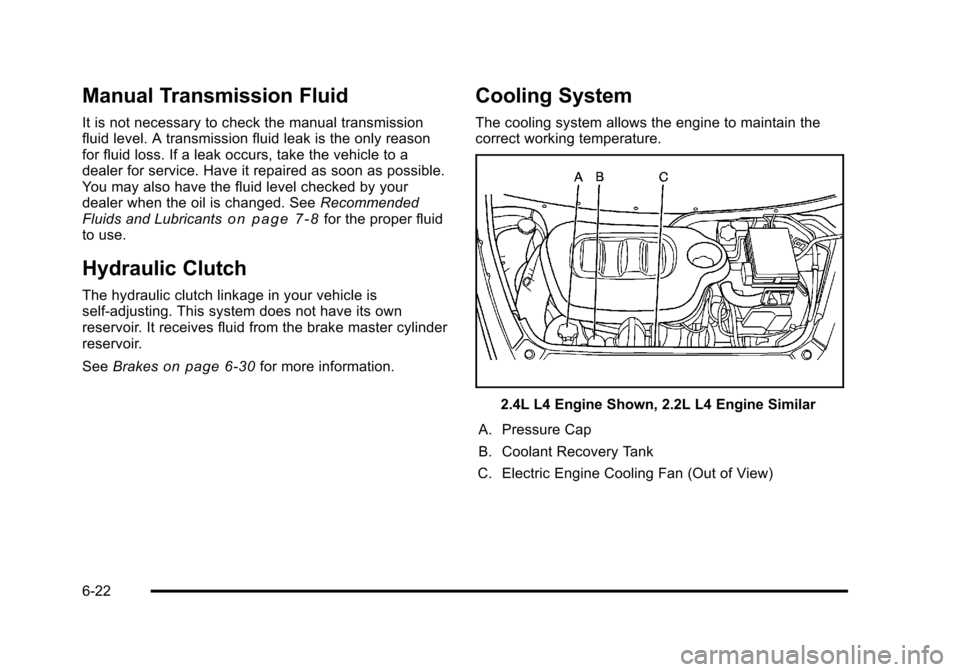
2.4L L4 Engine Shown, 2.2L L4 Engine Similar
A. Pressure Cap
B. Coolant Recovery Tank
C. Electric Engine Cooling Fan (Out of View)
6-22
Page 300 of 430
Black plate (24,1)Chevrolet HHR Owner Manual - 2011
Engine Coolant
The cooling system in the vehicle is filled with
DEX-COOL®engine coolant. This coolant is designed
to remain in the vehicle for 5 years or 240 000 km
(150,000 mi), whichever occurs first.
The following explains the cooling system and how to
check and add coolant when it is low. If there is a
problem with engine overheating, see Engine
Overheating on page 6‑28
What to Use
{WARNING:
Adding only plain water or some other liquid to the
cooling system can be dangerous. Plain water
and other liquids, can boil before the proper
coolant mixture will. The vehicle's coolant warning
system is set for the proper coolant mixture. With
plain water or the wrong mixture, the engine could
get too hot but you would not get the overheat
warning. The engine could catch fire and you or
others could be burned. Use a 50/50 mixture of
clean, drinkable water and DEX-COOL coolant. Use a 50/50 mixture of clean, drinkable water and
DEX-COOL coolant. If using this mixture, nothing else
needs to be added. This mixture:
.Gives freezing protection down to
−34°F (−37°C),
outside temperature.
.Gives boiling protection up to 265°F (129°C),
engine temperature.
.Protects against rust and corrosion.
.Will not damage aluminum parts.
.Helps keep the proper engine temperature.
Notice: If an improper coolant mixture is used, the
engine could overheat and be badly damaged. The
repair cost would not be covered by the vehicle
warranty. Too much water in the mixture can freeze
and crack the engine, radiator, heater core, and
other parts.
Notice: If extra inhibitors and/or additives are used
in the vehicle's cooling system, the vehicle could be
damaged. Use only the proper mixture of the engine
coolant listed in this manual for the cooling system.
See Recommended Fluids and Lubricants
on
page 7‑8for more information.
Checking Coolant
The vehicle must be on a level surface when checking
the coolant level.
6-24
Page 307 of 430
Black plate (31,1)Chevrolet HHR Owner Manual - 2011
Do not top off the brake/clutch fluid. Adding fluid does
not correct a leak. If fluid is added when the brake
linings are worn, there will be too much fluid when new
brake linings are installed. Add or remove fluid, as
necessary, only when work is done on the brake/clutch
hydraulic system.
{WARNING:
If too much brake fluid is added, it can spill on the
engine and burn, if the engine is hot enough. You
or others could be burned, and the vehicle could
be damaged. Add brake fluid only when work is
done on the brake and/or clutch hydraulic system.
When the brake fluid falls to a low level, the brake
warning light comes on. See Brake System Warning
Light on page 4‑29.
What to Add
Use only new DOT 3 brake fluid from a sealed
container. See Recommended Fluids and Lubricantson
page 7‑8.
Always clean the brake fluid reservoir cap and the area
around the cap before removing it. This helps keep dirt
from entering the reservoir.
{WARNING:
With the wrong kind of fluid in the brake or clutch
hydraulic system, the brakes or clutch might not
work well. This could cause a crash. Always use
the proper brake fluid.
Notice:
.Using the wrong fluid can badly damage
brake or clutch hydraulic system parts. For
example, just a few drops of mineral-based
oil, such as engine oil, in the brake or clutch
hydraulic system can damage brake or
clutch hydraulic system parts so badly that
they will have to be replaced. Do not let
someone put in the wrong kind of fluid.
.If brake fluid is spilled on the vehicle's
painted surfaces, the paint finish can be
damaged. Be careful not to spill brake fluid
on the vehicle. If you do, wash it off
immediately. See Washing Your Vehicle
on
page 6‑95
.
6-31
Page 368 of 430
Black plate (92,1)Chevrolet HHR Owner Manual - 2011
Appearance Care
Interior Cleaning
The vehicle's interior will continue to look its best if it is
cleaned often. Although not always visible, dust and dirt
can accumulate on the upholstery. Dirt can damage
carpet, fabric, leather, and plastic surfaces. Regular
vacuuming is recommended to remove particles from
the upholstery. It is important to keep the upholstery
from becoming and remaining heavily soiled. Soils
should be removed as quickly as possible. The
vehicle's interior may experience extremes of heat that
could cause stains to set rapidly.
Lighter colored interiors may require more frequent
cleaning. Use care because newspapers and garments
that transfer color to home furnishings may also transfer
color to the vehicle's interior.
When cleaning the vehicle's interior, only use cleaners
specifically designed for the surfaces being cleaned.
Permanent damage may result from using cleaners on
surfaces for which they were not intended. Use glass
cleaner only on glass. Remove any accidental
over-spray from other surfaces immediately. To prevent
over-spray, apply cleaner directly to the cleaning cloth.Notice:
Using abrasive cleaners when cleaning
glass surfaces on the vehicle, could scratch the
glass and/or cause damage to the rear window
defogger. When cleaning the glass on the vehicle,
use only a soft cloth and glass cleaner.
Many cleaners contain solvents that may become
concentrated in the vehicle's breathing space. Before
using cleaners, read and adhere to all safety
instructions on the label. While cleaning the vehicle's
interior, maintain adequate ventilation by opening the
vehicle's doors and windows.
Dust may be removed from small buttons and knobs
using a small brush with soft bristles.
Products that remove odors from the vehicle's
upholstery and clean the vehicle's glass can be
obtained from your dealer.
Do not clean the vehicle using:
.A knife or any other sharp object to remove a soil
from any interior surface.
.A stiff brush. It can cause damage to the vehicle's
interior surfaces.
.Heavy pressure or aggressive rubbing with a
cleaning cloth. Use of heavy pressure can damage
the interior and does not improve the effectiveness
of soil removal.
6-92
Page 372 of 430

Black plate (96,1)Chevrolet HHR Owner Manual - 2011
Finish Care
Occasional waxing or mild polishing of the vehicle by
hand may be necessary to remove residue from the
paint finish. Approved cleaning products can be
obtained from your dealer.
If the vehicle has a basecoat/clearcoat paint finish, the
clearcoat gives more depth and gloss to the colored
basecoat. Always use waxes and polishes that are
non-abrasive and made for a basecoat/clearcoat paint
finish.
Notice:Machine compounding or aggressive
polishing on a basecoat/clearcoat paint finish may
damage it. Use only non-abrasive waxes and
polishes that are made for a basecoat/clearcoat
paint finish on the vehicle.
Foreign materials such as calcium chloride and other
salts, ice melting agents, road oil and tar, tree sap, bird
droppings, chemicals from industrial chimneys, etc., can
damage the vehicle's finish if they remain on painted
surfaces. Wash the vehicle as soon as possible.
If necessary, use non-abrasive cleaners that are
marked safe for painted surfaces to remove foreign
matter.
Exterior painted surfaces are subject to aging, weather
and chemical fallout that can take their toll over a period
of years. To help keep the paint finish looking new, keep
the vehicle garaged or covered whenever possible.
Protecting Exterior Bright Metal Parts
Bright metal parts should be cleaned regularly to keep
their luster. Washing with water is all that is usually
needed. However, chrome polish may be used on
chrome or stainless steel trim, if necessary.
Use special care with aluminum trim. To avoid
damaging protective trim, never use auto or chrome
polish, steam or caustic soap to clean aluminum.
A coating of wax, rubbed to high polish, is
recommended for all bright metal parts.
Windshield and Wiper Blades
Clean the outside of the windshield with glass cleaner.
Clean the rubber blades using a lint free cloth or paper
towel soaked with windshield washer fluid or a mild
detergent. Wash the windshield thoroughly when
cleaning the blades. Bugs, road grime, sap, and a
buildup of vehicle wash/wax treatments may cause
wiper streaking. Replace the wiper blades if they are
worn or damaged.
Wipers can be damaged by:
.Extreme dusty conditions
.Sand and salt
.Heat and sun
.Snow and ice, without proper removal
6-96
Page 383 of 430

Black plate (107,1)Chevrolet HHR Owner Manual - 2011
Capacities and Specifications
The following approximate capacities are given in English and metric conversions. Please refer toMaintenance
Replacement Partson page 7‑10for more information.
Application Capacities
English Metric
Air Conditioning Refrigerant R134a For the air conditioning system refrigerant charge
amount, see the refrigerant label located under the hood. See your dealer for more information.
Cooling System 2.2L Engine 7.4 qt7.0 L
2.4L Engine with Automatic Transmission 8.5 qt8.0 L
2.4L Engine with Manual Transmission 8.7 qt8.2 L
Engine Oil with Filter 5.0 qt4.7 L
Fuel Tank 16.2 gal61.3 L
Transmission Fluid
Automatic (Bottom Pan Removal) 7.0 qt6.6 L
Manual —2.2L L4 or 2.4L L4 Engine (Drain and Refill) 1.7 qt1.6 L
Wheel Nut Torque 100 lb ft140Y
All capacities are approximate. When adding, be sure to fill to the approximate level, as recommended in this manual.
6-107
Page 388 of 430

Black plate (4,1)Chevrolet HHR Owner Manual - 2011
.Fluids visual leak check (or every 12 months,
whichever occurs first). A leak in any system must
be repaired and the fluid level checked.
.Engine air cleaner filter inspection. SeeEngine Air
Cleaner/Filter on page 6‑20.
.Brake system inspection (or every 12 months,
whichever occurs first).
.Steering and suspension inspection. Visual
inspection for damaged, loose, or missing parts or
signs of wear.
.Body hinges and latches, key lock cylinders, and
rear compartment hinges lubrication. See
Recommended Fluids and Lubricants
on
page 7‑8. More frequent lubrication may be
required when the vehicle is exposed to a
corrosive environment. Applying silicone grease on
weatherstrips with a clean cloth makes them last
longer, seal better, and not stick or squeak.
.Restraint system component check. See Checking
the Restraint Systems on page 2‑73.
.Fuel system inspection for damage or leaks.
.Exhaust system and nearby heat shields
inspection for loose or damaged components.
Additional Required Services
Every 12 000 km/7,500 Miles
.Rotate tires. Tires should be rotated every
12 000 km/7,500 miles. See Tire Inspection and
Rotation on page 6‑60.
At Each Fuel Stop
.Engine oil level check. See Engine Oilon
page 6‑16.
.Engine coolant level check. See Engine Coolanton page 6‑24.
.Windshield washer fluid level check. See
Windshield Washer Fluid on page 6‑30.
Once a Month
.Tire inflation pressures check. See Inflation - Tire
Pressure on page 6‑54.
.Tire wear inspection. See Tire Inspection and
Rotation on page 6‑60.
.Sunroof track and seal inspection, if equipped. See
Sunroof on page 3‑48.
7-4
Page 390 of 430

Black plate (6,1)Chevrolet HHR Owner Manual - 2011
.Evaporative control system inspection. Check all
fuel and vapor lines and hoses for proper hook‐up,
routing, and condition. Check that the purge valve,
if the vehicle has one, works properly. Replace as
needed.An Emission Control Service. The U.S.
Environmental Protection Agency or the California
Air Resources Board has determined that the
failure to perform this maintenance item will not
nullify the emission warranty or limit recall liability
prior to the completion of the vehicle's useful life.
We, however, urge that all recommended
maintenance services be performed at the
indicated intervals and the maintenance be
recorded.
First Engine Oil Change After Every
160 000 km/100,000 Miles
.Spark plug replacement and spark plug wires
inspection. An Emission Control Service.
First Engine Oil Change After Every
240 000 km/150,000 Miles
.Engine cooling system drain, flush, and refill (or
every five years, whichever occurs first). See
Engine Coolant
on page 6‑24.An Emission
Control Service.
.Engine drive belts inspection for fraying, excessive
cracks, or obvious damage (or every 10 years,
whichever occurs first). Replace, if needed.
Owner Checks and Services
Starter Switch Check
{WARNING:
When you are doing this inspection, the vehicle
could move suddenly. If the vehicle moves, you or
others could be injured.
1. Before starting this check, be sure there is enough room around the vehicle.
2. Firmly apply both the parking brake and the regular brake. See Parking Brake on page 3‑30.
Do not use the accelerator pedal, and be ready to
turn off the engine immediately if it starts.
3. For automatic transmission vehicles, try to start the engine in each gear. The starter should work only
in P (Park) or N (Neutral). If the starter works in any
other position, your vehicle needs service.
For manual transmission vehicles, put the shift
lever in Neutral, push the clutch pedal down
halfway, and try to start the engine. The starter
should work only when the clutch pedal is pushed
down all the way to the floor. If the starter works
when the clutch pedal is not pushed all the way
down, your vehicle needs service.
7-6
Page 392 of 430
Black plate (8,1)Chevrolet HHR Owner Manual - 2011
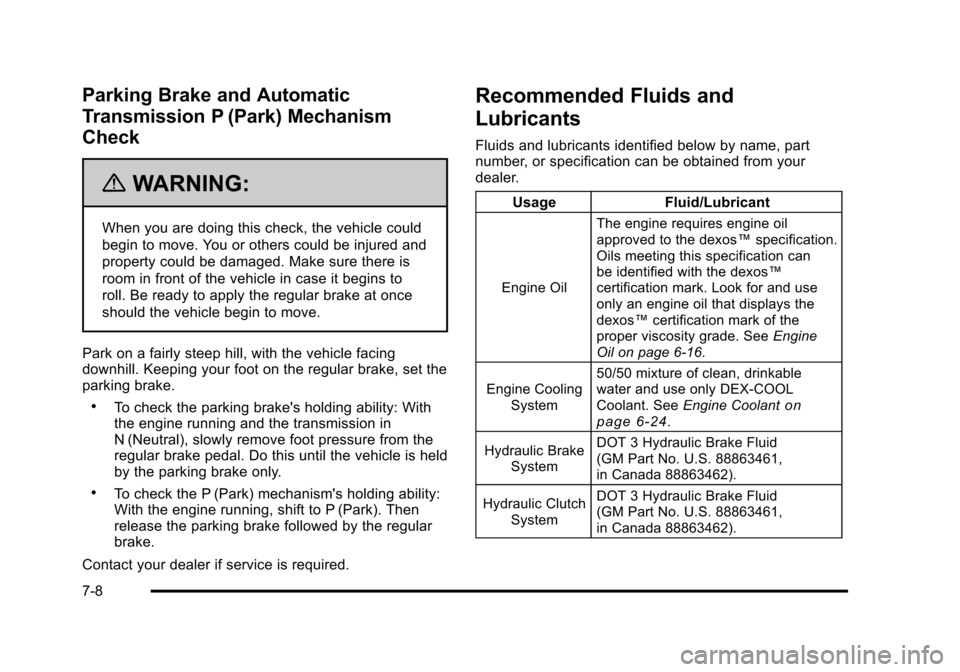
Parking Brake and Automatic
Transmission P (Park) Mechanism
Check
{WARNING:
When you are doing this check, the vehicle could
begin to move. You or others could be injured and
property could be damaged. Make sure there is
room in front of the vehicle in case it begins to
roll. Be ready to apply the regular brake at once
should the vehicle begin to move.
Park on a fairly steep hill, with the vehicle facing
downhill. Keeping your foot on the regular brake, set the
parking brake.
.To check the parking brake's holding ability: With
the engine running and the transmission in
N (Neutral), slowly remove foot pressure from the
regular brake pedal. Do this until the vehicle is held
by the parking brake only.
.To check the P (Park) mechanism's holding ability:
With the engine running, shift to P (Park). Then
release the parking brake followed by the regular
brake.
Contact your dealer if service is required.
Recommended Fluids and
Lubricants
Fluids and lubricants identified below by name, part
number, or specification can be obtained from your
dealer.
Usage Fluid/Lubricant
Engine Oil The engine requires engine oil
approved to the dexos™
specification.
Oils meeting this specification can
be identified with the dexos™
certification mark. Look for and use
only an engine oil that displays the
dexos™ certification mark of the
proper viscosity grade. See Engine
Oil on page 6‑16.
Engine Cooling System 50/50 mixture of clean, drinkable
water and use only DEX-COOL
Coolant. See
Engine Coolant
on
page 6‑24.
Hydraulic Brake System DOT 3 Hydraulic Brake Fluid
(GM Part No. U.S. 88863461,
in Canada 88863462).
Hydraulic Clutch System DOT 3 Hydraulic Brake Fluid
(GM Part No. U.S. 88863461,
in Canada 88863462).
7-8
Page 424 of 430
Black plate (8,1)Chevrolet HHR Owner Manual - 2011
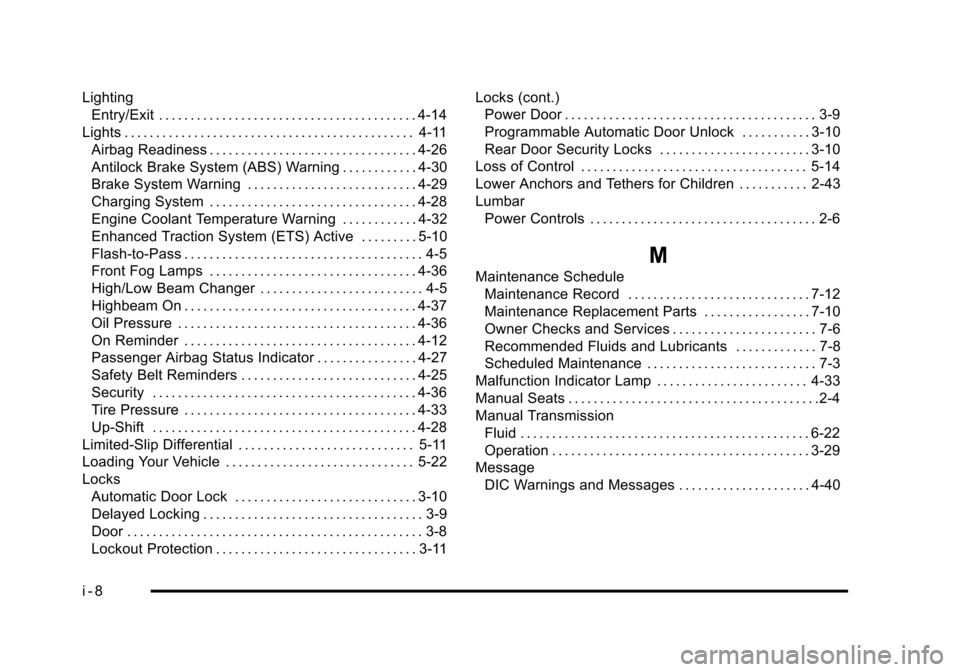
LightingEntry/Exit . . . . . . . . . . . . . . . . . . . . . . . . . . . . . . . . . . . . . . . . . 4-14
Lights . . . . . . . . . . . . . . . . . . . . . . . . . . . . . . . . . . . . . . . . . . . . . . 4-11 Airbag Readiness . . . . . . . . . . . . . . . . . . . . . . . . . . . . . . . . . 4-26
Antilock Brake System (ABS) Warning . . . . . . . . . . . . 4-30
Brake System Warning . . . . . . . . . . . . . . . . . . . . . . . . . . . 4-29
Charging System . . . . . . . . . . . . . . . . . . . . . . . . . . . . . . . . . 4-28
Engine Coolant Temperature Warning . . . . . . . . . . . . 4-32
Enhanced Traction System (ETS) Active . . . . . . . . . 5-10
Flash-to-Pass . . . . . . . . . . . . . . . . . . . . . . . . . . . . . . . . . . . . . . 4-5
Front Fog Lamps . . . . . . . . . . . . . . . . . . . . . . . . . . . . . . . . . 4-36
High/Low Beam Changer . . . . . . . . . . . . . . . . . . . . . . . . . . 4-5
Highbeam On . . . . . . . . . . . . . . . . . . . . . . . . . . . . . . . . . . . . . 4-37
Oil Pressure . . . . . . . . . . . . . . . . . . . . . . . . . . . . . . . . . . . . . . 4-36
On Reminder . . . . . . . . . . . . . . . . . . . . . . . . . . . . . . . . . . . . . 4-12
Passenger Airbag Status Indicator . . . . . . . . . . . . . . . . 4-27
Safety Belt Reminders . . . . . . . . . . . . . . . . . . . . . . . . . . . . 4-25
Security . . . . . . . . . . . . . . . . . . . . . . . . . . . . . . . . . . . . . . . . . . 4-36
Tire Pressure . . . . . . . . . . . . . . . . . . . . . . . . . . . . . . . . . . . . . 4-33
Up-Shift . . . . . . . . . . . . . . . . . . . . . . . . . . . . . . . . . . . . . . . . . . 4-28
Limited-Slip Differential . . . . . . . . . . . . . . . . . . . . . . . . . . . . 5-11
Loading Your Vehicle . . . . . . . . . . . . . . . . . . . . . . . . . . . . . . 5-22
Locks
Automatic Door Lock . . . . . . . . . . . . . . . . . . . . . . . . . . . . . 3-10
Delayed Locking . . . . . . . . . . . . . . . . . . . . . . . . . . . . . . . . . . . 3-9
Door . . . . . . . . . . . . . . . . . . . . . . . . . . . . . . . . . . . . . . . . . . . . . . . 3-8
Lockout Protection . . . . . . . . . . . . . . . . . . . . . . . . . . . . . . . . 3-11 Locks (cont.)
Power Door . . . . . . . . . . . . . . . . . . . . . . . . . . . . . . . . . . . . . . . . 3-9
Programmable Automatic Door Unlock . . . . . . . . . . . 3-10
Rear Door Security Locks . . . . . . . . . . . . . . . . . . . . . . . . 3-10
Loss of Control . . . . . . . . . . . . . . . . . . . . . . . . . . . . . . . . . . . . 5-14
Lower Anchors and Tethers for Children . . . . . . . . . . . 2-43
Lumbar Power Controls . . . . . . . . . . . . . . . . . . . . . . . . . . . . . . . . . . . . 2-6
M
Maintenance ScheduleMaintenance Record . . . . . . . . . . . . . . . . . . . . . . . . . . . . . 7-12
Maintenance Replacement Parts . . . . . . . . . . . . . . . . . 7-10
Owner Checks and Services . . . . . . . . . . . . . . . . . . . . . . . 7-6
Recommended Fluids and Lubricants . . . . . . . . . . . . . 7-8
Scheduled Maintenance . . . . . . . . . . . . . . . . . . . . . . . . . . . 7-3
Malfunction Indicator Lamp . . . . . . . . . . . . . . . . . . . . . . . . 4-33
Manual Seats . . . . . . . . . . . . . . . . . . . . . . . . . . . . . . . . . . . . . . . .2-4
Manual Transmission Fluid . . . . . . . . . . . . . . . . . . . . . . . . . . . . . . . . . . . . . . . . . . . . . . 6-22
Operation . . . . . . . . . . . . . . . . . . . . . . . . . . . . . . . . . . . . . . . . . 3-29
Message DIC Warnings and Messages . . . . . . . . . . . . . . . . . . . . . 4-40
i - 8