maintenance CHEVROLET KODIAK 2005 Owner's Guide
[x] Cancel search | Manufacturer: CHEVROLET, Model Year: 2005, Model line: KODIAK, Model: CHEVROLET KODIAK 2005Pages: 374, PDF Size: 5.46 MB
Page 278 of 374
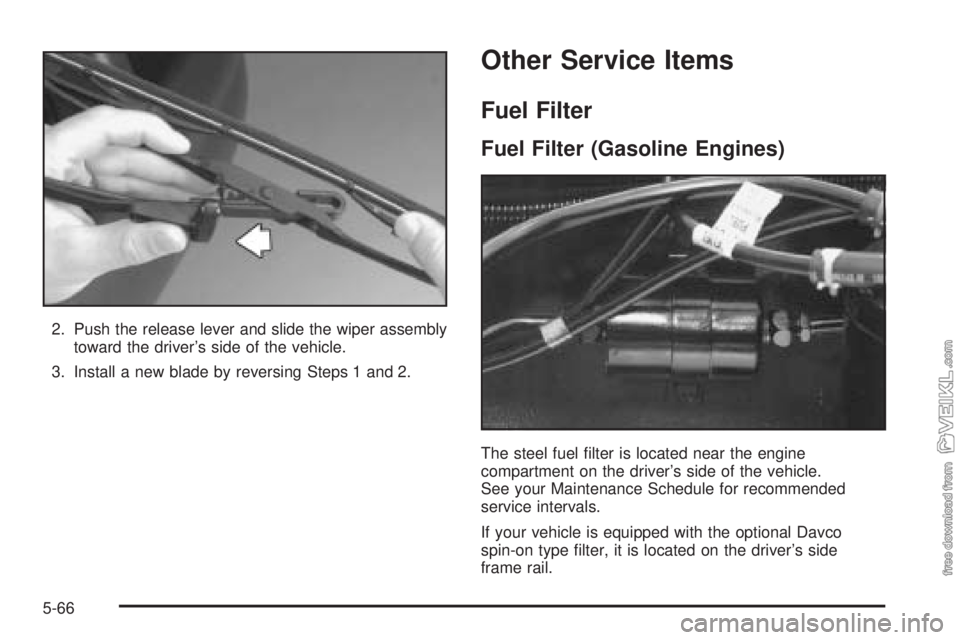
2. Push the release lever and slide the wiper assembly
toward the driver’s side of the vehicle.
3. Install a new blade by reversing Steps 1 and 2.
Other Service Items
Fuel Filter
Fuel Filter (Gasoline Engines)
The steel fuel filter is located near the engine
compartment on the driver’s side of the vehicle.
See your Maintenance Schedule for recommended
service intervals.
If your vehicle is equipped with the optional Davco
spin-on type filter, it is located on the driver’s side
frame rail.
5-66
Page 279 of 374
Fuel Filter (Diesel Engines)
If you have a diesel engine, your fuel filter is located in
the engine compartment on the driver’s side of the
vehicle, or along the driver’s side frame rail. SeeFuel
Filter Replacementearlier in this section for further
information.
Also seeScheduled Maintenance on page 6-5for
recommended service intervals.
Primary Fuel Filter and Water
Separator
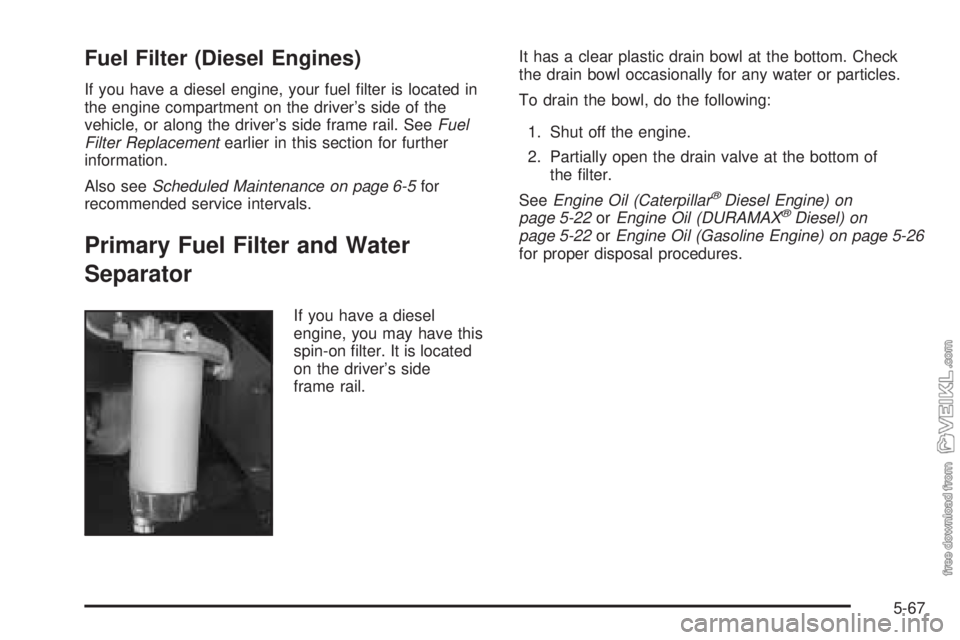
If you have a diesel
engine, you may have this
spin-on filter. It is located
on the driver’s side
frame rail.It has a clear plastic drain bowl at the bottom. Check
the drain bowl occasionally for any water or particles.
To drain the bowl, do the following:
1. Shut off the engine.
2. Partially open the drain valve at the bottom of
the filter.
SeeEngine Oil (Caterpillar
®Diesel Engine) on
page 5-22orEngine Oil (DURAMAX®Diesel) on
page 5-22orEngine Oil (Gasoline Engine) on page 5-26
for proper disposal procedures.
5-67
Page 281 of 374
6. Install a new gasket whenever you take out the
cylinder. Use only one gasket and spread a light
film of clean oil on it before installation.
7. Put in the new cylinder. Turn it clockwise until it just
starts to contact the gasket.
8. Tighten the cylinder another half turn (180 degrees).
Don’t over-tighten.
9. Retighten the cylinder clamp.
Front Wheel Bearings with
Oil-Filled Hubs
Notice:If you drive your vehicle through deep
water that is higher than the front or rear axle, water
may enter the axle housing and cause the axle
lubricant to break down. This could damage
the gears inside. Avoid driving your vehicle through
deep water.
You should avoid driving your vehicle through deep
puddles or standing water. If you must drive through
water that is higher than the front or rear axle, see your
dealer immediately afterward to have the condition of
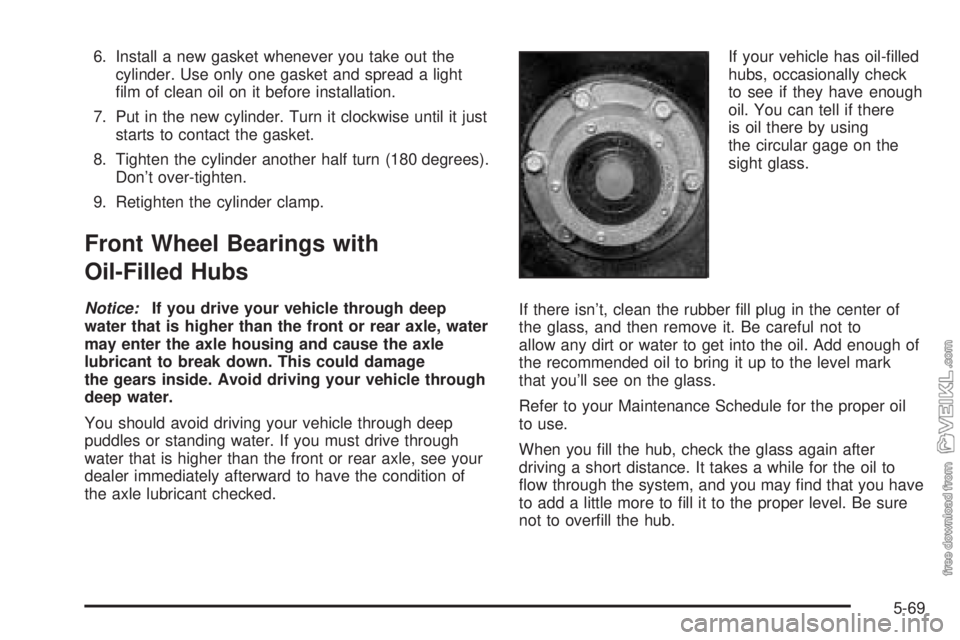
the axle lubricant checked.If your vehicle has oil-filled
hubs, occasionally check
to see if they have enough
oil. You can tell if there
is oil there by using
the circular gage on the
sight glass.
If there isn’t, clean the rubber fill plug in the center of
the glass, and then remove it. Be careful not to
allow any dirt or water to get into the oil. Add enough of
the recommended oil to bring it up to the level mark
that you’ll see on the glass.
Refer to your Maintenance Schedule for the proper oil
to use.
When you fill the hub, check the glass again after
driving a short distance. It takes a while for the oil to
flow through the system, and you may find that you have
to add a little more to fill it to the proper level. Be sure
not to overfill the hub.
5-69
Page 288 of 374
{CAUTION:
If wheel studs are damaged, they can break. If
all the studs on a wheel broke, the wheel could
come off and cause a crash. If any stud is
damaged because of a loose-running wheel, it
could be that all of the studs are damaged. To
be sure, replace all studs on the wheel. If the
stud holes in a wheel have become larger, the
wheel could collapse in operation. Replace any
wheel if its stud holes have become larger or
distorted in any way. Inspect hubs and
hub-piloted wheels for damage. Because of
loose running wheels, piloting pad damage may
occur and require replacement of the entire hub,
for proper centering of the wheels. When
replacing studs, hubs, wheel nuts or wheels, be
sure to use GM original equipment parts.
{CAUTION:
Rust or dirt on a wheel, or on the parts to
which it is fastened, can make wheel nuts
become loose after a time. The wheel could
come off and cause a crash. When you change
a wheel, remove any rust or dirt from places
where the wheel attaches to the vehicle. In an
emergency, you can use a cloth or a paper
towel to do this; but be sure to use a scraper
or wire brush later, if you need to, to get all the
rust or dirt off.
How Often to Check
Wheel tightness is so important you should have a
technician check nut tightness on all wheels with
a torque wrench after your first 100 miles (160 km), and
then 1,000 miles (1 600 km) after that. Be sure to
repeat this service whenever you have a tire removed
or serviced. SeeScheduled Maintenance on page 6-5
for further information.
5-76
Page 297 of 374
Tires
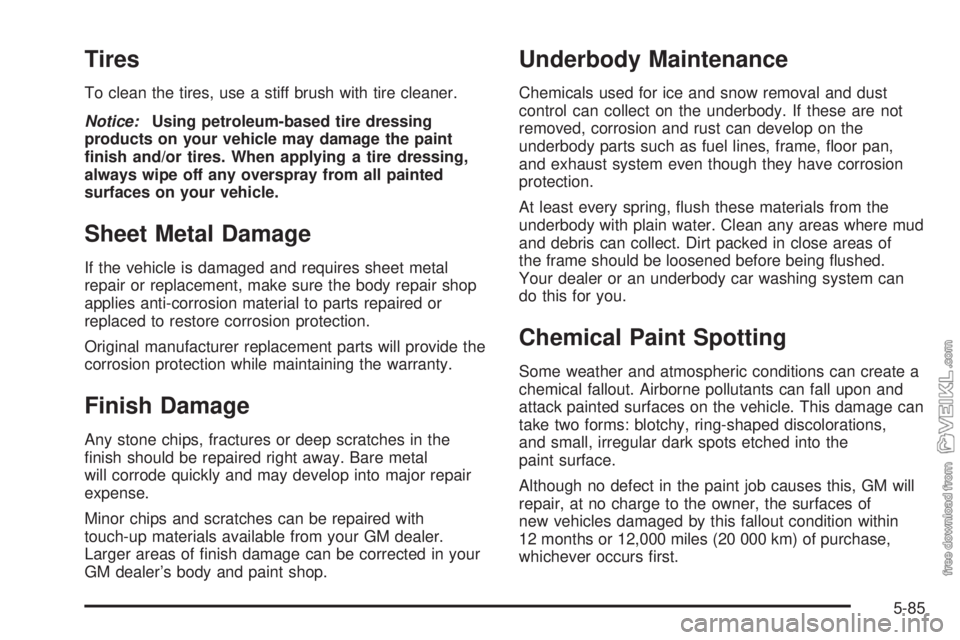
To clean the tires, use a stiff brush with tire cleaner.
Notice:Using petroleum-based tire dressing
products on your vehicle may damage the paint
nish and/or tires. When applying a tire dressing,
always wipe off any overspray from all painted
surfaces on your vehicle.
Sheet Metal Damage
If the vehicle is damaged and requires sheet metal
repair or replacement, make sure the body repair shop
applies anti-corrosion material to parts repaired or
replaced to restore corrosion protection.
Original manufacturer replacement parts will provide the
corrosion protection while maintaining the warranty.
Finish Damage
Any stone chips, fractures or deep scratches in the
finish should be repaired right away. Bare metal
will corrode quickly and may develop into major repair
expense.
Minor chips and scratches can be repaired with
touch-up materials available from your GM dealer.
Larger areas of finish damage can be corrected in your
GM dealer’s body and paint shop.
Underbody Maintenance
Chemicals used for ice and snow removal and dust
control can collect on the underbody. If these are not
removed, corrosion and rust can develop on the
underbody parts such as fuel lines, frame, floor pan,
and exhaust system even though they have corrosion
protection.
At least every spring, flush these materials from the
underbody with plain water. Clean any areas where mud
and debris can collect. Dirt packed in close areas of
the frame should be loosened before being flushed.
Your dealer or an underbody car washing system can
do this for you.
Chemical Paint Spotting
Some weather and atmospheric conditions can create a
chemical fallout. Airborne pollutants can fall upon and
attack painted surfaces on the vehicle. This damage can
take two forms: blotchy, ring-shaped discolorations,
and small, irregular dark spots etched into the
paint surface.
Although no defect in the paint job causes this, GM will
repair, at no charge to the owner, the surfaces of
new vehicles damaged by this fallout condition within
12 months or 12,000 miles (20 000 km) of purchase,
whichever occurs first.
5-85
Page 311 of 374
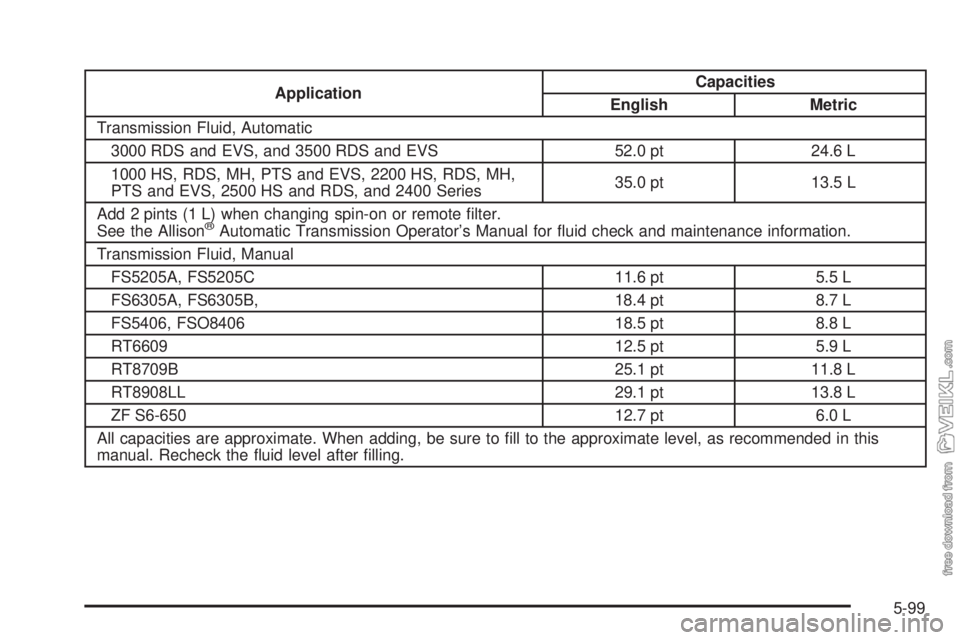
ApplicationCapacities
English Metric
Transmission Fluid, Automatic
3000 RDS and EVS, and 3500 RDS and EVS 52.0 pt 24.6 L
1000 HS, RDS, MH, PTS and EVS, 2200 HS, RDS, MH,
PTS and EVS, 2500 HS and RDS, and 2400 Series35.0 pt 13.5 L
Add 2 pints (1 L) when changing spin-on or remote filter.
See the Allison
®Automatic Transmission Operator’s Manual for fluid check and maintenance information.
Transmission Fluid, Manual
FS5205A, FS5205C 11.6 pt 5.5 L
FS6305A, FS6305B, 18.4 pt 8.7 L
FS5406, FSO8406 18.5 pt 8.8 L
RT6609 12.5 pt 5.9 L
RT8709B 25.1 pt 11.8 L
RT8908LL 29.1 pt 13.8 L
ZF S6-650 12.7 pt 6.0 L
All capacities are approximate. When adding, be sure to fill to the approximate level, as recommended in this
manual. Recheck the fluid level after filling.
5-99
Page 312 of 374
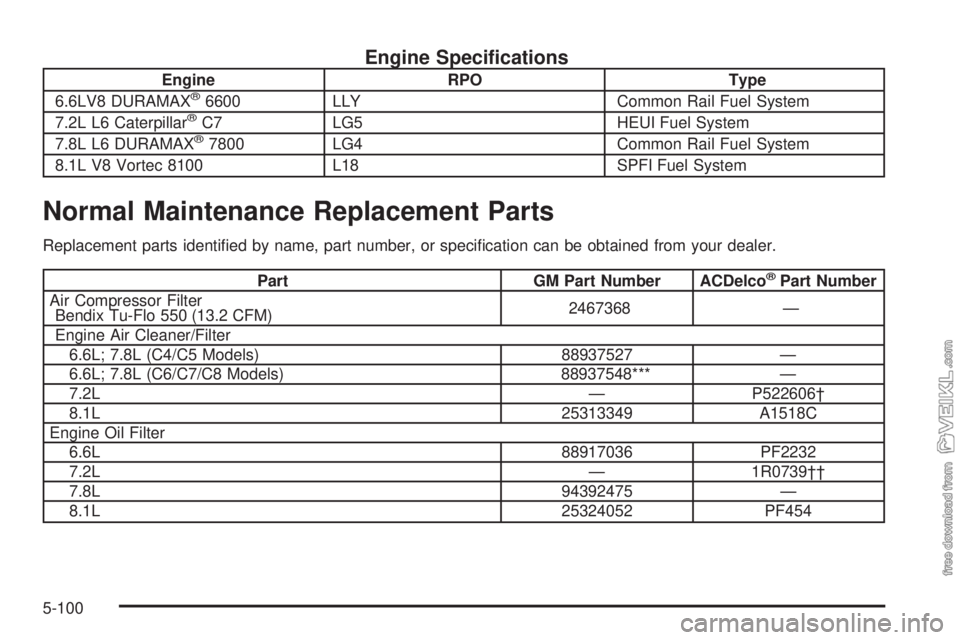
Engine Specications
Engine RPO Type
6.6LV8 DURAMAX®6600 LLY Common Rail Fuel System
7.2L L6 Caterpillar®C7 LG5 HEUI Fuel System
7.8L L6 DURAMAX®7800 LG4 Common Rail Fuel System
8.1L V8 Vortec 8100 L18 SPFI Fuel System
Normal Maintenance Replacement Parts
Replacement parts identified by name, part number, or specification can be obtained from your dealer.
Part GM Part Number ACDelco®Part Number
Air Compressor Filter
Bendix Tu-Flo 550 (13.2 CFM)2467368 —
Engine Air Cleaner/Filter
6.6L; 7.8L (C4/C5 Models) 88937527 —
6.6L; 7.8L (C6/C7/C8 Models) 88937548*** —
7.2L — P522606†
8.1L 25313349 A1518C
Engine Oil Filter
6.6L 88917036 PF2232
7.2L — 1R0739††
7.8L 94392475 —
8.1L 25324052 PF454
5-100
Page 315 of 374
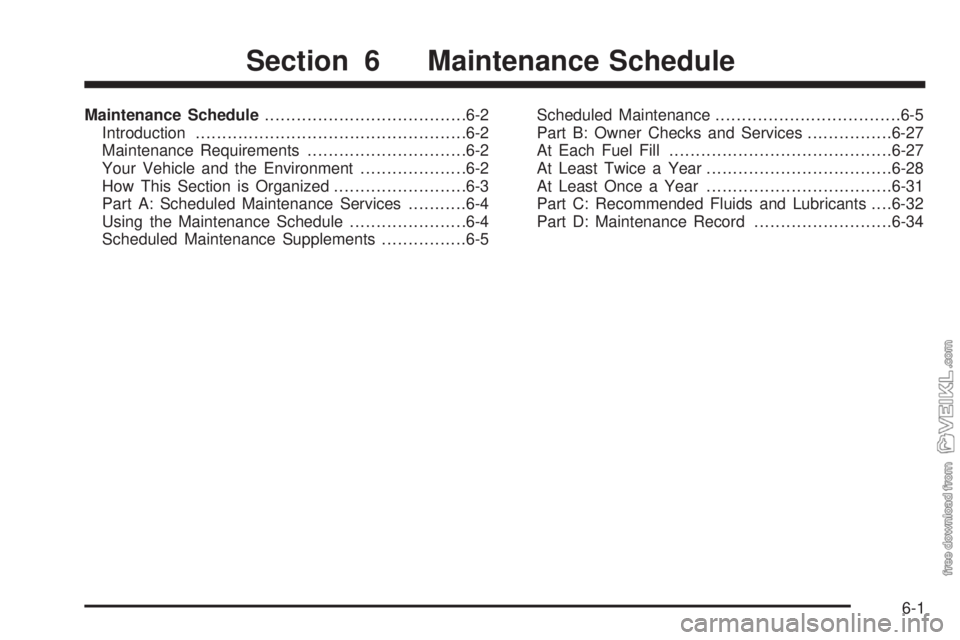
Maintenance Schedule......................................6-2
Introduction...................................................6-2
Maintenance Requirements..............................6-2
Your Vehicle and the Environment....................6-2
How This Section is Organized.........................6-3
Part A: Scheduled Maintenance Services...........6-4
Using the Maintenance Schedule......................6-4
Scheduled Maintenance Supplements................6-5Scheduled Maintenance...................................6-5
Part B: Owner Checks and Services................6-27
At Each Fuel Fill..........................................6-27
At Least Twice a Year...................................6-28
At Least Once a Year...................................6-31
Part C: Recommended Fluids and Lubricants. . . .6-32
Part D: Maintenance Record..........................6-34
Section 6 Maintenance Schedule
6-1
Page 316 of 374
Maintenance Schedule
Introduction
Important: Keep engine oil at the proper level and
change as recommended.
Have you purchased the GM Protection Plan? The Plan
supplements your new vehicle warranties. See your
Warranty and Owner Assistance booklet or your dealer
for details.
Maintenance Requirements
Maintenance intervals, checks, inspections and
recommended fluids and lubricants as prescribed in this
manual are necessary to keep your vehicle in good
working condition. Any damage caused by failure
to follow scheduled maintenance may not be
covered by warranty.
Your Vehicle and the Environment
Proper vehicle maintenance not only helps to keep your
vehicle in good working condition, but also helps the
environment. Improper vehicle maintenance can
even affect the quality of the air we breathe. Improper
fluid levels or the wrong tire inflation can increase
the level of emissions from your vehicle. To help protect
our environment, and to keep your vehicle in good
condition, be sure to maintain your vehicle properly.
6-2
Page 317 of 374
How This Section is Organized
This maintenance schedule is divided into four parts:
“Part A: Scheduled Maintenance Services”explains
what to have done and how often. Some of these
services can be complex, so unless you are technically
qualified and have the necessary equipment, you
should let your GM dealer’s service department do
these jobs.
Your GM dealer has GM-trained and supported
service people that will perform the work using
genuine GM parts.
{CAUTION:
Performing maintenance work on a vehicle can
be dangerous. In trying to do some jobs, you
can be seriously injured. Do your own
maintenance work only if you have the
required know-how and the proper tools and
equipment for the job. If you have any doubt,
have a qualied technician do the work.
If you want to purchase service information, seeService
Publications Ordering Information on page 7-8.“Part B: Owner Checks and Services”tells you what
should be checked and when. It also explains what
you can easily do to keep your vehicle in good condition.
“Part C: Recommended Fluids and Lubricants”
lists some recommended products necessary to help
keep your vehicle properly maintained. These products,
or their equivalents, should be used whether you do
the work yourself or have it done.
“Part D: Maintenance Record”is a place for you to
record and keep track of the maintenance performed on
your vehicle. Keep your maintenance receipts. They
may be needed to qualify your vehicle for warranty
repairs.
6-3