towing CHEVROLET KODIAK 2007 User Guide
[x] Cancel search | Manufacturer: CHEVROLET, Model Year: 2007, Model line: KODIAK, Model: CHEVROLET KODIAK 2007Pages: 430, PDF Size: 6.06 MB
Page 241 of 430
Towing
Towing Your Vehicle
Consult your dealer or a professional towing service
if you need to have your disabled vehicle towed.
SeeRoadside Assistance Program on page 408.
Releasing Air-Operated Parking Brakes
If your vehicle has air brakes, you could have a
special towing problem. If your vehicle has to
be towed because of a complete loss of air
pressure from both systems, the parking brakes
will have automatically engaged. The tow operator
can release the brakes manually by using the
following steps. Then your vehicle can be towed
with all wheels or only the rear wheels on
the ground.
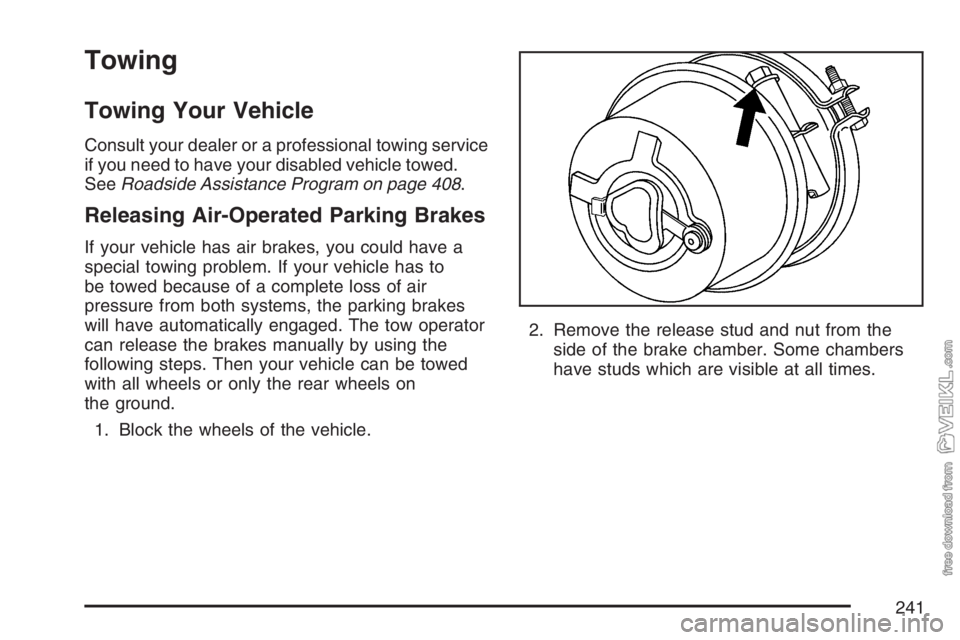
1. Block the wheels of the vehicle.2. Remove the release stud and nut from the
side of the brake chamber. Some chambers
have studs which are visible at all times.
241
Page 243 of 430
Trailer Connections
Heavy-Duty Trailer Wiring Package
Your vehicle may be equipped with an eight-wire
trailer towing harness. This harness, with a
seven-pin universal heavy-duty trailer connector,
is attached to a bracket on the platform hitch.
The Center High-Mounted Stoplamp (CHMSL)
wire is tied next to the trailer wiring harness for
use with a trailer.
The eight-wire harness contains the following
trailer circuits:
•Yellow: Left Stop/Turn Signal
•Dark Green: Right Stop/Turn Signal
•Brown: Taillamps
•White: Ground
•Light Green: Back-up Lamps
•Light Blue: CHMSL
•Red: Battery Feed
•Dark Blue: Trailer Brake
Trailer Connections
(C7/C8 Models Only)
If your vehicle has these trailer connections, they
are located at the rear of the cab for a tractor
and at the rear of the chassis when towing
a trailer. There will be an air connection and an
electrical connection.
Be sure that the couplings to the trailer are
made correctly.
Air Connections
If you are not connecting the trailer air line
connections to another piece of equipment,
be sure to replace their protective caps.
Electrical Connections
This system is a seven-wire cable that will
connect to the trailer, supplying power to the
trailer’s lighting system. When not in use, it
is stored in the trailer air-hose storage bracket.
243
Page 294 of 430
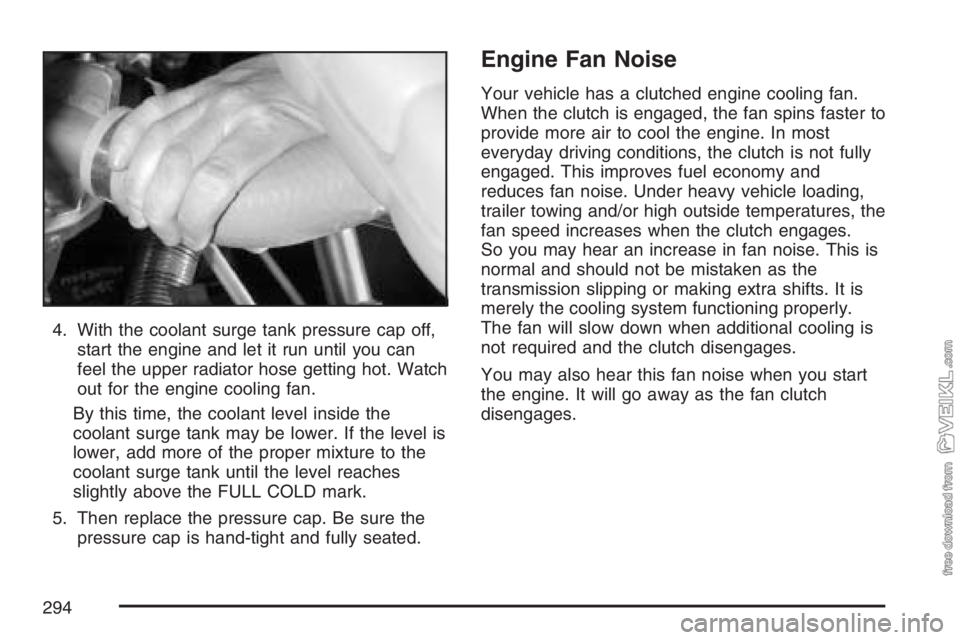
4. With the coolant surge tank pressure cap off,
start the engine and let it run until you can
feel the upper radiator hose getting hot. Watch
out for the engine cooling fan.
By this time, the coolant level inside the
coolant surge tank may be lower. If the level is
lower, add more of the proper mixture to the
coolant surge tank until the level reaches
slightly above the FULL COLD mark.
5. Then replace the pressure cap. Be sure the
pressure cap is hand-tight and fully seated.
Engine Fan Noise
Your vehicle has a clutched engine cooling fan.
When the clutch is engaged, the fan spins faster to
provide more air to cool the engine. In most
everyday driving conditions, the clutch is not fully
engaged. This improves fuel economy and
reduces fan noise. Under heavy vehicle loading,
trailer towing and/or high outside temperatures, the
fan speed increases when the clutch engages.
So you may hear an increase in fan noise. This is
normal and should not be mistaken as the
transmission slipping or making extra shifts. It is
merely the cooling system functioning properly.
The fan will slow down when additional cooling is
not required and the clutch disengages.
You may also hear this fan noise when you start
the engine. It will go away as the fan clutch
disengages.
294
Page 408 of 430
Roadside Assistance Program
GM Medium Duty Truck’s Roadside Assistance
provides stranded owners with towing service
for disabled vehicles.
This service combines the efforts of trained
telephone representatives with a network of
GM Medium Duty Truck’s dealer services.
Just dial GM Medium Duty Truck Roadside
Assistance at1-800-862-4389to reach a qualified
representative who can assist you in a repair or
arrange a tow. Other recommended services
can also be arranged for situations such as
retrieving locked in keys, changing a tire, or
delivering gasoline, at a charge to the customer.
We also provide dealer information at no
charge, such as location of the nearest authorized
medium duty GM Truck dealer and their hours
of operation.Roadside Assistance is available 24 hours a day,
7 days a week, 365 days a year. Should you
have any questions about Roadside Assistance,
call the GM Medium Duty Truck Roadside
Assistance Center or contact your dealer.
Canadian Roadside Assistance
In Canada, Medium Duty trucks are not eligible
for Roadside Assistance services. However,
owners/operators who contact Roadside
Assistance by calling1-800-268-6800may have
a tow arranged for them at the owner/operator
expense.
If a Medium Duty truck is towed to the nearest
General Motors dealership and the towing
was necessary due to failure of a warranted part,
the dealer will accept the towing charges and
submit them as part of the warranty claim.
408
Page 412 of 430
If an Accident Occurs
Here is what to do if you are involved in an
accident.
•Try to relax and then check to make sure you
are all right. If you are uninjured, make sure
that no one else in your vehicle, or the
other vehicle, is injured.
•If there has been an injury, call 911 for help.
Do not leave the scene of an accident until all
matters have been taken care of. Move your
vehicle only if its position puts you in danger or
you are instructed to move it by a police officer.
•Give only the necessary and requested
information to police and other parties involved
in the accident. Do not discuss your personal
condition, mental frame of mind, or anything
unrelated to the accident. This will help guard
against post-accident legal action.
•If you need roadside assistance, call GM
Roadside Assistance. SeeRoadside
Assistance Program on page 408for more
information.
•If your vehicle cannot be driven, know where
the towing service will be taking it. Get a card
from the tow truck operator or write down the
driver’s name, the service’s name, and the
phone number.
•Remove any valuables from your vehicle before
it is towed away. Make sure this includes your
insurance information and registration if you
keep these items in your vehicle.
•Gather the important information you will need
from the other driver. Things like name,
address, phone number, driver’s license
number, vehicle license plate, vehicle make,
model and model year, Vehicle Identification
Number (VIN), insurance company and policy
number, and a general description of the
damage to the other vehicle.
•If possible, call your insurance company from
the scene of the accident. They will walk you
through the information they will need. If they
ask for a police report, phone or go to the police
department headquarters the next day and you
can get a copy of the report for a nominal fee.
412
Page 429 of 430
Tires (cont.)
Wheel Loading......................................... 323
Wheel Replacement................................. 328
When It Is Time for New Tires................. 324
Tow Hooks.................................................. 237
Towing
Your Vehicle............................................. 241
Traction
Control System (TCS).............................. 216
Trailer
Connections............................................. 243
Trailer Brake Hand Control Valve................ 214
Transmission
Fluid, Automatic....................................... 282
Fluid, Manual........................................... 283
Service Warning Light.............................. 168
Temperature Gage................................... 178
Transmission Operation, Automatic.............. 115
Transmission Operation, Manual.................. 116
Trip Odometer............................................. 163
Turn and Lane-Change Signals................... 144
Turn Signal/Multifunction Lever.................... 143
Two-Speed Rear Axle Electric Shift Control . 113U
Understanding Radio Reception................... 201
V
Vehicle
Control..................................................... 210
Damage Warnings....................................... 5
Loading.................................................... 238
Symbols...................................................... 5
Vehicle Data Collection and Event Data
Recorders................................................ 409
Vehicle Identification
Number (VIN).......................................... 340
Service Parts Identification Label.............. 340
Ventilation Adjustment.................................. 160
Visors........................................................... 95
Voltmeter Gage........................................... 168
429