wheel CHEVROLET KODIAK 2007 User Guide
[x] Cancel search | Manufacturer: CHEVROLET, Model Year: 2007, Model line: KODIAK, Model: CHEVROLET KODIAK 2007Pages: 430, PDF Size: 6.06 MB
Page 98 of 430
Starter Motor Operation
•The starter motor will disengage if you release
the key or the engine reaches a predetermined
engine speed.
•To prevent overheating, the starter motor will
disengage after continuously operating for
15 seconds. You must release the key
from the start position to re-engage the starter.
•The starter motor will not engage if the engine
is already running.
•The starter motor will disengage if, after
two seconds, the starter pinion gear does not
engage the flywheel or there is no engine
rpm signal from the engine speed sensor.
Starting Your Engine
1. Without pushing the accelerator pedal, turn
your ignition key to START. When the
engine starts, let go of the key. The idle speed
will go down as your engine gets warm.2. If the engine does not start in 10 seconds,
push the accelerator pedal all the way down
and crank the engine for five more seconds,
unless it starts sooner.
3. If your engine still will not start, or starts but
then stops, it could be flooded with too much
gasoline.
Wait 15 seconds to let the starter motor cool
down. Do Steps 1 through 3 again.
When the engine starts, let go of the key and
the accelerator pedal.
Notice:Your engine is designed to work with
the electronics in your vehicle. If you add
electrical parts or accessories, you could
change the way the engine operates. Before
adding electrical equipment, check with your
dealer. If you do not, your engine might not
perform properly. Any resulting damage would
not be covered by your vehicle’s warranty.
If you ever need to have your vehicle towed, see
Towing Your Vehicle on page 241.
98
Page 119 of 430
Four-Wheel Drive
If your vehicle has four-wheel drive, you can send
the engine’s driving power to all four wheels for
extra traction. To get the most satisfaction
out of four-wheel drive, you must be familiar with
its operation. Read the part that follows before
using four-wheel drive. You should use two-wheel
drive high for most normal driving conditions.
Notice:Driving on clean, dry pavement
in four-wheel drive for an extended period of
time can cause premature wear on your
vehicle’s powertrain. Do not drive on clean,
dry pavement in four-wheel drive for extended
periods of time.
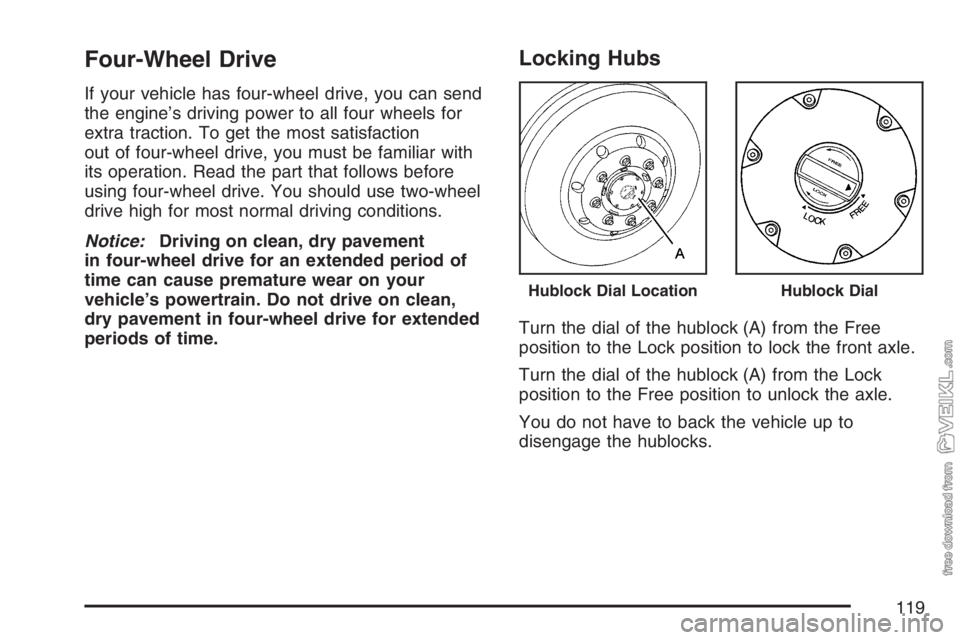
Locking Hubs
Turn the dial of the hublock (A) from the Free
position to the Lock position to lock the front axle.
Turn the dial of the hublock (A) from the Lock
position to the Free position to unlock the axle.
You do not have to back the vehicle up to
disengage the hublocks.
Hublock Dial LocationHublock Dial
119
Page 120 of 430
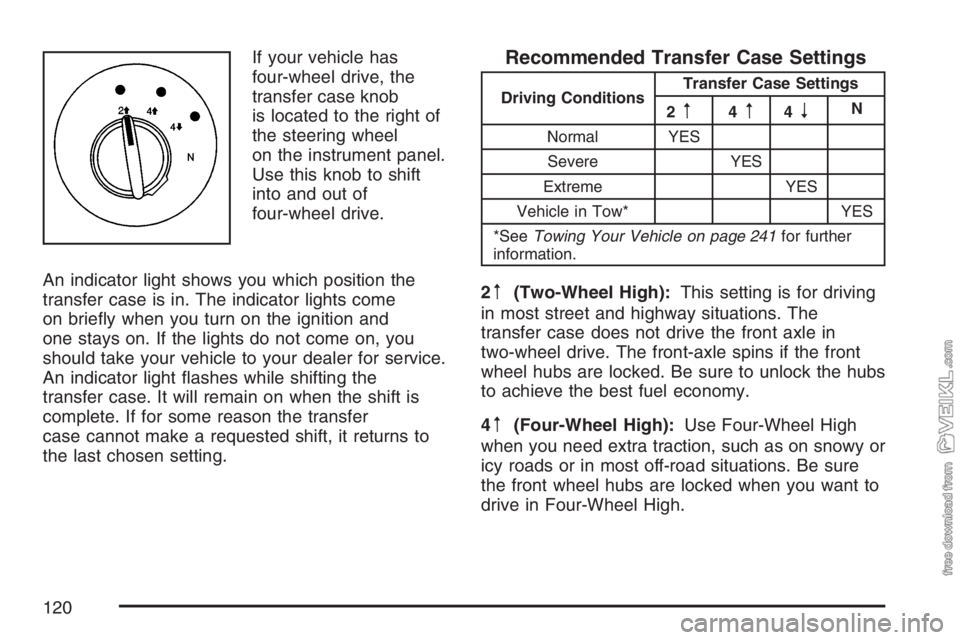
If your vehicle has
four-wheel drive, the
transfer case knob
is located to the right of
the steering wheel
on the instrument panel.
Use this knob to shift
into and out of
four-wheel drive.
An indicator light shows you which position the
transfer case is in. The indicator lights come
on briefly when you turn on the ignition and
one stays on. If the lights do not come on, you
should take your vehicle to your dealer for service.
An indicator light flashes while shifting the
transfer case. It will remain on when the shift is
complete. If for some reason the transfer
case cannot make a requested shift, it returns to
the last chosen setting.Recommended Transfer Case Settings
Driving ConditionsTransfer Case Settings
2m4m4nN
Normal YES
Severe YES
Extreme YES
Vehicle in Tow* YES
*SeeTowing Your Vehicle on page 241for further
information.
2m(Two-Wheel High):This setting is for driving
in most street and highway situations. The
transfer case does not drive the front axle in
two-wheel drive. The front-axle spins if the front
wheel hubs are locked. Be sure to unlock the hubs
to achieve the best fuel economy.
4
m(Four-Wheel High):Use Four-Wheel High
when you need extra traction, such as on snowy or
icy roads or in most off-road situations. Be sure
the front wheel hubs are locked when you want to
drive in Four-Wheel High.
120
Page 121 of 430
4n(Four-Wheel Low):This setting sends
maximum power to all four wheels. You might
choose Four-Wheel Low if you are driving off-road
in deep sand, deep mud, and climbing or
descending steep hills. Be sure the front wheel
hubs are locked when you want to drive in
Four-Wheel Low.
{CAUTION:
Shifting the transfer case to NEUTRAL
can cause your vehicle to roll even if the
transmission is in PARK (P). You or
someone else could be injured. If you are
going to leave your vehicle, set the
parking brake and shift the transmission
to PARK (P) and make sure the transfer
case is in a drive gear.Notice:If your vehicle has an Allison
®
transmission and you try to put the
transmission in PARK (P) while the transfer
case is in Four-Wheel Low, the transmission
might not go into PARK (P) and could damage
your vehicle. When parking your vehicle,
make sure the transfer case is in Two-Wheel
High or Four-Wheel High.
NEUTRAL:Shift the vehicle’s transfer case to
NEUTRAL only when towing your vehicle.
Shifting Into Four-Wheel High
Turn the knob to four-wheel high. This can be
done at 3 mph or less, while you are shifting out
of Four-Wheel Low. The indicator light flashes
while shifting. It remains on after the shift is
complete. Be sure to lock your front hubs.
121
Page 122 of 430
Shifting Into Two-Wheel High
Turn the knob to Two-Wheel High. This can be
done at 3 mph or less, while you are shifting out of
Four-Wheel Low.
Shifting Into Four-Wheel Low
To shift to Four-Wheel Low, the vehicle’s engine
must be running and the vehicle must be stopped
or moving less than 3 mph (5 km/h) with the
transmission in NEUTRAL (N). The preferred
method for shifting into Four-Wheel Low is to have
your vehicle moving 1 or 2 mph (1.6 to 3.2 km/h).
Turn the knob to Four-Wheel Low. You must
wait for the Four-Wheel Low indicator light to stop
flashing and remain on before shifting the
transmission into gear. Be sure to lock the
front hubs.Notice:Shifting the transmission into gear
before the Four-Wheel Drive Low indicator light
has stopped ashing could damage the
transfer case. To help avoid damaging your
vehicle, always wait for the Four-Wheel
Drive Low indicator light to stop ashing
before shifting the transmission into gear.
If you turn the knob to Four-Wheel Low while your
vehicle is in gear and/or moving, the Four-Wheel
Low indicator light flashes for 30 seconds and
does not complete the shift unless your vehicle is
moving less than 3 mph (4.8 km/h) and the
transmission is in NEUTRAL (N). After 30 seconds,
the transfer case returns to the setting last
chosen. If your vehicle is in gear and moving less
than 3 mph (4.8 km/h), the transfer case shifts
to Four-Wheel High.
122
Page 123 of 430
Shifting Out of Four-Wheel Low
To shift from Four-Wheel Low to Four-Wheel High
or Two-Wheel High, your vehicle must be
stopped or moving less than 3 mph (5 km/h) with
the transmission in NEUTRAL (N) and the
engine running. The preferred method for shifting
out of Four-Wheel Low is to have your vehicle
moving 1 or 2 mph (1.6 to 3.2 km/h). Turn the knob
to Four-Wheel High or Two-Wheel High. You
must wait for the Four-Wheel High or Two-Wheel
High indicator light to stop flashing and remain
on before shifting the transmission into gear.
Notice:Shifting the transmission into gear
before the Four-Wheel High or Two-Wheel High
indicator light has stopped ashing could
damage the transfer case. To help avoid
damaging your vehicle, always wait for the
Four-Wheel High or Two-Wheel High indicator
light to stop ashing before shifting the
transmission into gear.
If the knob is turned to Four-Wheel High or
Two-Wheel High while your vehicle is in gear and/or
moving, the Four-Wheel High or Two-Wheel high
indicator light flashes for 30 seconds. It will not
complete the shift unless your vehicle is moving
less than 3 mph (5 km/h) with the transmission in
NEUTRAL (N).
Shifting Into NEUTRAL
Before shifting the transfer case to NEUTRAL, first
make sure the vehicle is parked so that it will
not roll.
1. Set the parking brake.
2. Start the vehicle.
3. Put the transmission in NEUTRAL (N).
4. Shift the transfer case to Two-Wheel High.
5. Turn the transfer case knob all of the way past
Four-Wheel Low and hold it there for a
minimum of 10 seconds. The NEUTRAL
indicator light comes on.
6. Shift the transmission to REVERSE (R) for
one second, then shift the transmission to
DRIVE (D) for one second.
7. Turn the ignition to OFF.
8. Place the transmission shift lever in
PARK. (P).
9. Turn the ignition to LOCK.
123
Page 124 of 430
Shifting Out of NEUTRAL
To shift the transfer case out of NEUTRAL, do the
following:
1. Set the parking brake and apply the regular
brake pedal.
2. Turn the ignition to RUN with the engine off.
3. Put the transmission in NEUTRAL (N).
4. Turn the transfer case knob to the desired
shift position (Two-Wheel High, Four-Wheel
High, Four-Wheel Low).
5. After the transfer case has shifted out of
NEUTRAL, the indicator light goes out.Notice:Driving with the parking brake on can
overheat the brake system and cause
premature wear or damage to brake system
parts. Verify that the parking brake is fully
released and the brake warning light is
off before driving.
6. Release the parking brake.
7. Start the engine and shift the transmission
lever to the desired position.
Excessively shifting the transfer case into or out of
the different modes can cause the transfer case
to enter the shift protection mode. This protects the
transfer case from possible damage and only
allows the transfer case to respond to one shift per
10 seconds. The transfer case can stay in this
mode for up to three minutes.
124
Page 137 of 430
Instrument Panel Overview........................ 140
Hazard Warning Flashers.......................... 142
Other Warning Devices............................. 142
Horn.......................................................... 142
Tilt Wheel.................................................. 142
Turn Signal/Multifunction Lever.................. 143
Turn and Lane-Change Signals................. 144
Headlamp High/Low-Beam Changer.......... 144
Windshield Wipers..................................... 145
Windshield Washer.................................... 146
Cruise Control........................................... 146
Exterior Lamps.......................................... 150
Headlamps on Reminder........................... 150
Daytime Running Lamps (DRL)................. 151
Marker Lamps........................................... 152
Instrument Panel Brightness...................... 152
Dome Lamps............................................. 153
Entry Lighting............................................ 154
Reading Lamps......................................... 154
Instrument Panel Switchbank..................... 154
Accessory Power Outlet(s)........................ 156
Ashtray(s) and Cigarette Lighter................ 157Climate Controls......................................... 157
Climate Control System............................. 157
Outlet Adjustment...................................... 160
Rear Heating System................................ 161
Warning Lights, Gages, and Indicators..... 161
Instrument Panel Cluster........................... 162
Speedometer and Odometer...................... 163
Trip Odometer........................................... 163
Tachometer............................................... 163
Engine Speed Limiter................................ 164
Safety Belt Reminder Light........................ 164
Safety Belt Reminder Tone....................... 164
Airbag Readiness Light............................. 165
Airbag Off Light......................................... 166
Charging System Light.............................. 167
Voltmeter Gage......................................... 168
Service Transmission Warning Light.......... 168
Range Inhibit Warning Indicator................. 169
Brake System Warning Light..................... 169
Anti-Lock Brake System Warning Light...... 172
Trailer Anti-Lock Brake System
Warning Light........................................ 172
Section 3 Instrument Panel
137
Page 141 of 430
A. Air Outlets. SeeOutlet Adjustment on
page 160.
B. Instrument Panel Cluster. SeeInstrument
Panel Cluster on page 162.
C. Shift Lever. SeeAutomatic Transmission
Operation on page 115orManual Transmission
Operation on page 116.
D. Air Brake Controls. SeeParking Brake (With
Hydraulic Brakes) on page 125orParking
Brake (with Air Brakes) on page 126.
E. Transfer Case Controls (If Equipped). See
Four-Wheel Drive on page 119. Air Filter Gage
(If Equipped). SeeAir Filter Restriction
Indicator on page 182.
F. Auxiliary Gages. SeeWarning Lights, Gages,
and Indicators on page 161.
G. Exterior Lamp Control. SeeExterior Lamps on
page 150.H. Turn Signal/Multifunction Lever. SeeTurn
Signal/Multifunction Lever on page 143.
I. Hazard Warning Flashers Button. SeeHazard
Warning Flashers on page 142.
J. Audio System(s). SeeAudio System(s) on
page 184.
K. Climate Controls. SeeClimate Control System
on page 157.
L. Instrument Panel Switchbank. SeeInstrument
Panel Switchbank on page 154.
M. Airbag Off Switch. SeeAirbag Off Switch on
page 76.
N. Accessory Power Outlets. SeeAccessory
Power Outlet(s) on page 156.
141
Page 142 of 430
Hazard Warning Flashers
The hazard warning flashers warn others. They
also let police know you have a problem.
Your front and rear turn signal lamps will flash
on and off.
The hazard warning
flasher button is located
on top of the steering
column.
The hazard warning flashers work no matter what
ignition position the key is in, and even if the
key is not in the ignition.
Press the button to make the front and rear turn
signal lamps flash on and off. Press the button
again to turn the flashers off.
When the hazard warning flashers are on, your
turn signals will not work.
Other Warning Devices
If you carry reflective triangles, you can set them up
at the side of the road about 300 feet (100 m)
behind your vehicle.
Horn
Sound the horn by pushing the center of the
steering wheel. If you have the optional air horn, it is
controlled by a cord that you will find up above and
to the left of the driver. The harder you pull on the
cord, the louder the air horn will sound. The air horn
works only after your air brake system pressure
gets up to about 115 psi (790 kPa). The air horn will
work properly unless the air brake system pressure
drops below 60 psi (415 kPa).
Tilt Wheel
A tilt wheel allows you to adjust the steering wheel
before you drive. You can raise it to the highest
level to give your legs more room when you
exit and enter the vehicle.
142