wheel CHEVROLET KODIAK 2007 Workshop Manual
[x] Cancel search | Manufacturer: CHEVROLET, Model Year: 2007, Model line: KODIAK, Model: CHEVROLET KODIAK 2007Pages: 430, PDF Size: 6.06 MB
Page 323 of 430
Wheel Loading
Wheels are stamped with a maximum load and
cold inflation rating. Be sure you do not exceed
these limits. If you ever think you need to exceed
these limits, first contact the rim and wheel
maker to get their advice.
Dual Tire Operation
When the vehicle is new, check the wheel nut
tightness on all wheels with a torque wrench after
your first 100 miles (160 km) and then 1,000 miles
(1 600 km) after that. Whenever a wheel, wheel
bolt or wheel nut is removed or serviced,
repeat the 100 miles (160 km), and then 1,000 mile
(1 600 km) wheel nut tightness check.SeeTightening the Wheel Nuts on page 325for
wheel nut tightening information and proper
torque values.
{CAUTION:
If you operate your vehicle with a tire that
is badly underinated, the tire can
overheat. An overheated tire can lose air
suddenly or catch re. You or others could
be injured. Be sure all tires (including the
spare, if any) are properly inated.
SeeTires on page 321andInation - Tire
Pressure on page 322for more information on
proper tire inflation.
323
Page 324 of 430
When It Is Time for New Tires
Replace your tires when the tread depth is down
to 1/8 of an inch (3.2 mm) for the front tires,
or 1/16 of an inch (1.6 mm) for a rear tire. Also,
you need a new tire if:
•You can see cord or fabric showing through
the tire’s rubber.
•The tread or sidewall is cracked, cut or
snagged deep enough to show cord or fabric.
•The tire has a bump, bulge or split.
•The tire has a puncture, cut or other damage
that cannot be repaired well because of the
size or location of the damage.
{CAUTION:
Mixing tires could cause you to lose
control while driving. If you mix tires of
different types — like radial and
bias-belted tires — the vehicle may not
handle properly, and you could have a
crash. Be sure to use the same type of
tires all around.When you replace tires, make sure they are the
same size, load range, speed rating and
construction type (bias, bias-belted or radial) as
your original tires.
If your vehicle has four-wheel drive, the axle
differentials, propshafts and transfer case may be
damaged if tires of different sizes, brands or
tread types are installed on the front and rear
axles. That damage would not be covered under
your warranty.
Wheel Alignment and Tire Balance
The wheels on your vehicle were aligned at
the factory to give you the longest tire life and
best overall performance.
Proper front wheel alignment must be maintained
in order to ensure efficient steering, good
directional stability, and prevent abnormal tire
wear. If you notice unusual tire wear or your
vehicle is pulling one way or the other, the
alignment may need to be reset. If you notice your
vehicle vibrating when driving on a smooth
road, your wheels may need to be balanced.
324
Page 325 of 430
Tightening the Wheel Nuts
{CAUTION:
Wheel nuts that are not tight can work
loose. If all the nuts on a wheel come off,
the wheel can come off the vehicle,
causing a crash. All wheel nuts must be
properly tightened. Follow the rules in this
section to be sure they are.
This section lets you know how often to check the
tightness of the wheel nuts on your vehicle and
how tight they must be.
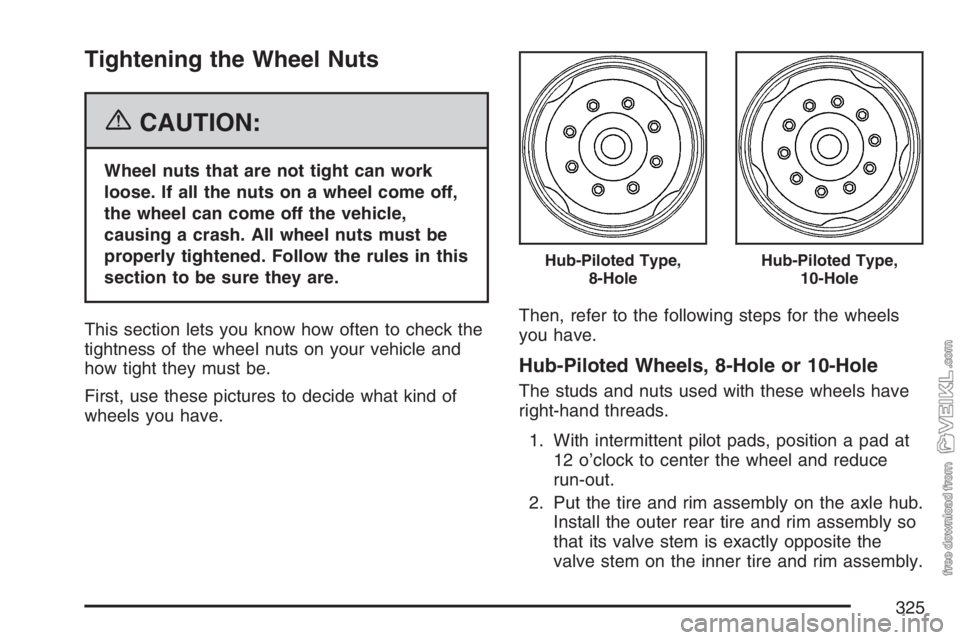
First, use these pictures to decide what kind of
wheels you have.Then, refer to the following steps for the wheels
you have.
Hub-Piloted Wheels, 8-Hole or 10-Hole
The studs and nuts used with these wheels have
right-hand threads.
1. With intermittent pilot pads, position a pad at
12 o’clock to center the wheel and reduce
run-out.
2. Put the tire and rim assembly on the axle hub.
Install the outer rear tire and rim assembly so
that its valve stem is exactly opposite the
valve stem on the inner tire and rim assembly.
Hub-Piloted Type,
8-HoleHub-Piloted Type,
10-Hole
325
Page 326 of 430
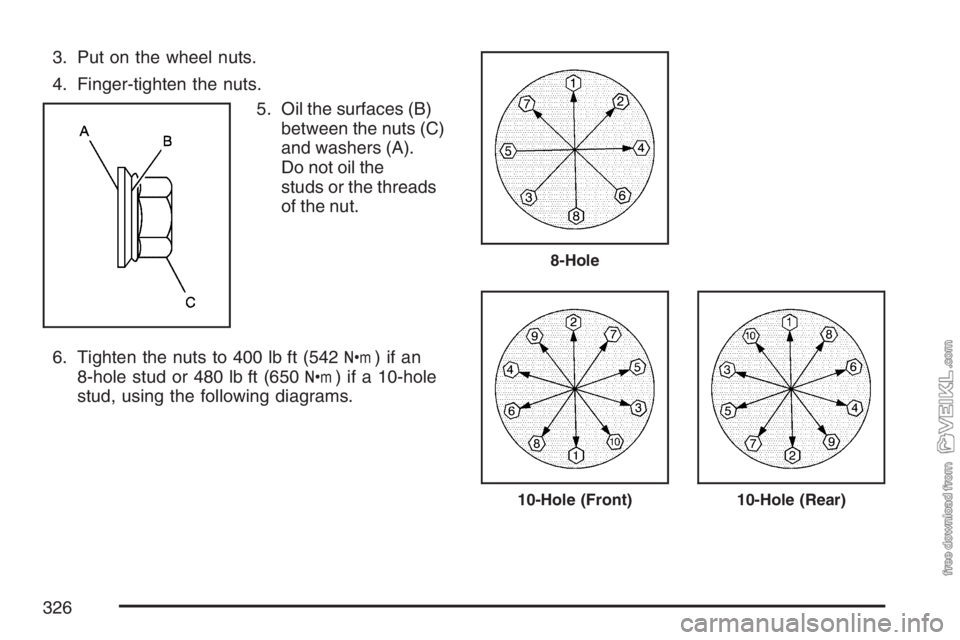
3. Put on the wheel nuts.
4. Finger-tighten the nuts.
5. Oil the surfaces (B)
between the nuts (C)
and washers (A).
Do not oil the
studs or the threads
of the nut.
6. Tighten the nuts to 400 lb ft (542
Y)ifan
8-hole stud or 480 lb ft (650
Y) if a 10-hole
stud, using the following diagrams.
8-Hole
10-Hole (Front)10-Hole (Rear)
326
Page 327 of 430
{CAUTION:
Never use oil or grease on studs or the
threads of the wheel nuts. If you do, the
wheel nuts might come loose and the
wheel could fall off, causing a crash.
{CAUTION:
If wheel studs are damaged, they can
break. If all the studs on a wheel broke, the
wheel could come off and cause a crash. If
any stud is damaged because of a
loose-running wheel, it could be that all of
the studs are damaged. To be sure, replace
all studs on the wheel. If the stud holes in a
wheel have become larger, the wheel could
collapse in operation. Replace any wheel if
its stud holes have become larger or
distorted in any way. Inspect hubs and
CAUTION: (Continued)
CAUTION: (Continued)
hub-piloted wheels for damage. Because
of loose running wheels, piloting pad
damage may occur and require
replacement of the entire hub, for proper
centering of the wheels. When replacing
studs, hubs, wheel nuts or wheels, be
sure to use GM original equipment parts.
{CAUTION:
Rust or dirt on a wheel, or on the parts to
which it is fastened, can make wheel nuts
become loose after a time. The wheel could
come off and cause a crash. When you
change a wheel, remove any rust or dirt
from places where the wheel attaches to
the vehicle. In an emergency, you can use a
cloth or a paper towel to do this; but be
sure to use a scraper or wire brush later, if
you need to, to get all the rust or dirt off.
327
Page 328 of 430
How Often to Check
Wheel tightness is so important you should have a
technician check nut tightness on all wheels with a
torque wrench after your first 100 miles (160 km),
and then 1,000 miles (1 600 km) after that. Be sure
to repeat this service whenever you have a tire
removed or serviced. SeeScheduled Maintenance
on page 363for further information.
Wheel Replacement
Replace any wheel that is bent, cracked or badly
rusted or corroded. If wheel nuts keep coming
loose, replace the wheel. If the wheel leaks
air, replace it.
Your dealer will know the kind of wheel you need.
Each new wheel should have the same
load-carrying capacity, diameter, width, offset and
be mounted the same way as the one it replaces.If you need to replace any of your wheels, wheel
bolts or wheel nuts, replace them only with
new GM original equipment parts. This way, you
will be sure to have the right wheel, wheel
bolts and wheel nuts for your vehicle.
{CAUTION:
A leaking wheel could fail without warning.
A wheel designed for tubeless tires could
be leaking because it is damaged. Do not
use an inner tube or some other thing to try
to stop the leaking. Get a new wheel of the
proper type.
328
Page 329 of 430
{CAUTION:
Without the correct wheel, you may not be
able to stop properly, and you could have
other problems like a tire air-out. You
could have a collision. If you do not go to
your dealer to get a new wheel, be sure
you get the correct one. Each new wheel
should match the original wheel in
load-carrying capacity, ination pressure
capacity, diameter, width, offset and
mounting conguration.
Using wheels and tires with higher load-carrying
limits than the original wheels and tires does
not change the Gross Axle Weight Rating (GAWR)
or the Gross Vehicle Weight Rating (GVWR) of
your vehicle. SeeLoading Your Vehicle on
page 238for more information.Notice:The wrong wheel can cause trouble in
bearing life, brake cooling,
speedometer/odometer calibration, headlamp
aim, bumper height, vehicle ground clearance,
stopping distance and tire clearance to the
body and chassis. You could also have other
problems like a tire air-out.
Used Replacement Wheels
{CAUTION:
Putting a used wheel on your vehicle is
dangerous. You cannot know how it has
been used or how far it has been driven. It
could fail suddenly and cause a crash. If
you have to replace a wheel, use a new
GM original equipment wheel.
329
Page 330 of 430
If a Tire Goes Flat
It is unusual for a tire to blowout while you are
driving, especially if you maintain your tires
properly. If air goes out of a tire, it is much more
likely to leak out slowly. But if you should ever
have a blowout, here are a few tips about what to
expect and what to do:
If a front tire fails, the flat tire will create a drag
that pulls the vehicle toward that side. Take your
foot off the accelerator pedal and grip the
steering wheel firmly. Steer to maintain lane
position, and then gently brake to a stop well out
of the traffic lane.
A rear blowout, particularly on a curve, acts much
like a skid and may require the same correction
you would use in a skid. In any rear blowout,
remove your foot from the accelerator pedal. Get
the vehicle under control by steering the way
you want the vehicle to go. It may be very bumpy
and noisy, but you can still steer. Gently brake
to a stop –– well off the road if possible.If a tire goes flat, avoid further tire and wheel
damage by driving slowly to a level place and turn
on your hazard warning flashers. SeeHazard
Warning Flashers on page 142.
{CAUTION:
Your vehicle, when new, did not include
tire changing equipment or a place to
store a tire in the vehicle. Special tools
and procedures are required if a tire
needs to be serviced. If these tools and
procedures are not used, you or others
could be injured or killed while trying to
change or service a truck tire.
330
Page 331 of 430
Your truck, when new, did not include tire changing
equipment or a place to store a tire in the
vehicle. Few drivers of these vehicles have the
necessary equipment aboard to be able to change
a flat tire safely. For example, you would need
a truck jack that can lift several thousand pounds
and a torque wrench that can generate several
hundred foot-pounds (
Y) of twisting force.
{CAUTION:
If you try to put air back into a tire that
has run at, even a tire that was extremely
low on air, the tire can have a sudden
air-out. This could cause you to lose
control of the vehicle and have a serious
crash. Do not rell a at or very low tire
with air without rst having the tire taken
off the wheel and checked for damage.
So if you are stopped somewhere by a flat or
damaged tire or wheel, you should get expert help.
SeeRoadside Assistance Program on page 408.
Appearance Care
Cleaning the Inside of Your Vehicle
Your vehicle’s interior will continue to look its
best if it is cleaned often. Although not always
visible, dust and dirt can accumulate on your
upholstery. Dirt can damage carpet, fabric, leather,
and plastic surfaces. Regular vacuuming is
recommended to remove particles from your
upholstery. It is important to keep your upholstery
from becoming and remaining heavily soiled.
Soils should be removed as quickly as possible.
Your vehicle’s interior may experience extremes of
heat that could cause stains to set rapidly.
Lighter colored interiors may require more frequent
cleaning. Use care because newspapers and
garments that transfer color to your home
furnishings may also transfer color to your
vehicle’s interior.
331
Page 337 of 430
Aluminum or Chrome-Plated Wheels
The vehicle may be equipped with either
aluminum or chrome-plated wheels.
Keep the wheels clean using a soft clean cloth
with mild soap and water. Rinse with clean water.
After rinsing thoroughly, dry with a soft clean
towel. A wax may then be applied.
Notice:If you use strong soaps, chemicals,
abrasive polishes, cleaners, brushes, or
cleaners that contain acid on aluminum or
chrome-plated wheels, you could damage the
surface of the wheel(s). The repairs would
not be covered by your warranty. Use
only GM-approved cleaners on aluminum or
chrome-plated wheels.
The surface of these wheels is similar to the
painted surface of your vehicle. Do not use strong
soaps, chemicals, abrasive polishes, abrasive
cleaners, cleaners with acid, or abrasive cleaning
brushes on them because you could damage
the surface. Do not use chrome polish on
aluminum wheels.Notice:Using chrome polish on aluminum
wheels could damage the wheels. The repairs
would not be covered by your warranty.
Use chrome polish on chrome wheels only.
Use chrome polish only on chrome-plated wheels,
but avoid any painted surface of the wheel, and
buff off immediately after application.
Tires
To clean the tires, use a stiff brush with tire cleaner.
Notice:Using petroleum-based tire dressing
products on your vehicle may damage the
paint nish and/or tires. When applying a tire
dressing, always wipe off any overspray
from all painted surfaces on your vehicle.
Sheet Metal Damage
If the vehicle is damaged and requires sheet metal
repair or replacement, make sure the body repair
shop applies anti-corrosion material to parts
repaired or replaced to restore corrosion protection.
Original manufacturer replacement parts will
provide the corrosion protection while maintaining
the warranty.
337