wheel CHEVROLET KODIAK 2007 Owner's Manual
[x] Cancel search | Manufacturer: CHEVROLET, Model Year: 2007, Model line: KODIAK, Model: CHEVROLET KODIAK 2007Pages: 430, PDF Size: 6.06 MB
Page 143 of 430
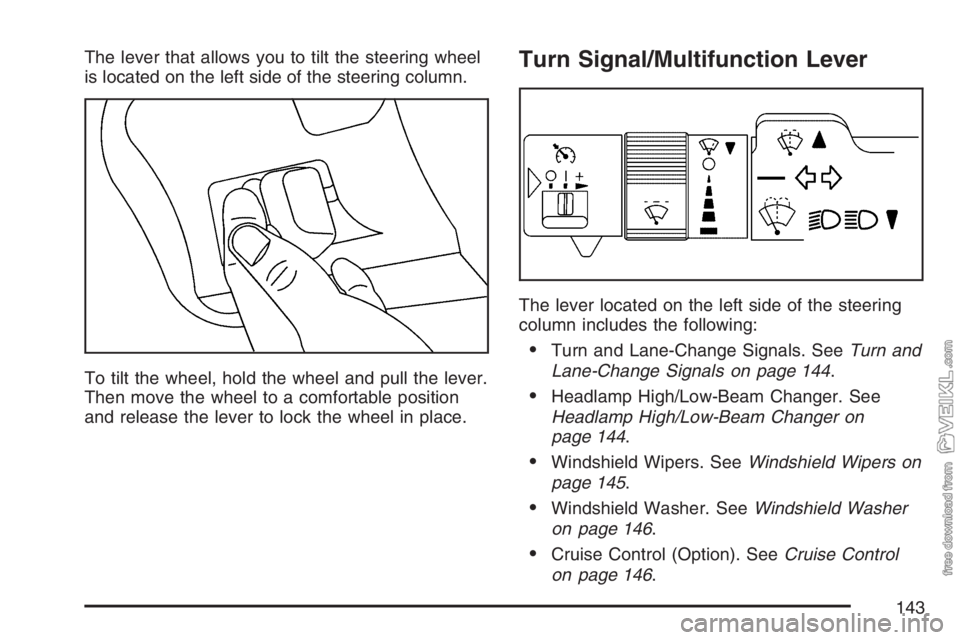
The lever that allows you to tilt the steering wheel
is located on the left side of the steering column.
To tilt the wheel, hold the wheel and pull the lever.
Then move the wheel to a comfortable position
and release the lever to lock the wheel in place.Turn Signal/Multifunction Lever
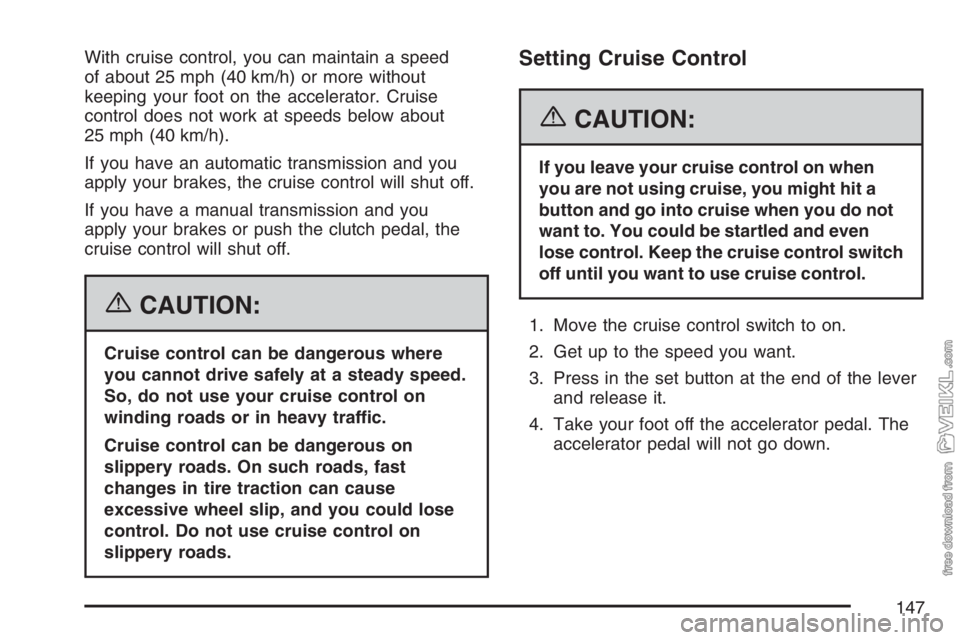
The lever located on the left side of the steering
column includes the following:
•Turn and Lane-Change Signals. SeeTurn and
Lane-Change Signals on page 144.
•Headlamp High/Low-Beam Changer. See
Headlamp High/Low-Beam Changer on
page 144.
•Windshield Wipers. SeeWindshield Wipers on
page 145.
•Windshield Washer. SeeWindshield Washer
on page 146.
•Cruise Control (Option). SeeCruise Control
on page 146.
143
Page 147 of 430
With cruise control, you can maintain a speed
of about 25 mph (40 km/h) or more without
keeping your foot on the accelerator. Cruise
control does not work at speeds below about
25 mph (40 km/h).
If you have an automatic transmission and you
apply your brakes, the cruise control will shut off.
If you have a manual transmission and you
apply your brakes or push the clutch pedal, the
cruise control will shut off.
{CAUTION:
Cruise control can be dangerous where
you cannot drive safely at a steady speed.
So, do not use your cruise control on
winding roads or in heavy traffic.
Cruise control can be dangerous on
slippery roads. On such roads, fast
changes in tire traction can cause
excessive wheel slip, and you could lose
control. Do not use cruise control on
slippery roads.
Setting Cruise Control
{CAUTION:
If you leave your cruise control on when
you are not using cruise, you might hit a
button and go into cruise when you do not
want to. You could be startled and even
lose control. Keep the cruise control switch
off until you want to use cruise control.
1. Move the cruise control switch to on.
2. Get up to the speed you want.
3. Press in the set button at the end of the lever
and release it.
4. Take your foot off the accelerator pedal. The
accelerator pedal will not go down.
147
Page 152 of 430
Marker Lamps
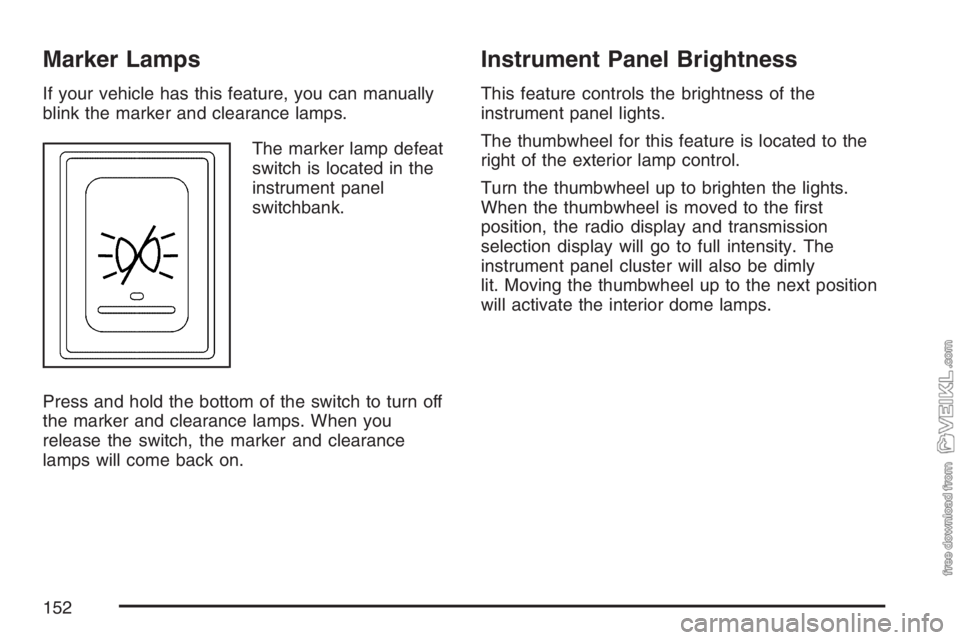
If your vehicle has this feature, you can manually
blink the marker and clearance lamps.
The marker lamp defeat
switch is located in the
instrument panel
switchbank.
Press and hold the bottom of the switch to turn off
the marker and clearance lamps. When you
release the switch, the marker and clearance
lamps will come back on.
Instrument Panel Brightness
This feature controls the brightness of the
instrument panel lights.
The thumbwheel for this feature is located to the
right of the exterior lamp control.
Turn the thumbwheel up to brighten the lights.
When the thumbwheel is moved to the first
position, the radio display and transmission
selection display will go to full intensity. The
instrument panel cluster will also be dimly
lit. Moving the thumbwheel up to the next position
will activate the interior dome lamps.
152
Page 153 of 430
Dome Lamps
The dome lamps will come on when you open
a door.
You can also turn the dome lamps on by moving
the thumbwheel, located to the right of the
exterior lamp control, all the way up to the second
position. In this position, the dome lamps will
remain on whether a door is open or closed.
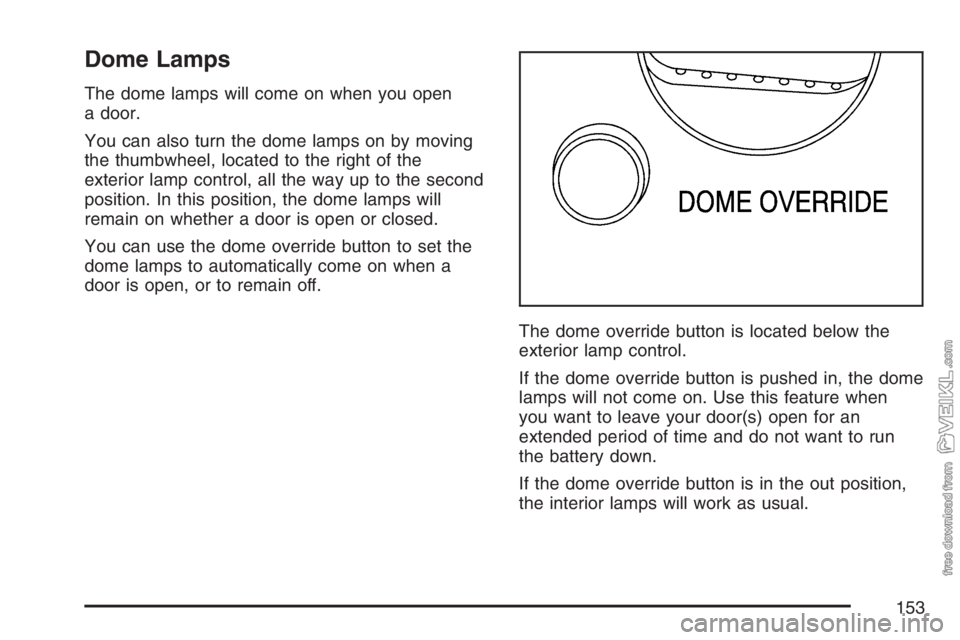
You can use the dome override button to set the
dome lamps to automatically come on when a
door is open, or to remain off.
The dome override button is located below the
exterior lamp control.
If the dome override button is pushed in, the dome
lamps will not come on. Use this feature when
you want to leave your door(s) open for an
extended period of time and do not want to run
the battery down.
If the dome override button is in the out position,
the interior lamps will work as usual.
153
Page 154 of 430
Entry Lighting
The delayed illumination feature will allow you to
enter or exit your vehicle with the lights on for
about 20 seconds, after the door is closed or the
ignition is cycled.
Reading Lamps
If your vehicle has reading lamps, press the button
next to the lamp to turn the lamp on or off.
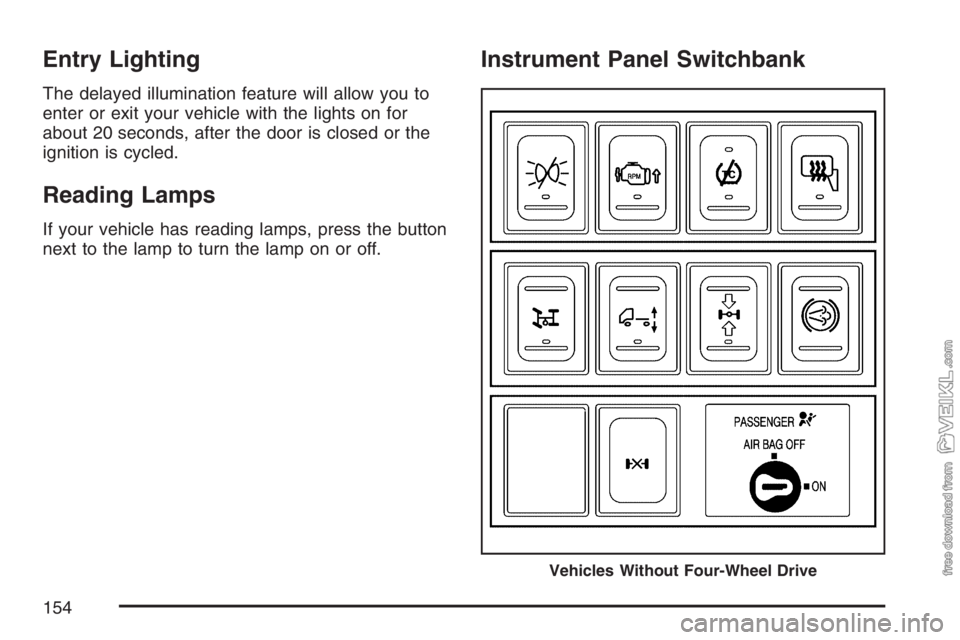
Instrument Panel Switchbank
Vehicles Without Four-Wheel Drive
154
Page 161 of 430
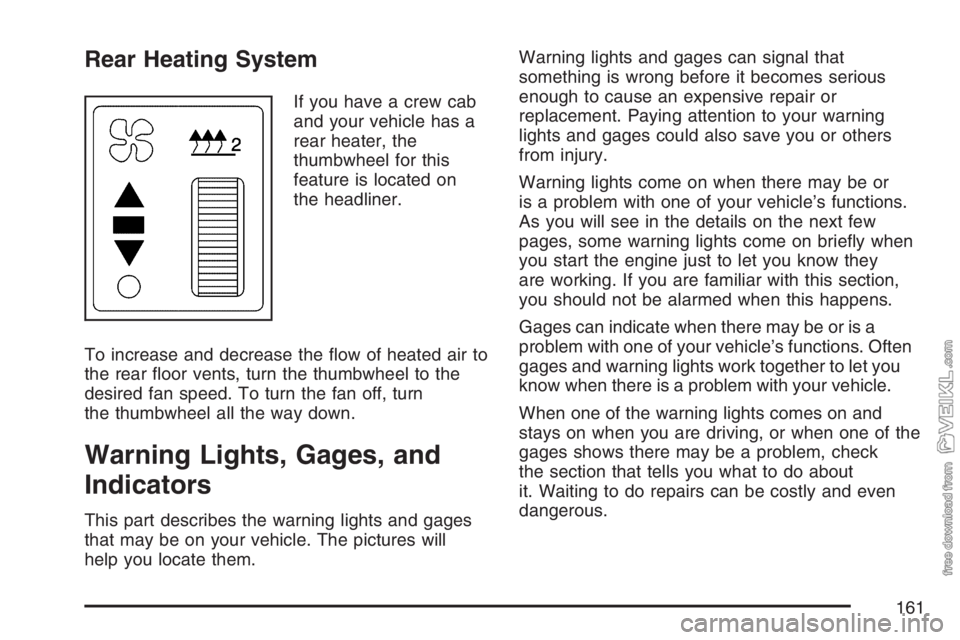
Rear Heating System
If you have a crew cab
and your vehicle has a
rear heater, the
thumbwheel for this
feature is located on
the headliner.
To increase and decrease the flow of heated air to
the rear floor vents, turn the thumbwheel to the
desired fan speed. To turn the fan off, turn
the thumbwheel all the way down.
Warning Lights, Gages, and
Indicators
This part describes the warning lights and gages
that may be on your vehicle. The pictures will
help you locate them.Warning lights and gages can signal that
something is wrong before it becomes serious
enough to cause an expensive repair or
replacement. Paying attention to your warning
lights and gages could also save you or others
from injury.
Warning lights come on when there may be or
is a problem with one of your vehicle’s functions.
As you will see in the details on the next few
pages, some warning lights come on briefly when
you start the engine just to let you know they
are working. If you are familiar with this section,
you should not be alarmed when this happens.
Gages can indicate when there may be or is a
problem with one of your vehicle’s functions. Often
gages and warning lights work together to let you
know when there is a problem with your vehicle.
When one of the warning lights comes on and
stays on when you are driving, or when one of the
gages shows there may be a problem, check
the section that tells you what to do about
it. Waiting to do repairs can be costly and even
dangerous.
161
Page 184 of 430
Audio System(s)
If your vehicle came without a radio, the wiring
provisions for a radio and an antenna were
installed at the assembly plant, so that if you want,
a radio can be installed at the dealer.
Determine which radio your vehicle has and then
read the pages following to familiarize yourself
with its features.
Driving without distraction is a necessity for a
safer driving experience. SeeDefensive Driving on
page 206. By taking a few moments to read this
manual and get familiar with your vehicle’s
audio system, you can use it with less effort, as
well as take advantage of its features. While your
vehicle is parked, set up your audio system by
presetting your favorite radio stations, setting the
tone and adjusting the speakers. Then, when
driving conditions permit, you can tune to
your favorite stations using the presets and
steering wheel controls if the vehicle has them.{CAUTION:
This system provides you with a far greater
access to audio stations and song listings.
Giving extended attention to entertainment
tasks while driving can cause a crash and
you or others can be injured or killed.
Always keep your eyes on the road and
your mind on the drive — avoid engaging
in extended searching while driving.
Keeping your mind on the drive is important for
safe driving. For more information, seeDefensive
Driving on page 206.
Here are some ways in which you can help avoid
distraction while driving.
184
Page 185 of 430
While your vehicle is parked:
•Familiarize yourself with all of its controls.
•Familiarize yourself with its operation.
•Set up your audio system by presetting your
favorite radio stations, setting the tone, and
adjusting the speakers. Then, when driving
conditions permit, you can tune to your favorite
radio stations using the presets and steering
wheel controls if the vehicle has them.
Notice:Before adding any sound equipment to
your vehicle, such as an audio system, CD
player, CB radio, mobile telephone, or two-way
radio, make sure that it can be added by
checking with your dealer. Also, check federal
rules covering mobile radio and telephone
units. If sound equipment can be added, it is
very important to do it properly. Added sound
equipment may interfere with the operation of
your vehicle’s engine, radio, or other systems,
and even damage them. Your vehicle’s systems
may interfere with the operation of sound
equipment that has been added.Notice:The chime signals related to safety
belts, parking brake, and other functions
of your vehicle operate through the
radio/entertainment system. If that equipment
is replaced or additional equipment is added
to your vehicle, the chimes may not work. Make
sure that replacement or additional equipment
is compatible with your vehicle before
installing it.
Setting the Time
Press and hold the HR (down) or MIN (up) arrow
for two seconds. Then press HR until the
correct hour appears on the display. Press and
hold MIN until the correct minute appears on
the display. The time can be set with the ignition
on or off.
185
Page 211 of 430
Avoid needless heavy braking. Some people drive
in spurts — heavy acceleration followed by heavy
braking — rather than keeping pace with traffic.
This is a mistake. The brakes may not have time to
cool between hard stops. The brakes will wear out
much faster if you do a lot of heavy braking. If you
keep pace with the traffic and allow realistic
following distances, you will eliminate a lot of
unnecessary braking. That means better braking
and longer brake life.
If your vehicle’s engine ever stops while you are
driving, brake normally but do not pump the
brakes. If you do, the pedal may get harder to
push down. If the engine stops, you will still have
some power brake assist. But you will use it
when you brake. Once the power assist is used
up, it may take longer to stop and the brake pedal
will be harder to push.Hydraulic Brake Systems
If your engine stops running, or if your primary
brake system stops working, your vehicle has a
reserve power assist system to help you slow down.
Just slowly and steadily apply the brake pedal until
you can safely get off the road. The pedal will seem
harder to push down. Do not pump the pedal; the
system will not work well or at all that way.
You may find that the steering wheel seems hard
to turn when you are turning and braking at
the same time. Also, the primary brake warning
light may come on and the warning tone may
sound. This is normal because the main hydraulic
brake system and power steering both use the
power steering pump. If this ever happens, let up
on the brake pedal a little. When you let up on
the brake pedal in that situation, it lets the steering
get a little more help from the pump.
211
Page 212 of 430
Anti-Lock Brake System (ABS)
Your vehicle has the Anti-Lock Brake System
(ABS), an advanced electronic braking system
that will help prevent a braking skid.
When you start your engine and begin to drive
away, ABS will check itself. You may hear a
momentary motor or clicking noise while this
test is going on. This is normal.
If there is a problem
with ABS, this warning
light will stay on.
SeeAnti-Lock Brake
System Warning
Light on page 172.
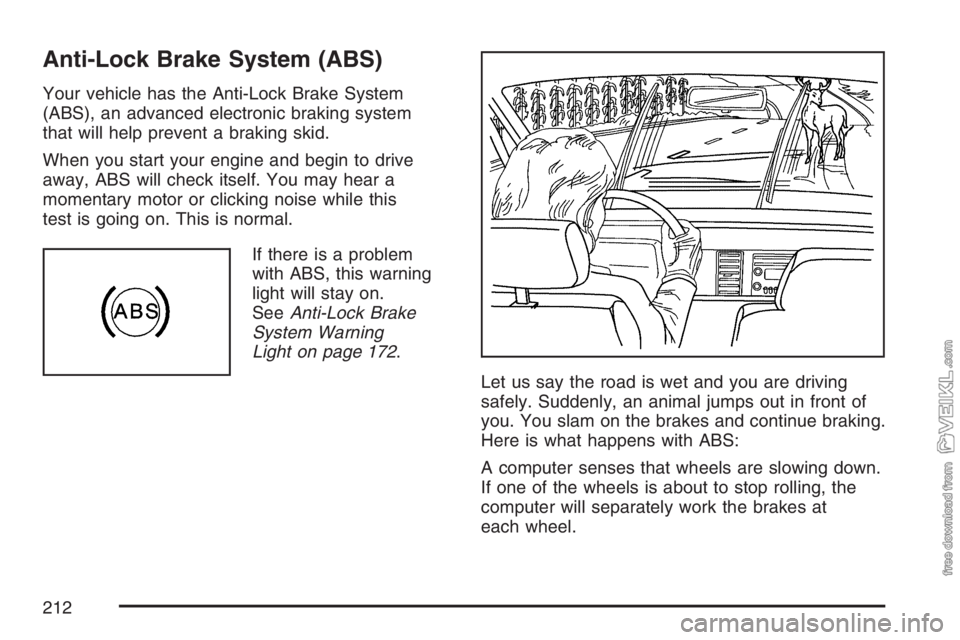
Let us say the road is wet and you are driving
safely. Suddenly, an animal jumps out in front of
you. You slam on the brakes and continue braking.
Here is what happens with ABS:
A computer senses that wheels are slowing down.
If one of the wheels is about to stop rolling, the
computer will separately work the brakes at
each wheel.
212