service CHEVROLET KODIAK 2007 Owner's Guide
[x] Cancel search | Manufacturer: CHEVROLET, Model Year: 2007, Model line: KODIAK, Model: CHEVROLET KODIAK 2007Pages: 430, PDF Size: 6.06 MB
Page 203 of 430
A non-scrubbing action, wet-type cleaner which
uses a cassette with a fabric belt to clean the tape
head can be used. This type of cleaning cassette
will not eject on its own. A non-scrubbing action
cleaner may not clean as thoroughly as the
scrubbing type cleaner. The use of a non-scrubbing
action, dry-type cleaning cassette is not
recommended.
After the player is cleaned, press and hold the
eject button for three seconds to reset the
CLN indicator. The radio will display --- to show
the indicator was reset.
Cassettes are subject to wear and the sound
quality may degrade over time. Always make sure
the cassette tape is in good condition before
the tape player is serviced.Care of Your CDs
Handle CDs carefully. Store them in their original
cases or other protective cases and away from
direct sunlight and dust. The CD player scans the
bottom surface of the disc. If the surface of a
CD is damaged, such as cracked, broken,
or scratched, the CD will not play properly or not
at all. If the surface of a CD is soiled, take a
soft, lint free cloth or dampen a clean, soft cloth in
a mild, neutral detergent solution mixed with
water, and clean it. Make sure the wiping process
starts from the center to the edge.
Do not touch the bottom side of a CD while
handling it; this could damage the surface. Pick up
CDs by grasping the outer edges or the edge of
the hole and the outer edge.
203
Page 229 of 430
Once you are moving on the freeway, make
certain you allow a reasonable following distance.
Expect to move slightly slower at night.
When you want to leave the freeway, move to the
proper lane well in advance. If you miss your
exit, do not, under any circumstances, stop and
back up. Drive on to the next exit.
The exit ramp can be curved, sometimes quite
sharply. The exit speed for cars — but not larger
vehicles — is usually posted. You should go
more slowly.
Reduce your speed according to your speedometer,
not to your sense of motion. After driving for any
distance at higher speeds, you may tend to think you
are going slower than you actually are.
Highway Hypnosis
Is there actually such a condition as highway
hypnosis? Or is it just plain falling asleep at
the wheel? Call it highway hypnosis, lack of
awareness, or whatever.When you drive the vehicle for a long distance,
there is something about an easy stretch of road
with the same scenery, along with the hum of the
tires on the road, the drone of the engine, and the
rush of the wind against the vehicle that can make
you sleepy. Do not let it happen to you! If it does,
your vehicle can leave the road in less than a
second, and you could crash and be injured.
What can you do about highway hypnosis?
First, be aware that it can happen.
Then here are some tips:
•Make sure your vehicle is well ventilated, with
a comfortably cool interior.
•Keep your eyes moving. Scan the road ahead
and to the sides. Check your mirrors and your
instruments frequently.
•If you get sleepy, pull off the road into a rest,
service, or parking area and take a nap, get
some exercise, or both. For safety, treat
drowsiness on the highway as an emergency.
229
Page 241 of 430
Towing
Towing Your Vehicle
Consult your dealer or a professional towing service
if you need to have your disabled vehicle towed.
SeeRoadside Assistance Program on page 408.
Releasing Air-Operated Parking Brakes
If your vehicle has air brakes, you could have a
special towing problem. If your vehicle has to
be towed because of a complete loss of air
pressure from both systems, the parking brakes
will have automatically engaged. The tow operator
can release the brakes manually by using the
following steps. Then your vehicle can be towed
with all wheels or only the rear wheels on
the ground.
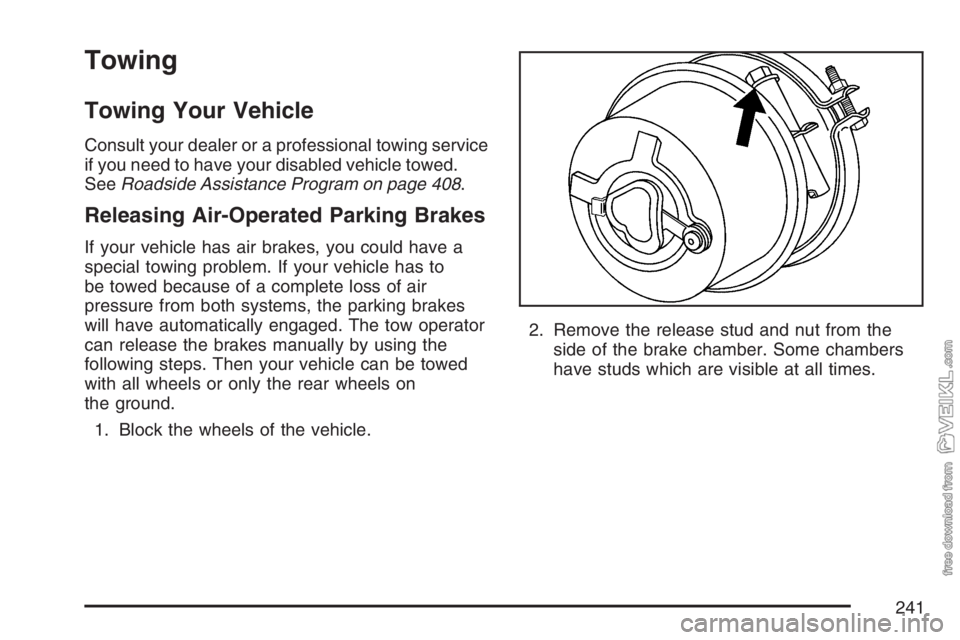
1. Block the wheels of the vehicle.2. Remove the release stud and nut from the
side of the brake chamber. Some chambers
have studs which are visible at all times.
241
Page 245 of 430
Service........................................................ 248
California Proposition 65 Warning.............. 248
Doing Your Own Service Work.................. 249
Engine Fan Breakage................................ 250
Fuel............................................................. 251
Gasoline Octane........................................ 251
Gasoline Specifications.............................. 251
Additives................................................... 252
Diesel Engine Fuel.................................... 253
What Fuel to Use...................................... 253
Very Cold Weather Operation.................... 256
Water in Fuel............................................ 256
Running Out of Fuel.................................. 262
Fuel Filter Replacement............................. 263
Fuels in Foreign Countries........................ 264
Filling the Tank......................................... 264
Filling a Portable Fuel Container............... 266Checking Things Under the Hood.............. 266
Hood Latches............................................ 267
Engine Oil (Caterpillar
®Diesel Engine)...... 268
Engine Oil (Gasoline Engine).................... 268
Engine Oil (DURAMAX
®/Isuzu Diesel
Engine).................................................. 272
Engine Oil Life System
(Gasoline Engine).................................. 276
Engine Oil Life System
(DURAMAX
®Diesel)............................... 278
Engine Oil Life System
(Caterpillar
®Diesel Engine).................... 279
Engine Air Cleaner/Filter............................ 280
Automatic Transmission Fluid.................... 282
Manual Transmission Fluid........................ 283
Engine Coolant (Gas and
DURAMAX
®/Isuzu Engines).................... 284
Engine Coolant (Caterpillar®Diesel
Engines)................................................ 287
Coolant Surge Tank Pressure Cap............ 288
Section 5 Service and Appearance Care
245
Page 246 of 430
Engine Overheating................................... 288
Cooling System (Gas and
DURAMAX
®/Isuzu Engines).................... 290
Engine Fan Noise..................................... 294
Power Steering Fluid................................. 295
Windshield Washer Fluid........................... 296
Brakes...................................................... 297
Battery...................................................... 304
Jump Starting............................................ 305
Rear Axle.................................................... 311
Rear Axle Shift Motor................................ 312
Four-Wheel Drive........................................ 312
Front Axle................................................... 313
Noise Control System................................. 314
Tampering with Noise Control System
Prohibited.............................................. 314
Bulb Replacement....................................... 315
Windshield Wiper Blade Replacement....... 316Other Service Items.................................... 317
Fuel Filter.................................................. 317
Primary Fuel Filter and Water Separator...... 317
Secondary Fuel Filter and Water
Separator/Heater (Caterpillar
®Diesel)...... 318
Automatic Ether Injection System
(Caterpillar
®Diesel)................................ 318
Front Wheel Bearings with
Oil-Filled Hubs....................................... 319
Air Conditioning System............................ 320
Tires............................................................ 321
Inflation - Tire Pressure............................. 322
Wheel Loading.......................................... 323
Dual Tire Operation................................... 323
When It Is Time for New Tires.................. 324
Wheel Alignment and Tire Balance............ 324
Tightening the Wheel Nuts........................ 325
Wheel Replacement.................................. 328
If a Tire Goes Flat.................................... 330
Section 5 Service and Appearance Care
246
Page 247 of 430
Appearance Care........................................ 331
Cleaning the Inside of Your Vehicle.......... 331
Fabric/Carpet............................................. 333
Instrument Panel, Vinyl, and Other
Plastic Surfaces..................................... 334
Care of Safety Belts.................................. 334
Weatherstrips............................................ 334
Washing Your Vehicle............................... 335
Cleaning Exterior Lamps/Lenses................ 335
Finish Care............................................... 335
Windshield and Wiper Blades.................... 336
Aluminum or Chrome-Plated Wheels......... 337
Tires......................................................... 337
Sheet Metal Damage................................. 337
Finish Damage.......................................... 338
Underbody Maintenance............................ 338
Chemical Paint Spotting............................ 338Vehicle Identication.................................. 340
Vehicle Identification Number (VIN)........... 340
Service Parts Identification Label............... 340
Electrical System........................................ 340
Add-On Electrical Equipment..................... 340
Headlamp Wiring....................................... 341
Windshield Wiper Fuses............................ 341
Fusible Links............................................. 341
Power Windows and Other Power
Options.................................................. 341
Fuses and Circuit Breakers....................... 341
Instrument Panel Fuse Block..................... 342
Underhood Fuse Block.............................. 344
Capacities and Specications.................... 347
Normal Maintenance Replacement Parts..... 352
Engine Drive Belt Routing......................... 355
Section 5 Service and Appearance Care
247
Page 248 of 430
Service
Your dealer knows your vehicle best and wants
you to be happy with it. We hope you will go
to your dealer for all your service needs. You will
get genuine GM parts and GM-trained and
supported service people.
We hope you will want to keep your GM vehicle all
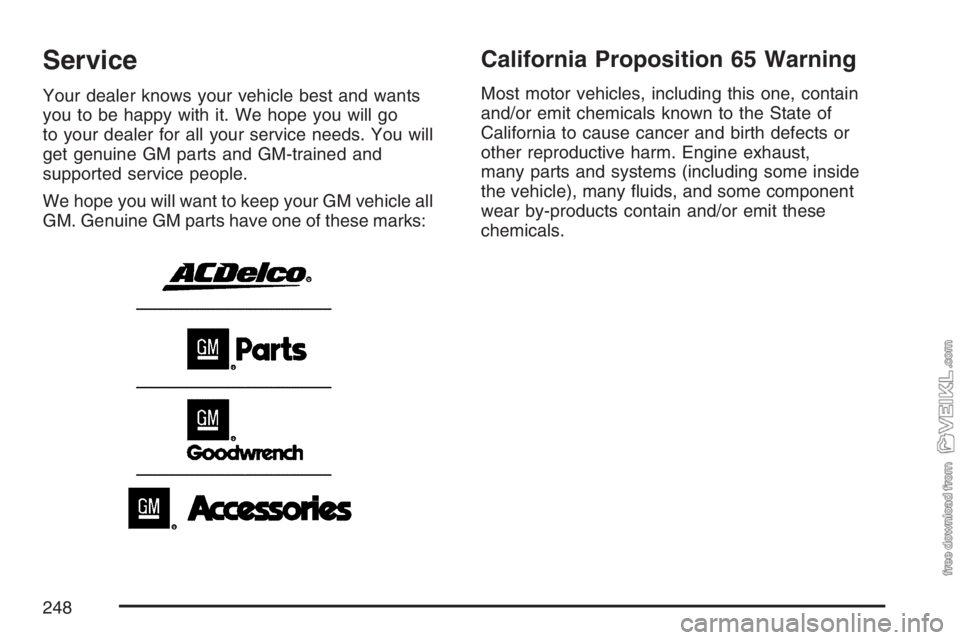
GM. Genuine GM parts have one of these marks:
California Proposition 65 Warning
Most motor vehicles, including this one, contain
and/or emit chemicals known to the State of
California to cause cancer and birth defects or
other reproductive harm. Engine exhaust,
many parts and systems (including some inside
the vehicle), many fluids, and some component
wear by-products contain and/or emit these
chemicals.
248
Page 249 of 430
Doing Your Own Service Work
{CAUTION:
You can be injured and your vehicle could
be damaged if you try to do service work
on a vehicle without knowing enough
about it.
Be sure you have sufficient knowledge,
experience, the proper replacement
parts, and tools before you attempt any
vehicle maintenance task.
Be sure to use the proper nuts, bolts,
and other fasteners. English and metric
fasteners can be easily confused. If you
use the wrong fasteners, parts can later
break or fall off. You could be hurt.If you want to do some of your own service work,
you will want to use the proper service manual.
It tells you much more about how to service your
vehicle than this manual can. To order the
proper service manual, seeService Publications
Ordering Information on page 415.
Your vehicle has an airbag system. Before
attempting to do your own service work, see
Servicing Your Airbag-Equipped Vehicle on
page 80.
You should keep a record with all parts receipts
and list the mileage and the date of any service
work you perform. SeePart D: Maintenance
Record on page 400.
249
Page 250 of 430
Engine Fan Breakage
{CAUTION:
Changing the Fan Drive Ratio or Engine
Governed Speed:
If you change the fan drive ratio or
increase the governed speed of the
engine, you may increase stress and the
fan could eventually fail. If the fan breaks
apart while it is rotating, pieces can cause
severe injury to anyone — such as a
service technician — who is nearby. And,
of course, the pieces can severely
damage the vehicle. Do not change the
fan drive ratio or increase the governed
speed of the vehicle without getting the
necessary information from your dealer.
CAUTION: (Continued)
CAUTION: (Continued)
Winter Fronts, Grille Covers or
Obstructions:
Winter Fronts, grille covers or other
add-on equipment causing obstructions in
front or behind the fan should not be used
on this vehicle. If this causes the fan to
eventually break apart while it is rotating,
the pieces can cause severe injury to
anyone nearby, such as a service
technician working on the engine, and of
course the pieces can severely damage
the vehicle.
250
Page 251 of 430
Fuel
If your vehicle has a diesel engine, seeDiesel
Engine Fuel on page 253.
For vehicles with gasoline engines, please
read this.
Use of the recommended fuel is an important part
of the proper maintenance of your vehicle. To
help keep your engine clean and maintain optimum
vehicle performance, GM recommends the use
of gasoline advertised as TOP TIER Detergent
Gasoline.
Gasoline Octane
Use regular unleaded gasoline with a posted
octane rating of 87 or higher. If the octane rating
is less than 87, you may notice an audible
knocking noise when you drive, commonly referred
to as spark knock. If this occurs, use a gasoline
rated at 87 octane or higher as soon as possible. If
you are using gasoline rated at 87 octane or
higher and you hear heavy knocking, your engine
needs service.
Gasoline Specications
At a minimum, gasoline should meet ASTM
specification D 4814 in the United States or
CAN/CGSB-3.5 in Canada. Some gasolines may
contain an octane-enhancing additive called
methylcyclopentadienyl manganese tricarbonyl
(MMT). General Motors recommends against the
use of gasolines containing MMT. SeeAdditives
on page 252for additional information.
251