lock CHEVROLET KODIAK 2007 Manual Online
[x] Cancel search | Manufacturer: CHEVROLET, Model Year: 2007, Model line: KODIAK, Model: CHEVROLET KODIAK 2007Pages: 430, PDF Size: 6.06 MB
Page 325 of 430
Tightening the Wheel Nuts
{CAUTION:
Wheel nuts that are not tight can work
loose. If all the nuts on a wheel come off,
the wheel can come off the vehicle,
causing a crash. All wheel nuts must be
properly tightened. Follow the rules in this
section to be sure they are.
This section lets you know how often to check the
tightness of the wheel nuts on your vehicle and
how tight they must be.
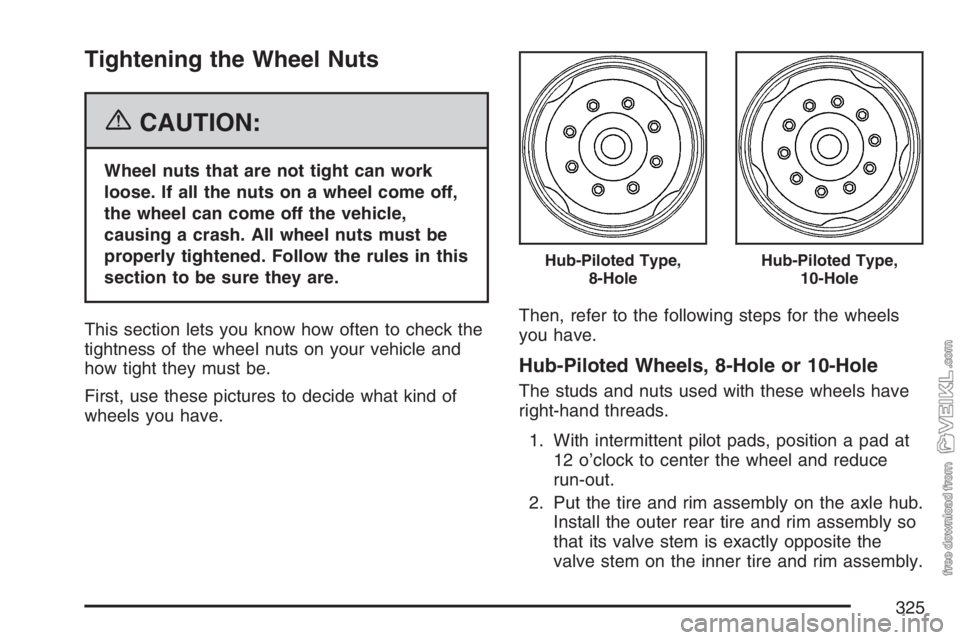
First, use these pictures to decide what kind of
wheels you have.Then, refer to the following steps for the wheels
you have.
Hub-Piloted Wheels, 8-Hole or 10-Hole
The studs and nuts used with these wheels have
right-hand threads.
1. With intermittent pilot pads, position a pad at
12 o’clock to center the wheel and reduce
run-out.
2. Put the tire and rim assembly on the axle hub.
Install the outer rear tire and rim assembly so
that its valve stem is exactly opposite the
valve stem on the inner tire and rim assembly.
Hub-Piloted Type,
8-HoleHub-Piloted Type,
10-Hole
325
Page 341 of 430
Headlamp Wiring
The headlamp wiring is protected by a circuit
breaker in the light switch. An electrical overload
will cause the lights to go on and off, or in
some cases to remain off. If this happens, have
your headlamp wiring checked right away.
Windshield Wiper Fuses
The windshield wiper motor is protected by a
circuit breaker inside the motor and a circuit
breaker or fuse in the fuse block. If the motor
overheats, the wipers will stop until the motor
cools. If the overload is caused by an electrical
problem, be sure to get it fixed.
Fusible Links
A fusible link is a short piece of wire several gauge
sizes smaller than the circuit it protects. It will melt
in an overload situation, opening the circuit.
Your starter and other circuits have these fusible
links. The size is printed on the insulation. If the
insulation is burned beyond recognition, consult
your dealer for the proper size. Replace a fusiblelink with one of the same size and insulation type.
Fusible link insulation is a special purpose
high-temperature material.
Some examples of circuits with fusible links are
the hydraulic brake booster motor feed circuit, the
generator output circuit, and the intake heater
feed circuit in vehicles with a diesel engine.
Power Windows and Other
Power Options
Circuit breakers in the fuse panel protect the power
windows and other power accessories. When the
current load is too heavy, the circuit breaker opens.
This protects the circuit until the current load returns
to normal or the problem is fixed.
Fuses and Circuit Breakers
The wiring circuits in your vehicle are protected
from short circuits by a combination of fuses, circuit
breakers, maxi-fuses and fusible links. This greatly
reduces the chance of a fire caused by an electrical
problem. There may be a fuse taped to the wiring
harness near the hydraulic brake booster.
341
Page 342 of 430
Instrument Panel Fuse Block
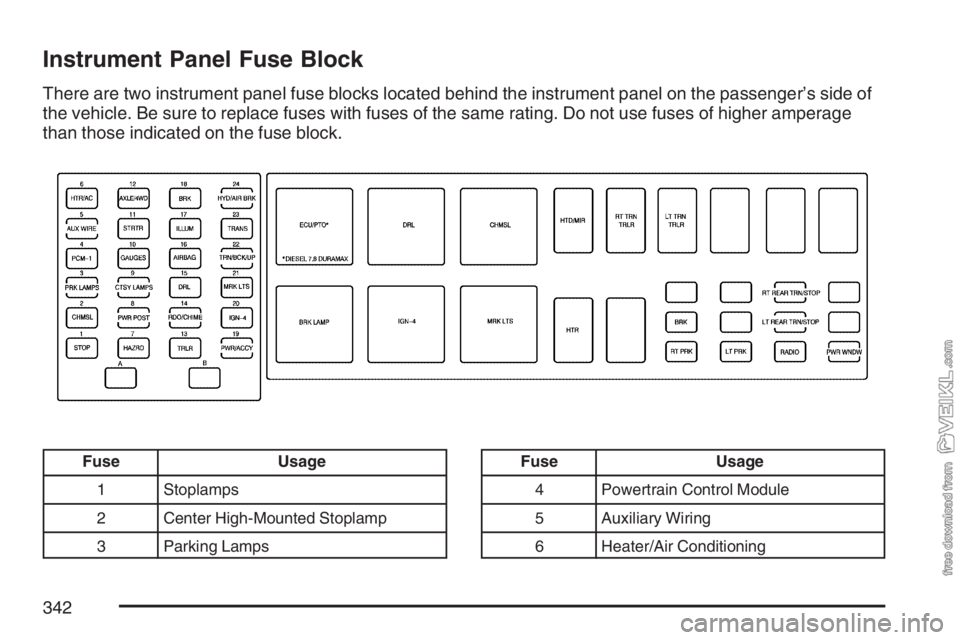
There are two instrument panel fuse blocks located behind the instrument panel on the passenger’s side of
the vehicle. Be sure to replace fuses with fuses of the same rating. Do not use fuses of higher amperage
than those indicated on the fuse block.
Fuse Usage
1 Stoplamps
2 Center High-Mounted Stoplamp
3 Parking LampsFuse Usage
4 Powertrain Control Module
5 Auxiliary Wiring
6 Heater/Air Conditioning
342
Page 344 of 430
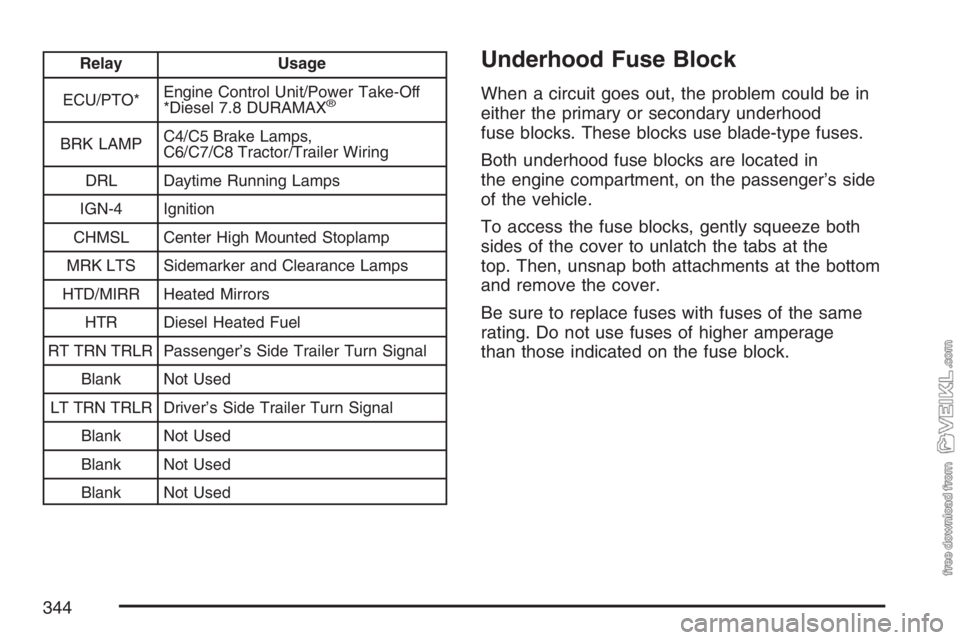
Relay Usage
ECU/PTO*Engine Control Unit/Power Take-Off
*Diesel 7.8 DURAMAX
®
BRK LAMPC4/C5 Brake Lamps,
C6/C7/C8 Tractor/Trailer Wiring
DRL Daytime Running Lamps
IGN-4 Ignition
CHMSL Center High Mounted Stoplamp
MRK LTS Sidemarker and Clearance Lamps
HTD/MIRR Heated Mirrors
HTR Diesel Heated Fuel
RT TRN TRLR Passenger’s Side Trailer Turn Signal
Blank Not Used
LT TRN TRLR Driver’s Side Trailer Turn Signal
Blank Not Used
Blank Not Used
Blank Not Used
Underhood Fuse Block
When a circuit goes out, the problem could be in
either the primary or secondary underhood
fuse blocks. These blocks use blade-type fuses.
Both underhood fuse blocks are located in
the engine compartment, on the passenger’s side
of the vehicle.
To access the fuse blocks, gently squeeze both
sides of the cover to unlatch the tabs at the
top. Then, unsnap both attachments at the bottom
and remove the cover.
Be sure to replace fuses with fuses of the same
rating. Do not use fuses of higher amperage
than those indicated on the fuse block.
344
Page 345 of 430
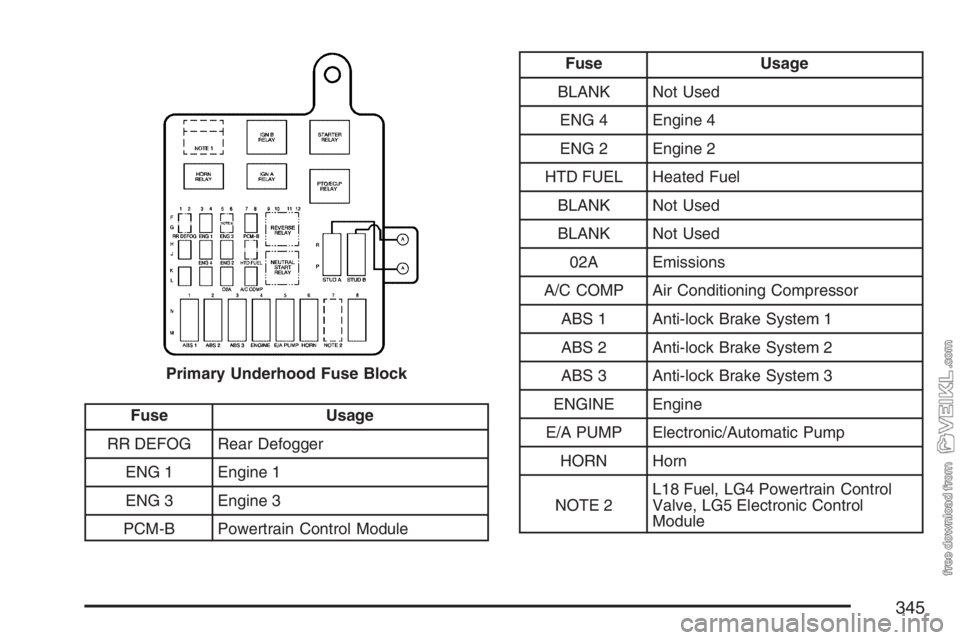
Fuse Usage
RR DEFOG Rear Defogger
ENG 1 Engine 1
ENG 3 Engine 3
PCM-B Powertrain Control Module
Fuse Usage
BLANK Not Used
ENG 4 Engine 4
ENG 2 Engine 2
HTD FUEL Heated Fuel
BLANK Not Used
BLANK Not Used
02A Emissions
A/C COMP Air Conditioning Compressor
ABS 1 Anti-lock Brake System 1
ABS 2 Anti-lock Brake System 2
ABS 3 Anti-lock Brake System 3
ENGINE Engine
E/A PUMP Electronic/Automatic Pump
HORN Horn
NOTE 2L18 Fuel, LG4 Powertrain Control
Valve, LG5 Electronic Control
Module Primary Underhood Fuse Block
345
Page 346 of 430
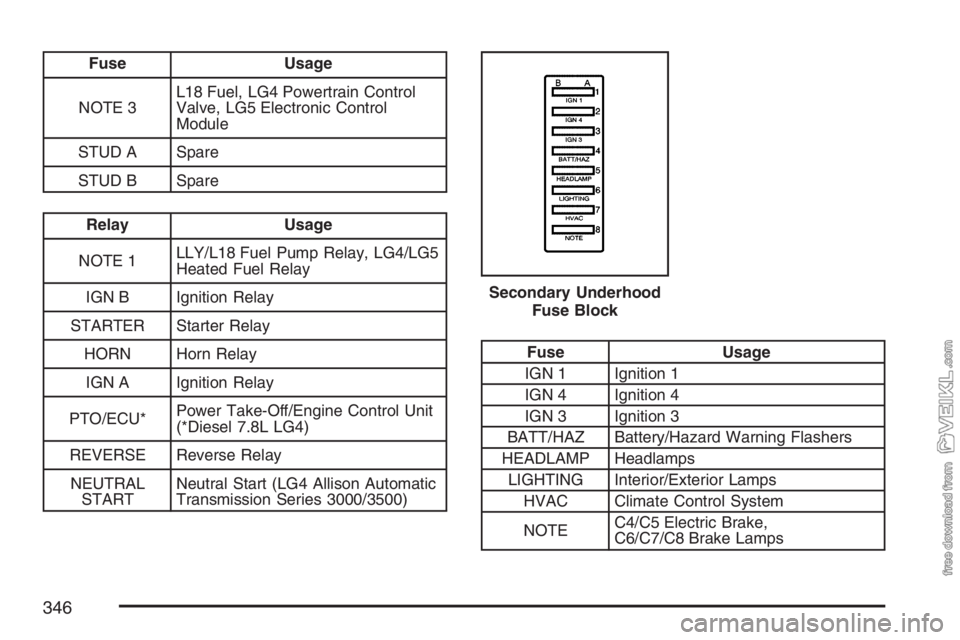
Fuse Usage
NOTE 3L18 Fuel, LG4 Powertrain Control
Valve, LG5 Electronic Control
Module
STUD A Spare
STUD B Spare
Relay Usage
NOTE 1LLY/L18 Fuel Pump Relay, LG4/LG5
Heated Fuel Relay
IGN B Ignition Relay
STARTER Starter Relay
HORN Horn Relay
IGN A Ignition Relay
PTO/ECU*Power Take-Off/Engine Control Unit
(*Diesel 7.8L LG4)
REVERSE Reverse Relay
NEUTRAL
STARTNeutral Start (LG4 Allison Automatic
Transmission Series 3000/3500)
Fuse Usage
IGN 1 Ignition 1
IGN 4 Ignition 4
IGN 3 Ignition 3
BATT/HAZ Battery/Hazard Warning Flashers
HEADLAMP Headlamps
LIGHTING Interior/Exterior Lamps
HVAC Climate Control System
NOTEC4/C5 Electric Brake,
C6/C7/C8 Brake Lamps Secondary Underhood
Fuse Block
346
Page 392 of 430
At Least Twice a Year
Restraint System Check
Make sure the safety belt reminder light (if
equipped) and all your belts, buckles, latch plates,
retractors, and anchorages are working properly.
Look for any other loose or damaged safety
belt system parts. If you see anything that might
keep a safety belt system from doing its job,
have it repaired. Have any torn or frayed safety
belts replaced.
Wiper Blade Check
Inspect wiper blades for wear or cracking. Replace
blade inserts that appear worn or damaged or
that streak or miss areas of the windshield. Also
seeWindshield and Wiper Blades on page 336.
Weatherstrip Lubrication
Silicone grease on weatherstrips will make them
last longer, seal better, and not stick or squeak.
Apply silicone grease with a clean cloth. During
very cold, damp weather more frequent application
may be required. Part C tells you what to use.
Body Lubrication Service
Lubricate all exposed surfaces such as door
checks, door lock bolts, lock strike plates, door
hinge bushings, latches, and dovetail bumper
wedges. Where oil holes are provided, a dripless
oil can be used. The seat adjusters, seat track,
door weatherstrips, and rubber cap bumpers
should also be lubricated. Part C tells you what to
use. More frequent lubrication may be required
when exposed to a corrosive environment.
Parking Brake Check
Park on a fairly steep hill and hold the vehicle with
the parking brake only. This checks holding ability.
392
Page 395 of 430
Lamps Check
Check panel lighting, warning lights, indicator
lights, and interior lamps. On the outside,
check: license plate lamps, sidemarker lamps,
reflectors or lights on outside mirrors, headlamps,
parking lamps, identification and clearance
lamps, taillamps, brake lamps, turn signals,
backup lamps, and hazard warning flashers.
Have headlamp aim checked at once if beams
seem improperly aimed.
Glass, Mirrors, Lamps and/or
Reectors Condition Check
Look for broken, scratched, dirty, or damaged
glass, mirrors, lamps, or reflectors that could
reduce the view or visibility or cause injury.
Replace, clean or repair promptly.
Door Latches Check
Check that doors close, latch, and lock tightly.
Check for broken, damaged, or missing parts that
might prevent tight latching.
Hood Latches Check
Check that the hood closes firmly. Check for
broken, damaged, loose, or missing parts
that might prevent tight latching. Make sure the
secondary latch (if equipped) keeps the hood
from opening all the way when the primary latch
is released.
Fluid Leaks Check
Check for fuel, coolant, oil, or other fluid leaks by
looking at the surface beneath the vehicle after
it has been parked for awhile.
395
Page 396 of 430
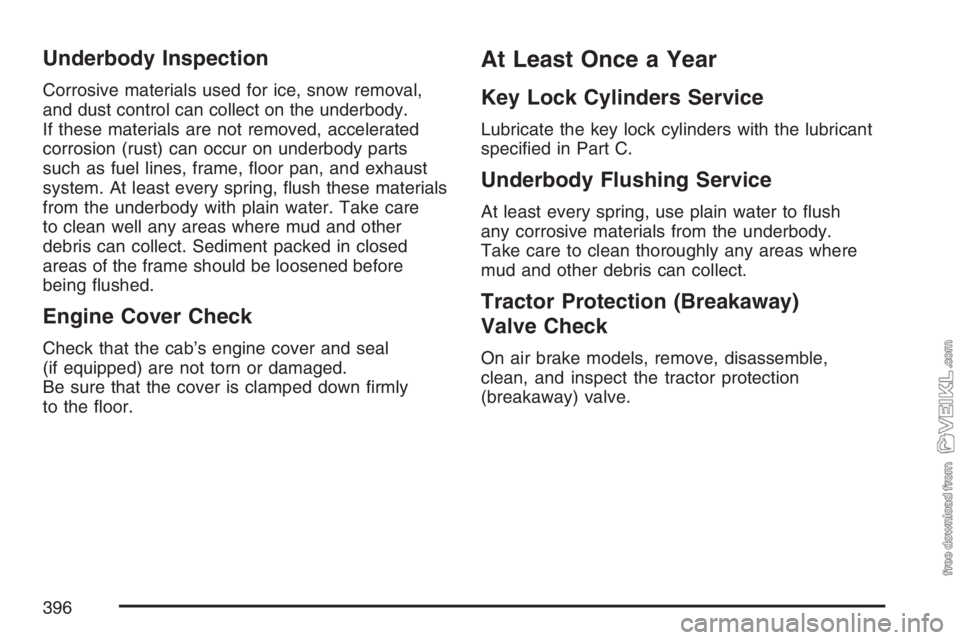
Underbody Inspection
Corrosive materials used for ice, snow removal,
and dust control can collect on the underbody.
If these materials are not removed, accelerated
corrosion (rust) can occur on underbody parts
such as fuel lines, frame, floor pan, and exhaust
system. At least every spring, flush these materials
from the underbody with plain water. Take care
to clean well any areas where mud and other
debris can collect. Sediment packed in closed
areas of the frame should be loosened before
being flushed.
Engine Cover Check
Check that the cab’s engine cover and seal
(if equipped) are not torn or damaged.
Be sure that the cover is clamped down firmly
to the floor.
At Least Once a Year
Key Lock Cylinders Service
Lubricate the key lock cylinders with the lubricant
specified in Part C.
Underbody Flushing Service
At least every spring, use plain water to flush
any corrosive materials from the underbody.
Take care to clean thoroughly any areas where
mud and other debris can collect.
Tractor Protection (Breakaway)
Valve Check
On air brake models, remove, disassemble,
clean, and inspect the tractor protection
(breakaway) valve.
396
Page 398 of 430
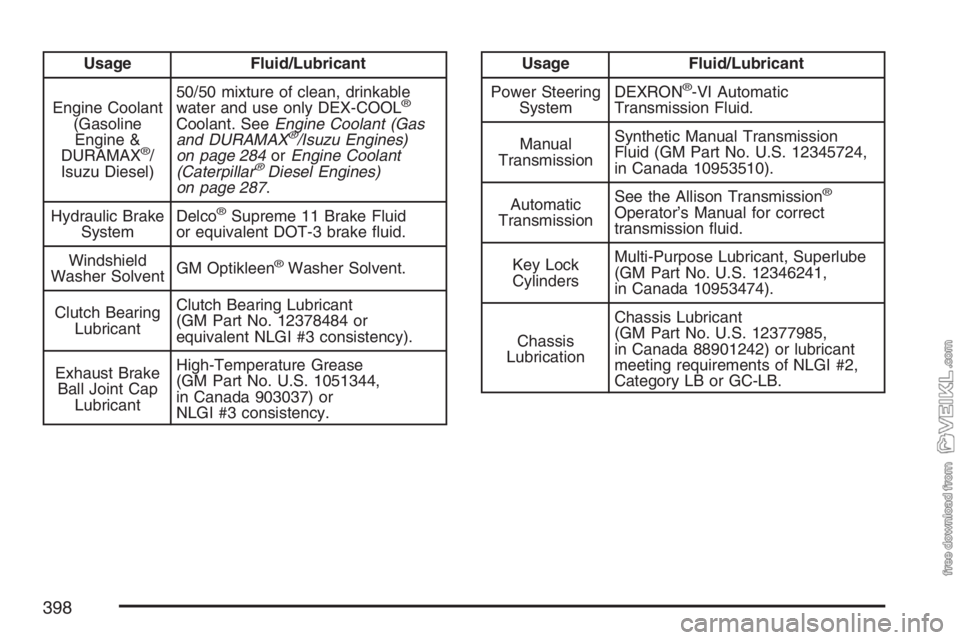
Usage Fluid/Lubricant
Engine Coolant
(Gasoline
Engine &
DURAMAX
®/
Isuzu Diesel)50/50 mixture of clean, drinkable
water and use only DEX-COOL
®
Coolant. SeeEngine Coolant (Gas
and DURAMAX®/Isuzu Engines)
on page 284orEngine Coolant
(Caterpillar
®Diesel Engines)
on page 287.
Hydraulic Brake
SystemDelco
®Supreme 11 Brake Fluid
or equivalent DOT-3 brake fluid.
Windshield
Washer SolventGM Optikleen
®Washer Solvent.
Clutch Bearing
LubricantClutch Bearing Lubricant
(GM Part No. 12378484 or
equivalent NLGI #3 consistency).
Exhaust Brake
Ball Joint Cap
LubricantHigh-Temperature Grease
(GM Part No. U.S. 1051344,
in Canada 903037) or
NLGI #3 consistency.
Usage Fluid/Lubricant
Power Steering
SystemDEXRON
®-VI Automatic
Transmission Fluid.
Manual
TransmissionSynthetic Manual Transmission
Fluid (GM Part No. U.S. 12345724,
in Canada 10953510).
Automatic
TransmissionSee the Allison Transmission
®
Operator’s Manual for correct
transmission fluid.
Key Lock
CylindersMulti-Purpose Lubricant, Superlube
(GM Part No. U.S. 12346241,
in Canada 10953474).
Chassis
LubricationChassis Lubricant
(GM Part No. U.S. 12377985,
in Canada 88901242) or lubricant
meeting requirements of NLGI #2,
Category LB or GC-LB.
398