lock CHEVROLET KODIAK 2009 Owner's Manual
[x] Cancel search | Manufacturer: CHEVROLET, Model Year: 2009, Model line: KODIAK, Model: CHEVROLET KODIAK 2009Pages: 376, PDF Size: 5.39 MB
Page 71 of 376
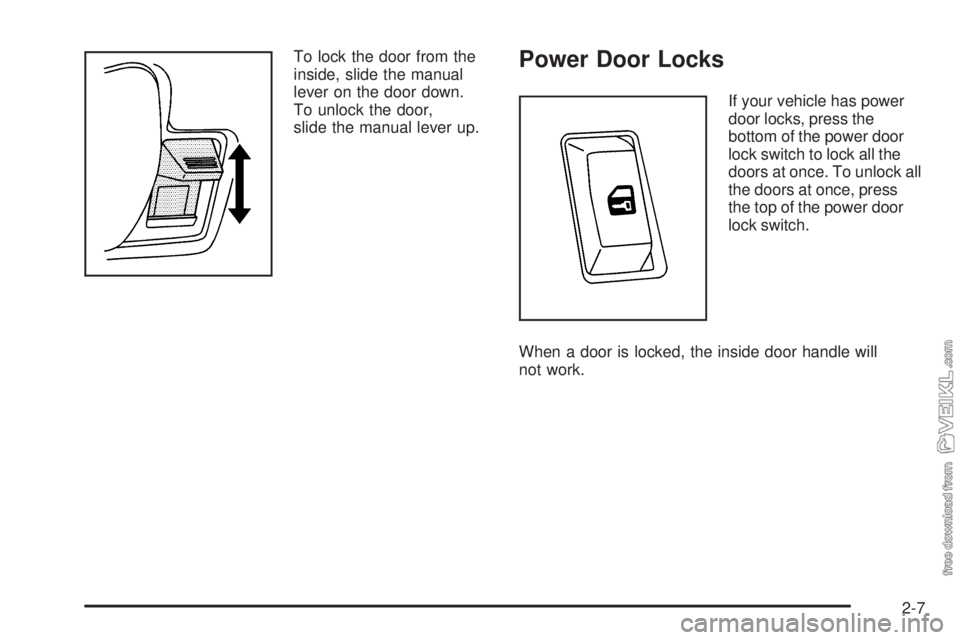
To lock the door from the
inside, slide the manual
lever on the door down.
To unlock the door,
slide the manual lever up.Power Door Locks
If your vehicle has power
door locks, press the
bottom of the power door
lock switch to lock all the
doors at once. To unlock all
the doors at once, press
the top of the power door
lock switch.
When a door is locked, the inside door handle will
not work.
2-7
Page 73 of 376
Manual Windows
Turn the hand crank on each door to raise or lower the
window.
Power Windows
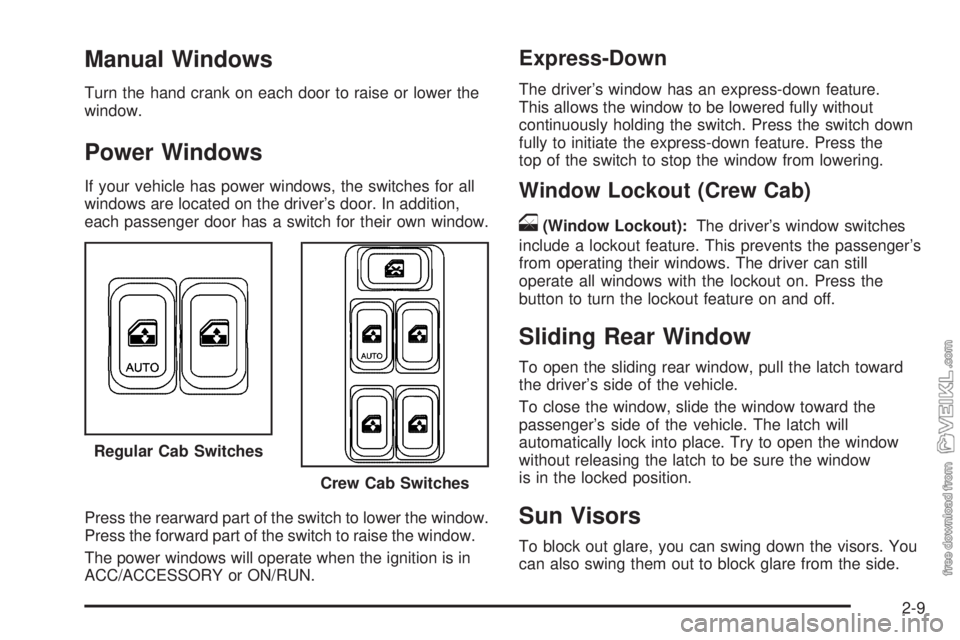
If your vehicle has power windows, the switches for all
windows are located on the driver’s door. In addition,
each passenger door has a switch for their own window.
Press the rearward part of the switch to lower the window.
Press the forward part of the switch to raise the window.
The power windows will operate when the ignition is in
ACC/ACCESSORY or ON/RUN.
Express-Down
The driver’s window has an express-down feature.
This allows the window to be lowered fully without
continuously holding the switch. Press the switch down
fully to initiate the express-down feature. Press the
top of the switch to stop the window from lowering.
Window Lockout (Crew Cab)
o
(Window Lockout):The driver’s window switches
include a lockout feature. This prevents the passenger’s
from operating their windows. The driver can still
operate all windows with the lockout on. Press the
button to turn the lockout feature on and off.
Sliding Rear Window
To open the sliding rear window, pull the latch toward
the driver’s side of the vehicle.
To close the window, slide the window toward the
passenger’s side of the vehicle. The latch will
automatically lock into place. Try to open the window
without releasing the latch to be sure the window
is in the locked position.
Sun Visors
To block out glare, you can swing down the visors. You
can also swing them out to block glare from the side. Regular Cab Switches
Crew Cab Switches
2-9
Page 75 of 376
Ignition Positions
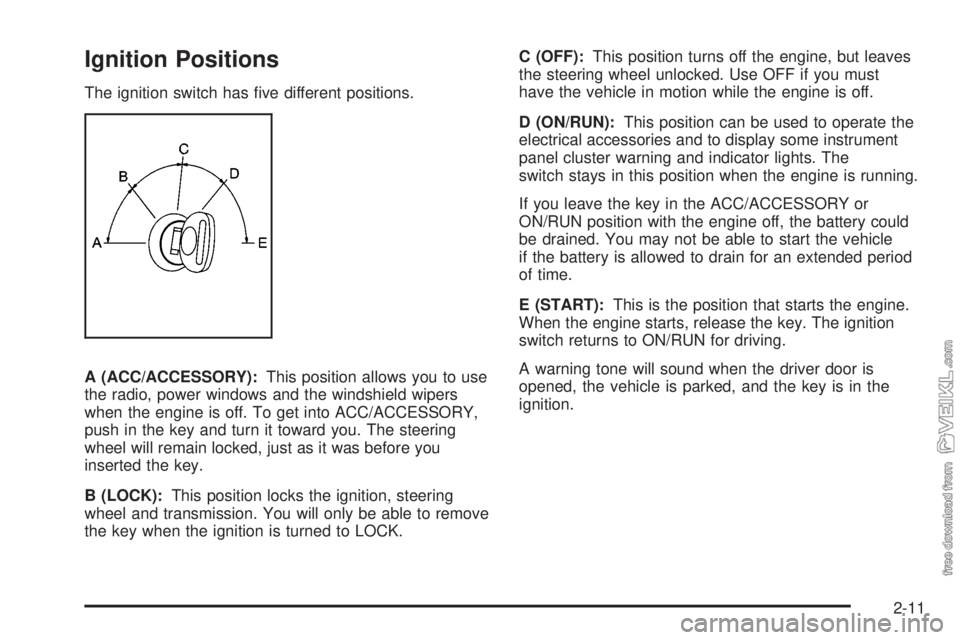
The ignition switch has five different positions.
A (ACC/ACCESSORY):This position allows you to use
the radio, power windows and the windshield wipers
when the engine is off. To get into ACC/ACCESSORY,
push in the key and turn it toward you. The steering
wheel will remain locked, just as it was before you
inserted the key.
B (LOCK):This position locks the ignition, steering
wheel and transmission. You will only be able to remove
the key when the ignition is turned to LOCK.C (OFF):This position turns off the engine, but leaves
the steering wheel unlocked. Use OFF if you must
have the vehicle in motion while the engine is off.
D (ON/RUN):This position can be used to operate the
electrical accessories and to display some instrument
panel cluster warning and indicator lights. The
switch stays in this position when the engine is running.
If you leave the key in the ACC/ACCESSORY or
ON/RUN position with the engine off, the battery could
be drained. You may not be able to start the vehicle
if the battery is allowed to drain for an extended period
of time.
E (START):This is the position that starts the engine.
When the engine starts, release the key. The ignition
switch returns to ON/RUN for driving.
A warning tone will sound when the driver door is
opened, the vehicle is parked, and the key is in the
ignition.
2-11
Page 84 of 376
The ENGINE SHUTDOWN WARNING LIGHT will come
on and a continuous chime will alert the driver
30 seconds before the engine goes into idle shutdown
mode. The engine shutdown warning light and chime will
stay on for the entire duration of the idle shutdown
event to inform the driver that the engine is in idle
shutdown mode. SeeEngine Shutdown Warning Light
on page 3-40for more information.
After the engine shutdown occurs, the engine is no
longer running, and the ignition is still in the ON/RUN
position, all accessories can be used. Turn the ignition
switch to START to restart the engine or turn it to
LOCK or OFF to prevent the battery from draining.High Idle System
High Idle System with Switch
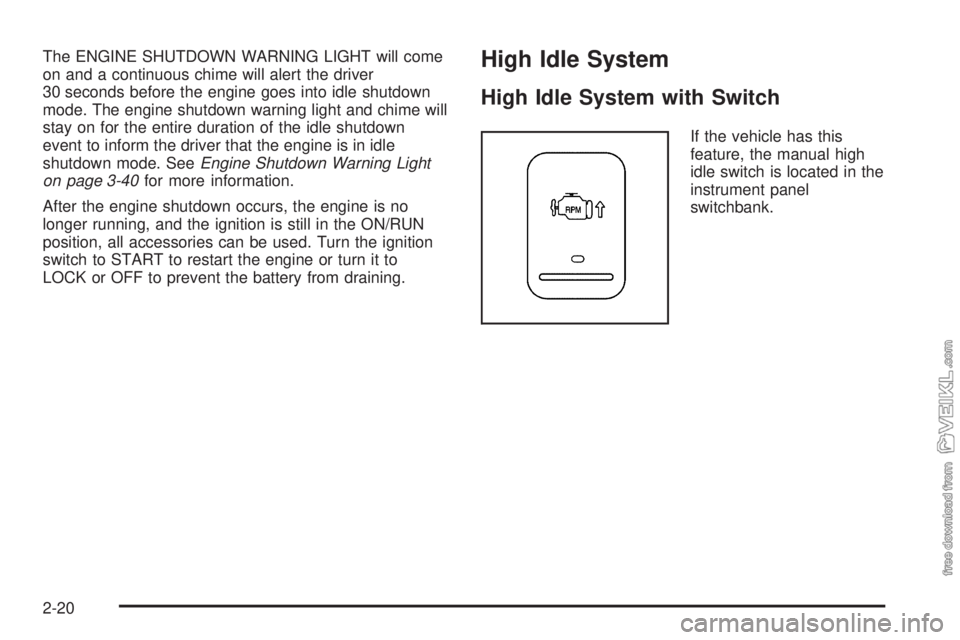
If the vehicle has this
feature, the manual high
idle switch is located in the
instrument panel
switchbank.
2-20
Page 90 of 376
Diesel Engine Exhaust Brake
If the vehicle has a Isuzu 6H Diesel Engine, it may have
an exhaust brake, which is located in the exhaust
system.
If the vehicle has a 6.6L DURAMAX
®6600 or
Caterpillar®Diesel Engine, it may have an exhaust
brake, which is controlled through the turbocharger.
The exhaust brake for both engines operates the same.
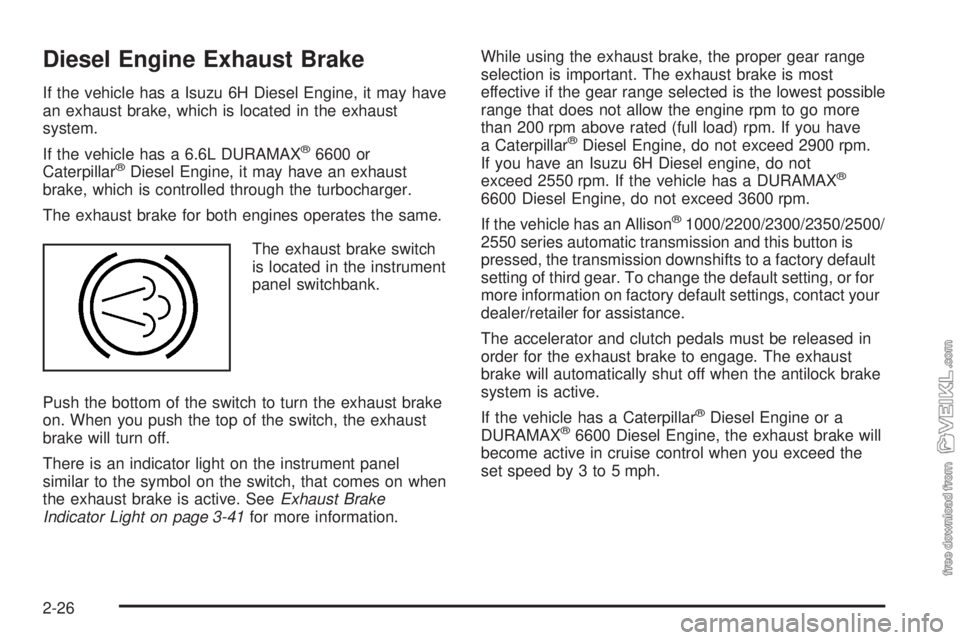
The exhaust brake switch
is located in the instrument
panel switchbank.
Push the bottom of the switch to turn the exhaust brake
on. When you push the top of the switch, the exhaust
brake will turn off.
There is an indicator light on the instrument panel
similar to the symbol on the switch, that comes on when
the exhaust brake is active. SeeExhaust Brake
Indicator Light on page 3-41for more information.While using the exhaust brake, the proper gear range
selection is important. The exhaust brake is most
effective if the gear range selected is the lowest possible
range that does not allow the engine rpm to go more
than 200 rpm above rated (full load) rpm. If you have
a Caterpillar
®Diesel Engine, do not exceed 2900 rpm.
If you have an Isuzu 6H Diesel engine, do not
exceed 2550 rpm. If the vehicle has a DURAMAX
®
6600 Diesel Engine, do not exceed 3600 rpm.
If the vehicle has an Allison
®1000/2200/2300/2350/2500/
2550 series automatic transmission and this button is
pressed, the transmission downshifts to a factory default
setting of third gear. To change the default setting, or for
more information on factory default settings, contact your
dealer/retailer for assistance.
The accelerator and clutch pedals must be released in
order for the exhaust brake to engage. The exhaust
brake will automatically shut off when the antilock brake
system is active.
If the vehicle has a Caterpillar
®Diesel Engine or a
DURAMAX®6600 Diesel Engine, the exhaust brake will
become active in cruise control when you exceed the
set speed by 3 to 5 mph.
2-26
Page 95 of 376
Locking Hubs
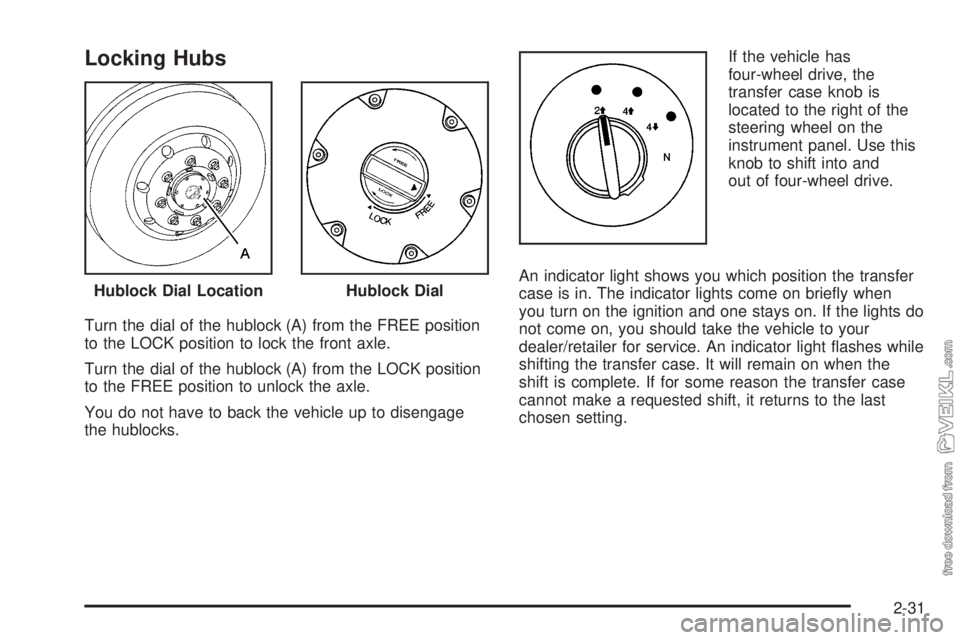
Turn the dial of the hublock (A) from the FREE position
to the LOCK position to lock the front axle.
Turn the dial of the hublock (A) from the LOCK position
to the FREE position to unlock the axle.
You do not have to back the vehicle up to disengage
the hublocks.If the vehicle has
four-wheel drive, the
transfer case knob is
located to the right of the
steering wheel on the
instrument panel. Use this
knob to shift into and
out of four-wheel drive.
An indicator light shows you which position the transfer
case is in. The indicator lights come on briefly when
you turn on the ignition and one stays on. If the lights do
not come on, you should take the vehicle to your
dealer/retailer for service. An indicator light flashes while
shifting the transfer case. It will remain on when the
shift is complete. If for some reason the transfer case
cannot make a requested shift, it returns to the last
chosen setting. Hublock Dial Location
Hublock Dial
2-31
Page 96 of 376
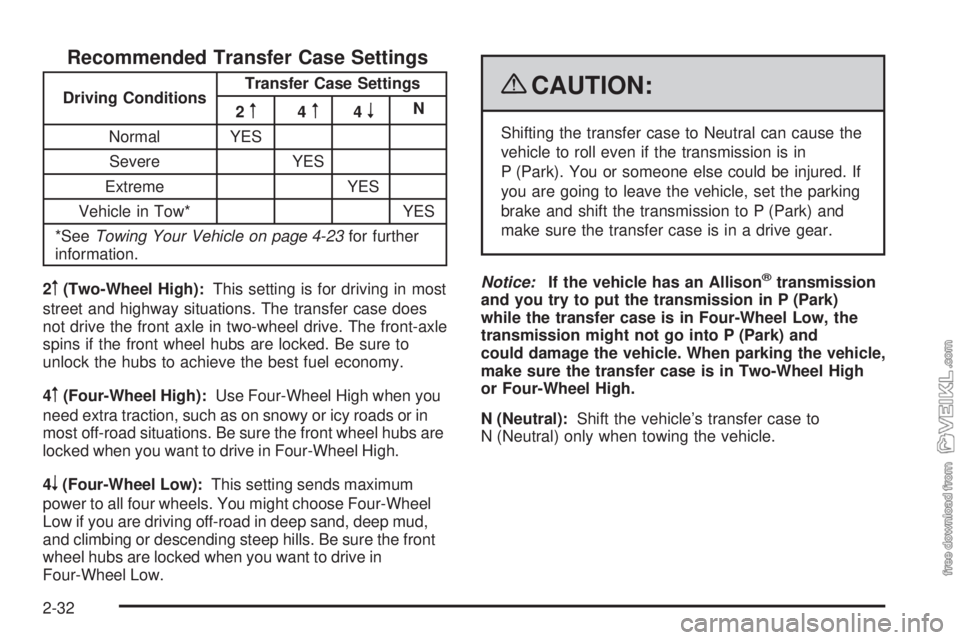
Recommended Transfer Case Settings
Driving ConditionsTransfer Case Settings
2m4m4nN
Normal YES
Severe YES
Extreme YES
Vehicle in Tow* YES
*SeeTowing Your Vehicle on page 4-23for further
information.
2
m(Two-Wheel High):This setting is for driving in most
street and highway situations. The transfer case does
not drive the front axle in two-wheel drive. The front-axle
spins if the front wheel hubs are locked. Be sure to
unlock the hubs to achieve the best fuel economy.
4
m(Four-Wheel High):Use Four-Wheel High when you
need extra traction, such as on snowy or icy roads or in
most off-road situations. Be sure the front wheel hubs are
locked when you want to drive in Four-Wheel High.
4
n(Four-Wheel Low):This setting sends maximum
power to all four wheels. You might choose Four-Wheel
Low if you are driving off-road in deep sand, deep mud,
and climbing or descending steep hills. Be sure the front
wheel hubs are locked when you want to drive in
Four-Wheel Low.
{CAUTION:
Shifting the transfer case to Neutral can cause the
vehicle to roll even if the transmission is in
P (Park). You or someone else could be injured. If
you are going to leave the vehicle, set the parking
brake and shift the transmission to P (Park) and
make sure the transfer case is in a drive gear.
Notice:If the vehicle has an Allison
®transmission
and you try to put the transmission in P (Park)
while the transfer case is in Four-Wheel Low, the
transmission might not go into P (Park) and
could damage the vehicle. When parking the vehicle,
make sure the transfer case is in Two-Wheel High
or Four-Wheel High.
N (Neutral):Shift the vehicle’s transfer case to
N (Neutral) only when towing the vehicle.
2-32
Page 97 of 376
Shifting Into Four-Wheel High
Turn the knob to four-wheel high. This can be done at
3 mph or less. The indicator light flashes while shifting.
It remains on after the shift is complete. Be sure to
lock the front hubs.
Shifting Into Two-Wheel High
Turn the knob to Two-Wheel High. This can be done at
3 mph or less.
Shifting Into Four-Wheel Low
To shift to Four-Wheel Low, the vehicle’s engine must be
running and the vehicle must be stopped or moving less
than 3 mph (5 km/h) with the transmission in N (Neutral).
The preferred method for shifting into Four-Wheel Low is
to have the vehicle moving 1 or 2 mph (1.6 to 3.2 km/h).
Turn the knob to Four-Wheel Low. You must wait for
the Four-Wheel Low indicator light to stop flashing and
remain on before shifting the transmission into gear.
Be sure to lock the front hubs.Notice:Shifting the transmission into gear before
the Four-Wheel Drive Low indicator light has
stopped flashing could damage the transfer case.
To help avoid damaging the vehicle, always wait for
the Four-Wheel Drive Low indicator light to stop
flashing before shifting the transmission into gear.
If you turn the knob to Four-Wheel Low while the
vehicle is in gear and/or moving, the Four-Wheel Low
indicator light flashes for 30 seconds and does not
complete the shift unless the vehicle is moving less than
3 mph (4.8 km/h) and the transmission is in N (Neutral).
After 30 seconds, the transfer case returns to the
setting last chosen. If the vehicle is in gear and moving
less than 3 mph (4.8 km/h), the transfer case shifts
to Four-Wheel High.
2-33
Page 98 of 376
Shifting Out of Four-Wheel Low
To shift from Four-Wheel Low to Four-Wheel High or
Two-Wheel High, the vehicle must be stopped or moving
less than 3 mph (5 km/h) with the transmission in
N (Neutral) with the engine running. The preferred
method for shifting out of Four-Wheel Low is to have
the vehicle moving 1 or 2 mph (1.6 to 3.2 km/h).
Turn the knob to Four-Wheel High or Two-Wheel High.
You must wait for the Four-Wheel High or Two-Wheel
High indicator light to stop flashing and remain on before
shifting the transmission into gear.
Notice:Shifting the transmission into gear before
the Four-Wheel High or Two-Wheel High indicator
light has stopped flashing could damage the transfer
case. To help avoid damaging the vehicle, always
wait for the Four-Wheel High or Two-Wheel High
indicator light to stop flashing before shifting
the transmission into gear.
If the knob is turned to Four-Wheel High or Two-Wheel
High while the vehicle is in gear and/or moving, the
Four-Wheel High or Two-Wheel high indicator light
flashes for 30 seconds. It will not complete the shift
unless the vehicle is moving less than 3 mph (5 km/h)
with the transmission in N (Neutral).
Shifting Into Neutral
Before shifting the transfer case to N (Neutral), first
make sure the vehicle is parked so that it will not roll.
1. Set the parking brake. SeeParking Brake (With
Hydraulic Brakes) on page 2-38orParking Brake
(With Air Brakes) on page 2-41for parking
brake apply procedure.
2. Start the vehicle.
3. Put the transmission in N (Neutral).
4. Shift the transfer case to Two-Wheel High.
5. Turn the transfer case knob all of the way past
Four-Wheel Low and hold it there for a minimum
of 10 seconds. The N (Neutral) indicator light
comes on.
6. Shift the transmission to R (Reverse) for
one second, then shift the transmission to D (Drive)
for one second.
7. Turn the ignition to OFF.
8. Place the transmission shift lever in P (Park).
9. Turn the ignition to LOCK.
2-34
Page 109 of 376
Engine Exhaust
{CAUTION:
Engine exhaust contains Carbon Monoxide (CO)
which cannot be seen or smelled. Exposure to CO
can cause unconsciousness and even death.
Exhaust may enter the vehicle if:
•The vehicle idles in areas with poor ventilation
(parking garages, tunnels, deep snow that
may block underbody airflow or tail pipes).
•The exhaust smells or sounds strange or
different.
•The exhaust system leaks due to corrosion or
damage.
CAUTION: (Continued)
CAUTION: (Continued)
•
The vehicle’s exhaust system has been
modified, damaged or improperly repaired.
•There are holes or openings in the vehicle
body from damage or after-market
modifications that are not completely sealed.
If unusual fumes are detected or if it is suspected
that exhaust is coming into the vehicle:
•Drive it only with the windows
completely down.
•Have the vehicle repaired immediately.
Never park the vehicle with the engine running in
an enclosed area such as a garage or a building
that has no fresh air ventilation.
2-45