lock CHEVROLET KODIAK 2009 Workshop Manual
[x] Cancel search | Manufacturer: CHEVROLET, Model Year: 2009, Model line: KODIAK, Model: CHEVROLET KODIAK 2009Pages: 376, PDF Size: 5.39 MB
Page 183 of 376
Rear Axle Differential Lock Control
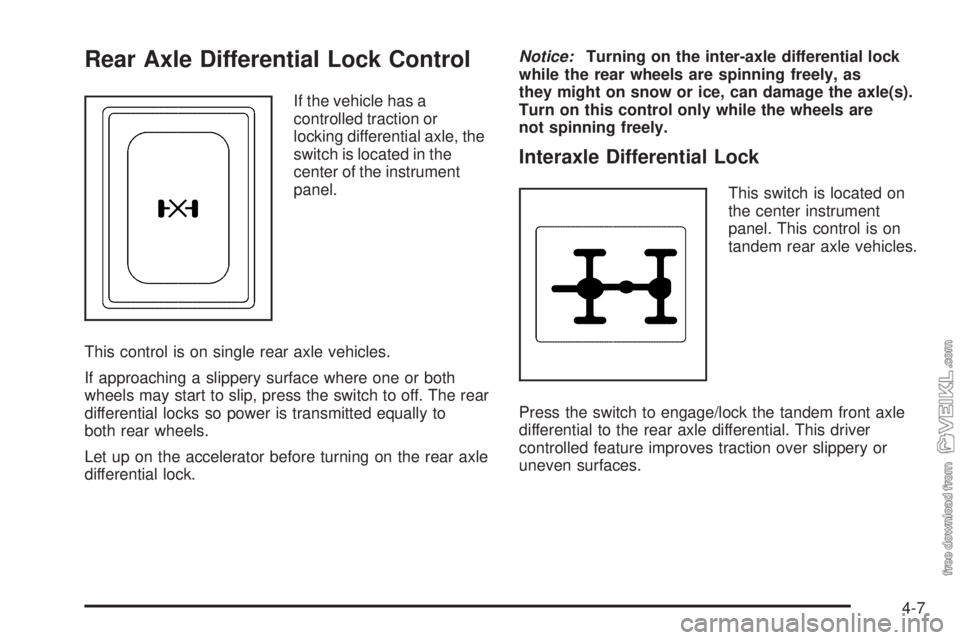
If the vehicle has a
controlled traction or
locking differential axle, the
switch is located in the
center of the instrument
panel.
This control is on single rear axle vehicles.
If approaching a slippery surface where one or both
wheels may start to slip, press the switch to off. The rear
differential locks so power is transmitted equally to
both rear wheels.
Let up on the accelerator before turning on the rear axle
differential lock.Notice:Turning on the inter-axle differential lock
while the rear wheels are spinning freely, as
they might on snow or ice, can damage the axle(s).
Turn on this control only while the wheels are
not spinning freely.
Interaxle Differential Lock
This switch is located on
the center instrument
panel. This control is on
tandem rear axle vehicles.
Press the switch to engage/lock the tandem front axle
differential to the rear axle differential. This driver
controlled feature improves traction over slippery or
uneven surfaces.
4-7
Page 184 of 376
Traction Control System (TCS)
The vehicle may have a traction control system that limits
wheel spin. This is especially useful in slippery road
conditions. The system operates only if it senses that one
or both of the rear wheels are spinning or beginning to
lose traction. When this happens, the system applies the
brake(s) at the affected wheel(s).
The bottom light on TCS on/off button will come on
when the TCS is limiting wheel spin. The system may
be heard or felt while it is working, but this is normal.
TCS will function at speeds up to about 25 mph
(42 km/h).
TCS may operate on dry roads under some conditions.
When this happens, a reduction in acceleration may
be noticed. This is normal and doesn’t mean there’s a
problem with the vehicle. Examples of these conditions
include a hard acceleration in a turn, an abrupt
upshift or downshift of the transmission or driving on
rough roads.When the light in the top of the TCS button is on, TCS
is off and will not limit wheel spin. Adjust your driving
accordingly.
The light in the top of the TCS button will come on if
TCS is turned off by pressing the TCS on/off button.
The light may also come on if a problem has been
detected in either the traction control system or
the anti-lock brake system.
The traction control system automatically comes on
whenever the vehicle is started. To limit wheel
spin, especially in slippery road conditions, the system
should always be left on. But the traction control
system can be turned off if needed. Turn the system off
if the vehicle ever gets stuck in sand, mud or snow
and rocking the vehicle is required. SeeRocking Your
Vehicle to Get It Out on page 4-19for more information.
4-8
Page 186 of 376
Steering in Emergencies
There are times when steering can be more effective
than braking. For example, you come over a hill and find
a truck stopped in your lane, or a car suddenly pulls
out from nowhere, or a child darts out from between
parked cars and stops right in front of you. These
problems can be avoided by braking — if you can stop
in time. But sometimes you cannot stop in time
because there is no room. That is the time for evasive
action — steering around the problem.
The vehicle can perform very well in emergencies like
these. First apply the brakes. SeeBraking on page 4-4.
It is better to remove as much speed as possible
from a collision. Then steer around the problem, to the
left or right depending on the space available.
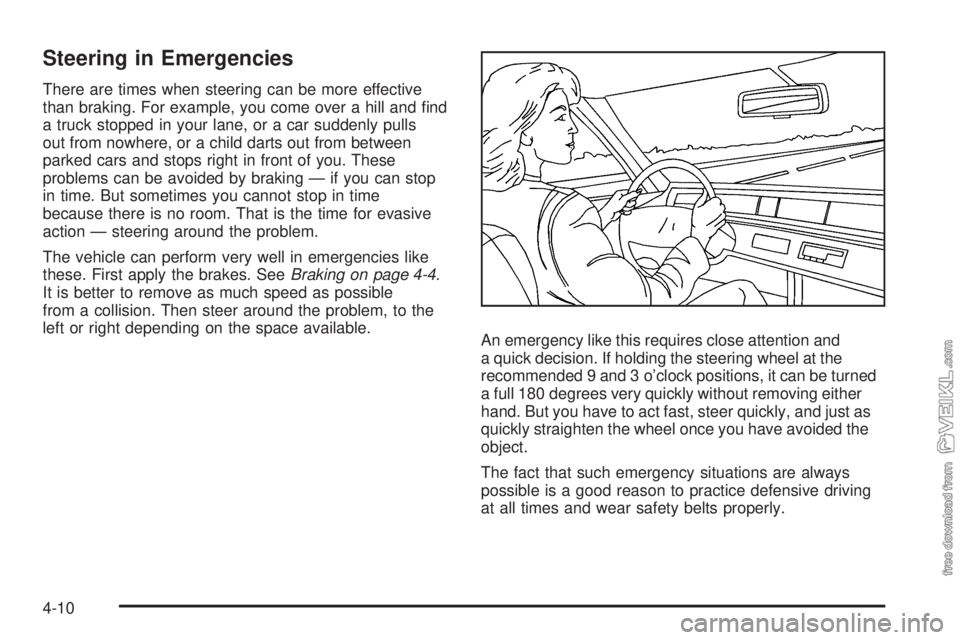
An emergency like this requires close attention and
a quick decision. If holding the steering wheel at the
recommended 9 and 3 o’clock positions, it can be turned
a full 180 degrees very quickly without removing either
hand. But you have to act fast, steer quickly, and just as
quickly straighten the wheel once you have avoided the
object.
The fact that such emergency situations are always
possible is a good reason to practice defensive driving
at all times and wear safety belts properly.
4-10
Page 188 of 376
Loss of Control
Let us review what driving experts say about what
happens when the three control systems — brakes,
steering, and acceleration — do not have enough friction
where the tires meet the road to do what the driver has
asked.
In any emergency, do not give up. Keep trying to steer
and constantly seek an escape route or area of less
danger.
Skidding
In a skid, a driver can lose control of the vehicle.
Defensive drivers avoid most skids by taking reasonable
care suited to existing conditions, and by not overdriving
those conditions. But skids are always possible.
The three types of skids correspond to the vehicle’s three
control systems. In the braking skid, the wheels are not
rolling. In the steering or cornering skid, too much speed
or steering in a curve causes tires to slip and lose
cornering force. And in the acceleration skid, too much
throttle causes the driving wheels to spin.
If the vehicle has the Traction Control System (TCS),
remember: It helps avoid only the acceleration skid.
SeeTraction Control System (TCS) on page 4-8.Ifthe
vehicle does not have this system, or if the system
is off, then an acceleration skid is best handled
by easing your foot off the accelerator pedal.Of course, traction is reduced when water, snow, ice,
gravel, or other material is on the road. For safety, slow
down and adjust your driving to these conditions. It is
important to slow down on slippery surfaces because
stopping distance will be longer and vehicle control more
limited.
While driving on a surface with reduced traction, try
your best to avoid sudden steering, acceleration, or
braking, including reducing vehicle speed by shifting to
a lower gear. Any sudden changes could cause the tires
to slide. You may not realize the surface is slippery until
the vehicle is skidding. Learn to recognize warning
clues — such as enough water, ice, or packed snow on
the road to make a mirrored surface — and slow down
when you have any doubt.
If the vehicle has the Antilock Brake System (ABS),
remember: It helps avoid only the braking skid. If
the vehicle does not have ABS, then in a braking skid,
where the wheels are no longer rolling, release
enough pressure on the brakes to get the wheels rolling
again. This restores steering control. Push the brake
pedal down steadily when you have to stop suddenly. As
long as the wheels are rolling, you will have steering
control.
4-12
Page 193 of 376
Winter Driving
Driving on Snow or Ice
Drive carefully when there is snow or ice between the
tires and the road, creating less traction or grip. Wet ice
can occur at about 32°F (0°C) when freezing rain
begins to fall, resulting in even less traction. Avoid
driving on wet ice or in freezing rain until roads can be
treated with salt or sand.
Drive with caution, whatever the condition. Accelerate
gently so traction is not lost. Accelerating too quickly
causes the wheels to spin and makes the surface under
the tires slick, so there is even less traction.
Try not to break the fragile traction. If you accelerate too
fast, the drive wheels will spin and polish the surface
under the tires even more.
For four-wheel-drive vehicles, shift into 4HI. See
Four-Wheel Drive on page 2-30.If the vehicle has theTraction Control System (TCS) on
page 4-8, it improves the ability to accelerate on
slippery roads, but slow down and adjust your driving to
the road conditions. When driving through deep snow,
turn off the traction control system to help maintain
vehicle motion at lower speeds.
TheAntilock Brake System (ABS) on page 4-5improves
vehicle stability during hard stops on a slippery roads,
but apply the brakes sooner than when on dry
pavement.
Allow greater following distance on any slippery road
and watch for slippery spots. Icy patches can occur on
otherwise clear roads in shaded areas. The surface
of a curve or an overpass can remain icy when
the surrounding roads are clear. Avoid sudden steering
maneuvers and braking while on ice.
Turn off cruise control, if equipped, on slippery surfaces.
4-17
Page 194 of 376
Blizzard Conditions
Being stuck in snow can be in a serious situation. Stay
with the vehicle unless there is help nearby. If possible,
use theRoadside Assistance Program on page 7-5.
To get help and keep everyone in the vehicle safe:
•Turn on theHazard Warning Flashers on page 3-6.
•Tie a red cloth to an outside mirror.
{CAUTION:
Snow can trap engine exhaust under the vehicle.
This may cause exhaust gases to get inside.
Engine exhaust contains carbon monoxide (CO)
which cannot be seen or smelled. It can cause
unconsciousness and even death.
If the vehicle is stuck in the snow:
•Clear away snow from around the base of
your vehicle, especially any that is blocking
the exhaust pipe.
•Check again from time to time to be sure
snow does not collect there.
CAUTION: (Continued)
CAUTION: (Continued)
•
Open a window about two inches (5 cm) on
the side of the vehicle that is away from the
wind to bring in fresh air.
•Fully open the air outlets on or under the
instrument panel.
•Adjust the Climate Control system to a setting
that circulates the air inside the vehicle and
set the fan speed to the highest setting. See
Climate Control System in the Index.
For more information about carbon monoxide, see
Engine Exhaust on page 2-45.
Snow can trap exhaust gases under your vehicle.
This can cause deadly CO (carbon monoxide) gas
to get inside. CO could overcome you and kill you.
You cannot see it or smell it, so you might not
know it is in your vehicle. Clear away snow from
around the base of your vehicle, especially any
that is blocking the exhaust.
Run the engine for short periods only as needed to
keep warm, but be careful.
To save fuel, run the engine for only short periods as
needed to warm the vehicle and then shut the engine off
and close the window most of the way to save heat.
4-18
Page 199 of 376
Towing
Towing Your Vehicle
Consult your dealer/retailer or a professional towing
service to have the vehicle towed. They can provide the
right equipment and know-how to tow it without
damage. SeeRoadside Assistance Program on
page 7-5.
Releasing Air-Operated Parking Brakes
If the vehicle has air brakes, there could be a special
towing problem. If the vehicle has to be towed because
of a complete loss of air pressure from both systems,
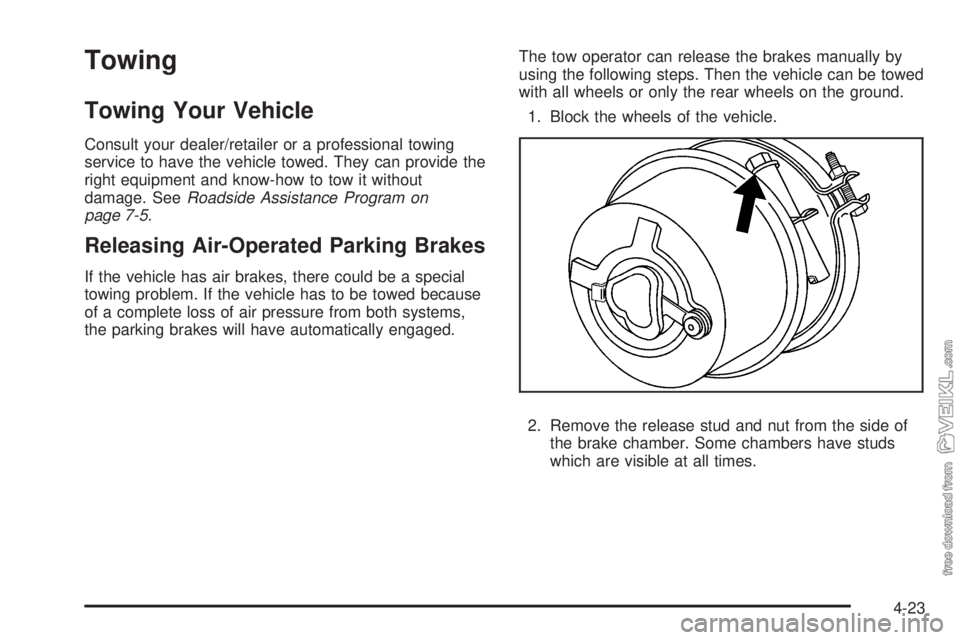
the parking brakes will have automatically engaged.The tow operator can release the brakes manually by
using the following steps. Then the vehicle can be towed
with all wheels or only the rear wheels on the ground.
1. Block the wheels of the vehicle.
2. Remove the release stud and nut from the side of
the brake chamber. Some chambers have studs
which are visible at all times.
4-23
Page 200 of 376
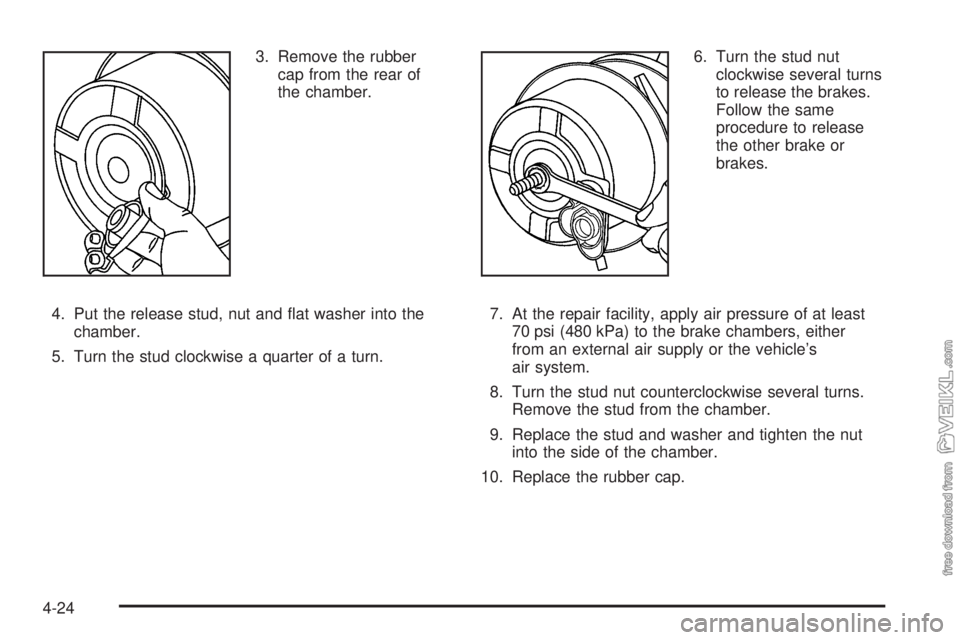
3. Remove the rubber
cap from the rear of
the chamber.
4. Put the release stud, nut and flat washer into the
chamber.
5. Turn the stud clockwise a quarter of a turn.6. Turn the stud nut
clockwise several turns
to release the brakes.
Follow the same
procedure to release
the other brake or
brakes.
7. At the repair facility, apply air pressure of at least
70 psi (480 kPa) to the brake chambers, either
from an external air supply or the vehicle’s
air system.
8. Turn the stud nut counterclockwise several turns.
Remove the stud from the chamber.
9. Replace the stud and washer and tighten the nut
into the side of the chamber.
10. Replace the rubber cap.
4-24
Page 204 of 376
Windshield Wiper Blade Replacement..............5-71
Other Service Items........................................5-72
Fuel Filter....................................................5-72
Primary Fuel Filter and Water Separator..........5-73
Secondary Fuel Filter and Water Separator/
Heater (Caterpillar Diesel)............................5-74
Front Wheel Bearings with
Oil-Filled Hubs..........................................5-75
Tires..............................................................5-76
Inflation - Tire Pressure.................................5-77
Wheel Loading.............................................5-78
Dual Tire Operation.......................................5-78
When It Is Time for New Tires.......................5-78
Buying New Tires.........................................5-79
Wheel Alignment and Tire Balance..................5-80
Tightening the Wheel Nuts.............................5-80
Wheel Replacement......................................5-84
If a Tire Goes Flat........................................5-85
Appearance Care............................................5-87
Interior Cleaning...........................................5-87
Fabric/Carpet...............................................5-88
Instrument Panel, Vinyl, and Other
Plastic Surfaces........................................5-89
Care of Safety Belts......................................5-89
Weatherstrips...............................................5-89
Washing Your Vehicle...................................5-90Cleaning Exterior Lamps/Lenses.....................5-90
Finish Care..................................................5-90
Windshield and Wiper Blades.........................5-91
Aluminum or Chrome-Plated Wheels
and Trim..................................................5-92
Tires...........................................................5-92
Sheet Metal Damage.....................................5-93
Finish Damage.............................................5-93
Underbody Maintenance................................5-93
Chemical Paint Spotting.................................5-93
Vehicle Identification
......................................5-94
Vehicle Identification Number (VIN).................5-94
Service Parts Identification Label.....................5-94
Electrical System............................................5-95
Add-On Electrical Equipment..........................5-95
Headlamp Wiring..........................................5-95
Windshield Wiper Fuses................................5-95
Fusible Links................................................5-95
Power Windows and Other Power Options..........5-96
Fuses and Circuit Breakers............................5-96
Instrument Panel Fuse Block..........................5-96
Underhood Fuse Block..................................5-99
Capacities and Specifications........................5-102
Normal Maintenance Replacement Parts.........5-108
Maintenance Replacement Parts...................5-108
Engine Drive Belt Routing............................5-110
Section 5 Service and Appearance Care
5-2
Page 205 of 376
Service
For service and parts needs, visit your dealer/retailer.
You will receive genuine GM parts and GM-trained and
supported service people.
Genuine GM parts have one of these marks:
Accessories and Modifications
Adding non-dealer accessories to the vehicle can affect
its performance and safety. Such things as airbags,
braking, stability, ride and handling, emissions systems,
aerodynamics, durability, and electronic systems like
anti-lock brakes, traction control, and stability control
could be affected. Some non-dealer accessories could
even cause malfunction or damage to parts and systems
and would not be covered by the vehicle warranty.
Damage to vehicle components resulting from the
installation or use of non-GM certified parts, including
control module modifications, are not covered under the
terms of the vehicle warranty and may affect remaining
warranty coverage for affected parts.
GM Accessories are designed to complement and
function with other systems on the vehicle. Your GM
dealer can accessorize the vehicle using genuine
GM Accessories. When you go to your GM dealer and
ask for GM Accessories, you will know that GM-trained
and supported service technicians will perform the
work using genuine GM Accessories.
Also, seeAdding Equipment to Your Airbag-Equipped
Vehicle on page 1-58.
5-3