lock CHEVROLET KODIAK 2009 Owner's Guide
[x] Cancel search | Manufacturer: CHEVROLET, Model Year: 2009, Model line: KODIAK, Model: CHEVROLET KODIAK 2009Pages: 376, PDF Size: 5.39 MB
Page 115 of 376
Mirrors
Manual Rearview Mirror
Hold the inside rearview mirror in the center to move
it for a clearer view behind your vehicle. Adjust the
mirror to avoid glare from the headlamps behind you.
Push the tab forward for daytime use and pull it for
nighttime use.
Outside Manual Mirrors
Adjust the outside rearview mirrors to see a little of the
side of your vehicle, and the area beside your vehicle.
Manually fold the mirrors inward to prevent damage when
going through an automatic car wash. To fold, push the
mirror toward the vehicle. Push the mirror outward, to
return to its original position.
Outside Power Mirrors
If the vehicle has outside power mirrors, they can be
adjusted from the inside of the vehicle.
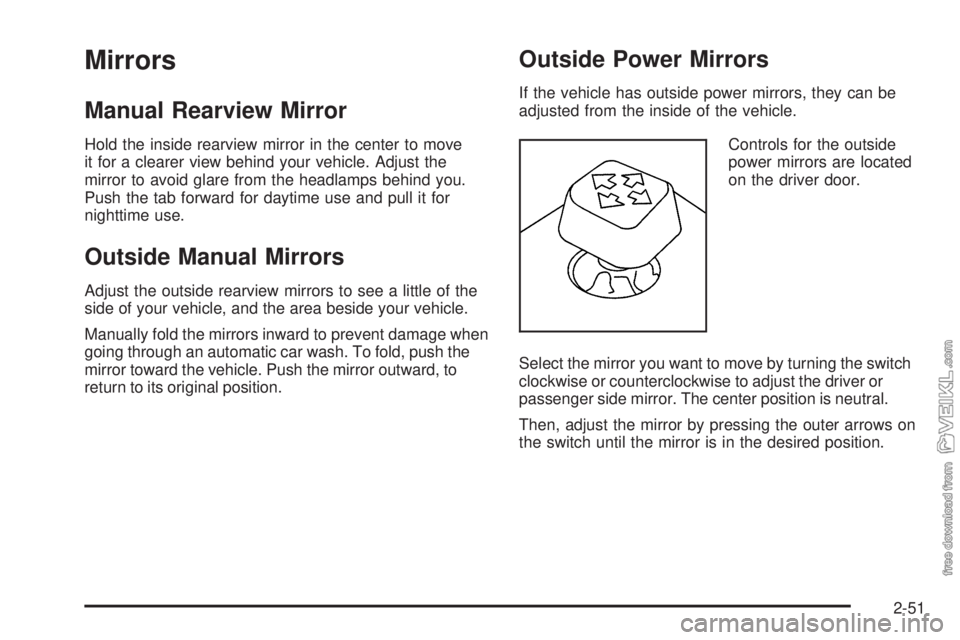
Controls for the outside
power mirrors are located
on the driver door.
Select the mirror you want to move by turning the switch
clockwise or counterclockwise to adjust the driver or
passenger side mirror. The center position is neutral.
Then, adjust the mirror by pressing the outer arrows on
the switch until the mirror is in the desired position.
2-51
Page 117 of 376
Storage Areas
Your vehicle includes a number of storage
compartments.
Some vehicles have storage areas in the instrument
panel. Another small storage area may be located
overhead. Other models may have more storage area
underneath the front passenger bench seat. Lift the seat
cushion to use the storage area.
Your vehicle may have a storage tray located behind
the driver and passenger seats.
All models also have storage compartments located
beneath the floorboard on both sides of the vehicle.
Center Console Storage
Your vehicle may have a center console compartment.
The back of your center bench seat may also fold
forward to reveal a console compartment.
The release strap for the center console is located
between the center seat and passenger seat.
To expose the storage compartment, pull the strap to
release the seatback. Then fold the seatback forward.
To open the storage compartment, press the release
button and lift the lid rearward. With the lid closed, it can
be used as a clipboard to hold papers in place.
Before returning the seatback to the upright position,
make sure the console is closed. Lift the seatback all the
way up until it clicks. Push and pull on the seatback
to make sure the seat is locked in place.
2-53
Page 119 of 376
Instrument Panel Overview...............................3-4
Hazard Warning Flashers................................3-6
Horn .............................................................3-6
Tilt Wheel.....................................................3-6
Turn Signal/Multifunction Lever.........................3-7
Turn and Lane-Change Signals........................3-7
Headlamp High/Low-Beam Changer..................3-8
Windshield Wipers..........................................3-8
Windshield Washer.........................................3-9
Cruise Control..............................................3-10
Exterior Lamps.............................................3-14
Headlamps on Reminder................................3-14
Daytime Running Lamps (DRL).......................3-15
Marker Lamps..............................................3-16
Instrument Panel Brightness...........................3-16
Dome Lamps ...............................................3-16
Entry Lighting...............................................3-17
Reading Lamps............................................3-17
Instrument Panel Switchbank..........................3-18
Accessory Power Outlet(s).............................3-19
Ashtray(s) and Cigarette Lighter......................3-19Climate Controls............................................3-20
Climate Control System.................................3-20
Outlet Adjustment.........................................3-22
Rear Heating System....................................3-23
Warning Lights, Gages, and Indicators............3-23
Instrument Panel Cluster................................3-24
Speedometer and Odometer...........................3-25
Trip Odometer..............................................3-25
Tachometer.................................................3-25
Engine Speed Limiter....................................3-25
Safety Belt Reminders...................................3-26
Airbag Readiness Light..................................3-27
Airbag Off Light............................................3-28
Charging System Light
..................................3-29
Voltmeter Gage............................................3-30
Service Transmission Warning Light................3-30
Range Inhibit Warning Indicator......................3-31
Brake System Warning Light..........................3-31
Antilock Brake System (ABS) Warning Light........3-33
Trailer Antilock Brake System Warning Light.......3-34
Engine Coolant Temperature Gage..................3-34
Section 3 Instrument Panel
3-1
Page 120 of 376
Low Coolant Warning Light............................3-35
Wait to Start Light........................................3-35
Malfunction Indicator Lamp.............................3-36
Oil Pressure Gage........................................3-38
Low Oil Level Light.......................................3-39
Change Engine Oil Light................................3-39
Engine Overspeed Warning Light....................3-40
Engine Shutdown Warning Light.....................3-40
Transmission Temperature Gage.....................3-40
Exhaust Brake Indicator Light.........................3-41
Differential Lock Indicator Light.......................3-41
Reduced Engine Power Light.........................3-42
Highbeam On Light.......................................3-42
Daytime Running Lamps (DRL)
Indicator Light...........................................3-42
Low Washer Fluid Warning Light.....................3-43
Power Take-Off Light (PTO)...........................3-43Check Gages Warning Light...........................3-43
Fuel Gage...................................................3-44
Water in Fuel Warning Light...........................3-45
Change Fuel Filter Warning Light....................3-45
Diesel Particulate Filter Warning Light..............3-46
Air Filter Restriction Indicator..........................3-46
Air Pressure Gage........................................3-47
Hourmeter Gage...........................................3-47
Audio System(s).............................................3-48
Setting the Clock..........................................3-48
Radio(s)......................................................3-49
Theft-Deterrent Feature..................................3-57
Radio Reception...........................................3-58
Fixed Mast Antenna......................................3-58
Chime Level Adjustment................................3-58
Section 3 Instrument Panel
3-2
Page 124 of 376
Hazard Warning Flashers
|(Hazard Warning Flasher):Press this button
located on top of the steering column, to make the front
and rear turn signal lamps flash on and off. This warns
others that you are having trouble. Press again to turn the
flashers off.
When the hazard warning flashers are on, the vehicle’s
turn signals will not work.
Horn
Sound the horn by pushing the center of the steering
wheel. If you have the optional air horn, it is controlled
by a cord that you will find up above and to the left
of the driver. The harder the cord is pulled, the louder
the air horn will sound. The air horn works only after the
air brake system pressure gets up to about 115 psi
(790 kPa). The air horn will work properly unless the air
brake system pressure drops below 60 psi (415 kPa).
Tilt Wheel
A tilt wheel lets the steering wheel be adjusted.
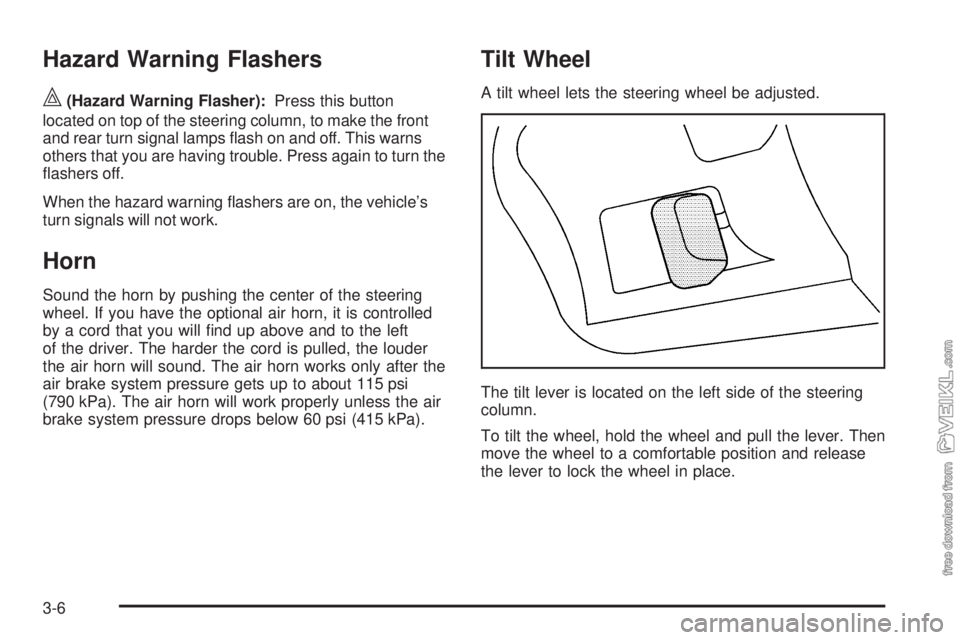
The tilt lever is located on the left side of the steering
column.
To tilt the wheel, hold the wheel and pull the lever. Then
move the wheel to a comfortable position and release
the lever to lock the wheel in place.
3-6
Page 127 of 376
For steady wiping at low speed, turn the band toward
you to the first solid band below the delay settings.
For high-speed wiping, turn the band farther, to the last
solid band below the delay settings.
Clear ice and snow from the wiper blades before using
them. If the wipers are frozen to the windshield,
carefully loosen or thaw them. If they become worn or
damaged, get new blades or blade inserts. For more
information, seeWindshield Wiper Blade Replacement
on page 5-71.
The windshield wiper motor is protected from overload
by a circuit breaker and a fuse. If the motor overheats
due to heavy snow or ice the wiper will stop until
the motor cools. Although the circuit is protected from
electrical overload, overload due to heavy snow or
ice may cause wiper linkage damage.Windshield Washer
L(Washer Fluid):There is a paddle marked with the
windshield washer symbol at the top of the multifunction
lever. Press the paddle to spray washer fluid on the
windshield. The wipers will clear the window and then
either stop or return to the preset speed.
{CAUTION:
In freezing weather, do not use your washer until
the windshield is warmed. Otherwise the washer
fluid can form ice on the windshield, blocking your
vision.
3-9
Page 132 of 376
Exterior Lamps
The control located to the left of the steering column
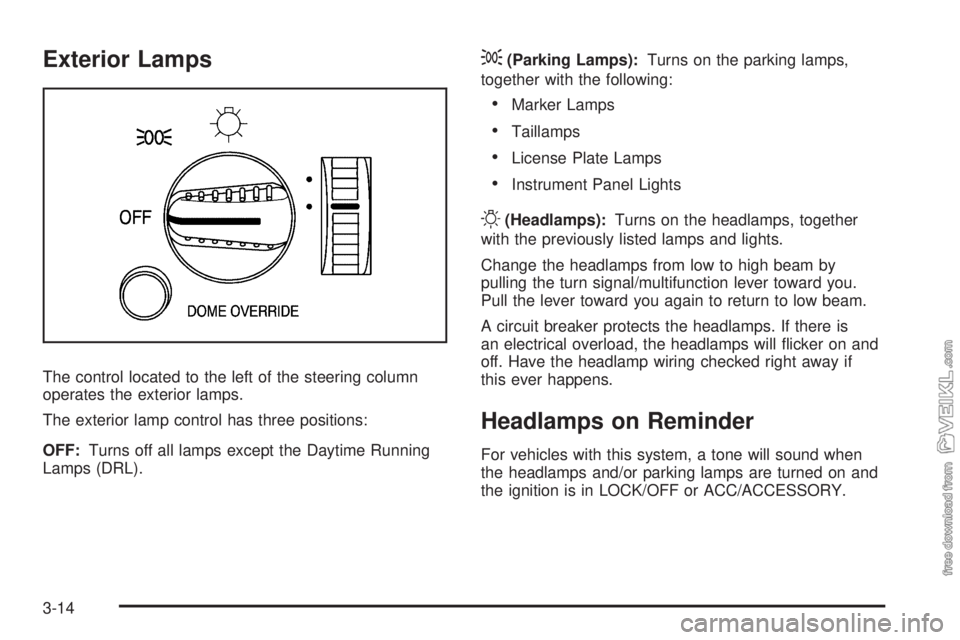
operates the exterior lamps.
The exterior lamp control has three positions:
OFF:Turns off all lamps except the Daytime Running
Lamps (DRL).
;(Parking Lamps):Turns on the parking lamps,
together with the following:
•Marker Lamps
•Taillamps
•License Plate Lamps
•Instrument Panel Lights
O(Headlamps):Turns on the headlamps, together
with the previously listed lamps and lights.
Change the headlamps from low to high beam by
pulling the turn signal/multifunction lever toward you.
Pull the lever toward you again to return to low beam.
A circuit breaker protects the headlamps. If there is
an electrical overload, the headlamps will flicker on and
off. Have the headlamp wiring checked right away if
this ever happens.
Headlamps on Reminder
For vehicles with this system, a tone will sound when
the headlamps and/or parking lamps are turned on and
the ignition is in LOCK/OFF or ACC/ACCESSORY.
3-14
Page 136 of 376
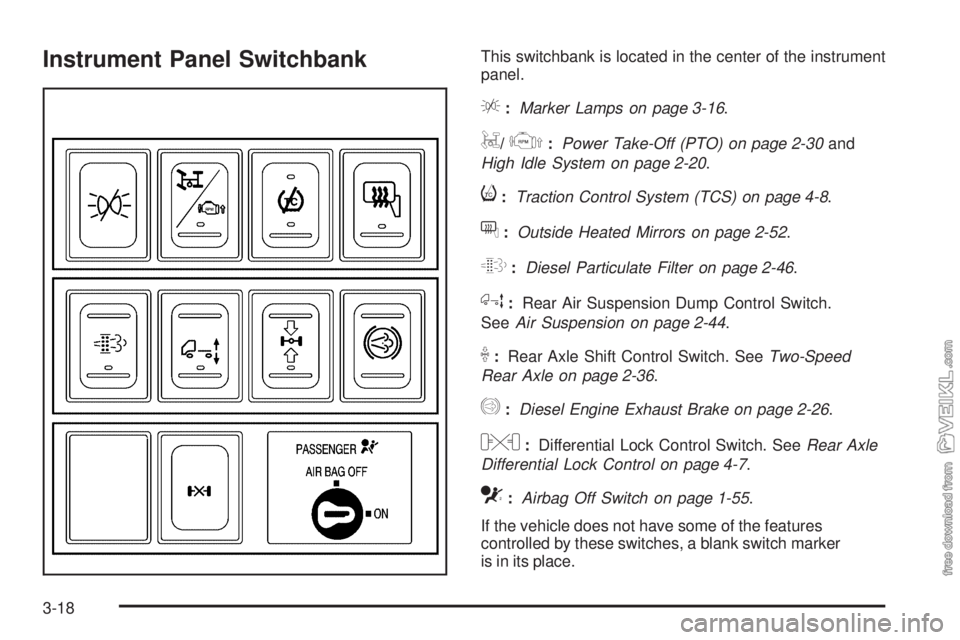
Instrument Panel SwitchbankThis switchbank is located in the center of the instrument
panel.
e:Marker Lamps on page 3-16.
g/j:Power Take-Off (PTO) on page 2-30and
High Idle System on page 2-20.
i:Traction Control System (TCS) on page 4-8.
f:Outside Heated Mirrors on page 2-52.
L:Diesel Particulate Filter on page 2-46.
h:Rear Air Suspension Dump Control Switch.
SeeAir Suspension on page 2-44.
k:Rear Axle Shift Control Switch. SeeTwo-Speed
Rear Axle on page 2-36.
q:Diesel Engine Exhaust Brake on page 2-26.
l:Differential Lock Control Switch. SeeRear Axle
Differential Lock Control on page 4-7.
c:Airbag Off Switch on page 1-55.
If the vehicle does not have some of the features
controlled by these switches, a blank switch marker
is in its place.
3-18
Page 138 of 376
Climate Controls
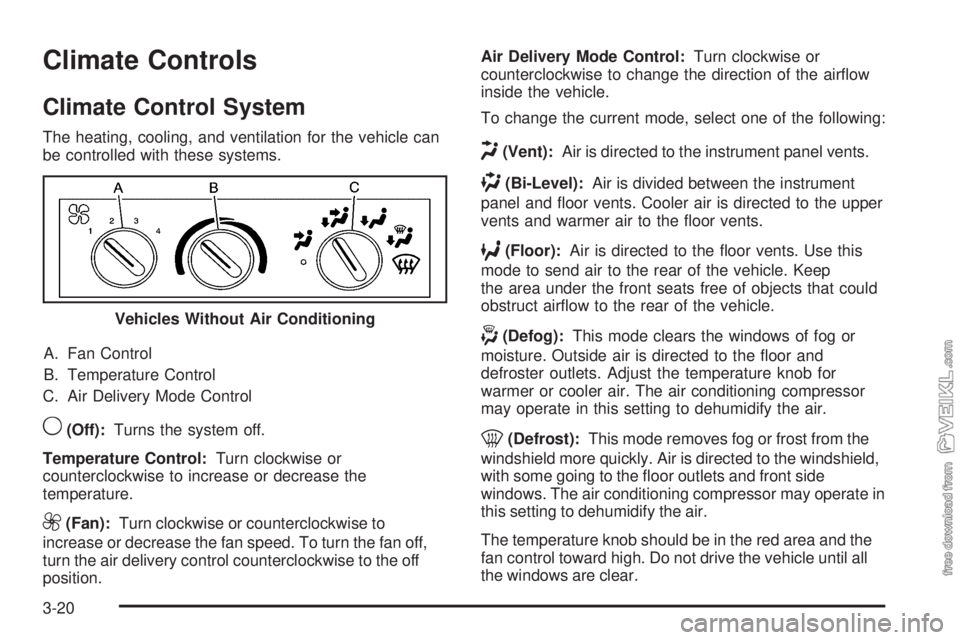
Climate Control System
The heating, cooling, and ventilation for the vehicle can
be controlled with these systems.
A. Fan Control
B. Temperature Control
C. Air Delivery Mode Control
9(Off):Turns the system off.
Temperature Control:Turn clockwise or
counterclockwise to increase or decrease the
temperature.
9(Fan):Turn clockwise or counterclockwise to
increase or decrease the fan speed. To turn the fan off,
turn the air delivery control counterclockwise to the off
position.Air Delivery Mode Control:Turn clockwise or
counterclockwise to change the direction of the airflow
inside the vehicle.
To change the current mode, select one of the following:
H(Vent):Air is directed to the instrument panel vents.
)(Bi-Level):Air is divided between the instrument
panel and floor vents. Cooler air is directed to the upper
vents and warmer air to the floor vents.
6(Floor):Air is directed to the floor vents. Use this
mode to send air to the rear of the vehicle. Keep
the area under the front seats free of objects that could
obstruct airflow to the rear of the vehicle.
-(Defog):This mode clears the windows of fog or
moisture. Outside air is directed to the floor and
defroster outlets. Adjust the temperature knob for
warmer or cooler air. The air conditioning compressor
may operate in this setting to dehumidify the air.
0(Defrost):This mode removes fog or frost from the
windshield more quickly. Air is directed to the windshield,
with some going to the floor outlets and front side
windows. The air conditioning compressor may operate in
this setting to dehumidify the air.
The temperature knob should be in the red area and the
fan control toward high. Do not drive the vehicle until all
the windows are clear. Vehicles Without Air Conditioning
3-20
Page 139 of 376
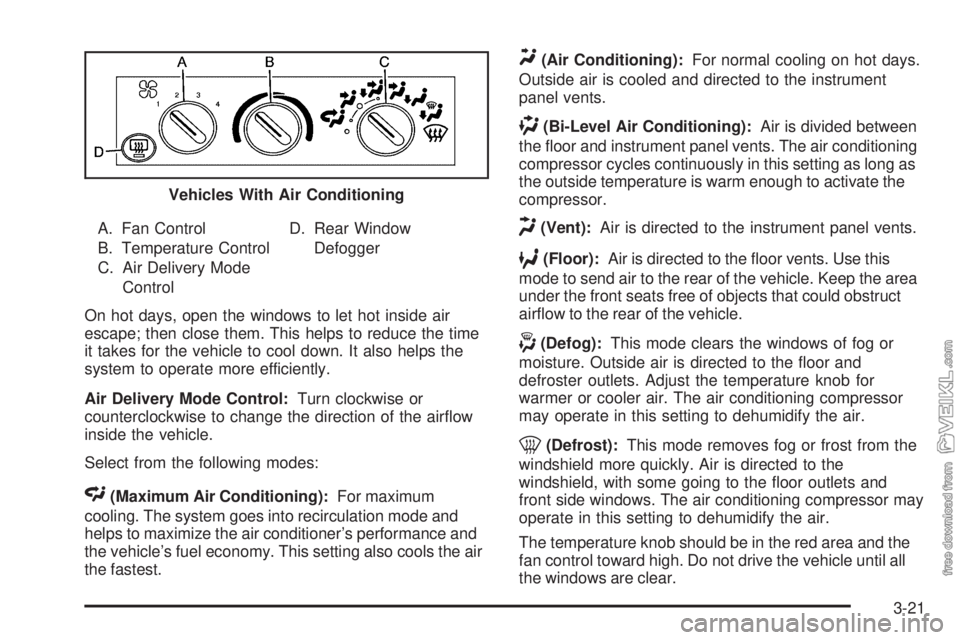
A. Fan Control
B. Temperature Control
C. Air Delivery Mode
ControlD. Rear Window
Defogger
On hot days, open the windows to let hot inside air
escape; then close them. This helps to reduce the time
it takes for the vehicle to cool down. It also helps the
system to operate more efficiently.
Air Delivery Mode Control:Turn clockwise or
counterclockwise to change the direction of the airflow
inside the vehicle.
Select from the following modes:
<(Maximum Air Conditioning):For maximum
cooling. The system goes into recirculation mode and
helps to maximize the air conditioner’s performance and
the vehicle’s fuel economy. This setting also cools the air
the fastest.
Y(Air Conditioning):For normal cooling on hot days.
Outside air is cooled and directed to the instrument
panel vents.
)(Bi-Level Air Conditioning):Air is divided between
the floor and instrument panel vents. The air conditioning
compressor cycles continuously in this setting as long as
the outside temperature is warm enough to activate the
compressor.
H(Vent):Air is directed to the instrument panel vents.
6(Floor):Air is directed to the floor vents. Use this
mode to send air to the rear of the vehicle. Keep the area
under the front seats free of objects that could obstruct
airflow to the rear of the vehicle.
-(Defog):This mode clears the windows of fog or
moisture. Outside air is directed to the floor and
defroster outlets. Adjust the temperature knob for
warmer or cooler air. The air conditioning compressor
may operate in this setting to dehumidify the air.
0(Defrost):This mode removes fog or frost from the
windshield more quickly. Air is directed to the
windshield, with some going to the floor outlets and
front side windows. The air conditioning compressor may
operate in this setting to dehumidify the air.
The temperature knob should be in the red area and the
fan control toward high. Do not drive the vehicle until all
the windows are clear. Vehicles With Air Conditioning
3-21