lock CHEVROLET KODIAK 2009 Repair Manual
[x] Cancel search | Manufacturer: CHEVROLET, Model Year: 2009, Model line: KODIAK, Model: CHEVROLET KODIAK 2009Pages: 376, PDF Size: 5.39 MB
Page 217 of 376
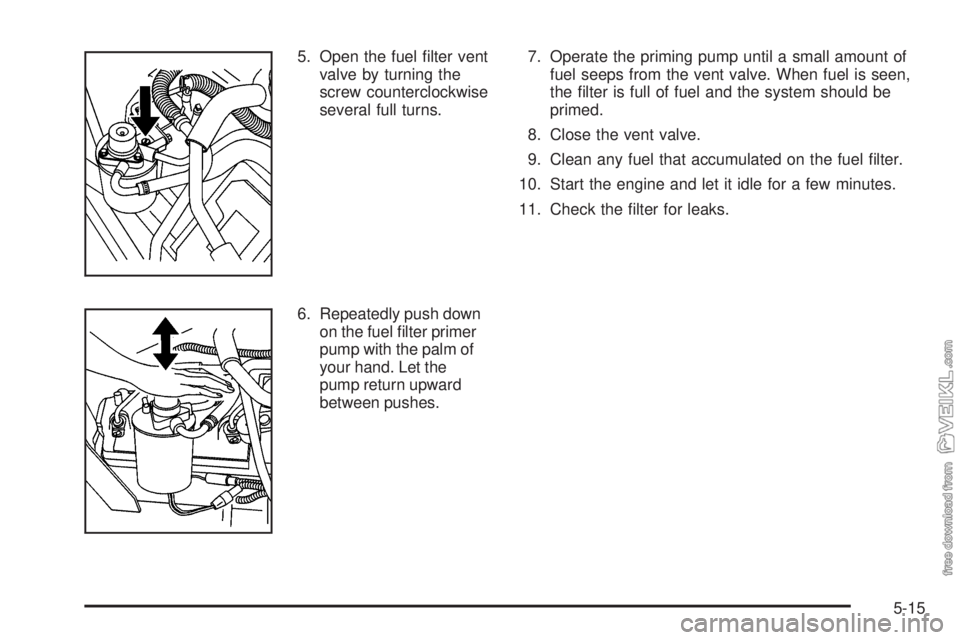
5. Open the fuel filter vent
valve by turning the
screw counterclockwise
several full turns.
6. Repeatedly push down
on the fuel filter primer
pump with the palm of
your hand. Let the
pump return upward
between pushes.7. Operate the priming pump until a small amount of
fuel seeps from the vent valve. When fuel is seen,
the filter is full of fuel and the system should be
primed.
8. Close the vent valve.
9. Clean any fuel that accumulated on the fuel filter.
10. Start the engine and let it idle for a few minutes.
11. Check the filter for leaks.
5-15
Page 218 of 376
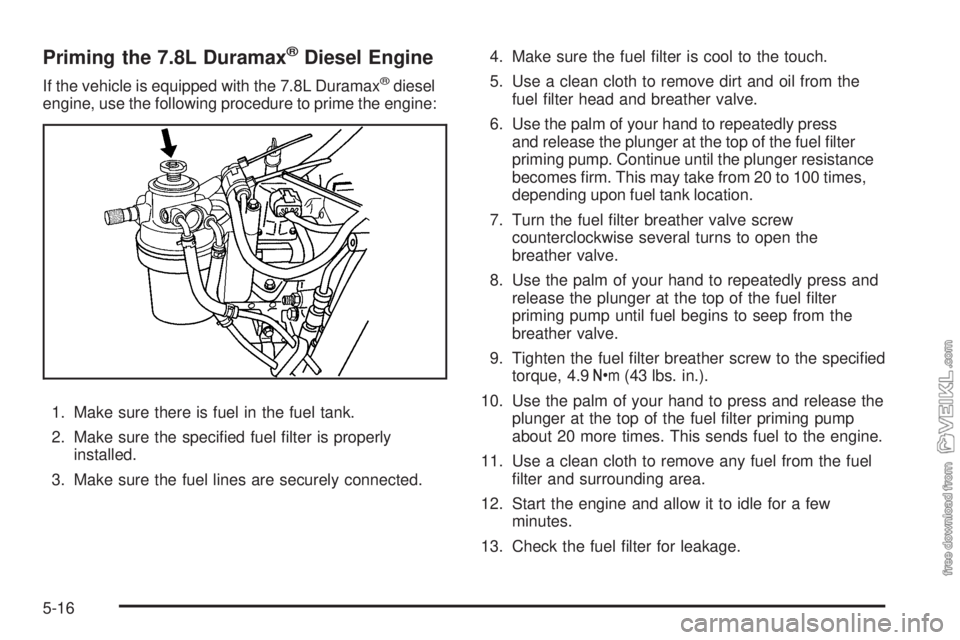
Priming the 7.8L Duramax®Diesel Engine
If the vehicle is equipped with the 7.8L Duramax®diesel
engine, use the following procedure to prime the engine:
1. Make sure there is fuel in the fuel tank.
2. Make sure the specified fuel filter is properly
installed.
3. Make sure the fuel lines are securely connected.4. Make sure the fuel filter is cool to the touch.
5. Use a clean cloth to remove dirt and oil from the
fuel filter head and breather valve.
6. Use the palm of your hand to repeatedly press
and release the plunger at the top of the fuel filter
priming pump. Continue until the plunger resistance
becomes firm. This may take from 20 to 100 times,
depending upon fuel tank location.
7. Turn the fuel filter breather valve screw
counterclockwise several turns to open the
breather valve.
8. Use the palm of your hand to repeatedly press and
release the plunger at the top of the fuel filter
priming pump until fuel begins to seep from the
breather valve.
9. Tighten the fuel filter breather screw to the specified
torque, 4.9Y(43 lbs. in.).
10. Use the palm of your hand to press and release the
plunger at the top of the fuel filter priming pump
about 20 more times. This sends fuel to the engine.
11. Use a clean cloth to remove any fuel from the fuel
filter and surrounding area.
12. Start the engine and allow it to idle for a few
minutes.
13. Check the fuel filter for leakage.
5-16
Page 221 of 376
4. Install the new filter element.
5. Reinstall and tighten the filter container and
reconnect the water sensor wire to the filter.
6. Use the fuel filter priming procedure earlier in this
section to prime the fuel filter.
7. Tighten the air bleed valve by turning it clockwise
until hand-tight.
8. Start the engine and let it idle for five minutes.
Check the fuel filter and air bleed valve for leaks.
How to Reset Fuel Filter Change
Light - DURAMAX 6.6L (LMM) Engine
The engine controller calculates when to change the fuel
filter based on vehicle and fuel use. Whenever the
fuel filter is changed, reset the fuel filter light so
the engine controller can calculate when the next fuel
filter change is required. If the fuel filter is ever changed
prior to a change fuel filter light being turned on,
reset the fuel filter change light.To reset the Fuel Filter Change light:
1. Turn the ignition key to ON/RUN with the engine off
2. Fully press the accelerator and brake pedals at the
same time for 10 seconds. If the Fuel Filter Change
light flashes for 5 seconds, the system is resetting.
3. Turn the key to OFF.
If the Fuel Filter Change light comes back on when you
start the vehicle, the light has not been reset. Repeat
the procedure. SeeChange Fuel Filter Warning Light on
page 3-45for more information.
Fuels in Foreign Countries
If you plan on driving in another country outside the
United States or Canada, the proper fuel might be hard
to find. Never use leaded gasoline or any other fuel
not recommended in the previous text on fuel. Costly
repairs caused by use of improper fuel would not
be covered by the vehicle warranty.
To check the fuel availability, ask an auto club, or
contact a major oil company that does business in the
country where you will be driving.
5-19
Page 222 of 376
Filling the Tank
{CAUTION:
Fuel vapor is highly flammable. It burns violently,
and that can cause very bad injuries. Do not
smoke if you are near fuel or refueling the vehicle.
Keep sparks, flames and smoking materials away
from fuel.
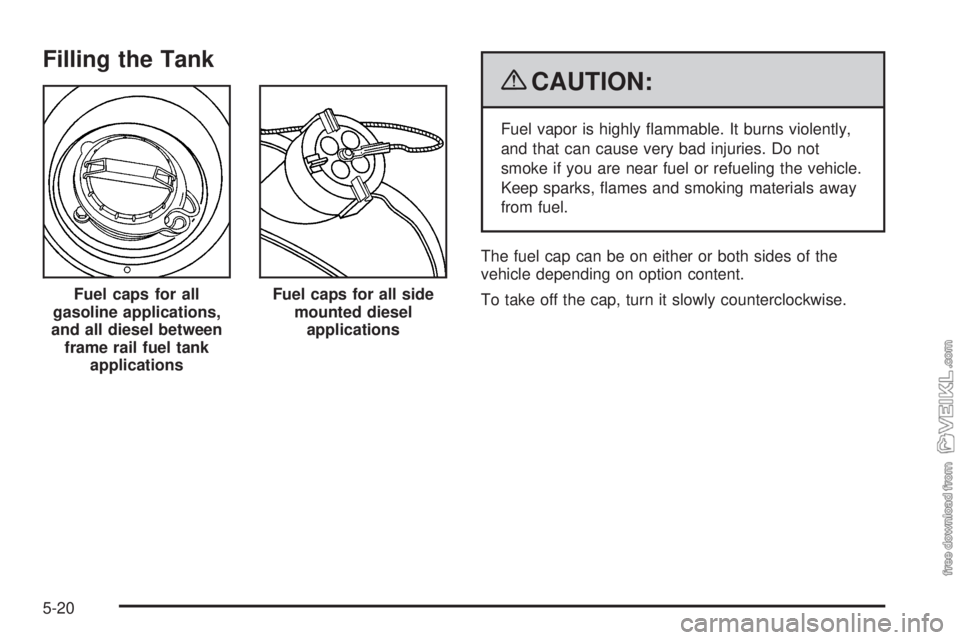
The fuel cap can be on either or both sides of the
vehicle depending on option content.
To take off the cap, turn it slowly counterclockwise. Fuel caps for all
gasoline applications,
and all diesel between
frame rail fuel tank
applications
Fuel caps for all side
mounted diesel
applications
5-20
Page 223 of 376
{CAUTION:
If you get fuel on yourself and then something
ignites it, you could be badly burned. Fuel can
spray out on you if you open the fuel cap too
quickly. This spray can happen if the tank is nearly
full, and is more likely in hot weather. Open the
fuel cap slowly and wait for any “hiss” noise to
stop. Then unscrew the cap all the way.
When reinstalling the cap, turn it clockwise until it is
tight.
Notice:If you need a new fuel cap, be sure to get
the right type. Your dealer/retailer can get one
for you. If you get the wrong type, it may not fit
properly. This may cause the malfunction indicator
lamp to light and may damage the fuel tank and
emissions system. SeeMalfunction Indicator Lamp
on page 3-36.If the vehicle has dual tanks, fill the driver side tank,
or forward tank, first. The fuel gage will give better
readings this way. The gage will show the total fuel left
in both tanks.
If the vehicle is a C4/C5 model and has dual tanks, the
engine must be off when refueling or the fuel transfer
system may become inoperable.
If the vehicle has a single tank with dual fillers, where
there is a filler on each side of the vehicle, do not
attempt to fill the tank through both fillers at the same
time. Do not fill the tank with both caps removed or
over-filling the tank and fuel spillage can result.
5-21
Page 242 of 376
How to Inspect the Engine Air Cleaner/
Filters (Gas V8 8.1L, Caterpillar 7.2L and
Isuzu 7.8L Diesel Engines)
{CAUTION:
Operating the engine with the air cleaner/filter off
can cause you or others to be burned. The air
cleaner not only cleans the air; it helps to stop
flames if the engine backfires. If it is not there and
the engine backfires, you could be burned. Do not
drive with it off, and be careful working on the
engine with the air cleaner/filter off.
Notice:If the air cleaner/filter is off, a backfire can
cause a damaging engine fire. And, dirt can easily get
into the engine, which will damage it. Always have
the air cleaner/filter in place when you are driving.
The engine air cleaner/filter is located in the center of
the engine compartment.To inspect the engine air cleaner/filter:
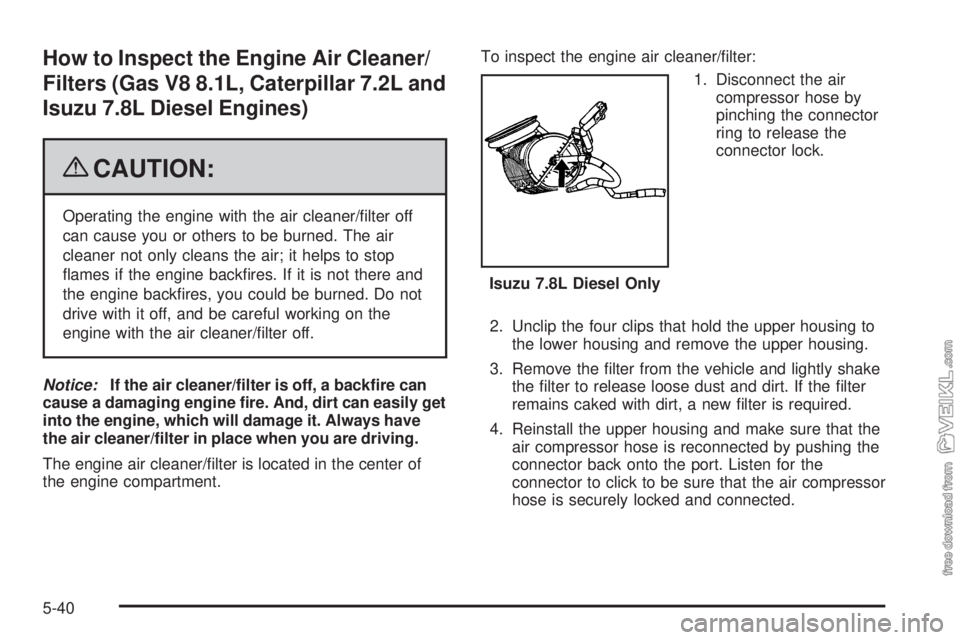
1. Disconnect the air
compressor hose by
pinching the connector
ring to release the
connector lock.
2. Unclip the four clips that hold the upper housing to
the lower housing and remove the upper housing.
3. Remove the filter from the vehicle and lightly shake
the filter to release loose dust and dirt. If the filter
remains caked with dirt, a new filter is required.
4. Reinstall the upper housing and make sure that the
air compressor hose is reconnected by pushing the
connector back onto the port. Listen for the
connector to click to be sure that the air compressor
hose is securely locked and connected. Isuzu 7.8L Diesel Only
5-40
Page 243 of 376
Hood Inlet Seal
If the vehicle is being used in heavy snow conditions or
for snow plowing, there is a possibility of snow and
ice build up in the inlet to the air cleaner, which
can block airflow to the engine and affect impacting
engine performance.
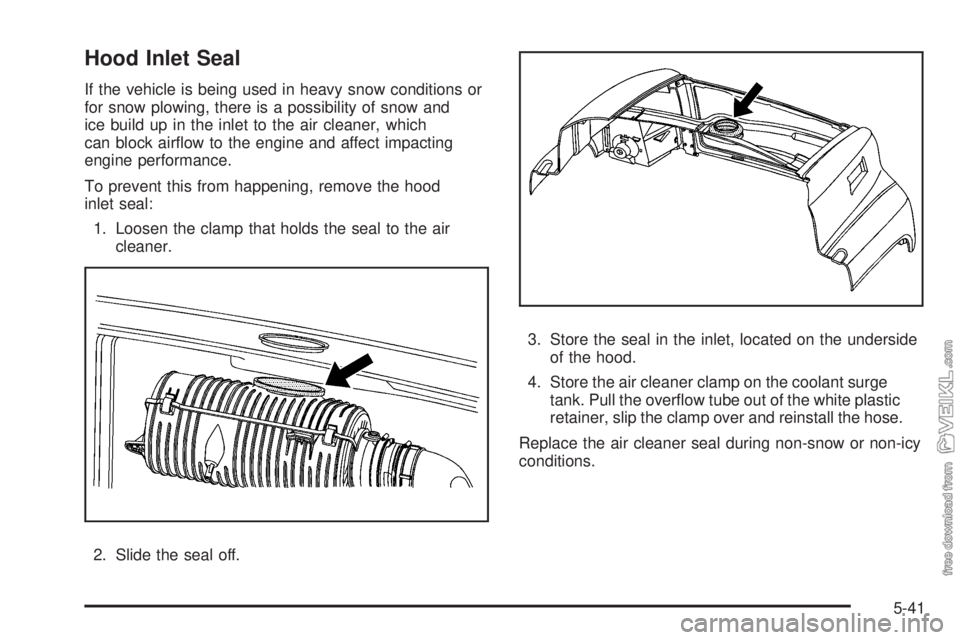
To prevent this from happening, remove the hood
inlet seal:
1. Loosen the clamp that holds the seal to the air
cleaner.
2. Slide the seal off.3. Store the seal in the inlet, located on the underside
of the hood.
4. Store the air cleaner clamp on the coolant surge
tank. Pull the overflow tube out of the white plastic
retainer, slip the clamp over and reinstall the hose.
Replace the air cleaner seal during non-snow or non-icy
conditions.
5-41
Page 248 of 376
{CAUTION:
You can be burned if you spill coolant on hot
engine parts. Coolant contains ethylene glycol and
it will burn if the engine parts are hot enough. Do
not spill coolant on a hot engine.
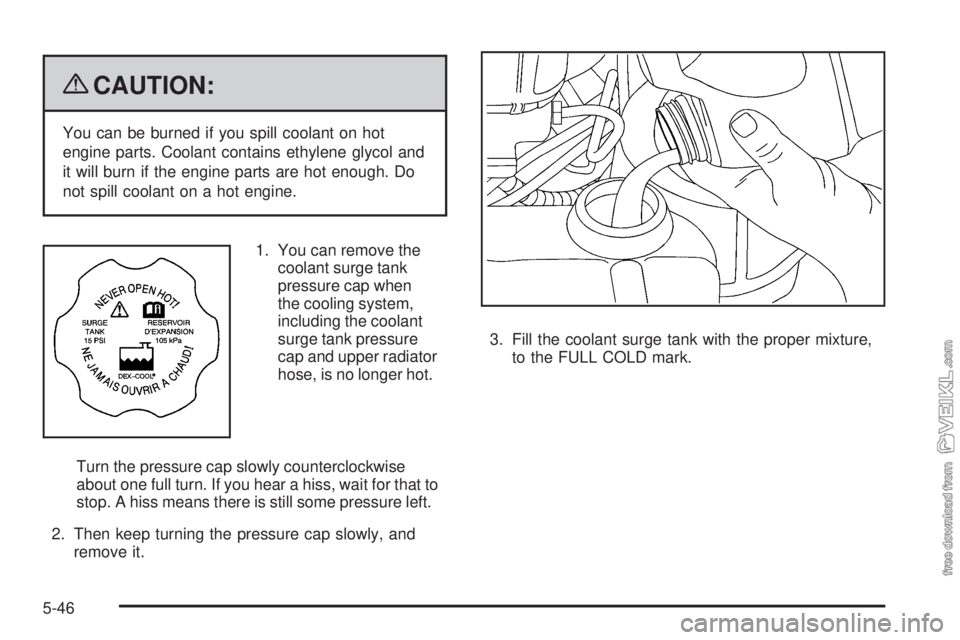
1. You can remove the
coolant surge tank
pressure cap when
the cooling system,
including the coolant
surge tank pressure
cap and upper radiator
hose, is no longer hot.
Turn the pressure cap slowly counterclockwise
about one full turn. If you hear a hiss, wait for that to
stop. A hiss means there is still some pressure left.
2. Then keep turning the pressure cap slowly, and
remove it.3. Fill the coolant surge tank with the proper mixture,
to the FULL COLD mark.
5-46
Page 270 of 376
Rear Axle Shift Motor
When to Check and Change Fluid
If you have an optional air-shift two-speed, controlled
traction, or locking differential type rear axle, a good time
to check the fluid level in the axle shift motor is when
the rear axle lubricant is checked.
How to Check Fluid
Remove the plug on the front plate of the axle shift
motor, add enough fluid to raise the level to the bottom
of the filler plug hole, then replace the plug.
What to Use
Refer to your Maintenance Schedule to determine what
kind of lubricant to use. SeePart C: Recommended
Fluids and Lubricants on page 6-31.
Four-Wheel Drive
Transfer Case
When to Check Lubricant
It is not necessary to regularly check transfer case fluid
unless you suspect there is a leak or you hear an
unusual noise. A fluid loss could indicate a problem.
Have it inspected and repaired.
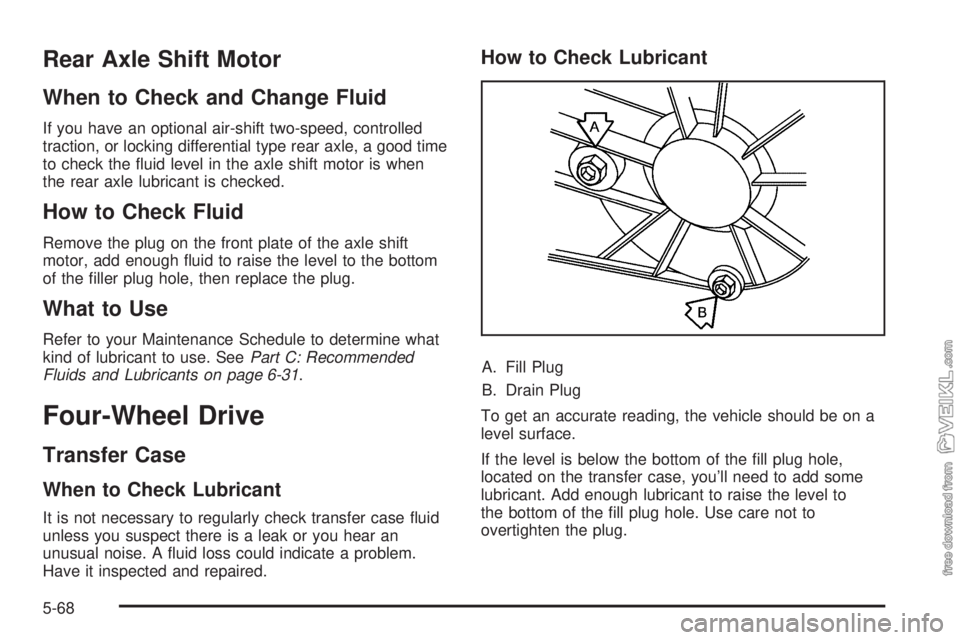
How to Check Lubricant
A. Fill Plug
B. Drain Plug
To get an accurate reading, the vehicle should be on a
level surface.
If the level is below the bottom of the fill plug hole,
located on the transfer case, you’ll need to add some
lubricant. Add enough lubricant to raise the level to
the bottom of the fill plug hole. Use care not to
overtighten the plug.
5-68
Page 283 of 376
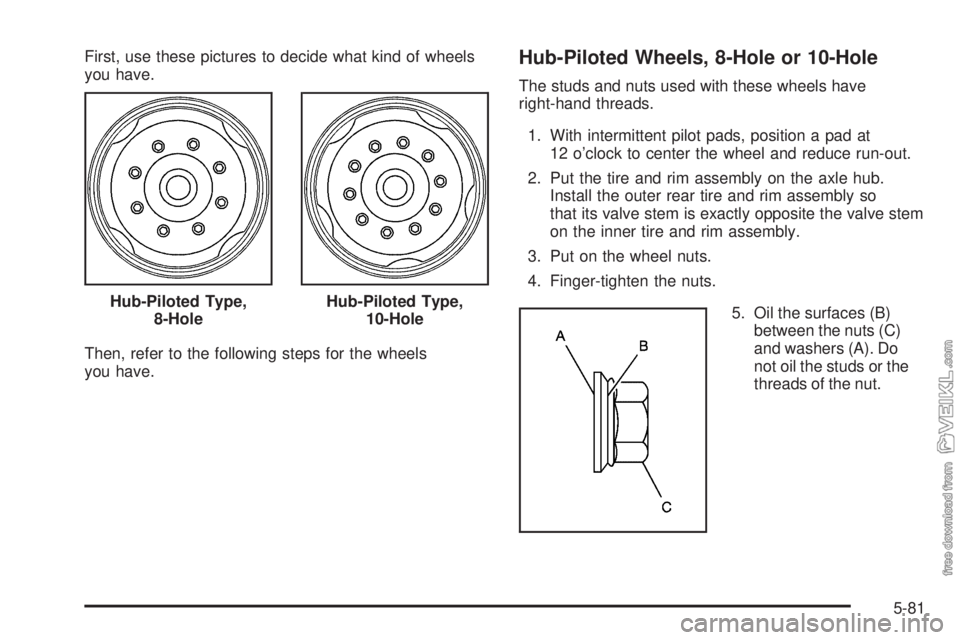
First, use these pictures to decide what kind of wheels
you have.
Then, refer to the following steps for the wheels
you have.Hub-Piloted Wheels, 8-Hole or 10-Hole
The studs and nuts used with these wheels have
right-hand threads.
1. With intermittent pilot pads, position a pad at
12 o’clock to center the wheel and reduce run-out.
2. Put the tire and rim assembly on the axle hub.
Install the outer rear tire and rim assembly so
that its valve stem is exactly opposite the valve stem
on the inner tire and rim assembly.
3. Put on the wheel nuts.
4. Finger-tighten the nuts.
5. Oil the surfaces (B)
between the nuts (C)
and washers (A). Do
not oil the studs or the
threads of the nut. Hub-Piloted Type,
8-Hole
Hub-Piloted Type,
10-Hole
5-81