service CHEVROLET KODIAK 2009 Workshop Manual
[x] Cancel search | Manufacturer: CHEVROLET, Model Year: 2009, Model line: KODIAK, Model: CHEVROLET KODIAK 2009Pages: 376, PDF Size: 5.39 MB
Page 256 of 376
Four-Wheel Disc Brakes
(Hydraulic Only)
The vehicle has four-wheel disc brakes.
Some driving conditions or climates can cause a brake
squeal when the brakes are first applied or lightly
applied. This does not mean something is wrong with
the brakes.
Brake linings should always be replaced as complete
axle sets.
Four-Wheel and Six-Wheel Drum
Brakes (Air Only)
The brake drums should be removed and inspected
each time the tires are removed for rotation or changing.
When the front brakes are replaced, have the rear
brakes inspected, too.
Brake linings should always be replaced as complete
axle sets.
Brake Pedal Travel
See your dealer/retailer if the brake pedal does not
return to normal height, or if there is a rapid increase in
pedal travel. This could be a sign that brake service
might be required.
Brake Adjustment
Every brake stop, the brakes adjust for wear.
Brake Adjustment on Air Braked Vehicles
The vehicle has automatic slack adjusters. Every
brake stop, the brakes automatically adjust for wear.
Slack adjusters should never be manually adjusted
to correct excessive brake chamber pushrod stroke.
Excessive brake chamber pushrod stroke means
that the brake system needs to be serviced by a
qualified service technician.
Notice:Do not manually adjust automatic slack
adjusters. Manual adjustment of the automatic slack
adjusters can result in a degradation of the slack
adjuster performance over time. If the brake
chamber pushrod stroke is out of adjustment, the
brake system needs to be serviced by a qualified
service technician.
5-54
Page 257 of 376
Replacing Brake System Parts
The braking system on a vehicle is complex. Its many
parts have to be of top quality and work well together if
the vehicle is to have really good braking. The vehicle
was designed and tested with top-quality brake parts.
When parts of the braking system are replaced — for
example, when the brake linings wear down and new
ones are installed — be sure to get new approved
replacement parts. If this is not done, the brakes might
not work properly. For example, if someone puts in brake
linings that are wrong for the vehicle, the balance
between the front and rear brakes can change — for the
worse. The braking performance expected can change in
many other ways if the wrong replacement brake parts
are installed.
Hydraulic Brake Pads
Brake pad lining life will vary depending on
vehicle application, working environment, equipment
maintenance, and style of driving. The brake pad lining
wear rate has to be monitored for individual driving
habits — original equipment linings have mechanical
wear indicators to help with this. When down to the last
10% of the brake lining, the brake lining wear indicator
rubs on the rotor, causing a scratching or chirping
sound. When this sound is heard, service to the brake
pads is needed. SeeScheduled Maintenance on
page 6-5.
Aftermarket brake linings might not meet the same
stringent requirements as the original equipment linings.
Using aftermarket brake linings can affect braking
performance, pedal feel, noise, and lining wear.
5-55
Page 259 of 376
Electric Air Compressor
The vehicle might have an electric air compressor.
This compressor is used to run options that require
pressurized air, such as an air horn or air seat.
The air compressor is used when vehicles do not have
an air brake system.
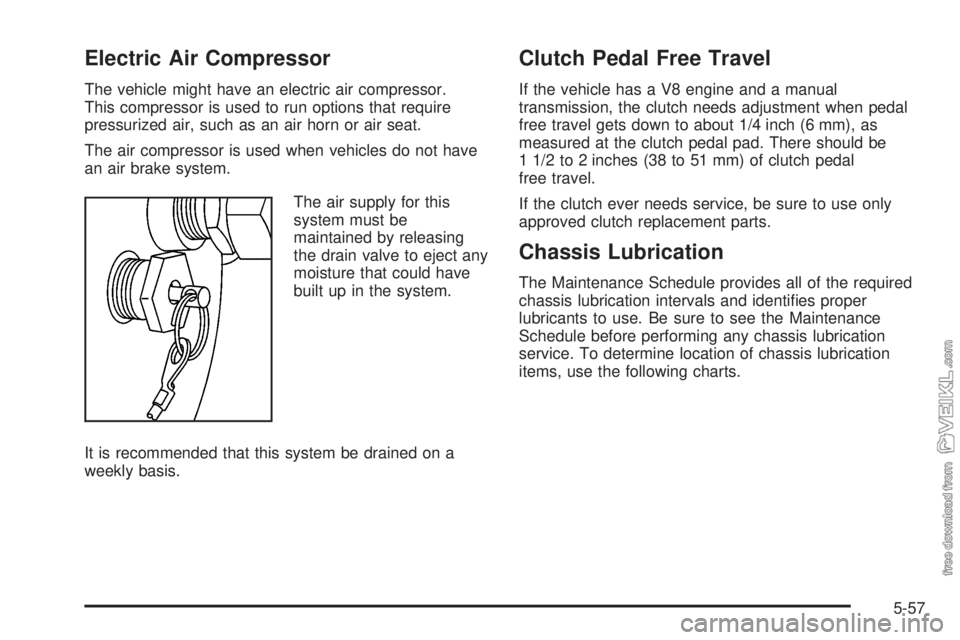
The air supply for this
system must be
maintained by releasing
the drain valve to eject any
moisture that could have
built up in the system.
It is recommended that this system be drained on a
weekly basis.
Clutch Pedal Free Travel
If the vehicle has a V8 engine and a manual
transmission, the clutch needs adjustment when pedal
free travel gets down to about 1/4 inch (6 mm), as
measured at the clutch pedal pad. There should be
1 1/2 to 2 inches (38 to 51 mm) of clutch pedal
free travel.
If the clutch ever needs service, be sure to use only
approved clutch replacement parts.
Chassis Lubrication
The Maintenance Schedule provides all of the required
chassis lubrication intervals and identifies proper
lubricants to use. Be sure to see the Maintenance
Schedule before performing any chassis lubrication
service. To determine location of chassis lubrication
items, use the following charts.
5-57
Page 267 of 376
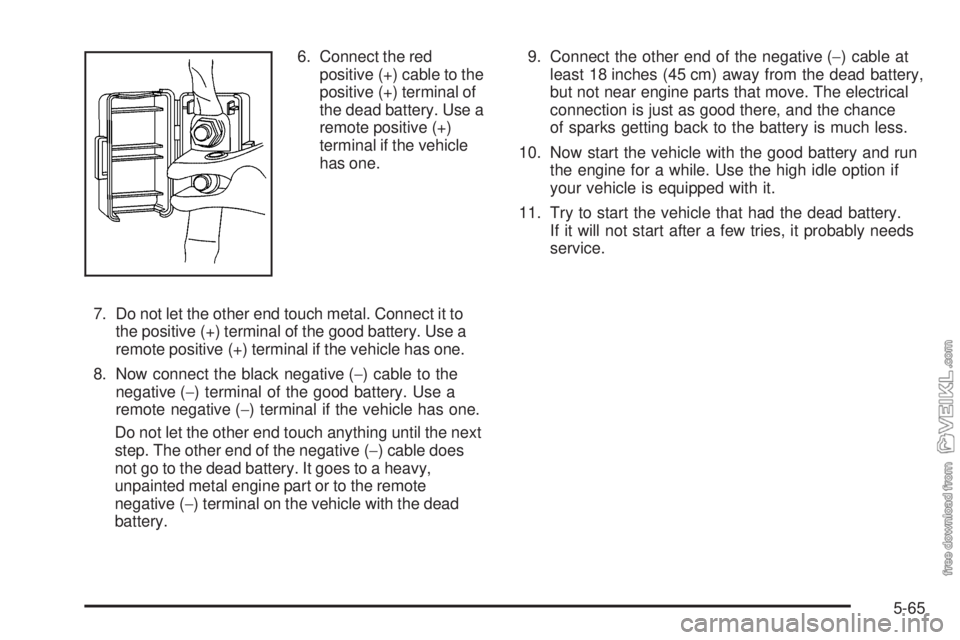
6. Connect the red
positive (+) cable to the
positive (+) terminal of
the dead battery. Use a
remote positive (+)
terminal if the vehicle
has one.
7. Do not let the other end touch metal. Connect it to
the positive (+) terminal of the good battery. Use a
remote positive (+) terminal if the vehicle has one.
8. Now connect the black negative (−) cable to the
negative (−) terminal of the good battery. Use a
remote negative (−) terminal if the vehicle has one.
Do not let the other end touch anything until the next
step. The other end of the negative (−) cable does
not go to the dead battery. It goes to a heavy,
unpainted metal engine part or to the remote
negative (−) terminal on the vehicle with the dead
battery.9. Connect the other end of the negative (−) cable at
least 18 inches (45 cm) away from the dead battery,
but not near engine parts that move. The electrical
connection is just as good there, and the chance
of sparks getting back to the battery is much less.
10. Now start the vehicle with the good battery and run
the engine for a while. Use the high idle option if
your vehicle is equipped with it.
11. Try to start the vehicle that had the dead battery.
If it will not start after a few tries, it probably needs
service.
5-65
Page 274 of 376
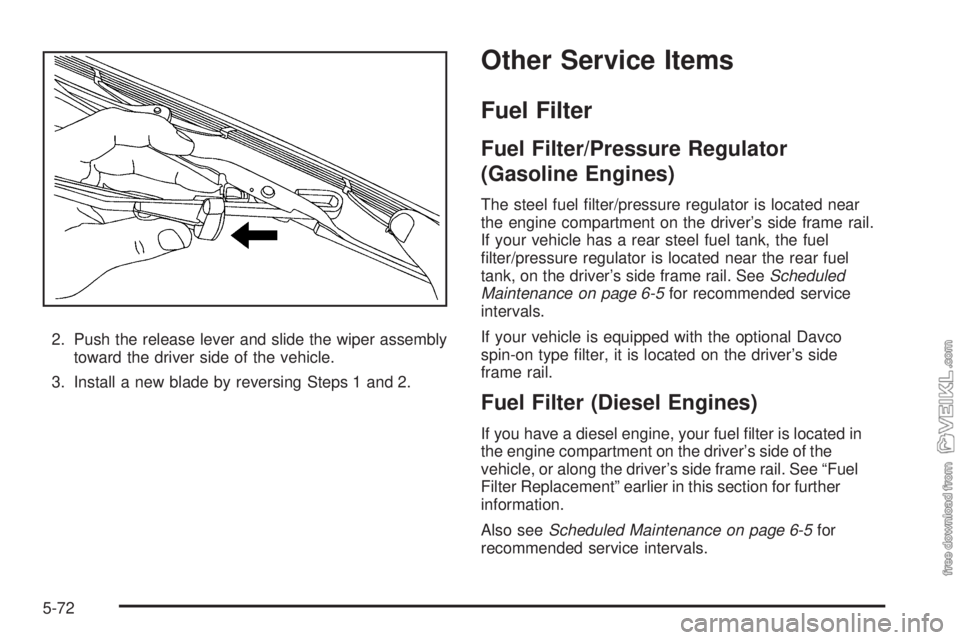
2. Push the release lever and slide the wiper assembly
toward the driver side of the vehicle.
3. Install a new blade by reversing Steps 1 and 2.
Other Service Items
Fuel Filter
Fuel Filter/Pressure Regulator
(Gasoline Engines)
The steel fuel filter/pressure regulator is located near
the engine compartment on the driver’s side frame rail.
If your vehicle has a rear steel fuel tank, the fuel
filter/pressure regulator is located near the rear fuel
tank, on the driver’s side frame rail. SeeScheduled
Maintenance on page 6-5for recommended service
intervals.
If your vehicle is equipped with the optional Davco
spin-on type filter, it is located on the driver’s side
frame rail.
Fuel Filter (Diesel Engines)
If you have a diesel engine, your fuel filter is located in
the engine compartment on the driver’s side of the
vehicle, or along the driver’s side frame rail. See “Fuel
Filter Replacement” earlier in this section for further
information.
Also seeScheduled Maintenance on page 6-5for
recommended service intervals.
5-72
Page 278 of 376
Tires
Your new vehicle comes with high-quality tires
made by a leading tire manufacturer. If you ever
have questions about your tire warranty and where
to obtain service, see your vehicle Warranty booklet
for details. For additional information refer to the tire
manufacturer.
{CAUTION:
Poorly maintained and improperly used tires
are dangerous.
•Overloading your vehicle’s tires can
cause overheating as a result of too
much flexing. You could have an air-out
and a serious accident. SeeLoading the
Vehicle on page 4-20.
CAUTION: (Continued)
CAUTION: (Continued)
•
Underinflated tires pose the same danger
as overloaded tires. The resulting accident
could cause serious injury. Check all tires
frequently to maintain the recommended
pressure. Tire pressure should be
checked when your vehicle’s tires are
cold. SeeInflation - Tire Pressure on
page 5-77.
•Overinflated tires are more likely to be
cut, punctured, or broken by a sudden
impact — such as when you hit a pothole.
Keep tires at the recommended pressure.
•Worn, old tires can cause accidents. If the
tire’s tread is badly worn, or if your
vehicle’s tires have been damaged,
replace them.
5-76
Page 280 of 376
Wheel Loading
Wheels are stamped with a maximum load and cold
inflation rating. Be sure you do not exceed these limits.
Dual Tire Operation
When the vehicle is new, check the wheel nut tightness
on all wheels with a torque wrench after your first
100 miles (160 km) and then 1,000 miles (1 600 km) after
that. Whenever a wheel, wheel bolt or wheel nut is
removed or serviced, repeat the 100 miles (160 km), and
then 1,000 mile (1 600 km) wheel nut tightness check.
SeeTightening the Wheel Nuts on page 5-80for wheel
nut tightening information and proper torque values.
{CAUTION:
If you operate your vehicle with a tire that is badly
underinflated, the tire can overheat. An overheated
tire can lose air suddenly or catch fire. You or
others could be injured. Be sure all tires (including
the spare, if any) are properly inflated.
SeeTires on page 5-76andInflation - Tire Pressure on
page 5-77for more information on proper tire inflation.
When It Is Time for New Tires
Various factors, such as maintenance, temperatures,
driving speeds, vehicle loading, and road conditions,
influence when you need new tires.
Replace your tires when the tread depth is down to
1/8 of an inch (3.2 mm) for the front tires, or 1/16 of an
inch (1.6 mm) for a rear tire. Also, you need a new
tire if:
•You can see cord or fabric showing through the
tire’s rubber.
•The tread or sidewall is cracked, cut, or snagged
deep enough to show cord or fabric.
•The tire has a bump, bulge, or split.
•The tire has a puncture, cut, or other damage that
cannot be repaired well because of the size or
location of the damage.
The rubber in tires degrades over time, even if they are
not being used. This is also true for the spare tire, if your
vehicle has one. Multiple conditions affect how fast this
aging takes place, including temperatures, loading
conditions, and inflation pressure maintenance. With
proper care and maintenance tires will typically wear out
before they degrade due to age. If you are unsure about
the need to replace your tires as they get older, consult
the tire manufacturer for more information.
5-78
Page 285 of 376
{CAUTION:
If wheel studs are damaged, they can break. If all
the studs on a wheel broke, the wheel could come
off and cause a crash. If any stud is damaged
because of a loose-running wheel, it could be that
all of the studs are damaged. To be sure, replace
all studs on the wheel. If the stud holes in a wheel
have become larger, the wheel could collapse in
operation. Replace any wheel if its stud holes
have become larger or distorted in any way.
Inspect hubs and hub-piloted wheels for damage.
Because of loose running wheels, piloting pad
damage may occur and require replacement of the
entire hub, for proper centering of the wheels.
When replacing studs, hubs, wheel nuts or
wheels, be sure to use GM original equipment
parts.
{CAUTION:
Rust or dirt on a wheel, or on the parts to
which it is fastened, can make wheel nuts
become loose after a time. The wheel could
come off and cause a crash. When you
change a wheel, remove any rust or dirt from
places where the wheel attaches to the
vehicle. In an emergency, you can use a
cloth or a paper towel to do this; but be sure
to use a scraper or wire brush later, if you
need to, to get all the rust or dirt off.
How Often to Check
Wheel tightness is so important you should have a
technician check nut tightness on all wheels with
a torque wrench after your first 100 miles (160 km), and
then 1,000 miles (1 600 km) after that. Be sure to
repeat this service whenever you have a tire removed
or serviced. SeeScheduled Maintenance on page 6-5
for further information.
5-83
Page 288 of 376
If a tire goes flat, avoid further tire and wheel damage
by driving slowly to a level place and turn on your
hazard warning flashers. SeeHazard Warning Flashers
on page 3-6.
{CAUTION:
Your vehicle, when new, did not include tire
changing equipment or a place to store a tire in
the vehicle. Special tools and procedures are
required if a tire needs to be serviced. If these
tools and procedures are not used, you or others
could be injured or killed while trying to change or
service a truck tire.
Your truck, when new, did not include tire changing
equipment or a place to store a tire in the vehicle. Few
drivers of these vehicles have the necessary equipment
aboard to be able to change a flat tire safely. For
example, you would need a truck jack that can lift several
thousand pounds and a torque wrench that can generate
several hundred foot-pounds (Y) of twisting force.
{CAUTION:
If you try to put air back into a tire that has run
flat, even a tire that was extremely low on air, the
tire can have a sudden air-out. This could cause
you to lose control of the vehicle and have a
serious crash. Do not refill a flat or very low tire
with air without first having the tire taken off the
wheel and checked for damage.
So if you are stopped somewhere by a flat or damaged
tire or wheel, you should get expert help. See
Roadside Assistance Program on page 7-5.
5-86
Page 296 of 376
Vehicle Identification
Vehicle Identification Number (VIN)
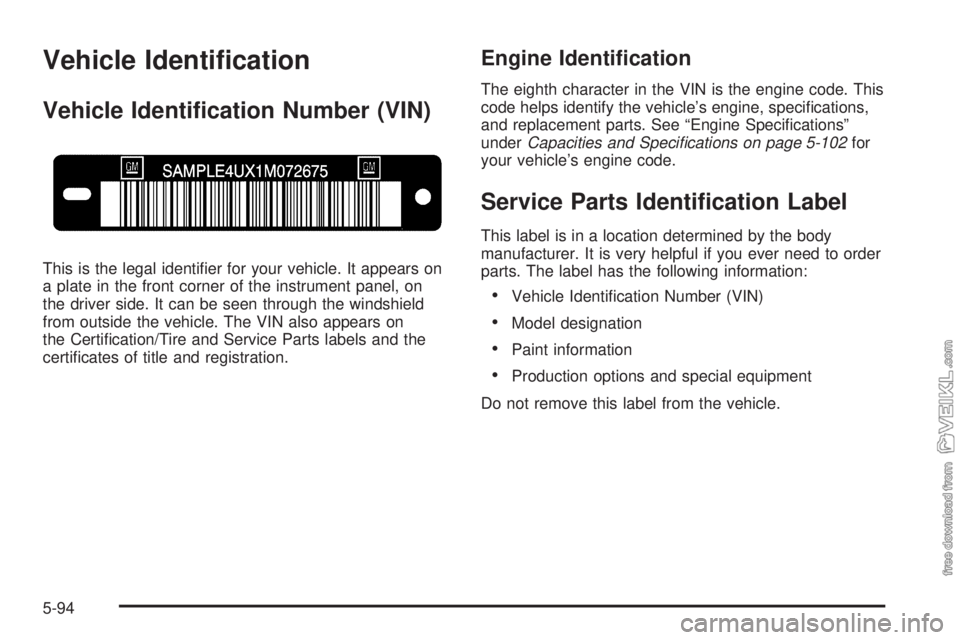
This is the legal identifier for your vehicle. It appears on
a plate in the front corner of the instrument panel, on
the driver side. It can be seen through the windshield
from outside the vehicle. The VIN also appears on
the Certification/Tire and Service Parts labels and the
certificates of title and registration.
Engine Identification
The eighth character in the VIN is the engine code. This
code helps identify the vehicle’s engine, specifications,
and replacement parts. See “Engine Specifications”
underCapacities and Specifications on page 5-102for
your vehicle’s engine code.
Service Parts Identification Label
This label is in a location determined by the body
manufacturer. It is very helpful if you ever need to order
parts. The label has the following information:
•Vehicle Identification Number (VIN)
•Model designation
•Paint information
•Production options and special equipment
Do not remove this label from the vehicle.
5-94