brake CHEVROLET KODIAK 2009 Owner's Guide
[x] Cancel search | Manufacturer: CHEVROLET, Model Year: 2009, Model line: KODIAK, Model: CHEVROLET KODIAK 2009Pages: 376, PDF Size: 5.39 MB
Page 128 of 376
Cruise Control
With cruise control, a speed of about 25 mph (40 km/h)
or more can be maintained without keeping your foot
on the accelerator. Cruise control does not work
at speeds below about 25 mph (40 km/h).
If the brakes or clutch pedal, if the vehicle has a manual
transmission, is applied, the cruise control will shut off.
{CAUTION:
Cruise control can be dangerous where you
cannot drive safely at a steady speed. So, do not
use the cruise control on winding roads or in
heavy traffic.
Cruise control can be dangerous on slippery
roads. On such roads, fast changes in tire traction
can cause excessive wheel slip, and you could
lose control. Do not use cruise control on slippery
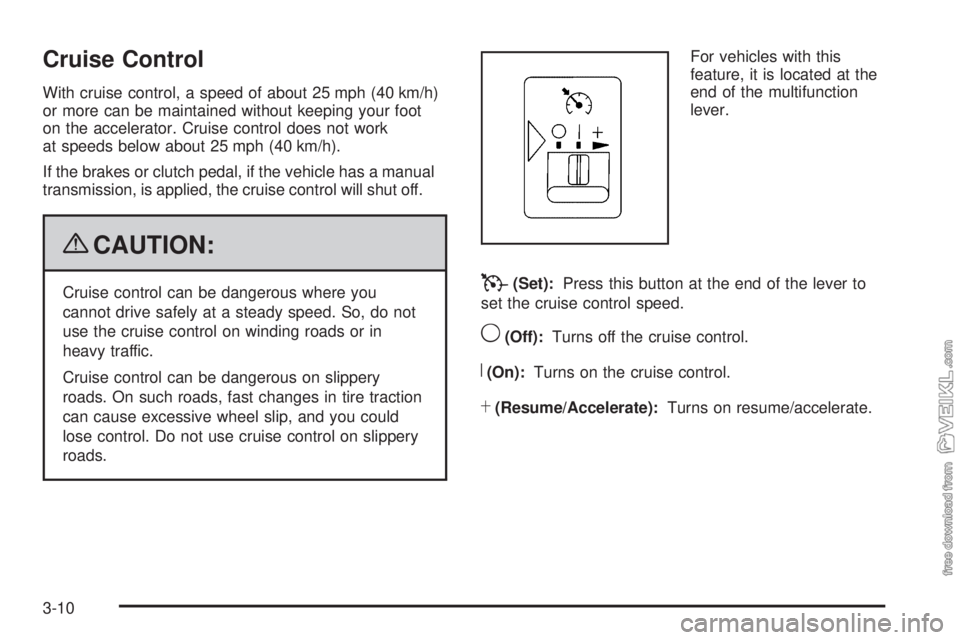
roads.For vehicles with this
feature, it is located at the
end of the multifunction
lever.T(Set):Press this button at the end of the lever to
set the cruise control speed.
9(Off):Turns off the cruise control.
R(On):Turns on the cruise control.
S(Resume/Accelerate):Turns on resume/accelerate.
3-10
Page 129 of 376
Setting Cruise Control
{CAUTION:
If you leave your cruise control on when you are
not using cruise, you might hit a button and go
into cruise when you do not want to. You could be
startled and even lose control. Keep the cruise
control switch off until you want to use cruise
control.
1. Move the cruise control switch to on.
2. Get up to the desired speed.
3. Press
Tat the end of the lever and release it.
4. Take your foot off the accelerator pedal. The
accelerator pedal will not go down.
Resuming a Set Speed
If the cruise control is set at a desired speed and then
the brake is applied, this shuts off the cruise control.
But it does not need to be reset.
Once the vehicle is going about 25 mph (40 km/h) or
more, move the cruise control switch briefly from
RtoS.
The vehicle returns to the previously chosen speed
and stays there.
If the switch is held at resume/accelerate, the vehicle
keeps going faster until the switch is released or
apply the brake. So unless you want the vehicle to go
faster, do not hold the switch at resume/accelerate.
3-11
Page 131 of 376
Using Cruise Control on Hills
How well the cruise control works on hills depends upon
the vehicles speed, load and the steepness of the hills.
When going up steep hills, you may want to step on the
accelerator pedal to maintain your speed. When going
downhill, you may have to brake or shift to a lower gear to
keep your speed down. When the brake or clutch is
applied the cruise control will shut off.
For vehicles with the exhaust brake option and the
exhaust brake is turned on, the exhaust brake may come
on and try to slow down the vehicle to the set cruise
control speed if the vehicle has accelerated past the set
cruise control speed while going downhill.
Ending Cruise Control
There are four different ways to turn off the cruise
control:
•Step lightly on the brake pedal (manual and
automatic transmissions).
•Press the clutch pedal to the floor (manual
transmissions).
•Move the cruise switch to9.
•Shift the transmission to N (Neutral).
Erasing Speed Memory
The cruise control set speed memory is erased when
the ignition is turned off.
3-13
Page 133 of 376
Daytime Running Lamps (DRL)
Daytime Running Lamps (DRL) can make it easier for
others to see the front of your vehicle during the
day. Fully functional daytime running lamps are required
on all vehicles first sold in Canada.
The DRL system will make the headlamps come on
at reduced brightness when the following conditions
are met:
•The ignition is on,
•the exterior lamp control is off, and
•the parking brake is released.
When the DRL are on, only the headlamps will be on.
The taillamps, sidemarker, instrument panel lights,
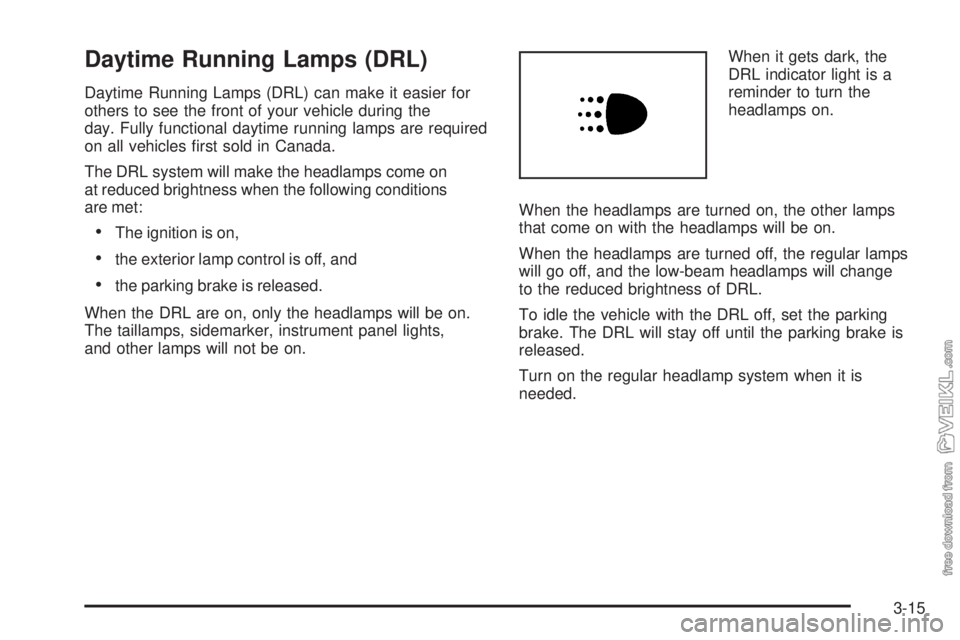
and other lamps will not be on.When it gets dark, the
DRL indicator light is a
reminder to turn the
headlamps on.
When the headlamps are turned on, the other lamps
that come on with the headlamps will be on.
When the headlamps are turned off, the regular lamps
will go off, and the low-beam headlamps will change
to the reduced brightness of DRL.
To idle the vehicle with the DRL off, set the parking
brake. The DRL will stay off until the parking brake is
released.
Turn on the regular headlamp system when it is
needed.
3-15
Page 136 of 376
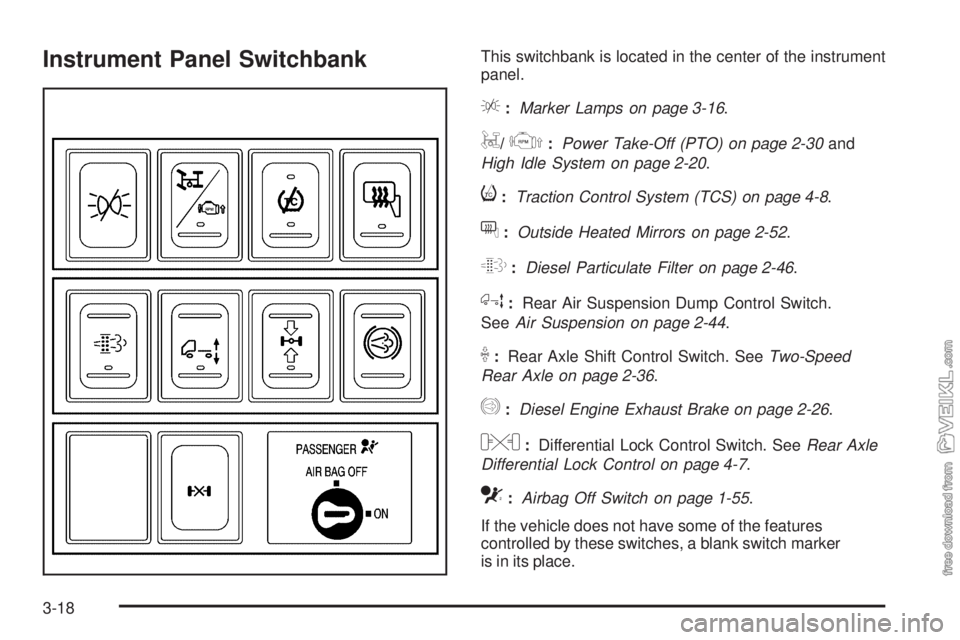
Instrument Panel SwitchbankThis switchbank is located in the center of the instrument
panel.
e:Marker Lamps on page 3-16.
g/j:Power Take-Off (PTO) on page 2-30and
High Idle System on page 2-20.
i:Traction Control System (TCS) on page 4-8.
f:Outside Heated Mirrors on page 2-52.
L:Diesel Particulate Filter on page 2-46.
h:Rear Air Suspension Dump Control Switch.
SeeAir Suspension on page 2-44.
k:Rear Axle Shift Control Switch. SeeTwo-Speed
Rear Axle on page 2-36.
q:Diesel Engine Exhaust Brake on page 2-26.
l:Differential Lock Control Switch. SeeRear Axle
Differential Lock Control on page 4-7.
c:Airbag Off Switch on page 1-55.
If the vehicle does not have some of the features
controlled by these switches, a blank switch marker
is in its place.
3-18
Page 149 of 376
Range Inhibit Warning Indicator
If your vehicle has an Allison 1000/2200/2300/
2500 series automatic transmission, a lighted bar
under the current gear selected will flash.
If your vehicle has an Allison 3000/3500 series automatic
transmission, the current gear selected on the pushbutton
display will flash.
The flashing bar or gear selection indicates that
transmission range shifts may not occur.
For detailed information on shift inhibit limitations, see
the Allison Automatic Transmission Operator’s Manual in
your vehicle for further information.
Brake System Warning Light
Your vehicle has either hydraulic or air brakes. Each
system has different warning lights.
Hydraulic Brake System Warning Lights
Vehicles with hydraulic brake systems have two brake
system warning lights on the instrument panel.
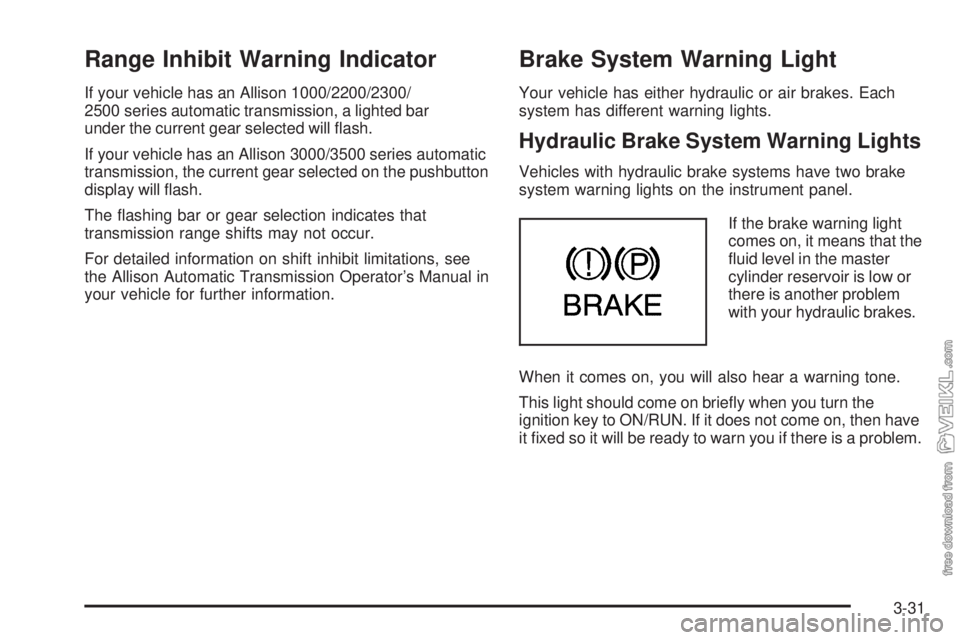
If the brake warning light
comes on, it means that the
fluid level in the master
cylinder reservoir is low or
there is another problem
with your hydraulic brakes.
When it comes on, you will also hear a warning tone.
This light should come on briefly when you turn the
ignition key to ON/RUN. If it does not come on, then have
it fixed so it will be ready to warn you if there is a problem.
3-31
Page 150 of 376
If the light comes on while driving, pull off the road and
stop carefully. The pedal might be harder to push or
might go the floor. It can take longer to stop. If the light
remains on, have the vehicle towed for service. See
Towing Your Vehicle on page 4-23for more information.
The brake warning light may come on, and the
warning tone may sound, when you are turning and
braking at the same time. This is normal. See “Hydraulic
Brake Systems” underBraking on page 4-4.
Parking Brake Warning Light
Your vehicle has a brake warning light. When the
ignition is on, this light will come on when you set your
parking brake. The light will stay on if your parking
brake does not release fully.
This light should also come on when you turn the
ignition key to START. If it does not come on then, have
it fixed so it will be ready to remind you if the parking
brake is applied or has not released fully.
Air Brake System Warning Light
Vehicles with air brake systems have a brake system
warning light on the instrument panel.
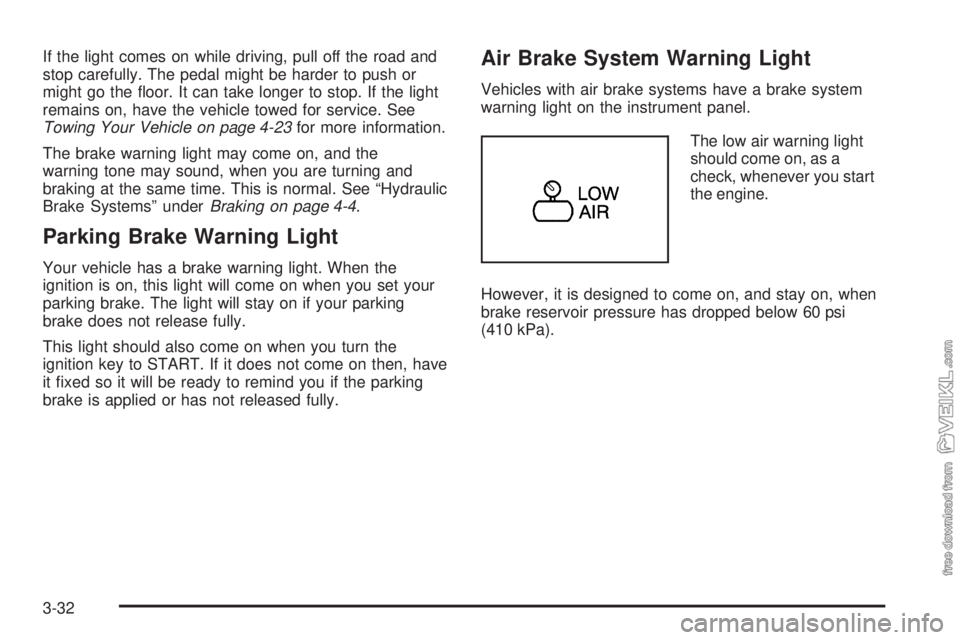
The low air warning light
should come on, as a
check, whenever you start
the engine.
However, it is designed to come on, and stay on, when
brake reservoir pressure has dropped below 60 psi
(410 kPa).
3-32
Page 151 of 376
When the warning light comes on while you are driving,
you should drive only as far as the nearest point of
safety and then stop the vehicle. Here is a very
important thing for you to know:
{CAUTION:
If the air brake system warning light comes on and
the warning tone sounds, the vehicle can stop
suddenly and without further warning. This is
because the parking brake will come on if the
pressure falls below 35 to 45 psi (240 to 310 kPa).
You or others could be injured. If the air brake
system warning light comes on and the warning
tone sounds, stop as soon as you can. You will
not know how quickly the system is losing
pressure, so be aware that the parking brake may
come on suddenly.
Antilock Brake System (ABS)
Warning Light
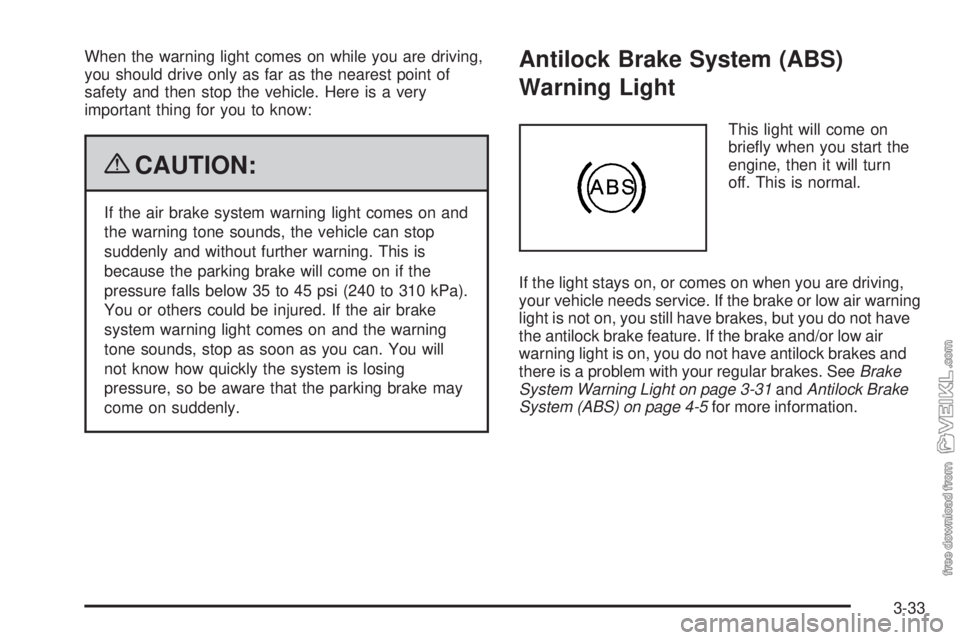
This light will come on
briefly when you start the
engine, then it will turn
off. This is normal.
If the light stays on, or comes on when you are driving,
your vehicle needs service. If the brake or low air warning
light is not on, you still have brakes, but you do not have
the antilock brake feature. If the brake and/or low air
warning light is on, you do not have antilock brakes and
there is a problem with your regular brakes. SeeBrake
System Warning Light on page 3-31andAntilock Brake
System (ABS) on page 4-5for more information.
3-33
Page 152 of 376
Trailer Antilock Brake System
Warning Light
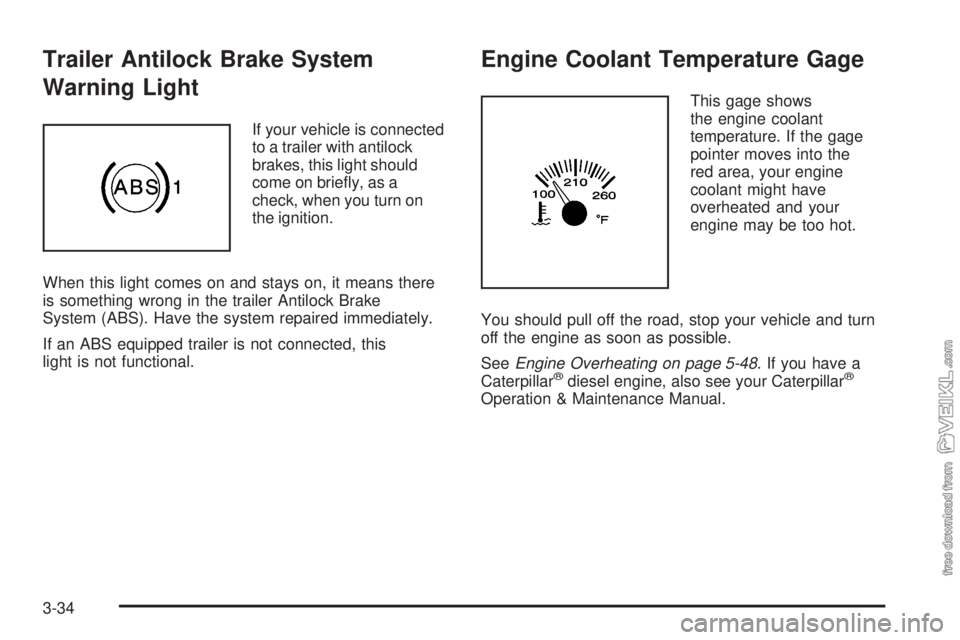
If your vehicle is connected
to a trailer with antilock
brakes, this light should
come on briefly, as a
check, when you turn on
the ignition.
When this light comes on and stays on, it means there
is something wrong in the trailer Antilock Brake
System (ABS). Have the system repaired immediately.
If an ABS equipped trailer is not connected, this
light is not functional.
Engine Coolant Temperature Gage
This gage shows
the engine coolant
temperature. If the gage
pointer moves into the
red area, your engine
coolant might have
overheated and your
engine may be too hot.
You should pull off the road, stop your vehicle and turn
off the engine as soon as possible.
SeeEngine Overheating on page 5-48. If you have a
Caterpillar
®diesel engine, also see your Caterpillar®
Operation & Maintenance Manual.
3-34
Page 159 of 376
Exhaust Brake Indicator Light
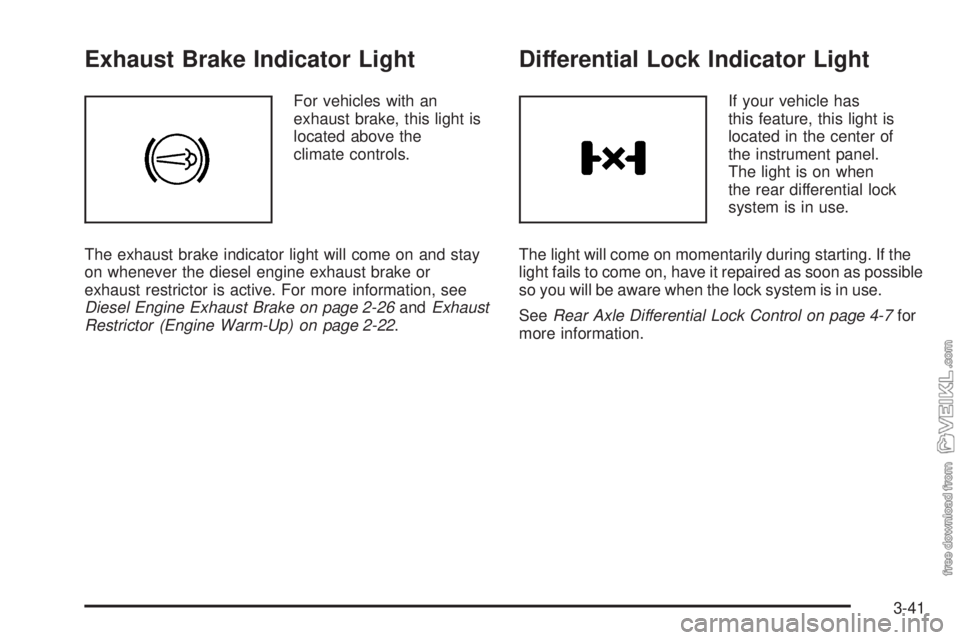
For vehicles with an
exhaust brake, this light is
located above the
climate controls.
The exhaust brake indicator light will come on and stay
on whenever the diesel engine exhaust brake or
exhaust restrictor is active. For more information, see
Diesel Engine Exhaust Brake on page 2-26andExhaust
Restrictor (Engine Warm-Up) on page 2-22.
Differential Lock Indicator Light
If your vehicle has
this feature, this light is
located in the center of
the instrument panel.
The light is on when
the rear differential lock
system is in use.
The light will come on momentarily during starting. If the
light fails to come on, have it repaired as soon as possible
so you will be aware when the lock system is in use.
SeeRear Axle Differential Lock Control on page 4-7for
more information.
3-41