airbag off CHEVROLET KODIAK 2009 Owners Manual
[x] Cancel search | Manufacturer: CHEVROLET, Model Year: 2009, Model line: KODIAK, Model: CHEVROLET KODIAK 2009Pages: 376, PDF Size: 5.39 MB
Page 5 of 376
Front Seats......................................................1-2
Bucket Seats.................................................1-2
Split Bench Seat (80/20 Split)..........................1-6
Air Suspension Seats......................................1-6
Rear Seats.....................................................1-10
Rear Seat Operation.....................................1-10
Safety Belts...................................................1-11
Safety Belts: They Are for Everyone................1-11
How to Wear Safety Belts Properly.................1-16
Lap-Shoulder Belt.........................................1-24
Safety Belt Use During Pregnancy..................1-26
Lap Belt......................................................1-27
Safety Belt Extender.....................................1-28
Child Restraints.............................................1-28
Older Children..............................................1-28
Infants and Young Children............................1-32
Child Restraint Systems.................................1-36
Where to Put the Restraint.............................1-38
Lower Anchors and Tethers for
Children (LATCH)......................................1-40
Securing a Child Restraint in a Rear
Outside Seat Position (Crew Cab)................1-40Securing a Child Restraint in the Center
Rear Seat Position (Crew Cab)...................1-42
Securing a Child Restraint in the Center
Front Seat Position....................................1-44
Securing a Child Restraint in the Right
Front Seat Position....................................1-44
Airbag System...............................................1-48
Where Are the Airbags?................................1-50
When Should an Airbag Inflate?.....................1-52
What Makes an Airbag Inflate?.......................1-53
How Does an Airbag Restrain?.......................1-53
What Will You See After an Airbag Inflates?........1-54
Airbag Off Switch..........................................1-55
Servicing Your Airbag-Equipped Vehicle...........1-58
Adding Equipment to Your Airbag-Equipped
Vehicle...................................................
.1-58
Restraint System Check..................................1-59
Checking the Restraint Systems......................1-59
Replacing Restraint System Parts
After a Crash............................................1-60
Section 1 Seats and Restraint System
1-1
Page 36 of 376
Infants and Young Children
Everyone in a vehicle needs protection! This includes
infants and all other children. Neither the distance
traveled nor the age and size of the traveler changes the
need, for everyone, to use safety restraints. In fact, the
law in every state in the United States and in every
Canadian province says children up to some age must
be restrained while in a vehicle.{CAUTION:
Children can be seriously injured or strangled if a
shoulder belt is wrapped around their neck and
the safety belt continues to tighten. Never leave
children unattended in a vehicle and never allow
children to play with the safety belts.
Airbags plus lap-shoulder belts offer protection for adults
and older children, but not for young children and infants.
Neither the vehicle’s safety belt system nor its airbag
system is designed for them. Every time infants and
young children ride in vehicles, they should have the
protection provided by appropriate child restraints.
Children who are not restrained properly can strike other
people, or can be thrown out of the vehicle.
1-32
Page 42 of 376
Securing the Child Within the Child
Restraint
{CAUTION:
A child can be seriously injured or killed in a crash
if the child is not properly secured in the child
restraint. Secure the child properly following the
instructions that came with that child restraint.
Where to Put the Restraint
Accident statistics show that children are safer if they
are restrained in the rear rather than the front seat.
We recommend that children and child restraints
be secured in a rear seat, including: an infant or a child
riding in a rear-facing child restraint; a child riding in
a forward-facing child seat; an older child riding in
a booster seat; and children, who are large enough,
using safety belts.
Air Suspension Seats
{CAUTION:
A child restraint cannot be secured properly in an
air-suspension type seat. This is because an
air-suspension seat is designed to move up and
down for an adult passenger. Do not use a child
restraint in an air-suspension seat.
If your vehicle is a regular cab model with an
air-suspension seat in the right front passenger’s
position, there is no place in your vehicle to secure a
child restraint. The only answer is to have infants
and young children make the trip in another vehicle,
where they can get the protection they need.
Bucket or Bench Seats
If your vehicle is a regular cab model with a bucket or
bench seat in the right front passenger’s position,
the child restraint must be secured properly.
If your vehicle has airbags and you need to secure a
child restraint in the right front passenger’s seat, there is
a switch on the instrument panel that you can use to
turn off the passenger’s airbag. SeeAirbag Off Switch
on page 1-55andSecuring a Child Restraint in the Right
Front Seat Position on page 1-44for more on this,
including important safety information.
1-38
Page 43 of 376
A label on your sun visor says, “Never put a rear-facing
child seat in the front.” This is because the risk to the
rear-facing child is so great, if the airbag deploys.
{CAUTION:
A child in a rear-facing child restraint can be
seriously injured or killed if the right front passenger
airbag inflates. This is because the back of the
rear-facing child restraint would be very close to the
inflating airbag. A child in a forward-facing child
restraint can be seriously injured or killed if the right
front passenger airbag inflates and the passenger
seat is in a forward position.
Even if the airbag switch has turned off the right
front passenger frontal airbag, no system is
fail-safe. No one can guarantee that an airbag will
not deploy under some unusual circumstance, even
though it is turned off.
CAUTION: (Continued)
CAUTION: (Continued)
Secure rear-facing child restraints in a rear seat,
even if the airbag is off. If you secure a
forward-facing child restraint in the right front seat,
always move the front passenger seat as far back
as it will go. It is better to secure the child restraint
in a rear seat.
When securing a child restraint in a rear seating
position, study the instructions that came with your child
restraint to make sure it is compatible with this vehicle.
Wherever you install a child restraint, be sure to
secure the child restraint properly.
Keep in mind that an unsecured child restraint can
move around in a collision or sudden stop and injure
people in the vehicle. Be sure to properly secure
any child restraint in your vehicle — even when
no child is in it.
1-39
Page 48 of 376
Securing a Child Restraint in the
Center Front Seat Position
{CAUTION:
A child in a child restraint in the center front seat
can be badly injured or killed by the frontal airbags
if they inflate. Never secure a child restraint in the
center front seat if your vehicle has airbags or if it
interferes with shifting gears. It is always better to
secure a child restraint in a rear seat.
Do not use child restraints in the center front seat
position if your vehicle has airbags. If your vehicle does
not have airbags, use the instructions forSecuring a
Child Restraint in the Center Rear Seat Position (Crew
Cab) on page 1-42to install a child restraint in the
center front position.
Securing a Child Restraint in the
Right Front Seat Position
This vehicle may have airbags. A rear seat is a safer
place to secure a forward-facing child restraint. See
Where to Put the Restraint on page 1-38.
There may be a switch on the instrument panel that you
can use to turn off the right front passenger frontal
airbag. SeeAirbag Off Switch on page 1-55for more on
this, including important safety information.
A label on your sun visor says, “Never put a rear-facing
child seat in the front.” This is because the risk to the
rear-facing child is so great, if the airbag deploys.
1-44
Page 49 of 376
{CAUTION:
A child in a rear-facing child restraint can be
seriously injured or killed if the right front
passenger airbag inflates. This is because the
back of the rear-facing child restraint would be
very close to the inflating airbag. A child in a
forward-facing child restraint can be seriously
injured or killed if the right front passenger airbag
inflates and the passenger seat is in a forward
position.
Even if the airbag switch has turned off the right
front passenger frontal airbag, no system is
fail-safe. No one can guarantee that an airbag will
not deploy under some unusual circumstance,
even though it is turned off.
Secure rear-facing child restraints in a rear seat,
even if the airbag is off. If you secure a
forward-facing child restraint in the right front seat,
always move the front passenger seat as far back
as it will go. It is better to secure the child restraint
in a rear seat.
{CAUTION:
If the airbag readiness light ever comes on when
you have turned off the airbag, it means that
something may be wrong with the airbag system.
The right front passenger’s airbag could inflate
even though the switch is off. If this ever happens,
do not let anyone whom the national government
has identified as a member of a passenger airbag
risk group sit in the right front passenger’s position
(for example, do not secure a rear-facing child
restraint in the right front passenger’s seat) until
you have your vehicle serviced. SeeAirbag Off
Switch on page 1-55andAirbag Readiness Light
on page 3-27for more on this, including important
safety information.
If the vehicle does not have a rear seat that will
accommodate a rear-facing child restraint, a rear-facing
child restraint should not be installed in the vehicle,
even if the airbag is off.
1-45
Page 50 of 376
Do not secure a child restraint in a position without a
top tether anchor if a national or local law requires that
the top tether be anchored, or if the instructions that
come with the child restraint say that the top strap must
be anchored.
In Canada, the law requires that forward-facing child
restraints have a top tether, and that the tether be
attached.
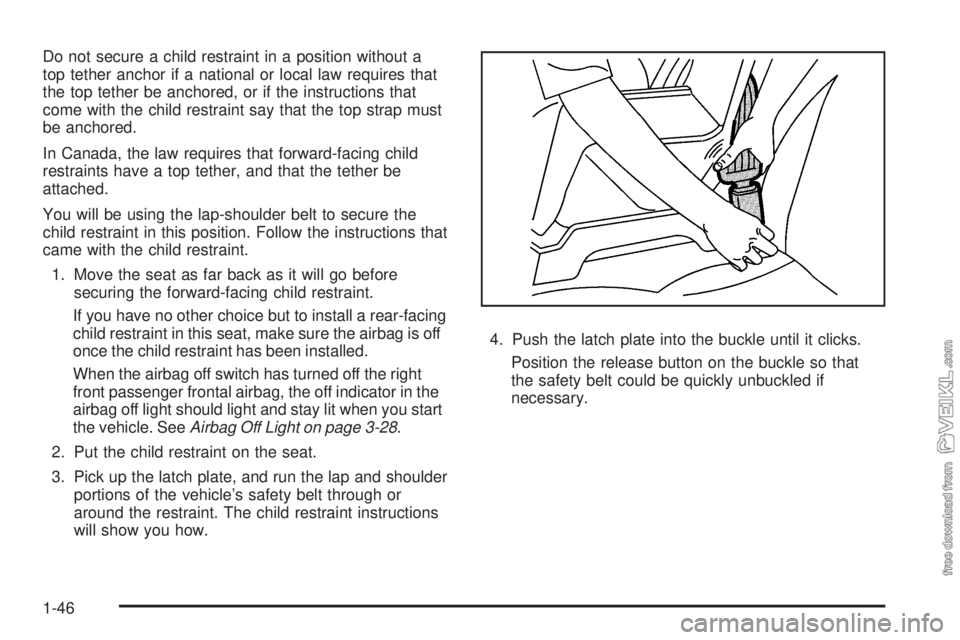
You will be using the lap-shoulder belt to secure the
child restraint in this position. Follow the instructions that
came with the child restraint.
1. Move the seat as far back as it will go before
securing the forward-facing child restraint.
If you have no other choice but to install a rear-facing
child restraint in this seat, make sure the airbag is off
once the child restraint has been installed.
When the airbag off switch has turned off the right
front passenger frontal airbag, the off indicator in the
airbag off light should light and stay lit when you start
the vehicle. SeeAirbag Off Light on page 3-28.
2. Put the child restraint on the seat.
3. Pick up the latch plate, and run the lap and shoulder
portions of the vehicle’s safety belt through or
around the restraint. The child restraint instructions
will show you how.4. Push the latch plate into the buckle until it clicks.
Position the release button on the buckle so that
the safety belt could be quickly unbuckled if
necessary.
1-46
Page 52 of 376
If you turned the airbag off with the switch, turn on the
right front passenger airbag when you remove the
child restraint from the vehicle unless the person who
will be sitting there is a member of a passenger
airbag risk group. SeeAirbag Off Switch on page 1-55
for more information, including important safety
information.
{CAUTION:
If the right front passenger’s airbag is turned off
for a person who is not in a risk group identified
by the national government, that person will not
have the extra protection of an airbag. In a crash,
the airbag will not be able to inflate and help
protect the person sitting there.
Do not turn off the passenger’s airbag unless the
person sitting there is in a risk group identified by
the national government. SeeAirbag Off Switch on
page 1-55for more on this, including important
safety information.
Airbag System
The vehicle may have the following airbags:
•A frontal airbag for the driver.
•A frontal airbag for the right front passenger.
For frontal airbags, the word AIRBAG will appear on the
middle part of the steering wheel for the driver and
on the instrument panel for the right front passenger.
Airbags are designed to supplement the protection
provided by safety belts. Even though today’s airbags
are also designed to help reduce the risk of injury
from the force of an inflating bag, all airbags must inflate
very quickly to do their job.
1-48
Page 54 of 376
{CAUTION:
Children who are up against, or very close to, any
airbag when it inflates can be seriously injured or
killed. Airbags plus lap-shoulder belts offer
protection for adults and older children, but not for
young children and infants. Neither the vehicle’s
safety belt system nor its airbag system is
designed for them. Young children and infants
need the protection that a child restraint system
can provide. Always secure children properly in
your vehicle. To read how, seeOlder Children on
page 1-28orInfants and Young Children on
page 1-32.
There is an airbag
readiness light on the
instrument panel cluster,
which shows the airbag
symbol.The system checks the airbag electrical system for
malfunctions. The light tells you if there is an electrical
problem. SeeAirbag Readiness Light on page 3-27
for more information.
Where Are the Airbags?
The driver’s airbag is in the middle of the steering
wheel.
1-50
Page 59 of 376

•Your vehicle has a crash sensing and diagnostic
module which records information after a
crash. SeeVehicle Data Recording and Privacy
(Isuzu 7.8L L6 Engine) on page 7-11andEvent
Data Recorders (Isuzu 7.8L L6 Engine) on
page 7-12.
•Let only qualified technicians work on the airbag
system. Improper service can mean that an
airbag system will not work properly. See your
dealer/retailer for service.
Airbag Off Switch
If the vehicle has a right
front passenger airbag,
it has an airbag on-off
switch that you can use to
manually turn on or off the
right front passenger
airbag.This switch should only be turned to the off position if
the person in the right front passenger position is a
member of a passenger risk group identified by
the national government as follows:
Infant.An infant (less than 1 year old) must
ride in the front seat because:
•
My vehicle has no rear seat;
•My vehicle has a rear seat too small to
accommodate a rear-facing infant seat; or
•The infant has a medical condition which, according
to the infant’s physician, makes it necessary for the
infant to ride in the front seat so that the driver
can constantly monitor the child’s condition.
Child Age 1 to 12.A child age 1 to 12 must
ride in the front seat because:
•
My vehicle has no rear seat;
•Although children ages 1 to 12 ride in the rear
seat(s) whenever possible, children ages 1 to 12
sometimes must ride in the front because no space
is available in the rear seat(s) of my vehicle; or
•The child has a medical condition which, according
to the child’s physician, makes it necessary for the
child to ride in the front seat so that the driver
can constantly monitor the child’s condition.
1-55