oil level CHEVROLET LOW CAB FORWARD 2017 User Guide
[x] Cancel search | Manufacturer: CHEVROLET, Model Year: 2017, Model line: LOW CAB FORWARD, Model: CHEVROLET LOW CAB FORWARD 2017Pages: 414, PDF Size: 7.97 MB
Page 169 of 414
Chevrolet Low Cab Forward Owner Manual (GMNA-Localizing-U.S.-
10716700) - 2017 - crc - 12/6/16
168 Driving and Operating
flammable material, such as
grass, waste paper, oil, or old
tires near the exhaust pipe.
Cold Weather Starting
If you plan ahead for cold weather,
starting and driving your vehicle
should be no problem.
Oil gets thicker as it gets colder,
which slows down the engine
cranking speed.
To be sure the engine can turn fast
enough to start, use SAE 0W-30
viscosity engine oil when prevailing
temperatures drop below 0 °C (32 °
F). See the oil quality and oil
viscosity recommendations. Using
the proper viscosity oil will make
starting easier down to -23 °C (-10 °
F). When prevailing temperatures
drop below -23 °C (-10 °F), the
optional engine block heater may be
needed for starting.
Stopping the Engine
When stopping the gasoline engine,
take the following steps: 1. Bring the vehicle to a complete stop. 2. Firmly apply the parking brake.
3. Move the selector lever to the
P position and make sure that
the shift indicator shows P.
4. Allow the engine to idle for approximately 3 minutes.
5. Turn the engine control switch to the ACC or LOCK position.
To prevent the battery from going
dead, turn the engine control switch
to the ACC or LOCK position after
stopping the engine. If you leave the
vehicle for an extended period of
time, place the engine control switch
in the LOCK position.
If the Vehicle Has Not Been Used
for a Long Period
If the vehicle is to be placed in
storage for a prolonged period of
time, certain precautions must be
taken to prevent deterioration. See
your authorized dealer for more
detailed information.
. Before using a vehicle that has
not been driven for a long
period, check the engine and
transmission for oil leakage, and make sure the oil is at the
required levels. If there is
insufficient oil, it will not
adequately reach and lubricate
components, and a breakdown
will result.
. Start the engine and allow it to
idle for at least 5 minutes. Check
for abnormal noises.
. For instructions on warming up
the engine, refer to “Starting the
Engine” previously in this
section.
Starting and Stopping the
Vehicle (Diesel Only)
Check around the Vehicle before
Starting the Engine
Proper care and operation will not
only extend the service life of your
vehicle but also improve fuel
economy.
Before pulling away, perform a
thorough safety check, making sure
there are no children or obstructions
around the vehicle. Take off the
chocks after confirming that the
parking brake is securely applied.
Page 173 of 414

Chevrolet Low Cab Forward Owner Manual (GMNA-Localizing-U.S.-
10716700) - 2017 - crc - 12/6/16
172 Driving and Operating
If the Vehicle Has Not Been Used
for a Long Period
If a diesel vehicle has been
standing for an extended period of
time, the turbocharger bearings
should be pre-lubricated prior to
starting. See your authorized dealer
for more detailed information.
Before using a vehicle that has not
been driven for a long period, check
the engine and transmission for oil
leakage, and make sure the oil is at
the required levels. If there is
insufficient oil, it will not adequately
reach and lubricate components,
and a breakdown will result.
Start the engine and allow it to idle
for at least five minutes. Check for
abnormal noises.
For instructions on warming up the
engine, refer to“Starting the Engine”
previously in this section.
For diesel vehicles, if 1 year has
passed since the diesel exhaust
fluid (DEF) in the DEF tank was
added, the DEF in the tank should
be replaced. Be careful not to inhale
the ammonia odor when replacing the DEF. Also, please contact your
nearest dealer about the
replacement work.
Operating Temperature
Recommendations for Warming
Up the Engine
The engine is sufficiently warmed
up when the needle of the engine
coolant temperature gauge starts
to move.
Do not race the engine or quickly
accelerate before the engine has
sufficiently warmed up. Oil would
not have adequately reached and
lubricated components, and a
breakdown may result.
The exhaust pipe becomes
extremely hot while the engine is
idling. Before warming up the
engine, make sure there is no
flammable material, such as grass,
waste paper, oil, or old tires near the
exhaust pipe.
Engine Warm-up System
During cold ambient conditions, the
automatic engine warm-up system
operates to reduce engine warm-up
time during idling.
Automatic Engine Warm-up :
When the engine is idling with the
engine coolant temperature below
62 °C (144 °F), the engine warm-up
system automatically closes the
exhaust brake and increases engine
idle speed so that the engine is
warmed more quickly. Warm-up is
cancelled when the accelerator
pedal is pressed, and resumed
when the pedal is released.
Warm-up is automatically cancelled
entirely after the engine coolant
temperature rises above 65 °C
(149 °F).
Winter Cover
.
Do not cover the front of the
radiator with newspapers,
cardboard or any other
flammable material to raise the
engine coolant temperature.
Page 181 of 414

Chevrolet Low Cab Forward Owner Manual (GMNA-Localizing-U.S.-
10716700) - 2017 - crc - 12/6/16
180 Driving and Operating
Diesel Particulate
Filter
Diesel Particulate Filter (DPF)
The DPF purifies diesel exhaust
gases of particulate matter (PM). PM
is filtered from the exhaust gas and
collected in the DPF. When PM is
collected to the predetermined level
by the engine control module, the
DPF automatically burns the PM in
a process called regeneration.
Regeneration may not be completed
under certain driving conditions.
If this occurs, the multi-information
display (DIC) will provide prompts to
properly complete DPF
regeneration.
The following sections will provide
details on DPF regeneration. Follow
the steps carefully to keep the DPF
in good working order. SeeDriver
Information Center (DIC) (Diesel
Only) 093, Recommended Fluids
and Lubricants 0378, and Engine
Oil (Gasoline) 0257 orEngine Oil
(Diesel) 0251.
{Warning
Exhaust parts and gases become
very hot when the DPF is being
regenerated.
Parking over flammable items
could allow them to touch hot
exhaust parts under your vehicle
and cause them to ignite. Do not
park over papers, leaves, grass
or other things that can burn. You
and others could be seriously
injured.
This content is to restore the
function of the DPF and it is not a
malfunction. However, the check
engine malfunction indicator light
and reduced engine power indicator
light may come on and the power
output may be limited if driving or
power take-off (PTO) operation is
continued for a long time with the
regeneration required warning light
or selectable (switch) regeneration
required warning light (amber/
red) on. This is to prevent the DPF from
being damaged. When operating
PTO during parking, check to
ensure that the regeneration
required warning light or selectable
(switch) regeneration required
warning light (amber/red) on the DIC
is not on.
Engine oil that supports DPF (low
ash oil) is recommended. Use of low
ash oil extends the maintenance
interval of the DPF filter.
Do not modify the DPF or exhaust
pipe. Changing the alignment,
length or diameter of the exhaust
pipe would adversely affect the
exhaust system's exhaust emission
reduction function. If any
modification is necessary to install a
component to the rear of the
vehicle, consult your dealer.
Although the DPF filter automatically
undergoes regeneration (burning of
the accumulated PM) when a
certain amount of PM has
accumulated, driving conditions can
prevent completion of regeneration.
Page 233 of 414
Chevrolet Low Cab Forward Owner Manual (GMNA-Localizing-U.S.-
10716700) - 2017 - crc - 12/6/16
232 Driving and Operating
Some gasolines contain an octane
enhancing additive called
methylcyclopentadienyl manganese
tricarbonyl (MMT). It is not
recommended to use gasoline
containing MMT. Some gasolines
contain an additive called methyl
tertiary butyl ether (MTBE).
Gasoline containing more than 15%
MTBE should not be used in this
vehicle.
Gasoline containing ethanol or
methanol may be available in your
area. Ethanol is ethyl or grain
alcohol. Methanol is methyl or wood
alcohol.
Fuels containing more than 5%
methanol or more than 10% ethanol,
such as E15 or E85, should not be
used in this vehicle. These fuels can
corrode metal parts in the fuel
system. They can also damage
plastic and rubber parts. This
damage would not be covered
under your warranty.
Fuels containing 5% methanol or
less must contain cosolvents and
corrosion prevention additives to
avoid damage to the fuel system.Gasoline for Cleaner Air
Gasolines with detergent additives
help to prevent deposits from
forming in your engine. This helps to
keep the engine in tune and the
emission control system working
properly. These additives as well as
gasoline blends containing oxygen,
such as MTBE or alcohol, promote
cleaner air. This is important in
locations that have high carbon
monoxide and ozone levels.
Fuels in Foreign
Countries
Foreign Operation
If you plan on driving in another
country outside the U.S. or Canada,
unleaded fuel may be hard to find.
Do not use leaded gasoline. If you
use even one tankful, your emission
controls won't work well or at all.
With continuous use, spark plugs
can get fouled, the exhaust system
can corrode, and your engine oil
can deteriorate quickly. Your
vehicle's oxygen sensor will bedamaged. All of that means costly
repairs that would not be covered by
your warranty.
To check on fuel availability, ask an
auto club, or contact a major oil
company that does business in the
country where you'll be driving.
Fuel for Diesel Engines
Diesel Fuel Requirement and
Fuel System
Fuel Requirements
Use of fuels other than ultra
low-sulfur fuel may not conform to
emission regulations.
The fuel supply pump, injector or
other parts of the fuel system and
engine can be damaged if you use
any fuel or fuel additive other than
those specifically recommended by
the dealer.
To help avoid fuel system or engine
damage, pay attention to the
following:
.
Some service stations mix used
engine oil with diesel fuel. Some
manufacturers of large diesel
Page 240 of 414
Chevrolet Low Cab Forward Owner Manual (GMNA-Localizing-U.S.-
10716700) - 2017 - crc - 12/6/16
Driving and Operating 239
2. Select the correct fuel (See"Diesel Fuel Requirement and
Fuel System"). Follow any
posted safety rules. Stand to
the side, never above or
opposite the filler opening.
3. Check that the fuel cap is tight, and see to it that engine oil,
engine coolant in the reservoir,
and washer fluid, etc. are at
proper levels. Then do the
Driver Daily Checklist.
See Owner Checks and Services
0 367.
Driving your vehicle until the fuel
tank is empty may activate the
check engine malfunction indicator
light. You do not need to have your
vehicle checked. After refueling,
perform the following:
. Bleed the fuel system.
. Start, turn off and restart the
engine three or four times.
. The check engine malfunction
indicator light will be cancelled. Before Starting the Engine
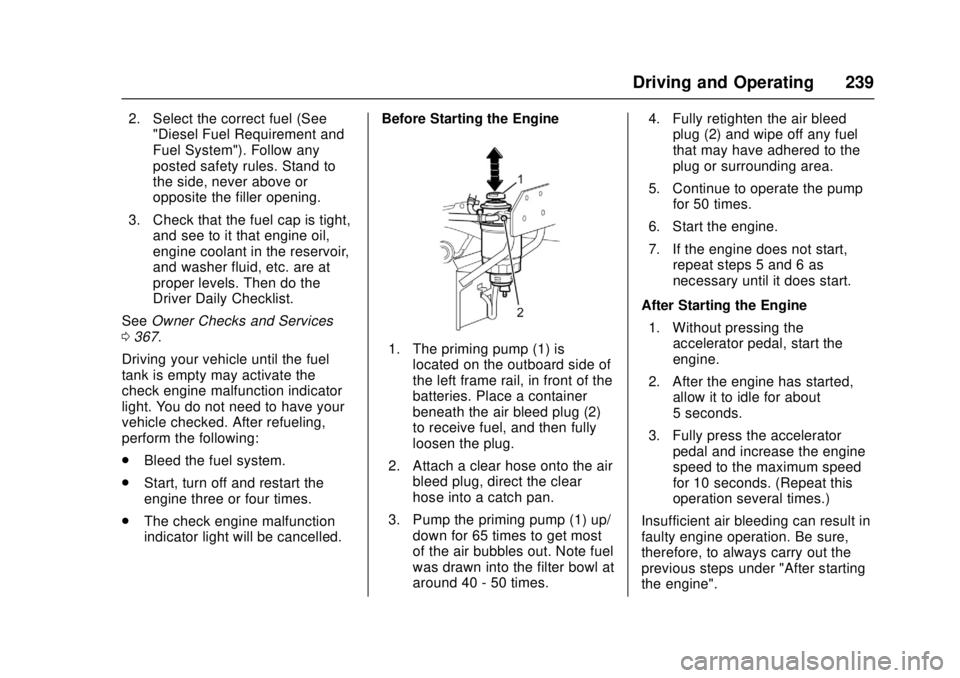
1. The priming pump (1) is
located on the outboard side of
the left frame rail, in front of the
batteries. Place a container
beneath the air bleed plug (2)
to receive fuel, and then fully
loosen the plug.
2. Attach a clear hose onto the air bleed plug, direct the clear
hose into a catch pan.
3. Pump the priming pump (1) up/ down for 65 times to get most
of the air bubbles out. Note fuel
was drawn into the filter bowl at
around 40 - 50 times. 4. Fully retighten the air bleed
plug (2) and wipe off any fuel
that may have adhered to the
plug or surrounding area.
5. Continue to operate the pump for 50 times.
6. Start the engine.
7. If the engine does not start, repeat steps 5 and 6 as
necessary until it does start.
After Starting the Engine 1. Without pressing the accelerator pedal, start the
engine.
2. After the engine has started, allow it to idle for about
5 seconds.
3. Fully press the accelerator pedal and increase the engine
speed to the maximum speed
for 10 seconds. (Repeat this
operation several times.)
Insufficient air bleeding can result in
faulty engine operation. Be sure,
therefore, to always carry out the
previous steps under "After starting
the engine".
Page 245 of 414
Chevrolet Low Cab Forward Owner Manual (GMNA-Localizing-U.S.-
10716700) - 2017 - crc - 12/6/16
244 Vehicle Care
Vehicle Care
General Information
General Information . . . . . . . . . . 245
California Proposition65 Warning . . . . . . . . . . . . . . . . . 245
California Perchlorate Materials Requirements . . . . . 245
Accessories and Modifications . . . . . . . . . . . . . . . . 245
Vehicle Checks
Doing Your OwnService Work . . . . . . . . . . . . . . . 245
Cab Tilting . . . . . . . . . . . . . . . . . . . . 247
Engine Compartment Overview . . . . . . . . . . . . . . . . . . . . 249
Engine Cover . . . . . . . . . . . . . . . . . 250
Engine Oil (Diesel) . . . . . . . . . . . 251
Engine Oil (Gasoline) . . . . . . . . . 257
Automatic Transmission Fluid . . . . . . . . . . . . . . . . . . . . . . . . 260
Engine Air Cleaner/Filter . . . . . . 263
Engine Coolant . . . . . . . . . . . . . . . 263
Engine Overheating . . . . . . . . . . 269
Power Steering Fluid . . . . . . . . . 273
Washer Fluid . . . . . . . . . . . . . . . . . 274
Brakes . . . . . . . . . . . . . . . . . . . . . . . 275
Brake Fluid . . . . . . . . . . . . . . . . . . . 280
Battery . . . . . . . . . . . . . . . . . . . . . . . . 281 Fuel Filter . . . . . . . . . . . . . . . . . . . . 282
Rear Axle (Gear Oil Viscosity
Chart) . . . . . . . . . . . . . . . . . . . . . . . 283
Rear Axle (Oil Level Check) . . . . . . . . . . . . . . . . . . . . . . 283
Noise Control System . . . . . . . . 284
Automatic Transmission Shift Lock Control Function Check
(Diesel Only) . . . . . . . . . . . . . . . . 285
Wiper Blade Replacement . . . . 286
Headlamp Aiming
Headlamp Aiming . . . . . . . . . . . . 288
Bulb Replacement
Bulb Replacement . . . . . . . . . . . . 288
Headlamps and Front Turn Signal . . . . . . . . . . . . . . . . . . . . . . . 291
Roofmarker Lamps . . . . . . . . . . . 295
Sidemarker Lamps (Including Turn Signal and Cornering
Lamps) . . . . . . . . . . . . . . . . . . . . . . 295
Taillamps, Turn Signal, Stoplamps, and Back-Up
Lamps . . . . . . . . . . . . . . . . . . . . . . 297
License Plate Lamp . . . . . . . . . . 297
Interior Lamps . . . . . . . . . . . . . . . . 298
Electrical System
Electrical System Overload . . . 298
Wheels and Tires
Wheels and Tires . . . . . . . . . . . . . 308
Tire Pressure . . . . . . . . . . . . . . . . . 322
Tire Rotation . . . . . . . . . . . . . . . . . 323
If a Tire Goes Flat . . . . . . . . . . . . 326
Jump Starting
Jump Starting - North America . . . . . . . . . . . . . . . . . . . . . 326
Towing the Vehicle
Towing the Vehicle . . . . . . . . . . . 332
Appearance Care
Exterior Care . . . . . . . . . . . . . . . . . 334
Interior Care . . . . . . . . . . . . . . . . . . 340
Page 248 of 414

Chevrolet Low Cab Forward Owner Manual (GMNA-Localizing-U.S.-
10716700) - 2017 - crc - 12/6/16
Vehicle Care 247
For diesel vehicles, when working
on the fuel line or fuel filter, remove
the fuel tank filler cap. The fuel
system is under pressure and the
fuel will overspill unless the
pressure is relieved, possibly
leading to combustion or a fire.
Do not make engine adjustments
yourself. Be sure to consult your
dealer.
Use only appropriate tools.
Oils, brake fluid and engine coolant
have lubrication, cooling and rust
prevention functions. If these liquids
deteriorate through loss or
contamination, it will cause a
decline in the performance of the
parts and such problems as seizure
or malfunctioning. Replenish or
change these liquids when
performing the checks (daily and
periodic checks) as required by the
relevant regulations or in
accordance with the Maintenance
Schedule (when either the specified
driving distance or period of time,
whichever comes first, has expired).Confirm that all systems and
components are normal after
performing the work.
Do not leave the removed parts or
tools in the engine compartment.
They could damage the equipment if
caught in the belts or other moving
components.
Dirty water, dirt and other impurities
seriously impair the effectiveness of
the oil, grease and fluids, and
damage the parts. Exercise all due
caution to prevent waste or other
refuse from coming in contact with
parts or materials that have been
removed when changing or
replenishing them.
Do not step on the engine or climb
onto it. You could cause an engine
failure by, for example, damaging
the cylinder head cover or various
connectors.
Electric Welding
Careless electric welding of vehicle
parts can cause welding current to
flow back through the vehicle’s
ground circuit and damage electrical
and electronic parts so that they donot function normally. Whenever
electric welding is necessary,
consult your dealer.
Cab Tilting
Before Tilting the Cab (Single Cab
Model)
{Warning
To help avoid personal injury and
property damage:
. Park the vehicle on level
ground and check that there
is enough space in front of
and above the cab.
. Set the parking brake firmly
and block the front wheels.
. Move the selector lever in
the "P" position.
. Secure loose articles in
the cab.
. Stop the engine.
. Close the cab door.
(Continued)
Page 252 of 414

Chevrolet Low Cab Forward Owner Manual (GMNA-Localizing-U.S.-
10716700) - 2017 - crc - 12/6/16
Vehicle Care 251
Engine Coolant Reserve Tank
Inspection Cover (Crew Cab
Model) 5.2L Diesel
To gain access to the engine
coolant reserve tank, remove the
inspection cover located under the
rear left seat.
Engine Oil (Diesel)
Engine oil is an important factor
determining engine performance
and longevity. Be sure to use only
the specified oil and oil filters. The
engine oil level must be checked
and the oil should be changed
regularly according to the
Maintenance Schedule.The engine oil performs the
following important functions:
.
It prevents engine parts from
becoming worn.
. It cools engine parts.
. It cleans engine parts.
. It seals the combustion
chambers and prevents rust.
Replace the engine oil at regular
intervals.
When particulate matter (PM) has
accumulated to a preset level in the
diesel particulate filter (DPF), the
filter is automatically regenerated
through combustion. To make this
regeneration (combustion) possible,
a small amount of fuel is injected
into the engine combustion chamber
after firing. This causes fuel to
gradually become mixed with the
engine oil, and the engine oil level
may rise beyond the original level.
This does not indicate a malfunction
of the engine.
Access to the Engine
Single Cab Model
Access to the engine oil dipstick is
located on the engine left side after
tilting the cab. See Cab Tilting
0 247.
Crew Cab Model
The engine oil dipstick is under the
engine inspection sub cover located
beneath the driver's seat.
Page 253 of 414

Chevrolet Low Cab Forward Owner Manual (GMNA-Localizing-U.S.-
10716700) - 2017 - crc - 12/6/16
252 Vehicle Care
Checking the Engine Oil Level
Press the engine oil level check
switch. If engine oil level is low the
red oil pressure warning light will
turn on. If the engine oil level is
above the "OK", the green oil level
indicator will turn on.
The oil level varies while the engine
is running, right after it is stopped,
and on sloping ground. When
checking the oil level, be sure the
vehicle is on level ground while the
engine is cool.
The engine oil level must be kept at
the right level to help assure proper
lubrication of your vehicle's engine.It is the owner's responsibility to
check the oil level at regular
intervals (such as every fuel stop),
according to the following
instructions. Park the vehicle on a
level surface and check the engine
oil level before starting or at least
30 minutes after turning off the
engine.
3.0L Shown, 5.2L Similar
1. Remove the oil dipstick (2) and wipe off any oil on the oil
dipstick.
3.0L Shown, 5.2L Similar
2. Reinsert the oil dipstick fully and then gently remove it.
The oil is at the correct level if
the oil level is between the
"Position A" and "MIN" marks.
3. If the oil level is too low, add oil to the "FULL" mark.
If the oil level is beyond the
"Position A" mark, the oil needs
to be changed.
4. Reinstall the oil dipstick into position after checking the oil
level.
Page 254 of 414

Chevrolet Low Cab Forward Owner Manual (GMNA-Localizing-U.S.-
10716700) - 2017 - crc - 12/6/16
Vehicle Care 253
Any oil level above the "Position A"
mark on the oil dipstick may cause
engine malfunctions. Change with
oil of the correct grade and quality
whenever its level exceeds the
"Position A" mark.
Fuel will gradually become mixed
with the engine oil, thinning it out.
Be sure to change the oil at the
specified intervals.
The oil level cannot be checked
correctly when the engine is
running.
If the engine has been running, wait
at least 30 minutes before checking.Adding the Engine Oil
3.0L Shown, 5.2L Similar
When the engine oil level is near or
below the "MIN" mark on the oil
dipstick, remove the oil filler cap (1)
and add the oil. Remove the oil
dipstick (2) at this time. Use only the
specified engine oil.
Caution
When adding oil, be careful not to
spill any, but keep a workshop rag
handy just in case there are any
spills. If any oil should spill onto (Continued)
Caution (Continued)
the engine, carefully wipe it away.
If this precaution is not taken, the
spilled oil could ignite and a fire
could spread.
Do not leave flammable items,
such as rags or gloves, in the
engine compartment. They could
cause a fire. You and others could
be seriously injured.
Engine oil lubricates and cools the
engine's internal components. The
quality of the oil is degraded and the
quantity of oil is reduced by
evaporation, discharge and
combustion during the operation of
the engine. Continually using the
same oil without checking the level,
or without replenishing and
changing it could cause seizure or
damage to the engine.
Prevent dirt from entering the filler
port when adding the oil. If foreign
matter mixes with the oil, it could
damage the engine.