oil level CHEVROLET LOW CAB FORWARD 2017 Owner's Guide
[x] Cancel search | Manufacturer: CHEVROLET, Model Year: 2017, Model line: LOW CAB FORWARD, Model: CHEVROLET LOW CAB FORWARD 2017Pages: 414, PDF Size: 7.97 MB
Page 255 of 414

Chevrolet Low Cab Forward Owner Manual (GMNA-Localizing-U.S.-
10716700) - 2017 - crc - 12/6/16
254 Vehicle Care
Adding oil above the "Position A"
mark on the oil dipstick could result
in faulty engine operation. Be sure
to check the oil level by using the oil
dipstick.
Failure to use the recommended
engine oil could result in engine or
DPF breakdown, or in poor fuel
efficiency. Be sure to use the
recommended engine oil.
Choosing the Right Quality Oil
If you do not use the oil intended for
a vehicle equipped with a Diesel
Particulate Filter (DPF), both the
engine and the DPF may break
down and fuel economy may
decrease. Be sure, therefore, to use
the oil intended for vehicles
equipped with DPF.
GM recommends engine oil that
supports DPF (Low ash oil). Use of
engine oil that does not support low
ash will increase the PM produced
by engine combustion.
Consequently, the maintenance
interval of the DPF filter will be
reduced.Oil Identification Logo
A logo (symbol) is used on most oil
containers to help you select the oil
you should use. The top portion of
the logo shows the oil quality by API
designations such as CK4 or others.
The center portion of the logo
shows the SAE viscosity grade,
such as SAE *W-40 (* indicates
viscosity on the low temperature
side). You should look for this logo
on the oil container, and use ONLY
oil containing the logo.
Change Intervals
The oil and oil filter change intervals
for your engine are based on the
use of recommended oil quality and
viscosity, as well as high-quality
filters such as genuine GM oil filters.
Using oil other than recommended,
or oil and filter change intervals
longer than recommended, could
reduce engine life. Damage to
engines due to improper
maintenance or use of incorrect oil
quality and/or viscosity is not
covered by the new vehicle
warranty.
Your engine was filled with a
high-quality engine oil when it was
built. You do not have to change this
oil before the first recommended
change interval. Oil and filter
change intervals depend on how
you use your vehicle. For
information on the proper oil and
filter change intervals. See
Maintenance Schedule
0345.
Page 257 of 414

Chevrolet Low Cab Forward Owner Manual (GMNA-Localizing-U.S.-
10716700) - 2017 - crc - 12/6/16
256 Vehicle Care
This Engine Oil Viscosity Grade
Chart shows general information.
For this vehicle, oil with *W-40
viscosity is recommended.
Changing the Engine Oil and
Oil Filter
Engine oil and the oil filter are
important factors in engine
performance and lifespan. Be sure
to use only the specified oil and oilfilters. The engine oil level must be
checked and the oil should be
changed regularly according to the
Maintenance Schedule.
Use the indicated oil quantities only
as guidelines when changing the
engine oil. After changing the oil,
make sure the oil is at the required
level. See
Capacities and
Specifications 0389. Failure to use the recommended
engine oil could result in engine or
DPF breakdown, or in poor fuel
efficiency. Be sure to use the
recommended engine oil.
Engine oil change precaution:
.
When adding oil, remove the
dipstick.
. After adding oil, wait for at least
5 minutes before starting the
engine. Be sure to reinstall the
dipstick.
Discarded Parts, Oils and
Other Liquids
When changing oils, filters, engine
coolant or other liquids, be sure to
have a container ready in advance
for their disposal.
Use methods conforming to legal
requirements for discarding or
disposing of parts, oils, filters or
engine coolant after change or
replacement.
Do not dispose of used engine oil,
fuel or any other oil in a careless
manner such as pouring it on the
ground, into sewers, or into streams
Page 258 of 414
Chevrolet Low Cab Forward Owner Manual (GMNA-Localizing-U.S.-
10716700) - 2017 - crc - 12/6/16
Vehicle Care 257
or bodies of water. Instead, recycle
it by taking it to a used oil collection
facility which may be found in your
community.
Engine Oil (Gasoline)
To ensure proper engine
performance and long life, careful
attention must be paid to engine oil.
Following these simple, but
important steps will help protect
your investment:
.Use engine oil approved to the
proper specification and of the
proper viscosity grade. See
“Selecting the Right Engine Oil”
in this section.
. Check the engine oil level
regularly and maintain the
proper oil level. See “Checking
Engine Oil” and“When to Add
Engine Oil” in this section.
. Change the engine oil at the
appropriate time. See
Maintenance Schedule 0345.
. Always dispose of engine oil
properly. See “What to Do with
Used Oil” in this section.
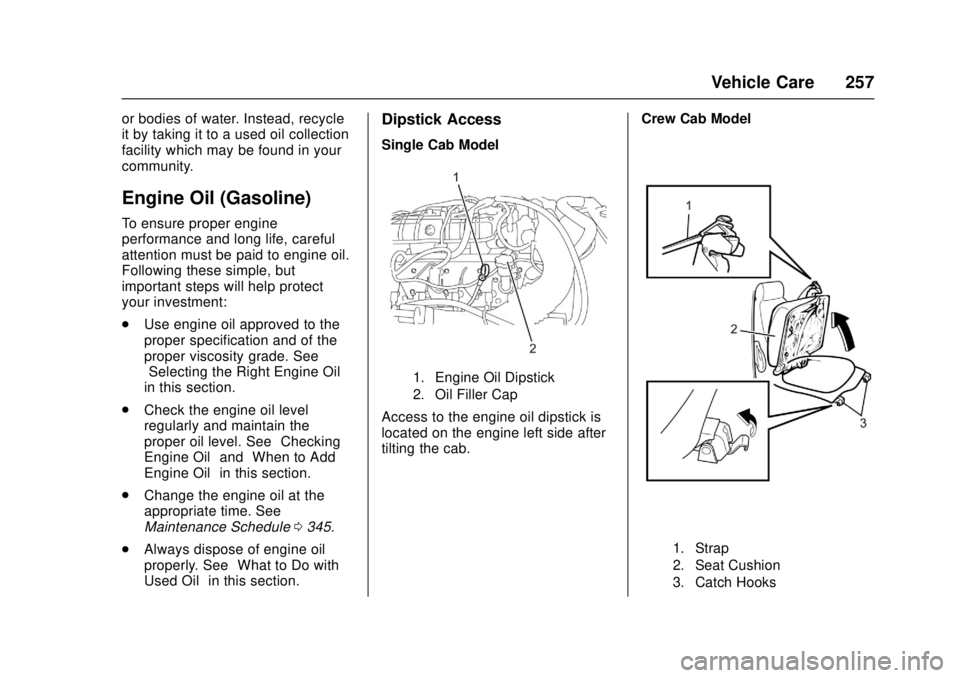
Dipstick Access
Single Cab Model
1. Engine Oil Dipstick
2. Oil Filler Cap
Access to the engine oil dipstick is
located on the engine left side after
tilting the cab. Crew Cab Model
1. Strap
2. Seat Cushion
3. Catch Hooks
Page 259 of 414

Chevrolet Low Cab Forward Owner Manual (GMNA-Localizing-U.S.-
10716700) - 2017 - crc - 12/6/16
258 Vehicle Care
The engine oil dipstick is under the
engine inspection sub cover located
beneath the passenger's seat.
Checking Engine Oil
Check the engine oil level regularly,
every 650 km (400 mi), especially
prior to a long trip. The engine oil
dipstick handle is a loop. See
Engine Compartment Overview
0249 for the location.
{Warning
The engine oil dipstick handle
may be hot; it could burn you.
Use a towel or glove to touch the
dipstick handle.
Follow these guidelines:
. To get an accurate reading, park
the vehicle on level ground.
Check the engine oil level after
the engine has been off for at
least two hours. Checking the
engine oil level on steep grades
or too soon after engine shutoff
can result in incorrect readings.
Accuracy improves when checking a cold engine prior to
starting. Remove the dipstick
and check the level.
. If unable to wait two hours, the
engine must be off for at least
15 minutes if the engine is
warm, or at least 30 minutes if
the engine is not warm. Pull out
the dipstick, wipe it with a clean
paper towel or cloth, then push it
back in all the way. Remove it
again, keeping the tip down, and
check the level.When to Add Engine Oil
If the oil is below the cross-hatched
area at the tip of the dipstick and
the engine has been off for at least
15 minutes, add 1 L (1 qt) of the
recommended oil and then recheck the level. See
“Selecting the Right
Engine Oil” later in this section for
an explanation of what kind of oil to
use. For engine oil crankcase
capacity, see Capacities and
Specifications 0389.
Caution
Do not add too much oil. Oil
levels above or below the
acceptable operating range
shown on the dipstick are harmful
to the engine. If you find that you
have an oil level above the
operating range, i.e., the engine
has so much oil that the oil level
gets above the cross-hatched
area that shows the proper
operating range, the engine could
be damaged. You should drain
out the excess oil or limit driving
of the vehicle and seek a service
professional to remove the
excess amount of oil.
See Engine Compartment Overview
0 249 for the location of the engine
oil fill cap.
Page 260 of 414

Chevrolet Low Cab Forward Owner Manual (GMNA-Localizing-U.S.-
10716700) - 2017 - crc - 12/6/16
Vehicle Care 259
Add enough oil to put the level
somewhere in the proper operating
range. Push the dipstick all the way
back in when through.
Any oil level above the "FULL" mark
on the oil dipstick may cause engine
malfunctions.
Selecting the Right Engine Oil
Selecting the right engine oil
depends on both the proper oil
specification and viscosity grade.
SeeRecommended Fluids and
Lubricants 0378.
Specification
Ask for and use engine oils that
meet the dexos1™ specification.
Engine oils that have been
approved by GM as meeting the
dexos1 specification are marked
with the dexos1 approved logo. See
www.gmdexos.com.
Caution
Failure to use the recommended
engine oil or equivalent can result
in engine damage not covered by
the vehicle warranty.
Viscosity Grade
Use SAE 5W-30 viscosity grade
engine oil.
Cold Temperature Operation: In an
area of extreme cold, where the
temperature falls below −29 °C
(−20 °F), an SAE 0W-30 oil may be
used. An oil of this viscosity grade
will provide easier cold starting for
the engine at extremely low
temperatures. When selecting an oil of the
appropriate viscosity grade, it is
recommended to select an oil of the
correct specification. See
“Specification”
earlier in this section.
Engine Oil Additives/Engine
Oil Flushes
Do not add anything to the oil. The
recommended oils meeting the
dexos1 specification are all that is
needed for good performance and
engine protection.
Engine oil system flushes are not
recommended and could cause
engine damage not covered by the
vehicle warranty.
What to Do with Used Oil
Used engine oil contains certain
elements that can be unhealthy for
your skin and could even cause
cancer. Do not let used oil stay on
your skin for very long. Clean your
skin and nails with soap and water,
or a good hand cleaner. Wash or
properly dispose of clothing or rags
containing used engine oil. See the
manufacturer's warnings about the
use and disposal of oil products.
Page 261 of 414

Chevrolet Low Cab Forward Owner Manual (GMNA-Localizing-U.S.-
10716700) - 2017 - crc - 12/6/16
260 Vehicle Care
Used oil can be a threat to the
environment. If you change your
own oil, be sure to drain all the oil
from the filter before disposal. Never
dispose of oil by putting it in the
trash or pouring it on the ground,
into sewers, or into streams or
bodies of water. Recycle it by taking
it to a place that collects used oil.
Automatic Transmission
Fluid
{Warning
Overfilling of the automatic
transmission can cause the fluid
to be "PURGED" out of the
breather hose onto the hot engine
parts and can cause a fire.
You and others could be seriously
injured.
Both quality and quantity of fluid are
important factors that have a
significant influence on the
performance and durability of the
automatic transmission. Be sure to use only the dealer recommended
fluid for replenishment, and observe
the specified fluid level.
Too much or too little transmission
oil could damage your transmission.
Too much could cause your
transmission to overheat and fluid to
spill out from the breather hose. Be
sure to get an accurate reading if
you check your transmission fluid.
When cleaning around the dipstick
and guide tube, make sure that you
thoroughly wipe away all of the dirt
and dust etc. Failure to do so may
cause a fault in the transmission.
Do not let coolants (ethylene glycol
type), water based substances,
or other fluids etc., mix with the
fluid. Otherwise, degraded
performance and faulty operation of
the system will result.
Checking the Automatic
Transmission Oil level
This operation could be difficult and
you may choose to have this done
at your dealer.
If you choose to do it yourself, then
be sure to follow all the instructions
below or you could get a false
reading on the dipstick.
Position of the Dipstick
For the single cab diesel vehicle,
the dipstick is located to the left side
of the automatic transmission at the
rear of the engine. Tilt the cab up to
inspect it.
Page 264 of 414

Chevrolet Low Cab Forward Owner Manual (GMNA-Localizing-U.S.-
10716700) - 2017 - crc - 12/6/16
Vehicle Care 263
.Diesel Engine Dipstick H
(HOT) —Transmission fluid
temperature Approx. 70 -
80 °C (158 - 176 °F).
. For diesel engines, the “C
(COLD)” range on the
dipstick is a guide used by
your dealer for specialized
equipment used to replace
or service the automatic
transmission fluid. When
performing your own
inspections, always use the
“H (HOT)” range after
warming up the vehicle.
The fluid must be hot to
ensure an accurate check.
The fluid level rises as
temperature increases.
6. If the fluid level is too low, add the specified fluid through the
dipstick guide tube. Also, check
whether there are no fluid
leaks.
7. Insert the dipstick securely into position.{Warning
Be extremely careful not to burn
yourself when checking the oil
level if the engine temperature is
high. Protect yourself with
gloves etc.
You and others could be seriously
injured.
Discarded parts, oil, grease and
fluids could have an adverse effect
on the environment. It is difficult to
dispose of these, so have your
dealer handle all checks and
replacements.
Engine Air Cleaner/Filter
Air Cleaner
Use of clogged air cleaner element
not only causes a deterioration in
the engine output but also increased
fuel consumption and dark exhaust
smoke. Be sure to use a genuine air cleaner
element. If other air cleaner element
is used, it may cause the sensor to
output a wrong signal.
See
Maintenance Schedule 0345.
Air Cleaner Indicator Light
(Diesel Vehicles Only)
When the air cleaner indicator light
comes on, check the air cleaner
element. If the air cleaner element is
clogged, replace the air cleaner
element.
See Vehicle Messages (Diesel
Only) 097.
See Maintenance Schedule 0345.
Engine Coolant
Protection of Engine against
Overcooling
Overcooling of the engine not only
accelerates wear of the vital engine
parts but also hurts fuel economy.
Page 266 of 414

Chevrolet Low Cab Forward Owner Manual (GMNA-Localizing-U.S.-
10716700) - 2017 - crc - 12/6/16
Vehicle Care 265
Warning (Continued)
eyes are still irritated or otherwise
feel abnormal, seek immediate
medical attention.
If the engine coolant gets on your
skin, rinse it off using a soap with
a large amount of water. Also,
if abnormality is seen, seek
medical attention.
Engine coolant is flammable, and
therefore, it must be kept away
from flames and other heat
sources. Engine coolant also
could ignite if it comes in contact
with a hot surface, such as the
exhaust manifold. Exercise
caution to prevent this from
happening.
You and others could be seriously
injured.
Preparing Engine Coolant
To prevent engine damage due to
freezing of the engine coolant and
to protect the cooling system from
corrosion, use a mixture of the recommended type antifreeze and
water. If the engine of the vehicle is
at
−30 °C (−22 °F) or above, the
coolant concentration should be
50%. Direct use of “50/50
Pre-diluted” product which is already
diluted to 50% concentration is
recommended. If the outside
temperature engine or vehicle is
used at −30 °C (−22 °F) or below,
coolant concentration of 55% is
recommended.
It is the owner ’s responsibility to:
. Maintain the engine cooling
system freeze protection at or
above −30 °C (−22 °F) (at or
below −30 °C (−22 °F) in colder
climates to ensure protection
against corrosion and loss of
engine coolant from boiling.
A 50/50 (55/45 for colder
climates) mixture of the
recommended type antifreeze
and water will provide freeze
protection to at or above −30 °C
(−22 °F), (at or below −30 °C
(−22 °F) in colder climates) and
boil protection to 128 °C
(262 °F). Periodic replacement
of engine coolant is needed to replenish the anticorrosion
additives that wear out with use.
Engine coolant that has become
dark in color shows that it needs
to be changed.
. Use only the recommended
coolant. See Recommended
Fluids and Lubricants 0378.
. Do not use methanol-base
antifreeze, alcohol or plain water
alone in your vehicle at any time.
They will boil at a lower point
than that at which the engine
coolant temperature gauge will
warn of overheating, and they do
not provide proper protection
against corrosion.
Engine Coolant Quantity
For the quantity of engine coolant,
see Capacities and Specifications
0 389. After changing the engine
coolant, check that the engine
coolant is up to the specified level.
Page 273 of 414

Chevrolet Low Cab Forward Owner Manual (GMNA-Localizing-U.S.-
10716700) - 2017 - crc - 12/6/16
272 Vehicle Care
4. If no steam or engine coolantcan be seen or heard from the
engine compartment:
.Tilt the cab or open the
engine access cover.
‐If the engine coolant is
boiling, wait until it stops
before proceeding.
‐ Look at the see-through
reserve tank. The
engine coolant level
should be between the
"MAX" and "MIN" lines
on the reserve tank.
‐ If necessary, pour
engine coolant (See
Engine Coolant 0263
for the proper coolant
and water mixture) into
the reserve tank only,
not directly into the
radiator. Also, do not
check engine coolant
level at the radiator.
. Make sure the fan belts are
not broken, or off the
pulleys, and that the fan
turns when the engine is started. Make sure the fan
blade and pulleys are not
broken.
. Diesel engine only, check
the radiator hoses and
connections, heater hoses
and connections, radiator,
water pump, EGR cooler,
and SCR system and hoses
for leakage.
. Gasoline engine only, if the
engine coolant level in the
reserve tank is low, look for
leaks at the radiator hoses
and connections, heater
hoses and connections,
radiator, and water pump.
If the engine coolant level in
the reserve tank is at the
correct level but there is still
an indication on the
instrument panel of an
overheat condition:
You must let the engine
cool first. You may then add
engine coolant directly to
the radiator. See "Adding
Engine Coolant" under
Engine Coolant 0263. 5. Inspect to see if there is any
dirt, etc. attached to the front
surface of the radiator. Also,
inspect to see if there is
anything blocking the core.
If there is anything attached,
clean and remove it.
6. After the inspection, regardless of the vehicle condition, please
contact the nearest dealer.
Once the engine coolant
temperature gauge no longer
signals an overheat condition, you
can resume driving at a reduced
speed. Return to normal driving
after about 10 minutes if the gauge
pointer does not again show an
overheat condition.
When tap water only has been used
for engine coolant in an emergency,
change the engine coolant as soon
as possible.
Engine damage may be caused if
an overheating engine is suddenly
refilled with water. Instead, refill
slowly.
Page 274 of 414

Chevrolet Low Cab Forward Owner Manual (GMNA-Localizing-U.S.-
10716700) - 2017 - crc - 12/6/16
Vehicle Care 273
Power Steering Fluid
The power steering fluid level must
be checked and it must be changed
according to the Maintenance
Schedule. SeeMaintenance
Schedule 0345.
When replenishing power steering
fluid or flushing the power steering
system, always use ATF
(Dexron
®-VI). Failure to use the
proper fluid may damage the power
steering system seals and hoses,
leading to fluid leakage.
Checking the Power Steering
Fluid Level
For the 3.0L diesel vehicles, the
fluid level is correct if it is between
the “MAX” and“MIN” lines on the
reserve tank. If the level is lower
that the “MIN”line, add fluid up to
the “MAX” line.
For the 5.2L diesel vehicles, the
fluid level is correct if it is between
the“MAX” and“MIN” lines on the
reserve tank. If the level is lower
that the “MIN”line, add fluid up to
the “MAX” line.
The reserve tank is located at the
rear of the engine compartment on
the right. When you have finished
checking the fluid level, securely
install the cap and cover.
For single cab gasoline vehicles, the
fluid level is correct if it is between
the "MAX" and "MIN" lines on the oil
dipstick. If the level is lower than the
"MIN" line, add fluid up to the
"MAX" line.
The reserve tank is located at the
front left side of the engine.