brake CHEVROLET LOW CAB FORWARD 2018 Repair Manual
[x] Cancel search | Manufacturer: CHEVROLET, Model Year: 2018, Model line: LOW CAB FORWARD, Model: CHEVROLET LOW CAB FORWARD 2018Pages: 358, PDF Size: 6.32 MB
Page 199 of 358
Chevrolet Low Cab Forward Owner Manual (GMNA-Localizing-U.S.-
11254764) - 2018 - crc - 12/5/16
198 Driving and Operating
ABS Operation Indications and
Signs
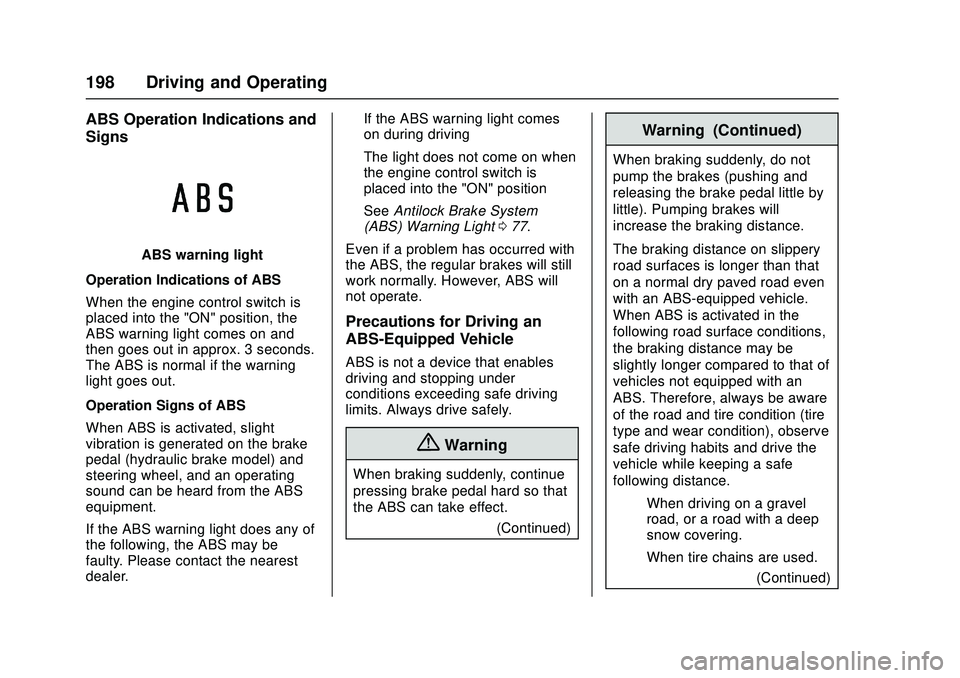
ABS warning light
Operation Indications of ABS
When the engine control switch is
placed into the "ON" position, the
ABS warning light comes on and
then goes out in approx. 3 seconds.
The ABS is normal if the warning
light goes out.
Operation Signs of ABS
When ABS is activated, slight
vibration is generated on the brake
pedal (hydraulic brake model) and
steering wheel, and an operating
sound can be heard from the ABS
equipment.
If the ABS warning light does any of
the following, the ABS may be
faulty. Please contact the nearest
dealer. ‐
If the ABS warning light comes
on during driving
‐ The light does not come on when
the engine control switch is
placed into the "ON" position
See Antilock Brake System
(ABS) Warning Light 077.
Even if a problem has occurred with
the ABS, the regular brakes will still
work normally. However, ABS will
not operate.
Precautions for Driving an
ABS-Equipped Vehicle
ABS is not a device that enables
driving and stopping under
conditions exceeding safe driving
limits. Always drive safely.
{Warning
When braking suddenly, continue
pressing brake pedal hard so that
the ABS can take effect. (Continued)
Warning (Continued)
When braking suddenly, do not
pump the brakes (pushing and
releasing the brake pedal little by
little). Pumping brakes will
increase the braking distance.
The braking distance on slippery
road surfaces is longer than that
on a normal dry paved road even
with an ABS-equipped vehicle.
When ABS is activated in the
following road surface conditions,
the braking distance may be
slightly longer compared to that of
vehicles not equipped with an
ABS. Therefore, always be aware
of the road and tire condition (tire
type and wear condition), observe
safe driving habits and drive the
vehicle while keeping a safe
following distance.
‐ When driving on a gravel
road, or a road with a deep
snow covering.
‐ When tire chains are used.
(Continued)
Page 200 of 358

Chevrolet Low Cab Forward Owner Manual (GMNA-Localizing-U.S.-
11254764) - 2018 - crc - 12/5/16
Driving and Operating 199
Warning (Continued)
‐When driving over road
joints or bumps such as
light reflectors on the road.
‐ When driving on a bumpy
road, stone-paved road or
track.
‐ When driving over an iron
plate or manhole lid.
ABS does not work for wheel skid
during a standing start,
acceleration and cornering which
do not involve braking. On a very
slippery icy road, tires may lose
grip and steering wheel operation
may not be able to control the
vehicle's direction, resulting in
very unstable driving. Always
drive the vehicle observing a safe
speed well matched with both
road surface and tire conditions,
and avoid sudden braking.
If powerful engine braking is
applied on a very slippery icy
road, the drive wheels may be (Continued)
Warning (Continued)
locked (the ABS then does not
work), resulting in loss of vehicle
control.
When ABS is activated, a slight
vibration (especially when the
road surface is different between
right and left wheels) and pulling
may be felt on the brake pedal
and steering wheel. In addition,
an operating sound is produced
from the ABS actuators. This
does not indicate any abnormal
condition. Stay calm and operate
the steering wheel properly.
Electronic Braking force
Distribution (EBD)
EBD is a function that uses the ABS
to distribute braking force ideally
between the front and rear wheels
in order to compensate for changes
in load conditions or any shift of the
load due to acceleration or
deceleration, thus preventing
premature locking of the rear
wheels.
{Warning
If a problem should occur with the
EBD function, the ABS warning
light and the brake system
warning light will come on
simultaneously.
The rear wheels will lock more
easily if there is a problem with
the EBD function. Have it
checked and serviced at the
nearest dealer as soon as
possible. You and others could be
seriously injured.
When the EBD operates, the brake
pedal may push back slightly or you
may hear a sound similar to that
generated by the ABS when
operational. Neither of them
indicates any abnormal condition.
Page 201 of 358

Chevrolet Low Cab Forward Owner Manual (GMNA-Localizing-U.S.-
11254764) - 2018 - crc - 12/5/16
200 Driving and Operating
Parking Brake
Parking Brake Lever
{Warning
Although the parking brake
indicator light will come on if the
parking brake is engaged while
the engine control switch is in the
ON position, this does not mean
the parking brake is fully
engaged, so always make sure
the lever is fully pulled up.
Never drive the vehicle with the
parking brake set as this will
cause excessive wear, reduce
parking brake effectiveness and
increase fuel consumption.
Choose a flat place where
stopping and parking are
permitted and where the vehicle
will not obstruct traffic.
Remove all dirt from the vehicle's
light lenses and reflectors to
ensure that the vehicle can be
seen from other vehicles. You and
others could be seriously injured.Avoid parking for long periods with
cargo on the vehicle.
Operation of Parking Brake
The parking brake lever is located to
the right of the driver's seat.
To set the parking brake, completely
stop the vehicle. Then, without
pressing the release button (1), hold
the brake pedal down while pulling
the parking brake lever (2) all the
way up.
The parking brake indicator light in
the instrument panel will come on
when the lever is pulled up. Before
you leave the driver's seat, follow
the steps under
“Parking, or Leaving
Driver's Seat”. See Braking0126.
To release the parking brake, hold
the brake pedal down while pushing
the release button of the parking
brake lever and lower the lever. The
parking brake indicator light in the
instrument panel will go out.
The parking brake indicator light is
designed to remind you if the
parking brake is not released when
the engine control switch is on.
If you notice the parking brake lever
travel has increased over time, this
means the cable adjustment must
be checked by a qualified
technician. Adjustment may be
required due to parking brake shoe
wear. See Control of a Vehicle
0 122.
Page 202 of 358

Chevrolet Low Cab Forward Owner Manual (GMNA-Localizing-U.S.-
11254764) - 2018 - crc - 12/5/16
Driving and Operating 201
Inspection
Pull the parking brake lever slowly
from the fully released position while
counting the clicks produced as the
lever engages ratchet plate notches
to check that it can be raised the
proper amount and the lever is held
firmly.
If the number of notches is not
within the standard value range
below, adjust it to the standard
value. Lever stroke is 6 to 8
notches.
Number of notches before parking
brake is set when lever is pulled
slowly from released position withpull force of about 147 N
(15 kgf/33 lbs).
See
Maintenance Schedule 0303
and Additional Maintenance and
Care 0323.
Exhaust Brake
Exhaust Brake Switch
When turned on, the system
increases the amount of power
absorbed by the engine while
coasting in gear. Whenever slowing
down the vehicle, such as on down
grades, in city traffic or approaching
stop signals, this brake system may
be used.
To turn on the exhaust brake system
while driving, pull the lever
backward. The exhaust brake
indicator light comes on. The
exhaust brake will engage
automatically when the accelerator
pedal is released and vehicle speed
is above 10 km/h (6.5 MPH).
The exhaust brake will disengage
when the accelerator pedal or brake
pedal is pressed. Releasing the
pedal reengages the exhaust brake.
Push the lever forward to turn the
exhaust brake off during idling.
{Warning
It is extremely dangerous to apply
the exhaust brake on slippery
roads as the tires can skid.
You and others could be seriously
injured.
Page 203 of 358

Chevrolet Low Cab Forward Owner Manual (GMNA-Localizing-U.S.-
11254764) - 2018 - crc - 12/5/16
202 Driving and Operating
Even if the selector lever is placed
in the N position, the exhaust brake
does not disengage until the engine
is warmed up if the warm-up system
is on.
Conditions for Inoperable Exhaust
Brake
Under the following conditions, the
exhaust brake does not engage
even if the exhaust brake indicator
light comes on:
.The accelerator pedal is
pressed.
. The selector lever is in the N
position.
. The vehicle is traveling at
5 km/h (3 MPH) or lower speeds.
If your vehicle is equipped with an
anti-lock brake system (ABS), the
exhaust brake may disengage
during ABS operation even when
the exhaust brake switch is in the
ON position and the exhaust brake
indicator light is on. The exhaust
brake may disengage temporarily as
the vehicle passes over a bump
even when the brake pedal is not
pressed. It is advisable to operate the
exhaust brake when descending a
slope or when stop and go driving is
involved.
The selection of transmission gears
and engine speed when operating
the brake system is important. The
exhaust brake is more effective in
the lower gears and at the higher
engine speeds. See
Exhaust Brake
Light 078.Cruise Control
The cruise control function allows
you to drive the vehicle at a
constant speed without operating
the accelerator pedal. Use this
function when the vehicle speed is
between 40 to 160 km/h (25 to 100
MPH). This function should only be
used when driving without frequent
starts and stops.
{Warning
Cruise control can be dangerous
where you cannot drive safely at
a steady speed. Do not use
cruise control on winding roads or
in heavy traffic. You and others
could be seriously injured.
Cruise control can be dangerous
on slippery roads. On such roads,
fast changes in tire traction can
cause needless wheel spinning,
and you could lose control. Do
not use cruise control on slippery
roads. You and others could be
seriously injured.
Page 205 of 358
Chevrolet Low Cab Forward Owner Manual (GMNA-Localizing-U.S.-
11254764) - 2018 - crc - 12/5/16
204 Driving and Operating
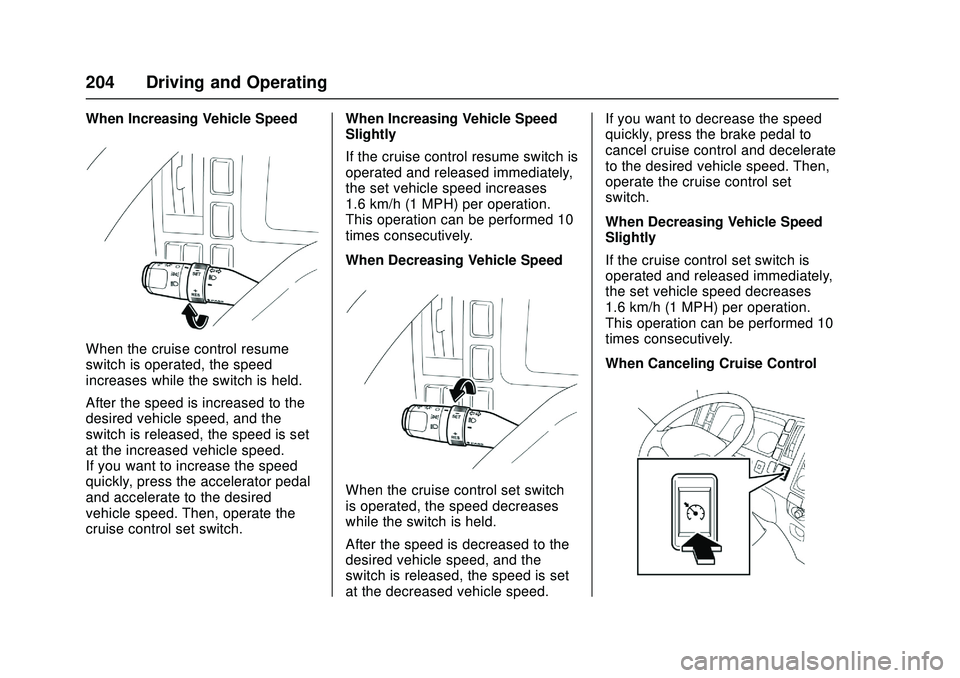
When Increasing Vehicle Speed
When the cruise control resume
switch is operated, the speed
increases while the switch is held.
After the speed is increased to the
desired vehicle speed, and the
switch is released, the speed is set
at the increased vehicle speed.
If you want to increase the speed
quickly, press the accelerator pedal
and accelerate to the desired
vehicle speed. Then, operate the
cruise control set switch.When Increasing Vehicle Speed
Slightly
If the cruise control resume switch is
operated and released immediately,
the set vehicle speed increases
1.6 km/h (1 MPH) per operation.
This operation can be performed 10
times consecutively.
When Decreasing Vehicle Speed
When the cruise control set switch
is operated, the speed decreases
while the switch is held.
After the speed is decreased to the
desired vehicle speed, and the
switch is released, the speed is set
at the decreased vehicle speed.If you want to decrease the speed
quickly, press the brake pedal to
cancel cruise control and decelerate
to the desired vehicle speed. Then,
operate the cruise control set
switch.
When Decreasing Vehicle Speed
Slightly
If the cruise control set switch is
operated and released immediately,
the set vehicle speed decreases
1.6 km/h (1 MPH) per operation.
This operation can be performed 10
times consecutively.
When Canceling Cruise Control
Page 206 of 358
Chevrolet Low Cab Forward Owner Manual (GMNA-Localizing-U.S.-
11254764) - 2018 - crc - 12/5/16
Driving and Operating 205
Press the cruise control main switch
again to turn the cruise control
system off. The cruise control main
indicator light will go out.
The cruise control set speed is
canceled in the following cases:
.When the brake pedal is
pressed.
. When the selector lever is
shifted to the N position.
. When cruising speed is
approximately 27 km/h (17
MPH). *
. When the vehicle speed
decreases more than 20% below
your set speed.
. When the cruise control main
switch is turned off. *
. When the engine control switch
is turned to the LOCK position. *
. When trouble develops in the
system. *
Memory speed is eliminated. *
When you do not use the cruise
control, be sure to place the cruise
control main switch into off. When you place the engine control
switch into ACC, place the cruise
control main switch into off, then
reset the cruise control if you want
to use the cruise control again.
Using Cruise Control on Hills
How well your cruise control will
work on hills depends upon your
speed, load and the steepness of
the hills. When going up steep hills,
you may want to step on the
accelerator pedal to maintain your
speed. When going downhill, you
may have to brake or shift to a lower
gear to keep your speed down. Of
course, applying the brake takes
you out of cruise control. Many
drivers find this to be too much
trouble and do not use cruise
control on steep hills.
When Returning to Cruise Control
Driving
If you have canceled cruise control
under the following conditions, you
can return to the cruise control
driving condition before cancellation
when you operate and release the
cruise control resume switch. The
moment the resume switch is
released, the cruise set indicator
light comes on.
.
When pressing the brake pedal.
. When the selector lever is
shifted to the N position.
When the vehicle speed decreases
to 40 km/h (25 MPH) or less, it is
not possible to return to the cruise
control driving. You must reset the
cruise control.
If the cruise control is turned back
on while the vehicle speed exceeds
what is set prior to the cancellation
of cruise control, the set vehicle
speed cannot be changed until the
vehicle reaches to the set speed.
Also, the vehicle speed must be 1
MPH below the previously set
vehicle speed.
If you hold the switch at the +RES
position, the vehicle will keep going
faster until you release the switch or
apply the brake. So unless you want
to go faster, do not hold the switch
at the +RES position.
Page 207 of 358

Chevrolet Low Cab Forward Owner Manual (GMNA-Localizing-U.S.-
11254764) - 2018 - crc - 12/5/16
206 Driving and Operating
Exhaust Brake Function
Diesel Vehicles Equipped with
Exhaust Brake-interlocked Cruise
Automatic activation of the exhaust
brake during cruise control driving
suppresses an increase in the
speed on a downhill slope,
decreasing the need for the driver to
apply the regular brake pedal. The
exhaust brake does not activate
when the exhaust brake switch is
turn off.
The maximum slope angle at which
the system can control the vehicle
speed increase is different
depending on the load the vehicle is
carrying.
Automatic Activation and
Automatic Release of Exhaust
Brake
The exhaust brake is engaged when
the vehicle speed exceeds the set
speed on a downhill slope.
The exhaust brake is disengaged
when the vehicle slows down close
to the set.
Fuel
Fuel for Diesel Engines
Diesel Fuel Requirement and
Fuel System
Fuel Requirements
Use of fuels other than ultra
low-sulfur fuel may not conform to
emission regulations.
The fuel supply pump, injector or
other parts of the fuel system and
engine can be damaged if you use
any fuel or fuel additive other than
those specifically recommended by
the dealer.
To help avoid fuel system or engine
damage, pay attention to the
following:
.Some service stations mix used
engine oil with diesel fuel. Some
manufacturers of large diesel
engines allow this; however, for
your diesel engine, do not use
diesel fuel which has been
contaminated with engine oil.
Besides causing engine
damage, such fuel can also affect emission control. Before
using any diesel fuel, check with
the service station operator to
see if the fuel has been mixed
with engine oil.
. Do not use any fuel additive
(other than as recommended
under "Biocides" in Water in
Fuel 0209). At the time this
manual was printed, no other
fuel additive was recommended.
(See your authorized dealer to
find out if this has changed.)
. Take care not to run out of diesel
fuel. If you do run out of fuel,
you may need to bleed air out of
the supply pump to re-start the
engine after fuel has been filled.
Your vehicle is designed to use
either Number 1-D or Number 2-D
diesel fuel. However, for better fuel
economy, use Number 2-D diesel
fuel whenever possible. At
temperatures below -7 °C (20 °F),
Number 2-D fuel may pose
operating problems (see "Cold
Weather Operation" which follows).
At colder temperatures, use Number
1-D fuel (if available) or use a
Page 213 of 358
Chevrolet Low Cab Forward Owner Manual (GMNA-Localizing-U.S.-
11254764) - 2018 - crc - 12/5/16
212 Driving and Operating
Running Out of Fuel
When the Fuel Tank is Empty
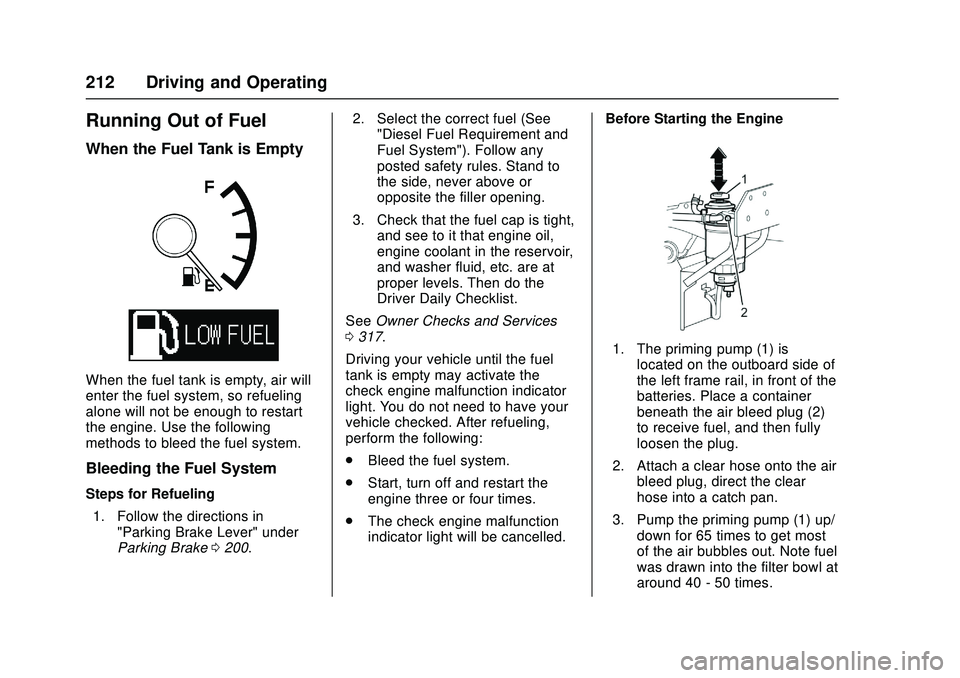
When the fuel tank is empty, air will
enter the fuel system, so refueling
alone will not be enough to restart
the engine. Use the following
methods to bleed the fuel system.
Bleeding the Fuel System
Steps for Refueling1. Follow the directions in "Parking Brake Lever" under
Parking Brake 0200. 2. Select the correct fuel (See
"Diesel Fuel Requirement and
Fuel System"). Follow any
posted safety rules. Stand to
the side, never above or
opposite the filler opening.
3. Check that the fuel cap is tight, and see to it that engine oil,
engine coolant in the reservoir,
and washer fluid, etc. are at
proper levels. Then do the
Driver Daily Checklist.
See Owner Checks and Services
0 317.
Driving your vehicle until the fuel
tank is empty may activate the
check engine malfunction indicator
light. You do not need to have your
vehicle checked. After refueling,
perform the following:
. Bleed the fuel system.
. Start, turn off and restart the
engine three or four times.
. The check engine malfunction
indicator light will be cancelled. Before Starting the Engine
1. The priming pump (1) is
located on the outboard side of
the left frame rail, in front of the
batteries. Place a container
beneath the air bleed plug (2)
to receive fuel, and then fully
loosen the plug.
2. Attach a clear hose onto the air bleed plug, direct the clear
hose into a catch pan.
3. Pump the priming pump (1) up/ down for 65 times to get most
of the air bubbles out. Note fuel
was drawn into the filter bowl at
around 40 - 50 times.
Page 217 of 358

Chevrolet Low Cab Forward Owner Manual (GMNA-Localizing-U.S.-
11254764) - 2018 - crc - 12/5/16
216 Driving and Operating
When Operating the PTO
For operation of special equipment,
see the manufacturer’s instructions.
Installations, or alterations to the
original equipment vehicle or
chassis, as manufactured and
assembled by General Motors, are
not covered by this warranty. The
body company, assembler,
or equipment installer is solely
responsible for warranties on the
body or equipment and any
alterations to any of the parts,
components, systems,
or assemblies installed by GM.
Examples include, but are not
limited to, special body installation,
such as recreational vehicles, the
installation of any non-GM part,
cutting, welding, or the
disconnecting of original equipment
vehicle or chassis parts and
components, extension of the
wheelbase, suspension, and
driveline modifications, and axle
additions. The engine control module (ECM)
has the ability to accommodate one
of three different PTO modes. Each
mode can be programmed to
accommodate many PTO devices.
Optional PTO switches are available
from your dealer to ease installation
of a PTO.
The optional PTO main switch and
PTO engine speed control switch
can be used increase the engine
idle r/min without additional
programming. Pressing the PTO
main switch once will activate the
PTO mode and raise the idle up
speed up to the preset 800 r/min.
Once in PTO mode the PTO engine
speed control switch can be used to
adjust the idle speeds between the
preset 1,300 and 1,700 r/min.
Moving the selector lever from park
or neutral, applying the brake pedal
or releasing the parking brake will
cancel PTO mode and return the
engine idle speed to normal. For
additional details about PTO
programming, contact your dealer.