lock CHEVROLET PRIZM 1998 3.G Workshop Manual
[x] Cancel search | Manufacturer: CHEVROLET, Model Year: 1998, Model line: PRIZM, Model: CHEVROLET PRIZM 1998 3.GPages: 364, PDF Size: 18.79 MB
Page 210 of 364
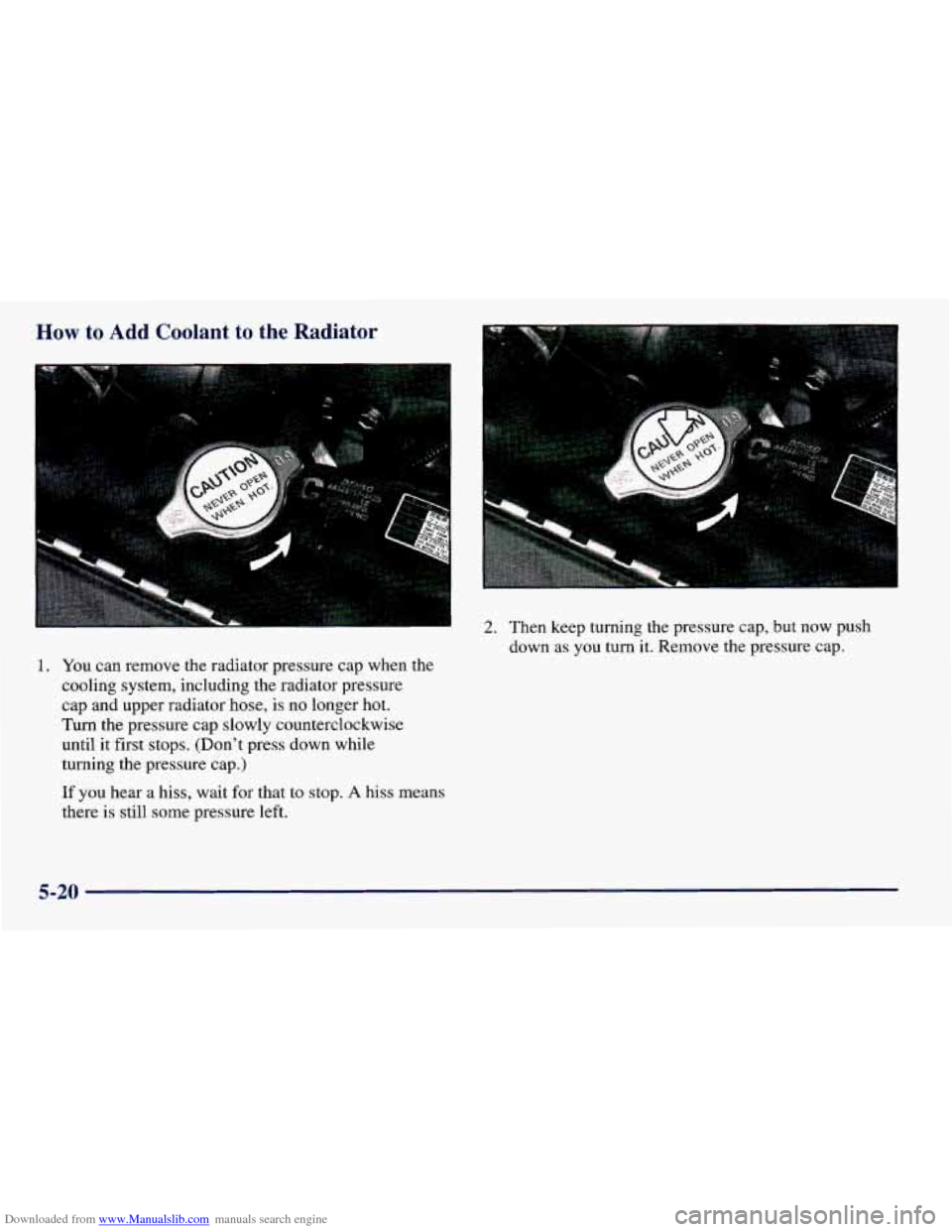
Downloaded from www.Manualslib.com manuals search engine How to Add Coolant to the Radiator
1. You can remove the radiator pressure cap when the
cooling system, including the radiator pressure
cap and upper radiator hose, is no longer
hot.
Turn the pressure cap slowly counterclockwise
until it first stops. (Don’t press down while
turning the pressure cap.)
If you hear a hiss, wait for that to stop. A hiss means
there
is still some pressure left.
2. Then keep turning the pressure cap, but now push
down as you
turn it. Remove the pressure cap.
5-20
Page 213 of 364
Downloaded from www.Manualslib.com manuals search engine If a Tire Goes Flat
It’s unusual for a tire to “blow out” while you’re driving,
especially if you maintain your tires properly. If air goes
out
of a tire, it’s much more likely to leak out slowly.
But if you should ever have a “blowout,” here are a
few tips about what to expect and what to do:
If a front tire fails, the flat tire will create a drag that
pulls the vehicle toward that side. Take your foot off
the accelerator pedal and grip the steering wheel firmly.
Steer to maintain lane position, and then gently brake
to
a stop well out of the traffic lane.
A rear blowout, particularly on a curve, acts much like
a
skid and may require the same correction you’d use
in a skid. In any rear blowout, remove your foot from
the accelerator pedal. Get the vehicle under control by steering the way you want the vehicle to
go. It may be
very bumpy and noisy, but you can still steer. Gently
brake to a stop
-- well off the road if possible.
If a tire goes flat, the next part shows how to use your
jacking equipment to change a flat tire safely.
Changing a Flat Tire
If a tire goes flat, avoid further tire and wheel damage
by driving slowly to a level place. Turn on your hazard
warning flashers.
Changing a tire can cause an injury. The vehicle
can slip
off the jack and roll over you or other
people. You and they could be badly injured.
Find a level place to change your tire. To help
prevent the vehicle from moving:
1. Set the parking brake firmly.
2. Put an automatic transaxle shift lever in
PARK
(P), or shift a manual transaxle to
FIRST
(1) or REVERSE (R).
3. lbrn off the engine.
To be even more certain the vehicle won’t move,
you can put blocks at the front and rear of the
tire farthest away from the one being changed.
That would be the tire on the other side of the
vehicle, at the opposite end.
5-23
Page 233 of 364
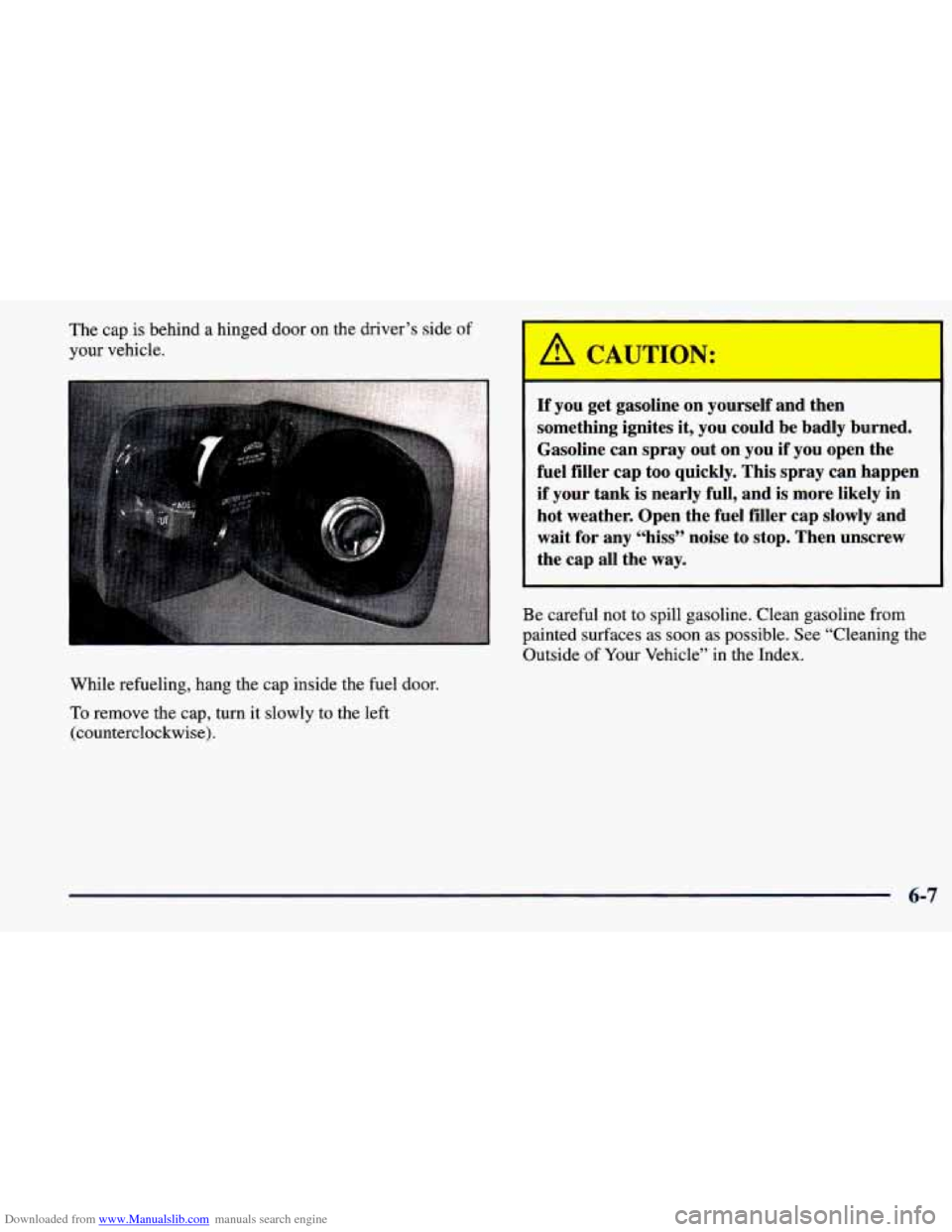
Downloaded from www.Manualslib.com manuals search engine The cap is behind a hinged door on the driver’s side of
your vehicle.
While refueling, hang the cap inside the fuel door.
To remove the cap, turn it slowly to the left
(counterclockwise).
A ,CAUTION
If you get gasoline on yourself and then
something ignites it, you could be badly burned.
Gasoline can spray out on you if you open the
fuel filler cap too quickly. This spray can happen
if your tank is nearly full, and is more likely in
hot weather. Open the fuel filler cap slowly and
wait for any “hiss” noise to stop. Then unscrew
the cap all the way.
Be careful not to spill gasoline. Clean gasoline from
painted surfaces as soon as possible.
See “Cleaning the
Outside of Your Vehicle” in the Index.
6-7
Page 234 of 364
Downloaded from www.Manualslib.com manuals search engine When you put the cap back on, turn it to the right
(clockwise) until you hear a clicking sound. Make
sure you fully install the cap. The diagnostic system
can determine
if the fuel cap has been left off or
improperly installed. This would allow fuel to
evaporate into the atmosphere. See “Malfunction
Indicator Lamp” in the Index.
NOTICE:
If you need a new cap, be sure to get the right
type. Your dealer can get one for you.
If you get
the wrong type, it may not fit properly. This may
cause your malfunction indicator lamp to light
and your fuel tank and emissions system may be
damaged. See “Malfunction Indicator Lamp” in
the Index.
Filling a Portable Fuel Container
Never fill a portable fuel container while it is in
your vehicle. Static electricity discharge from the
container can ignite the gasoline vapor.
You can
be badly burned and your vehicle damaged if this
occurs. To help avoid injury to you and others:
Dispense gasoline only into approved
containers.
Do not fill a container while it is inside a
vehicle, in a vehicle’s trunk, pickup bed or
on any surface other than the ground.
inside
of the fill opening before operating
the nozzle. Contact should be maintained
until the filling
is complete.
0 Bring the fill nozzle in contact with the
Don’t smoke while pumping gasoline.
Page 237 of 364
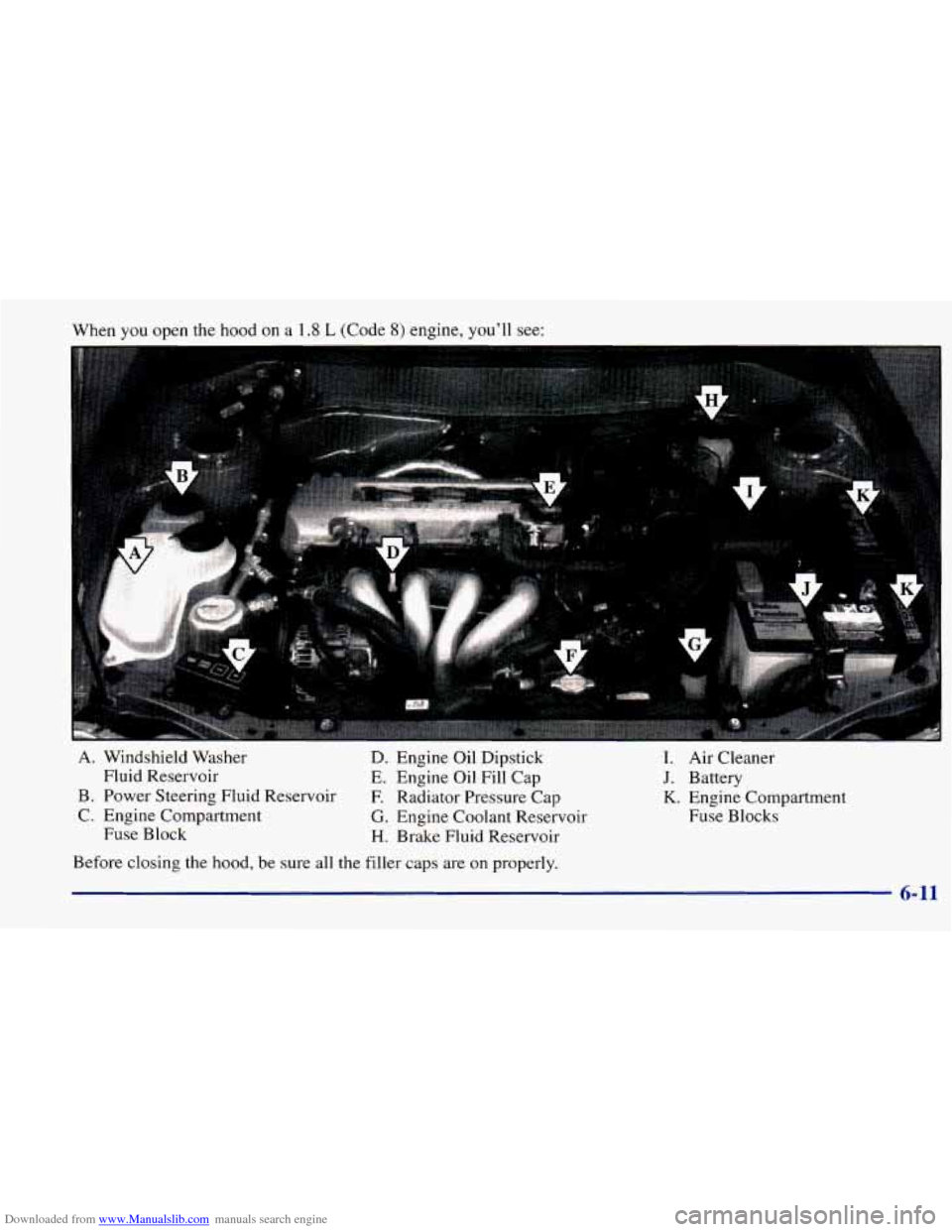
Downloaded from www.Manualslib.com manuals search engine When you open the hood on a 1.8 L (Code 8) engine, you'll see:
A. Windshield Washer
D. Engine Oil Dipstick I. Air Cleaner
Fluid Reservoir
E. Engine Oil Fill Cap
J. Battery
B. Power Steering Fluid Reservoir
F. Radiator Pressure Cap K. Engine Compartment
C. Engine Compartment
G. Engine Coolant Reservoir Fuse Blocks
Fuse Block
H. Brake Fluid Reservoir
Before closing the hood, be sure all the filler caps are on properly.
6-11
Page 246 of 364
Downloaded from www.Manualslib.com manuals search engine 3,
4.
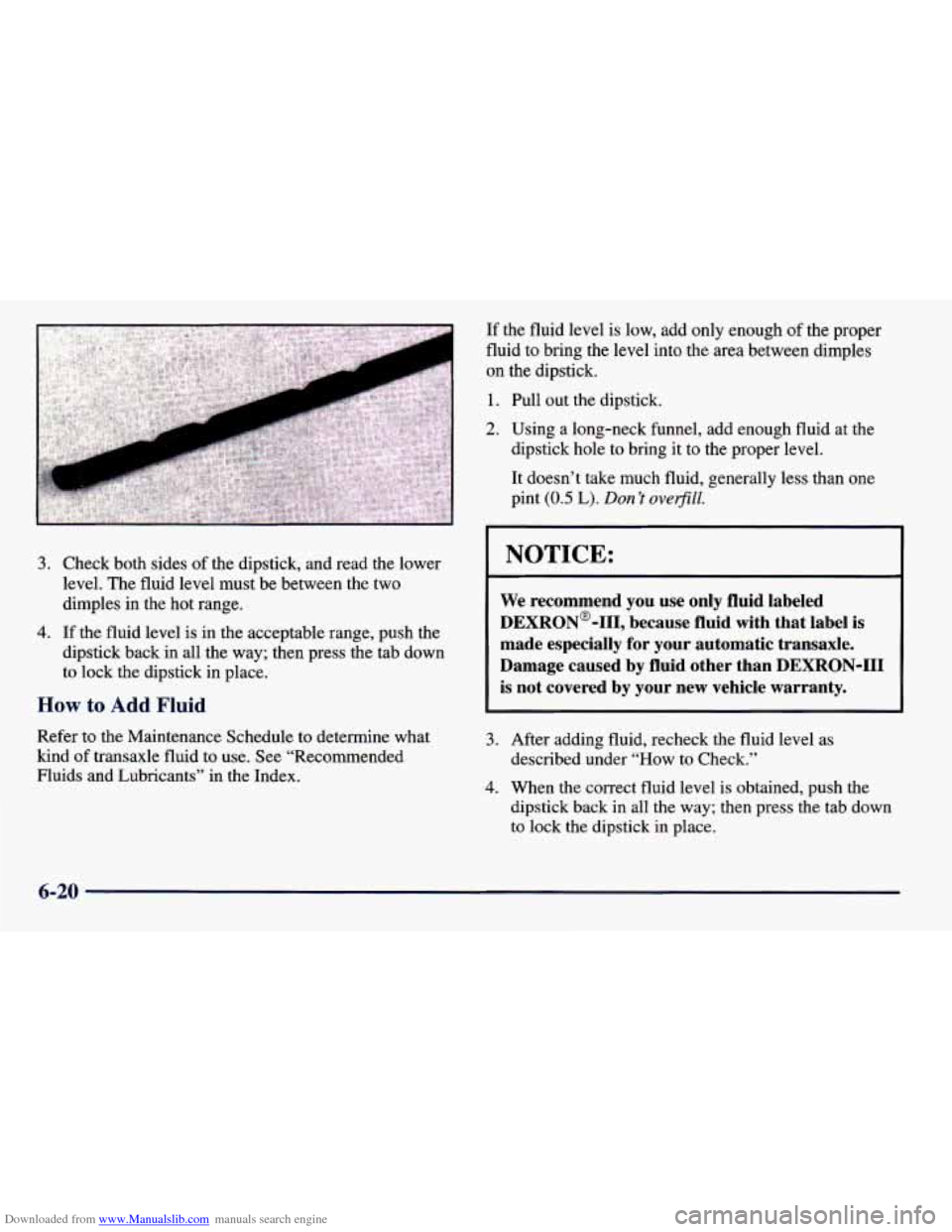
Check both sides of the dipstick, and read the lower
level.
The fluid level must be between the two
dimples
in the hot range.
If the fluid level is in the acceptable range, push the
dipstick back in all the way; then press the tab down
to lock the dipstick in place.
How to Add Fluid
Refer to the Maintenance Schedule to determine what
kind
of transaxle fluid to use. See “Recommended
Fluids
and Lubricants” in the Index. If
the fluid level is low, add only enough
of the proper
fluid to bring the level into the area between dimples
on the dipstick.
1. Pull out the dipstick.
2. Using a long-neck funnel, add enough fluid at the
dipstick hole to bring it to the proper level.
It doesn’t take much fluid, generally less than one
pint
(0.5 L). Don’t overfill.
NOTICE:
We recommend you use only fluid labeled
DEXRON@-111, because fluid with that label is
made especially for your automatic transaxle. Damage caused by fluid other than
DEXRON-111
~ is not covered by your new vehicle warranty.
3. After adding fluid, recheck the fluid level as
described under “How to Check.”
4. When the correct fluid level is obtained, push the
dipstick back
in all the way; then press the tab down
to lock the dipstick
in place.
6-20
Page 281 of 364
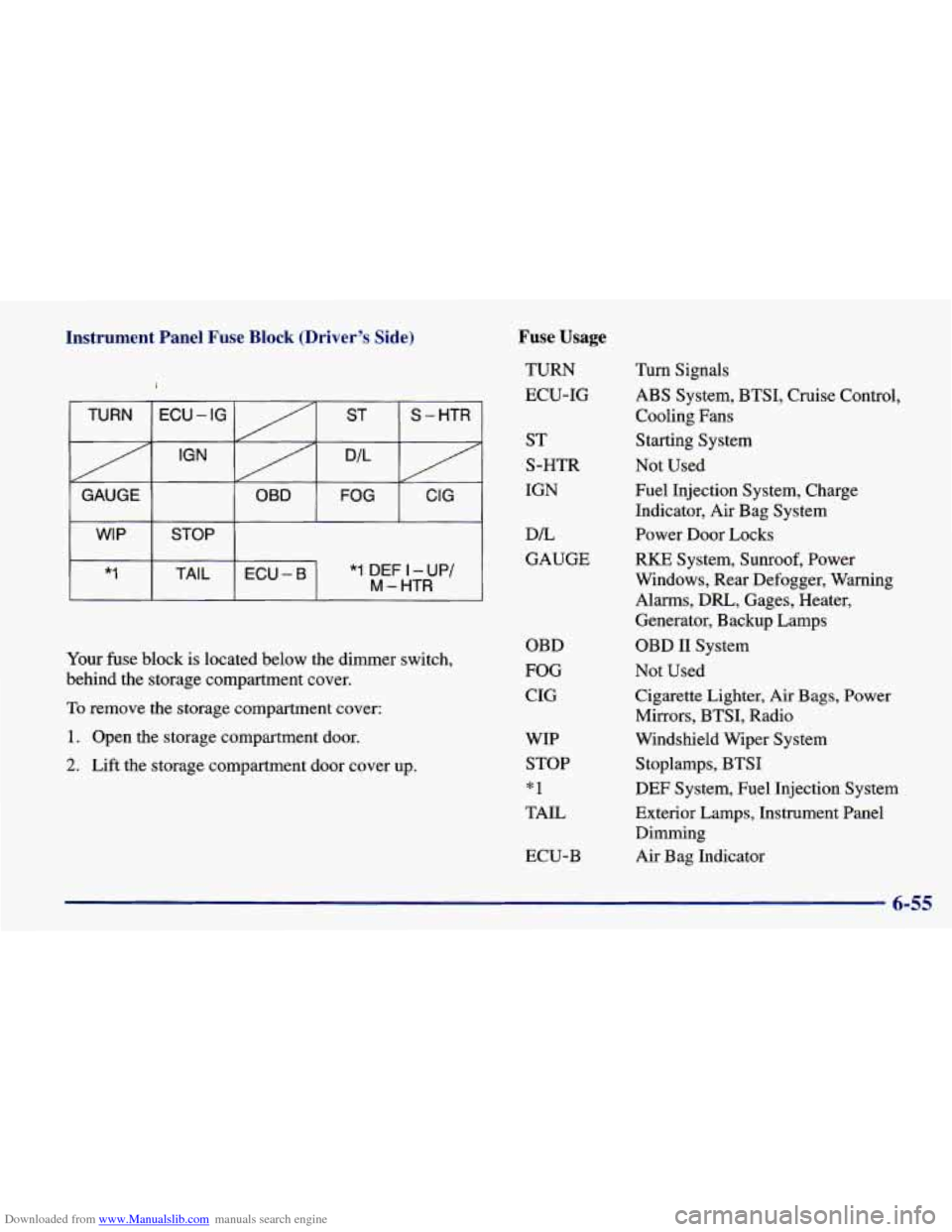
Downloaded from www.Manualslib.com manuals search engine Instrument Panel Fuse Block (Driver's Side)
1
TURN S - HTR ST ECU - IG
IGN D/L
GAUGE CIG FOG OBD
WIP STOP
*I DEF I - UP/
M - HTR
Your fuse block is located below the dimmer switch,
behind the storage compartment cover.
To remove the storage compartment cover:
1. Open the storage compartment door.
2. Lift the storage compartment door cover up.
Fuse Usage
TURN
ECU-IG
ST
S-HTR
IGN
DL
GAUGE
OBD
FOG
CIG
WIP STOP
"1
TAIL
ECU-B
Turn Signals
ABS System, BTSI, Cruise Control,
Cooling Fans
Starting System
Not Used
Fuel Injection System, Charge
Indicator, Air Bag System Power Door
Locks
RKE System, Sunroof, Power
Windows, Rear Defogger, Warning Alarms,
DRL, Gages, Heater,
Generator, Backup Lamps
OBD 11 System
Not Used
Cigarette Lighter, Air Bags, Power
Mirrors, BTSI, Radio
Windshield Wiper System
Stoplamps, BTSI
DEF System, Fuel Injection System
Exterior Lamps, Insmment Panel
Dimming
Air Bag Indicator
6-55
Page 282 of 364
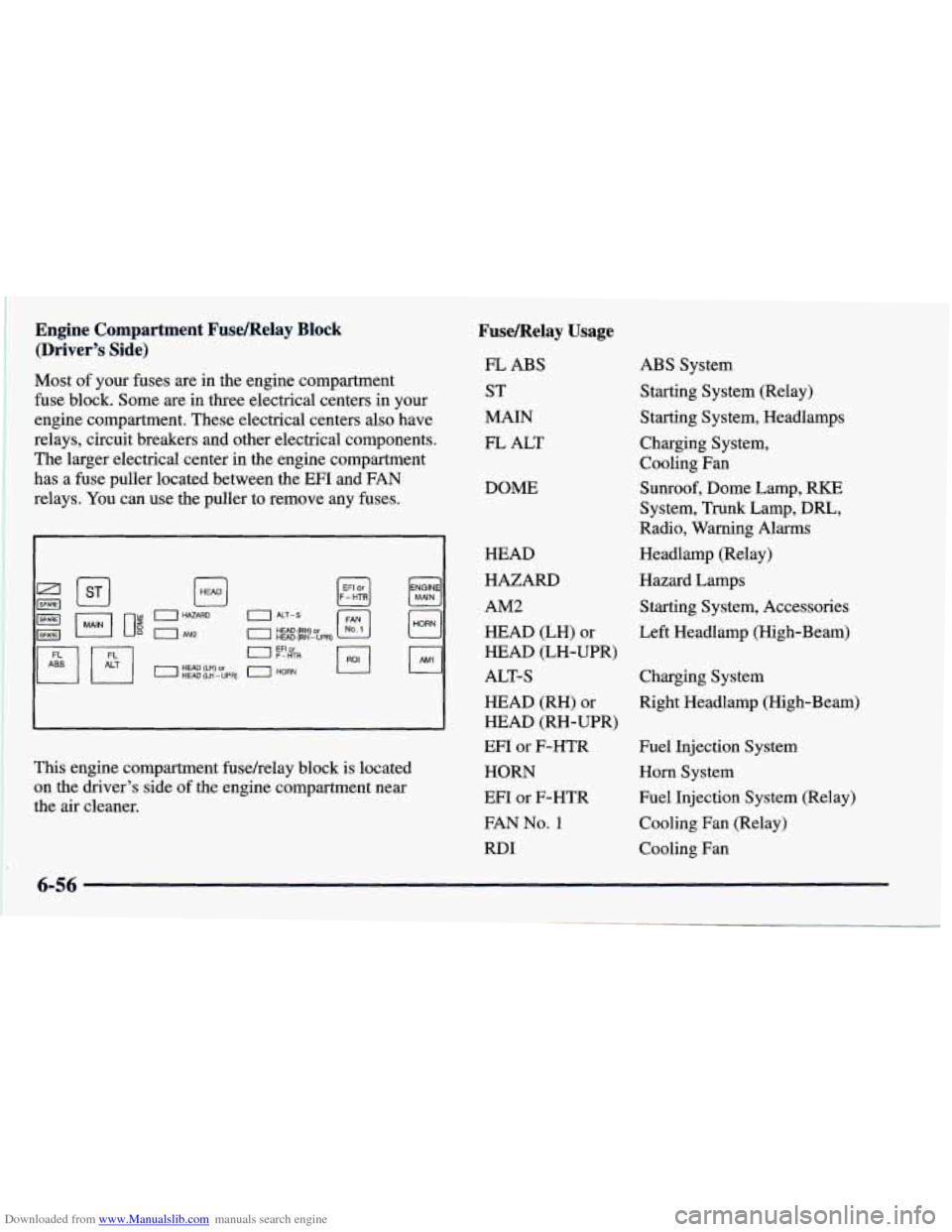
Downloaded from www.Manualslib.com manuals search engine Engine Compartment Fusemelay Block
(Driver's Side)
Most of your fuses are in the engine compartment
fuse block. Some are in three electrical centers in your
engine compartment. These electrical centers also have
relays, circuit breakers and other electrical components.
The larger electrical center in the engine compartment
has a fuse puller located between the EFI and FAN
relays. You can use the puller to remove any fuses.
Fusemelay Usage
FL ABS
ST
MAIN
FL ALT
DOME
[.-I
0 HAZARD
0 AM2
0 HEAD (LH -UPR) HEAD (LH) or
[,,,,I ENGlN
This engine compartment fusehelay block is located
on the driver's side of the engine compartment near
the air cleaner. HEAD
HAZARD
AM2
HEAD (LH) or
HEAD (LH-UPR)
LT-S
HEAD
(RH) or
EFI or F-HTR
HORN
EFI or F-HTR
FAN
No. 1
RDI HEAD (RH-UPR)
ABS System
Starting System (Relay)
Starting System, Headlamps
Charging System,
Cooling Fan
Sunroof, Dome Lamp, RKE
System, Trunk Lamp, DRL,
Radio, Warning Alarms
Headlamp (Relay)
Hazard Lamps
Starting System, Accessories
Left Headlamp (High-Beam)
Charging System
Right Headlamp (High-Beam)
Fuel Injection System
Horn System
Fuel Injection System (Relay)
Cooling Fan (Relay) Cooling Fan
6-56
Page 283 of 364
Downloaded from www.Manualslib.com manuals search engine Fusemelay Usage
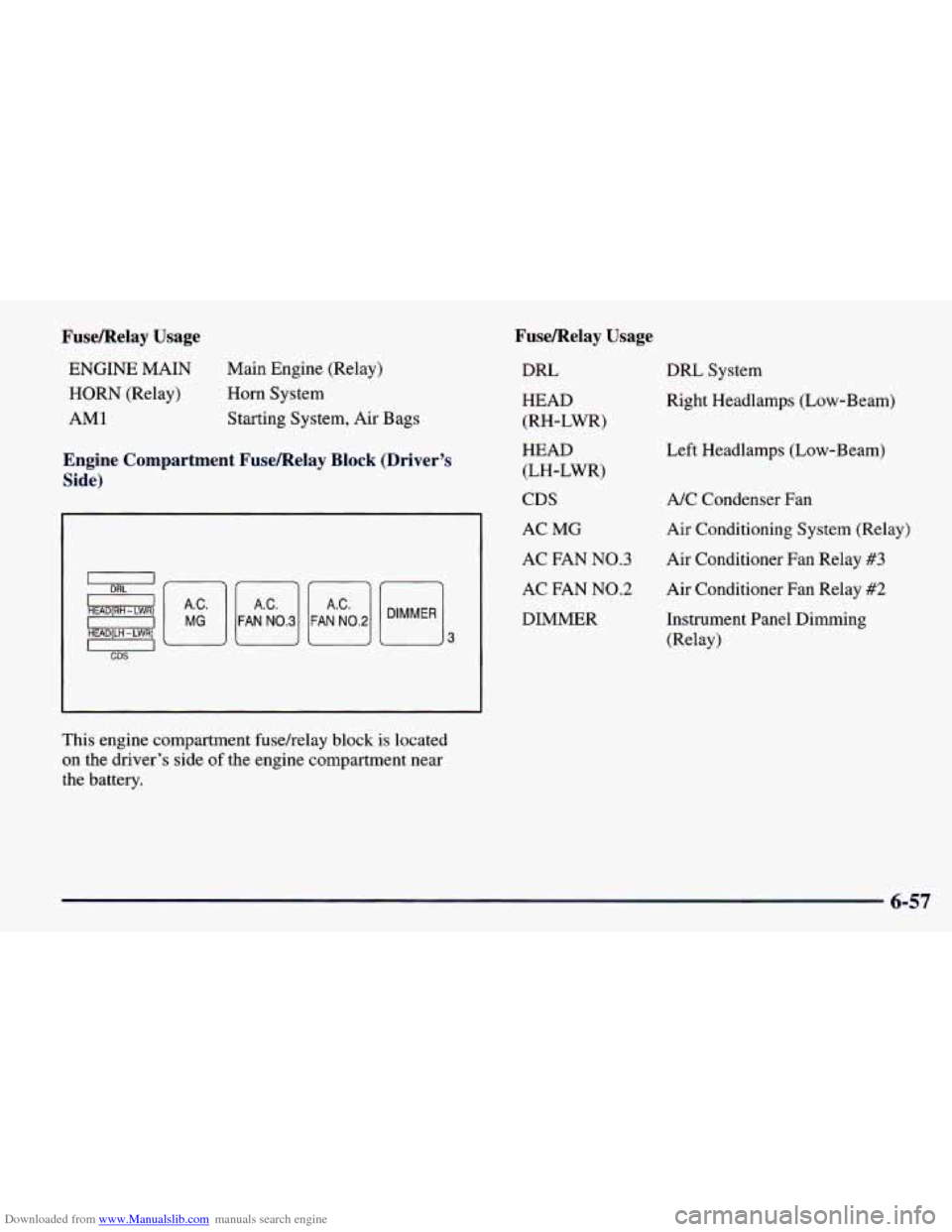
ENGINE MAIN
HORN (Relay)
AM1 Main Engine (Relay)
Horn System
Starting System, Air Bags
Engine Compartment Fusemelay Block (Driver’s
Side)
-
e5 HEAD(RH - LWR)
0
0
HEAD(LH -LWR)
CDS Elm FAN N0.3 FAN N0.2 El3
DIMMER
This engine compartment fusehelay block is located
on the driver’s side of the engine compartment near
the battery.
Fusemelay Usage
DRL
HEAD
(RH-LWR)
HEAD (LH-LWR)
CDS
AC
MG
AC FAN N0.3
AC FAN
N0.2
DIMMER DRL System
Right Headlamps (Low-Beam)
Left Headlamps (Low-Beam)
A/C Condenser Fan
Air Conditioning System (Relay)
Air Conditioner Fan Relay
#3
Air Conditioner Fan Relay #2
Instrument Panel Dimming
(Relay)
6-57
Page 284 of 364
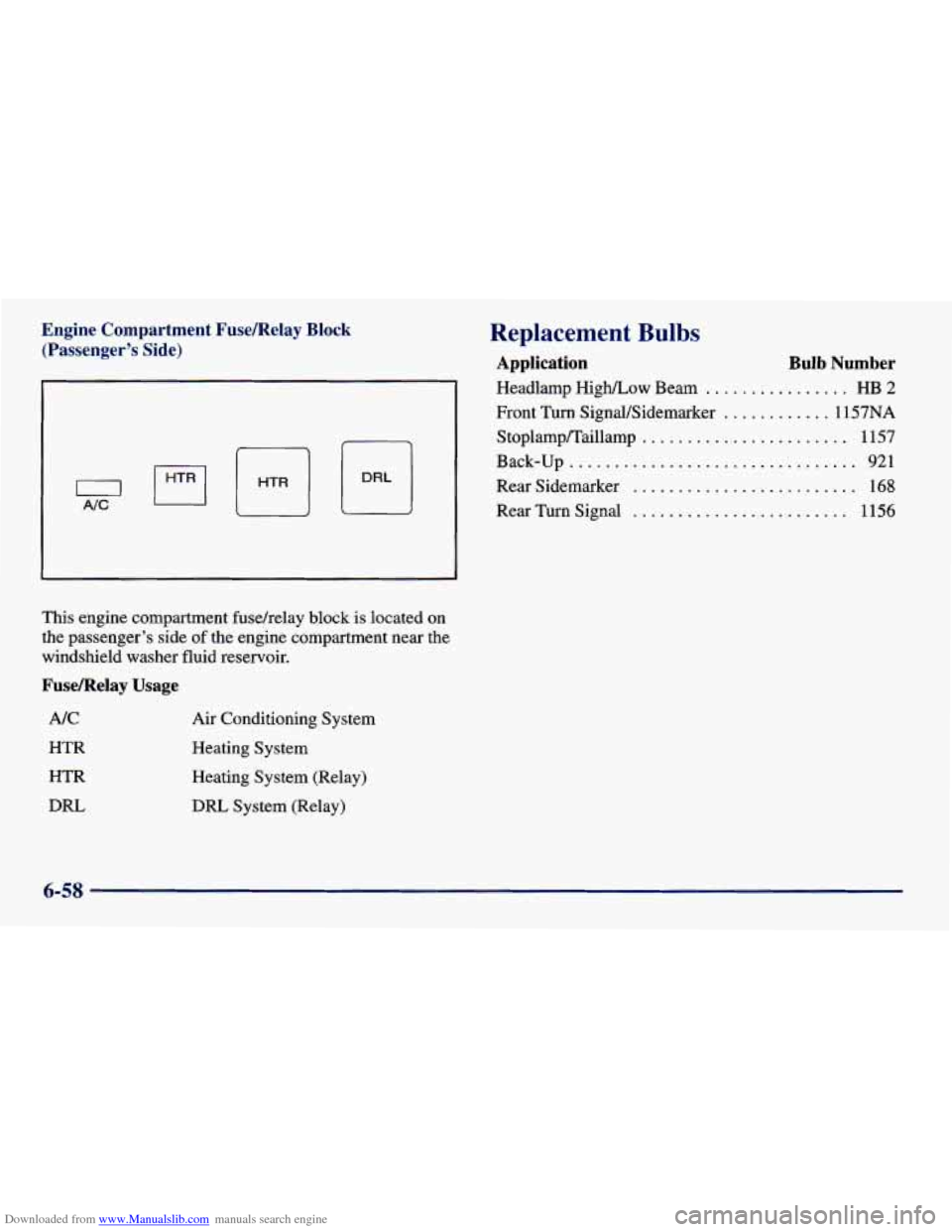
Downloaded from www.Manualslib.com manuals search engine Engine Compartment Fusemelay Block (Passenger's Side)
n
This engine compartment fusehelay block is located on
the passenger's side
of the engine compartment near the
windshield washer fluid reservoir.
Fusemelay Usage
NC
HTR
HTR
DRL Air Conditioning System
Heating System
Heating System (Relay)
DRL System (Relay)
Replacement Bulbs
Headlamp High/Low Beam ................ HB 2
Front Turn SignaVSidemarker ............ 1157NA
Application Bulb Number
Stoplamp/"aillamp ....................... 1157
Back-up
................................ 921
Rear Sidemarker ......................... 168
Rear Turn Signal
........................ 1156
6-58