tow CHEVROLET S10 1993 2.G User Guide
[x] Cancel search | Manufacturer: CHEVROLET, Model Year: 1993, Model line: S10, Model: CHEVROLET S10 1993 2.GPages: 356, PDF Size: 20.85 MB
Page 76 of 356

Downloaded from www.Manualslib.com manuals search engine Features & Contmls
3. If you have four-wheel drive with a manual transfer case shift\
lever, be
4. Move the ignition key to
LOCK.
sure the transfer case is in a drive gear-not in N (Neutral).
5. Remove the key and take it with you. If you can walk away from your
vehicle with the ignition key in your hand, your vehicle is in
P (Park).
Leaving Your Vehicle With the Engine Running
(Automatic Transmission Models Only)
1 CAUTION
It can be dangerous to leave your vehicle with the engine running.
Your vehicle could move suddenly
if the shift lever is not fully in P
(Park) with the parking brake firmly set. If you have four-wheel drive
with a manual transfer case shift lever and your transfer case\
is in
N
(Neutral), your vehicle will be free to roll, even if your shift lever is in
P (Park). So be sure the transfer case is in a drive gear-not in N
(Neutral). And, if you leave the vehicle with the engine running, it
could overheat and even catch fire. You or others could be injured.
I Don’t leave your vehicle with the engine running unless you have to.
If you have to leave your vehicle with the engine running, be sure your
vehicle is in
P (Park) and your parking brake is firmly set before you leave it.
If you have four-wheel drive with a manual transfer case shift le\
ver, be sure
that the transfer case is in
a drive gear-not in N (Neutral). After you’ve
moved the shift lever into the
P (Park) position, hold the regular brake pedal
down. Then, see if you can move the shift lever away from P (Park) without
first pulling it toward you.
If you can, it means that the shift lever wasn’t fully
locked into
P (Park).
Parking Your b bide (Manual Transmission Models
Before you get out of your vehicle, put your manual transmissi\
on in R
(Reverse) and firmly apply the parking brake.
If you have four-wheel drive with a manual transfer case shift le\
ver, be sure
your transfer case is in a drive gear. Your vehicle could roll
if it isn’t.
Only)
If you are parking on a hill, or if your vehicle is equipped to tow a trailer,
see “Parking
on Hills” or “Towing a Trailer” in the Index.
2-24
I
Page 79 of 356
Downloaded from www.Manualslib.com manuals search engine It can be dangerous to get out of your vehicle if the shift llever is not I
fully in P (Park) with the parking brake firmly set. Your vehide can
roll. Don’t leave your vehicle when the engine is running, \
unlless y~
have to.
If you’ve left the engine running, tihe vehicle can move
suddenly.
You or others could be injured. To be sure your vehicle
won’t move, when you’re on fairly level ground, always se\
t your
parking brake and move the shift lever to
P (Park).
If you have four-wheel drive with a manual transfer case shift lever
and your transfer case
is in N (Neutral), your vehide will be free to
roll, even if your shift lever is in P (Park). So, be sure the transfer
case is in a drive gear-not
in ‘N (Neutral)., Follow the proper steps
to be sure your vehicle
won’t move. See “Shifting Into P (Park)” in
the Index.
If you are parking on a hill, or if you’re pulling a trailer, also see
“Farking on Mills” or “Towing a Trailer” in the Index.
If your vehicle has four-wheel drive, you can send your engine’\
s driving power
to all four wheels for extra traction.
To shift out of two-wheel drive and into
four-wheel drive, move the transfer case shift lever
to 4 HIGH or 4 LOW. You
should use
2 WHEEL for most normal driving conditions, however.
2-27
Page 80 of 356
Downloaded from www.Manualslib.com manuals search engine Features & Controls
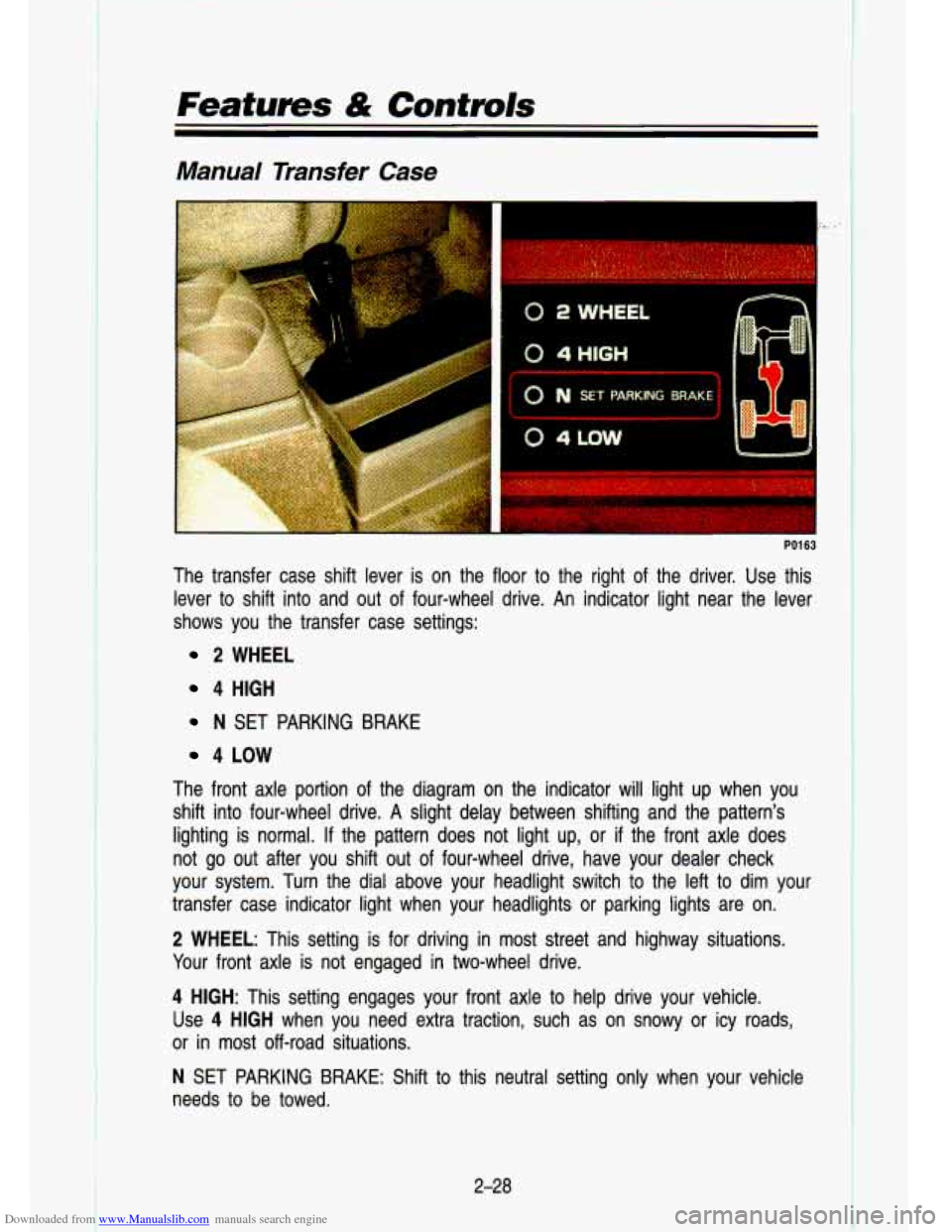
Manual Transfer Case
I
PO1 63
The transfer case shift lever is on the floor to the right of the driver. Use this
lever
to shift into and out of four-wheel drive. An indicator light near the lever
shows you the transfer case settings:
2 WHEEL
4 HIGH
N SET PARKING BRAKE
4 LOW
The front axle portion
of the diagram on the indicator will light up when you
shift into four-wheel drive. A slight delay between shifting and the patte\
rn's
lighting is normal.
If the pattern does not light up, or if the front axle does
not go out after you shift out
of four-wheel drive, have your dealer check
your system. Turn the dial above your headlight switch
to the left to dim your
transfer case indicator light when your headlights or parking l\
ights are on.
2 WHEEL: This setting is for driving in most street and highway situations.
Your front axle is not engaged in two-wheel drive.
4 HIGH: This setting engages your front axle to help drive your vehicle.
Use
4 HIGH when you need extra traction, such as on snowy or icy roads, \
or in most off-road situations.
N SET PARKING BRAKE: Shift to this neutral setting only when your vehicle
needs
to be towed.
2-28
I
Page 89 of 356

Downloaded from www.Manualslib.com manuals search engine To signal a lane change, just raise or lower the lever until the green ar\
row
starts to
flash. Hold it there until you complete your lane change. The lever
will return by itself when you release it.
As you signal a turn or a lane chi' -- if the arrows don’t flash but just stay
on, a signal bulb may be burned
OUT and other drivers won’t see your turn
signal.
(If your vehicle has the digital instrument cluster, the turn signa\
l arrows will
flash at a faster rate
if a signal bulb is burned out.)
If a bulb is burned out, replace it to help avoid an accident. If the green
arrows don’t go on at all when you signal a turn, check the fuse (see
“Fuses” in the Index) and for burned-out bulbs.
If you have a trailer towing option with added wiring for the tr\
ailer lights, a
different turn signal flasher is used. With this flasher instal\
led, the signal indicator will flash even if a turn signal bulb is burned out\
. Check the front
and rear turn signal lights regularly to make sure they are working.
Operation of Lights
Although your vehicle’s lighting system (headlights, parking \
lights, fog lamps,
side marker lights and tail lights) meet all applicable Federa\
l lighting
requirements, certain states and providences may apply their own\
lighting
regulations that may require special attention before you operat\
e these lights. For example, some jurisdictions may require that you operate yo\
ur lower
beam lights with fog lamps at all times, or that headlights b\
e turned on
whenever you must use your windshield wipers. In addition, most\
jurisdictions
prohibit driving solely with parking lights, especially at dawn \
or dusk.
It is
recommended that you check with your own state or provincial h\
ighway
authority for applicable lighting regulations.
2-37
Page 90 of 356
Downloaded from www.Manualslib.com manuals search engine Features & Controls
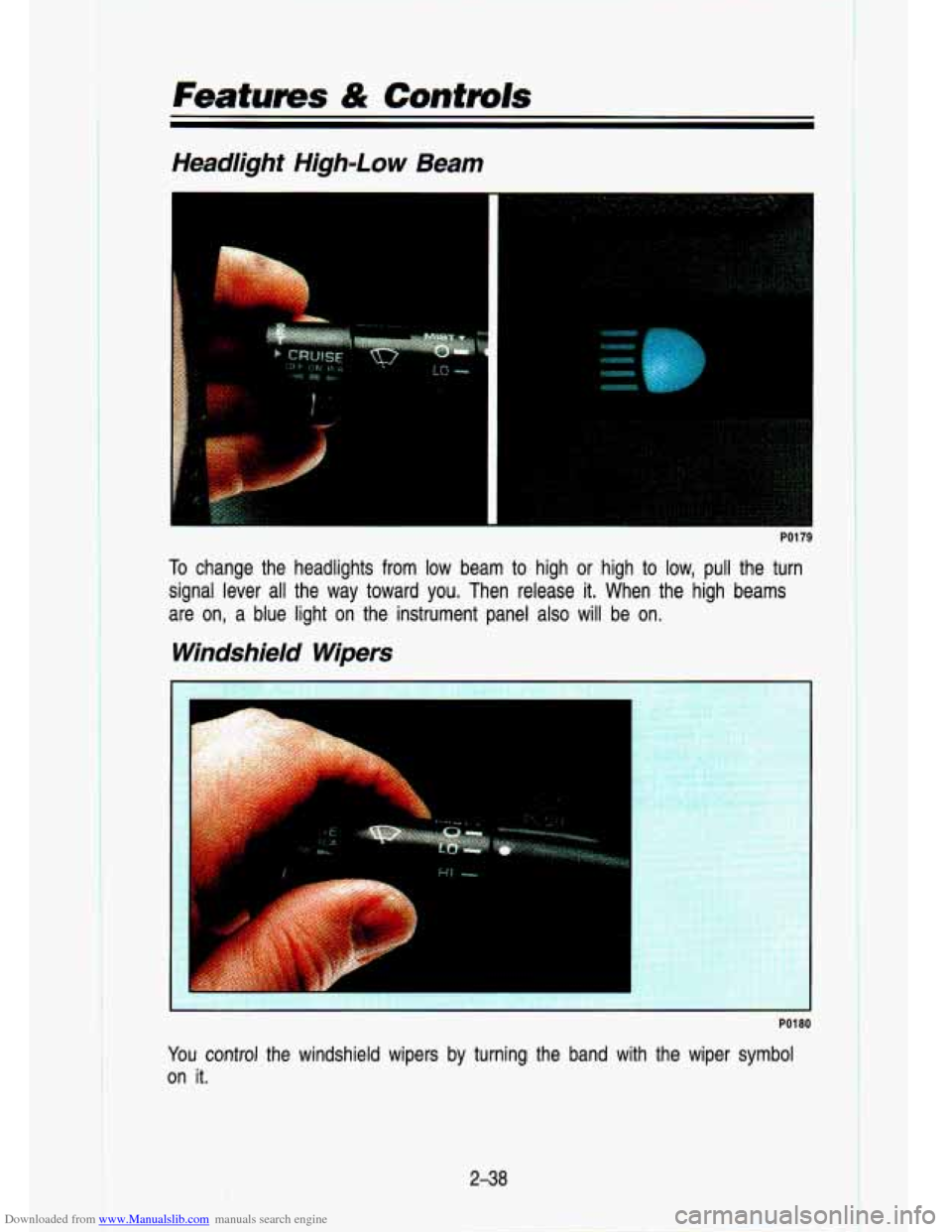
Headlight High-Low Beam
. .-
PI m
To change the headlights from low beam to high or high to low, pull the turn
signal lever all the way toward you. Then release
it. When the high beams
are on, a blue light on the instrument panel also will be on\
.
Windshield Wipers
r
PO1 80
I You control the windshield wipers by turning the band with the wiper symbol
on it.
2-38
Page 118 of 356
Downloaded from www.Manualslib.com manuals search engine i
Features & Controls
Gages can indicate when there may be or is a problem with one of your
vehicle’s functions. Often gages and warning lights work toge\
ther
to let you
know when there’s a problem with your vehicle.
When one of the warning lights comes on and stays on when you are
driving, or when one of the gages shows there may be a probl\
em, check the
section that tells you what to do about
it. Please follow the manual’s advice.
Waiting to do repairs can be costly-and even dangerous.
So please get to
know your warning lights and gages. They’re a big help.
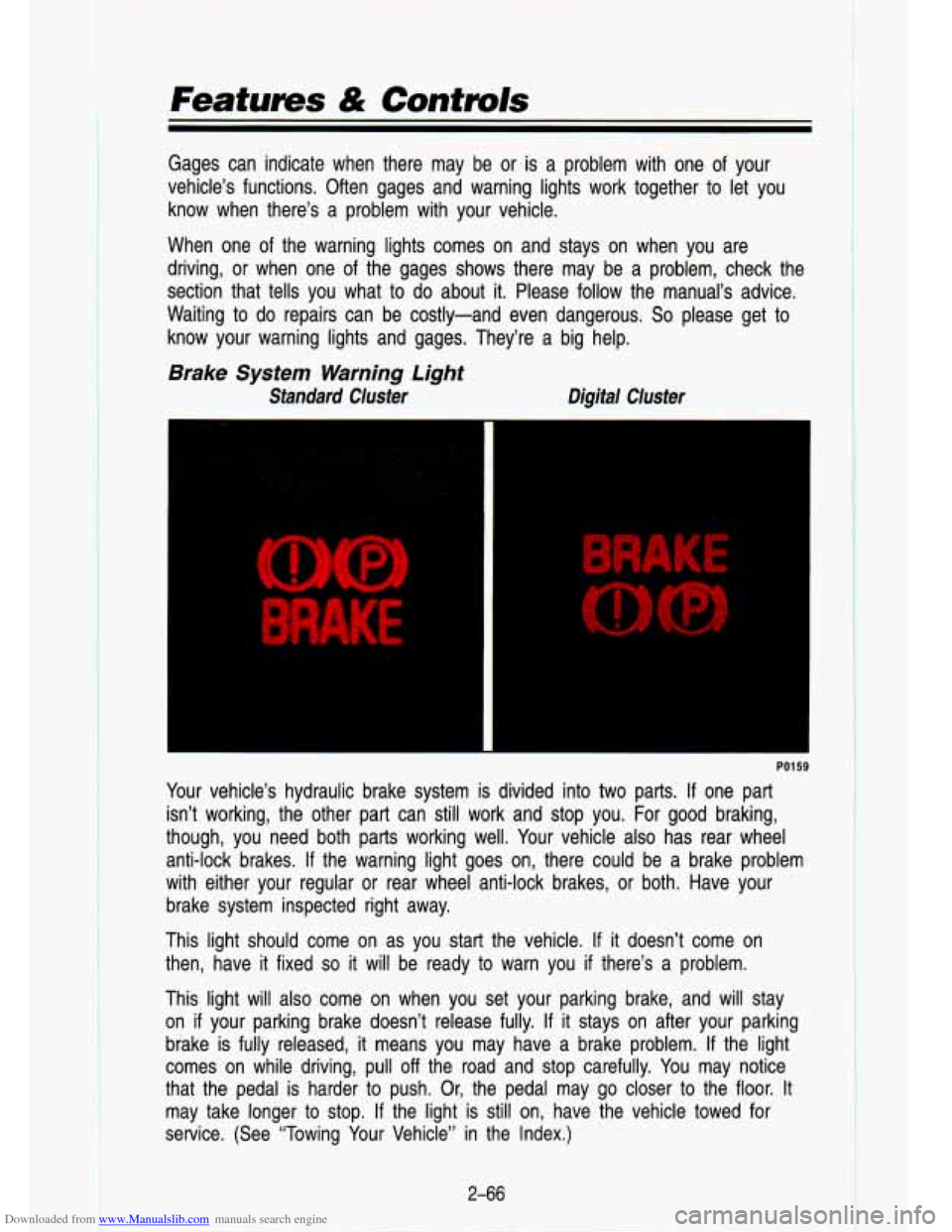
Brake System Warning Light
Standard Cluster Digital Cluster
Pol 59
Your vehicle’s hydraulic brake system is divided into two parts. If one part
isn’t working, the other part can still work and stop you. \
For good braking,
though, you need both parts working well. Your vehicle also ha\
s rear wheel anti-lock brakes. If the warning light goes on, there could be a brake problem
with either your regular or rear wheel anti-lock brakes, or both. Have you\
r
brake system inspected right away.
This light should come on as you start the vehicle. If it do\
esn’t come on
then, have it fixed
so it will be ready to warn you if there’s a problem.
This light will also come on when you set your parking brake, and will stay
on if your parking brake doesn’t release fully. If it stays on after your parking
brake is fully released,
it means you may have a brake problem. If the light
comes on while driving, pull
off the road and stop carefully. You may notice
that the pedal is harder
to push. Or, the pedal may go closer to the floor. It
may take longer to stop. If the light is still on, have the vehicle towed for
service. (See “Towing Your Vehicle” in the Index.)
2-66
I
Page 119 of 356
Downloaded from www.Manualslib.com manuals search engine I
1 CAUTION
1 A Your brake system may not be working properly if the brake warning
light is on. Driving with the brake warning light on can lead\
to an
accident.
If the light is still on after you’ve pulled off ? road and
stopped carefully, have the vehicle towed for servirn
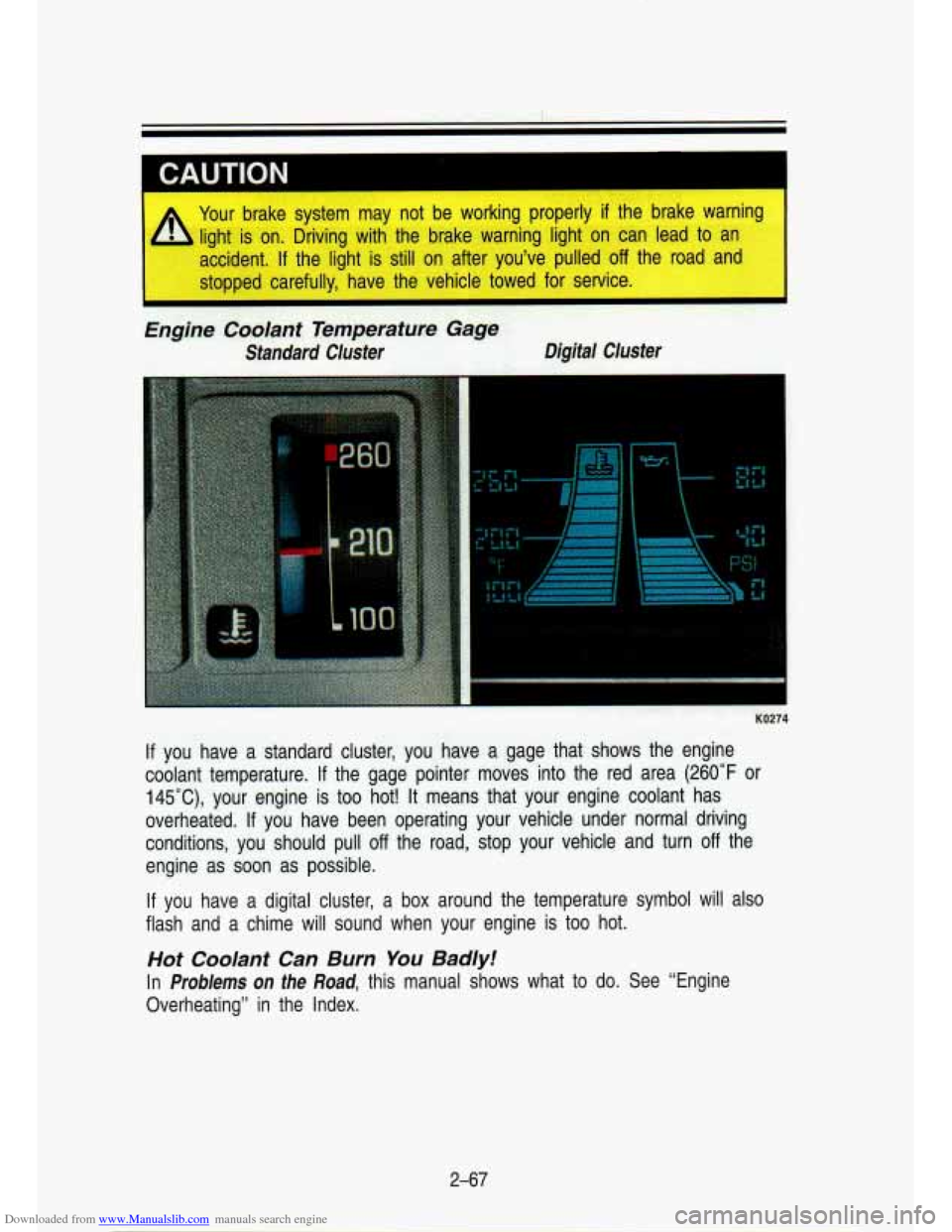
Engjne _Gaolant Temperature Gage
Standard Cluster Digital Cluster
KO274
2-67
Page 133 of 356
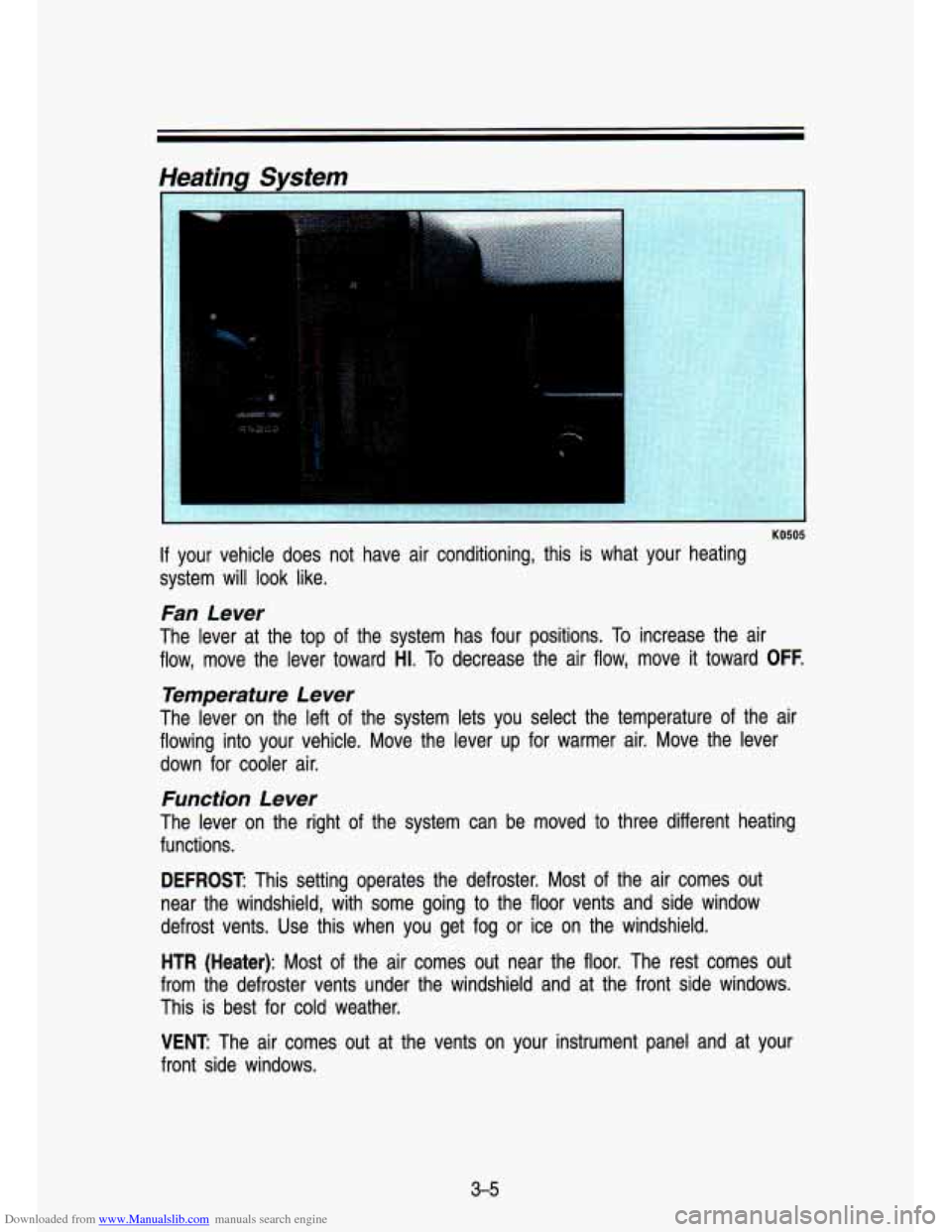
Downloaded from www.Manualslib.com manuals search engine Fan Lever
The lever at the top of the system has four positions. To increase the air
flow, move the lever toward
HI. To decrease the air flow, move it toward OFF.
Temperature Lever
The lever on the left of the system lets you select the temperature of the air
flowing into your vehicle. Move the lever up for warmer air. Move the leve\
r
down for cooler air.
Function Lever
The lever on the right of the system can be moved to three different heating
functions.
DEFROST: This setting operates the defroster. Most of the air comes out
near the windshield, with some going to the floor vents and side window
defrost vents. Use this when you get fog or ice on the windshield.
HTR (Heater): Most of the air comes out near the floor. The rest comes out
from the defroster vents under the windshield and at the front\
side windows.
This is best for cold weather.
VENT: The air comes out at the vents on your instrument panel and \
at your
front side windows.
3-5
Page 134 of 356
Downloaded from www.Manualslib.com manuals search engine Comforf Controls & Audio Systems
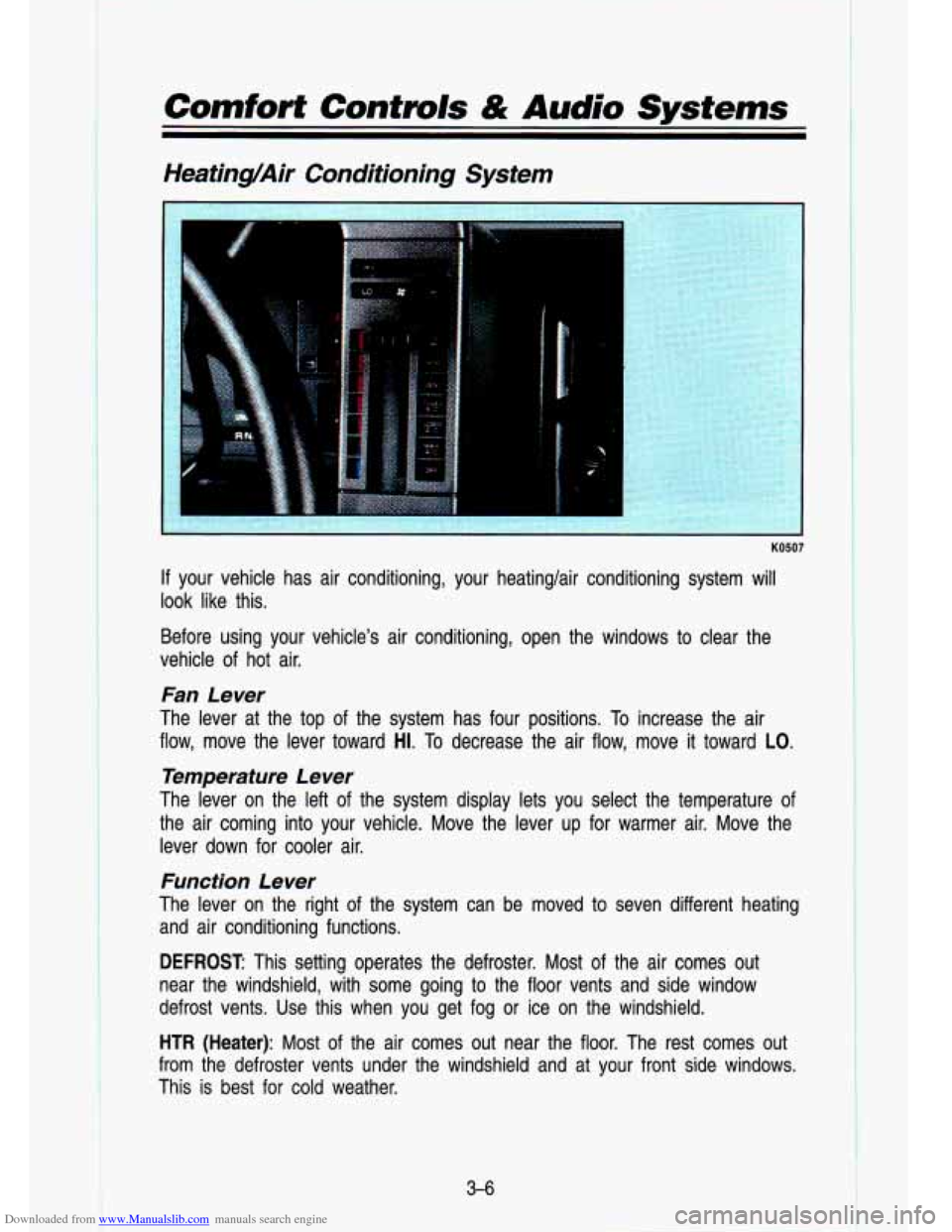
HeatingAir Conditioning System
K05ur
If your vehicle has air conditioning, your heatinglair conditioning \
system will
look like this.
Before using your vehicle’s air conditioning, open the window\
s to clear the
vehicle of hot air.
Fan Lever
The lever at the top of the system has four positions. To increase the air
flow, move the lever toward
H1. To decrease the air flow, move it toward LO.
Temperature Lever
The lever on the left of the system display lets you select the temperature of
the air coming into your vehicle. Move the lever up for warmer air. Move the
lever down for cooler air.
Function Lever
The lever on the right of the system can be moved to seven different heating
and air conditioning functions.
DEFROST This setting operates the defroster. Most of the air comes out
near the windshield, with some going to the floor vents and s\
ide window
defrost vents. Use this when you get fog or ice on the windshield.
HTR (Heater): Most of the air comes out near the floor. The rest comes out
from the defroster vents under the windshield and at your front
side windows.
This is best for cold weather.
3-6
Page 155 of 356

Downloaded from www.Manualslib.com manuals search engine Your Driving and the Road
.
Section
Here you’ll find information about driving on different kinds\
of roads and in
varying weather conditions
. We’ve also included many other useful tips on
driving
.
Road Signs ........................................................................\
.................................... 4-2
Defensive Driving
........................................................................\
.......................... 4-8
Drunken Driving
........................................................................\
............................. 4-9
Control
of a Vehicle ........................................................................\
.................... 4-12
Braking
........................................................................\
...................................... 4-12
Steering Tips
........................................................................\
............................ 4-18
Steering in Emergencies
........................................................................\
......... 4-18
Passing
........................................................................\
..................................... 4-20
Loss of Control ........................................................................\
........................ 4-22
Off-Road Driving With Your Four-wheel Drive Vehicle
.................................... 4-23
Driving at Night
........................................................................\
........................... 4-34
Driving in the Rain
........................................................................\
...................... 4-37
Driving in Fog, Mist and Haze
........................................................................\
.. 4-39
City Driving
........................................................................\
.................................. 4-41
Freeway Driving
........................................................................\
........................... 4-42
Driving a Long Distance
........................................................................\
............. 4-44
Hill and Mountain Roads
........................................................................\
............ 4-46
Winter Driving
........................................................................\
.............................. 4-51
Recreational Vehicle Towing (Four-wheel Drive Only)
.................................... 4-54
Towing a Trailer
........................................................................\
........................... 4-56
Parking
on Hills ........................................................................\
........................... 4-48
4-1