tow CHEVROLET S10 1993 2.G Owners Manual
[x] Cancel search | Manufacturer: CHEVROLET, Model Year: 1993, Model line: S10, Model: CHEVROLET S10 1993 2.GPages: 356, PDF Size: 20.85 MB
Page 16 of 356
Downloaded from www.Manualslib.com manuals search engine Seats & Safety Belts
Seats and Seat Controls
This section tells you about the seats-how to adjust them, and fold them up
and down.
Front Seats
You can lose control of the vehicle if you try to adjust a manual
1 driver’s seat while the vehicle is moving. The sudden moveme\
nt
could startle and confuse you, or make you push
a pedal when you
don’t want
to. Adjust the driver’s seat only when the vehicle is not
mov
I.
Manual Front‘ Seat
-
KO302
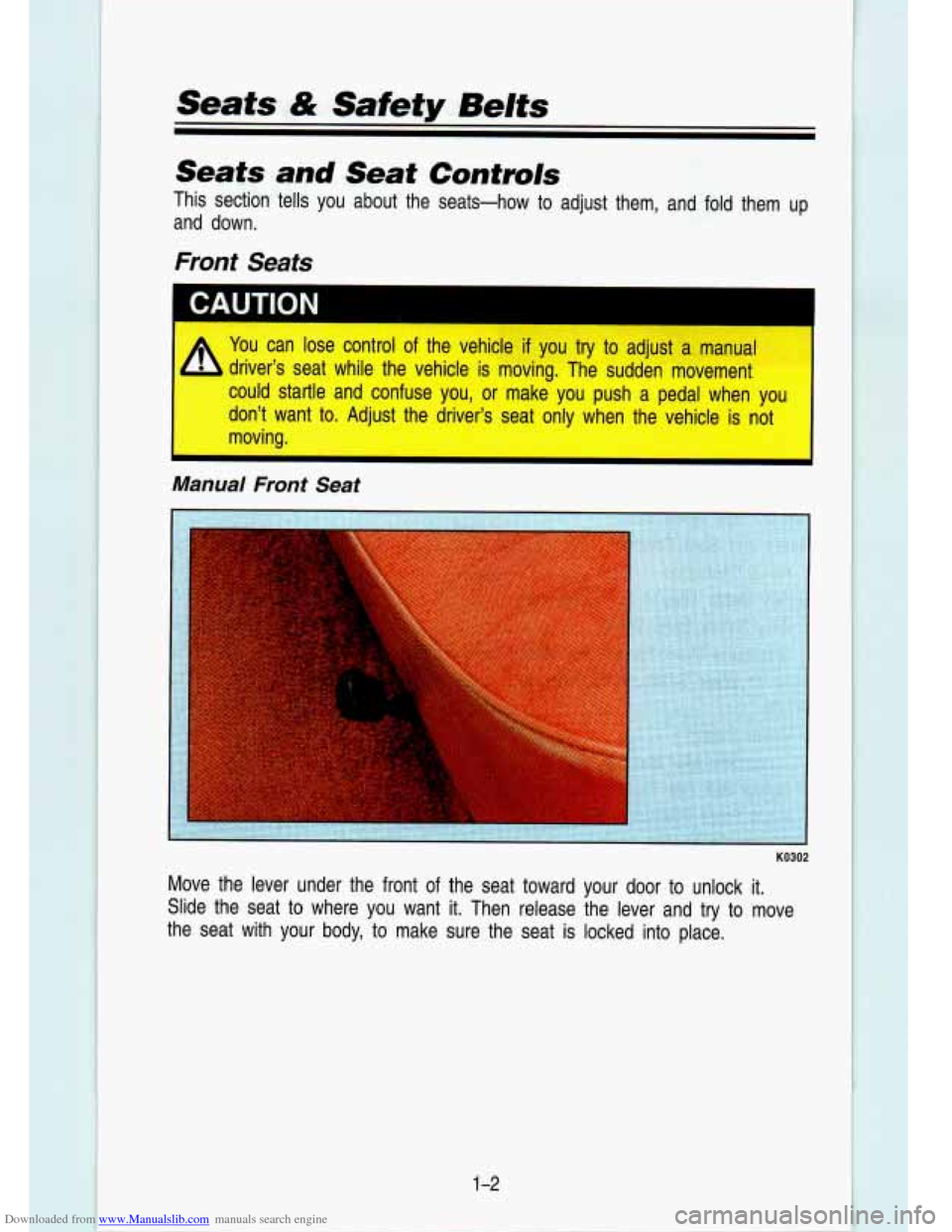
Move the lever under the front of the seat toward your door to unlock it.
Slide the seat
to where you want it. Then release the lever and try to move
the seat with your body, to make sure the seat is locked int\
o place.
Page 19 of 356
Downloaded from www.Manualslib.com manuals search engine KO303
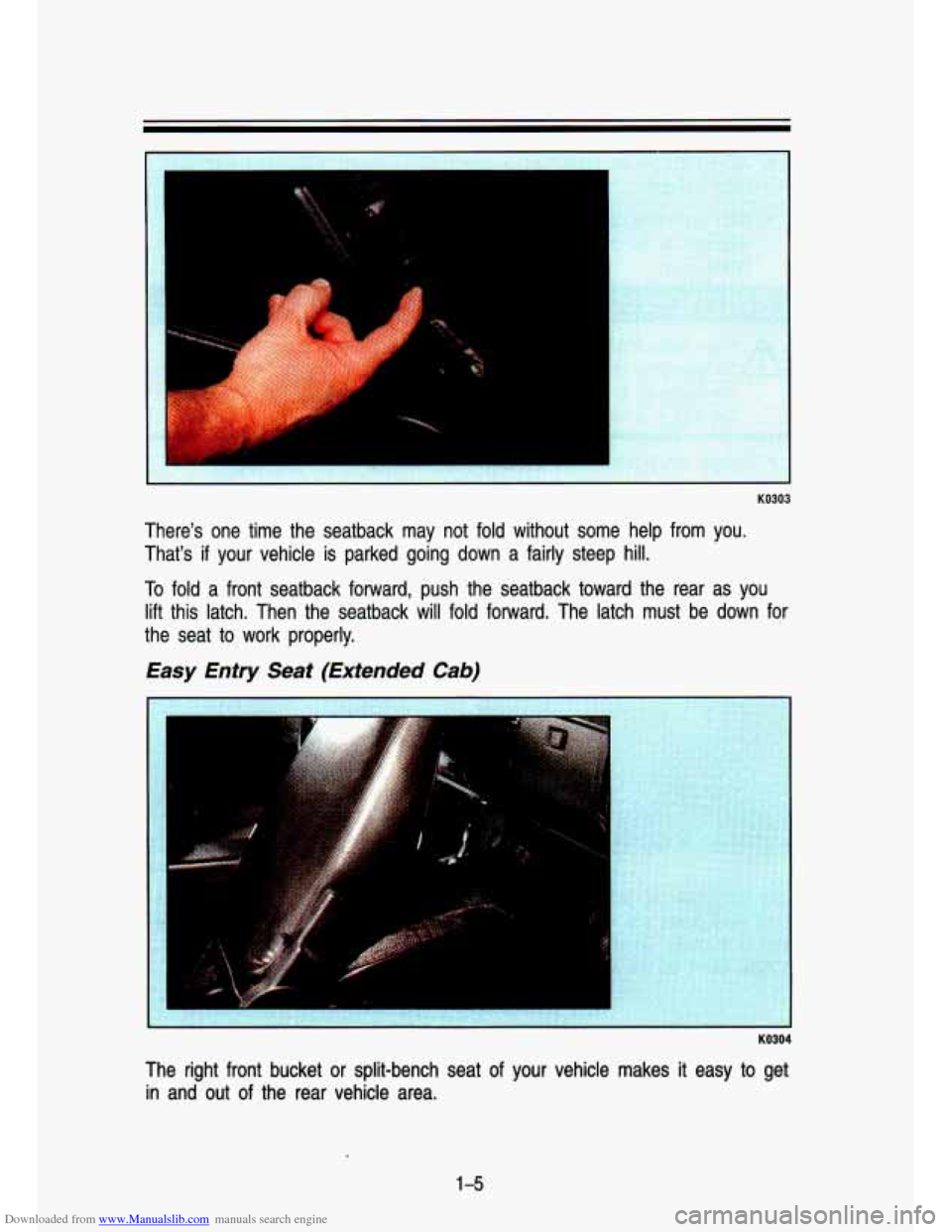
There’s one time the seatback may not fold without some help from you.
That’s
if your vehicle is parked going down a fairly steep hill.
To
fold a front seatback forward, push the seatback toward the rear as\
you
lift this latch. Then the seatback will fold forward. The latch mus\
t be down for
the seat
to work properly.
Easy Entry Seat (Extended Cab)
KO304
The right front bucket or split-bench seat of your vehicle mak\
es it easy to get
in and out
of the rear vehicle area.
1 -5
Page 48 of 356
Downloaded from www.Manualslib.com manuals search engine f
.-
Seats & Safety Belts
Q: What if a child is wearing a lap-shoulder belt, but the child is so
small that the shoulder belt is very close to the child’s face or neck?
A: Move the child toward the center of the vehicle, but be sure that the
shoulder belt still
is on the child’s shoulder, so that in a crash the child’s
upper body would have the restraint that belts provide.
If the child is so small
that the shoulder belt
still is very close to the child’s face or neck, you might
want
to place the child in a seat that has a lap belt, if your vehicle has one.
I’ -
AM170051
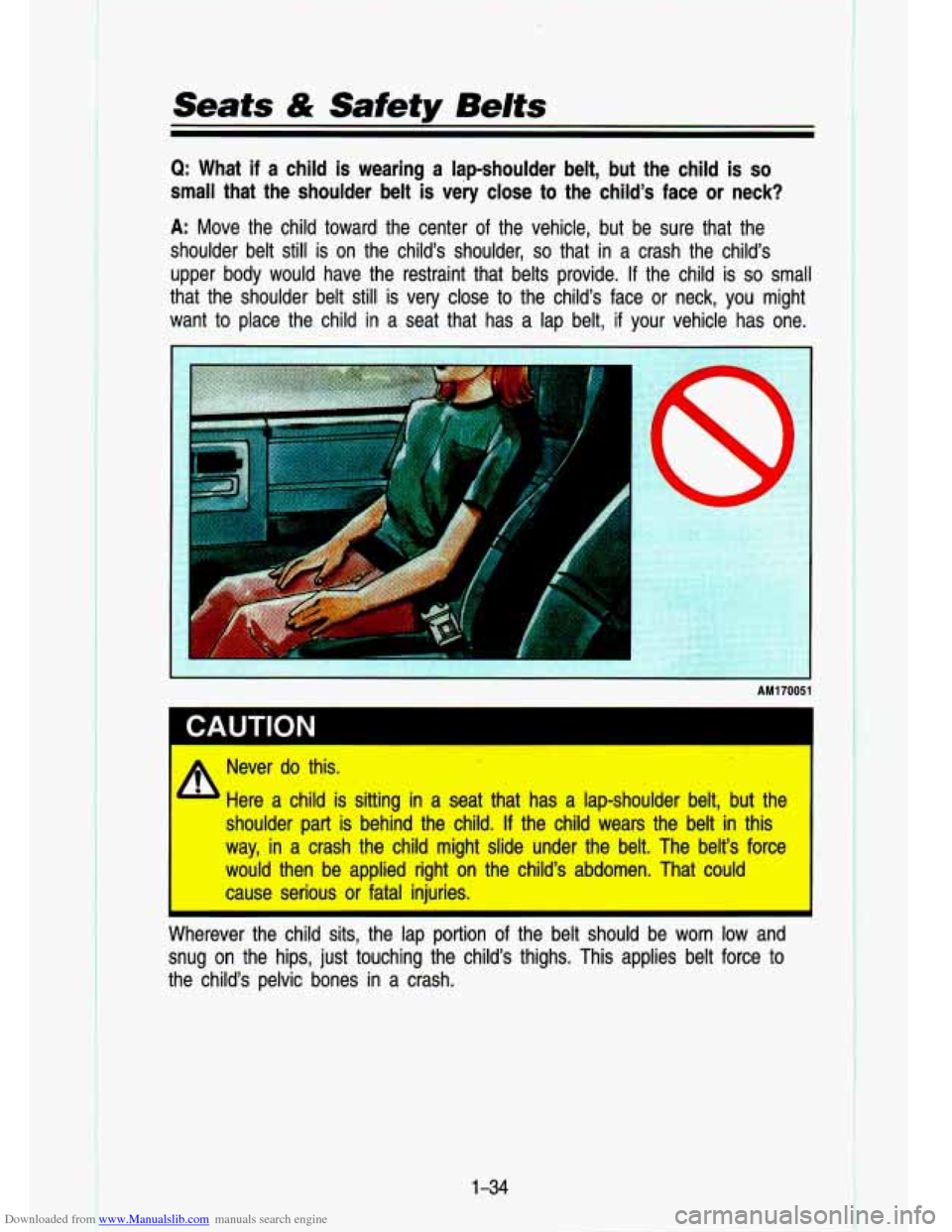
Never do this.
A Here a child is sitting in a seat that has a lap-shoulder be\
lt, but the
shoulder part is behind the child.
If the child wears the belt in this
way, in a crash the child might slide under the belt. The belt’\
s force
would then be applied right on the child’s abdomen. That co\
uld
cause serious or fatal injuries.
Wherever the child sits, the lap portion of the belt should b\
e worn low and
snug
on the hips, just touching the child’s thighs. This applies bel\
t force to
the child’s pelvic bones in a crash.
1-34
Page 57 of 356
Downloaded from www.Manualslib.com manuals search engine Your Doors And How They Work
Side Doors
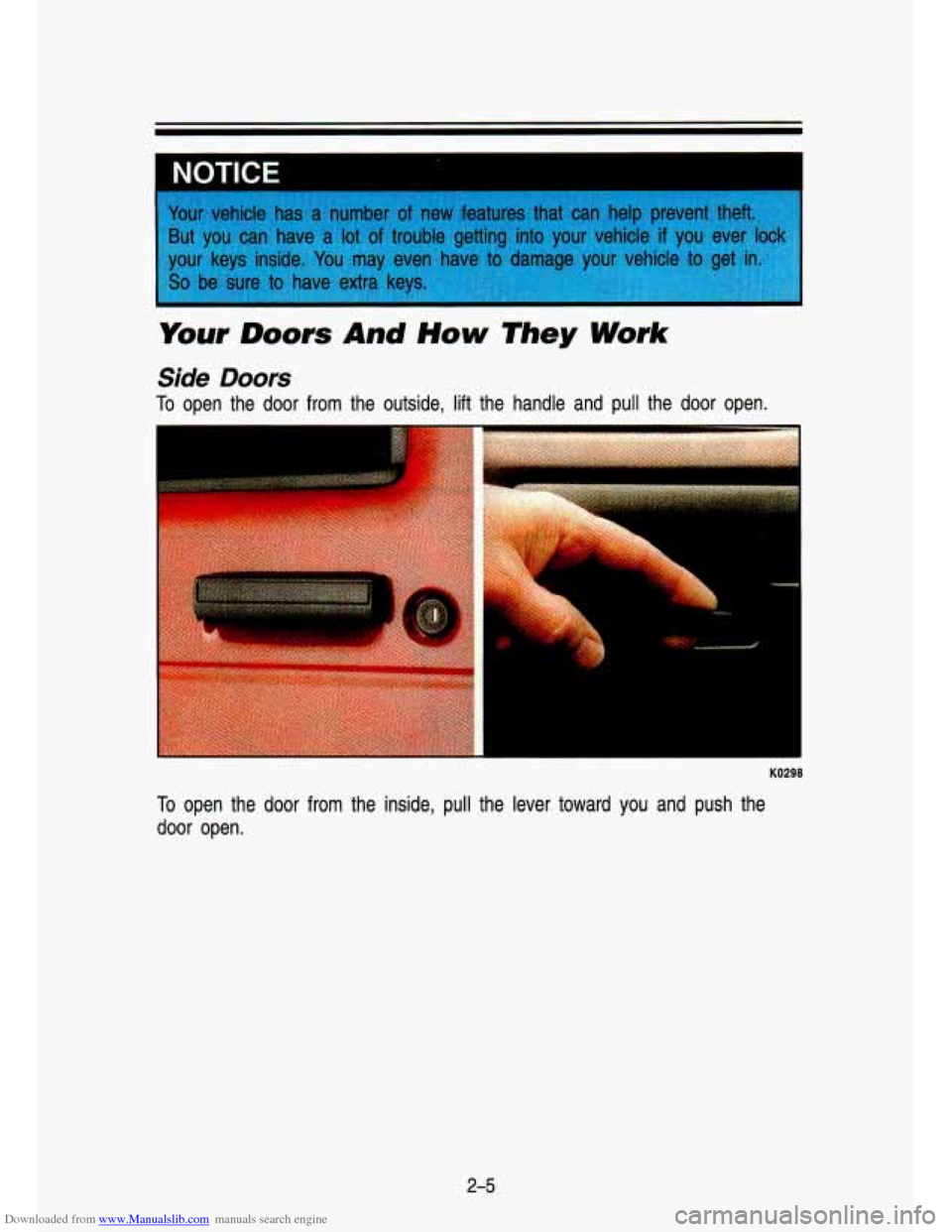
To open the door from the outside, lift the handle and pull the door open.
. . ._ .... “*i .
I..L.: .. x
KO298
To open the door from the inside, pull the lever toward you and push the
door open.
2-5
Page 59 of 356

Downloaded from www.Manualslib.com manuals search engine I
KO207
To unlock the door from the inside: Slide the lever on your insi\
de door
toward you. You will see a red area on the lever.
Power Door Locks
If your vehicle has power door locks, push the power door lock s\
witch on
either front door toward the key symbol.
This switch will lock all the doors at
once.
To unlock the doors, push the switch away from the key symbol.
Leaving Your Vehicle
If you are leaving the vehicle, take your keys, open your door a\
nd set the
locks from the inside. Then get out and close the door.
2-7
Page 61 of 356

Downloaded from www.Manualslib.com manuals search engine New Vehicle c'Break-ln99
IYU I IW
ignition Switch
Use your ignition key to start your vehicle. The ignition key \
lets you turn the
ignition switch
to five different positions:
F
KO404
Acc (Accessory): Acc lets you use things like the radio and \
the windshield
wipers when the engine is
off. To get into Acc, push in the key and turn it
toward you. Your steering wheel will remain locked,
just as it was before you
inserted the key.
2-9
Page 69 of 356
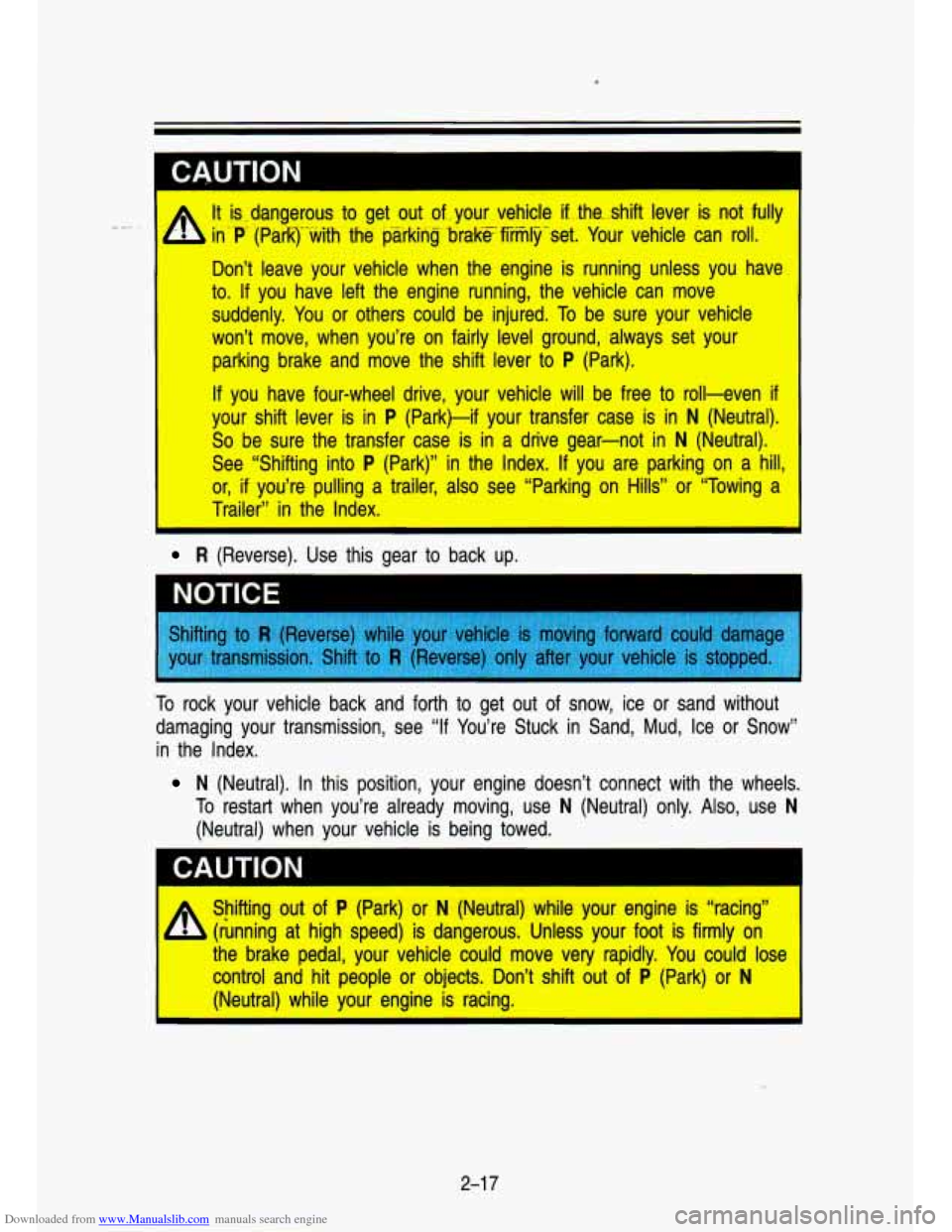
Downloaded from www.Manualslib.com manuals search engine I CAUTION
I A It is.-dangerous to get out of..your vehicle if. tha..shift lever is not fully
in-P (ParQ--wiih
the parking brake fiim~ljj-set. Yo’ur vehiclle ‘&n roll.
Doln’t leave your vehicle when the engine is running unless you have
to.
If you have left the engine running, tihe vehicle can move
suddenly. You or others could- be injured.
To be sure your vehicle
won’t move, when yolu’lre on fairly level ground, always set your
parking brake and move the shift lever to P (Park).
Of you have four-wheel drive, your vehicle will be free to roll-even if
your shift lever is in P (Park)i-if your transfer case i:s iln ‘N (Neutral).
So be sure the transfer case is in a drive gear-not in N (Neutral)’.
See “Shifting into P (Par’k)’’ in the Index. If you are ,parking on a hill,
or, if you’re p’ulling a traihr, also see “Parking on Hills” o:r “Towilnlg a
Trailer” in the Index.
R (Reverse). Use this gear to back up.
To rock your vehicle back and forth to get out of snow, ice or \
sand without
damaging your transmission, see
“If You’re Stuck in Sand, Mud, Ice or Snow”
in the Index.
N (Neutral). In this position, your engine doesn’t connect wi\
th the wheels.
To restart when you’re already moving, use N (Neutral) only. Also, use N
(Neutral) when your vehicle is being towed.
Shifting
out of P (Park) or N (Neutral) While your engine is “racing”
a (iunning aft hligh speed) is dangerous. ‘Unless your foot is firmly on
the brake ped’al,
your vehilcle could move very rapidly. You co1wl;d lose
(Neutral) while your engine is racing.
I contro’l and hit people or objects. Don’t shift out ‘of P (Park) or N
2-1 7
Page 70 of 356
Downloaded from www.Manualslib.com manuals search engine Features & Controls
I
e
OD (Automatic Overdrive). This position is for normal driving. If you need
more power for passing, and you’re:
- Going less than about 35 mph (56 km/h), push your accelerator
pedal about halfway down.
- Going about 35 mph (56 km/h) or more, push the accelerator all the
way down. You’ll shift down to the next gear and have more power.
OD should not be used when towing a trailer, carrying a heavy load,
driving on steep hills, or for off-road driving. Select
D (third gear) when
operating the vehicle under any of these conditions.
D (Third Gear). This is like OD, but you never go into Overdrive. You
should use
D when towing a trailer, carrying a heavy load, driving on
steeps hills, or for off-road driving.
2 (Second Gear). This position gives you more power but lower \
fuel
economy. You can use
2 (Second Gear) on hills. It can help control your
speed as you go down steep mountain roads, but then you would\
also
want to use your brakes off and on.
If you have a 4.3L engine (Codes Z and W) and if you manually select
2, the transmission will drive in second gear. You may use this feature
for reducing torque
to the rear wheels when you are trying to start your
vehicle from a stop on slippery road surfaces.
1 (First Gear). This position gives you even more power (but \
lower fuel
economy) than
2. You can use it on very steep hills, or in deep snow or
mud. If the selector lever is put in 1, the transmission won’t shift into
first gear until the vehicle is going slowly enough.
2-1 8
Page 74 of 356
Downloaded from www.Manualslib.com manuals search engine Featums & Controls
To release the parking brake:
Hold the regular brake pedal down. Pull the brake release lever.
I NOTICE
If you are on a hill:
See “Parking on Hills” in the Index. That part shows how\
to turn your front
wheels.
If you are towing a trailer and are parking on any hill:
See “Towing a Trailer” in the Index. That part shows what to
do first to keep
the trailer from moving.
Torque Lock
The parking brake should be set first whenever leaving the driver’s seat. If
you are parked on a hill and the transmission is placed in P (Park) before
the parking brake is set, the weight of the vehicle may put too much force
on the parking pawl in the transmission.
It may be difficult to pull the selector
lever out of
P (Park). This is called “torque lock.” To prevent this, the parking
brake should be set BEFORE moving the selector lever
to P (Park).
When preparing to move the vehicle, the selector lever should \
be moved out of
P (Park) BEFORE releasing the parking brake. Set the parking br\
ake first,
Then release the transmission from
P (Park), even on level surfaces.
If “torque lock” does occur, you may need to have another vehicle nudge this
vehicle uphill to take some
of the pressure off the transmission while you pull
the selector lever out of
P (Park).
2-22
~
Page 75 of 356
Downloaded from www.Manualslib.com manuals search engine Shifting Into P (Park) .(Automatic Transmission
Models Only)
fi A.UTION I.
It can be dangerous to get out of your vehicle if the shift lever is not I
fully in P (Park) with the parking brake firmly set. Your vehicle can
roll.
If you have left the engine running, the vehicle can move sudde..I,.
You or others could be injured.
To be sure your vehicle won’t move,
when you’re on fairly level ground, use the steps that foll\
ow.
If you have four-wheel drive, with a manual transfer case shif\
t lever
and your transfer case is in
N (Neutral), your vehicle will be free to
roll, even
if your shift lever is in P (Park). So, be sure the transfer
case is in a drive gear-not in
N (Neutral). If you are parking on a
hill, or
if you’re pulling a trailer, also see “Parking On Hills” or
“Towing a Trailer’’ in the Index.
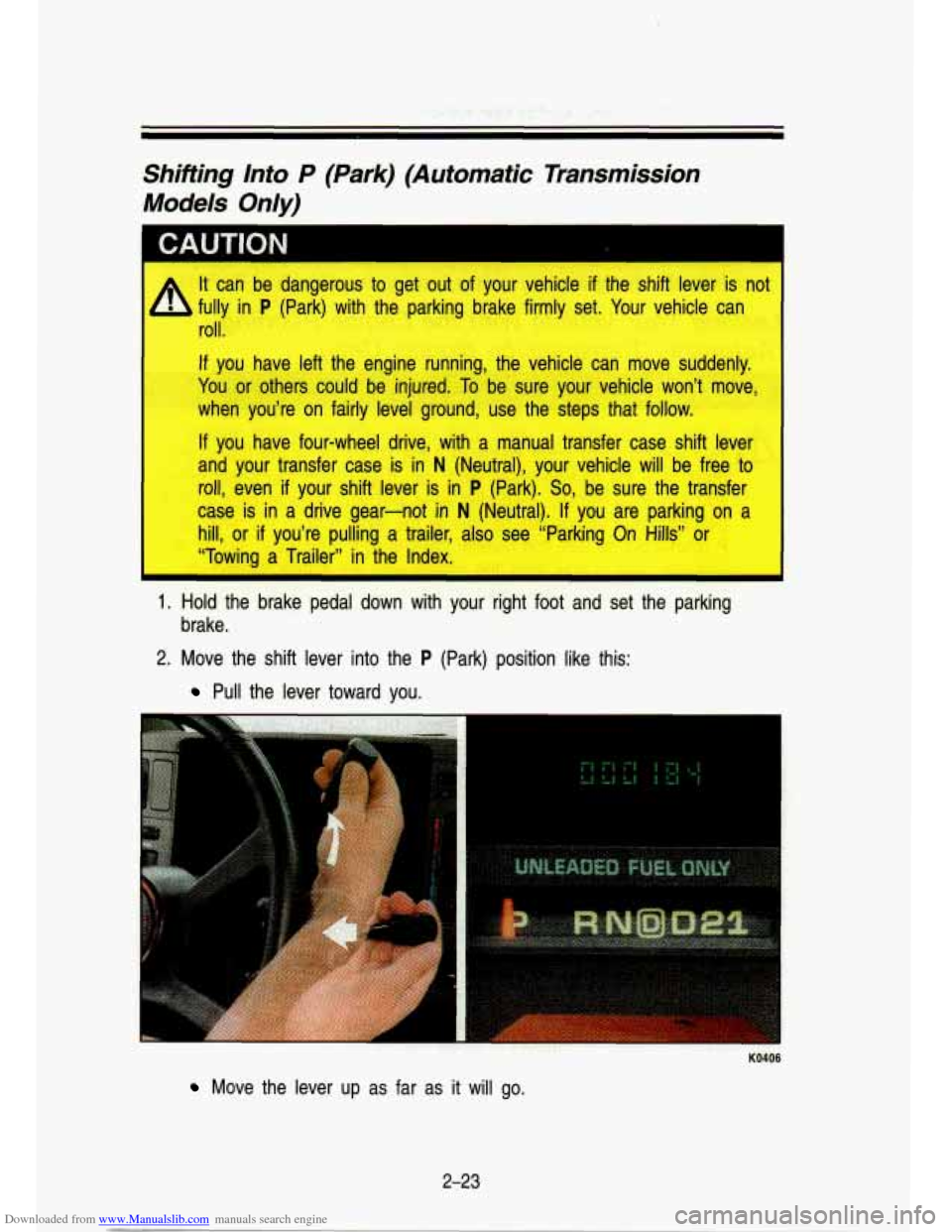
1. Hold the brake pedal down with your right foot and set the parking
2. Move the shift lever into the P (Park) position like this:
brake.
Pull the lever toward you.
KO406
Move the lever up as far as it will go.
2-23