tow CHEVROLET S10 1993 2.G Owner's Guide
[x] Cancel search | Manufacturer: CHEVROLET, Model Year: 1993, Model line: S10, Model: CHEVROLET S10 1993 2.GPages: 356, PDF Size: 20.85 MB
Page 216 of 356
Downloaded from www.Manualslib.com manuals search engine Your Driving and the Road
2. Let up on the brake pedal.
3. Drive slowly until the trailer is clear of the chocks.
4. Stop and have someone pick up and store the chocks.
Maintenance When Trailer Towing
Your vehicle will need service more often when you’re pulling a \
trailer. See
the Maintenance Schedule for more on this. Things that are esp\
ecially important in trailer operation are automatic transmission fluid (don’t ove\
rfill),
engine oil, axle lubricant, belt, cooling system, and brake adj\
ustment. Each of
these is covered in this manual, and the Index will help you find them
quickly.
If you’re trailering, it’s a good idea to review these sections before
you start your trip.
Check periodically to see that all hitch nuts and bolts are tight.
Trailer Light Wiring
See “Trailer Wiring Harness” in the Index.
Power Winches
If you wish to use a power winch on your vehicle, only use it when your
vehicle is stationary or anchored.
NOTICE
Use the regular brakes, set the parking brake Or UIWK ihe wheels IW keep
your vehicle from rolling.
4-62
Page 217 of 356
Downloaded from www.Manualslib.com manuals search engine prOb/ems on the Road
. .-
r
7
Here you’ll find what to do about some problems that can occur on the road .
Hazard Warning Flashers ........................................................................\
............. 5-2
Other Warning Devices ........................................................................\
................. 5-3
Jump Starting ........................................................................\
................................ 5-3
Towing Your Vehicle ........................................................................\
...................... 5-7
Engine Overheating ........................................................................\
....................... 5-9
If a Tire Goes Flat ........................................................................\
...................... 5-15
Changing a Flat Tire ........................................................................\
................... 5-16
Compact Spare Tire ........................................................................\
.................... 5-28
If You’re Stuck: In Sand, Mud, Ice or Snow ................................................... 5-30
Page 223 of 356
Downloaded from www.Manualslib.com manuals search engine Towing Your Vehicle
Try to have a GM dealer or a professional towing service tow your vehicle.
They can provide the right equipment and know how to tow it without
damage.
If your vehicle has been changed since it was factory-new, by adding things
like fog lamps, aero skirting, or special tires and wheels, th\
ese things could
be damaged during towing.
Before you do anything, turn on the hazard warning flashers.
When you call, tell the towing service:
That your vehicle has rear-wheel drive, or that it has the fo\
ur-wheel drive
0 The make, model, and year of your vehicle.
Whether you can move the shift lever for the transmission and \
shift the
If there was an accident, what was damaged.
option.
transfer case,
if you have one.
I CAUTION
To help avoid injury to you or others:
A * Never let passengers ride ‘in a vehicle that is being towed.
Never tow faster than safe or posted speeds.
0 Never tow with damaged pads not fully secured.
Never get under your vehide after it has been lifted by the tow
. 0 Always use separate safety chains on each side when towing a
truck.
vehicle.
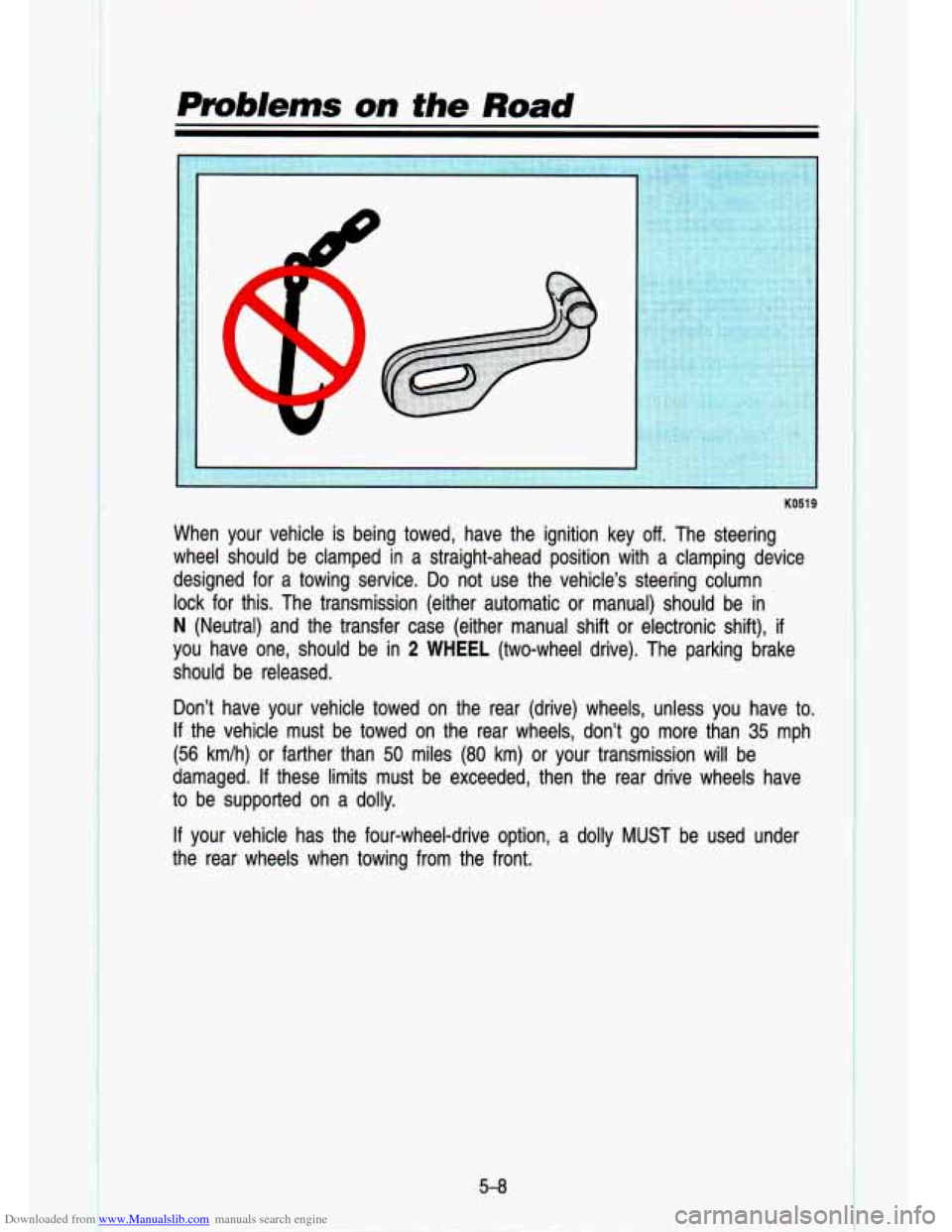
Never use “J” hooks. Use T-hooks instead.
5-7
Page 224 of 356
Downloaded from www.Manualslib.com manuals search engine , vr
KO51 9
When your vehicle is being towed, have the ignition key off. The steering
wheel should be clamped in a straight-ahead position with a clamping device
designed for a towing service. Do not use the vehicle's steeri\
ng column
lock for this. The transmission (either automatic or manual) should\
be in
N (Neutral) and the transfer case (either manual shift or elec\
tronic shift), if
you have one, should be in 2 WHEEL (two-wheel drive). The parking brake
should be released.
Don't have your vehicle towed on the rear (drive) wheels, un\
less you have
to,
If the vehicle must be towed on the rear wheels, don't go more than 35 mph
(56 km/h) or farther than 50 miles (80 km) or your transmission will be
damaged.
If these limits must be exceeded, then the rear drive wheels have\
to be supported on a dolly.
If your vehicle has the four-wheel-drive option, a dolly
MUST be used under
the rear wheels when towing from the front.
5-8
Page 226 of 356
Downloaded from www.Manualslib.com manuals search engine Problems on the Road
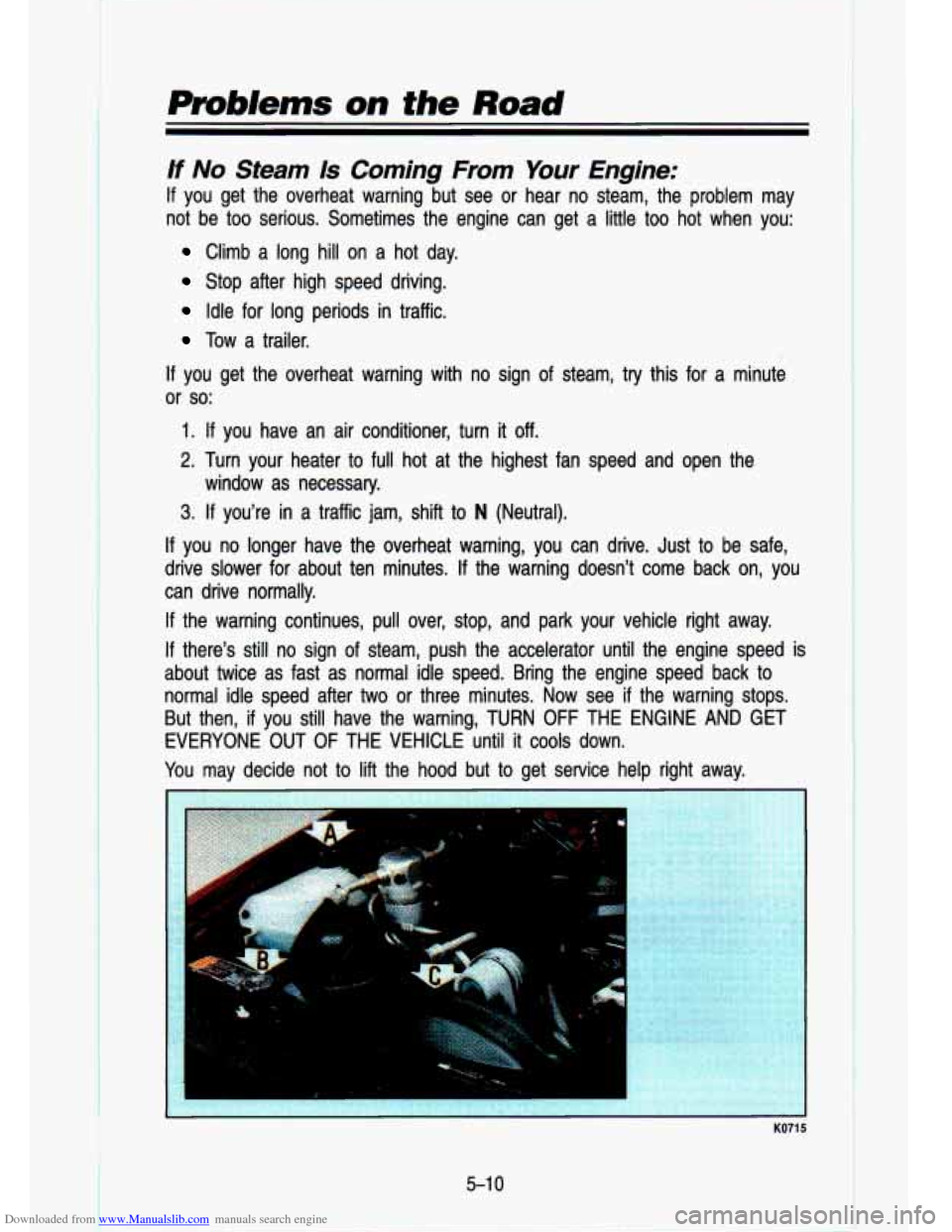
If No Steam Is Coming From Your Engine:
If you get the overheat warning but see or hear no steam, the problem may
not be too serious. Sometimes the engine can get a little
too hot when you:
Climb a long hill on a hot day.
Stop after high speed driving.
Idle for long periods in traffic.
Tow a trailer.
If you get the overheat warning with no sign of steam, try this for a minute
or so:
1. If you have an air conditioner, turn it off.
2. Turn your heater to full hot at the highest fan speed and open the
3. If you're in a traffic jam, shift to N (Neutral).
window as necessary.
If you no longer have the overheat warning, you can drive. Just to
be safe,
drive slower for about ten minutes. If the warning doesn't com\
e back on, you
can drive normally.
If the warning continues, pull over, stop, and park your vehicle \
right away.
If there's still no sign of steam, push the accelerator until the engine speed is
about twice as fast as normal idle speed. Bring the engine sp\
eed back to
normal idle speed after
two or three minutes. Now see if the warning stops.
But then,
if you still have the warning, TURN OFF THE ENGINE AND GET
EVERYONE
OUT OF THE VEHICLE until it cools down.
You may decide
not to lift the hood but to get service help right away.
KO71 5
5-1 0
I
Page 231 of 356

Downloaded from www.Manualslib.com manuals search engine KO721
8. Then replace the pressure cap. Be sure the arrows on the pres\
sure cap line up like this.
Engine Fan Noise
This vehicle has a clutched engine cooling fan. When the clutch is engaged,
the fan spins faster to provide more air to cool the engine. In most every day
driving conditions the clutch is not engaged. This improves fue\
l economy and
reduces fan noise. Under heavy vehicle loading, trailer towing andlor high
outside temperatures, the fan speed increases when the clutch e\
ngages.
So
you may hear an increase in fan noise. This is normal and should not be
mistaken as the transmission slipping or making extra shifts.
It is merely the
cooling system functioning properly. The fan will slow down whe\
n additional
cooling is not required and the clutch disengages.
You may also hear this fan noise when you start the engine. It will go away
as the fan clutch disengages.
If a Tire Goes Flat
It’s unusual for a tire to “blowout” while you’re d\
riving, especially if you
maintain your tires properly.
If air goes out of a tire, it’s much more likely to
leak out slowly. But if you should ever have a “blowout,”\
here are a few tips
about what to expect and what to do:
If a front tire fails, the flat tire will create a drag that pu\
lls the vehicle toward
that side. Take your foot off the accelerator pedal and grip the steering wheel
firmly. Steer to maintain lane position, then gently brake to \
a stop well out of
the traffic lane.
5-1 5
Page 233 of 356
Downloaded from www.Manualslib.com manuals search engine AM545003
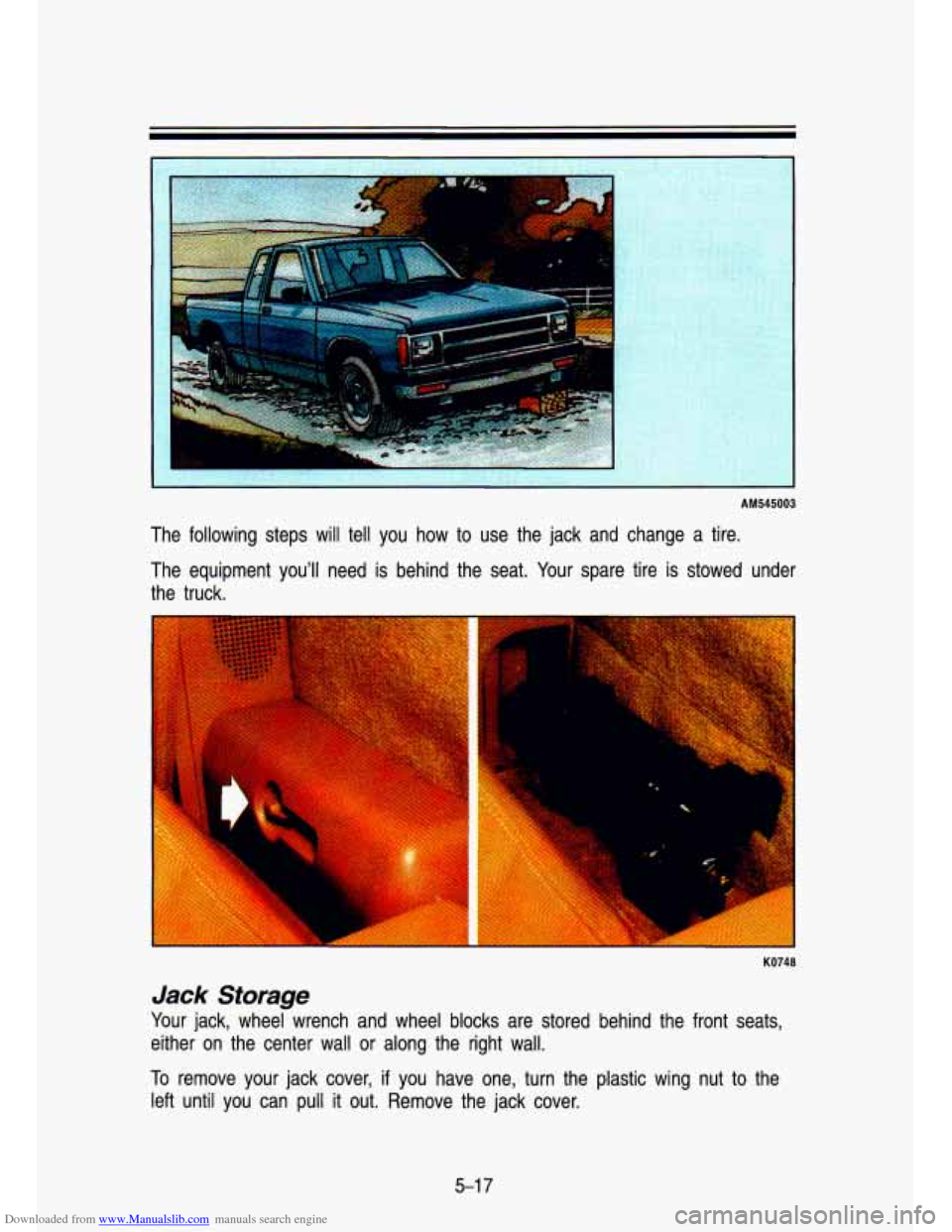
The following steps will tell you how to use the jack and change a tire.
The equipment you'll need is behind the seat. Your spare tire is stowed under
the truck.
KO748
Jack Storage
Your jack, wheel wrench and wheel blocks are stored behind the front seats,
either on the center wall or along the right wall.
To remove your jack cover,
if you have one, turn the plastic wing nut to the
left until you can pull it out. Remove the jack cover.
5-1 7
Page 235 of 356
Downloaded from www.Manualslib.com manuals search engine Spare Tire
1
KO744
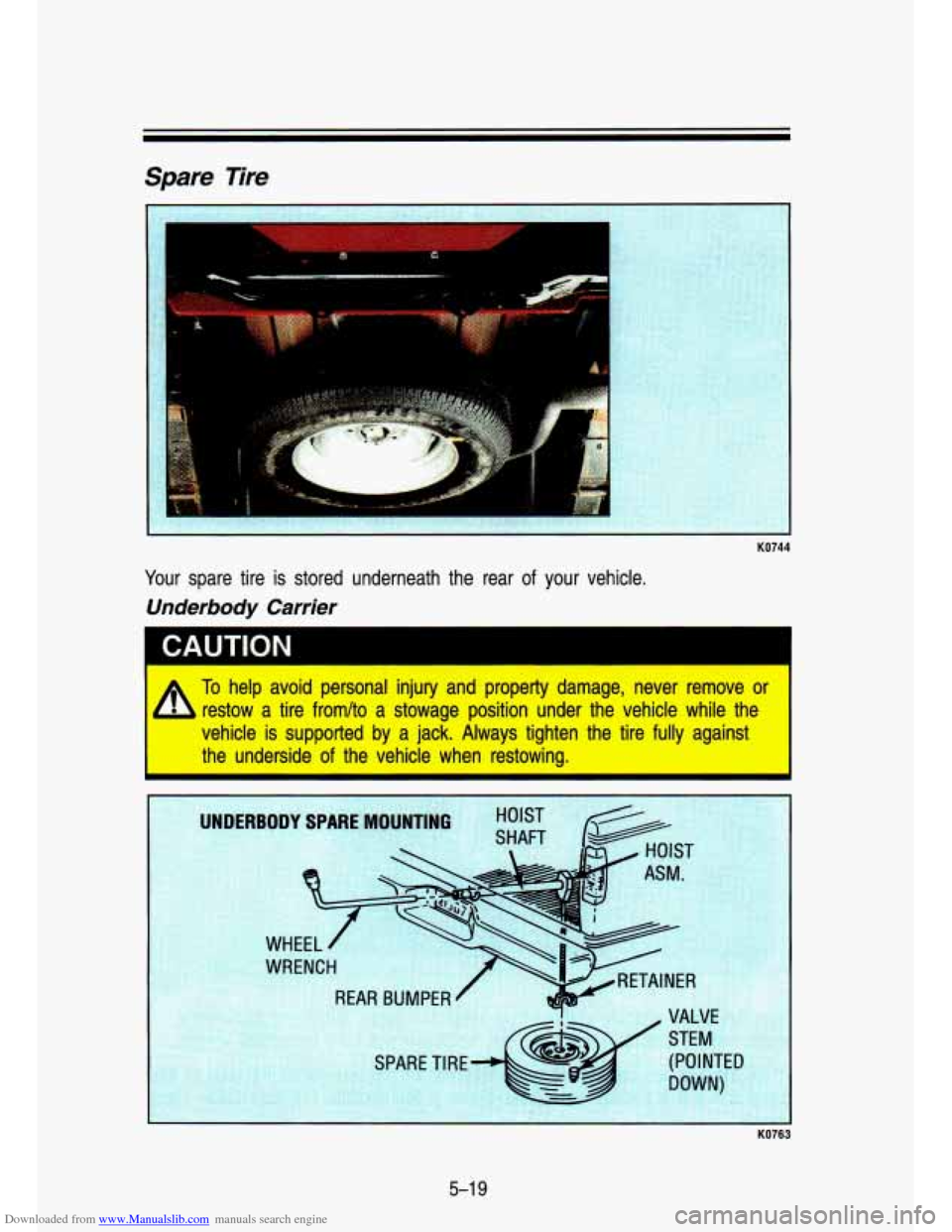
Your spare tire is stored underneath the rear of your vehicle.
Underbody Carrier
To help avoid personal injury and property damage, never remove or
restow a tire fromlto a stowage position under the vehicle while the
vehicle is supported
by a jack. Always tighten the tire fully against
the underside
of the vehicle when restowing. I
KOi - '63
5-1 9
Page 241 of 356
Downloaded from www.Manualslib.com manuals search engine I
CAUT'oN
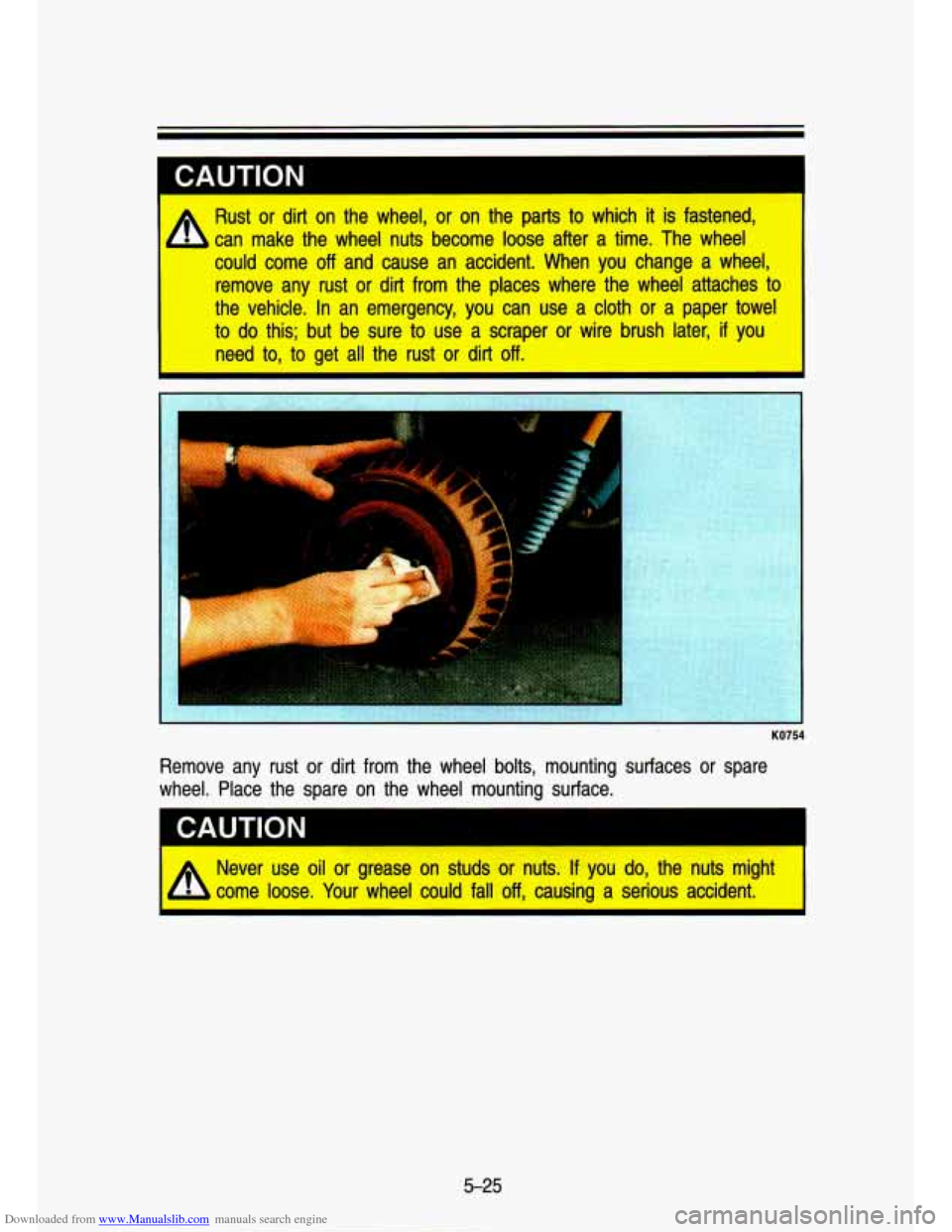
I A Rust or dirt on the wheel, or on the parts to which it is fastened,
4 can make the wheel nub become loose after a time. The wheel
could come off and cause an accident. When you change a wheel,
remove any rust or dirt from the places where the wheel attaches to
the vehicle.
In an emergency, you can use a doth or a paper towel
to
do this; but be sure to use a scraper or wire brush later, if you
need to, to get all the rust or dirt off.
KO754
Remove any rust or dirt from the wheel bolts, mounting surface\
s or spare
wheel. Place the spare on the wheel mounting surface.
I Never use oil or grease on studs or nuts. If you do, the nuts might
L come loose. Your wheel could fall off, causing a serious accident.
Page 242 of 356
Downloaded from www.Manualslib.com manuals search engine Problems on the Road
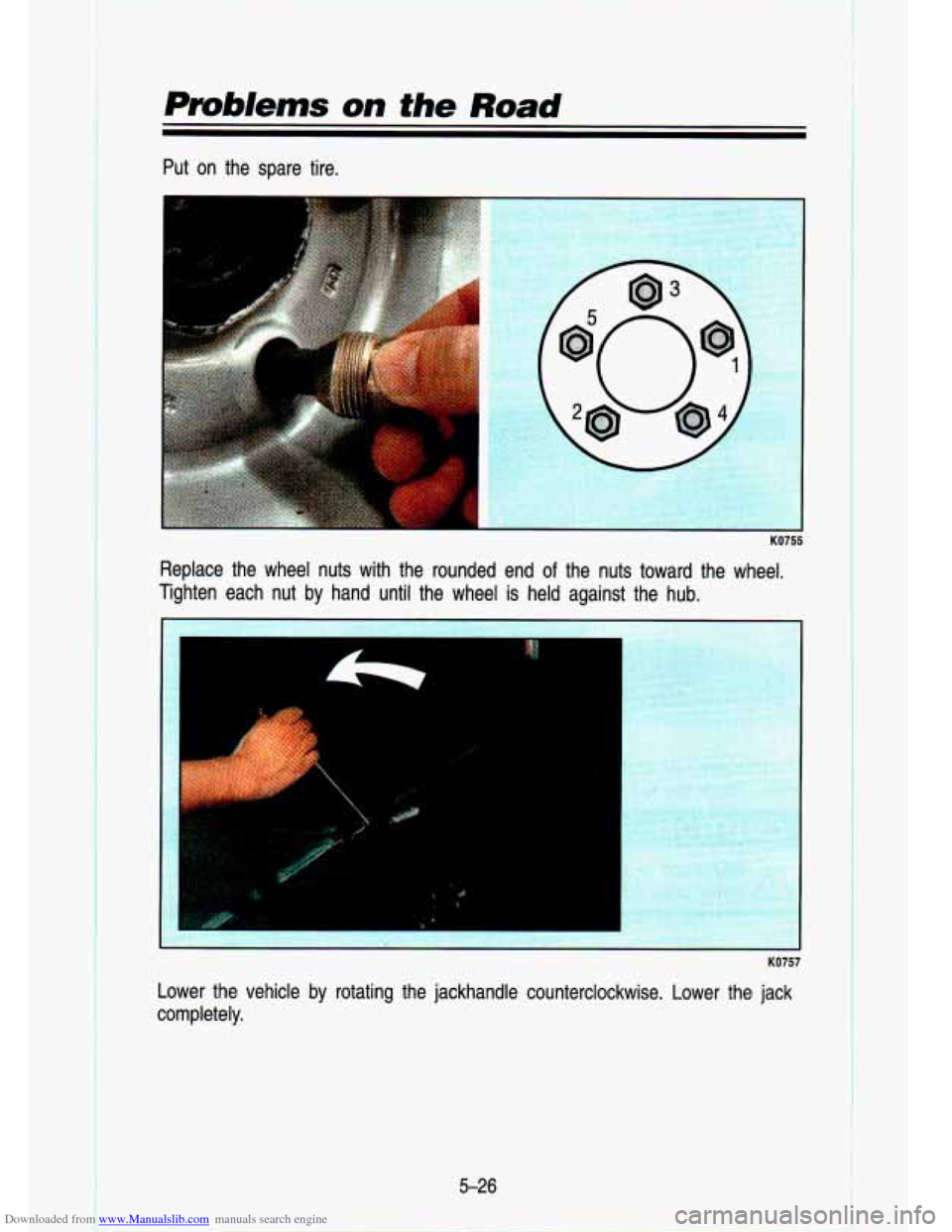
Put on the spare tire.
KO755
Replace the wheel nuts with the rounded end of the nuts toward the wheel.
Tighten each nut by hand until the wheel is held against the \
hub.
. ,~ , ._ i . , 9,; ;. - , .
KO757
Lower the vehicle by rotating the jackhandle counterclockwise. L\
ower the jack
completely.