tow CHEVROLET S10 1993 2.G Owner's Manual
[x] Cancel search | Manufacturer: CHEVROLET, Model Year: 1993, Model line: S10, Model: CHEVROLET S10 1993 2.GPages: 356, PDF Size: 20.85 MB
Page 162 of 356

Downloaded from www.Manualslib.com manuals search engine c. -. .. .
Your Driving and the Road
Turn and lane change signals: Always signal when you plan to \
turn or
change lanes.
If necessary, you can use hand signals out the window: Left arm \
straight out
for a left turn, down for slow or about-to-stop, and up for a right turn.
Slowing down:
If time allows, tap the brake pedal once or twice in advance
of slowing or stopping. This warns the driver behind you.
Disabled: Your four-way flashers signal that your vehicle is disabled or is a
hazard. See “Hazard Warning Flasher’’ in the Index.
Traffic Officer
The traffic police officer is also a source of important information. The officer’s
signals govern, no matter what the traffic lights or other sig\
ns say.
The next part discusses some of the road conditions you may encounter.
Defensive Driving
The best advice anyone can give about driving is: Drive defens\
ively.
Please
start with a very important safety device in your vehicle: Buckle up.
(See “Safety Belts” in the Index.)
Defensive driving really means “be ready for anything.” On\
city streets, rural
roads, or freeways, it means “always expect the unexpected.”
Assume that pedestrians or other drivers are going to be careless and make
mistakes. Anticipate what they might
do. Be ready for their mistakes.
Expect children to dash out from behind parked cars, often followed by other
children. Expect occupants in parked cars to open doors into traffic. Watch for
movement in parked cars-someone may be about to open a door.
Expect other drivers to run stop signs .when you are on a through street. Be
ready to brake
if necessary as you go through intersections. You may not
have to use the brake, but if you
do, you will be ready.
If you’re driving through a shopping center parking lot where there are
well-marked lanes, directional arrows, and designated parking are\
as, expect
some drivers to ignore all these markings and dash straight toward one part
of the lot.
Pedestrians can be careless. Watch for them. In general, you m\
ust give way
to pedestrians even
if you know you have the right of way.
Rear-end collisions are about the most preventable of accidents. Yet they are
common. Allow enough following distance. It’s the best defens\
ive driving
4-8
Page 197 of 356
Downloaded from www.Manualslib.com manuals search engine to merge into the gap at close to the prevailing speed. Switch on your turn
signal, check your rearview mirrors as you move along, and glance over your
shoulder as often as necessary.
Try to blend smoothly with the traffic flow.
Driving on the Freeway
Once you are on the freeway, adjust your speed to the posted limit or to the
prevailing rate
if it’s slower. Stay in the right lane unless you want to pass. If
you are on a two-lane freeway, treat the right lane as the slow lane and the
left lane as the passing lane.
If you are on a three-lane freeway, treat the right lane as the slower-speed
through lane, the middle lane as the higher-speed through lane, and the left
lane as the passing lane.
Before changing lanes, check your rearview mirrors. Then use yo\
ur turn
signal. Just before you leave the lane, glance quickly over your shoulder
to
make sure there isn’t another vehicle in your “blind” spot.
If you are moving from an outside to a center lane on a freeway having
more than
two lanes, make sure another vehicle isn’t about to move into the
same spot. Look
at the vehicles two lanes over and watch for telltale signs:
turn signals flashing, an increase in speed, or moving toward the edge
of the
lane. Be prepared to delay your move.
Once you are moving on the freeway, make certain you allow a reasonable
following distance. Expect to move slightly slower at night.
Leaving the Freeway
When you want to leave the freeway, move to the proper lane well in
advance. Dashing across lanes at the last minute is dangerous. \
If you miss
your exit do not, under any circumstances, stop and back up. \
Drive on to the
next exit.
At each exit point is a deceleration lane. Ideally
it should be long enough for
you to enter
it at freeway speed (after signaling, of course) and then do your
braking before moving onto the exit ramp. Unfortunately, not all deceleration
lanes are long enough-some are too short for all the braking. Decide when
to start braking.
If you must brake on the through lane, and if there is traffic
close behind you, you can allow a little extra time and flash your brake lights
(in addition to your turn signal) as extra warning that you are about to slow
down and exit.
The exit ramp can be curved, sometimes quite sharply. The exit\
speed
is
usually posted. Reduce your speed according to your speedometer, not to
your sense of motion. After driving for any distance at higher\
speeds, you
4-43
Page 201 of 356
Downloaded from www.Manualslib.com manuals search engine CAUTION
A Coasting downhill in N (Neutral) or with the ignition off is dangerous. I
2 Your brakes will have to do all the work of slowing down. They could
get
so hot that they wouldn’t work well. You could crash. Always
have your ignition on and your vehicle in gear when you go d\
ownhill.
e
Know how to go uphill. You may want to shift down to a lower gear.
The lower gears help cool your engine and transmission, and yo\
u can climb the hill better.
Stay in your own lane when driving on two-lane roads in hills or
mountains. Don’t swing wide or cut across the center
of the road. Drive
at speeds that let you stay in your own lane. That way, you won’t be
surprised by a vehicle coming toward you in the same lane.
It takes longer to pass another vehicle when you’re going u\
phill. You’ll
want
to leave extra room to pass. If a vehicle is passing you and
doesn’t have enough room, slow down to make
it easier for the other
vehicle to get by.
As you go over the top
of a hill, be alert. There could be something in
your lane, like a stalled car or an accident.
You may see highway signs on mountains that warn
of special. problems.
Examples are long grades, passing or no-passing zones, a fallin\
g rocks
area, or winding roads. Be alert to these and take appropriate\
action.
Winter driving can present special problems. See “Winter Driving” in the
Index.
Page 208 of 356
Downloaded from www.Manualslib.com manuals search engine -.
-.
”, . c.
Your Driving and the Road
-
. ..
..
I>: ”
.,. .,,-.
‘6
AM480042
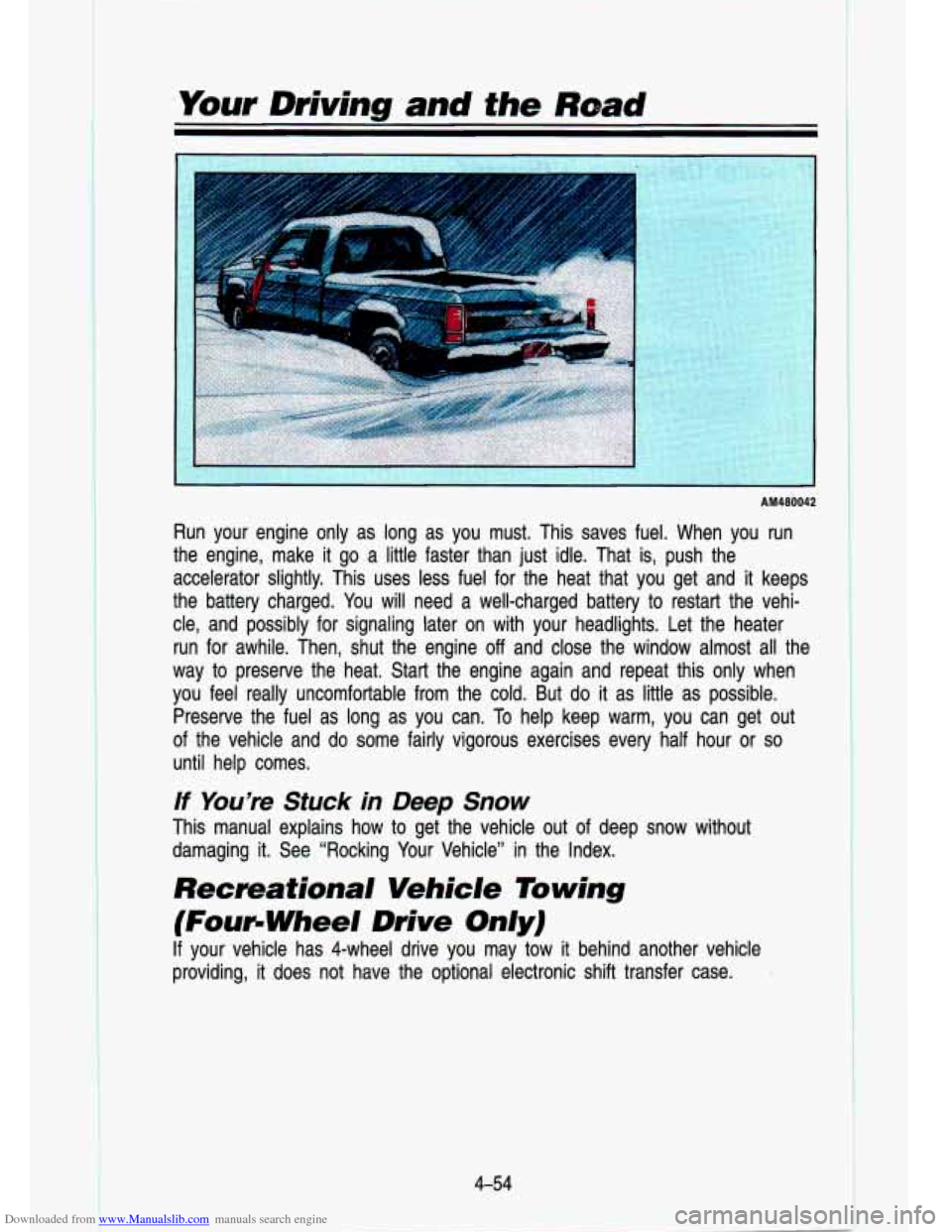
Run your engine only as long as you must. This saves fuel. W\
hen you run
the engine, make it go a little faster than just idle. That is, push the\
accelerator slightly. This uses less fuel for the heat that yo\
u get and it keeps
the battery charged. You will need
a well-charged battery to restart the vehi-
cle, and possibly for signaling later on with your headlights. Let the heater
run for awhile. Then, shut the engine
off and close the window almost all the
way
to preserve the heat. Start the engine again and repeat this only\
when
you feel really uncomfortable from the cold. But
do it as little as possible.
Preserve the fuel as long as you can.
To help keep warm, you can get out
of the vehicle and
do some fairly vigorous exercises every half hour or so
until help comes.
lf You’re Stuck in Deep Snow
This manual explains how to get the vehicle out of deep snow without
damaging it. See “Rocking Your Vehicle’’ in the Index.
Recreational Vehicle Towing
(Foue Wheel Drive Only)
If your vehicle has 4-wheel drive you may tow it behind another vehicle
providing, it does not have the optional electronic shift trans\
fer case.
4-54
Page 209 of 356
Downloaded from www.Manualslib.com manuals search engine Before towing you should:
1. Set the parking brake firmly.
2. Place the auto’matic transmission in P (Park) or the manual transmission
in th:e lowest gear
(1 st gear).
3. Firmly attach the vehicle being towed to the tow vehicle. Refer to the
hitch manufacturer’s instructions.
Shifting the transfer case to N (Neutral) can cause your veh\
icle
to
roll even if the transmission is in P (Park), for an automatic
transmission, or
if your vehicle is in gear, for a manual transmission.
This is because the transfer case overrides the transmission.
I
1 NOTICE
6. Insert the ignition key into the iginition switch and turn it one notch .for-
ward of the “LOCK’ position. This places the key into the “OFF” position,
which unlocks the steering column while preventing battery drain\
. Unlock-
ing the steering column will allow for proper movement of the front
wheelshires during towing.
4-55
Page 210 of 356

Downloaded from www.Manualslib.com manuals search engine Your Driving and the Road
Towing a mailer
CAUTION I
A
If you don’t use the correct equipment and drive properly, you \
can
lose control when you pull a trailer.
For example, if the trailer is too
heavy, the brakes may not work well-or even at all. You and your
passengers could be seriously injured. Pull a trailer only
if you have
followed all the steps in this section.
Every vehicle is ready for some trailer towing.
If it was t t with trailering
options, as many are, it’s ready for heavier trailers. But \
trailering is different
than just driving your vehicle by itself. Trailering means chan\
ges in handling,
durability, and fuel economy. Successful, safe trailering takes \
correct
equipment, and it has
to be used properly.
That’s the reason for this section. In it are many time-tested, important
trailering tips and safety rules. Many of these are important for your safety
and that of your passengers.
So please read this section carefully before you
pull a trailer.
If You Do Decide To Pull A Trailer
If you do, here are some important points.
e
e
e
e There are many different laws having to do with trailering. Make sure
your rig will be legal, not only where you live but also whe\
re you’ll be
driving.
A good source for this information can be state or provincial
police.
Consider using a sway control
if your trailer will weigh 2,000 pounds
(900 kg) or less. You should always use a sway control if your trailer will
weigh more than
2,000 pounds (900 kg). You can ask a hitch dealer
about sway controls.
Don’t tow a trailer at all during the first
500 miles (800 km) your new
vehicle
is driven. Your engine, axle, or other parts could be damaged.
Then, during the first
500 miles (800 km) that you tow a trailer, don’t
drive over
50 mph (80 kdh) and don’t make starts at full throttle. This
helps your engine and other parts of your vehicle wear in at the heavier
loads.
4-56
Page 211 of 356
Downloaded from www.Manualslib.com manuals search engine Three important considerations have to do with weight:
Weight
of the Trailer
How heavy can a trailer safely be? It depends on how you plan to\
use your
rig. For example, speed, altitude, road grades, outside temperat\
ure, and how
much your vehicle is used
to pull a trailer are all important. And, it can also
depend on any special equipment that you have on your vehicle.\
You can
ask your dealer for our trailering information or advice, or y\
ou can write
us at
the address listed in your Warranty and Owner Assistance Information
Booklet.
In Canada, write to:
General Motors of Canada, Limited
Customer Assistance Center 1908 Colonel Sam Drive
Oshawa, Ontario L1H 8P7
Weight
of the Trailer Tongue
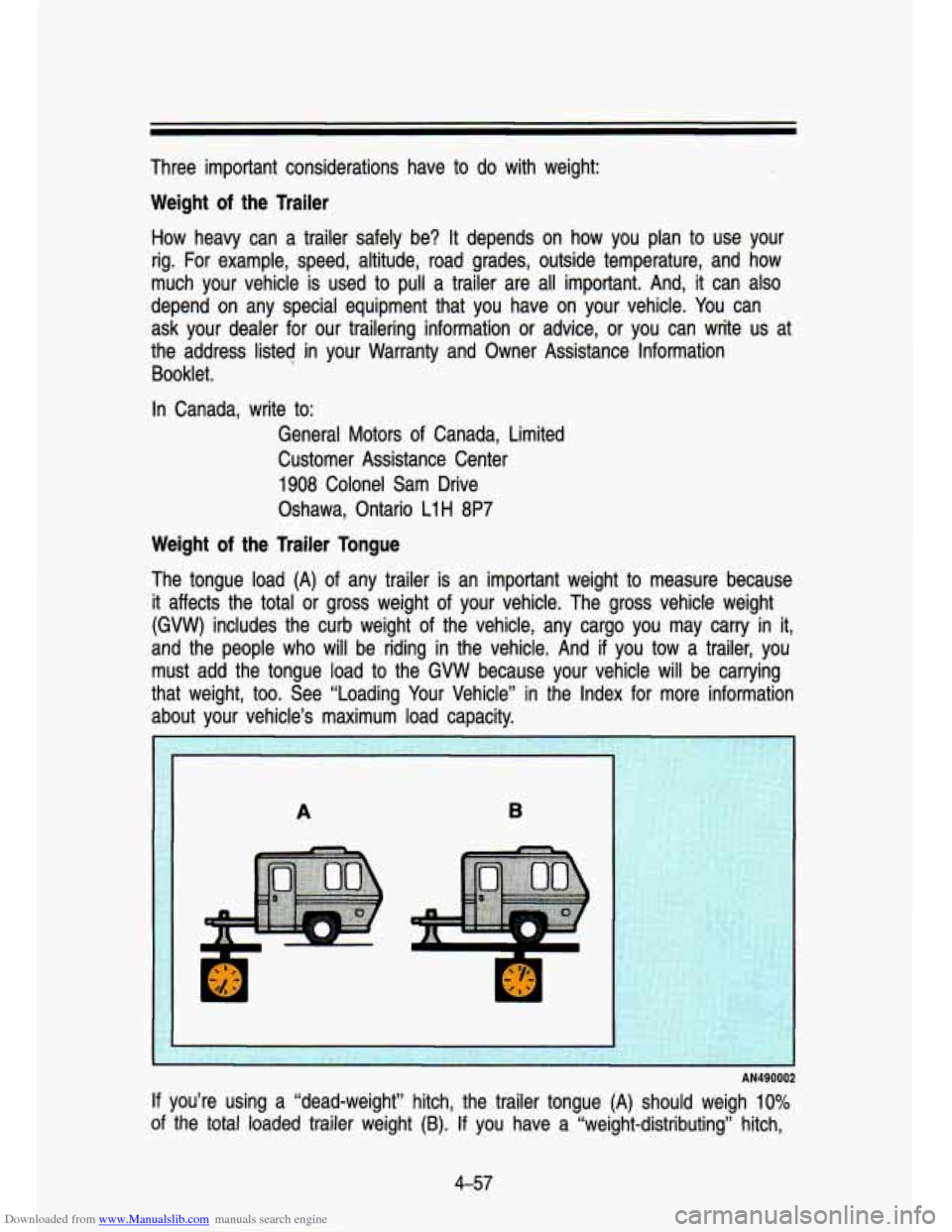
The tongue load
(A) of any trailer is an important weight to measure because
it affects the total or gross weight of your vehicle. The gross vehicle weight
(GVW) includes the curb weight of the vehicle, any cargo you may carry in it,
and the people who will be riding in the vehicle. And if you tow a trailer, you
must add the tongue load to the GVW because your vehicle will be carrying
that weight, too. See “Loading Your Vehicle” in the Index for more information
about your vehicle’s maximum load capaci’
AN490002
If you’re using a “dead-weight” hitch, the trailer tongue (A) should weigh 10%
of the total loaded trailer weight (B). If you have a “weight-distributing” hitch,
4-57
Page 212 of 356
Downloaded from www.Manualslib.com manuals search engine Your Driving and the Road
the trailer tongue (A) should weigh 12% of the total loaded trailer weight (B).
After you’ve loaded your trailer, weigh the trailer and then\
the tongue,
separately,
to see if the weights are proper. If they aren’t, you may be able
to get them right simply by moving some items around in the trai\
ler.
Total Weight
on Your Vehicle’s Tires
Be sure your vehicle’s tires are inflated
to the limit for cold tires. You’ll find
these numbers on the Certification Label on the driver’s doo\
r lock pillar (or see “Tire-Loading” in the Index). Then be sure you don’\
t go over the GVW
limit for your vehicle.
Hitches
It’s important to have the correct hitch equipment. Crosswind\
s, large trucks
going by, and rough roads are a few reasons why you’ll need the right hitch.
Here are some rules to follow:
If you’ll be pulling a trailer that, when loaded, will weigh more than 2,000
pounds (900 kg) be sure to use a properly mounted weight-distributing
hitch and sway control
of the proper size. This equipment is very
important for proper vehicle loading and good handling when you\
’re
driving.
You can tow trailers up to
2,000 pounds (900 kg) with a step bumper hitch,
but
if your trailer tongue has a V-shaped foot, your bumper could be
damaged in sharp turns. Check the distance from the front edge of the fo\
ot
to the middle of the hitch ball socket. If the distance is less than 12 inches,
take the foot
off the trailer tongue.
Page 213 of 356

Downloaded from www.Manualslib.com manuals search engine Safety Chains
You should always attach chains between your vehicle and your trail\
er. Cross
the safety chains under the tongue of the trailer
so that the tongue will not
drop to the road if
it becomes separated from the hitch. Instructions about
safety chains may be provided by the hitch manufacturer or by the trailer
manufacturer. Follow the manufacturer’s recommendation for atta\
ching safety
chains. Always leave just enough slack
so you can turn with your rig. And,
never allow safety chains to drag on the ground.
Trailer Brakes
If your trailer weighs more than 1,000 pounds (450 kg) loaded, then it needs
its own brakes-and they must be adequate. Be sure to read and follow the
instructions for the trailer brakes to install, adjust and maintain them properly.
And:
Don’t tap into your vehicle’s brake system if the trailer’s brake system
will use more than
0.02 cubic inch (0.3~~) of fluid from your vehicle’s
- master cylinder. If it does, both braking systems won’t work well. You
could even lose your brakes.
Will the trailer brake parts take 3,000 psi (20 650 kPa) of pressure? If
not, the trailer brake system must not be used with your vehi\
cle.
If everything checks out this far, then make the brake fluid tap \
at the
port on the master cylinder that sends fluid to the rear brak\
es. But don’t use copper tubing for this.
If you do, it will bend and finally break off.
Use steel brake tubing.
Driving with a Trailer
Towing a trailer requires a certain amount of experience. Before setti\
ng out
for the open road, you’ll want to get to know your rig. A\
cquaint yourself with
the feel of handling and braking with the added weight
of the trailer. And
always keep in mind that the vehicle you are driving is now a good deal
longer and not nearly
so responsive as your vehicle is by itself.
Before you start, check the trailer hitch and platform, safety \
chains, electrical
connector, lights, tires and mirror adjustment.
If the trailer has electric brakes,
start your vehicle and trailer moving and then apply the trail\
er brake controller
by hand to be sure the brakes are working. This lets you che\
ck your electrical
connection at the same time.
During your trip, check occasionally to be sure that the load \
is secure, and
that the lights and any trailer brakes are still working.
4-59
Page 214 of 356

Downloaded from www.Manualslib.com manuals search engine Your Driving and the Road
Following Distance
Stay at least twice as far behind the vehicle ahead as you w\
ould when
driving your vehicle without a trailer. This can help you avoi\
d situations that require heavy braking and sudden turns.
Passing
You’ll need more passing distance up ahead when you’re to\
wing a trailer.
And, because you’re a good deal longer, you’ll need
to go much farther
beyond the passed vehicle before you can return
to your lane.
Backing Up
Hold the bottom of the steering wheel with one hand. Then, to move the
trailer left, just move your hand to the left. To move the trailer to the right,
move your hand
to the right. Always back up slowly and, if possible, have
someone guide you.
Making Turns
When you’re turning with a trailer, make wider turns than n\
ormal. Do this so
your trailer wheels won’t strike soft shoulders, curbs, road \
signs, trees, or
other objects. Avoid jerky or sudden maneuvers. Signal well in advance.
Turn Signals When Towing a Trailer
When you tow a trailer, your vehicle has to have a different turn signal
flasher and extra wiring. The green arrows on your instrument \
panel will flash
whenever you signal a turn or lane change. Properly hooked up,\
the trailer lights will also flash, telling other drivers you’re about
to turn, change lanes,
or stop.
When towing a trailer, the green arrows on your instrument pan\
el will flash for
turns even
if the bulbs on the trailer are burned out. Thus, you may think \
drivers behind you are seeing your signal when they are not.
It’s important to
check occasionally to be sure the trailer bulbs are still work\
ing.
Driving on Grades
Reduce speed and shift to a lower gear before you start down a long or
steep downgrade.
If you don’t shift down, you might have to use your brakes
so much that they would get hot and no longer work well.
On a long uphill grade, shift down and reduce your speed to \
around
45 mph
(70 km/h) to reduce the possibility of engine and transmission ove\
rheating.
If you have an automatic transmission, you should use D when towing a
trailer. Operating your vehicle in
D when towing a trailer will minimize heat
buildup and extend the life of your transmission. Or, if you have a manual
transmission with fifth gear, it’s better not to use fifth \
gear, just drive in fourth
gear (or, as you need
to, a lower gear).
4-60