wheel CHEVROLET S10 1993 2.G User Guide
[x] Cancel search | Manufacturer: CHEVROLET, Model Year: 1993, Model line: S10, Model: CHEVROLET S10 1993 2.GPages: 356, PDF Size: 20.85 MB
Page 76 of 356

Downloaded from www.Manualslib.com manuals search engine Features & Contmls
3. If you have four-wheel drive with a manual transfer case shift\
lever, be
4. Move the ignition key to
LOCK.
sure the transfer case is in a drive gear-not in N (Neutral).
5. Remove the key and take it with you. If you can walk away from your
vehicle with the ignition key in your hand, your vehicle is in
P (Park).
Leaving Your Vehicle With the Engine Running
(Automatic Transmission Models Only)
1 CAUTION
It can be dangerous to leave your vehicle with the engine running.
Your vehicle could move suddenly
if the shift lever is not fully in P
(Park) with the parking brake firmly set. If you have four-wheel drive
with a manual transfer case shift lever and your transfer case\
is in
N
(Neutral), your vehicle will be free to roll, even if your shift lever is in
P (Park). So be sure the transfer case is in a drive gear-not in N
(Neutral). And, if you leave the vehicle with the engine running, it
could overheat and even catch fire. You or others could be injured.
I Don’t leave your vehicle with the engine running unless you have to.
If you have to leave your vehicle with the engine running, be sure your
vehicle is in
P (Park) and your parking brake is firmly set before you leave it.
If you have four-wheel drive with a manual transfer case shift le\
ver, be sure
that the transfer case is in
a drive gear-not in N (Neutral). After you’ve
moved the shift lever into the
P (Park) position, hold the regular brake pedal
down. Then, see if you can move the shift lever away from P (Park) without
first pulling it toward you.
If you can, it means that the shift lever wasn’t fully
locked into
P (Park).
Parking Your b bide (Manual Transmission Models
Before you get out of your vehicle, put your manual transmissi\
on in R
(Reverse) and firmly apply the parking brake.
If you have four-wheel drive with a manual transfer case shift le\
ver, be sure
your transfer case is in a drive gear. Your vehicle could roll
if it isn’t.
Only)
If you are parking on a hill, or if your vehicle is equipped to tow a trailer,
see “Parking
on Hills” or “Towing a Trailer” in the Index.
2-24
I
Page 79 of 356
Downloaded from www.Manualslib.com manuals search engine It can be dangerous to get out of your vehicle if the shift llever is not I
fully in P (Park) with the parking brake firmly set. Your vehide can
roll. Don’t leave your vehicle when the engine is running, \
unlless y~
have to.
If you’ve left the engine running, tihe vehicle can move
suddenly.
You or others could be injured. To be sure your vehicle
won’t move, when you’re on fairly level ground, always se\
t your
parking brake and move the shift lever to
P (Park).
If you have four-wheel drive with a manual transfer case shift lever
and your transfer case
is in N (Neutral), your vehide will be free to
roll, even if your shift lever is in P (Park). So, be sure the transfer
case is in a drive gear-not
in ‘N (Neutral)., Follow the proper steps
to be sure your vehicle
won’t move. See “Shifting Into P (Park)” in
the Index.
If you are parking on a hill, or if you’re pulling a trailer, also see
“Farking on Mills” or “Towing a Trailer” in the Index.
If your vehicle has four-wheel drive, you can send your engine’\
s driving power
to all four wheels for extra traction.
To shift out of two-wheel drive and into
four-wheel drive, move the transfer case shift lever
to 4 HIGH or 4 LOW. You
should use
2 WHEEL for most normal driving conditions, however.
2-27
Page 80 of 356
Downloaded from www.Manualslib.com manuals search engine Features & Controls
Manual Transfer Case
I
PO1 63
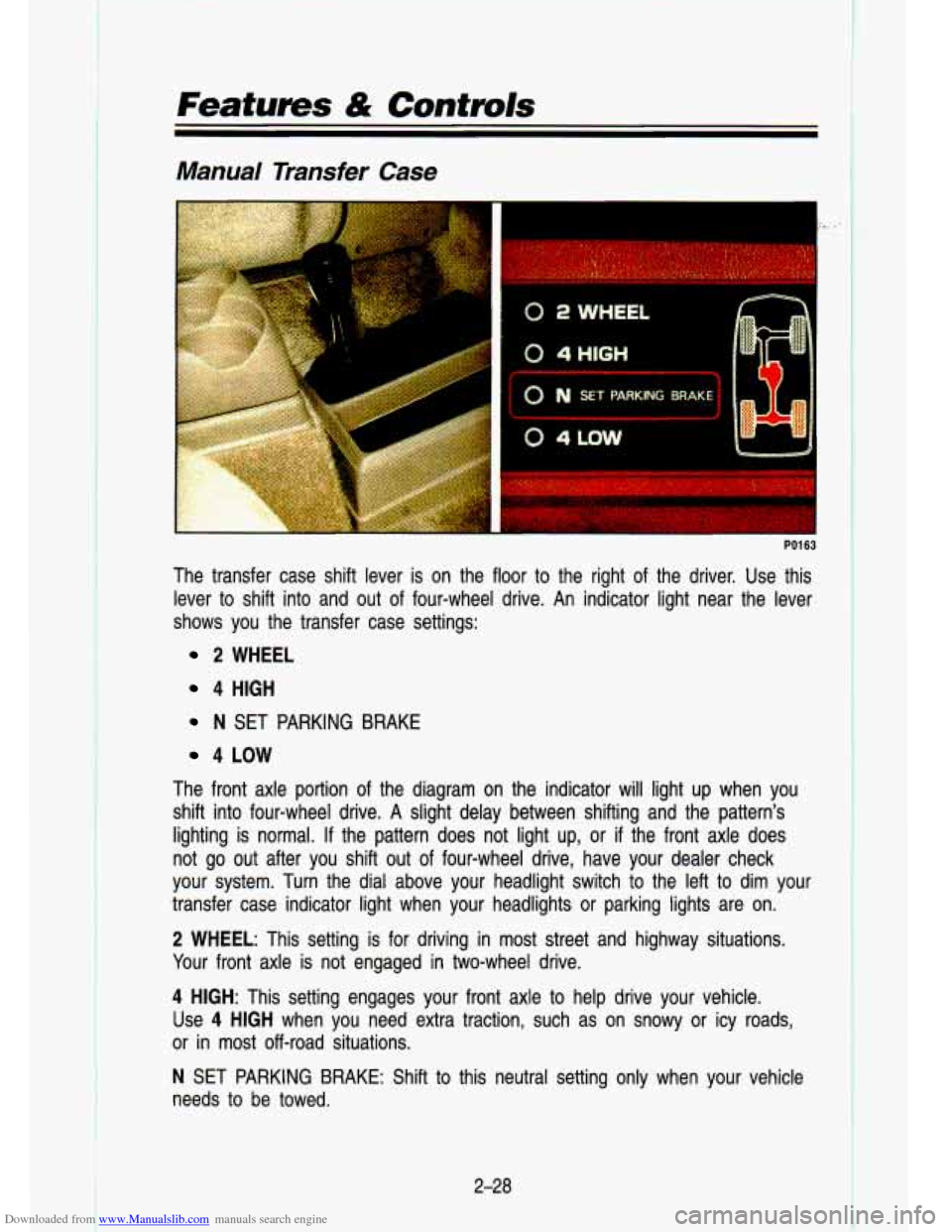
The transfer case shift lever is on the floor to the right of the driver. Use this
lever
to shift into and out of four-wheel drive. An indicator light near the lever
shows you the transfer case settings:
2 WHEEL
4 HIGH
N SET PARKING BRAKE
4 LOW
The front axle portion
of the diagram on the indicator will light up when you
shift into four-wheel drive. A slight delay between shifting and the patte\
rn's
lighting is normal.
If the pattern does not light up, or if the front axle does
not go out after you shift out
of four-wheel drive, have your dealer check
your system. Turn the dial above your headlight switch
to the left to dim your
transfer case indicator light when your headlights or parking l\
ights are on.
2 WHEEL: This setting is for driving in most street and highway situations.
Your front axle is not engaged in two-wheel drive.
4 HIGH: This setting engages your front axle to help drive your vehicle.
Use
4 HIGH when you need extra traction, such as on snowy or icy roads, \
or in most off-road situations.
N SET PARKING BRAKE: Shift to this neutral setting only when your vehicle
needs
to be towed.
2-28
I
Page 81 of 356
Downloaded from www.Manualslib.com manuals search engine 4 LOW: This setting also engages your front axle to give you extra traction.
You may never need
4 LOW. It sends the maximum power to all four wheels.
You might choose
4 LOW if you were driving off-road in sand, mud, or deep
snow and climbing or descending steep hills.
You can shift from
2 WHEEL to 4 HIGH or from 4 HIGH to 2 WHEEL while
the vehicle is moving.
It is not necessary for you to press the transfer case
shift lever button. Your front axle will engage faster if you take your foot
off
of the accelerator for a few seconds after you shift.
To shift into or out of 4 LOW or N SET PARKING BRAKE:
-
1. Stop your vehicle and shift your transmission into neutral.
2. Press the transfer case shift button and shift in one continuous motion.
Don’t pause in
N SET PARKING BRAKE as you shift into or out of 4 LOW,
or your gears could clash.
Remember that driving in
4 HIGH or 4 LOW may reduce fuel economy. Also,
driving in four-wheel drive on dry pavement could cause your tires to wear
faster and make your transfer case harder to shift.
Electronic Transfer Case
1
KO41 2
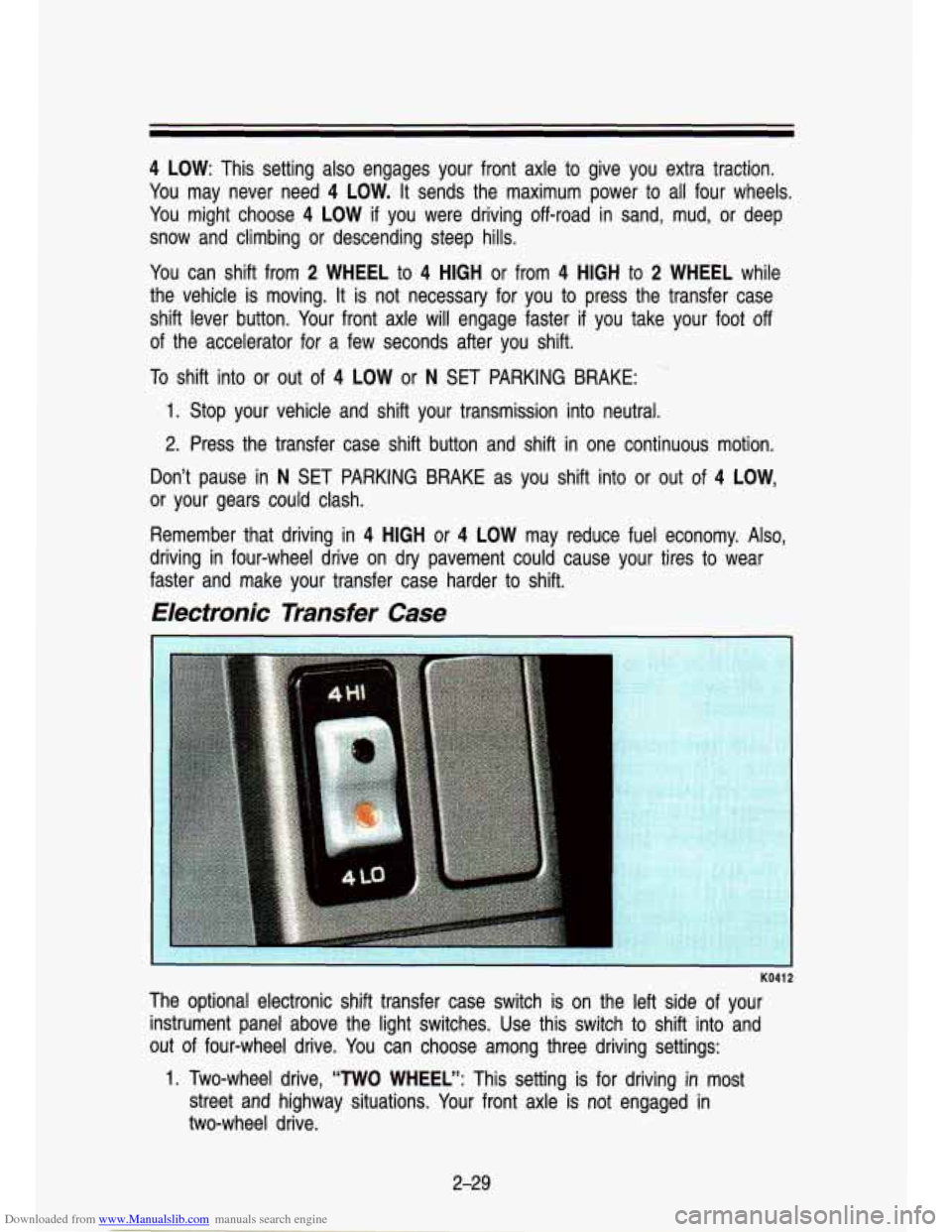
The optional electronic shift transfer case switch is on the left side of your
instrument panel above the light switches. Use this switch to \
shift into and
out of four-wheel drive. You can choose among three driving settings:
1. Two-wheel drive, “TWO WHEEL”: This setting is for driving in most
street and highway situations. Your front axle
is not engaged in
two-wheel drive.
2-29
Page 82 of 356

Downloaded from www.Manualslib.com manuals search engine t
Featums & Contmls
2. 4HI: This setting engages your front axle to help drive your \
vehicle. Use 4HI when you need extra traction, such as on snowy or ic\
y roads,
or in most off-road situations.
3. 4LO: This setting also engages your front axle to give you extra traction.
You may never need 4LO. It sends the maximum power to
all four
wheels. You might choose 4L0
if you were driving off-road in sand,
mud, or deep snow and climbing or descending steep hills.
Indicator lights on the switch show you which setting you are \
in. Both
indicator lights
will come on briefly when you turn on the ignition. If both
lights
do not come on, you should take your vehicle in for service. The 4HI
position has a green indicator light and the 4LO position has \
an amber
indicator light. When shifting from 4HI to 4LO or 4LO to 4HI,\
the indicator
light will flash until the shift is completed.
Two-Wheel Drive, “TWO WHEEL”, does not have a switch posi\
tion or an indicator light. Your vehicle will be in
two wheel drive if neither indicator light
is on.
To shift from two-wheel drive,
“TWO WHEEL”, to 4HI: Press and release
the 4HI switch. This can be done at any speed, and the front\
axle will lock
automatically.
To shift from 4HI to two-wheel drive, “TWO WHEEL”: Press and\
release
the 4HI switch. This can be done at any speed, and the front\
axle will unlock
automatically.
To shift from two-wheel drive, ‘‘TWO WHEEL”, or 4HI to 4LO: Stop your
vehicle. Shift your transmission into
N (Neutral) or depress your clutch pedal.
Press and release the 4LO switch. You must wait for the amber 4LO
indicator light to stop flashing and go solid amber before shi\
fting your
transmission into gear or releasing the clutch pedal.
If the 4L0 switch is pressed when your vehicle is in gear and/or moving, the
amber 4L0 indicator light will flash for
30 seconds and not complete the shift
unless your vehicle is below
3 mph and the transmission is in N (Neutral) or
the clutch pedal depressed.
On automatic transmission equipped vehicles:
If your transfer case does not
shift into 4L0, your transmission indicator switch may require adjustment. With
your transmission in
N (Neutral), press and release the 4LO switch. While the
amber 4LO indicator light is flashing, shift your transmission \
into
P (Park).
Wait until the 4LO indicator light goes solid amber before shifting your
transmission into gear. This will get you into 4L0, but you should take your
vehicle in for service
so normal operation can be restored.
2-30
Page 83 of 356
Downloaded from www.Manualslib.com manuals search engine To shift from 4LO to 4HI: Stop your vehicle. Shift your transmission into N
(Neutral) or depress your clutch pedal. Press and release the\
4HI switch. You
must wait for the green 4HI indicator light to stop flashing \
and go solid green
before shifting your transmission into gear or releasing the clutch pedal.
If the 4HI switch is pressed wh’en your vehicle is in gear and/or moving, the
green 4H1 indicator light will flash for
30 seconds but not complete the shift
unless the vehicle is below
3 mph and the transmission is in N (Neutral) or
the clutch pedal depressed.
On automatic transmission equipped vehicles:
If your transfer case does not
shift into- 4HI, your transmission indicator switch may require adjustment. With
your transmission in
N (Neutral), press and release the 4HI switch. While the
green 4HI indicator light
is flashing, shift your transmission into P (Park). Wait
until the 4HI indicator light goes solid green before shifting \
your transmission
into gear. This will get you into 4HI, but you should take your vehicle \
in for
service
so normal operation can be restored.
To shift from 4LO to two-wh’eel drive, “lW0 WHEEL”: You must shift from
4LO to 4HI before shifting back into two-wheel drive.
Windows
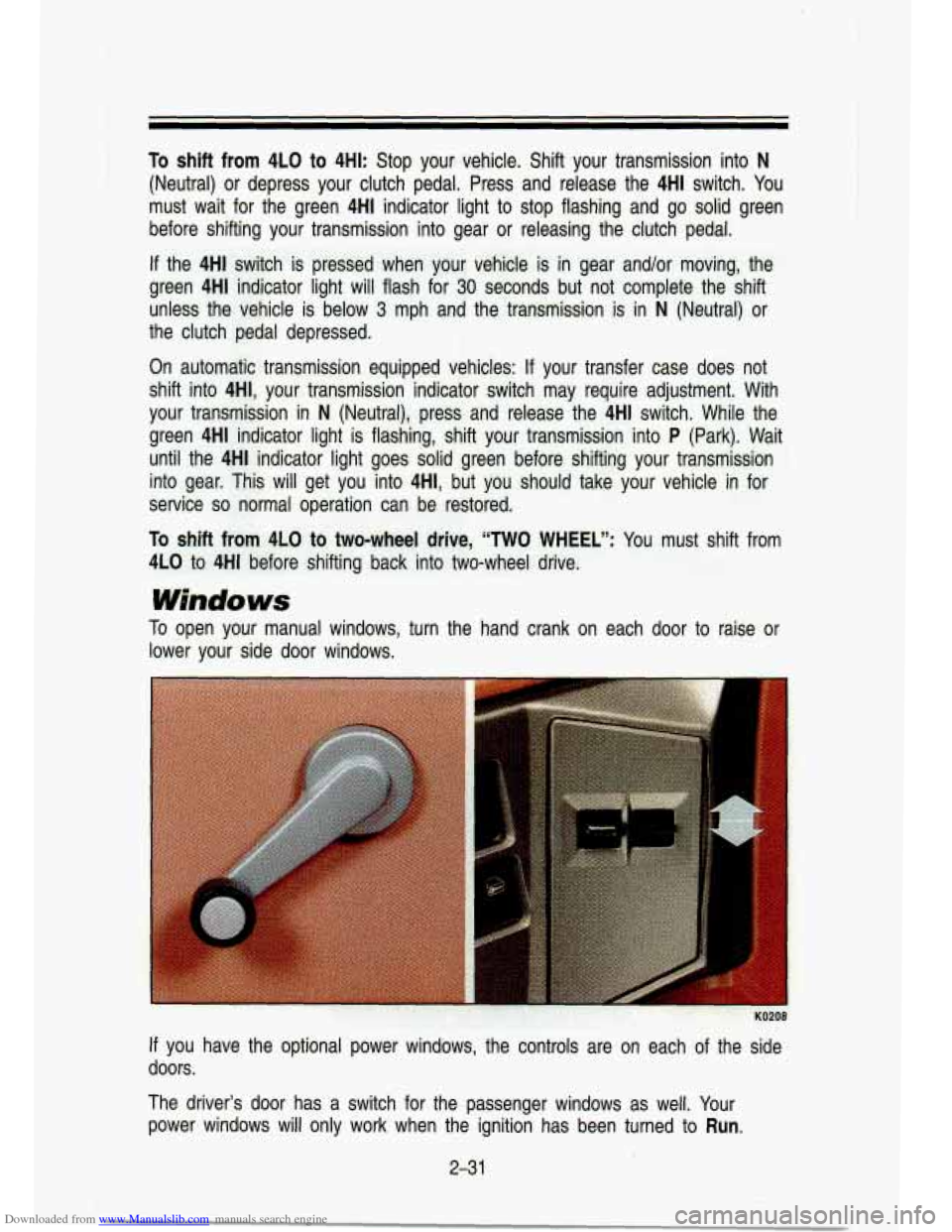
To open your manual windows, turn the hand crank on each door to raise or
lower your side door windows.
If you have the optional power windows, the co’ntrols are on e\
ach of the side
doors.
The driver’s door has a switch for the passenger windows as\
well. Your
power windows
will only work when the ignition has been turned to Run.
231
Page 85 of 356
Downloaded from www.Manualslib.com manuals search engine Tailgate
KO216
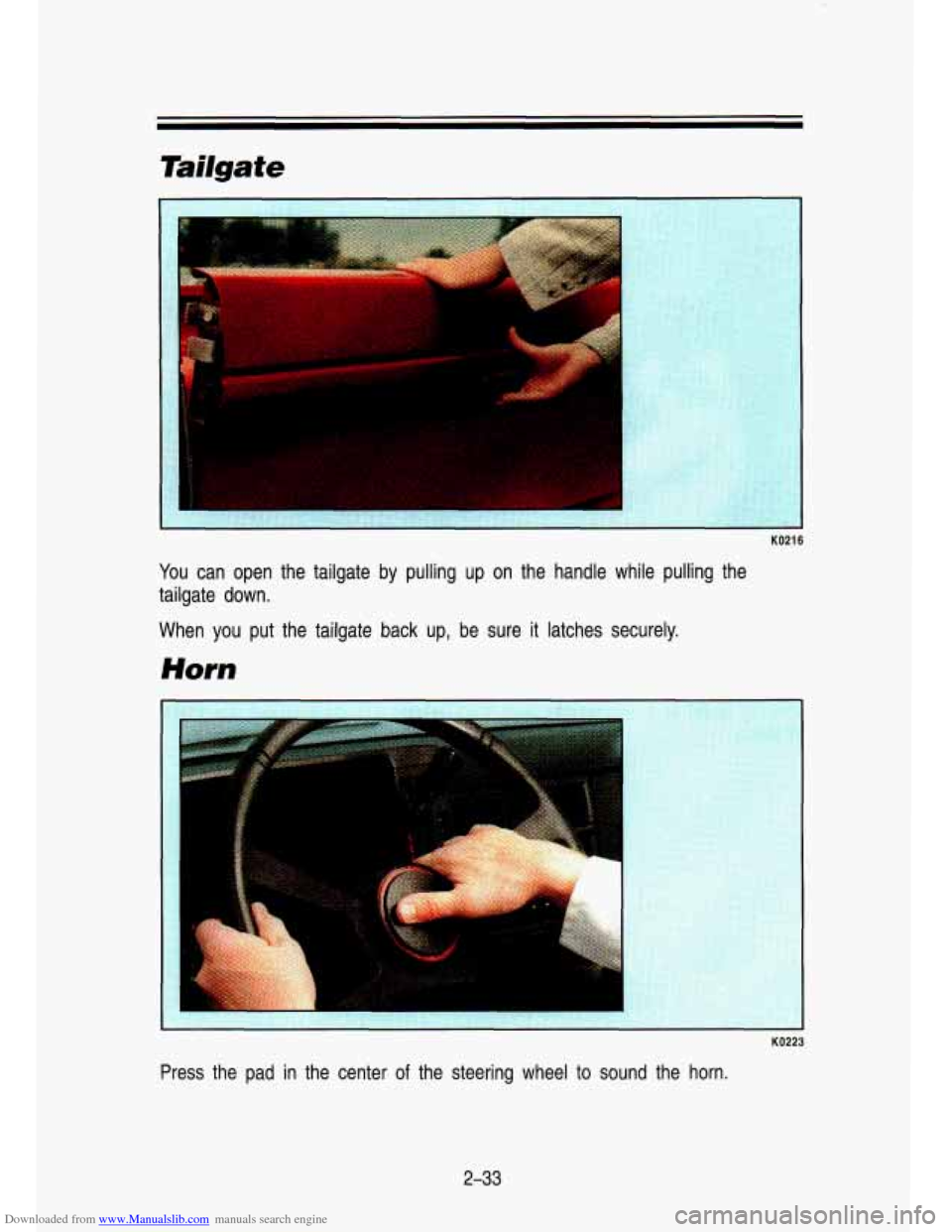
You can open the tailgate by pulling up on the handle while pulling the
tailgate down.
When you put the tailgate back up, be sure it latches securely.
Horn
KO223
Press the pad in the center of the steering wheel to sound the horn.
2-33
Page 86 of 356
Downloaded from www.Manualslib.com manuals search engine Features & Controls
Tilt Wheel
+j ....
I
KO225
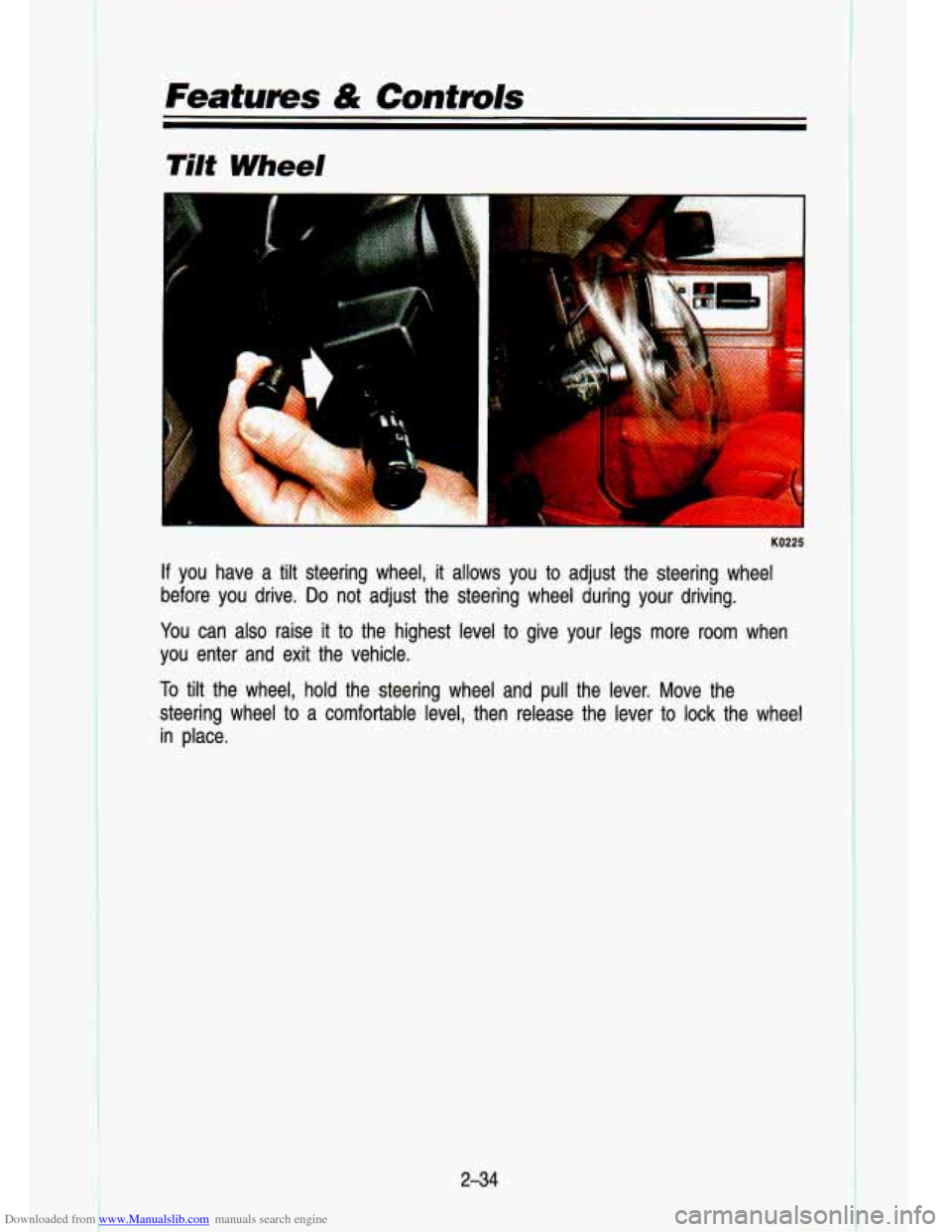
If you have a tilt steering wheel, it allows you to adjust the steering wheel
before you drive.
Do not adjust the steering wheel during your driving.
You can also raise it to the highest level to give your legs more ro\
om when
you enter and
exit the vehicle.
To tilt the wheel, hold the steering wheel and pull the lever. M\
ove the
steering wheel to a comfortable level, then release the lever to lock the wheel
in place.
234
1
Page 94 of 356

Downloaded from www.Manualslib.com manuals search engine Features & Contmls
t
1 CALITION I. - .. ;Fg ,. L A Cruise Control can be dangerous where you can't drive safely a\
t
a steady speed.
So, don't use your Cruise Control on winding
roads
or in heavy traffic.
Cruise Control can be dangerous on slippery roads. On such
roads, fast changes in tire traction can cause needless wheel
spinning, and you could lose control. Don't use Cruise Control \
on slippery roads.
To Set Cruise Control
Move the Cruise Control switch to ON.
1 CAUTION
A If you leave your Cruise Control switch on when you're not using \
k Cruise, you might hit a button and go into Cruise when you don't
want to. You could be startled and even lose control. Keep the
Cruise Control switch
OFF until you want to use it.
Get up to the speed you want.
Push in the set button at the end of the lever and release it.
Take your foot off the accelerator pedal.
2-42
Page 118 of 356
Downloaded from www.Manualslib.com manuals search engine i
Features & Controls
Gages can indicate when there may be or is a problem with one of your
vehicle’s functions. Often gages and warning lights work toge\
ther
to let you
know when there’s a problem with your vehicle.
When one of the warning lights comes on and stays on when you are
driving, or when one of the gages shows there may be a probl\
em, check the
section that tells you what to do about
it. Please follow the manual’s advice.
Waiting to do repairs can be costly-and even dangerous.
So please get to
know your warning lights and gages. They’re a big help.
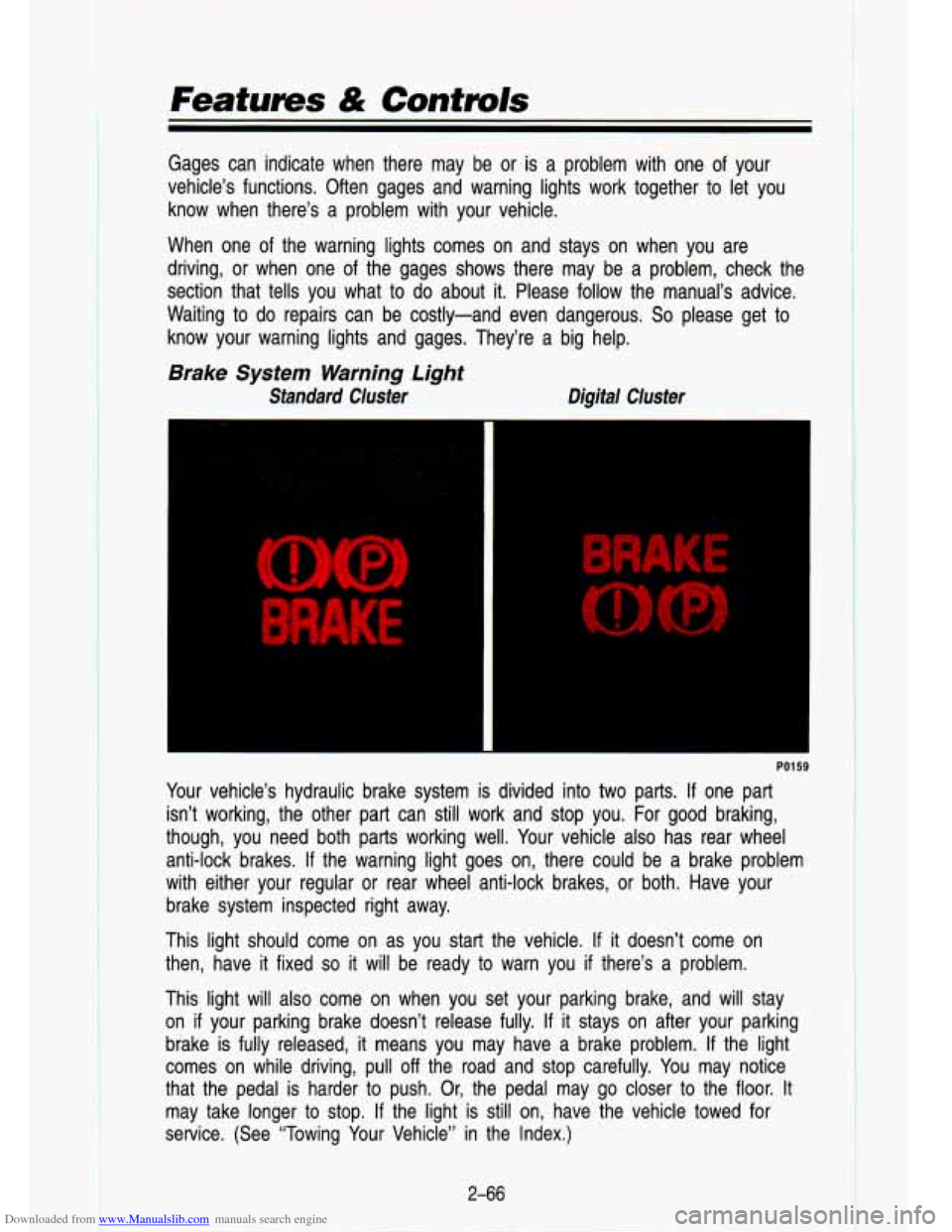
Brake System Warning Light
Standard Cluster Digital Cluster
Pol 59
Your vehicle’s hydraulic brake system is divided into two parts. If one part
isn’t working, the other part can still work and stop you. \
For good braking,
though, you need both parts working well. Your vehicle also ha\
s rear wheel anti-lock brakes. If the warning light goes on, there could be a brake problem
with either your regular or rear wheel anti-lock brakes, or both. Have you\
r
brake system inspected right away.
This light should come on as you start the vehicle. If it do\
esn’t come on
then, have it fixed
so it will be ready to warn you if there’s a problem.
This light will also come on when you set your parking brake, and will stay
on if your parking brake doesn’t release fully. If it stays on after your parking
brake is fully released,
it means you may have a brake problem. If the light
comes on while driving, pull
off the road and stop carefully. You may notice
that the pedal is harder
to push. Or, the pedal may go closer to the floor. It
may take longer to stop. If the light is still on, have the vehicle towed for
service. (See “Towing Your Vehicle” in the Index.)
2-66
I