wheel CHEVROLET S10 1993 2.G Service Manual
[x] Cancel search | Manufacturer: CHEVROLET, Model Year: 1993, Model line: S10, Model: CHEVROLET S10 1993 2.GPages: 356, PDF Size: 20.85 MB
Page 199 of 356
Downloaded from www.Manualslib.com manuals search engine On the Road
Unless you are the only driver, it is good to share the driving task with
others. Limit turns behind the wheel to about
100 miles (160 km) or two
hours at a sitting. Then, either change drivers or stop for s\
ome refreshment
like coffee, tea or soft drinks and some limbering up. But
do stop and move
around. Eat lightly along the way. Heavier meals tend to make some people
sleepy.
On two-lane highways or undivided multilane highways that
do not have
controlled access, you’ll want to watch for some situations not usually found
on freeways. Examples are: stop signs and signals, shopping cen\
ters with
direct access to the highway, no passing zones and school zones, vehicles
turning left and right
off the road, pedestrians, cyclists, parked vehicles, and
even animals.
Highway Hypnosrs
Is there actually such a condition as “highway hypnosis?” Or \
is it just plain
falling asleep at the wheel? Call it highway hypnosis, lack of awareness, or
whatever.
There is something about an easy stretch of road with the same scenery,
along with the hum of the tires on the road, the drone of the engine, and the
rush of the wind against the vehicle that can make you sleepy. Don’\
t let it
happen to you!
If it does, your vehicle can leave the road in less than a
second, and you could crash and be injured.
What can you
do about highway hypnosis? First, be aware that it can
happen.
Then here are some tips:
Make sure your vehicle is well ventilated, with a comfortably \
cool interior.
Keep your eyes moving. Scan the road ahead and to the sides. \
Check
your rearview mirrors frequently and your instruments from time \
to time.
This can help you avoid a fixed stare.
Wear good sunglasses in bright light. Glare can cause drowsines\
s. But don’t wear sunglasses at night. They will drastically reduce \
your overall
vision at the very time you need all the seeing power you have.
If you get sleepy, pull off the road into a rest, service, or parking area
and take a nap, get some exercise, or both. For safety, treat drowsiness
on the highway as an emergency.
As in any driving situation, keep pace with traffic and allow adequat\
e
following distances.
4-45
Page 202 of 356

Downloaded from www.Manualslib.com manuals search engine Your Driving and the Road
Parking on Hills
Hills and mountains mean spectacular scenery. But please be careful where \
you stop
if you decide to look at the view or take pictures. Look for pu\
ll-offs
or parking areas provided for scenic viewing.
I
AM470005
Another part of this manual tells how to use your parking brake (see “Parking
Brake” in the Index). But on a mountain or steep
hill, you can do one more
thing. You can turn your front wheels to keep your vehicle from rolling down-\
hill
or out into traffic. Here’s how:
Parking Downhill
AM470010
Turn your wheels to the right.
Page 203 of 356
Downloaded from www.Manualslib.com manuals search engine You don’t have to jam your tires against the curb, if there is a curb. A gentle
contact is all you need.
Parking Uphill
AM47001 5
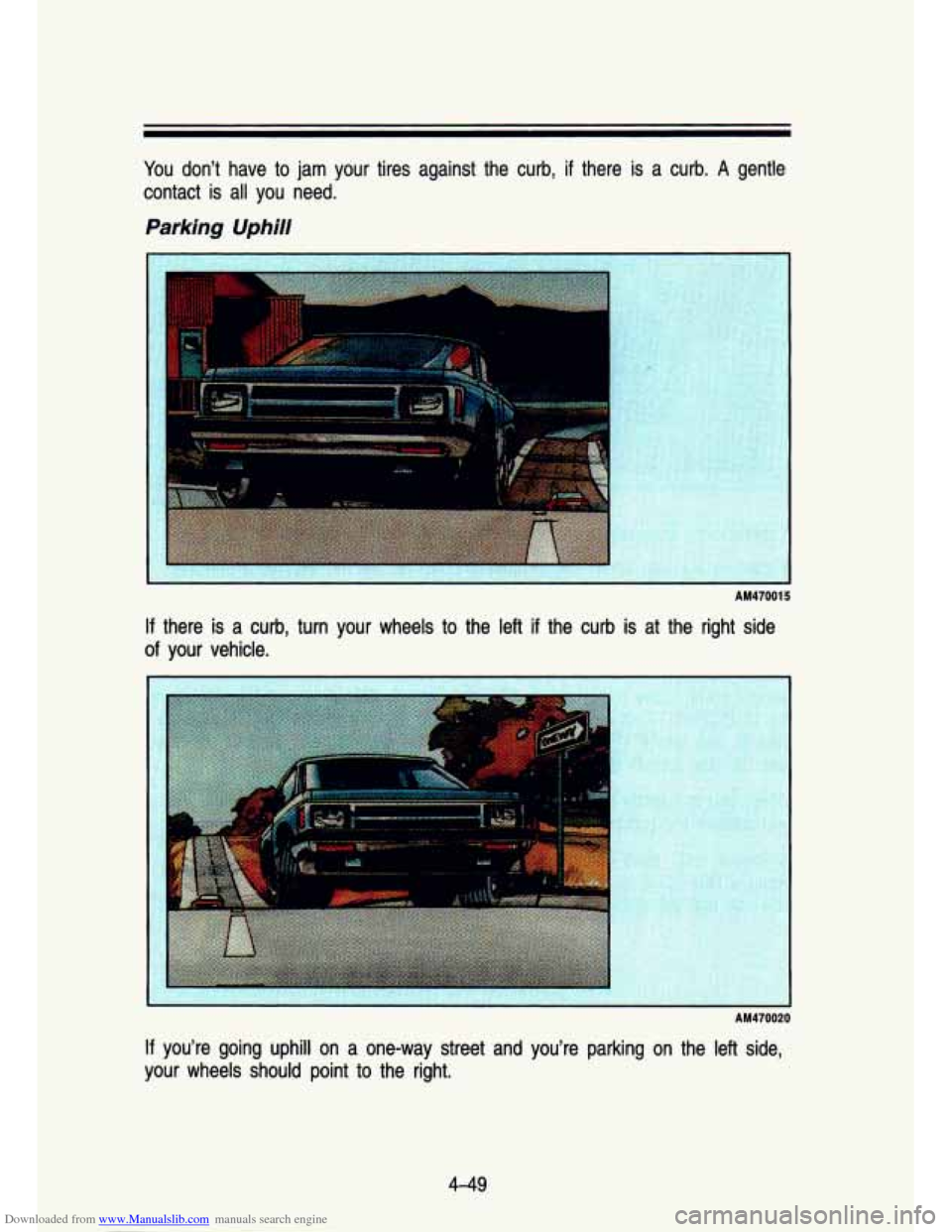
If there is a curb, turn your wheels to the left if the curb is at the right side
of your vehicle.
AM470020
If you’re going uphill on a one-way street and you’re parking on the left side,
your wheels should point to the right.
4-49
Page 204 of 356
Downloaded from www.Manualslib.com manuals search engine Your Driving and the Road
I ~~~~~~~~~~~~~~~~~~~~~~~~~~~~~~~~~~~~~
",.*,lcG~2*"*w" "* .**b;.. "~~" nl ~ -; *_ -~ ,,-,., ',.".~
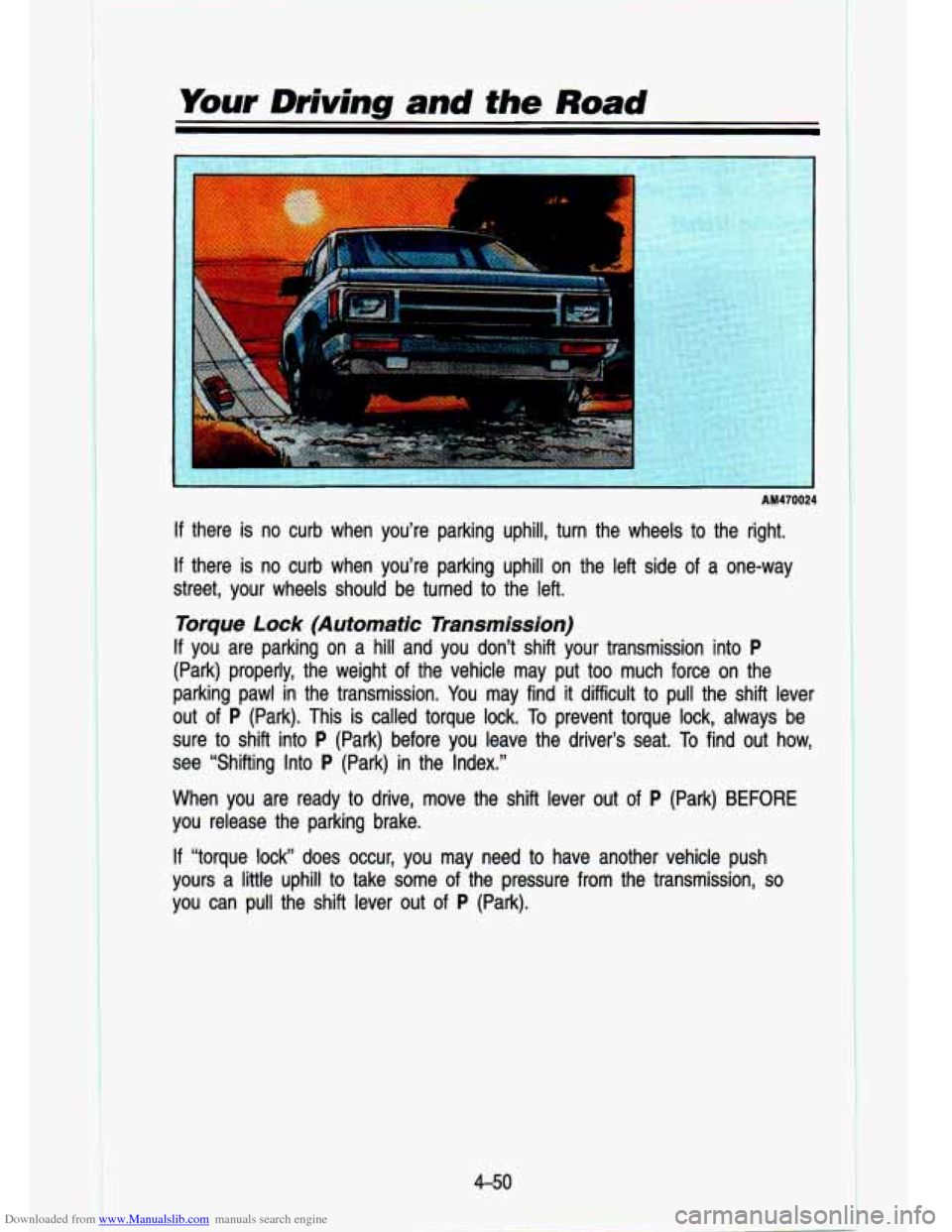
If there is no curb when you're parking uphill, turn the wheels to the right.
If there is no curb when you're parking uphill on the left side \
of a one-way
street, your wheels should be turned
to the left.
Torque Lock (Automatic Transmission)
If you are parking on a hill and you don't shift your transmissi\
on into P
(Park) properly, the weight of the vehicle may put too much \
force on the
parking pawl in the transmission.
You may find it difficult to pull the shift lever
out of
P (Park). This is called torque lock. To prevent torque lock, always be
sure to shift into
P (Park) before you leave the driver's seat. To find out how,
see "Shifting Into
P (Park) in the Index."
When you are ready
to drive, move the shift lever out of P (Park) BEFORE
you release the parking brake.
AM470024
If "torque lock" does occur, you may need to have another vehicle push
yours a little uphill
to take some of the pressure from the transmission, so
you can pull the shift lever out of P (Park).
4-50
Page 206 of 356

Downloaded from www.Manualslib.com manuals search engine Your Driving and the Road
r-
AM480016
What’s the worst time for this? “Wet ice.” Very cold \
snow or ice can be slick
and hard
to drive on. But wet ice can be even more trouble because it ma\
y
offer the least traction of all. You can get “wet ice” when it’s about freezing
(32°F; 0°C) and freezing rain begins to fall. Try to avoid driving on wet ice
until salt and sand crews can get there.
Whatever the condition-smooth ice, packed, blowing or loose snow\
-drive
with caution. Accelerate gently. Try not
to break the fragile traction. If you
accelerate
too fast, the drive wheels will spin and polish the surface under \
the tires even more.
Your antilock brakes improve your ability
to make a hard stop on a slippery
road. Even though you have the antilock braking system, you’\
ll want
to begin
stopping sooner than you would on dry pavement. See “Antiloc\
k” in the
Index.
Allow greater following distance on any slippery road.
Watch for slippery spots. The road might be fine until you hit a spot
that’s covered with ice. On an otherwise clear road, ice pa\
tches may appear in shaded areas where the sun can’t reach: around clumps of
trees, behind buildings, or under bridges. Sometimes the surface\
of
a
curve or an overpass may remain icy when the surrounding roads\
are
clear.
If you see a patch of ice ahead of you, brake before you are on
it. Try not to brake while you’re actually on the ice, and avoid sudden
steering maneuvers.
4-52
I i
Page 208 of 356
Downloaded from www.Manualslib.com manuals search engine -.
-.
”, . c.
Your Driving and the Road
-
. ..
..
I>: ”
.,. .,,-.
‘6
AM480042
Run your engine only as long as you must. This saves fuel. W\
hen you run
the engine, make it go a little faster than just idle. That is, push the\
accelerator slightly. This uses less fuel for the heat that yo\
u get and it keeps
the battery charged. You will need
a well-charged battery to restart the vehi-
cle, and possibly for signaling later on with your headlights. Let the heater
run for awhile. Then, shut the engine
off and close the window almost all the
way
to preserve the heat. Start the engine again and repeat this only\
when
you feel really uncomfortable from the cold. But
do it as little as possible.
Preserve the fuel as long as you can.
To help keep warm, you can get out
of the vehicle and
do some fairly vigorous exercises every half hour or so
until help comes.
lf You’re Stuck in Deep Snow
This manual explains how to get the vehicle out of deep snow without
damaging it. See “Rocking Your Vehicle’’ in the Index.
Recreational Vehicle Towing
(Foue Wheel Drive Only)
If your vehicle has 4-wheel drive you may tow it behind another vehicle
providing, it does not have the optional electronic shift trans\
fer case.
4-54
Page 209 of 356
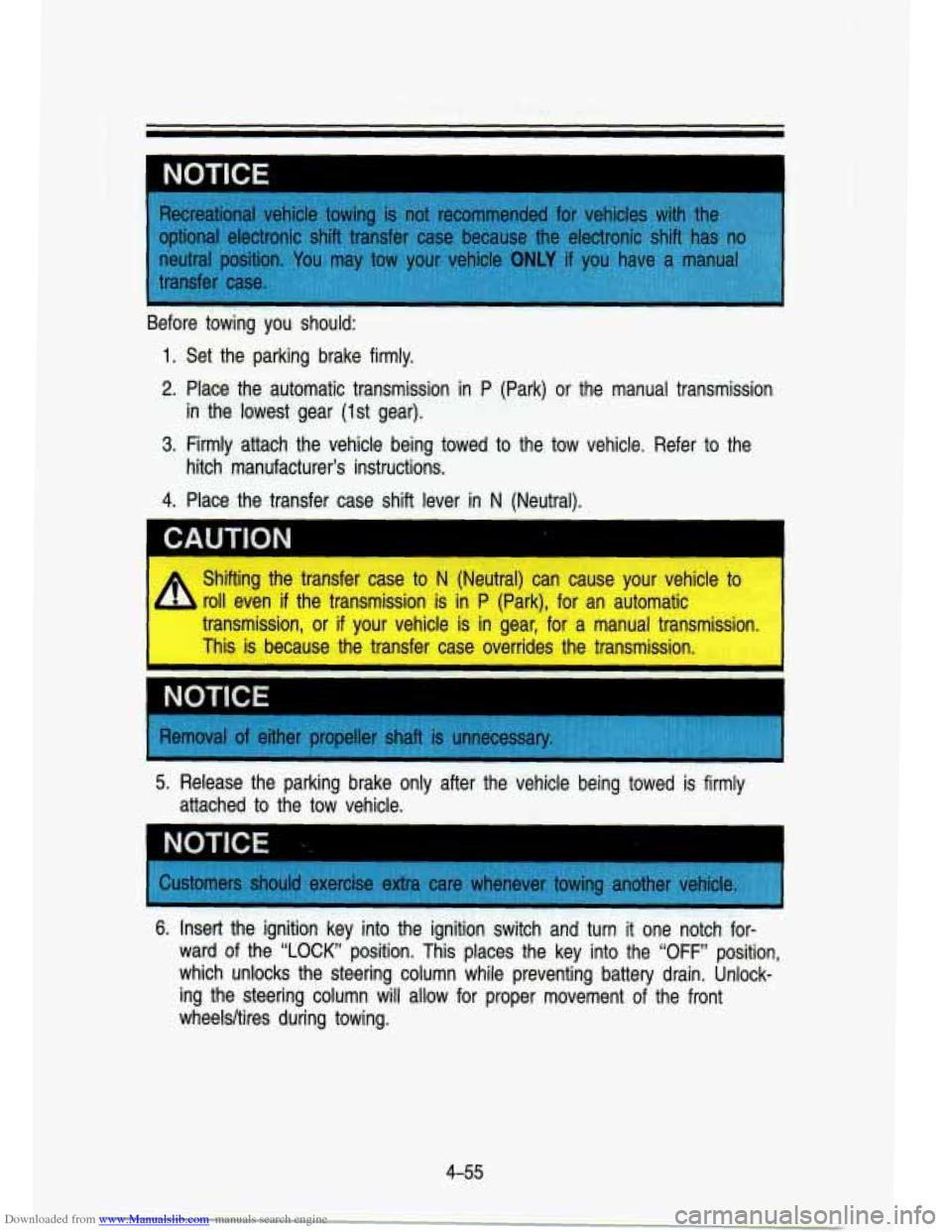
Downloaded from www.Manualslib.com manuals search engine Before towing you should:
1. Set the parking brake firmly.
2. Place the auto’matic transmission in P (Park) or the manual transmission
in th:e lowest gear
(1 st gear).
3. Firmly attach the vehicle being towed to the tow vehicle. Refer to the
hitch manufacturer’s instructions.
Shifting the transfer case to N (Neutral) can cause your veh\
icle
to
roll even if the transmission is in P (Park), for an automatic
transmission, or
if your vehicle is in gear, for a manual transmission.
This is because the transfer case overrides the transmission.
I
1 NOTICE
6. Insert the ignition key into the iginition switch and turn it one notch .for-
ward of the “LOCK’ position. This places the key into the “OFF” position,
which unlocks the steering column while preventing battery drain\
. Unlock-
ing the steering column will allow for proper movement of the front
wheelshires during towing.
4-55
Page 214 of 356

Downloaded from www.Manualslib.com manuals search engine Your Driving and the Road
Following Distance
Stay at least twice as far behind the vehicle ahead as you w\
ould when
driving your vehicle without a trailer. This can help you avoi\
d situations that require heavy braking and sudden turns.
Passing
You’ll need more passing distance up ahead when you’re to\
wing a trailer.
And, because you’re a good deal longer, you’ll need
to go much farther
beyond the passed vehicle before you can return
to your lane.
Backing Up
Hold the bottom of the steering wheel with one hand. Then, to move the
trailer left, just move your hand to the left. To move the trailer to the right,
move your hand
to the right. Always back up slowly and, if possible, have
someone guide you.
Making Turns
When you’re turning with a trailer, make wider turns than n\
ormal. Do this so
your trailer wheels won’t strike soft shoulders, curbs, road \
signs, trees, or
other objects. Avoid jerky or sudden maneuvers. Signal well in advance.
Turn Signals When Towing a Trailer
When you tow a trailer, your vehicle has to have a different turn signal
flasher and extra wiring. The green arrows on your instrument \
panel will flash
whenever you signal a turn or lane change. Properly hooked up,\
the trailer lights will also flash, telling other drivers you’re about
to turn, change lanes,
or stop.
When towing a trailer, the green arrows on your instrument pan\
el will flash for
turns even
if the bulbs on the trailer are burned out. Thus, you may think \
drivers behind you are seeing your signal when they are not.
It’s important to
check occasionally to be sure the trailer bulbs are still work\
ing.
Driving on Grades
Reduce speed and shift to a lower gear before you start down a long or
steep downgrade.
If you don’t shift down, you might have to use your brakes
so much that they would get hot and no longer work well.
On a long uphill grade, shift down and reduce your speed to \
around
45 mph
(70 km/h) to reduce the possibility of engine and transmission ove\
rheating.
If you have an automatic transmission, you should use D when towing a
trailer. Operating your vehicle in
D when towing a trailer will minimize heat
buildup and extend the life of your transmission. Or, if you have a manual
transmission with fifth gear, it’s better not to use fifth \
gear, just drive in fourth
gear (or, as you need
to, a lower gear).
4-60
Page 215 of 356

Downloaded from www.Manualslib.com manuals search engine Parking on Hills
You really should not park your vehicle, with a trailer attached, \
on a hill. If
something goes wrong, your rig could start to move. People can be injured,
and both your vehicle and the trailer can be damaged.
But
if you ever have to park your rig on a hill, here’s how to \
do it:
1. Apply your regular brakes, but don’t shift into P (Park) yet, or into gear
2. Have someone place chocks under the trailer wheels.
3. When the wheel chocks are in place, release the regular brakes until the
chocks absorb the load.
4. Reapply the regular brakes. Then apply your parking brake, and \
then
shift to
P (Park), or R (Reverse) for a manual transmission.
5. If you have a four-wheel-drive vehicle with a manual transfer case\
shift
lever, be sure the transfer case is in a drive gear-not in
N (Neutral).
6. Release the regular brakes.
for a manual transmission.
A
It can be dangerous to get out of your vehicle if the shift lever is not
fully in
P (Park) with the parking brake firmly set. Your vehicle can
roll.
If you have left the engine running, the vehicle can move suddenl\
y.
You
or others could be injured. To be sure your vehicle won’t move,
even when you’re on fairly level ground, use the steps that\
follow.
If you have four-wheel drive with a manual transfer case shift le\
ver
and your transfer case is in
N (Neutral), your vehicle will be free to
roll, even if your shift lever is in
P (Park). So be sure the transfer
case is in a drive gear-not in
N (Neutral). If you are parking on a
hill, or if you’re pulling a trailer, see also “Parking On Hills” in the
Index.
When You Are Ready to Leave After Parking on a Hill
1. Apply your regular brakes and hold the pedal down while you:
Start your engine.
Shift into a gear; and
Release the parking brake.
4-61
Page 216 of 356
Downloaded from www.Manualslib.com manuals search engine Your Driving and the Road
2. Let up on the brake pedal.
3. Drive slowly until the trailer is clear of the chocks.
4. Stop and have someone pick up and store the chocks.
Maintenance When Trailer Towing
Your vehicle will need service more often when you’re pulling a \
trailer. See
the Maintenance Schedule for more on this. Things that are esp\
ecially important in trailer operation are automatic transmission fluid (don’t ove\
rfill),
engine oil, axle lubricant, belt, cooling system, and brake adj\
ustment. Each of
these is covered in this manual, and the Index will help you find them
quickly.
If you’re trailering, it’s a good idea to review these sections before
you start your trip.
Check periodically to see that all hitch nuts and bolts are tight.
Trailer Light Wiring
See “Trailer Wiring Harness” in the Index.
Power Winches
If you wish to use a power winch on your vehicle, only use it when your
vehicle is stationary or anchored.
NOTICE
Use the regular brakes, set the parking brake Or UIWK ihe wheels IW keep
your vehicle from rolling.
4-62