service CHEVROLET S10 1993 2.G Workshop Manual
[x] Cancel search | Manufacturer: CHEVROLET, Model Year: 1993, Model line: S10, Model: CHEVROLET S10 1993 2.GPages: 356, PDF Size: 20.85 MB
Page 285 of 356
Downloaded from www.Manualslib.com manuals search engine Refer to the Maintenance Schedule to determine how often to lubricate them
and what type
of lubricant to use.
Exhaust System
To help prevent damage to your exhaust system, do not continue to drive
your vehicle if you notice:
Engine misfiring
* Loss of performance
Other unusual operating conditions
Have your engine and exhaust system serviced regularly.
Three- Way Catalytic Converter
Your vehicle’s three-way catalytic converter is designed to reduce \
the
pollutants in your vehicle’s exhaust. Use only unleaded fuel \
in your vehicle.
If
you use leaded fuel, you could damage your three-way catalytic \
converter, and other engine components.
The Malfunction Indicator (SERVICE ENGINE SOON) lamp on your instrument panel lets you know when your emission system needs \
service.
The light will come on briefly when you start your engine to let you know
that the system is working.
If it does not come on when you start your
engine, or
if it comes on and stays on while you’re driving, your system \
may
need service. Your vehicle should still be driveable, but you should have your
system serviced right away.
6-37
Page 286 of 356
Downloaded from www.Manualslib.com manuals search engine Service & Appearance Care
Loading Your Vehicle
K3651
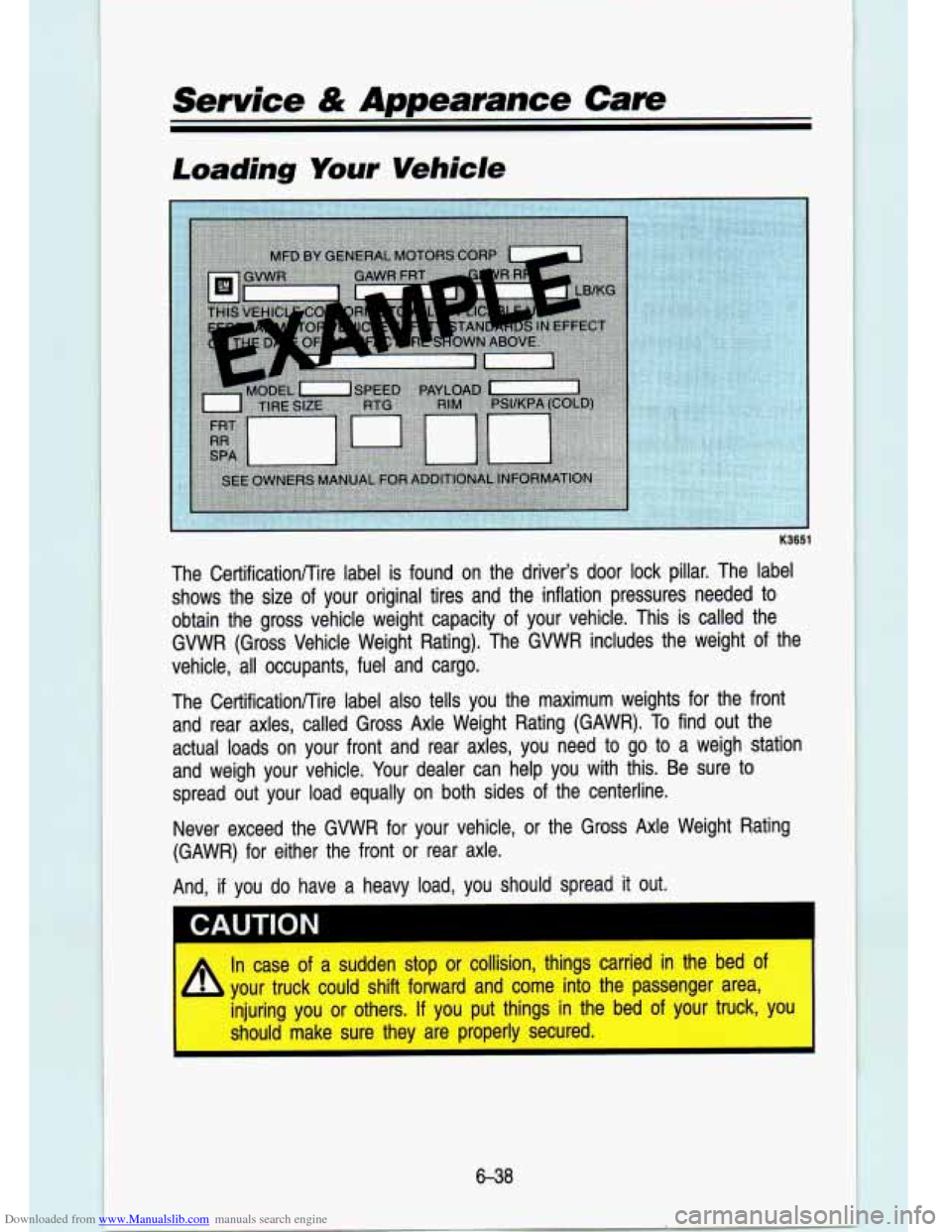
The CertificationRire label is found on the drive~r's door lock pillar. The label
shows t'he size of your original t'ires and the inflation pressu8res ne-eded to
obtain the gross vehicle weight capac-ity of your vehicle. This
is called the
GVWR (Gross Vehicle Weight Rating). The- GVWR includes the weight of the
vehlicle, all occupants, fuel and cargo.
The Certifi'cationKtre label also tells you the maximum weights for the front
and rear axles, called Gross
Axle Weight Rating (GAWR). To find out the
actual
loads on your front and rear axles, you need to go to a weigh station
and weigh your vehicle. Your dealer can help you with this. Be sure to
spread out your load equally
on both sides of the centerline.
Never exceed the GVWR for your vehicle, or the Gross Axle Wei\
ght Rating
(GAWR) for either the front or rear axle.
And,
if you do have a heavy load, you should spread it out.
I CAUTION
In case of a sudden stop or collision, things carried in the bed\
of
I [I! your truck could shift forward and come into the passenger are\
a
injuring you or others.
If you put things in the bed of your truck,
should make sure they are properly secured.
1
6-38
Page 288 of 356
Downloaded from www.Manualslib.com manuals search engine .-
.. .. -. .- -. -. .
Service & Appearance Care
Trailering Package
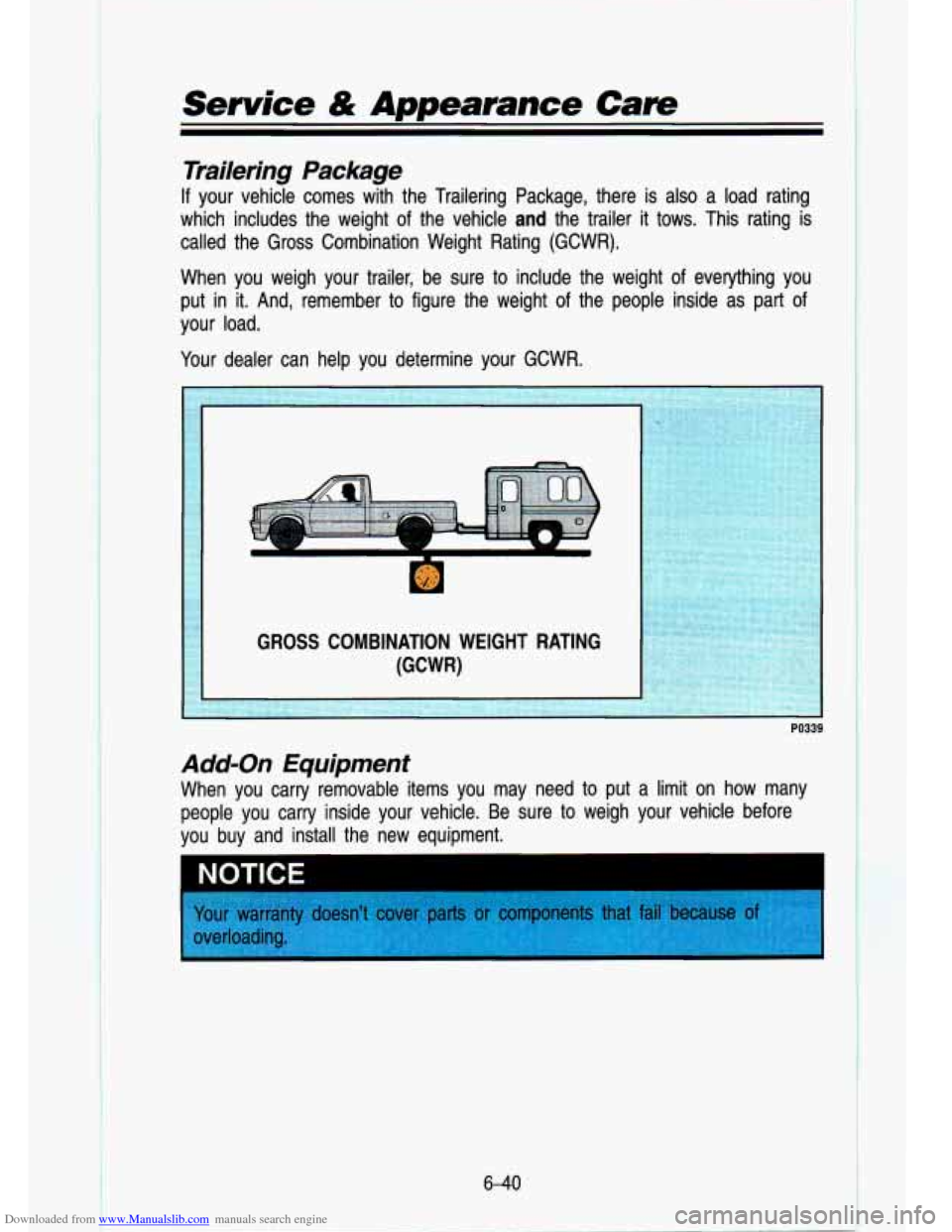
If your vehicle comes with the Trailering Package, there is also a load rating
which includes the weight of the vehicle
and the trailer it tows. This rating is
called the Gross Combination Weight Rating (GCWR).
When you weigh your trailer, be sure to include the weight of everything you
put in it. And, remember to figure the weight
of the people inside as part of
your load.
Your dealer can help you ?-‘ermine your GCWR.
Page 290 of 356
Downloaded from www.Manualslib.com manuals search engine I
Service & Appearance Care
TRUCK LOADING INFORMATION EXAMPLE OF PROPER TRUICK
AND CAMPER MATCH
1. Recommended location for cargo 7. Camper center of gravity.
center
of gravity for cargo weight 2. Recommended center of gravity
rating (Pickup Truck).
K-L.<:- location zone.
Note: Use rear edge of load floor : .‘$Ti: * .Refer to Truck Camper Loading
for measurement purposes.
- - Information label in glove box for
“A” and “B” dimensions.
.Y %!, -
PO254
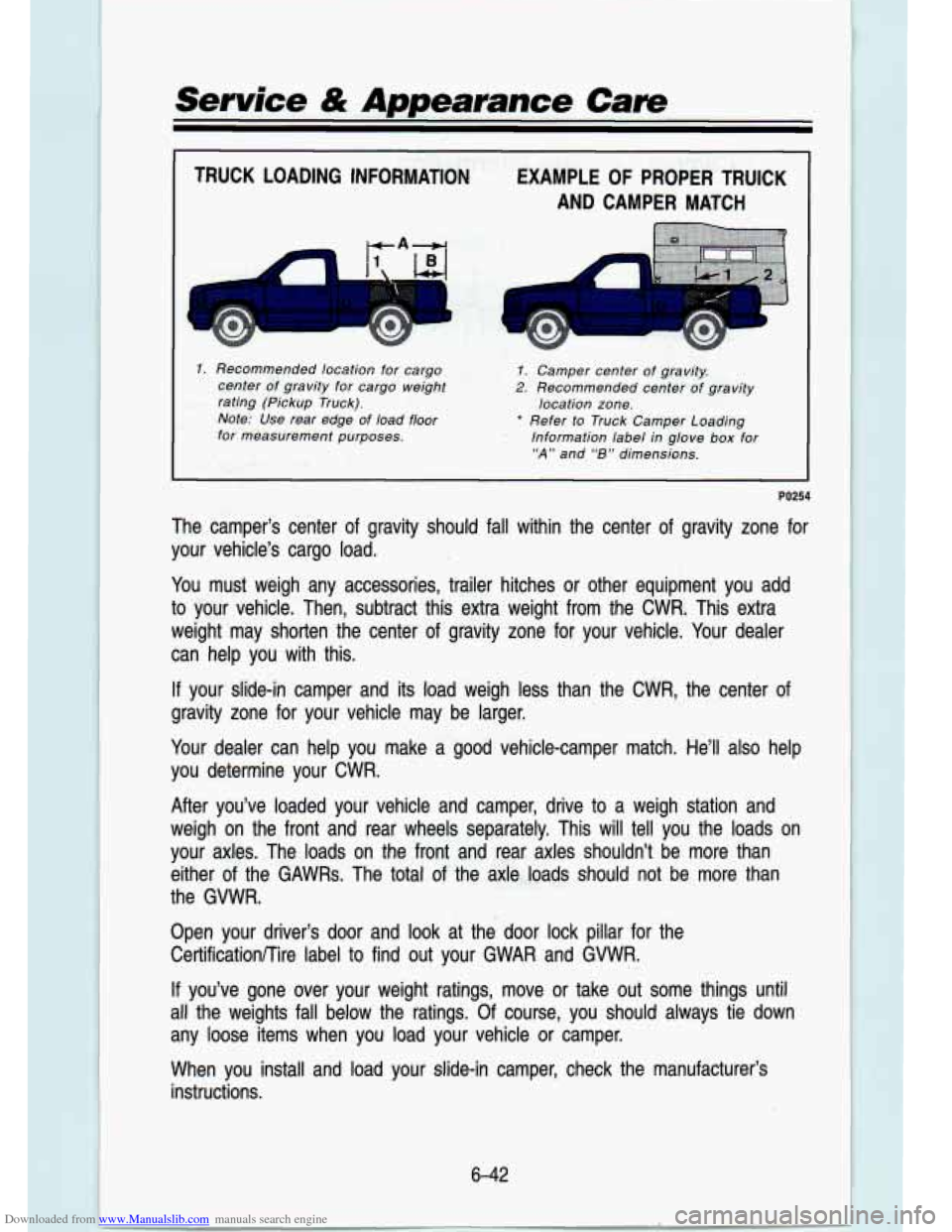
The camper’s center of gravity should fall within the center of gravity zone for
your vehicle’s cargo load.
You must weigh any accessories, trailer hitches or other equipment you add
to your vehicle. Then, subtract this extra weight from the CWR,
This extra
weight may shotten the center of gravity zone for your vehicle. Your dealer
can help you with this.
If your slide-in camper and its load weigh less than the CWR, the center of
gravity zone for your vehicle may be larger.
Your dealer can help you make
a good vehicle-camper match. He’ll also help
you determine your CWR.
After you’ve loaded your vehicle and camper, drive to a weigh station and
weigh on the front and rear wheels separately. This will tell you the loads on
your
axles. The loads on the front and rear axles shouldn’t be more th\
an
either
of the GAWRs. The total of the axie..loads should not be more than
the GVWR.
Open your driver’s door and look at the door lock pillar f\
or the CertificationKire label to find out your GWAR and GWVR.
If you’ve gone over your weight ratings, move or take out some\
things until
all the weights fall below the ratings. Of course, you should always tie down
any loose items when you load your vehicle or camper.
When you install and load your slide-in camper, check the manufacturer’s
instructions.
6-42
Page 292 of 356

Downloaded from www.Manualslib.com manuals search engine Service & Appearance Care
Inflation-Tire Pressure
The Certification/Tire label, which is on the driver’s door \
lock pillar, shows the
correct inflation pressures for your tires, when they’re cold\
. “Cold’’ means your
vehicle has been sitting for at least three hours or driven n\
o more than a mile.
I NOTICE I
When to Check: Check your tires once a month or more. Don’t forget \
your
compact spare tire (if
so equipped). It should be at 60 psi (420 kPa).
How to Check: Use a good quality pocket-type gage to check tire pressure.
Simply looking at the tires will not tell you the pressure, e\
specially
if you
have radial tires-which may
l’ook properly inflated even if they’re
underinflated.
If your tires have valve caps, be sure
to put them back on. They help
prevent leaks by keeping out dirt and moisture.
Ere lnspection and Rotation
To make your tires last longer, have them inspected and rotated a\
t the
mileages recommended in the Maintenance Schedule. See Scheduled
Maintenance Services in the Index.
6-44
Page 294 of 356
Downloaded from www.Manualslib.com manuals search engine Service & Appearance Care
When It’s Time for New Tires
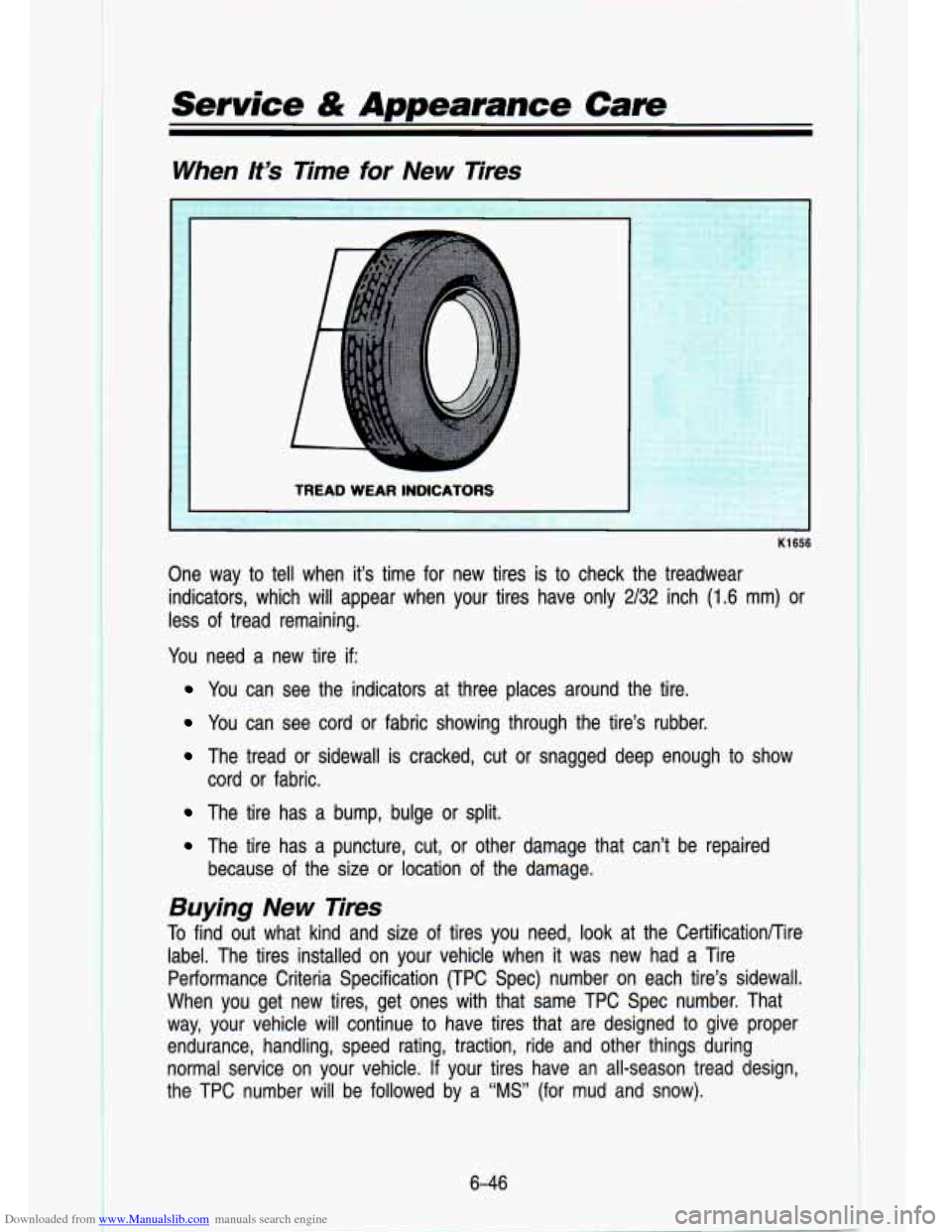
K1656
One way to tell when it’s time for new tires is to check the treadwear
indicators, which will appear when your tires have only
2/32 inch (1.6 mm) or
less of tread remaining.
You need a new tire
if:
You can see the indicators at three places around the tire.
You can see cord or fabric showing through the tire’s rubber.
The tread or sidewall is cracked, cut or snagged deep enough to show
cord or fabric.
The tire has a bump, bulge or split.
The tire has a puncture, cut, or other damage that can’t b\
e repaired
because of the size
or location of the damage.
Buying New Eres
To find out what kind and size of tires you need, look at the CertificationRire
label. The tires installed on your vehicle when it was mew had a Tire
Performance Criteria Specification (TPC Spec) number on each t\
ire’s sidewall.
When you get new tires, get ones with that same TPC Spec num\
ber. That
way, your vehicle will continue to have tires that are designed to give proper
endurance, handling, speed rating, traction, ride and other thin\
gs during
normal service on your vehicle.
If your tires have an all-season tread design,
the TPC number
will be followed by a “MS” (for mud and snow).
6-46
Page 295 of 356
Downloaded from www.Manualslib.com manuals search engine If you ever replace your tires with those not having a TPC Spec number,
make sure they are the same size, load range, speed rating an\
d construction
type (bias, bias-belted or radial) as your original tires.
Mixing tires
could cause you to lose control while driving. If you mix
tires of different types (like radial and bias-belted tires) the vehicl\
e
may nlot handle properly, an'd you could have a cras'h. Be sure to
use the same size 'and type tires on all four wheels.
It's all right to drive with your compact spare (if you have one). It
I was developed for use on your vehicle.
Uniform Tire Quality Grading
The following information relates to the system developed by th\
e United
States National Highway Traffic Safety Administration which grade\
s tires by
treadwear, traction and temperature performance. (This applies o\
nly to
vehicles
sold in the United States.)
Treadwear
The treadwear grade is a comparative rating based on the wear rate of the
tire when tested under controlled conditions on a specified government test
course. For example, a tire graded
150 would wear one and a half (1 -1/2)
times as well on the government course as a tire graded 100. The relative
performance of tires depends upon the actual conditions of their use,
however, and may depart significantly from the norm due to var\
iations in
driving habits, service practices and differences in road charac\
teristics and
climate.
Traction-A, B, C
The traction grades, from highest to lowest are: A, B, and C. They represent
the tire's ability to stop on wet pavement as measured under controlled
conditions on specified government test surfaces of asphalt and concrete.
A
tire marked C may have poor traction performance.
Warning: The traction grade assigned to this tire is based on braking
(straight-ahead) traction tests and does not include cornering \
(turning) traction.
Temperature-A, B, C
The temperature grades are A (the highest), B, and C, representing the tire's
resistance
to the generation of heat and its ability to dissipate heat when
tested under controlled conditions on a specified indoor laboratory test wheel,
Sustained high temperature can cause the material of the tire
to degenerate
and reduce tire life, and excessive temperature can lead to sudden tire
6-47
Page 296 of 356
Downloaded from www.Manualslib.com manuals search engine Service & Appearance Care
failure. The grade C corresponds to a level of performance which all
passenger car tires must meet under the Federal Motor Vehicle \
Safety
Standard
No. 109. Grades B and A represent higher levels of performance on
the laboratory test wheel than the minimum required by law.
Warning: The temperature grade for this tire is established for\
a tire that is
properly inflated and not overloaded. Excessive speed, underinfla\
tion, or
excessive loading, either separately or in combination, can cause heat buildup
and possible tire failure.
These grades are molded on the sidewalls of passenger car tire\
s.
While the tires available as standard or optional equipment on \
General Motors
vehicles may vary with respect
to these grades, all such tires meet General
Motors performance standards and have been approved for use on \
General
Motors vehicles.
All passenger type (P Metric) tires must conform to Federal
safety requirements in addition
to these grades.
Wheel Alignment and Tire Balance
The wheels on your vehicle were aligned and balanced carefully \
ar IT.-
factory to give you the longest tire life and best overall performance.
In most cases, you will not need
to have your wheels aligned again.
However,
if you notice unusual tire wear or your vehicle pulling one way \
or
the other, the alignment may need
to be reset. If you notice your vehicle
vibrating when driving on a smooth road, your wheels may need
to be
rebalanced.
Wheel Replacement
Replace any wheel that is bent, cracked or badly rusted. If wheel nuts keep
coming loose, the wheel, wheel bolts, and wheel nuts should be\
replaced. If
the wheel leaks air out, replace it (except some aluminum wheels, which can
sometimes be repaired). See your GM dealer
if any of these conditions exist.
Your dealer will know the kind of wheel you need.
Each new wheel should have the same load carrying capacity, di\
ameter,
width, offset, and be mounted the same way as the one
it replaces.
If you need to replace any of your wheels, wheel bolts, or wheel nuts,
replace them only with
new GM original equipment parts. This way, you will
be sure you have the right wheel, wheel bolts, and wheel nuts\
for your
vehicle.
6-48
I
Page 298 of 356

Downloaded from www.Manualslib.com manuals search engine Service & Appearance Care
Appearance Care
-
KO640
CAI lTlnN
I.
Cleaning products can be dangerous. Some are toxic. Others can \
burst into flame
if you strike a match or get them on a hot part of
the vehicle. Some are dangerous if you breathe their fumes in a
closed space. When you use anything in a container to clean your
vehicle, be sure to follow the instructions. And always open your
doors or windows when you’re cleaning the inside.
Never use these to clean your vehicle:
Gasoline Benzene
Naphtha
Carbon Tetrachloride
Acetone Paint Thinner
Turpentine Lacquer Thinner
Nail Polish Remover
They can all be hazardous-some more than others-and they can
all damage your vehicle, too.
6-50
Page 300 of 356
Downloaded from www.Manualslib.com manuals search engine Service & Appearance
Rinse the section with a clean, wet sponge.
Wipe off what’s left with a slightly damp paper towel or c\
loth.
Then dry it immediately with an air hose, a hair dryer or a heat lamp.
Wipe wlrh a clean cloth.
Using Solvent-Type Cleaner on Fabric
First, see if you have to use solvent-type cleaner at all. Some spots and
stains will clean off better with just water and mild soap.
If you need to use it, then:
Gently scrape excess soil from the trim material with a clean,\
dull knife
or scraper. Use very little cleaner, light pressure and clean cloths
(preferably cheesecloth). Cleaning should start at the outside \
of the stain,
“feathering” toward the center. Keep changing to a clean section of the
cloth.
When you clean a stain from fabric, immediately dry the area \
with an air hose, hair dryer, or heat lamp to help prevent a cleaning ring. (See
.
previous NOTICE.)
Special Cleaning Problems
Greasy or Oily Stains: Like grease, oil, butter, margarine, shoe polish, coffee
with cream, chewing gum, cosmetic creams, vegetable oils, wax c\
rayon, tar and asphalt.
Carefully scrape off excess stain.
Then follow the solvent-type instructions above.
Shoe polish, wax crayons, tar and asphalt will stain if left on a vehicle
seat fabric. They should be removed as soon as possible. Be c\
areful, because the cleaner will dissolve them and may cause them
to bleed.
Non-Greasy Stains: Like catsup, coffee (black), egg, fruit, fr\
uit juice, milk,
soft drinks, wine, vomit, urine and blood.
Carefully scrape off excess stain, then sponge the place with cool water.
If a stain remains, follow the foam-type instructions above.
6-52
i