wheel CHEVROLET S10 1993 2.G Repair Manual
[x] Cancel search | Manufacturer: CHEVROLET, Model Year: 1993, Model line: S10, Model: CHEVROLET S10 1993 2.GPages: 356, PDF Size: 20.85 MB
Page 239 of 356

Downloaded from www.Manualslib.com manuals search engine PO345
Position the jack under the vehicle.
Your vehicle has a hole in the frame near each front wheel, and a\
hole in
the spring hanger near each rear wheel for the jack. Fit the \
jack into the
hole nearest the flat tire.
I CAUTION
If the 1 Getting under a vehicle when it is jacked up is dangerous.
vehicle slips
off the jack, you could be badly injured or killed. Never
get under a vehicle when it is supported only
by a jack.
5-23
Page 240 of 356
Downloaded from www.Manualslib.com manuals search engine Problems on the Road
KO751
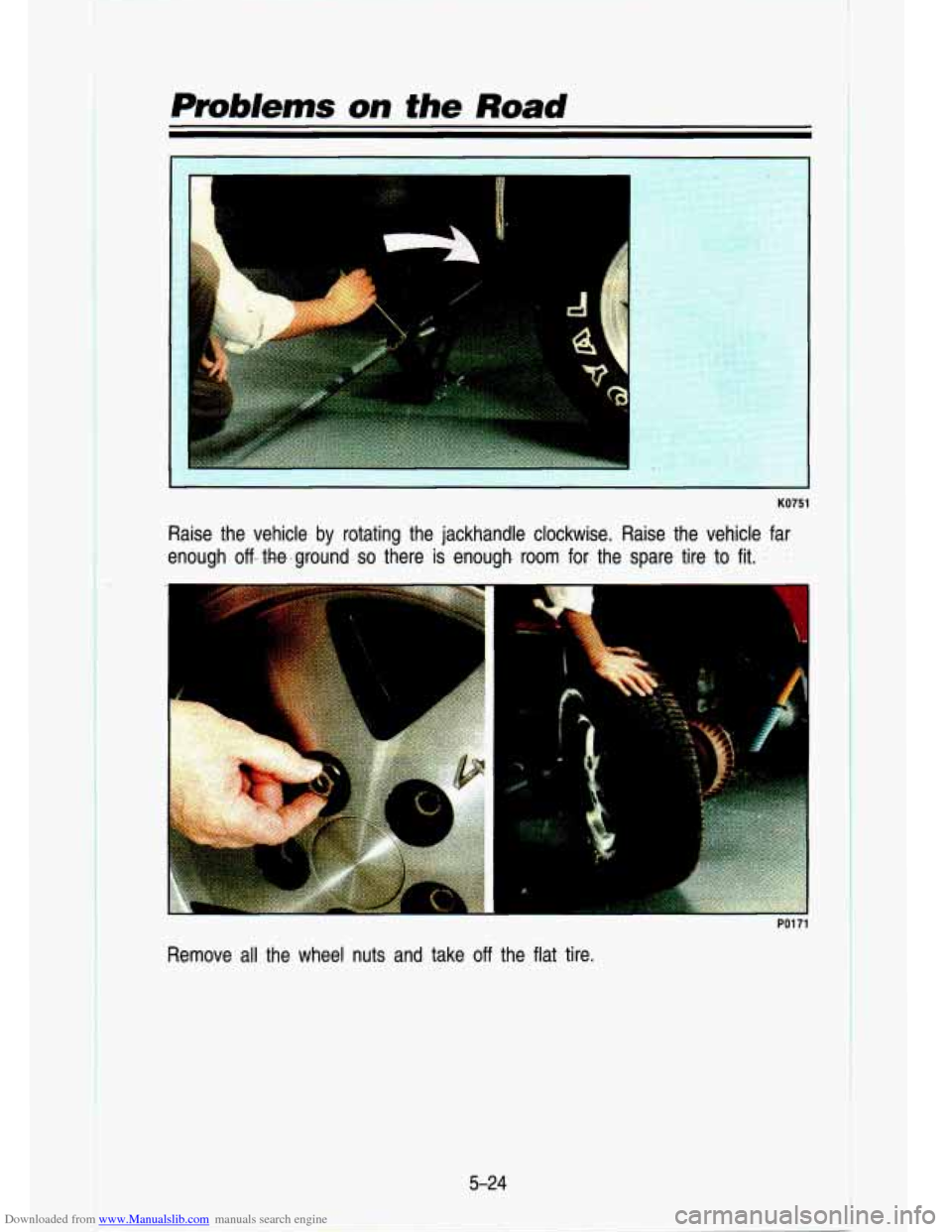
Raise the vehicle by rotating the jackhandle clockwise. Raise the vehicle far
enough off--hke.-ground
so there is enough. room for the spare tire to fit.
d
PO1 71
Remove all the wheel nuts and take off the flat tire.
5-24
Page 241 of 356
Downloaded from www.Manualslib.com manuals search engine I
CAUT'oN
I A Rust or dirt on the wheel, or on the parts to which it is fastened,
4 can make the wheel nub become loose after a time. The wheel
could come off and cause an accident. When you change a wheel,
remove any rust or dirt from the places where the wheel attaches to
the vehicle.
In an emergency, you can use a doth or a paper towel
to
do this; but be sure to use a scraper or wire brush later, if you
need to, to get all the rust or dirt off.
KO754
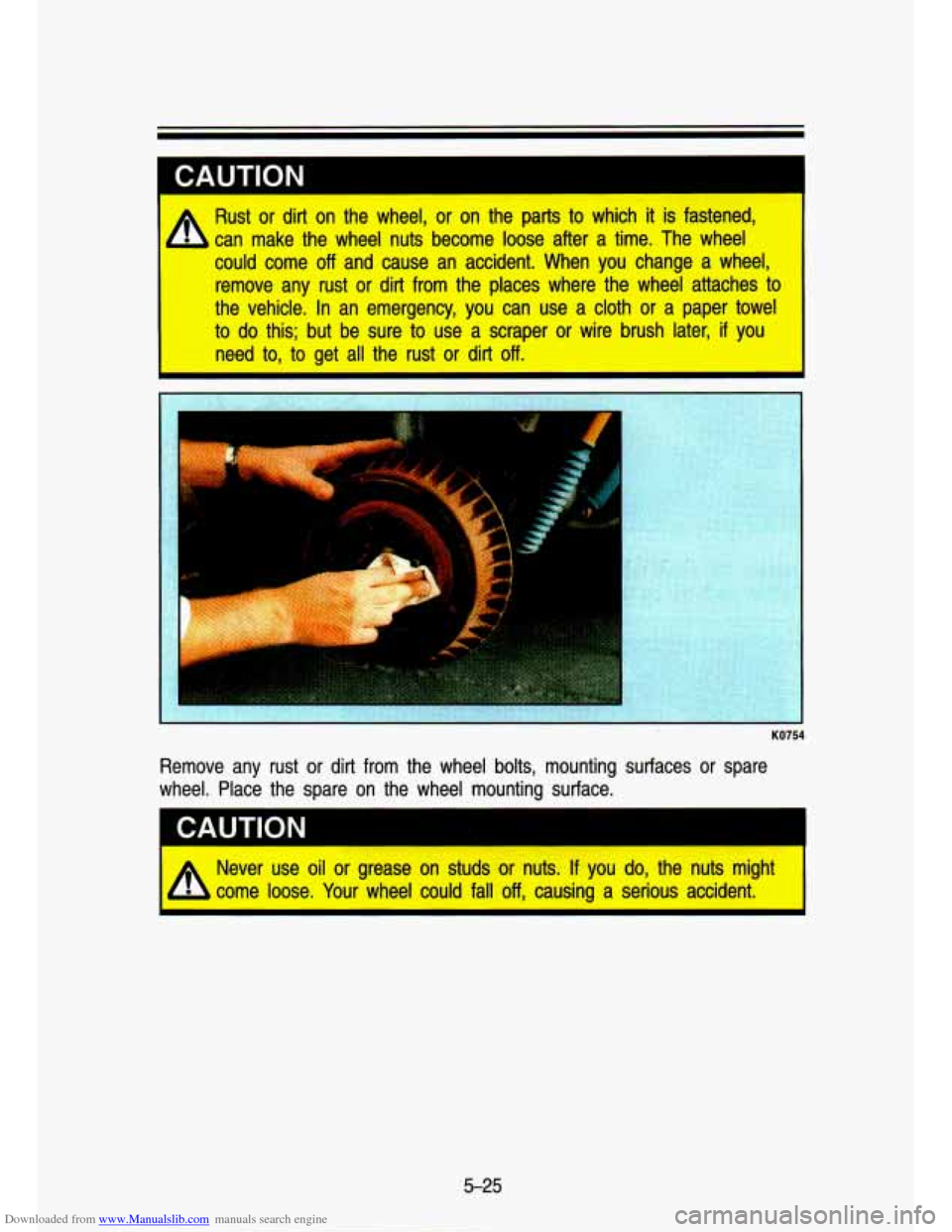
Remove any rust or dirt from the wheel bolts, mounting surface\
s or spare
wheel. Place the spare on the wheel mounting surface.
I Never use oil or grease on studs or nuts. If you do, the nuts might
L come loose. Your wheel could fall off, causing a serious accident.
Page 242 of 356
Downloaded from www.Manualslib.com manuals search engine Problems on the Road
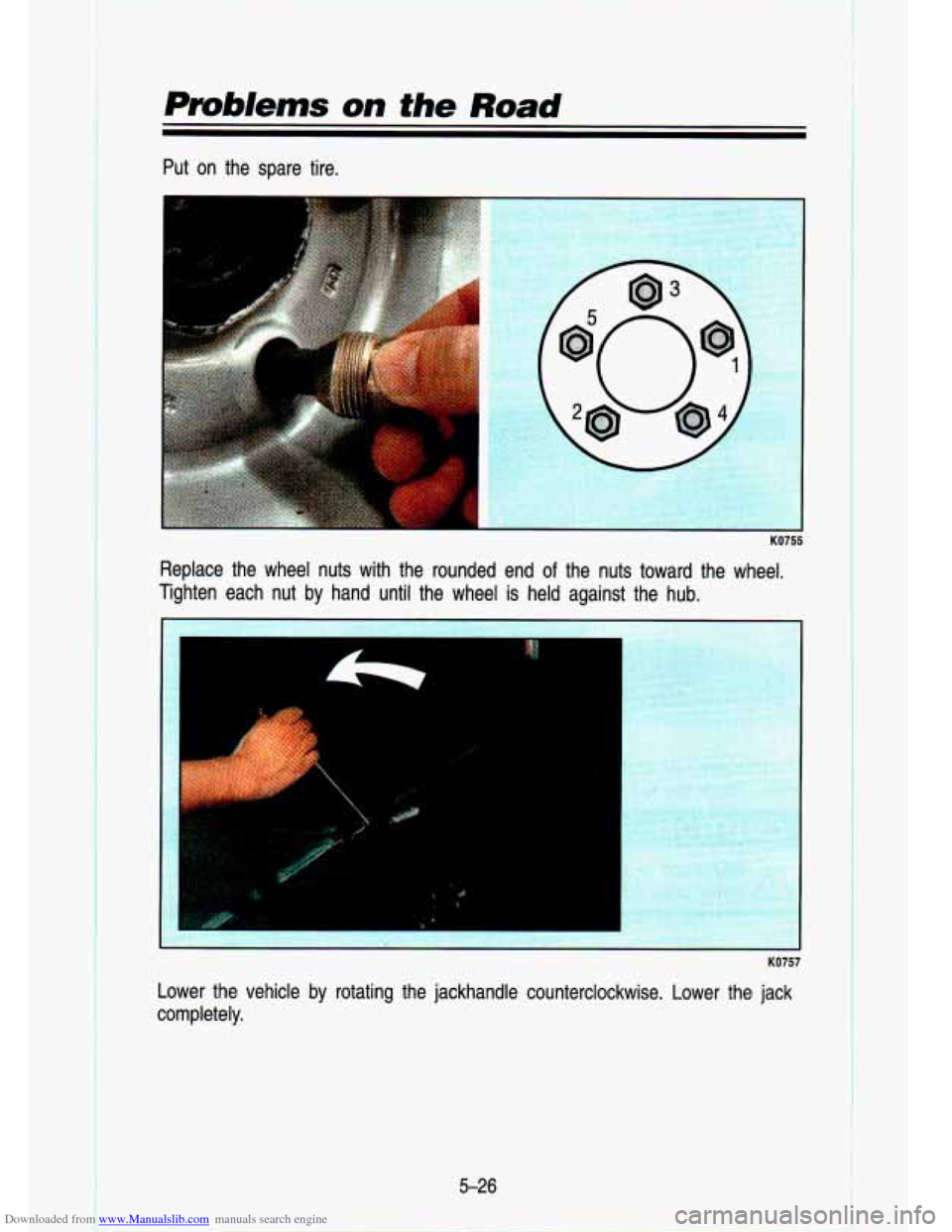
Put on the spare tire.
KO755
Replace the wheel nuts with the rounded end of the nuts toward the wheel.
Tighten each nut by hand until the wheel is held against the \
hub.
. ,~ , ._ i . , 9,; ;. - , .
KO757
Lower the vehicle by rotating the jackhandle counterclockwise. L\
ower the jack
completely.
Page 243 of 356
Downloaded from www.Manualslib.com manuals search engine 1
I
KO758
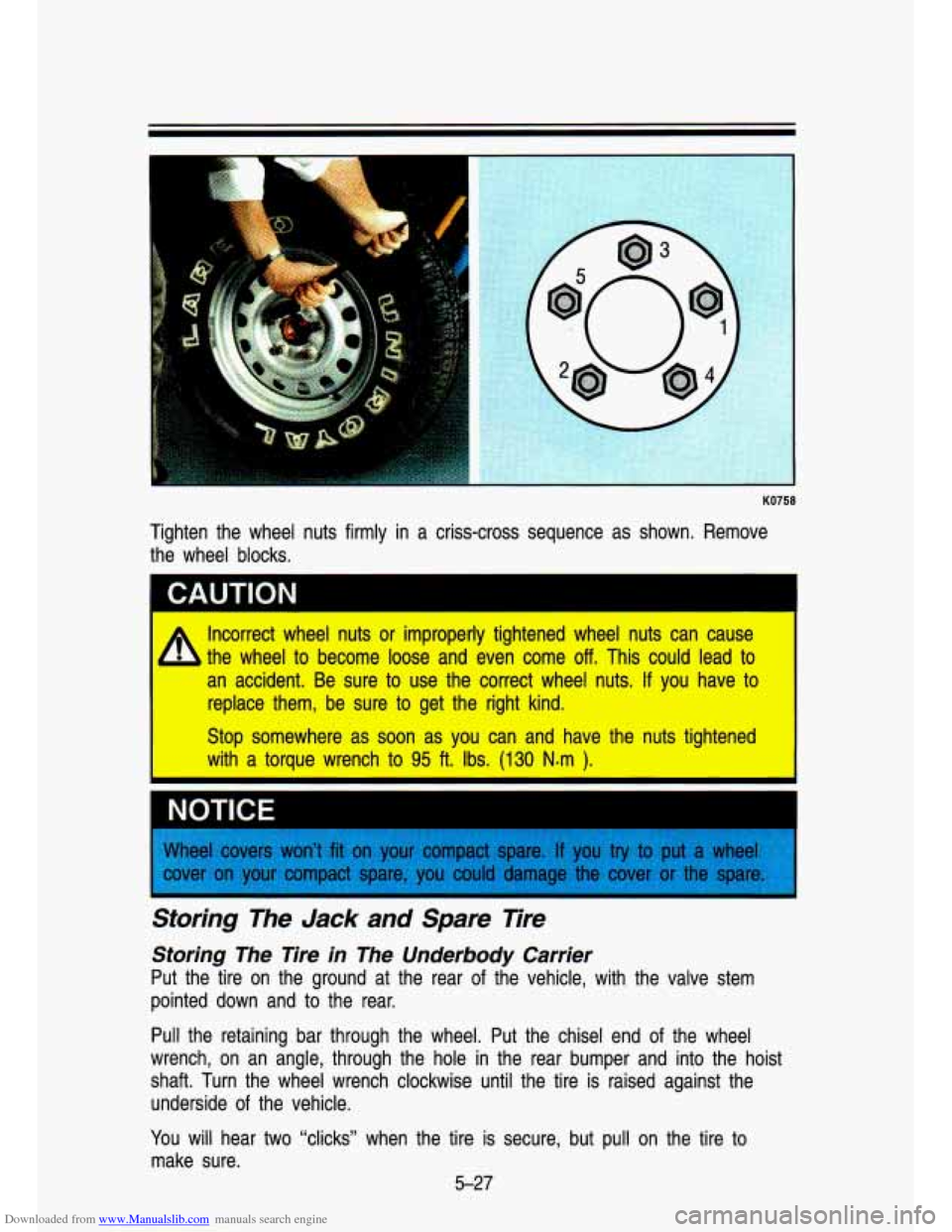
Tighten the wheel nuts firmly in a criss-cross sequence as shown. Remove
the wheel blocks.
A
Incorrect wheel nuts or improperly tightened wheel nuts can cause
the wheel to become loose and even come
off. This could lead to
an accident. Be sure to use the correct wheel nuts. If you have to
replace them, be sure
to get the right kind.
Stop somewhere as soon as you can and have the nuts tightened
with
a torque wrench to 95 ft. Ibs. (1 30 N.m ).
Storing The Tire in The Underbody Carrier
Put the tire on the ground at the rear of the vehicle, with the valve stem
pointed down and to the rear.
Pull the retaining bar through the wheel. Put the chisel end
of the wheel
wrench, on an angle, through the hole in the rear bumper and into the hoist
shaft. Turn the wheel wrench clockwise until the tire is raised against the
underside of the vehicle.
You will hear two “clicks” when the tire is secure,
but pull on the tire to
make sure.
5-27
Page 244 of 356

Downloaded from www.Manualslib.com manuals search engine Problenrs on the Road
KO546
Return the jack, wheel wrench and wheel blocks to the proper \
location behind
the seat. Secure the items and replace the jack cover.
Storing a jack, a tire, or other equipment in the passenger
compartment of the vehicle could cause injury. In a sudden stop or
collision, loose equipment could strike someone. Store all these\
in
I the proper place.
Compact Spare (If So Equipped)
Although your compact spare was fully inflated when the vehicle\
was new,
it can lose air over time. Check its inflation pressure regularly.\
It should be
60 psi (420 kPa). The compact spare is made to go up to 3,000 miles
(5000 km), so you can finish your trip and get a new tire where you want.
Of course, it's best to replace your spare with
a full-size tire as soon as you
can. Your spare will last longer and be in good shape in case you ever need
it again.
5-28
Page 245 of 356

Downloaded from www.Manualslib.com manuals search engine I NOTICE
Don’t use your compact spare on some other vehicle. And don\
’t mix your
compact spare or wheel with other wheels or tires. They won’\
t fit. Keep your
spare and its wheel together.
I CAUTION
Storing a jack, a tire, or other equipment in the passenger
compartment
of the vehicle could cause injury. In a sudden stop or
I collision, loose equipment could strike someone. Store all these\
in
the proper place. A
~~ ~
NOTICE
5-29
Page 246 of 356
Downloaded from www.Manualslib.com manuals search engine Pm6/ems on the Road
If You’re Stuck: In Sand, Mud, Ice or
snow
What you don’t want to do when your vehicle is stuck is to spin your
wheels. The method known as “rocking” can help you get o\
ut when you’re
stuck, but you must use caution.
~
fi If you let your tires spin at high speed, they can explode and you1 or
others could be injured. And, the transmiss’ion or other parts of the
vehicle
can overheat. That could cause an engine comparlme’nt fire
or other damage. When you’re
stuck, spin the wheels as little as
possible.
Don’t spin the wheels above 35 rnph 1(55 krn/h) as shown
oln the speedometer.
Rocking Your Vehicle To Get It Out:
First, turn your steering wheel left and right. That will clear the area \
around
your front wheels. Then shift back and forth between
R (Reverse) and a
forward gear (or with a manual transmission, between
1 (First) or 2 (Second)
gear and
R (Reverse), spinning the wheels as little as possible. Release \
the
accelerator pedal while you shift, and press lightly on the accelerator pedal
when the transmission is in gear.
If that doesn’t get you out after a few tries,
you may need to be towed
out. Or, you can use your recovery hooks, if your
vehicle has them.
If you do need to be towed out, see “Towing Your Vehicle’’
in the Index.
5-30
Page 261 of 356
Downloaded from www.Manualslib.com manuals search engine Energy Conserving II
Oils with these words on the container will help you save fuel.
This doughnut-shaped logo (symbol) is used
on most oil containers to help
you select the correct oil.
You should look for this on the oil container, and use
only those oils that
display the logo.
GM Goodwrench@ oil (in Canada, GM Engine Oil) meets all the requirements
for your vehicle.
Engine Oil Additives:
Don’t add anything to your oil. Your GM dealer is ready to advise if you think
something should be added.
When to Change Engine c)k
See if any one of these is true for you:
Most trips are less than 4 miles (6 km).
It’s below freezing outside and most trips are less than 10 miles
(16 km).
The engine is at low speed most of the time (as in door-to-door delivery,
You tow a trailer often.
or in stop-and-go traffic).
Most trips are through dusty places.
The vehicle is frequently operated off-road.
If any one of these is true for your vehicle, you need to chang\
e your oil and
filter every 3,000 miles (5000 km) or 3 months-whichever comes first.
If none of them are true, change the oil every 7,500 miles (12 500 km) or
12 months-whichever comes first. Change the filter at the first oil change
and at every other oil change after that.
If your vehicle has 4-wheel drive, you ,will have a remote oil filter located
under the hood.
It is mounted to the front left inner fender, behind the
headlights.
Engine Block Heater:
An engine block heater can be a big help if you have to park outside in very
cold weather,
-0°F (-18°C) or colder. If your vehicle has this option, see
“Engine Block Heater” in the Index.
6-1 3
Page 269 of 356
Downloaded from www.Manualslib.com manuals search engine Rear Axle
When to Check and Change Lubricant:
Refer to the Maintenance Schedule to determine how often to check the
lubricant and when to change it. See “Scheduled Maintenance Services” in
the Index.
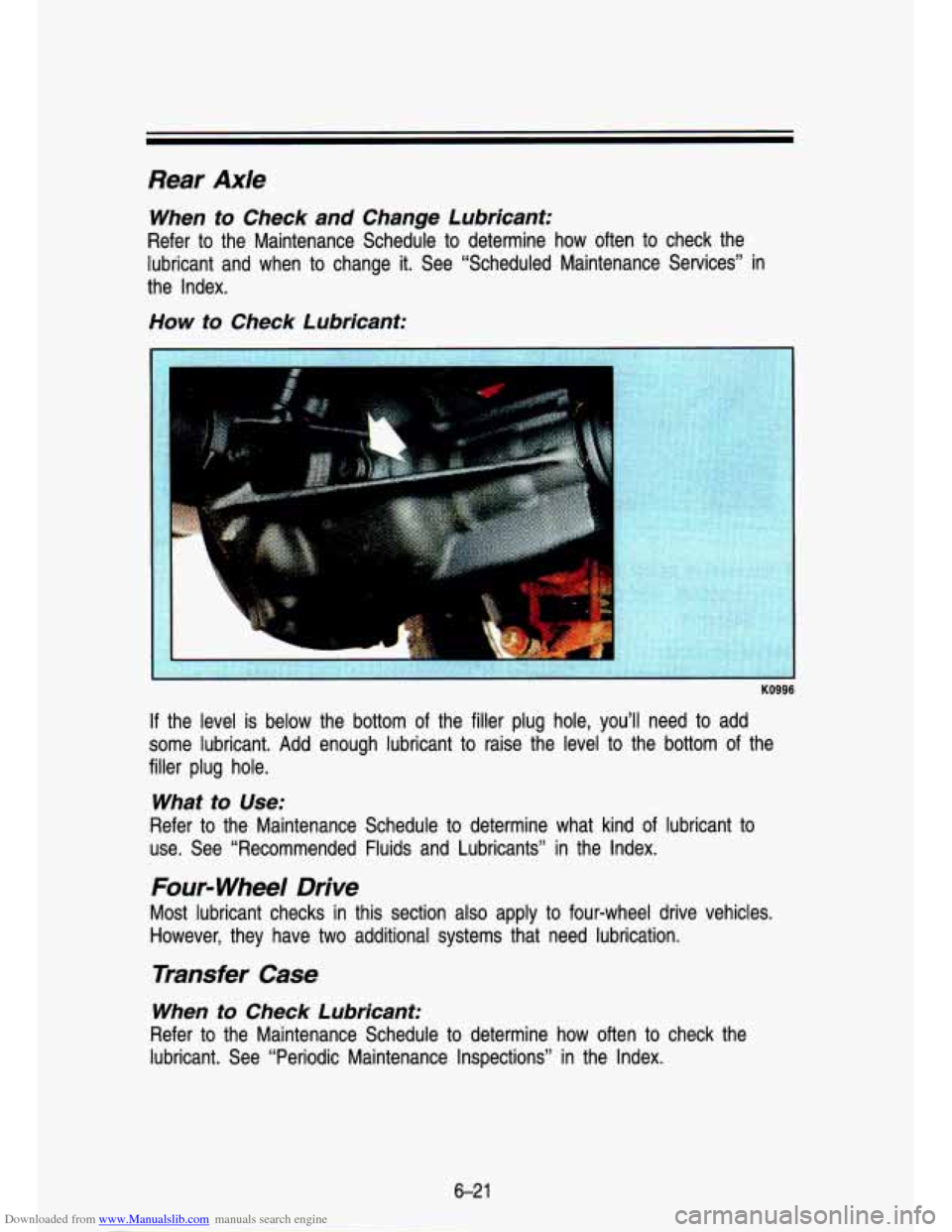
How to Check Lubricant:
KO996
If the level is below the bottom of the filler plug hole, you’ll need to add
some lubricant. Add enough lubricant to raise the level to the bottom
of the
filler plug hole.
What to Use:
Refer to the Maintenance Schedule to determine what kind of lubricant to
use. See “Recommended Fluids and Lubricants” in the Index.
Four- Wheel Drive
Most lubricant checks in this section also apply to four-wheel drive vehicles.
However, they have two additional systems that need lubrication.
Transfer Case
When to Check Lubricant:
Refer to the Maintenance Schedule to determine how often to check the
lubricant. See “Periodic Maintenance Inspections”
in the Index.
6-2 1