wheel CHEVROLET S10 1993 2.G Manual PDF
[x] Cancel search | Manufacturer: CHEVROLET, Model Year: 1993, Model line: S10, Model: CHEVROLET S10 1993 2.GPages: 356, PDF Size: 20.85 MB
Page 282 of 356
Downloaded from www.Manualslib.com manuals search engine Service & Appearance Care
Other Maintenance Items
Hydraulic Clutch Grease Fitting
If you have the 4.3L (VIN code Z) engine with a manual transmission, a
grease fitting is on the clutch housing for lubricating the cl\
utch fork ball stud.
Refer to the Maintenance Schedule for information on how to lu\
bricate the
clutch housing, and what type of lubricant to use. Be sure no\
t to over-fill
because you could
damage your clutch.
Front Suspension and Steering Linkage
Refer to the Maintenance Schedule to determine how often to lubricate the
fittings and what type of lubricant to use.
Front Wheel Bearings (Two-Wheel Drive)
If your vehicle is two-wheel drive, it has wheel bearings that mu\
st be cleaned
and repacked.
Refer
to the Maintenance Schedule to determine how often this must be
done.
Single Belt Accessory Drive
Your new vehicle uses a serpentine belt that is lighter, and more durable than
systems with several belts.
The belt runs over or around the pulleys
on the engine. A tensioner is used
to keep the belt tight at all times. The tensioner also makes replacing the
belt easier.
If you need to replace the belt, be sure to get the correct
replacement belt. Your dealership or parts supplier can help yo\
u with this.
The Accessory Drive Belt Routing label on your vehicle will sh\
ow you how to
route the belt your vehicle uses.
6-34
Page 290 of 356
Downloaded from www.Manualslib.com manuals search engine I
Service & Appearance Care
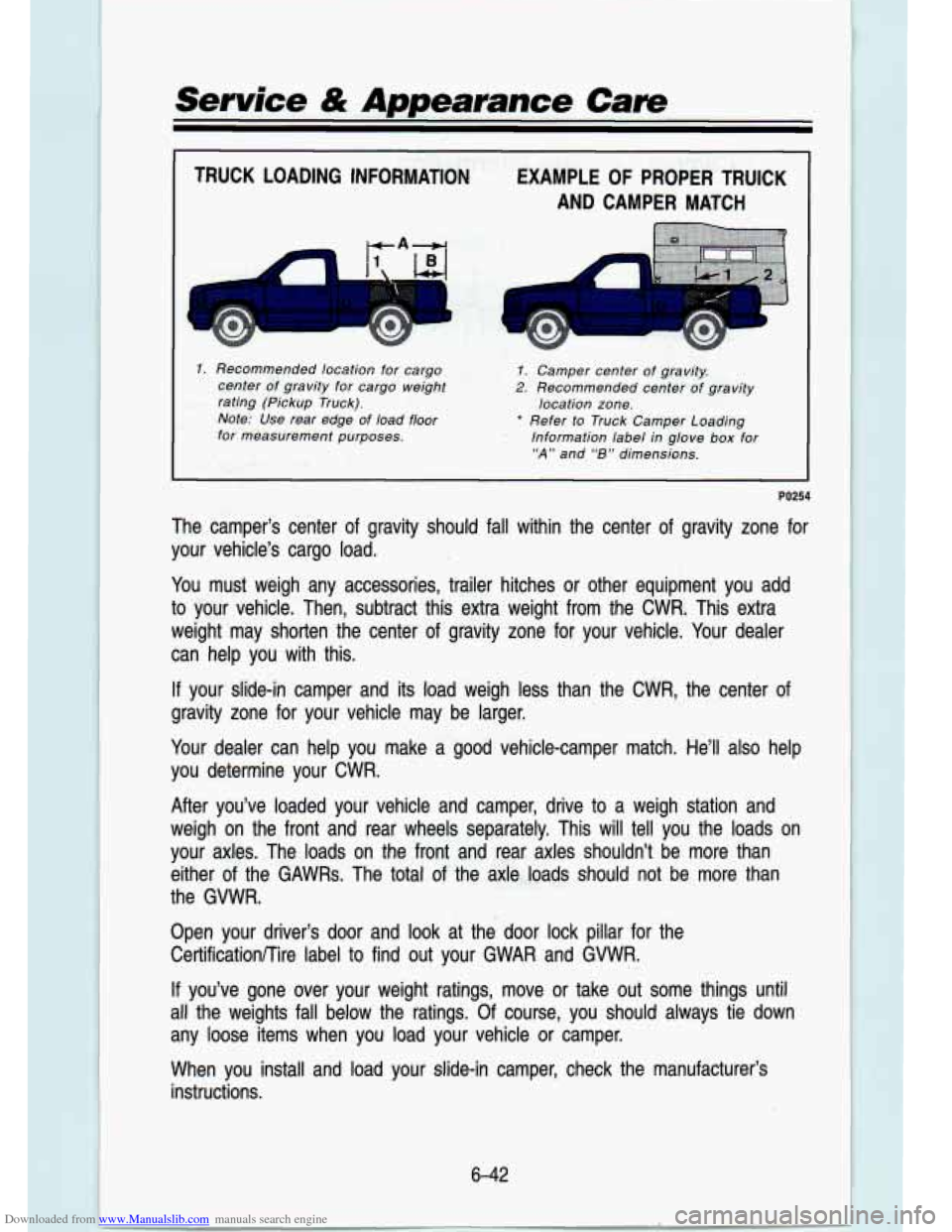
TRUCK LOADING INFORMATION EXAMPLE OF PROPER TRUICK
AND CAMPER MATCH
1. Recommended location for cargo 7. Camper center of gravity.
center
of gravity for cargo weight 2. Recommended center of gravity
rating (Pickup Truck).
K-L.<:- location zone.
Note: Use rear edge of load floor : .‘$Ti: * .Refer to Truck Camper Loading
for measurement purposes.
- - Information label in glove box for
“A” and “B” dimensions.
.Y %!, -
PO254
The camper’s center of gravity should fall within the center of gravity zone for
your vehicle’s cargo load.
You must weigh any accessories, trailer hitches or other equipment you add
to your vehicle. Then, subtract this extra weight from the CWR,
This extra
weight may shotten the center of gravity zone for your vehicle. Your dealer
can help you with this.
If your slide-in camper and its load weigh less than the CWR, the center of
gravity zone for your vehicle may be larger.
Your dealer can help you make
a good vehicle-camper match. He’ll also help
you determine your CWR.
After you’ve loaded your vehicle and camper, drive to a weigh station and
weigh on the front and rear wheels separately. This will tell you the loads on
your
axles. The loads on the front and rear axles shouldn’t be more th\
an
either
of the GAWRs. The total of the axie..loads should not be more than
the GVWR.
Open your driver’s door and look at the door lock pillar f\
or the CertificationKire label to find out your GWAR and GWVR.
If you’ve gone over your weight ratings, move or take out some\
things until
all the weights fall below the ratings. Of course, you should always tie down
any loose items when you load your vehicle or camper.
When you install and load your slide-in camper, check the manufacturer’s
instructions.
6-42
Page 293 of 356
Downloaded from www.Manualslib.com manuals search engine K2655
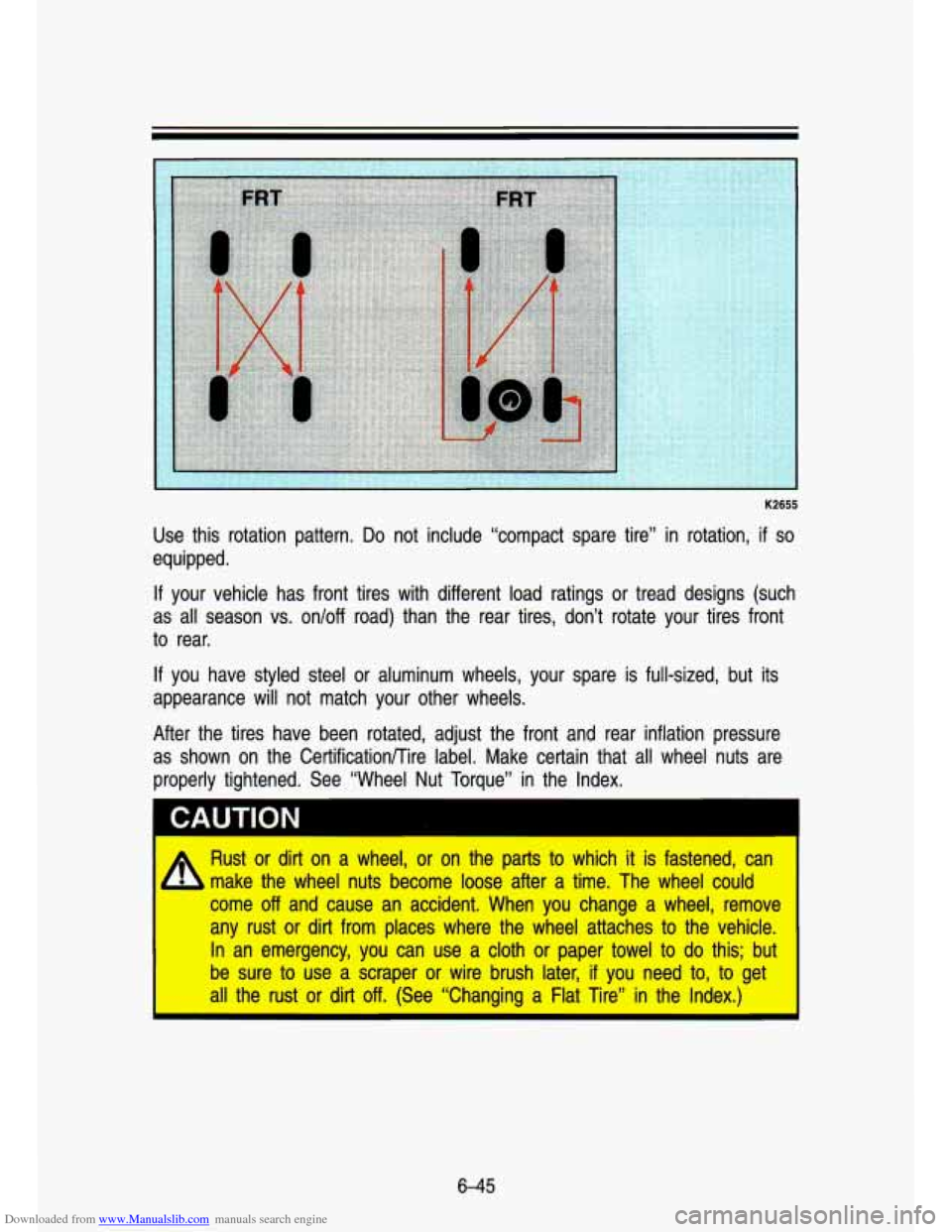
Use this rotation pattern. Do not include “compact spare tire” in rotation, if so
equipped.
If your vehicle has front tires with different load ratings or tr\
ead designs (such
as all season vs. on/off road) than the rear tires, don’t \
rotate your tires front
to rear.
If you have styled steel or aluminum wheels, your spare is full-s\
ized, but its
appearance will not match your other wheels.
After the tires have been rotated, adjust the front and rear \
inflation pressure as shown on the CertificationRire label. Make certain that
all wheel nuts are
properly tightened. See “Wheel Nut Torque” in the Index.
A
Rust or dirt on a wheel, or on the parts to which it is fastened, can
make the wheel nuts become loose after a time. The wheel coul\
d
come off and cause an accident. When you change a wheel, remove
any rust or dirt from places where the wheel attaches to the \
vehicle.
In an emergency, you can use a cloth or paper towel to
do this; but
be sure to use a scraper or wire brush later, if you need to, to get
all the rust or dirt off. (See “Changing a Flat Tire” in t\
he Index.)
6-45
Page 295 of 356
Downloaded from www.Manualslib.com manuals search engine If you ever replace your tires with those not having a TPC Spec number,
make sure they are the same size, load range, speed rating an\
d construction
type (bias, bias-belted or radial) as your original tires.
Mixing tires
could cause you to lose control while driving. If you mix
tires of different types (like radial and bias-belted tires) the vehicl\
e
may nlot handle properly, an'd you could have a cras'h. Be sure to
use the same size 'and type tires on all four wheels.
It's all right to drive with your compact spare (if you have one). It
I was developed for use on your vehicle.
Uniform Tire Quality Grading
The following information relates to the system developed by th\
e United
States National Highway Traffic Safety Administration which grade\
s tires by
treadwear, traction and temperature performance. (This applies o\
nly to
vehicles
sold in the United States.)
Treadwear
The treadwear grade is a comparative rating based on the wear rate of the
tire when tested under controlled conditions on a specified government test
course. For example, a tire graded
150 would wear one and a half (1 -1/2)
times as well on the government course as a tire graded 100. The relative
performance of tires depends upon the actual conditions of their use,
however, and may depart significantly from the norm due to var\
iations in
driving habits, service practices and differences in road charac\
teristics and
climate.
Traction-A, B, C
The traction grades, from highest to lowest are: A, B, and C. They represent
the tire's ability to stop on wet pavement as measured under controlled
conditions on specified government test surfaces of asphalt and concrete.
A
tire marked C may have poor traction performance.
Warning: The traction grade assigned to this tire is based on braking
(straight-ahead) traction tests and does not include cornering \
(turning) traction.
Temperature-A, B, C
The temperature grades are A (the highest), B, and C, representing the tire's
resistance
to the generation of heat and its ability to dissipate heat when
tested under controlled conditions on a specified indoor laboratory test wheel,
Sustained high temperature can cause the material of the tire
to degenerate
and reduce tire life, and excessive temperature can lead to sudden tire
6-47
Page 296 of 356
Downloaded from www.Manualslib.com manuals search engine Service & Appearance Care
failure. The grade C corresponds to a level of performance which all
passenger car tires must meet under the Federal Motor Vehicle \
Safety
Standard
No. 109. Grades B and A represent higher levels of performance on
the laboratory test wheel than the minimum required by law.
Warning: The temperature grade for this tire is established for\
a tire that is
properly inflated and not overloaded. Excessive speed, underinfla\
tion, or
excessive loading, either separately or in combination, can cause heat buildup
and possible tire failure.
These grades are molded on the sidewalls of passenger car tire\
s.
While the tires available as standard or optional equipment on \
General Motors
vehicles may vary with respect
to these grades, all such tires meet General
Motors performance standards and have been approved for use on \
General
Motors vehicles.
All passenger type (P Metric) tires must conform to Federal
safety requirements in addition
to these grades.
Wheel Alignment and Tire Balance
The wheels on your vehicle were aligned and balanced carefully \
ar IT.-
factory to give you the longest tire life and best overall performance.
In most cases, you will not need
to have your wheels aligned again.
However,
if you notice unusual tire wear or your vehicle pulling one way \
or
the other, the alignment may need
to be reset. If you notice your vehicle
vibrating when driving on a smooth road, your wheels may need
to be
rebalanced.
Wheel Replacement
Replace any wheel that is bent, cracked or badly rusted. If wheel nuts keep
coming loose, the wheel, wheel bolts, and wheel nuts should be\
replaced. If
the wheel leaks air out, replace it (except some aluminum wheels, which can
sometimes be repaired). See your GM dealer
if any of these conditions exist.
Your dealer will know the kind of wheel you need.
Each new wheel should have the same load carrying capacity, di\
ameter,
width, offset, and be mounted the same way as the one
it replaces.
If you need to replace any of your wheels, wheel bolts, or wheel nuts,
replace them only with
new GM original equipment parts. This way, you will
be sure you have the right wheel, wheel bolts, and wheel nuts\
for your
vehicle.
6-48
I
Page 297 of 356

Downloaded from www.Manualslib.com manuals search engine -nu I IUlY
1 Using the wrong replacement wheels, wheel bolts, or wheel nuts \
on
A your vehicle can be dangerous. It could affect the braking and
handling of your vehicle, make your tires lose air and make you lose
control. You could have a collision in which you or others could be
injured. Always use the correct wheel, wheel bolts, and wheel \
nuts
for replacement.
NOTICE I
I
A
Putting a used wheel on your vehicle is dangerous. You can’t know
how it’s been used or how many miles it’s been driven.
It could fail
suddenly and cause an accident. If you have to replace
a wheel, use
a new
GM original equipment wheel.
Tire Chains
6-49
Page 309 of 356
Downloaded from www.Manualslib.com manuals search engine Be sure to use the correct fuse. If you ever have a problem on the road and
don’t have a spare fuse, you can “borrow” one of the correct value. Just pick
some feature of your vehicle that you can get along without-like the radio or
cigarette lighter-and use its fuse,
if it is of the value you need. Replace it
as soon as you can. See “Fuses and Circuit Breakers” in this section.
Cap cities and Specification Charts
Replac -merit Parts
Replacement part numbers listed in this section are based on the latest
information available at the time of printing, and are subject to change.
If a
part listed in this manual is not the same as the part used in your vehicle
when
it was built, or if you have any questions, please contact your GM truck
dealer.
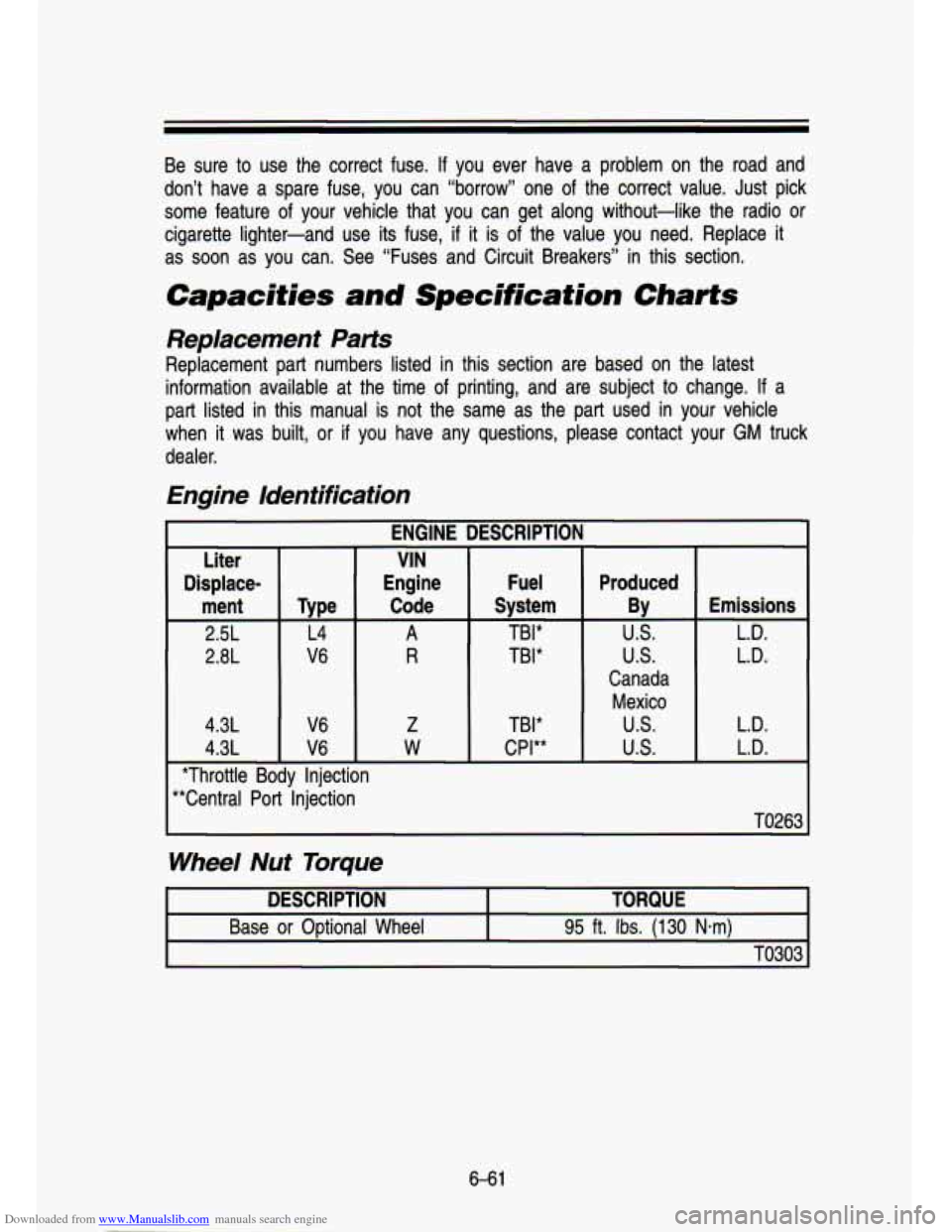
Engine Identification
ENGINE DESCRIPTION I
Liter VJN
Displace- Engine ment Type Cde
2.5L L4
A
2.8L V6 R
4.3L
V6 Z
4.3L V6 W
*Throttle Body Injection
“Central Port Injection Fuel
Svstem
TBI*
TBI*
TBI*
CPI**
Produced
BY
U.S.
us.
Canada Mexico
US.
U.S.
Emissions
L.D.
L.D.
L.D.
L.D.
TO263
Wheel Nut Torque
DESCRIPTION TORQUE
Base or Optional Wheel
95 ft. Ibs. (1 30 Nam)
TO303
6-61
Page 313 of 356
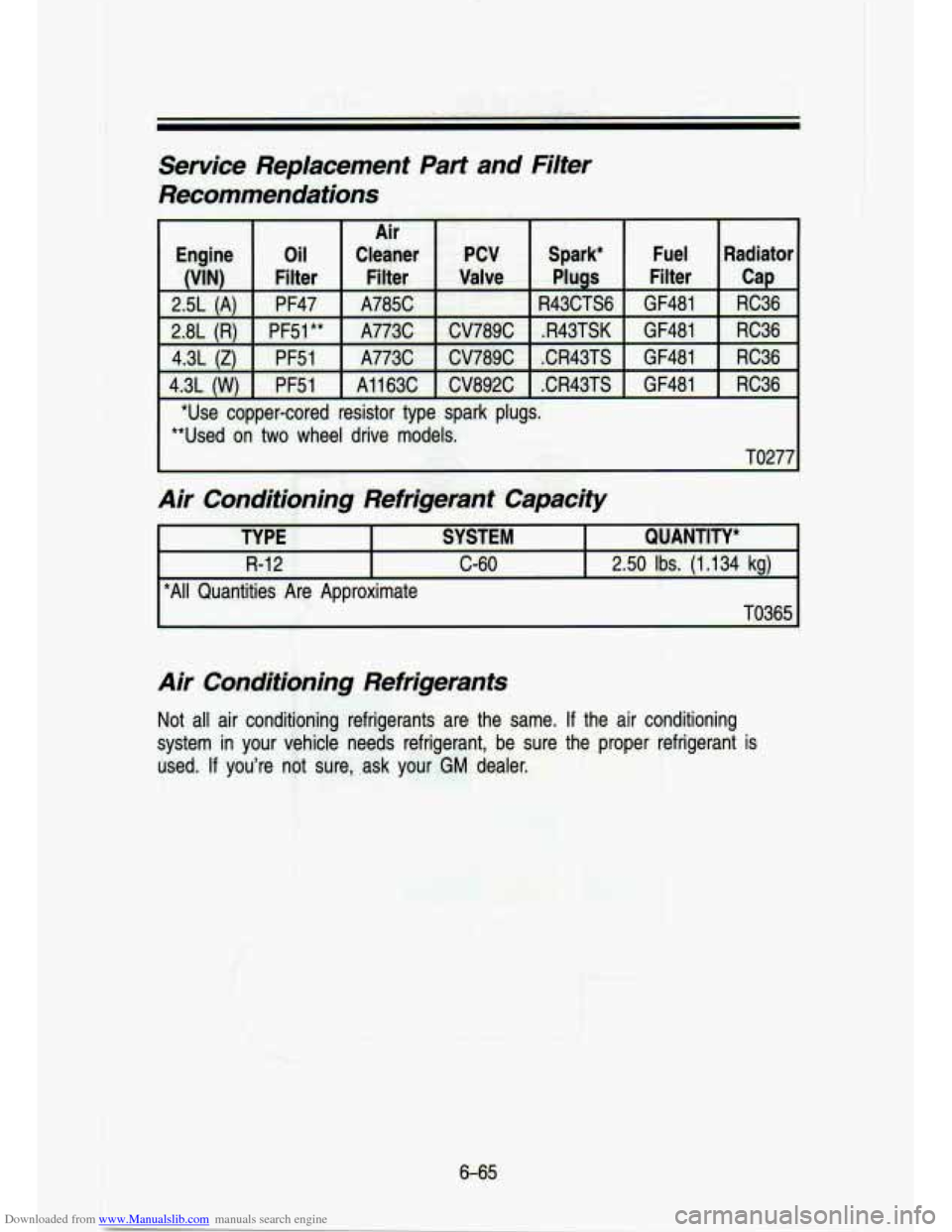
Downloaded from www.Manualslib.com manuals search engine Service Replacement Part an'd Filter
Recommendations
2.8L (R)
4.3L
(Z)
4.3L CW)
Oil Cleaner PCV
Filter Filter
Valve
;
A773C CV78@C
PF51
I A1163C I CV892C
PF51 I A1163C I CV892C
A773C CV78@C Air
Oil Cleaner PCV Spark*
.R43TSK
I GF481
Spark*
.R43TSK I GF481
.CR43TS
I GF481
.CR43TS
I GF481
1
1
Radsiator
RC36
Radsiator
RC36
RC36
I RC36 I
*Use copper-cored resistor type spark plugs.
**Used on two wheel drive m!odels. TO277
Air Conditioning Refrigerant Capacity
TYPE SYSTEM WANTITY'
R-12 C-60 2.50 Ibs. (1.134 kg)
*All Quantities Are Approximate
TO365
Air Conditioning Refrigerants
Not all air conditio'ning refrigerants are the same. If the air conditioning
system in your vehimcle needs lefrigerant, be sure
the pro'per refriaerant is
used. If you're not we, .ask your GM dealer.
6-65
. ."
Page 315 of 356
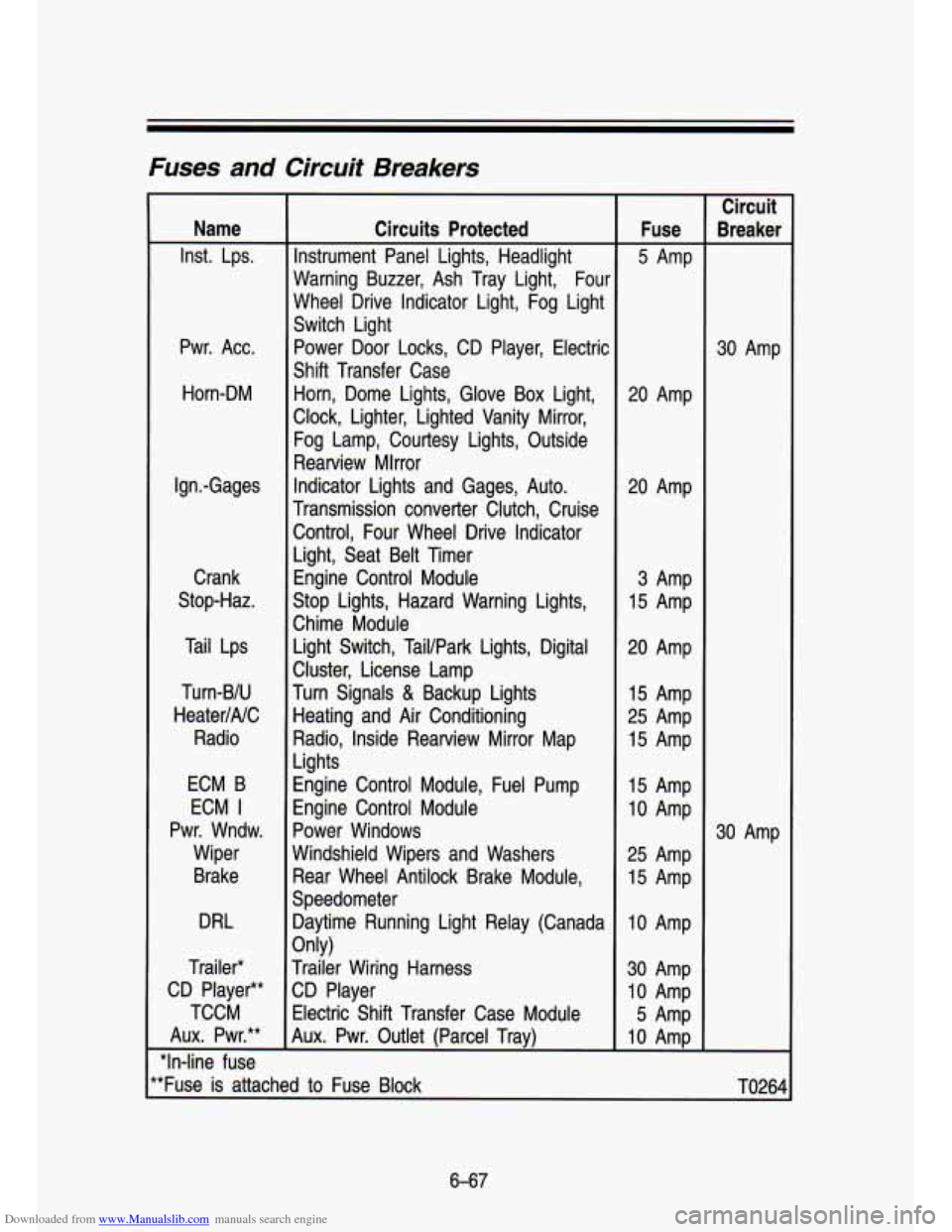
Downloaded from www.Manualslib.com manuals search engine Fuses and Circuit Breakers
Name
Inst. Lps.
Pwr. Acc. Horn-DM
Ign.-Gages Crank
Stop-Haz.
Tail Lps
Turn-BIU
HeaterINC Radio
ECM B
ECM
I
Pwr. Wndw. Wiper
Brake
DRL
Trailer*
CD Player**
TCCM
Aux. Pwr.**
"In-line fuse Circuits Protected
Instrument Panel Lights, Headlight
Warning Buzzer, Ash Tray Light, Four
Wheel Drive Indicator Light, Fog Light
Switch Light Power Door Locks, CD Player, Electric
Shift Transfer Case Horn, Dome Lights, Glove Box Light,
Clock, Lighter, Lighted Vanity Mirror,
Fog Lamp, Courtesy Lights, Outside
Rearview Mlrror
Indicator Lights and Gages, Auto.
Transmission converter Clutch, Cruise Control, Four Wheel Drive Indicator
Light, Seat Belt Timer Engine Control Module
Stop Lights, Hazard Warning Lights,
Chime Module Light Switch, Tail/Park Lights, Digital
Cluster, License Lamp
Turn Signals
& Backup Lights
Heating and Air Conditioning
Radio, Inside Rearview Mirror Map
Lights
Engine Control Module, Fuel Pump
Engine Control Module
Power Windows
Windshield Wipers and Washers Rear Wheel Antilock Brake Module,
Speedometer Daytime Running Light Relay (Canada
Trailer Wiring Harness
CD Player
Electric Shift Transfer Case Module
Aux. Pwr. Outlet (Parcel Trav)
Only) Fuse
5 Amp
20 Amp
20 Amp
3 Amp
15 Amp
20 Amp 15 Amp
25 Amp
15 Amp
15 Amp
10 Amp
25 Amp
15 Amp
10 Amp
30 Amp
10 Amp
5 Amp
10 AmD Circuit
kea ker
30 Amp
30 Amp
'*Fuse is attached to Fuse Block
TO264
6-67
Page 319 of 356

Downloaded from www.Manualslib.com manuals search engine Scheduled Maintenance Services
This part tells you the maintenance services you should have d\
one ana when
you should schedule them. Your
GM dealer knows your vehicle best and
wants you to be happy with
it. If you go to your dealer for all your service
needs, you’ll know that GM-trained and supported service peop\
le will perform
the work using genuine GM parts.
These schedules are for vehicles that:
carry passengers and cargo within the recommended limits. You will find
these limits on your vehicle’s Certification Label. See “L\
oading Your
Vehicle’’ in the Index.
are driven on regular road surfaces, and within legal driving \
limits, as
are driven off-road in the recommended manner. See “Off Road Driving
use the proper fuel. See “Fuel” in the Index.
described in Section
4, “Your
Driving and the Road”.
With Your Four-wheel Drive Vehicle” in the Index.
Selecting The Proper Maintenant- ~ Schedule
Your driving conditions and how you use your vehicle will help you \
determine
which schedule to use. The schedules are found later in this section.
MAINTENANCE SCHEDULE
I
Is any one of these’ true for your vehicle?
Most trips are less than 4 miles (6 kilometers).
Most trips are less than 10 miles (16 kilometers) and the outside
The engine is at low speed most of the time (as in stop-and-go traffic,
temperatures are below freezing.
door-to-door delivery, or other commercial uses).
You
operate in dusty areas or off-road frequently.
You tow a trailer.
If any one (or more) of these is true for your driving, follow Schedule I. The
chart for Schedule
I has plus signs (t).
MAINTENANCE SCHEDULE II
Follow Schedule II ONLY if none of the above conditions are true. The chart
for Schedule
II has dots (e).
7-3