lights CHEVROLET S10 1994 2.G User Guide
[x] Cancel search | Manufacturer: CHEVROLET, Model Year: 1994, Model line: S10, Model: CHEVROLET S10 1994 2.GPages: 340, PDF Size: 18.45 MB
Page 93 of 340
 Indicator Light
(Canada Only)
If your vehicle was first sold, when new, in Canada, you will\")
Downloaded from www.Manualslib.com manuals search engine Daytime Running Lights (DRL) Indicator Light
(Canada Only)
If your vehicle was first sold, when new, in Canada, you will\
have this light
on the instrument panel. It goes on whenever the Daytime Running Lights
are on, the ignition is on, the headlamp switch is
off, and the parking brake
is released.
Daytime Running Lights (Canada Only)
The Canadian Federal Government has decided that “Daytime Running \
Lights” (DRL) is a useful feature, in that
DRL can make your vehicle more
visible to pedestrians and other drivers during daylight hours. \
DRL is
required on new vehicles sold in Canada.
The high beam headlights will come
on at reduced brightness in daylight
when:
0 The ignition is on,
The headlight switch is off, and
The parking brake is released.
When you turn on your headlights, the DRL will switch off and the exterior
lights will come on. When you turn
off the headlights, the exterior lights
will go out and the high beams will change to the reduced brightness
of
DRL again.
The DRL indicator light on the instrument panel will go on whenever the
DRL is on. This light means that only the DRL is on. When you turn on
your exterior lights, this light will
20 out.
If the DRL indicator light is on at uawn or dusk, it is a reminder to turn on
your headlights.
2-47
Page 94 of 340
Downloaded from www.Manualslib.com manuals search engine Of course, you may still turn on the headlights any time you need to.
To idle your vehicle with the DRL off, set the parking brake. The DRL will
stay
off until you release the parking brake.
Headlights-On Reminder
A reminder tone will sound when your headlights or parking lights\
are
turned on and your ignition is in
OFF, LOCK or ACC. To turn the tone off,
turn the dimmer switch all the way down.
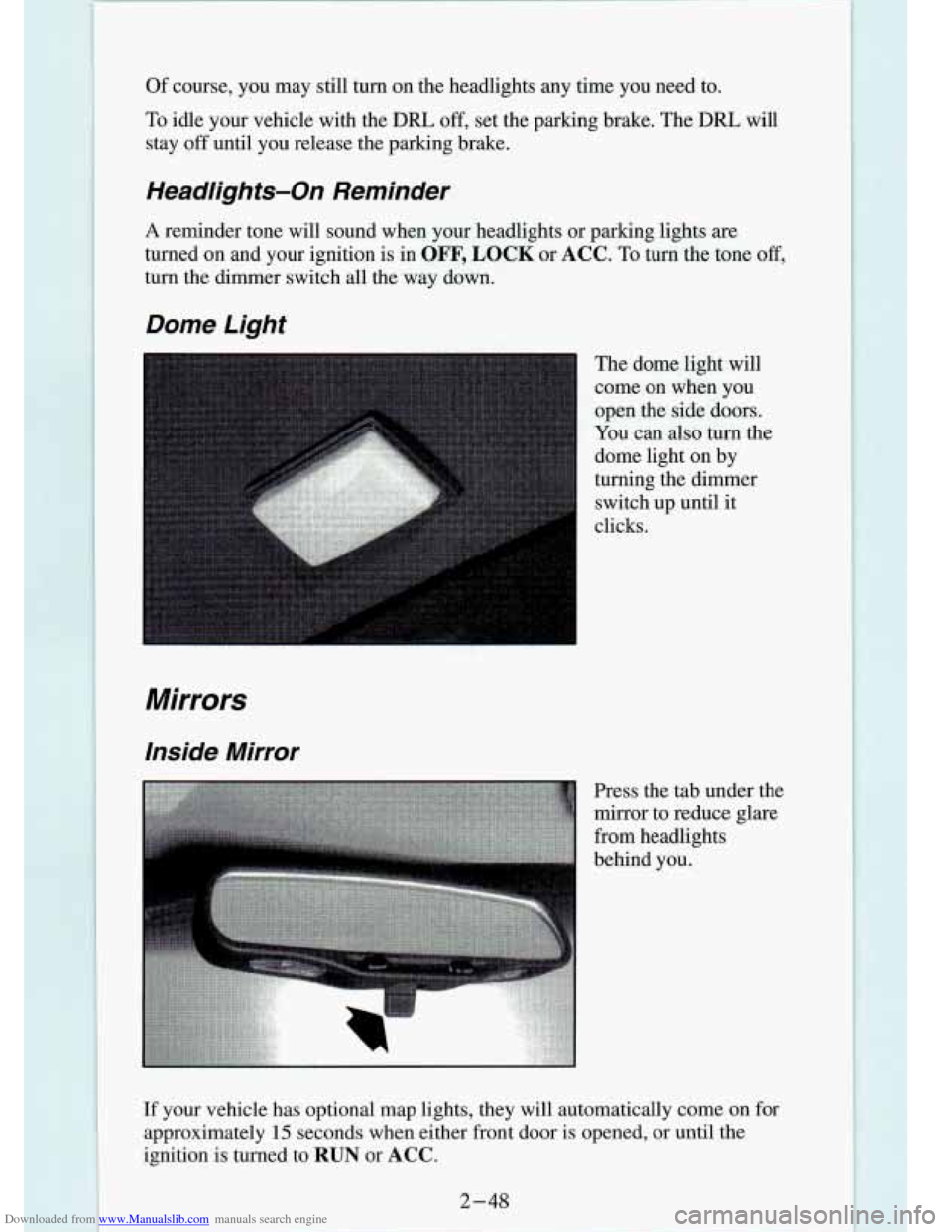
Dome Light
Mirrors
Inside Mirror
The dome light will
come
on when you
open the side
doors.
You can also turn the
dome light on by
turning the dimmer
switch up until it
clicks.
Press the tab under the
mirror to reduce glare
from headlights
behind you.
If your vehicle has optional map lights, they will automatically c\
ome on for
approximately
15 seconds when either front door is opened, or until the
ignition is turned to
RUN or ACC.
Page 97 of 340
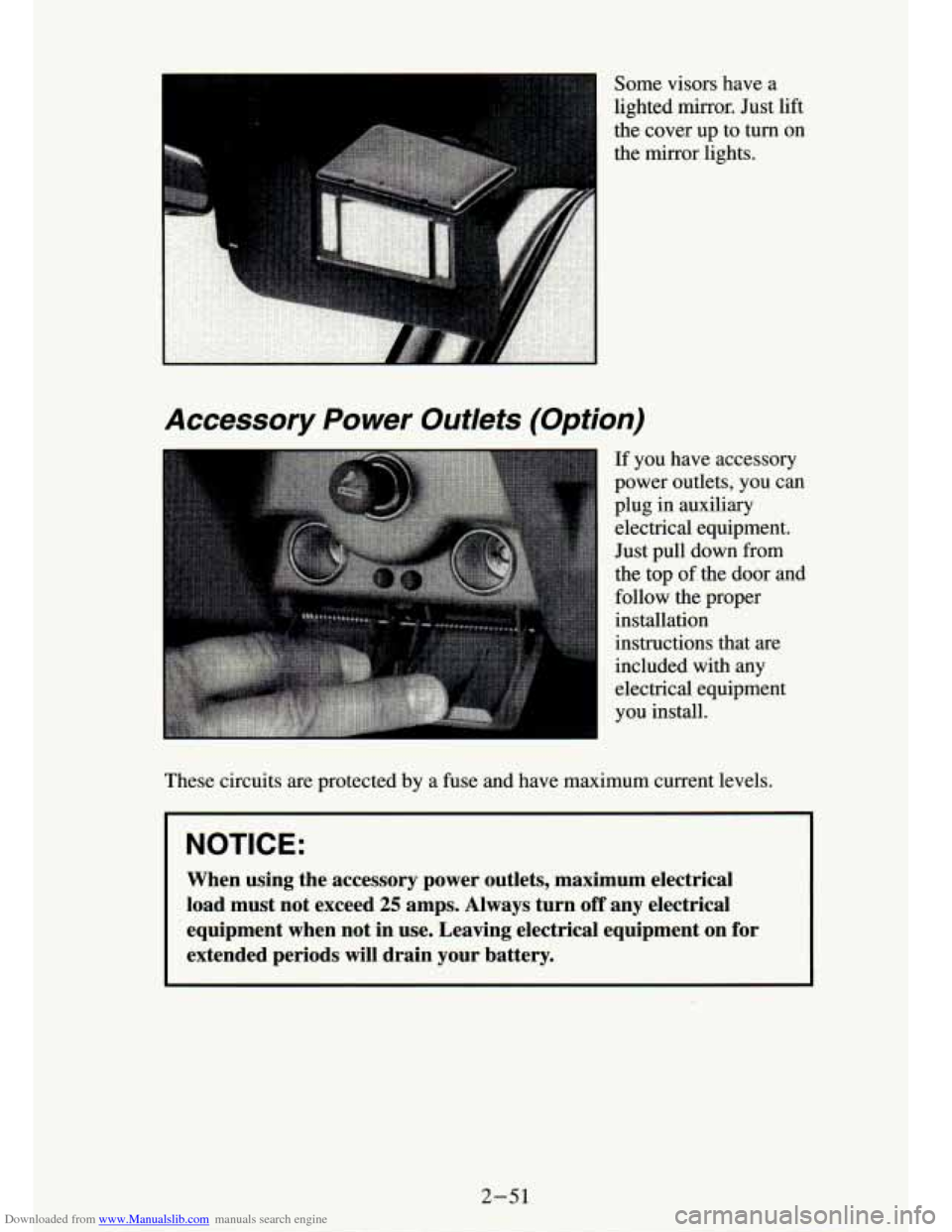
Downloaded from www.Manualslib.com manuals search engine Some visors have a
lighted mirror. Just lift
the cover up to turn on
the mirror lights.
Accessory Power Outlets (Option)
If you have accessory
power outlets, you can
plug
in auxiliary
electrical equipment.
Just pull down from
the top of the door and
follow the proper
installation
instructions that are
included with any
electrical equipment
you install.
These circuits
are protected by a fuse and have maximum current levels.
NOTICE:
When using the accessory power outlets, maximum electrical
load must not exceed
25 amps. Always turn off any electrical
equipment when not in use. Leaving electrical equipment
on for
extended periods will drain your battery.
2-51
Page 104 of 340
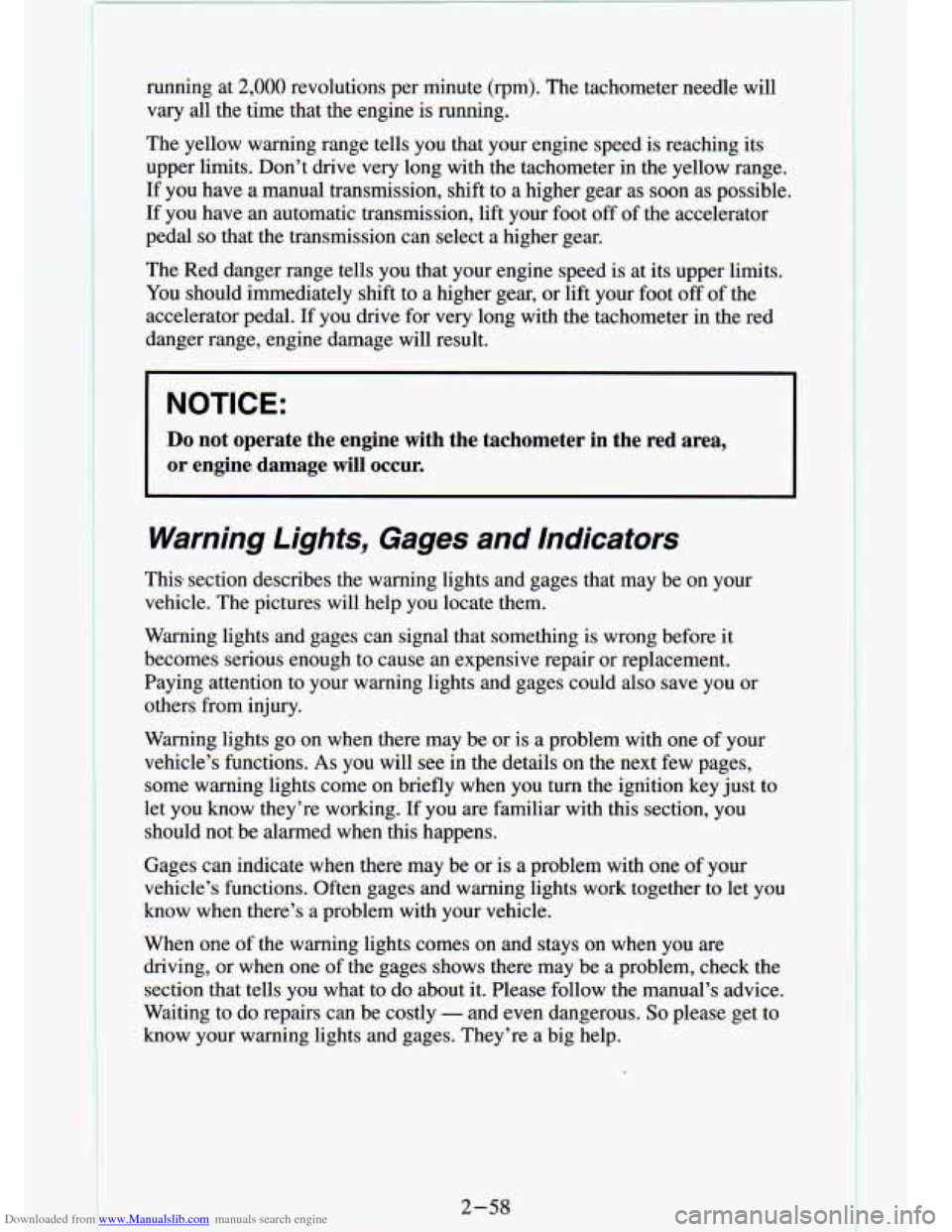
Downloaded from www.Manualslib.com manuals search engine running at 2,000 revolutions per minute (rpm). The tachometer needle will
vary all the time that the engine is running.
The yellow warning range tells you that your engine speed is reach\
ing its
upper limits. Don’t drive very long with the tachometer in the yellow range.
If you have a manual transmission, shift to a higher gear as soon as possible.
If you have an automatic transmission, lift your foot off
of the accelerator
pedal
so that the transmission can select a higher gear.
The Red danger range tells you that your engine speed is at its upper limits.
You should immediately shift to a higher gear, or lift your foot
off of the
accelerator pedal. If you drive for very long with the tachometer in the red
danger range, engine damage will result.
NOTICE:
Do not operate the engine with the tachometer in the red area,
or engine damage
will occur.
I
Warning Lightsy Gages and Indicators
This section describes the warning lights and gages that may be on your
vehicle. The pictures will help you locate them.
Warning lights and gages can signal that something is wrong be\
fore it
becomes serious enough to cause an expensive repair or replacem\
ent.
Paying attention to your warning lights and gages could also s\
ave you or
others from injury.
Warning lights
go on when there may be or is a problem with one of your
vehicle’s functions.
As you will see in the details on the next few pages,
some warning lights come on briefly when you turn the ignition\
key just to
let you know they’re working. If you are familiar with this sec\
tion, you
should not
be alarmed when this happens.
Gages can indicate when there may be or is a problem with one
of your
vehicle’s functions. Often gages and warning lights work toge\
ther to let you
know when there’s a problem with your vehicle.
When one of the warning lights comes on and stays on when you are
driving, or when one of the gages shows there may be a problem, check the
section that tells you what to
do about it. Please follow the manual’s advice.
Waiting to do repairs can be costly
- and even dangerous. So please get to
know your warning lights and gages. They’re a big help.
2-58
I
Page 108 of 340
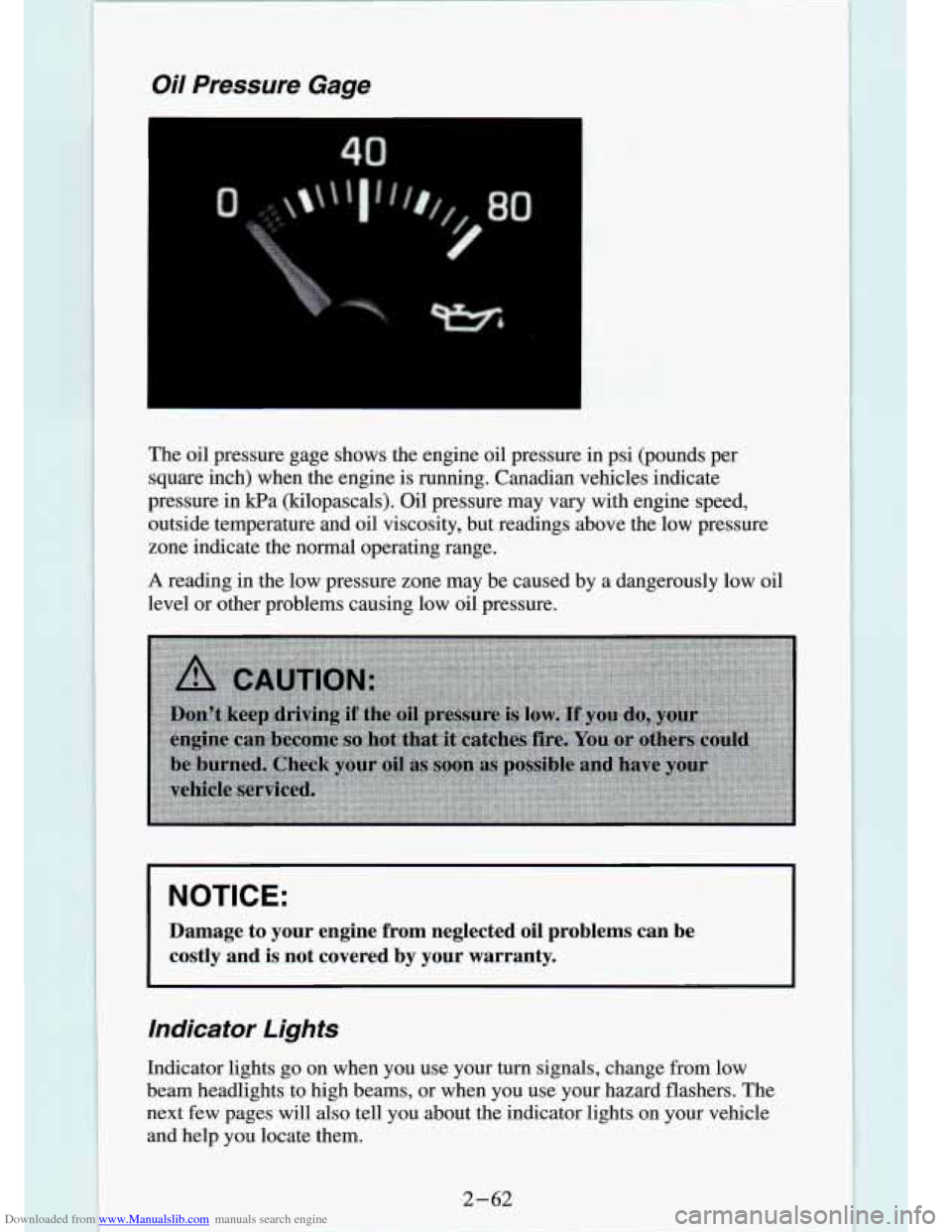
Downloaded from www.Manualslib.com manuals search engine Oil Pressure Gage
I
The oil pressure gage shows the engine oil pressure in psi (pounds per
square inch) when the engine is running. Canadian vehicles indicate
pressure in Pa (kilopascals). Oil pressure may vary with engine speed,
outside temperature and oil viscosity, but readings above the l\
ow pressure
zone indicate the normal operating range.
A reading in the low pressure zone may be caused by a dangerously low oil \
level or other problems causing low oil pressure.
NOTICE:
Damage to your engine from neglected oil problems can be
costly and
is not covered by your warranty.
Indicator Lights
Indicator lights go on when you use your turn signals, change from low
beam headlights to high beams, or when you use your hazard fl\
ashers. The
next few pages will also tell you about the indicator lights \
on your vehicle
and help you locate them.
Page 110 of 340
Downloaded from www.Manualslib.com manuals search engine :.
Daytime Running Lights (DRL) Indicator Light
(Canada Only)
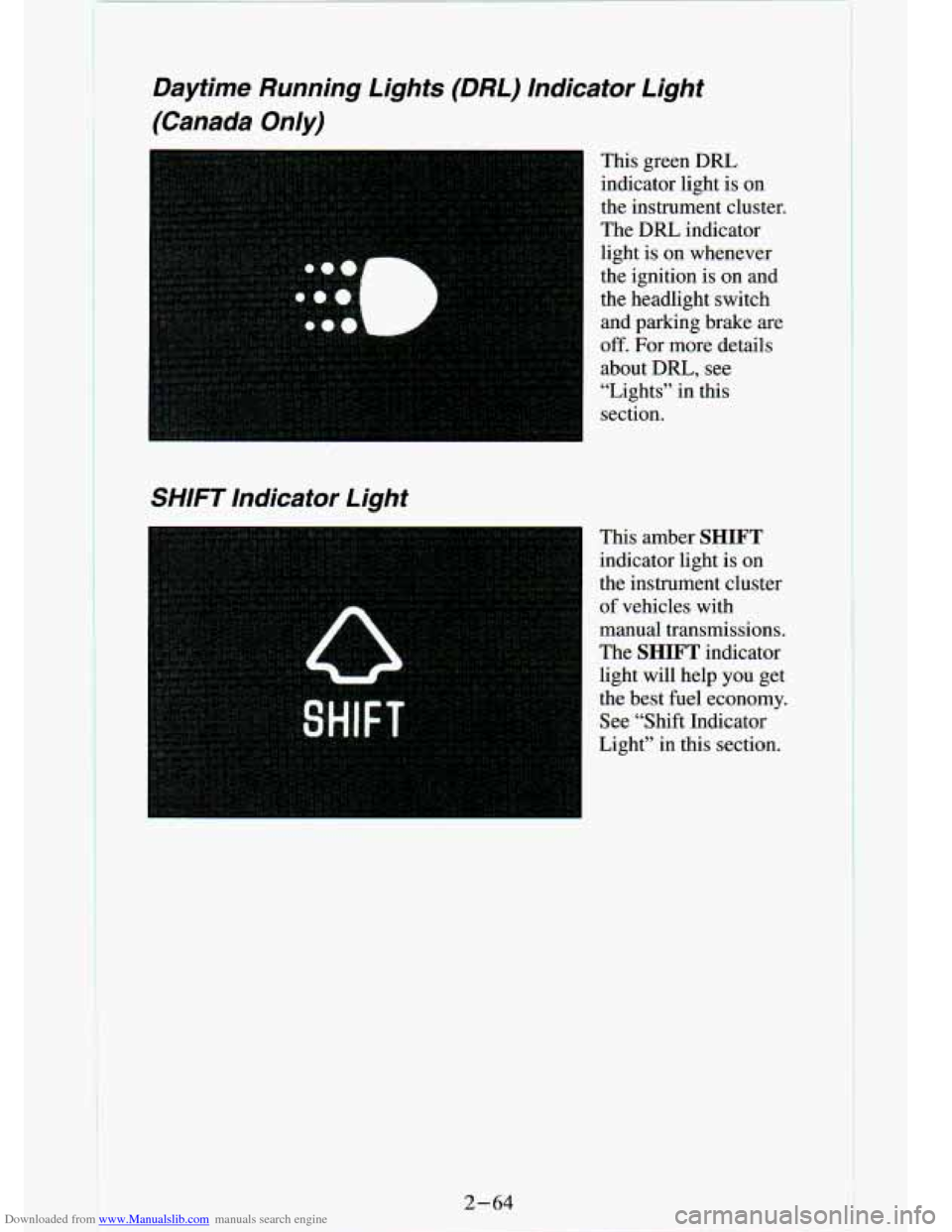
This green DRL indicator light is on
the instrument cluster.
The
DRL indicator
light is on whenever
the ignition is
on and
the headlight switch
and parking brake are
off. For more details
about DRL,
see
“Lights” in this
section.
SHIFT Indicator Light
This amber SHIFT
indicator light is on
the instrument cluster
of vehicles with
manual transmissions.
The
SHIFT indicator
light will help
you get
the best fuel economy.
See “Shift Indicator
Light” in this section.
2-64
Page 111 of 340
Downloaded from www.Manualslib.com manuals search engine Headlight High Beam Indicator Light
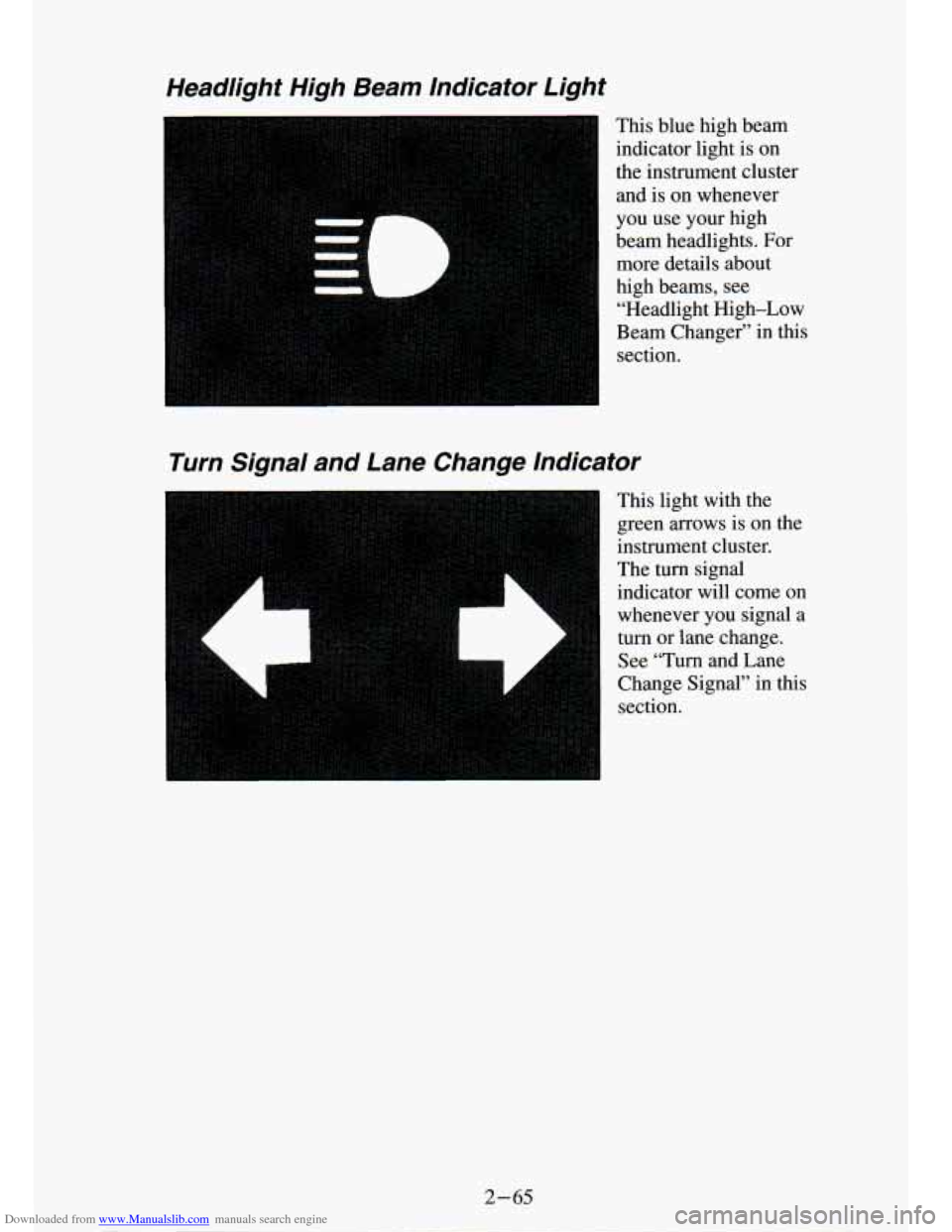
This blue high beam
indicator light
is on
the instrument cluster and is on whenever
you use your high
beam headlights. For
more details about
high beams, see
“Headlight High-Low
Beam Changer” in this
section.
Turn Signal and Lane Change Indicator
instrument cluster.
The turn signal indicator will come on
whenever you signal a
turn or lane change.
See “Turn and Lane
Change Signal” in this
section.
2-65
Page 148 of 340
Downloaded from www.Manualslib.com manuals search engine Check your rnlrro , glance over your shoulder, and start your left lane
change signal before moving out of the right lane to pass. When you
are far enough ahead of the passed vehicle to see its front in your inside
mirror, activate your right lane change signal and move back i\
nto the
right lane. (Remember that your right outside mirror is convex\
. The
vehicle you just passed may seem to be farther away from you than it
really is.)
Reconsider before passing the next vehicle.
brake lights are not flashing, it may be slowing down or starting to turn.
ahead of you. Perhaps you can ease a little to the right.
0 Try not to pass more than one vehicle at a time on two-lane \
roads.
Don’t overtake a slowly moving vehicle too rapidly. Even tho\
ugh the
If you’re being passed, make it easy for the following driver to get
Loss of 0 mo/
Let’s review what driving experts say about what happens whe\
n the three
control systems (brakes, steering and acceleration) don’t ha\
ve enough
friction where the tires meet the road to do what the driver has asked.
In any emergency, don’t give up. Keep trying to steer and \
constantly seek
an
escape route or area of less danger.
Skidding
In a skid, a driver can lose control of the vehicle. Defensive drivers avoid
most skids by taking reasonable care suited to existing conditi\
ons, and by
not “overdriving” those conditions. But skids are always p\
ossible.
The three types of skids correspond to your Vehicle’s three control systems.
In the braking skid your wheels aren’t rolling.
In the steering or cornering
skid, too much speed or steering in a curve causes tires to slip and lose
comering force. And in the acceleration skid too much throttle causes t\
he
driving wheels to spin.
A cornering skid and an acceleration skid are best handled by easing your
foot off the accelerator pedal.
If your vehicle starts to slide, ease your foot off the accelerator pedal and
quickly steer the way you want
the vehicle to go. If you start steering
quickly enough, your vehicle may straighten out. Always be ready for a
second skid if it occurs.
Of course, traction is reduced when water, snow, ice, gravel, or other
material is
on the road. For safety, you’ll want to slow down and adjust \
your
driving to these conditions. It is important
to slow down on slippery
surfaces because stopping distance
will be longer and vehicle control more
limited.
. L.
4-12
F. ”
Page 152 of 340
Downloaded from www.Manualslib.com manuals search engine Surface Obstacles. Unseen or hidden obstacles can be hazardous. A rock,
log, hole, rut, or bump can startle you
if you’re not prepared for them. Often
these obstacles are hidden by grass, bushes, snow or even the rise and fall of
the terrain itself. Here are some things to consider:
Is the path ahead clear?
Will the surface texture change abruptly up ahead?
Does the travel take you uphill or downhill? (There’s more \
discussion
of these subjects later.)
Will you have to stop suddenly or change direction quickly?
When you drive over obstacles or rough terrain, keep a firm g\
rip on the steering wheel. Ruts, troughs, or other surface features can jerk the wheel
out
of your hands if you’re not prepared.
When you drive over bumps, rocks, or other obstacles, your whe\
els can leave the ground.
If this happens, even with one or two wheels, you can’t
control the vehicle as well or at all.
Because you will be
on an unpaved surface, it’s especially important to
avoid sudden acceleration, sudden turns,
or sudden braking.
In a way, off-road driving requires a different kind
of alertness from driving
on paved roads and highways. There are no road signs, posted \
speed limits
or signal lights. You have to use your own good judgment about what is safe
and what isn’t.
Drinking and driving can be very dangerous on any road. And t\
his is
certainly true for off-road driving. At the very time you need special
alertness and driving skills, your reflexes, perceptions and jud\
gment can be
affected by even a small amount of alcohol. You could have a serious
- or
even fatal
- accident if you drink and drive or ride with a driver who has
been drinking. (See “Drunken Driving” in the Index.)
1
4-16.
Page 154 of 340

Downloaded from www.Manualslib.com manuals search engine Driving Uphill
Once you decide you can safely drive up the hill, you need t\
o take some
special steps.
Use a low gear and get a firm grip on the steering wheel.
Get a smooth start up the hill and try to maintain your spee\
d. Don’t use
more power than you need, because you don’t want your wheel\
s to start
spinning or sliding.
turns, you might want to find another route.
Try to drive straight up the hill if at all possible. If the path twists and
Ease up on your speed as you approach the top of the hill.
Attach a flag to the vehicle to make you more visible to approaching
Sound the horn as you approach the top of the hill to let opposing
traffic on trails or hills.
traffic know you’re there.
Use your headlights even during the day. They make you more v\
isible
to oncoming traffic.
..
4- 18