parking brake CHEVROLET S10 1994 2.G User Guide
[x] Cancel search | Manufacturer: CHEVROLET, Model Year: 1994, Model line: S10, Model: CHEVROLET S10 1994 2.GPages: 340, PDF Size: 18.45 MB
Page 110 of 340
Downloaded from www.Manualslib.com manuals search engine :.
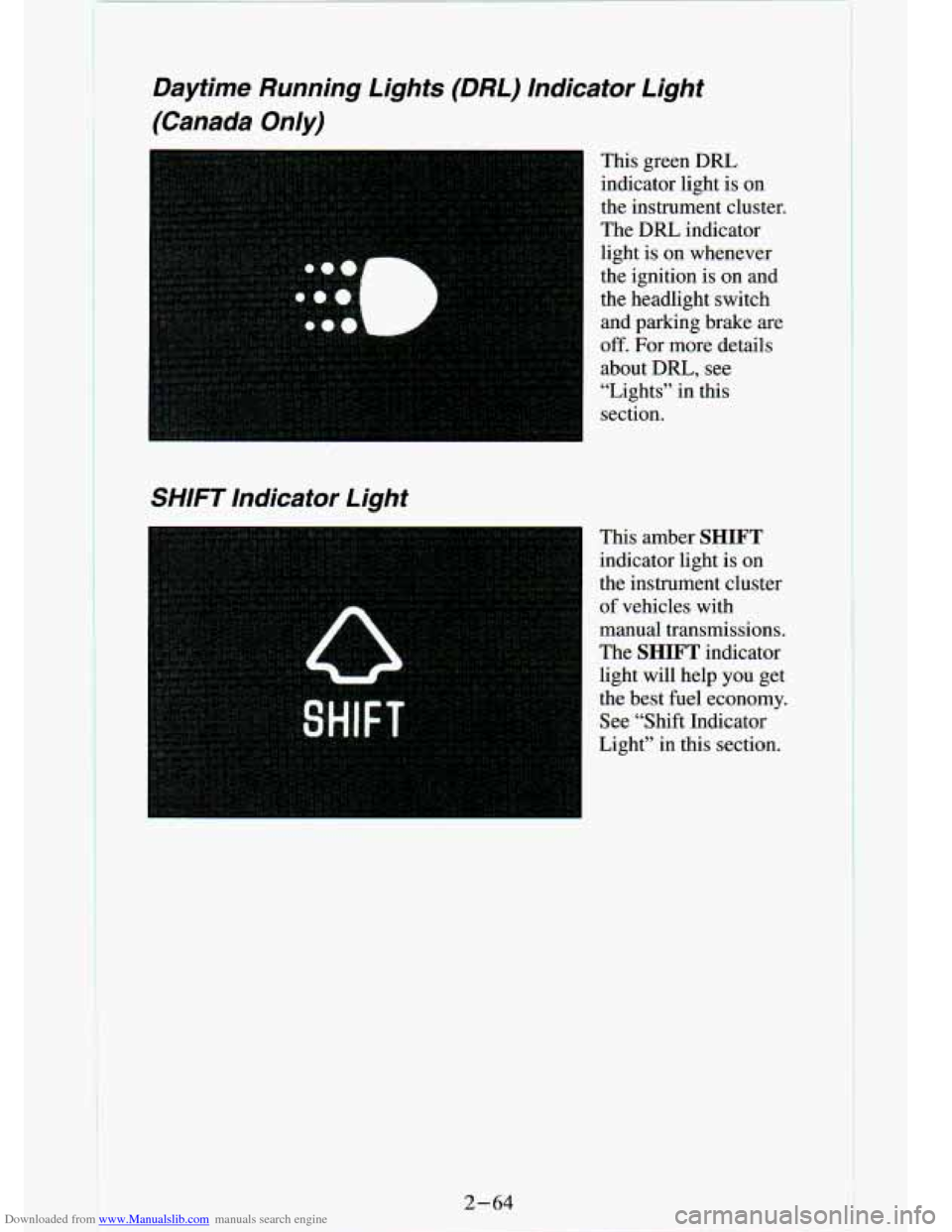
Daytime Running Lights (DRL) Indicator Light
(Canada Only)
This green DRL indicator light is on
the instrument cluster.
The
DRL indicator
light is on whenever
the ignition is
on and
the headlight switch
and parking brake are
off. For more details
about DRL,
see
“Lights” in this
section.
SHIFT Indicator Light
This amber SHIFT
indicator light is on
the instrument cluster
of vehicles with
manual transmissions.
The
SHIFT indicator
light will help
you get
the best fuel economy.
See “Shift Indicator
Light” in this section.
2-64
Page 155 of 340
Downloaded from www.Manualslib.com manuals search engine Q: What should I do if my vehicle stalls, or is about to stall, and I
A: If this happens, there are some things you should do, and there are
some things you must not do. First, here’s what you
should do:
can’t make it up the hill?
Push the brake pedal to stop the vehicle and keep it from rolling
backwards. Also, apply
the parking brake.
If your engine is still running, shift the transmission into reverse,
release the parking brake, and slowly back down the hill in r\
everse.
If your engine has stopped running, you’ll need to restart it. With the
brake pedal depressed and the parking brake still applied, shift the
transmission to
“P” (Park) (or, shift to “N” (Neutral) if your vehicle h\
as
a manual transmission) and restart the engine. Then, shift to \
reverse,
release the parking brake, and slowly back down the hill as s\
traight
as
possible in reverse.
wheel at the
12 o’clock position. This way, you’ll be able to tell if your
wheels are straight and maneuver as you back down. It’s bes\
t that you
back down the hill with your wheels straight rather than in the left or
right direction. Turning the wheel too far to the left or right will
increase the possibility
of a rollover.
Here are some things you
must not do if you stall, or are about to stall,
when going up a hill.
0 As you are backing down the hill, put your left hand on the steering
0 Never attempt to prevent a stall by shifting into “N’ (Neutral) (or
depressing the clutch, if you have a manual transmission) to “rev-up”
the engine and regain forward momentum. This won’t work. Your
vehicle will roll backwards very quickly and you could go out \
of
control.
Instead, apply the regular brake to stop the vehicle. Then app\
ly the
parking brake. Shift into reverse, release the parking brake, and slowly
back straight down.
0 Never attempt to turn around if you are about to stall when going up a
hill.
If the hill is steep enough to stall your vehicle, it’s steep enough to
cause you to roll over
if you turn around. If you can’t make it up the
hill, you must back straight down the hill.
Page 156 of 340
Downloaded from www.Manualslib.com manuals search engine Q: Suppose, after stalling, I try to back down the hin and decide I just
A: Set the parking brake, put your transmission in “P’ (Park) (or the
can’t do it. What should I do?
manual transmission in first gear) , and turn off the engine. Leave the
vehicle and go get some help. Exit on the uphill side and st\
ay clear of
the path the vehicle would take if it rolled downhill.
Do not shift the
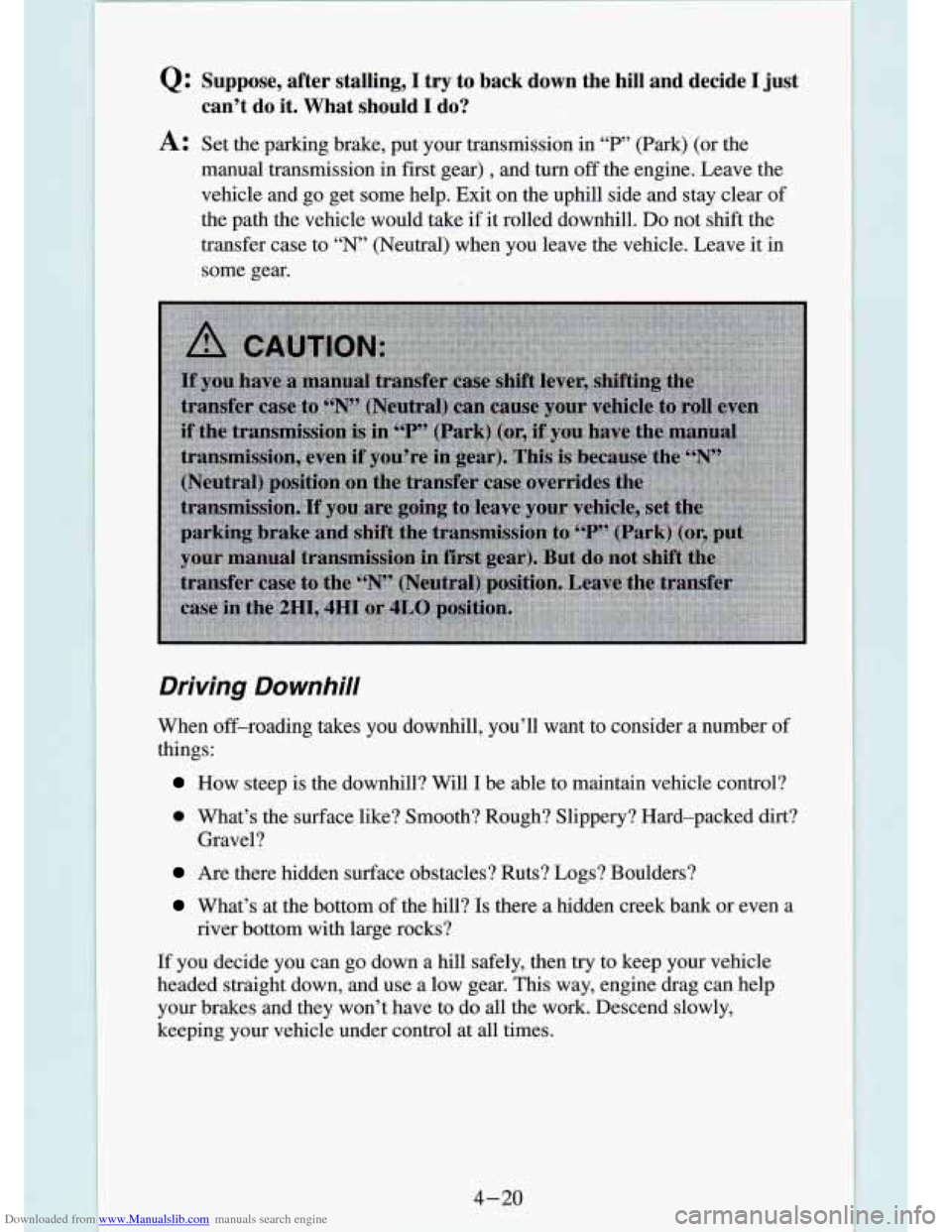
transfer case to
“N’ (Neutral) when you leave the vehicle. Leave it in
some gear.
Driving Downhill
When off-roading takes you downhill, you’ll want to consider \
a number of
things:
How steep is the downhill? Will I be able to maintain vehicle control?
0 What’s the surface like? Smooth? Rough? Slippery? Hard-packed dirt?
Gravel?
Are there hidden surface obstacles? Ruts? Logs? Boulders?
What’s at the bottom of the hill? Is there a hidden creek bank or even a
river bottom with large rocks?
If you decide you can go down a hill safely, then try to keep your vehicle
headed straight down, and use a low gear. This way, engine drag
can help
your brakes and they won’t have to do all the work. Descen\
d slowly,
keeping your vehicle under control at all times.
4-20
Page 157 of 340
Downloaded from www.Manualslib.com manuals search engine Q : Are ;there some things I should not, do when driving .down a hiIl?
A : Yes! These are important because if you ignore them you could lase
control and have a serious accident.
Shift to “P’ (Park) (or to Neutral with the manual transmission) and,
while
still braking, restart the engine.
Shift back to a low gear, release the parking brake, and drive straight
If the engine won’t start, get out and get help.
down.
4-21
Page 173 of 340
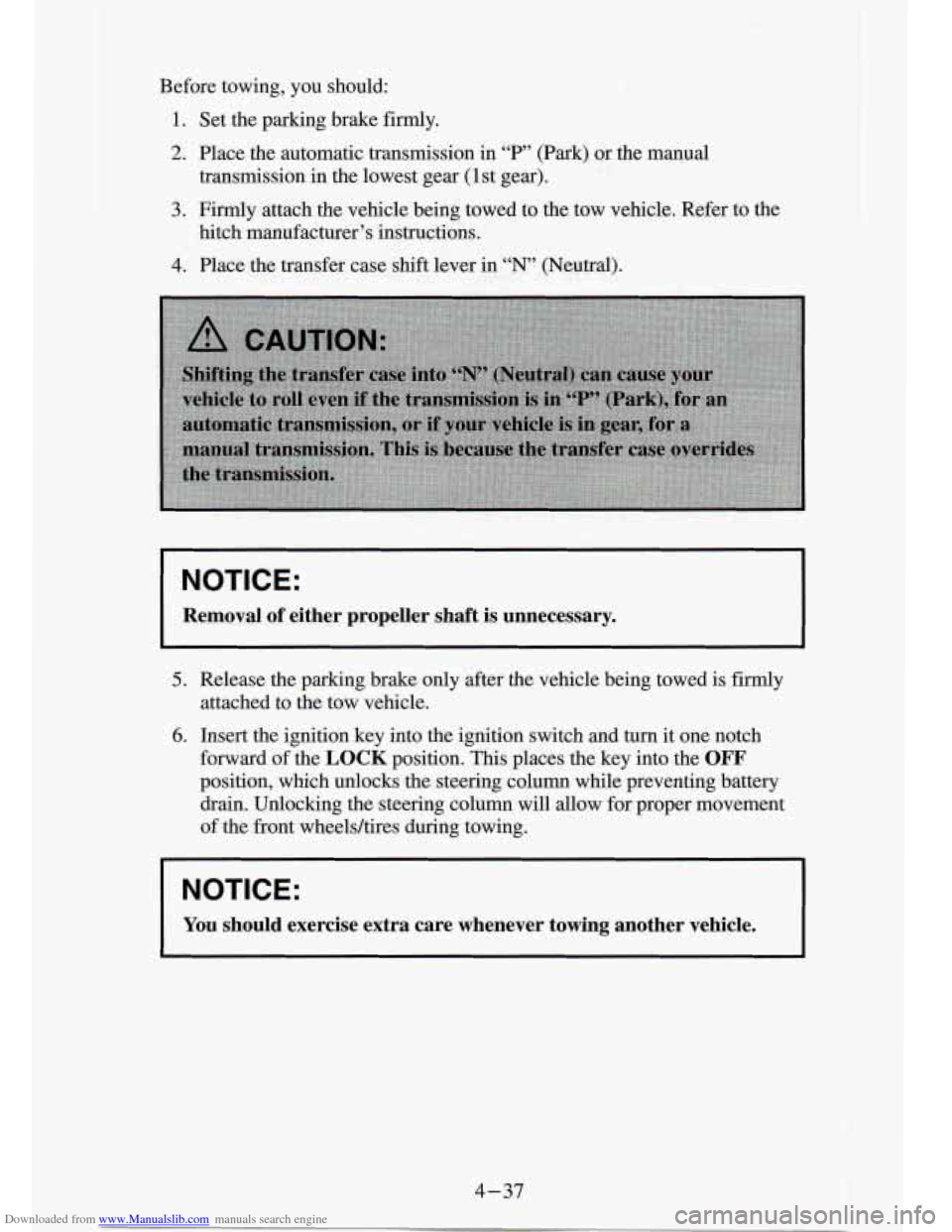
Downloaded from www.Manualslib.com manuals search engine Before towing, you should:
1. Set the parking brake firmly.
2. Place the automatic transmission in “P’ (Park) or the manual
transmission
in the lowest gear (1 st gear).
hitch manufacturer’s instructions.
3. Firmly attach
the vehicle being towed to the tow vehicle. Refer to the
4. Place the transfer case shift lever in “N’ (Neutral).
5. Release the parking brake only after the vehicle being towed i\
s firmly
6. Insert the ignition key into the ignition switch and turn it one notch
forward
of the LOCK position. This places the key into the OFF
po.sition, which unlocks the steering column while preventing battery
drain. Unlocking the steering column
will allow for proper movement
of the front wheelshires during towing.
attached to
the tow vehicle.
I NOTICE:
I You should exercise extra care whenever towing another vehicle.
4-37
Page 179 of 340
Downloaded from www.Manualslib.com manuals search engine Driving On Grades
Reduce speed and shift to a lower gear before you start dawn a long or
steep downgrade. If you don’t shift down, you might have to use your
brakes
so much that they would get hot and no longer work well.
On a long uphill grade, shift down and reduce your speed
to around 45 mph
(70 km/h) to reduce the possibility of engine and transmission overheating.
If you have an automatic transmission, you should use “D” when towing a
trailer. Operating your vehicle
in “D” when towing a trailer will minimize
heat buildup and extend the life of your transmission.
Or, if you have a
rrianual transmission with fifth gear, it’s better not to use fifth gear, just
drive in fourth gear (or, as
you need to, a lower gear).
Parking on Hills
You really should not park your vehicle, with a trailer attached, \
on a hill. If
something goes wrong, your rig could start to move. People
can be injured,
and both your vehicle and the trailer can be damaged.
But if you ever have
to park your rig on a hill, here’s how to do it:
1. Apply your regular brakes, but don’t shift into “P” (Park) yet, or into
2. Have someone place chocks under the trailer wheels.
3. When the wheel chocks are in place, release the regular brakes until the
gear
for
a manual transmission.
chocks absorb the load.
4. Reapply the regular brakes. Then apply your parking brake, and \
then
shift into
“P” (Park), or “R” (Reverse) for a manual transmission.
5. If you have a four-wheel drive vehicle with a manual transfer \
case shift
lever, be sure the transfer case is
in a drive gear-not in “N” (Neutral).
6. Release the parking brakes,
4-43
Page 180 of 340
Downloaded from www.Manualslib.com manuals search engine - . ?
-. “C ^.
When You Are Ready to Leave After Parking on a Hill
1. Apply your regular brakes and hold the pedal down while you:
Start your engine;
Shift into a gear; and
Release the parking brake.
2. Let up on the brake pedal.
3. Drive slowly until the trailer is clear of the chocks.
4. Stop and have someone pick up and store the chocks.
Maintenance When Trailer Towing
Your vehicle will need service more often when you’re pulling a trailer. See
the Maintenance Schedule for more on this. Things that are especially
important in trailer operation are automatic transmission fluid (don’t
overfill), engine oil, axle lubricant, belt, cooling system, an\
d brake
adjustment. Each
of these is covered in this manual, and the Index will help
you find them quickly.
If you’re trailering, it’s a good idea to review these
sections before you
start your trip.
Check periodically to see that all hitch nuts and bolts are tight.
Trailer Light Wiring
See “Trailer Wiring Harness” in the Index.
4-44
I b
Page 181 of 340
Downloaded from www.Manualslib.com manuals search engine Power Winches
If you wish to use a power wlncn on your vehicle, only use it when your
vehicle
is stationary or anchored.
NOTICE:
When operating a power winch on your vehicle always leave the \
transmission in the neutral position.
Do not leave an automatic
transmission in P (Park) or a manual transmission in gear or\
the
transmission may be damaged.
Use the regular brakes, set the parking brake or block the wh\
eels to keep
your vehicle from rolling.
4-45
Page 186 of 340

Downloaded from www.Manualslib.com manuals search engine I E
To Jump Start Your Vehicle:
1. Check the other vehicle. It must have a 12-volt battery wlm a\
negauve
ground system.
NOTICE:
If the other system isn’t a 12-volt system with a negative \
ground, both vehicles can be damaged.
2. Get the vehicles close enough so the jumper cables can reach, but be
sure the vehicles aren’t touching each other. If they are, it could cause
a
ground connection you don’t want. You wouldn’t be able to start your
vehicle, and the bad grounding could damage the electrical syst\
ems.
You could be injured if the vehicles roll, Set the parking brake
firmly
on each vehicle. Put an automatic transmission in “P” (Park)\
or a
manual transmission
in “N’ (Neutral). If you have a four-wheel drive
vehicle with
a manual transfer case shift lever, be sure the transfer case
is not in “N’ (Neutral).
3. Turn off the ignition on both vehicles. Turn off all lights t\
hat aren’t
needed, and radios. This will avoid sparks and help save both batteries.
And it could save your radio!
I NOTICE:
I
If you leave your radio on, it could be badly damaged. The
repairs wouldn’t be covered by your warranty.
4. Open the hoods and locate the batteries. Find the positive (+) and
negative
(-) terminals on each battery.
5-4
I
Page 234 of 340
Downloaded from www.Manualslib.com manuals search engine . . . -*
I NOTICE:
Too much or too little fluid can damage your transmission. Too
much can mean that some of the fluid could come out and fall on
hot engine parts or exhaust system, starting a fire. Be sure to get
an accurate reading if you check your transmission fluid.
Wait at least 30 minutes before checking the transmission fluid\
level if you
have been driving:
When outside temperatures are above 90°F (32°C).
At high speed for quite a while.
In heavy traffic - especially in hot weather.
While pulling a trailer.
To get the right reading, the fluid should be at normal operating\
temperature, which is 180°F to 200°F (82°C to 93°C).
To check transmissionfluid hot: Get the vehicle warmed up by driving
about 15 miles (24
km) when outside temperatures are above 50°F (10OC).
If it's colder than 50°F (10" C), drive the vehicle in "D" (3rd Gear) until the
engine temperature gage moves and then remains steady for ten minutes.
Then follow the hot check procedures.
Tu check transmission fluid cold: A cold check is made after the vehicle has
been sitting for eight hours or more with the engine off and is used only as \
a
reference. Let the engine run at idle for five minutes if outside temperatures
are
50°F (10OC) or more. If it's colder than 50°F (lO"C), you may have to
idle the engine longer. Should the fluid level be low during a cold ch\
eck,
you
must perform a hot check before adding fluid. This will give you a\
more accurate reading of the fluid level.
To check the fluid hot or cold
Park your vehicle on a level place.
With the parking brake applied, place the shift lever in "P' (Park).
With your foot on the brake pedal, move the shift lever throu\
gh each
gear range, pausing
for about three seconds in each range. Then,
position the shift lever in
"P' (Park).
Let the engine run at idle for three minutes or more.
6- 16
I