engine CHEVROLET SILVERADO 2017 3.G Owners Manual
[x] Cancel search | Manufacturer: CHEVROLET, Model Year: 2017, Model line: SILVERADO, Model: CHEVROLET SILVERADO 2017 3.GPages: 509, PDF Size: 8.87 MB
Page 365 of 509
Chevrolet Silverado Owner Manual (GMNA-Localizing-U.S./Canada/Mexico-9956065) - 2017 - CRC - 4/29/16
364 Vehicle Care
three seconds in each range.Then, move the shift lever backto P (Park).
4. Allow the engine to idle (500–800 rpm) for at leastone minute. Slowly release thebrake pedal.
5. Keep the engine running andcheck the transmission fluidtemperature on the DriverInformation Center (DIC). SeeDriver Information Center (DIC)(Base Level)0145orDriverInformation Center (DIC)(Uplevel)0147.
6. Using the transmission fluidtemperature reading, determineand perform the appropriatecheck procedure. If thetransmission fluid temperaturereading is not within therequired temperature ranges,allow the vehicle to cool,or operate the vehicle until theappropriate transmission fluidtemperature is reached.
Cold Check Procedure
Use this procedure only as areference to determine if thetransmission has enough fluid to beoperated safely until a hot checkprocedure can be made. The hotcheck procedure is the mostaccurate method to check the fluidlevel. Perform the hot checkprocedure at the first opportunity.Use this cold check procedure tocheck fluid level when thetransmission temperature isbetween 27 °C and 32 °C (80 °F and90 °F).
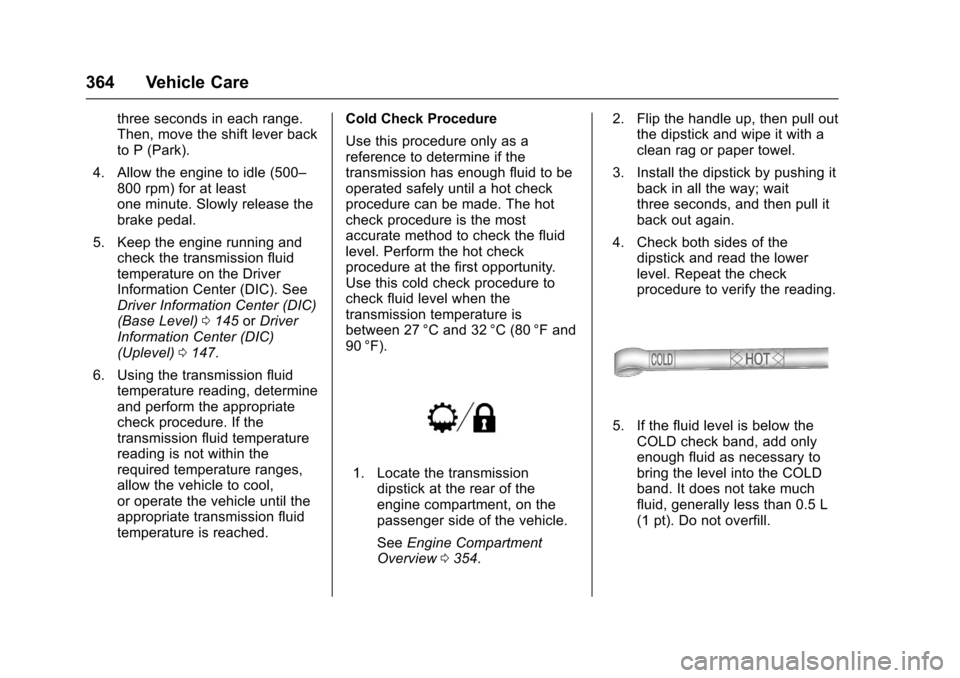
1. Locate the transmissiondipstick at the rear of theengine compartment, on thepassenger side of the vehicle.
SeeEngine CompartmentOverview0354.
2. Flip the handle up, then pull outthe dipstick and wipe it with aclean rag or paper towel.
3. Install the dipstick by pushing itback in all the way; waitthree seconds, and then pull itback out again.
4. Check both sides of thedipstick and read the lowerlevel. Repeat the checkprocedure to verify the reading.
5. If the fluid level is below theCOLD check band, add onlyenough fluid as necessary tobring the level into the COLDband. It does not take muchfluid, generally less than 0.5 L(1 pt). Do not overfill.
Page 366 of 509
Chevrolet Silverado Owner Manual (GMNA-Localizing-U.S./Canada/Mexico-9956065) - 2017 - CRC - 4/29/16
Vehicle Care 365
6. Perform a hot check at the firstopportunity after thetransmission reaches a normaloperating temperature between71 °C to 93 °C (160 °F to200 °F).
7. If the fluid level is in theacceptable range, push thedipstick back in all the way,then flip the handle down tolock the dipstick in place.
Hot Check Procedure
Use this procedure to check thetransmission fluid level when thetransmission fluid temperature isbetween 71 °C and 93 °C (160 °Fand 200 °F).
The hot check is the most accuratemethod to check the fluid level. Thehot check should be performed atthe first opportunity in order to verifythe cold check. The fluid level risesas fluid temperature increases, so itis important to ensure thetransmission temperature is withinrange.
1. Locate the transmissiondipstick at the rear of theengine compartment, on thepassenger side of the vehicle.
SeeEngine CompartmentOverview0354.
2. Flip the handle up, then pull outthe dipstick and wipe it with aclean rag or paper towel.
3. Install the dipstick by pushing itback in all the way; waitthree seconds, and then pull itback out again.
4. Check both sides of thedipstick and read the lowerlevel. Repeat the checkprocedure to verify the reading.
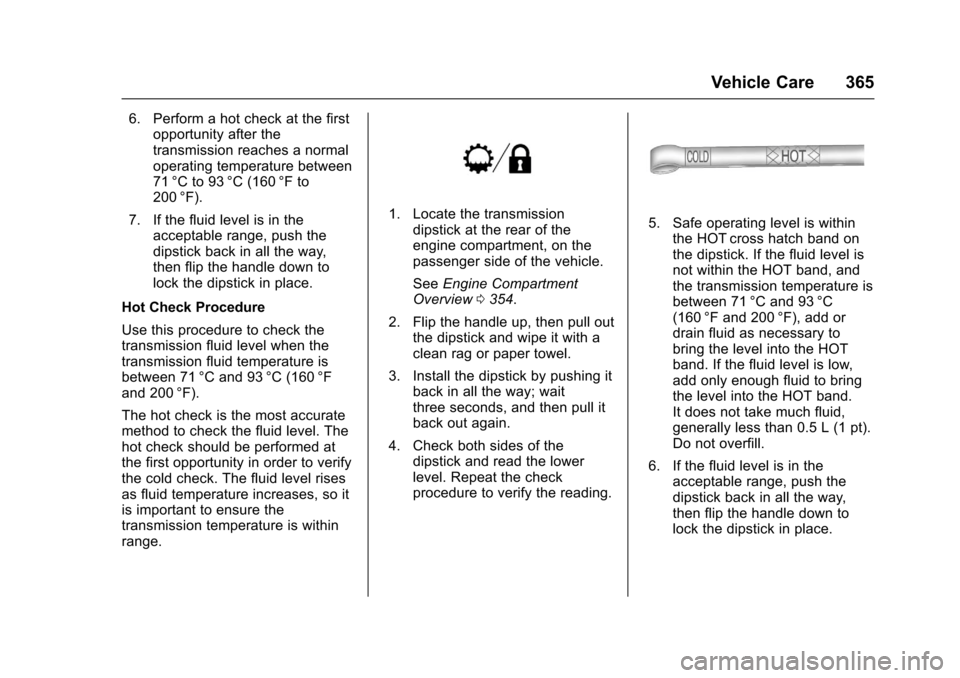
5. Safe operating level is withinthe HOT cross hatch band onthe dipstick. If the fluid level isnot within the HOT band, andthe transmission temperature isbetween 71 °C and 93 °C(160 °F and 200 °F), add ordrain fluid as necessary tobring the level into the HOTband. If the fluid level is low,add only enough fluid to bringthe level into the HOT band.It does not take much fluid,generally less than 0.5 L (1 pt).Do not overfill.
6. If the fluid level is in theacceptable range, push thedipstick back in all the way,then flip the handle down tolock the dipstick in place.
Page 368 of 509
Chevrolet Silverado Owner Manual (GMNA-Localizing-U.S./Canada/Mexico-9956065) - 2017 - CRC - 4/29/16
Vehicle Care 367
When to Check and What
to Use
The hydraulic clutch fluid reservoiris filled with DOT 3 brake fluid asindicated on the reservoir cap. SeeEngine Compartment Overview0354for reservoir location.
How to Check and Add Fluid
Visually check the clutch fluidreservoir to make sure the fluid levelis at the MIN (minimum) line on theside of the reservoir. The hydraulicclutch fluid system should be closedand sealed.
Do not remove the cap to check thefluid level or to top-off the fluid level.Remove the cap only whennecessary to add the proper fluiduntil the level reaches the MIN line.
Engine Air Cleaner/Filter
If the vehicle has a diesel engine,see“8-Cylinder Pickup Models”under“Engine Air Cleaner/Filter”inthe Duramax diesel supplement forthe correct inspection andreplacement procedures.
The engine air cleaner/filter is onthe passenger side of the enginecompartment. SeeEngineCompartment Overview0354.
When to Inspect the Engine Air
Cleaner/Filter
For intervals on changing andinspecting the engine air filter, seeMaintenance Schedule0452.
How to Inspect the Engine Air
Cleaner/Filter
Do not start the engine or have theengine running with the engine aircleaner/filter housing open. Beforeremoving the engine air cleaner/filter, make sure that the engine aircleaner/filter housing and nearbycomponents are free of dirt anddebris. Remove the engine aircleaner/filter. Lightly tap and shakethe engine air cleaner/filter (awayfrom the vehicle), to release loosedust and dirt. Inspect the engine aircleaner/filter for damage, andreplace if damaged. Do not cleanthe engine air cleaner/filter orcomponents with water orcompressed air.
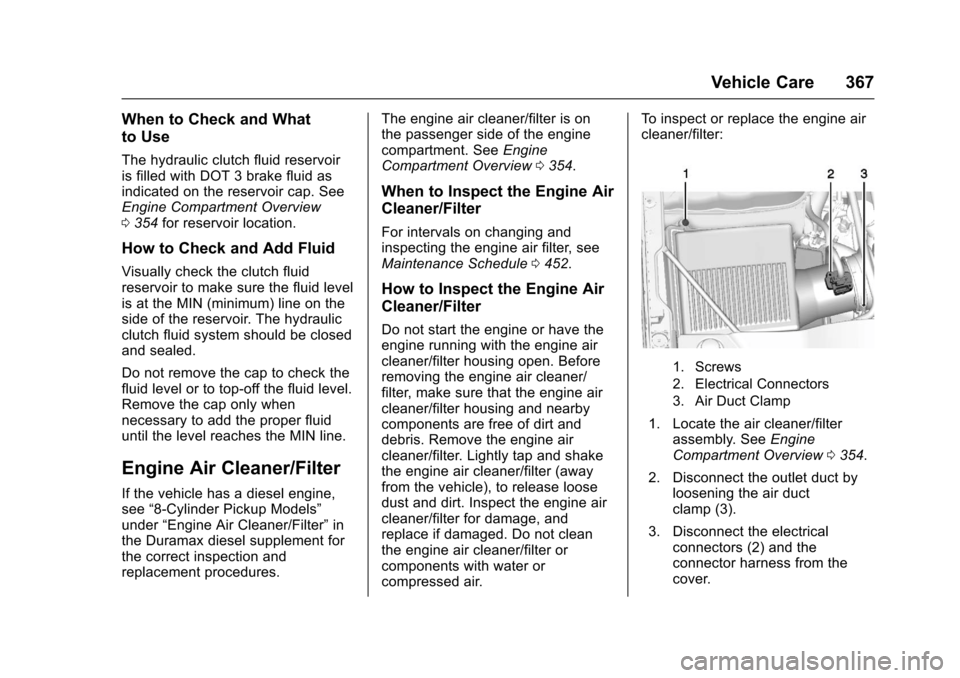
To i n s p e c t o r r e p l a c e t h e e n g i n e a i rcleaner/filter:
1. Screws
2. Electrical Connectors
3. Air Duct Clamp
1. Locate the air cleaner/filterassembly. SeeEngineCompartment Overview0354.
2. Disconnect the outlet duct byloosening the air ductclamp (3).
3. Disconnect the electricalconnectors (2) and theconnector harness from thecover.
Page 369 of 509
Chevrolet Silverado Owner Manual (GMNA-Localizing-U.S./Canada/Mexico-9956065) - 2017 - CRC - 4/29/16
368 Vehicle Care
4. Remove the four screws (1) ontop of the cover of the housingand lift up the cover.
5. Remove the engine air cleaner/filter from the housing. Takecare to dislodge as little dirt aspossible.
6. Clean the engine air cleaner/filter sealing surfaces and thehousing.
7. Inspect or replace the engineair cleaner/filter.
8. Reverse Steps 2–4toreinstallthe filter cover housing.
{Warning
Operating the engine with the air
cleaner/filter off can cause you or
others to be burned. The air
cleaner not only cleans the air; it
helps to stop flames if the engine
backfires. Use caution when
working on the engine and do not
drive with the air cleaner/filter off.
Caution
If the air cleaner/filter is off, dirt
can easily get into the engine,
which could damage it. Always
have the air cleaner/filter in place
when you are driving.
Cooling System
If the vehicle has the Duramaxdiesel engine, see the Duramaxdiesel supplement.
The cooling system allows theengine to maintain the correctworking temperature.
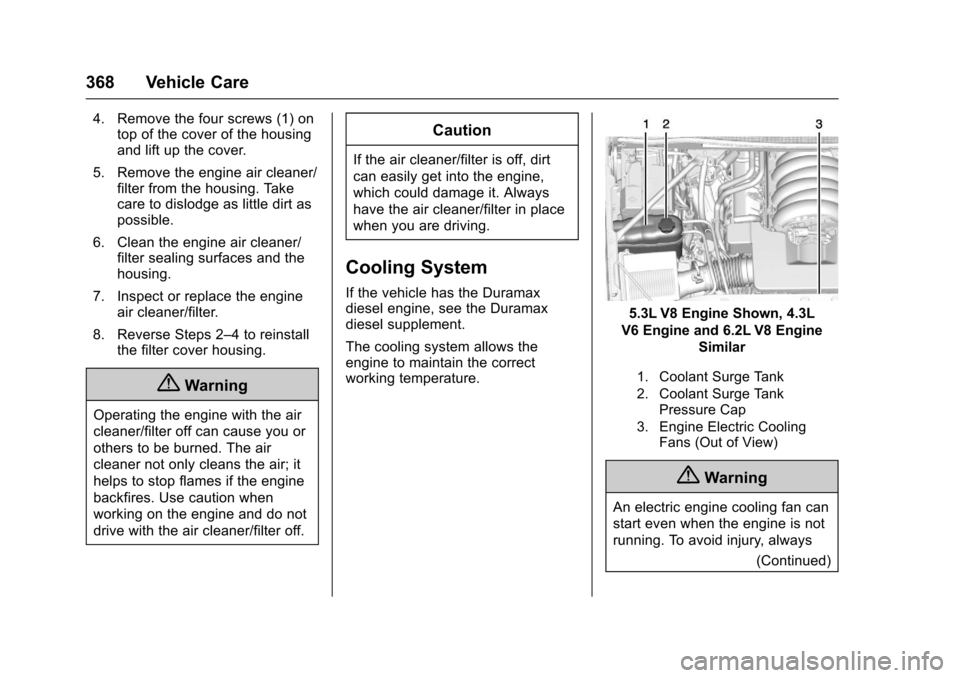
5.3L V8 Engine Shown, 4.3L
V6 Engine and 6.2L V8 Engine
Similar
1. Coolant Surge Tank
2. Coolant Surge TankPressure Cap
3. Engine Electric CoolingFans (Out of View)
{Warning
An electric engine cooling fan can
start even when the engine is not
running. To avoid injury, always
(Continued)
Page 370 of 509
Chevrolet Silverado Owner Manual (GMNA-Localizing-U.S./Canada/Mexico-9956065) - 2017 - CRC - 4/29/16
Vehicle Care 369
Warning (Continued)
keep hands, clothing, and tools
away from any engine
cooling fan.
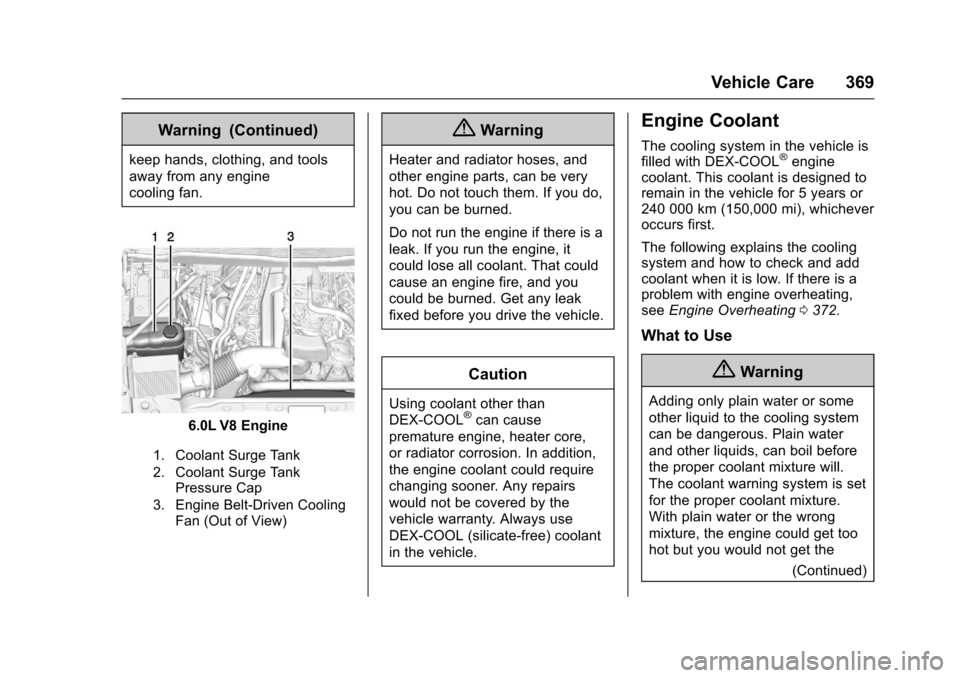
6.0L V8 Engine
1. Coolant Surge Tank
2. Coolant Surge TankPressure Cap
3. Engine Belt-Driven CoolingFan (Out of View)
{Warning
Heater and radiator hoses, and
other engine parts, can be very
hot. Do not touch them. If you do,
you can be burned.
Do not run the engine if there is a
leak. If you run the engine, it
could lose all coolant. That could
cause an engine fire, and you
could be burned. Get any leak
fixed before you drive the vehicle.
Caution
Using coolant other than
DEX-COOL®can cause
premature engine, heater core,
or radiator corrosion. In addition,
the engine coolant could require
changing sooner. Any repairs
would not be covered by the
vehicle warranty. Always use
DEX-COOL (silicate-free) coolant
in the vehicle.
Engine Coolant
The cooling system in the vehicle isfilled with DEX-COOL®enginecoolant. This coolant is designed toremain in the vehicle for 5 years or240 000 km (150,000 mi), whicheveroccurs first.
The following explains the coolingsystem and how to check and addcoolant when it is low. If there is aproblem with engine overheating,seeEngine Overheating0372.
What to Use
{Warning
Adding only plain water or some
other liquid to the cooling system
can be dangerous. Plain water
and other liquids, can boil before
the proper coolant mixture will.
The coolant warning system is set
for the proper coolant mixture.
With plain water or the wrong
mixture, the engine could get too
hot but you would not get the
(Continued)
Page 371 of 509
Chevrolet Silverado Owner Manual (GMNA-Localizing-U.S./Canada/Mexico-9956065) - 2017 - CRC - 4/29/16
370 Vehicle Care
Warning (Continued)
overheat warning. The engine
could catch fire and you or others
could be burned. Use a
50/50 mixture of clean, drinkable
water and DEX-COOL coolant.
Use a 50/50 mixture of clean,drinkable water and DEX-COOLcoolant. If using this mixture,nothing else needs to be added.This mixture:
.Gives freezing protection downto✓37 °C (✓34 °F), outsidetemperature.
.Gives boiling protection up to129 °C (265 °F), enginetemperature.
.Protects against rust andcorrosion.
.Will not damage aluminum parts.
.Helps keep the proper enginetemperature.
Caution
If improper coolant mixture,
inhibitors, or additives are used in
the vehicle cooling system, the
engine could overheat and be
damaged. Too much water in the
mixture can freeze and crack
engine cooling parts. The repairs
would not be covered by the
vehicle warranty. Use only the
proper mixture of engine coolant
for the cooling system. See
Recommended Fluids and
Lubricants0462.
Never dispose of engine coolant byputting it in the trash, or by pouringit on the ground, or into sewers,streams, or bodies of water. Havethe coolant changed by anauthorized service center, familiarwith legal requirements regardingused coolant disposal. This will helpprotect the environment and yourhealth.
Checking Coolant
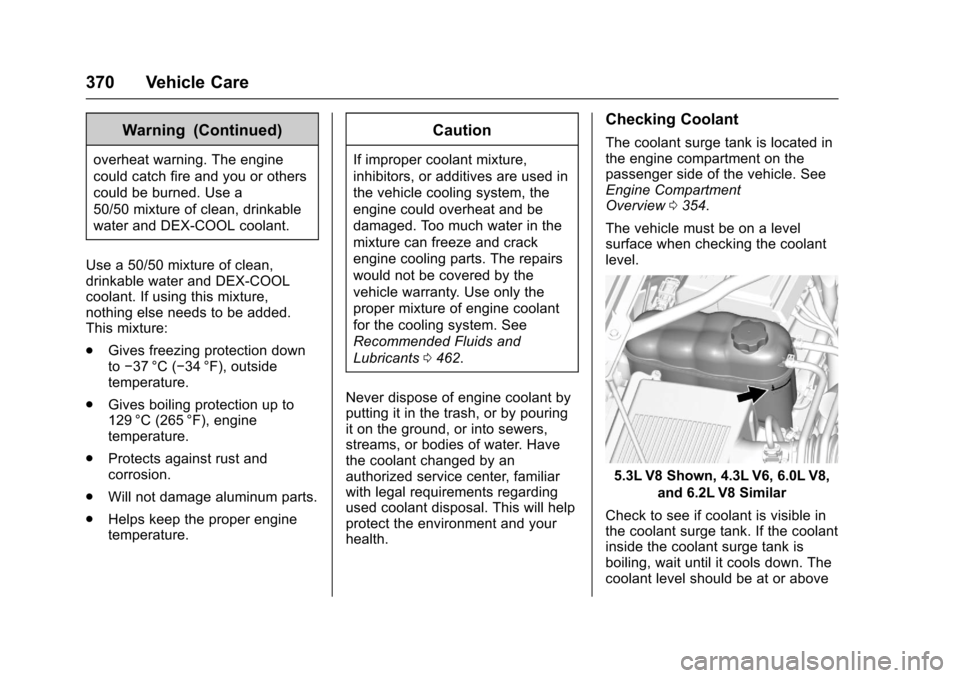
The coolant surge tank is located inthe engine compartment on thepassenger side of the vehicle. SeeEngine CompartmentOverview0354.
The vehicle must be on a levelsurface when checking the coolantlevel.
5.3L V8 Shown, 4.3L V6, 6.0L V8,
and 6.2L V8 Similar
Check to see if coolant is visible inthe coolant surge tank. If the coolantinside the coolant surge tank isboiling, wait until it cools down. Thecoolant level should be at or above
Page 372 of 509
Chevrolet Silverado Owner Manual (GMNA-Localizing-U.S./Canada/Mexico-9956065) - 2017 - CRC - 4/29/16
Vehicle Care 371
the FULL COLD mark. If it is not,there may be a leak in the coolingsystem.
If coolant is visible but the coolantlevel is not at or above the FULLCOLD mark, see“How to AddCoolant to the Coolant Surge Tankfor Gasoline Engines,”following.
How to Add Coolant to the
Coolant Surge Tank for
Gasoline Engines
If the vehicle has a diesel engine,see“Cooling System”in theDuramax diesel supplement for theproper coolant fill procedure.
{Warning
Yo u c a n b e b u r n e d i f y o u s p i l l
coolant on hot engine parts.
Coolant contains ethylene glycol
and it will burn if the engine parts
are hot enough. Do not spill
coolant on a hot engine.
Caution
This vehicle has a specific
coolant fill procedure. Failure to
follow this procedure could cause
the engine to overheat and be
severely damaged.
{Warning
Steam and scalding liquids from a
hot cooling system can blow out
and burn you badly. Never turn
the cap when the cooling system,
including the surge tank pressure
cap, is hot. Wait for the cooling
system and surge tank pressure
cap to cool.
If no coolant is visible in the surgetank, add coolant.
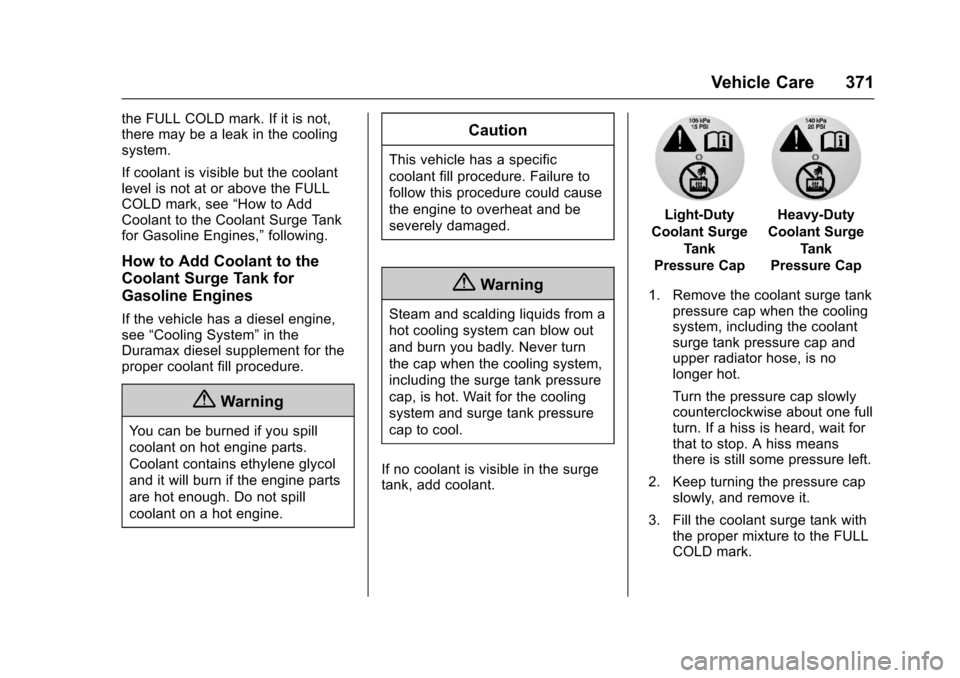
Light-Duty
Coolant Surge
Tank
Pressure Cap
Heavy-Duty
Coolant Surge
Tank
Pressure Cap
1. Remove the coolant surge tankpressure cap when the coolingsystem, including the coolantsurge tank pressure cap andupper radiator hose, is nolonger hot.
Turn the pressure cap slowlycounterclockwise about one fullturn. If a hiss is heard, wait forthat to stop. A hiss meansthere is still some pressure left.
2. Keep turning the pressure capslowly, and remove it.
3. Fill the coolant surge tank withthe proper mixture to the FULLCOLD mark.
Page 373 of 509
Chevrolet Silverado Owner Manual (GMNA-Localizing-U.S./Canada/Mexico-9956065) - 2017 - CRC - 4/29/16
372 Vehicle Care
4. With the coolant surge tankpressure cap off, start theengine and let it run until theengine coolant temperaturegauge indicates approximately90 °C (195 °F).
By this time, the coolant levelinside the coolant surge tankmay be lower. If the level islower, add more of the propermixture to the coolant surgetank until the level reaches theFULL COLD mark.
5. Replace the pressure captightly.
6. Verify coolant level after theengine is shut off and thecoolant is cold. If necessary,repeat coolant fill procedureSteps 1–6.
Caution
If the pressure cap is not tightly
installed, coolant loss and
possible engine damage may
occur. Be sure the cap is properly
and tightly secured.
Engine Overheating
If the vehicle has the Duramaxdiesel engine, see the Duramaxdiesel supplement.
Caution
Running the engine without
coolant may cause damage or a
fire. Vehicle damage would not be
covered by the vehicle warranty.
The vehicle has several indicatorsto warn of engine overheating.
There is a coolant temperaturegauge in the vehicle's instrumentcluster. SeeEngine CoolantTe m p e r a t u r e G a u g e0133.
In addition, there are ENGINEOVERHEATED STOP ENGINE,ENGINE OVERHEATED IDLEENGINE, and ENGINE POWER ISREDUCED messages in the DriverInformation Center (DIC). SeeEngine Cooling System Messages0152andEngine PowerMessages0153.
If the decision is made not to lift thehood when this warning appears,get service help right away. SeeRoadside AssistanceProgram0476.
If the decision is made to lift thehood, make sure the vehicle isparked on a level surface.
4.3L V6, 5.3L V8, and 6.2LV8 Engines
Check to see if the engine coolingfans are running. If the engine isoverheating, the fans should berunning. If they are not, do notcontinue to run the engine and havethe vehicle serviced.
If Steam is Coming from the
Engine Compartment
{Warning
Steam from an overheated engine
can burn you badly, even if you
just open the hood. Stay away
from the engine if you see or hear
steam coming from it. Just turn it
(Continued)
Page 374 of 509
Chevrolet Silverado Owner Manual (GMNA-Localizing-U.S./Canada/Mexico-9956065) - 2017 - CRC - 4/29/16
Vehicle Care 373
Warning (Continued)
off and get everyone away from
the vehicle until it cools down.
Wait until there is no sign of
steam or coolant before you open
the hood.
If you keep driving when the
engine is overheated, the liquids
in it can catch fire. You or others
could be badly burned. Stop the
engine if it overheats, and get out
of the vehicle until the engine
is cool.
If No Steam is Coming from
the Engine Compartment
The ENGINE OVERHEATED STOPENGINE or the ENGINEOVERHEATED IDLE ENGINEmessage, along with a low coolantcondition, can indicate a seriousproblem.
If there is an engine overheatwarning, but no steam is seen orheard, the problem may not be tooserious. Sometimes the engine canget a little too hot when the vehicle:
.Climbs a long hill on a hot day.
.Stops after high-speed driving.
.Idles for long periods in traffic.
.To w s a t r a i l e r ; s e eTr a i l e rTo w i n g0318.
If the ENGINE OVERHEATEDSTOP ENGINE or the ENGINEOVERHEATED IDLE ENGINEmessage appears with no sign ofsteam, try this for a minute or so:
1. Turn the air conditioning off.
2. Turn the heater on to thehighest temperature and to thehighest fan speed. Open thewindows as necessary.
3. When it is safe to do so, pull offthe road, shift to P (Park) orN(Neutral)andlettheengine idle.
If the temperature overheat gauge isno longer in the overheat zone or anoverheat warning no longer
displays, the vehicle can be driven.Continue to drive the vehicle slowlyfor about 10 minutes. Keep a safevehicle distance from the vehicle infront. If the warning does not comeback on, continue to drive normallyand have the cooling systemchecked for proper fill and function.
If the warning continues, pull over,stop, and park the vehicleright away.
If there is still no sign of steam andthe vehicle is equipped with anengine driven cooling fan, pushdown the accelerator until theengine speed is about twice as fastas normal idle speed for at leastfive minutes while the vehicle isparked. If the warning is still there,turn off the engine and get everyoneout of the vehicle until it cools down.
If there is no sign of steam, idle theengine for five minutes whileparked. If the warning is stilldisplayed, turn off the engine until itcools down.
Page 375 of 509
Chevrolet Silverado Owner Manual (GMNA-Localizing-U.S./Canada/Mexico-9956065) - 2017 - CRC - 4/29/16
374 Vehicle Care
Overheated Engine
Protection
Operating Mode
If an overheated engine conditionexists and the ENGINE POWER ISREDUCED message displays, anoverheat protection mode whichalternates firing groups of cylindershelps to prevent engine damage. Inthis mode, a loss in power andengine performance will be noticed.This operating mode allows thevehicle to be driven to a safe placein an emergency. Driving extendeddistances and/or towing a trailer inthe overheat protection modeshould be avoided.
Caution
After driving in the overheated
engine protection operating
mode, the engine oil will be
severely degraded. Any repairs
performed before the engine is
cool may cause engine damage.
Allow the engine to cool before
(Continued)
Caution (Continued)
attempting any repair. Repair the
cause of coolant loss, change the
oil, and reset the oil life system.
SeeEngine Oil0359.
Engine Fan
If the vehicle has a clutched enginecooling fan, when the clutch isengaged, the fan spins faster toprovide more air to cool the engine.In most everyday driving conditions,the fan is spinning slower and theclutch is not fully engaged. Thisimproves fuel economy and reducesfan noise. Under heavy vehicleloading, trailer towing, and/or highoutside temperatures, the fan speedincreases as the clutch more fullyengages, so an increase in fannoise may be heard. This is normaland should not be mistaken as thetransmission slipping or makingextra shifts. It is merely the coolingsystem functioning properly. The fanwill slow down when additionalcooling is not required and theclutch disengages.
This fan noise may also be heardwhen starting the engine. It will goaway as the fan clutch partiallydisengages.
If the vehicle has electric coolingfan(s), the fans may be heardspinning at low speed during mosteveryday driving. The fans may turnoff if no cooling is required. Underheavy vehicle loading, trailer towing,high outside temperatures,or operation of the air conditioningsystem, the fans may change tohigh speed and an increase in fannoise may be heard. This is normaland indicates that the coolingsystem is functioning properly. Thefans will change to low speed whenadditional cooling is no longerrequired.
The electric engine cooling fansmay run after the engine has beenturned. off. This is normal and noservice is required.