brake CHEVROLET SILVERADO 2017 3.G Repair Manual
[x] Cancel search | Manufacturer: CHEVROLET, Model Year: 2017, Model line: SILVERADO, Model: CHEVROLET SILVERADO 2017 3.GPages: 509, PDF Size: 8.87 MB
Page 317 of 509
Chevrolet Silverado Owner Manual (GMNA-Localizing-U.S./Canada/Mexico-9956065) - 2017 - CRC - 4/29/16
316 Driving and Operating
.The trailer must be equippedwith brakes adequate for theintended use. A loaded trailerweighing more than 900 kg(2,000 lb) must be equipped withits own brake system, withbrakes working on all axles.Trailer braking equipmentconforming to CanadianStandards Association (CSA)requirement CAN3-D313, or itsequivalent, is recommended.
.Do not tow a trailer during thefirst 800 km (500 mi) to preventdamage to the engine, axle,or other parts.
.Then during the first 800 km(500 mi) of trailer towing, do notdrive over 80 km/h (50 mph) anddo not make starts at full throttle.
.Vehicles can tow in D (Drive).The Tow/Haul Mode may beused if the transmission shiftstoo often. SeeTo w / H a u lMode0282.
.Turn off Park Assist whentowing.
{Warning
When towing a trailer, exhaust
gases may collect at the rear of
the vehicle and enter if the
liftgate, trunk/hatch, or rear-most
window is open.
When towing a trailer:
.Do not drive with theliftgate, trunk/hatch,or rear-most window open.
.Fully open the air outlets onor under the instrumentpanel.
.Also adjust the climatecontrol system to a settingthat brings in only outsideair. See“Climate ControlSystems”in the Index.
For more information about
carbon monoxide, seeEngine
Exhaust0276.
To w i n g a t r a i l e r r e q u i r e s a c e r t a i namount of experience. Thecombination you are driving islonger and not as responsive as the
vehicle itself. Get acquainted withthe handling and braking of the rigbefore setting out for the open road.
The structure, tires, and brakes ofthe trailer must be rated to carry theload. Inadequate trailer equipmentcan cause the combination tooperate in an unexpected or unsafemanner.
Before starting, check all trailer hitchparts and attachments, safetychains, electrical connectors, lamps,tires, and mirrors. Get familiar withthe handling and braking of the rig.If the trailer has electric brakes, startthe combination moving and thenapply the trailer brake controller byhand to be sure the brakes work.
During the trip, check occasionallyto be sure that the load is secureand the lamps and any trailerbrakes still work.
Following Distance
Stay at least twice as far behind thevehicle ahead as you would whendriving the vehicle without a trailer.This can help to avoid heavybraking and sudden turns.
Page 318 of 509
Chevrolet Silverado Owner Manual (GMNA-Localizing-U.S./Canada/Mexico-9956065) - 2017 - CRC - 4/29/16
Driving and Operating 317
Passing
More passing distance is neededwhen towing a trailer. Thecombination will not accelerate asquickly and is longer so it isnecessary to go much fartherbeyond the passed vehicle beforereturning to the lane.
Backing Up
Hold the bottom of the steeringwheel with one hand. To move thetrailer to the left, move that hand tothe left. To move the trailer to theright, move your hand to the right.Always back up slowly and,if possible, have someoneguide you.
Making Turns
Caution
Making very sharp turns while
trailering could cause the trailer to
come in contact with the vehicle.
The vehicle could be damaged.
Avoid making very sharp turns
while trailering.
When turning with a trailer, makewider turns than normal. Do this sothe trailer will not strike softshoulders, curbs, road signs, trees,or other objects. Avoid jerky orsudden maneuvers. Signal well inadvance.
If the trailer turn signal bulbs burnout, the arrows on the instrumentcluster will still flash for turns. It isimportant to check occasionally tobe sure the trailer bulbs are stillworking.
Driving on Grades
Reduce speed and shift to a lowergearbeforestarting down a long orsteep downgrade. If thetransmission is not shifted down, thebrakes might get hot and no longerwork well.
Vehicles can tow in D (Drive). Shiftthe transmission to a lower gear ifthe transmission shifts too oftenunder heavy loads and/or hillyconditions.
The Tow/Haul Mode may be used ifthe transmission shifts too often.SeeTo w / H a u l M o d e0282.
When towing at high altitude onsteep uphill grades, consider thefollowing: Engine coolant will boil atalowertemperaturethanatnormalaltitudes. If the engine is turned offimmediately after towing at highaltitude on steep uphill grades, thevehicle may show signs similar toengine overheating. To avoid this,let the engine run while parked,preferably on level ground, with thetransmission in P (Park) for a fewminutes before turning the engineoff. If the overheat warning comeson, seeEngine Overheating0372.
Parking on Hills
{Warning
Parking the vehicle on a hill with
the trailer attached can be
dangerous. If something goes
wrong, the rig could start to move.
People can be injured, and both
the vehicle and the trailer can be
damaged. When possible, always
park the rig on a flat surface.
Page 319 of 509
Chevrolet Silverado Owner Manual (GMNA-Localizing-U.S./Canada/Mexico-9956065) - 2017 - CRC - 4/29/16
318 Driving and Operating
If parking the rig on a hill:
1. Press the brake pedal, but donot shift into P (Park) yet. Turnthe wheels into the curb iffacing downhill or into traffic iffacing uphill.
2. Have someone place chocksunder the trailer wheels.
3. When the wheel chocks are inplace, release the regularbrakes until the chocks absorbthe load.
4. Reapply the brake pedal. Thenapply the parking brake andshift into P (Park).
5. Release the brake pedal.
Leaving After Parking on a Hill
1. Apply and hold the brakepedal.
2. Start the engine.
3. Shift into a gear.
4. Release the parking brake.
5. Let up on the brake pedal.
6. Drive slowly until the trailer isclear of the chocks.
7. Stop and have someone pickup and store the chocks.
Maintenance when Trailer
Towing
The vehicle needs service moreoften when pulling a trailer. SeeMaintenance Schedule0452.Things that are especially importantin trailer operation are automatictransmission fluid, engine oil, axlelubricant, belts, cooling system, andbrake system. It is a good idea toinspect these before and duringthe trip.
Check periodically to see that allhitch nuts and bolts are tight.
Trailer Towing
If the vehicle has a diesel engine,see the Duramax dieselsupplement.
If the vehicle is bi-fuel, see thebi-fuel supplement.
Do not tow a trailer during break-in.SeeNew Vehicle Break-In0267.
{Warning
The driver can lose control when
pulling a trailer if the correct
equipment is not used or the
vehicle is not driven properly. For
example, if the trailer is too heavy
or the trailer brakes are
inadequate for the load, the
vehicle may not stop as expected.
The driver and passengers could
be seriously injured. The vehicle
may also be damaged; the
resulting repairs would not be
covered by the vehicle warranty.
Pull a trailer only if all the steps in
this section have been followed.
Ask your dealer for advice and
information about towing a trailer
with the vehicle.
Caution
Pulling a trailer improperly can
damage the vehicle and result in
costly repairs not covered by the
(Continued)
Page 338 of 509
Chevrolet Silverado Owner Manual (GMNA-Localizing-U.S./Canada/Mexico-9956065) - 2017 - CRC - 5/6/16
Driving and Operating 337
pickups. Trailer pin box extensionsand sliding fifth-wheel hitchassemblies can help this condition.There should be at least 15 cm (6 in)of clearance between the top of thepickup box and the bottom of thetrailer shelf that extends overthe box.
Safety Chains
Always attach chains between thevehicle and the trailer. Cross thesafety chains under the tongue ofthe trailer to help prevent the tonguefrom contacting the road if itbecomes separated from the hitch.Instructions about safety chainsmay be provided by the hitchmanufacturer or by the trailermanufacturer. If the trailer beingtowed weighs up to 2 271 kg(5,000 lb) with a factory-installedstep bumper, safety chains may beattached to the attaching points onthe bumper; otherwise, safetychains should be attached to holeson the trailer hitch platform. Alwaysleave just enough slack so thecombination can turn. Never allowsafety chains to drag on the ground.
Trailer Brakes
Aloadedtrailerthatweighsmorethan 900 kg (2,000 lb) must beequipped with its own brake system,with brakes working on all axles.Trailer braking equipmentconforming to Canadian StandardsAssociation (CSA) requirementCAN3-D313, or its equivalent, isrecommended.
State and local regulations may alsorequire the trailer to have its ownbraking system if loaded above acertain threshold.
Be sure to read and follow theinstructions for the trailer brakes sothey are installed, adjusted, andmaintained properly.
Do not tap into the vehicle'shydraulic brake system.
Auxiliary Battery
The auxiliary battery provision canbe used to supply electrical powerto additional equipment that may beadded, such as a slide-in camper.If equipped, this relay will be on thedriver side of the vehicle, next to theunderhood electrical center.
Be sure to follow the properinstallation instructions included withany electrical equipment that isinstalled.
Caution
Leaving electrical equipment on
for extended periods will drain the
battery. Always turn off electrical
equipment when not in use and
do not use equipment that
exceeds the maximum amperage
rating of 30 amps for the auxiliary
battery provision.
Trailer Wiring Harness
The vehicle is equipped with one ofthe following wiring harnesses fortowing a trailer or hauling a slide-incamper.
Basic Trailer Wiring
All regular, double cab, and crewcab pickups have a seven-wiretrailer towing harness.
Page 339 of 509
Chevrolet Silverado Owner Manual (GMNA-Localizing-U.S./Canada/Mexico-9956065) - 2017 - CRC - 5/6/16
338 Driving and Operating
Use only a round, seven-wireconnector with flat blade terminalsmeeting SAE J2863 specificationsfor proper electrical connectivity.
For vehicles not equipped withheavy-duty trailering, the harness issecured to the vehicle's framebehind the spare tire mount. Theharness requires the installation of atrailer connector, which is availablethrough your dealer.
Heavy-Duty Trailer Wiring HarnessPackage
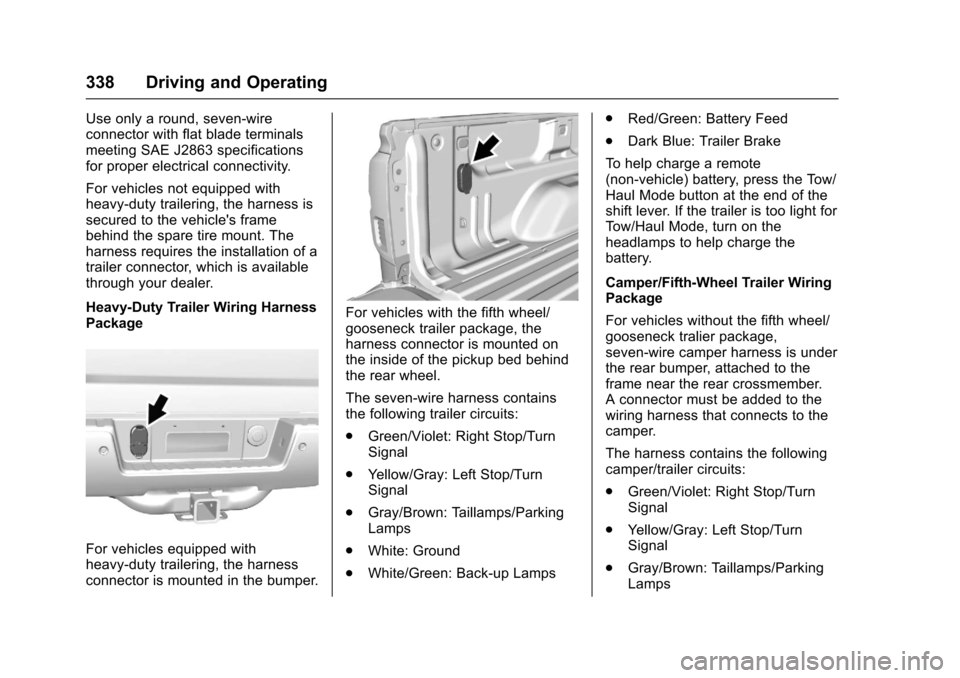
For vehicles equipped withheavy-duty trailering, the harnessconnector is mounted in the bumper.
For vehicles with the fifth wheel/gooseneck trailer package, theharness connector is mounted onthe inside of the pickup bed behindthe rear wheel.
The seven-wire harness containsthe following trailer circuits:
.Green/Violet: Right Stop/TurnSignal
.Ye l l o w / G r a y : L e f t S t o p / T u r nSignal
.Gray/Brown: Taillamps/ParkingLamps
.White: Ground
.White/Green: Back-up Lamps
.Red/Green: Battery Feed
.Dark Blue: Trailer Brake
To h e l p c h a r g e a r e m o t e(non-vehicle) battery, press the Tow/Haul Mode button at the end of theshift lever. If the trailer is too light forTo w / H a u l M o d e , t u r n o n t h eheadlamps to help charge thebattery.
Camper/Fifth-Wheel Trailer WiringPackage
For vehicles without the fifth wheel/gooseneck tralier package,seven-wire camper harness is underthe rear bumper, attached to theframe near the rear crossmember.Aconnectormustbeaddedtothewiring harness that connects to thecamper.
The harness contains the followingcamper/trailer circuits:
.Green/Violet: Right Stop/TurnSignal
.Ye l l o w / G r a y : L e f t S t o p / T u r nSignal
.Gray/Brown: Taillamps/ParkingLamps
Page 340 of 509
Chevrolet Silverado Owner Manual (GMNA-Localizing-U.S./Canada/Mexico-9956065) - 2017 - CRC - 4/29/16
Driving and Operating 339
.White: Ground
.White/Green: Back-up Lamps
.Red/Green: Battery Feed
.Dark Blue: Trailer Brake
If the vehicle is equipped with theheavy-duty trailering option, see“Heavy-Duty Trailer Wiring HarnessPackage”earlier in this section.
When the camper-wiring harness isordered without the heavy-dutytrailering package, a seven-wireharness with a seven-pin connectoris at the rear of the vehicle and istied to the vehicle's frame.
Electric Brake Control Wiring
Provisions
These wiring provisions areincluded with the vehicle as part ofthe trailer wiring package. Theseprovisions are for an electric brakecontroller.
The harness should be installed byyour dealer or a qualified servicecenter.
Tow/Haul Mode
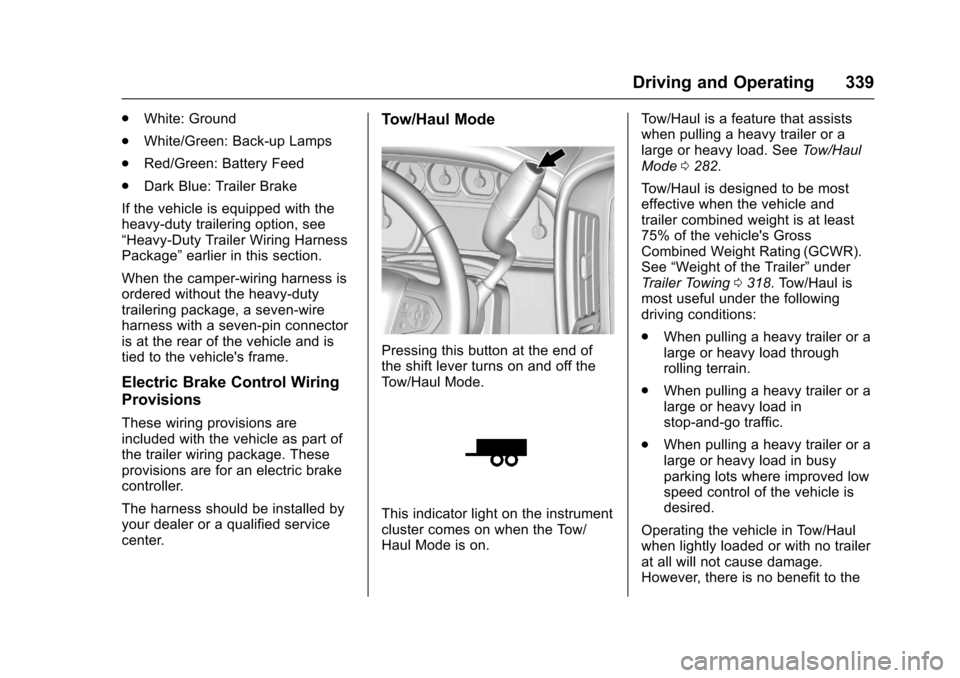
Pressing this button at the end ofthe shift lever turns on and off theTo w / H a u l M o d e .
This indicator light on the instrumentcluster comes on when the Tow/Haul Mode is on.
To w / H a u l i s a f e a t u r e t h a t a s s i s t swhen pulling a heavy trailer or alarge or heavy load. SeeTo w / H a u lMode0282.
To w / H a u l i s d e s i g n e d t o b e m o s teffective when the vehicle andtrailer combined weight is at least75% of the vehicle's GrossCombined Weight Rating (GCWR).See“Weight of the Trailer”underTr a i l e r To w i n g0318.Tow/Haulismost useful under the followingdriving conditions:
.When pulling a heavy trailer or alarge or heavy load throughrolling terrain.
.When pulling a heavy trailer or alarge or heavy load instop-and-go traffic.
.When pulling a heavy trailer or alarge or heavy load in busyparking lots where improved lowspeed control of the vehicle isdesired.
Operating the vehicle in Tow/Haulwhen lightly loaded or with no trailerat all will not cause damage.However, there is no benefit to the
Page 341 of 509
Chevrolet Silverado Owner Manual (GMNA-Localizing-U.S./Canada/Mexico-9956065) - 2017 - CRC - 4/29/16
340 Driving and Operating
selection of Tow/Haul when thevehicle is unloaded. Such aselection when unloaded may resultin unpleasant engine andtransmission driving characteristicsand reduced fuel economy. Tow/Haul is recommended only whenpulling a heavy trailer or a large orheavy load.
Integrated Trailer Brake
Control System
The vehicle may have an IntegratedTrailer Brake Control (ITBC) systemfor use with electric trailer brakes ormost electric over hydraulic trailerbrakes.
This symbol is on the Trailer BrakeControl Panel on vehicles with anITBC system. The power output tothe trailer brakes is based on theamount of brake pressure beingapplied by the vehicle’sbrake
system, and on the type of trailerbrakes detected. This availablepower output to the trailer brakescan be adjusted to a wide range oftrailering situations.
The ITBC system is integrated withthe vehicle’sbrake,antilockbrake,and StabiliTrak systems. In traileringconditions that cause the vehicle’santilock brake or StabiliTraksystems to activate, power sent tothe trailer's brakes will beautomatically adjusted to minimizetrailer wheel lock-up. This does notimply that the trailer has StabiliTrak.
If the vehicle’sbrake,antilockbrake,or StabiliTrak systems are notfunctioning properly, the ITBCsystem may not be fully functionalor may not function at all. Make sureall of these systems are fullyoperational to ensure fullfunctionality of the ITBC system.
The ITBC system is poweredthrough the vehicle's electricalsystem. Turning the ignition off willalso turn off the ITBC system. TheITBC system is fully functional onlywhen the ignition is in ON/RUN.
{Warning
Connecting a trailer that has an
air brake system may result in
reduced or complete loss of trailer
braking. There may be an
increase in stopping distance or
trailer instability which could
result in personal injury or
damage to the vehicle, trailer,
or other property. Use the ITBC
system only with electric or
electric over hydraulic trailer
brakes.
Page 342 of 509
Chevrolet Silverado Owner Manual (GMNA-Localizing-U.S./Canada/Mexico-9956065) - 2017 - CRC - 4/29/16
Driving and Operating 341
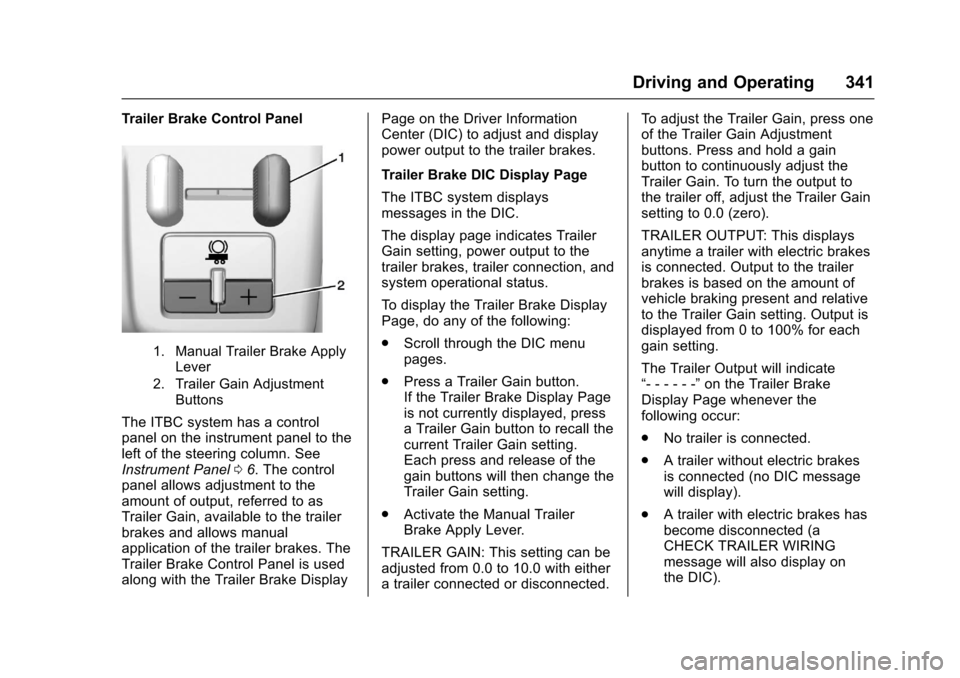
Trailer Brake Control Panel
1. Manual Trailer Brake ApplyLever
2. Trailer Gain AdjustmentButtons
The ITBC system has a controlpanel on the instrument panel to theleft of the steering column. SeeInstrument Panel06.Thecontrolpanel allows adjustment to theamount of output, referred to asTrailer Gain, available to the trailerbrakes and allows manualapplication of the trailer brakes. TheTrailer Brake Control Panel is usedalong with the Trailer Brake Display
Page on the Driver InformationCenter (DIC) to adjust and displaypower output to the trailer brakes.
Trailer Brake DIC Display Page
The ITBC system displaysmessages in the DIC.
The display page indicates TrailerGain setting, power output to thetrailer brakes, trailer connection, andsystem operational status.
To d i s p l a y t h e T r a i l e r B r a k e D i s p l a yPage, do any of the following:
.Scroll through the DIC menupages.
.Press a Trailer Gain button.If the Trailer Brake Display Pageis not currently displayed, pressaTrailerGainbuttontorecallthecurrent Trailer Gain setting.Each press and release of thegain buttons will then change theTrailer Gain setting.
.Activate the Manual TrailerBrake Apply Lever.
TRAILER GAIN: This setting can beadjusted from 0.0 to 10.0 with eitheratrailerconnectedordisconnected.
To a d j u s t t h e T r a i l e r G a i n , p r e s s o n eof the Trailer Gain Adjustmentbuttons. Press and hold a gainbutton to continuously adjust theTrailer Gain. To turn the output tothe trailer off, adjust the Trailer Gainsetting to 0.0 (zero).
TRAILER OUTPUT: This displaysanytime a trailer with electric brakesis connected. Output to the trailerbrakes is based on the amount ofvehicle braking present and relativeto the Trailer Gain setting. Output isdisplayed from 0 to 100% for eachgain setting.
The Trailer Output will indicate“------”on the Trailer BrakeDisplay Page whenever thefollowing occur:
.No trailer is connected.
.Atrailerwithoutelectricbrakesis connected (no DIC messagewill display).
.Atrailerwithelectricbrakeshasbecome disconnected (aCHECK TRAILER WIRINGmessage will also display onthe DIC).
Page 343 of 509
Chevrolet Silverado Owner Manual (GMNA-Localizing-U.S./Canada/Mexico-9956065) - 2017 - CRC - 4/29/16
342 Driving and Operating
.There is a fault present in thewiring to the trailer brakes (aCHECK TRAILER WIRINGmessage will also display onthe DIC).
.The ITBC system is not workingdue to a fault (a SERVICETRAILER BRAKE SYSTEMmessage will also display inthe DIC).
Manual Trailer Brake Apply
The Manual Trailer Brake ApplyLever is used to apply the trailer’selectric brakes independent of thevehicle’sbrakes.Slidingthelevertothe left will apply only the trailerbrakes. Use this lever to adjustTrailer Gain to properly adjust thepower output to the trailer brakes.
The trailer's and the vehicle's brakelamps will come on when eithervehicle brakes or manual trailerbrakes are applied.
Trailer Gain Adjustment Procedure
Trailer Gain should be set for aspecific trailering condition and mustbe adjusted anytime vehicle loading,trailer loading, or road surfaceconditions change.
{Warning
Trailer brakes that are
over-gained or under-gained may
not stop the vehicle and the trailer
as intended and can result in a
crash. Always follow the
instructions to set the Trailer Gain
for the proper trailer stopping
performance.
Use the following to adjust TrailerGain for each towing condition:
1. Drive the vehicle with the trailerattached on a level roadsurface representative of thetowing condition and free oftraffic at about 32 to 40 km/h(20 to 25 mph) and fully applythe Manual Trailer Brake ApplyLever.
Adjusting Trailer Gain atspeeds lower than 32 to40 km/h (20 to 25 mph) mayresult in an incorrect gainsetting.
2. Adjust the Trailer Gain, usingthe Trailer Gain AdjustmentButtons, to just below the pointof trailer wheel lock-up,indicated by trailer wheelsqueal or tire smoke when atrailer wheel locks.
Trailer wheel lock-up may notoccur if towing a heavily loadedtrailer. In this case, adjust theTrailer Gain to the highestallowable setting for the towingcondition.
3. Readjust Trailer Gain anytimevehicle loading, trailer loading,or road surface conditionschange or if trailer wheellock-up is noticed at any timewhile towing.
Page 344 of 509
Chevrolet Silverado Owner Manual (GMNA-Localizing-U.S./Canada/Mexico-9956065) - 2017 - CRC - 4/29/16
Driving and Operating 343
Other ITBC-Related DIC Messages
In addition to displaying TRAILERGAIN and OUTPUT through theDIC, trailer connection and ITBCsystem status are displayed onthe DIC.
TRAILER CONNECTED: Thismessage will briefly display when atrailer with electric brakes is firstconnected to the vehicle. Thismessage will automatically turn offin about 10 seconds. This messagecan be acknowledged before itautomatically turns off.
CHECK TRAILER WIRING: Thismessage will display if:
.The ITBC system firstdetermines connection to atrailer with electric brakes andthen the trailer harness becomesdisconnected from the vehicle.
If the disconnect occurs whilethe vehicle is stationary, thismessage will automatically turnoff in about 30 seconds. Thismessage will also turn off if it isacknowledged or if the trailerharness is reconnected.
If the disconnect occurs whilethe vehicle is moving, thismessage will continue until theignition is turned off. Thismessage will also turn off if it isacknowledged or if the trailerharness is reconnected.
.There is an electrical fault in thewiring to the trailer brakes. Thismessage will continue as longas there is an electrical fault inthe trailer wiring. This messagewill also turn off if it isacknowledged.
To d e t e r m i n e i f t h e e l e c t r i c a l f a u l t i son the vehicle side or trailer side ofthe trailer wiring harnessconnection:
1. Disconnect the trailer wiringharness from the vehicle.
2. Turn the ignition off.
3. Wait 10 seconds, then turn theignition back to RUN.
4. If the CHECK TRAILERWIRING message reappears,the electrical fault is on thevehicle side.
If the CHECK TRAILERWIRING message onlyreappears when connecting thetrailer wiring harness to thevehicle, the electrical fault is onthe trailer side.
SERVICE TRAILER BRAKESYSTEM: This message will displaywhen there is a problem with theITBC system. If this messagecontinues over multiple ignitioncycles, there is a problem with theITBC system. Have the vehicleserviced.
If either the CHECK TRAILERWIRING or SERVICE TRAILERBRAKE SYSTEM message displayswhile driving, the ITBC system maynot be fully functional or may notfunction at all. When trafficconditions allow, carefully pull thevehicle over to the side of the roadand turn the ignition off. Check thewiring connection to the trailer andturn the ignition back on. If either ofthese messages continues, eitherthe vehicle or trailer needs service.