lock CHEVROLET SSR 2005 1.G Owner's Manual
[x] Cancel search | Manufacturer: CHEVROLET, Model Year: 2005, Model line: SSR, Model: CHEVROLET SSR 2005 1.GPages: 388, PDF Size: 2.5 MB
Page 74 of 388
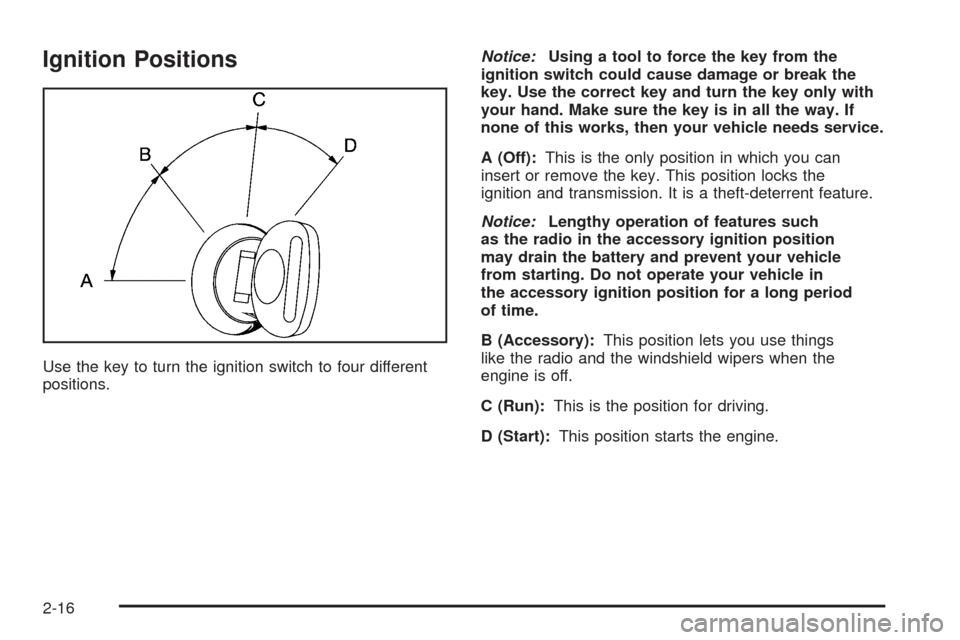
Ignition Positions
Use the key to turn the ignition switch to four different
positions.Notice:Using a tool to force the key from the
ignition switch could cause damage or break the
key. Use the correct key and turn the key only with
your hand. Make sure the key is in all the way. If
none of this works, then your vehicle needs service.
A (Off):This is the only position in which you can
insert or remove the key. This position locks the
ignition and transmission. It is a theft-deterrent feature.
Notice:Lengthy operation of features such
as the radio in the accessory ignition position
may drain the battery and prevent your vehicle
from starting. Do not operate your vehicle in
the accessory ignition position for a long period
of time.
B (Accessory):This position lets you use things
like the radio and the windshield wipers when the
engine is off.
C (Run):This is the position for driving.
D (Start):This position starts the engine.
2-16
Page 75 of 388
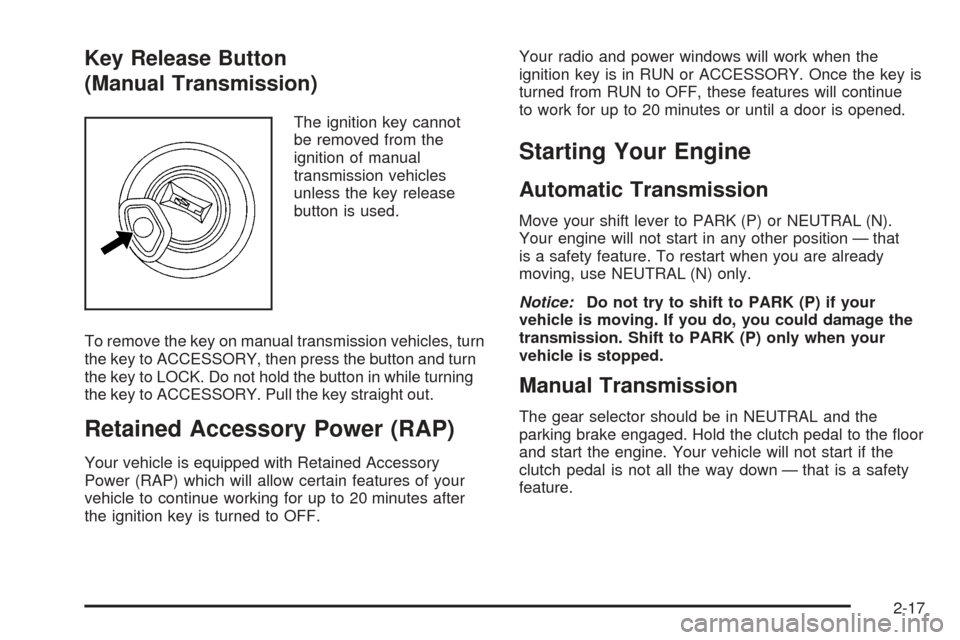
Key Release Button
(Manual Transmission)
The ignition key cannot
be removed from the
ignition of manual
transmission vehicles
unless the key release
button is used.
To remove the key on manual transmission vehicles, turn
the key to ACCESSORY, then press the button and turn
the key to LOCK. Do not hold the button in while turning
the key to ACCESSORY. Pull the key straight out.
Retained Accessory Power (RAP)
Your vehicle is equipped with Retained Accessory
Power (RAP) which will allow certain features of your
vehicle to continue working for up to 20 minutes after
the ignition key is turned to OFF.Your radio and power windows will work when the
ignition key is in RUN or ACCESSORY. Once the key is
turned from RUN to OFF, these features will continue
to work for up to 20 minutes or until a door is opened.
Starting Your Engine
Automatic Transmission
Move your shift lever to PARK (P) or NEUTRAL (N).
Your engine will not start in any other position — that
is a safety feature. To restart when you are already
moving, use NEUTRAL (N) only.
Notice:Do not try to shift to PARK (P) if your
vehicle is moving. If you do, you could damage the
transmission. Shift to PARK (P) only when your
vehicle is stopped.
Manual Transmission
The gear selector should be in NEUTRAL and the
parking brake engaged. Hold the clutch pedal to the oor
and start the engine. Your vehicle will not start if the
clutch pedal is not all the way down — that is a safety
feature.
2-17
Page 77 of 388

Automatic Transmission Operation
Your automatic transmission has a shift lever located
on the center console.
There are several different positions for your shift lever.
PARK (P):This position locks your rear wheels. It is
the best position to use when you start your engine
because your vehicle cannot move easily.
{CAUTION:
It is dangerous to get out of your vehicle if the
shift lever is not fully in PARK (P) with the
parking brake rmly set. Your vehicle can roll.
Do not leave your vehicle when the engine is
running unless you have to. If you have left the
engine running, the vehicle can move suddenly.
You or others could be injured. To be sure your
vehicle will not move, even when you are on
fairly level ground, always set your parking
brake and move the shift lever to PARK (P). See
Shifting Into Park (P) (Automatic Transmission)
on page 2-24. If you are pulling a trailer, see
Towing a Trailer on page 4-35.
Ensure the shift lever is fully in PARK (P) before
starting the engine. Your vehicle has an automatic
transmission shift lock control system. You have to
fully apply your regular brakes before you can shift
from PARK (P) when the ignition key is in RUN.
2-19
Page 80 of 388

THIRD, FOURTH, FIFTH and SIXTH (3, 4, 5 and 6):
Shift into THIRD (3), FOURTH (4), FIFTH (5) and
SIXTH (6) the same way you do for SECOND (2).
Slowly let up on the clutch pedal as you press the
accelerator pedal.
To stop, let up on the accelerator pedal and press
the brake pedal. Just before the vehicle stops, press the
clutch pedal and the brake pedal, and shift to
NEUTRAL.
NEUTRAL:Use this position when you start or idle
your engine.
REVERSE (R):To back up, press the clutch pedal.
After the vehicle stops, shift into REVERSE (R). Slowly
let up on the clutch pedal as you press the accelerator
pedal. If it is hard to shift, let the shift lever return
to NEUTRAL and release the clutch pedal. Then
press the clutch again and shift into REVERSE (R).
Do not attempt to shift into the fth gear position prior
to shifting into REVERSE (R). Your transmission
has a lock out feature which prevents a fth gear to
reverse gear shift.Notice:Shifting to REVERSE (R) while your vehicle
is moving forward could damage the transmission.
The repairs would not be covered by your warranty.
Shift to REVERSE (R) only after your vehicle is
stopped.
Use REVERSE (R), along with the parking brake, for
parking your vehicle.
Shift Speeds
{CAUTION:
If you skip a gear when you downshift, you
could lose control of your vehicle. You could
injure yourself or others. Don’t shift down
more than one gear at a time when you
downshift.
2-22
Page 82 of 388

Shifting Into Park (P)
(Automatic Transmission)
{CAUTION:
It can be dangerous to get out of your vehicle if
the shift lever is not fully in PARK (P) with the
parking brake rmly set. Your vehicle can roll.
Do not leave your vehicle when the engine is
running unless you have to. If you have left the
engine running, the vehicle can move suddenly.
You or others could be injured. To be sure your
vehicle will not move, even when you are on
fairly level ground, always set your parking
brake and move the shift lever to PARK (P).
1. Hold the brake pedal down with your right foot and
set the parking brake. SeeParking Brake on
page 2-23for more information.
2. Move the shift lever into PARK (P) by pressing the
button on the lever while pushing the lever all the
way toward the front of the vehicle.
3. Turn the ignition key to OFF.4. Remove the key and take it with you. If you can
remove the key from the ignition, the vehicle is in
PARK (P).
Leaving Your Vehicle With the Engine
Running (Automatic Transmission)
{CAUTION:
It can be dangerous to leave your vehicle with
the engine running. Your vehicle could move
suddenly if the shift lever is not fully in
PARK (P) with the parking brake rmly set.
And, if you leave the vehicle with the engine
running, it could overheat and even catch re.
You or others could be injured. Do not leave
your vehicle with the engine running.
If you have to leave your vehicle with the engine
running, be sure your vehicle is in PARK (P) and your
parking brake is rmly set before you leave it. After
you’ve moved the shift lever into PARK (P), hold down
the regular brake pedal. See if you can move the
shift lever away from PARK (P) without rst pulling it
toward you. If you can, it means that the shift lever
wasn’t fully locked into PARK (P).
2-24
Page 83 of 388

Torque Lock (Automatic Transmission)
If you are parking on a hill and you don’t shift your
transmission into PARK (P) properly, the weight of the
vehicle may put too much force on the parking pawl
in the transmission. You may nd it difficult to pull
the shift lever out of PARK (P). This is called “torque
lock.” To prevent torque lock, set the parking brake
and then shift into PARK (P) properly before you leave
the driver’s seat. To nd out how, see “Shifting Into
PARK (P)” listed previously in this section.
When you are ready to drive, move the shift lever out
of PARK (P) before you release the parking brake.
Shifting Out of Park (P)
(Automatic Transmission)
Your vehicle has an automatic transmission shift lock
control system. You have to fully apply your regular
brake before you can shift from PARK (P) when
the ignition is in RUN. SeeAutomatic Transmission
Operation on page 2-19.
If you cannot shift out of PARK (P), ease pressure on the
shift lever, push the shift lever all the way into PARK (P),
and release the shift lever button as you maintain brake
application. Then press the shift lever button and move
the shift lever into the gear you wish.
Parking Your Vehicle
(Manual Transmission)
Before you get out of your vehicle, move the shift
lever into REVERSE (R), and rmly apply the parking
brake. Once the shift lever has been placed into
REVERSE (R), with the clutch pedal pressed in, you
can turn the ignition key to OFF, press the key release
button to remove the key and release the clutch.
See Key Release Button (Manual Transmission) under
Ignition Positions on page 2-16.
If you are parking on a hill, see “Parking on Hills” under
Towing a Trailer on page 4-35.
If your vehicle is pulling a trailer, seeTowing a Trailer
on page 4-35.
2-25
Page 88 of 388

Outside Automatic Dimming
Heated Mirror
If the vehicle has this feature, the driver’s side outside
rearview mirror will adjust for the glare of headlamps
from behind by pushing the on and off settings on the
mirror. SeeAutomatic Dimming Rearview Mirror
with HomeLink
®on page 2-28for more information.
Both outside mirrors are also heated when the
rear window defogger is turned on. See “Rear Window
Defogger” underClimate Control System on page 3-20.
The mirrors can be manually folded inward to prevent
damage when going through an automatic car wash.
To fold, push the mirror toward the vehicle. To return
the mirror to its original position, push outward. Be sure
to return the mirrors to their original unfolded position
before driving.
HomeLink®Transmitter
HomeLink®
If your vehicle has this feature, the HomeLink®
transmitter buttons are located on the automatic
dimming rearview mirror. The three buttons on the left
side of the mirror are the HomeLink
®transmitter buttons.
HomeLink
®, a combined universal transmitter and
receiver, provides a way to replace up to three
hand-held transmitters used to activate devices such
as gate operators, garage door openers, entry door
locks, security systems and home lighting. Additional
HomeLink
®information can be found on the Internet at
www.homelink.com or by calling 1-800-355-3515.
2-30
Page 93 of 388

Storage Areas
Glove Box
To open the glove box, pull on the lever. Use your
door key to lock or unlock it.
Cupholder(s)
Your vehicle has one cupholder located on your
instrument panel and one cupholder that is removable
and snaps to the passenger’s side of the center console
in the bracket provided.
To open the cupholder on the instrument panel, push
in the center of the cupholder door. The cupholder
will then release and move outward toward you for
use. To return the cupholder to its closed position,
push in the center of the cupholder door near the top.
If you press in the center middle of the cupholder
door, the cupholder will not close properly.
Instrument Panel Storage Area
There is a storage tray located to the right of the
steering wheel on the instrument panel. Press on the
tray to release it. The tray will slide out of the instrument
panel toward you. You can then put small items into
the tray. To close the tray, push forward on the center of
the tray until it latches back into the instrument panel.
Center Console Storage Area
Your center console has a storage area that can be
locked and unlocked with the center console storage
key. SeeKeys on page 2-3for more information.
Map Pocket
The map/storage pockets are located on both the driver
and passenger side doors.
2-35
Page 101 of 388
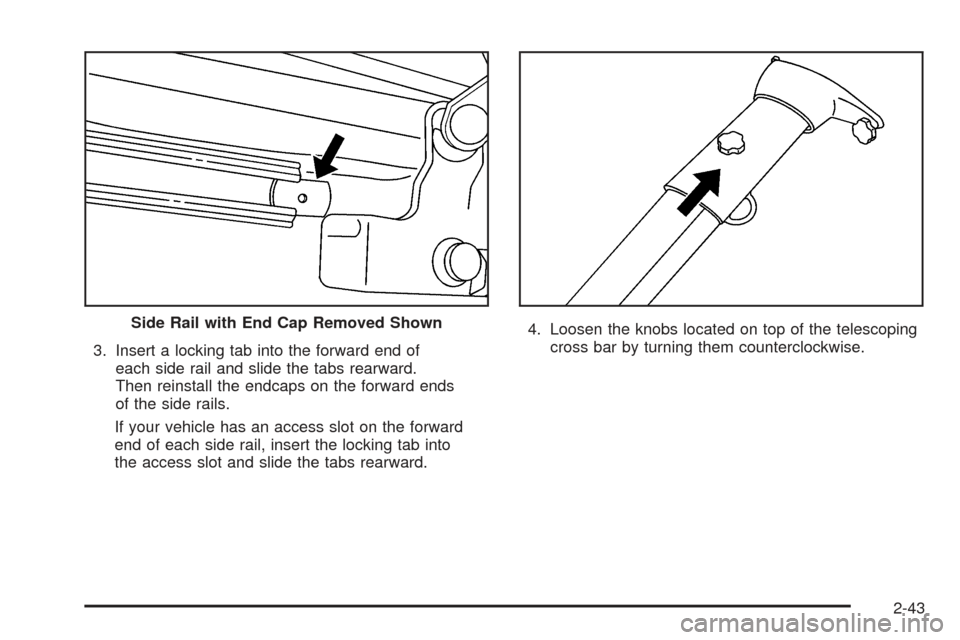
3. Insert a locking tab into the forward end of
each side rail and slide the tabs rearward.
Then reinstall the endcaps on the forward ends
of the side rails.
If your vehicle has an access slot on the forward
end of each side rail, insert the locking tab into
the access slot and slide the tabs rearward.4. Loosen the knobs located on top of the telescoping
cross bar by turning them counterclockwise. Side Rail with End Cap Removed Shown
2-43
Page 103 of 388
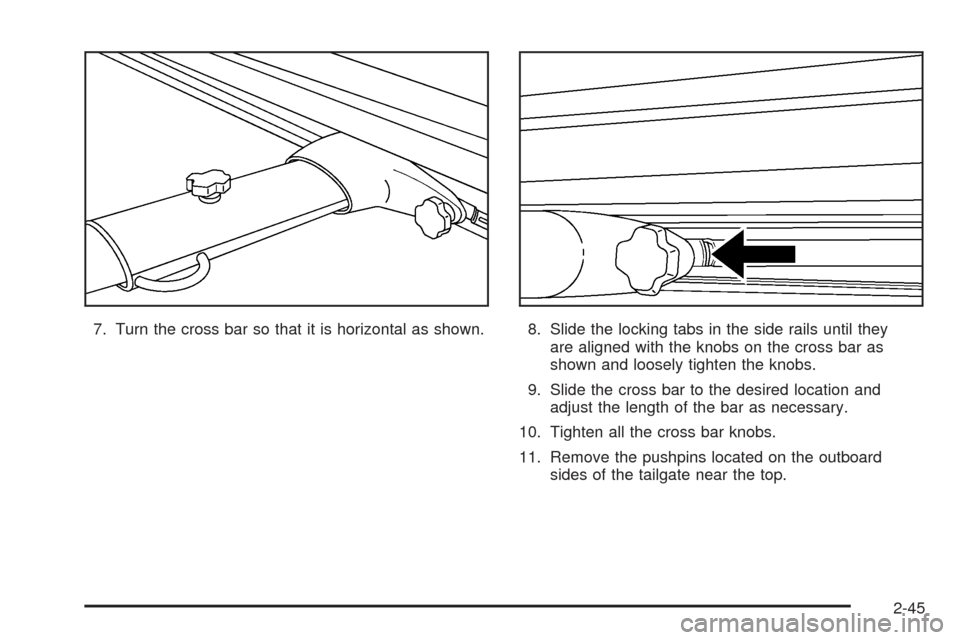
7. Turn the cross bar so that it is horizontal as shown. 8. Slide the locking tabs in the side rails until they
are aligned with the knobs on the cross bar as
shown and loosely tighten the knobs.
9. Slide the cross bar to the desired location and
adjust the length of the bar as necessary.
10. Tighten all the cross bar knobs.
11. Remove the pushpins located on the outboard
sides of the tailgate near the top.
2-45