transmission oil CHEVROLET SSR 2006 1.G Owners Manual
[x] Cancel search | Manufacturer: CHEVROLET, Model Year: 2006, Model line: SSR, Model: CHEVROLET SSR 2006 1.GPages: 390, PDF Size: 2.44 MB
Page 160 of 390
Battery Not Charging
If the battery is not charging during operation, this
message will appear on the DIC. The charging system
light may also be displayed on the instrument panel
cluster. SeeCharging System Light on page 3-30for
more information. Driving your vehicle when the battery is
not charging properly can drain the battery. Have the
electrical system checked by your GM dealer as soon as
possible. Press the select button to acknowledge this
message and clear it from the DIC display.
Battery Voltage Too High
This message will be displayed when the battery
voltage is higher than normal and you try to raise or
lower the convertible top. The charging system light may
also be displayed on the instrument panel cluster.
SeeCharging System Light on page 3-30for more
information. Press the select button to acknowledge the
message and clear it from the DIC display.
Battery Voltage Too Low
This message will be displayed when the battery
voltage is lower than normal and you try to raise or
lower the convertible top. The charging system light may
also be displayed on the instrument panel cluster.
SeeCharging System Light on page 3-30for more
information. Press the select button to acknowledge the
message and clear it from the DIC display.
Cargo Cover Ajar
This message will be displayed when trying to open or
close the convertible top while the cargo cover is
open. Make sure the cargo cover is fully closed before
trying to open or close the convertible top. This
message will clear itself from the DIC once the cargo
cover is closed.
Change Trans (Transmission) Fluid
(Automatic Transmission Only)
If the transmission fluid needs to be changed, this
message will appear on the DIC. SeeAutomatic
Transmission Fluid on page 5-20andScheduled
Maintenance on page 6-4for more information.
Check Oil Level
If the oil level in the vehicle is low, this message will
appear on the DIC. Check the oil level and add oil
as necessary. SeeEngine Oil on page 5-13for more
information. Press the select button to acknowledge this
message and clear it from the DIC display.
3-46
Page 245 of 390

Driving On Grades
Reduce speed and shift to a lower gear before you start
down a long or steep downgrade. If you don’t shift
down, you might have to use your brakes so much that
they would get hot and no longer work well.
If you have an automatic transmission, you can tow in
DRIVE (D). You may want to shift the transmission
to THIRD (3) or, if necessary, a lower gear if the
transmission shifts too often under heavy loads or hilly
conditions. If you have a manual transmission and
you are towing a trailer, it is better not to use SIXTH (6)
gear. Just drive in FIFTH (5) gear (or, as you need
to, a lower gear).
When towing at high altitude on steep uphill grades,
consider the following: Engine coolant will boil at a lower
temperature than at normal altitudes. If you turn your
engine off immediately after towing at high altitude
on steep uphill grades, your vehicle may show signs
similar to engine overheating. To avoid this, let the
engine run while parked, preferably on level ground, with
the automatic transmission in PARK (P) for a few
minutes before turning the engine off. For manual
transmissions, let the engine run while parked,
preferably on level ground, with the transmission out of
gear and the parking brake applied, for a few minutes
before turning the engine off. If you do get the overheat
warning, seeEngine Overheating on page 5-27.
Parking on Hills
{CAUTION:
You really should not park your vehicle, with a
trailer attached, on a hill. If something goes
wrong, your rig could start to move. People
can be injured, and both your vehicle and the
trailer can be damaged.
But if you ever have to park your rig on a hill, here’s
how to do it:
1. Apply your regular brakes, but don’t shift into
PARK (P) yet for an automatic transmission, or
into gear for a manual transmission. Turn your
wheels into the curb if facing downhill or into traffic
if facing uphill.
2. Have someone place chocks under the
trailer wheels.
3. When the wheel chocks are in place, release the
regular brakes until the chocks absorb the load.
4. Release the regular brakes.
4-45
Page 246 of 390

When You Are Ready to Leave After
Parking on a Hill
1. Apply your regular brakes and hold the pedal down
while you:
•Start your engine.
•Shift into a gear.
•Release the parking brake.
2. Let up on the brake pedal.
3. Drive slowly until the trailer is clear of the chocks.
4. Stop and have someone pick up and store
the chocks.
Maintenance When Trailer Towing
Your vehicle will need service more often when you’re
pulling a trailer. SeeScheduled Maintenance on
page 6-4for more information. Things that are especially
important in trailer operation are automatic transmission
fluid (don’t overfill), engine oil, axle lubricant, belt,
cooling system and brake system. Each of these is
covered in this manual. If you’re trailering, it’s a
good idea to review these sections before you start
your trip.
Check periodically to see that all hitch nuts and bolts
are tight.
4-46
Page 249 of 390

Service............................................................5-3
Accessories and Modifications..........................5-3
California Proposition 65 Warning.....................5-3
Doing Your Own Service Work.........................5-4
Adding Equipment to the Outside of
Your Vehicle..............................................5-5
Fuel................................................................5-5
Gasoline Octane............................................5-5
Gasoline Specifications....................................5-6
California Fuel...............................................5-6
Additives.......................................................5-6
Fuels in Foreign Countries...............................5-7
Filling the Tank..............................................5-8
Filling a Portable Fuel Container.....................5-10
Checking Things Under the Hood....................5-10
Hood Release..............................................5-11
Engine Compartment Overview.......................5-12
Engine Oil...................................................5-13
Engine Oil Life System..................................5-16
Engine Cover...............................................5-18
Engine Air Cleaner/Filter................................5-18
Automatic Transmission Fluid.........................5-20
Manual Transmission Fluid.............................5-22
Hydraulic Clutch...........................................5-23
Engine Coolant.............................................5-24
Coolant Surge Tank Pressure Cap..................5-27Engine Overheating.......................................5-27
Cooling System............................................5-29
Power Steering Fluid.....................................5-31
Windshield Washer Fluid................................5-31
Brakes........................................................5-32
Battery........................................................5-36
Jump Starting...............................................5-37
Rear Axle.......................................................5-42
Headlamp Aiming...........................................5-43
Bulb Replacement..........................................5-43
Halogen Bulbs..............................................5-44
Headlamps..................................................5-44
Front Turn Signal, Sidemarker and
Parking Lamps..........................................5-45
Taillamps, Turn Signal, and Stoplamps............5-47
Back-Up Lamps............................................5-48
Replacement Bulbs.......................................5-48
Windshield Wiper Blade Replacement..............5-49
Tires..............................................................5-51
Tire Sidewall Labeling...................................5-52
Tire Terminology and Definitions.....................5-54
Inflation - Tire Pressure.................................5-57
Tire Inspection and Rotation...........................5-59
When It Is Time for New Tires.......................5-59
Buying New Tires.........................................5-60
Section 5 Service and Appearance Care
5-1
Page 261 of 390
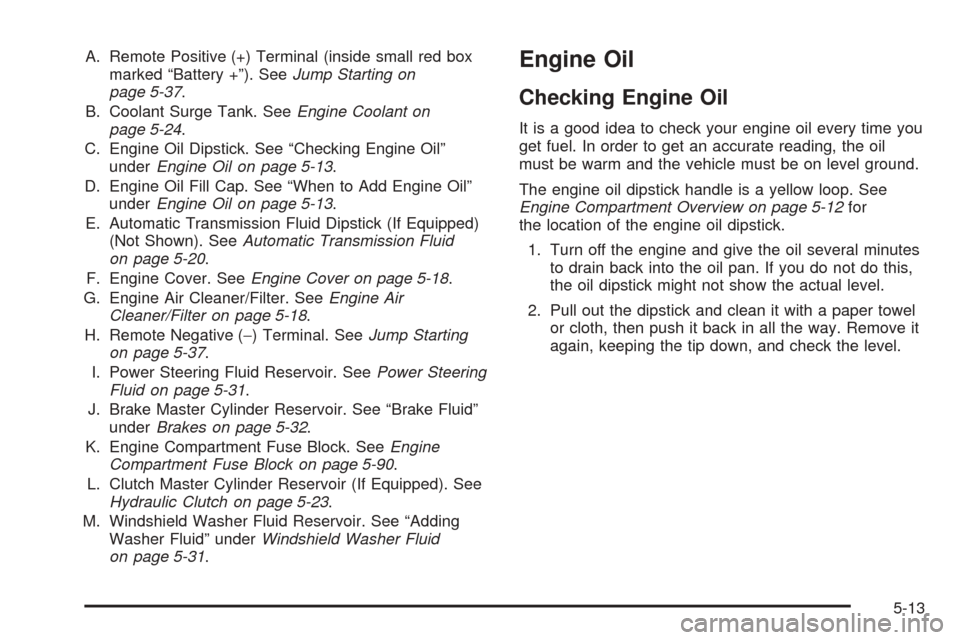
A. Remote Positive (+) Terminal (inside small red box
marked “Battery +”). SeeJump Starting on
page 5-37.
B. Coolant Surge Tank. SeeEngine Coolant on
page 5-24.
C. Engine Oil Dipstick. See “Checking Engine Oil”
underEngine Oil on page 5-13.
D. Engine Oil Fill Cap. See “When to Add Engine Oil”
underEngine Oil on page 5-13.
E. Automatic Transmission Fluid Dipstick (If Equipped)
(Not Shown). SeeAutomatic Transmission Fluid
on page 5-20.
F. Engine Cover. SeeEngine Cover on page 5-18.
G. Engine Air Cleaner/Filter. SeeEngine Air
Cleaner/Filter on page 5-18.
H. Remote Negative (−) Terminal. SeeJump Starting
on page 5-37.
I. Power Steering Fluid Reservoir. SeePower Steering
Fluid on page 5-31.
J. Brake Master Cylinder Reservoir. See “Brake Fluid”
underBrakes on page 5-32.
K. Engine Compartment Fuse Block. SeeEngine
Compartment Fuse Block on page 5-90.
L. Clutch Master Cylinder Reservoir (If Equipped). See
Hydraulic Clutch on page 5-23.
M. Windshield Washer Fluid Reservoir. See “Adding
Washer Fluid” underWindshield Washer Fluid
on page 5-31.Engine Oil
Checking Engine Oil
It is a good idea to check your engine oil every time you
get fuel. In order to get an accurate reading, the oil
must be warm and the vehicle must be on level ground.
The engine oil dipstick handle is a yellow loop. See
Engine Compartment Overview on page 5-12for
the location of the engine oil dipstick.
1. Turn off the engine and give the oil several minutes
to drain back into the oil pan. If you do not do this,
the oil dipstick might not show the actual level.
2. Pull out the dipstick and clean it with a paper towel
or cloth, then push it back in all the way. Remove it
again, keeping the tip down, and check the level.
5-13
Page 268 of 390

Automatic Transmission Fluid
When to Check and Change Automatic
Transmission Fluid
A good time to check your automatic transmission fluid
level is when the engine oil is changed.
Change the fluid and filter at the intervals listed in
Additional Required Services on page 6-6, and be sure
to use the transmission fluid listed inRecommended
Fluids and Lubricants on page 6-12.
How to Check Automatic
Transmission Fluid
Because this operation can be difficult, you may choose
to have this done at the dealership service department.
If you do it yourself, be sure to follow all the instructions
here, or you could get a false reading on the dipstick.
Notice:Too much or too little uid can damage
your transmission. Too much can mean that some
of the uid could come out and fall on hot engine
part or exhaust system parts, starting a re.
Too little uid could cause the transmission to
overheat. Be sure to get an accurate reading if you
check your transmission uid.Wait at least 30 minutes before checking the
transmission fluid level if you have been driving:
•When outside temperatures are above 90°F (32°C).
•At high speed for quite a while.
•In heavy traffic — especially in hot weather.
•While pulling a trailer.
To get the right reading, the fluid should be at
normal operating temperature, which is 180°F to
200°F (82°C to 93°C).
Get the vehicle warmed up by driving about 15 miles
(24 km) when outside temperatures are above 50°F
(10°C). If it is colder than 50°F (10°C), drive the vehicle
in THIRD (3) until the engine temperature gage
moves and then remains steady for 10 minutes.
A cold fluid check can be made after the vehicle has
been sitting for eight hours or more with the engine off,
but this is used only as a reference. Let the engine
run at idle for five minutes if outside temperatures are
50°F (10°C) or more. If it is colder than 50°F (10°C), you
may have to idle the engine longer. Should the fluid
level be low during this cold check, you must check the
fluid hot before adding fluid. Checking the fluid hot
will give you a more accurate reading of the fluid level.
5-20
Page 270 of 390

Consistency of Readings
Always check the fluid level at least twice using the
procedure described previously. Consistency (repeatable
readings) is important to maintaining proper fluid level. If
inconsistent readings continue, contact your dealer.
How to Add Automatic
Transmission Fluid
Refer to the Maintenance Schedule to determine what
kind of transmission fluid to use. SeeRecommended
Fluids and Lubricants on page 6-12.
Add fluid only after checking the transmission fluid while
it is hot. A cold check is used only as a reference. If
the fluid level is low, add only enough of the proper fluid
to bring the level up to the HOT area for a hot check.
It does not take much fluid, generally less than one pint
(0.5 L). Do not overfill.
Notice:Use of the incorrect automatic transmission
uid may damage your vehicle, and the damages
may not be covered by your warranty. Always
use the automatic transmission uid listed in
Recommended Fluids and Lubricants on page 6-12.
•After adding fluid, recheck the fluid level as
described under “How to Check Automatic
Transmission Fluid,” earlier in this section.
•When the correct fluid level is obtained, push the
dipstick back in all the way; then flip the handle
down to lock the dipstick in place.
Manual Transmission Fluid
When to Check Manual
Transmission Fluid
A good time to have the manual transmission fluid
checked is when the engine oil is changed. However,
the fluid in your manual transmission does not
require changing.
How to Check Manual
Transmission Fluid
Because this operation can be a little difficult, you
may choose to have this done at the dealership
service department.
If you do it yourself, be sure to follow all the instructions
here, or you could get a false reading.
Notice:Too much or too little uid can damage your
transmission. Too little uid could cause the
transmission to overheat. Be sure to get an accurate
reading if you check your transmission uid.
Check the fluid level only when your engine is off, the
vehicle is parked on a level place, and the transmission
is cool enough for you to rest your fingers on the
transmission case.
5-22
Page 339 of 390

Fuses Usage
4 Driver’s Side High Beam Headlamp
5 Driver’s Side Low Beam Headlamp
6 Cargo Cover Release
7Transmission Control
Module/Canister
8 Truck Body Controller
9 Windshield Washer
10 Driver’s Side Stoplamp/Turn Signals
11 Fuel Pump
12 Fog Lamps
13 Stoplamps
14 Headlamp Driver Module (HDM)
15Passenger’s Side Stoplamp/Turn
Signals
16 Cigarette Lighter
17 Hazard Warning Flashers
18 Coils
19 Truck Body Control, Ignition 1
20 Starter
21 Airbag System
22 Horn
23 Ignition EFuses Usage
24Instrument Panel Cluster, Driver
Information Center (DIC)
25Automatic Transmission Shift
Interlock Control System
26 Back-up lamps, Lock Out
27 Engine Control Module
28 Oxygen Sensor B
29 Injector B
30 Air Conditioning
31Engine Control Module (ECM),
Transmission Control Module (TCM)
32 Transmission
33 Engine 1
34Engine Control Module, Electronic
Brake Controller
35 Oxygen Sensor A
36 Injector A
37 Engine Cooling Fan
38 Anti-lock Brake System (ABS)
39 Ignition A
40 Climate Control Fan
41 Ignition B
5-91
Page 343 of 390

Capacities and Specications
The following approximate capacities are given in English and metric conversions. Refer toRecommended Fluids
and Lubricants on page 6-12for more information.
ApplicationCapacities
English Metric
Cooling System 13.7 qt 13.0 L
Engine Oil with Filter 6.0 qt 5.7 L
Fuel Tank 25.0 gal 94.6 L
Transmission
Automatic 5.0 qt 4.7 L
Manual 3.7 qt 3.5 L
Wheel Nut Torque 100 lb ft 140Y
All capacities are approximate. When adding fluids, be sure to fill to the appropriate level, as recommended in this
manual. Recheck the fluid level after filling.
Engine Specications
Engine VIN Code Transmission Spark Plug Gap
6.0L V8 HAutomatic
Manual0.040 inches (1.01 mm)
5-95
Page 349 of 390

Scheduled Maintenance
Service MaintenanceIMaintenanceII
Change engine oil and filter. SeeEngine Oil on page 5-13. Reset oil
life system. SeeEngine Oil Life System on page 5-16.An Emission
Control Service.••
Visually check for any leaks or damage.See footnote (g).••
Inspect engine air cleaner filter. If necessary, replace filter. SeeEngine Air
Cleaner/Filter on page 5-18.See footnote (j).•
Check tire inflation pressures and tire wear. SeeTires on page 5-51.••
Inspect brake system.See footnote (a).••
Check engine coolant and windshield washer fluid levels and add fluid
as needed.••
Perform any needed additional services. See “Additional Required Services”
in this section.••
Inspect suspension and steering components.See footnote (b).•
Inspect engine cooling system.See footnote (c).•
Inspect wiper blades.See footnote (d).•
Inspect restraint system components.See footnote (e).•
Lubricate body components.See footnote (f).•
Check transmission fluid level and add fluid as needed.•
6-5