engine CHEVROLET SUBURBAN 1995 User Guide
[x] Cancel search | Manufacturer: CHEVROLET, Model Year: 1995, Model line: SUBURBAN, Model: CHEVROLET SUBURBAN 1995Pages: 486, PDF Size: 26.58 MB
Page 86 of 486
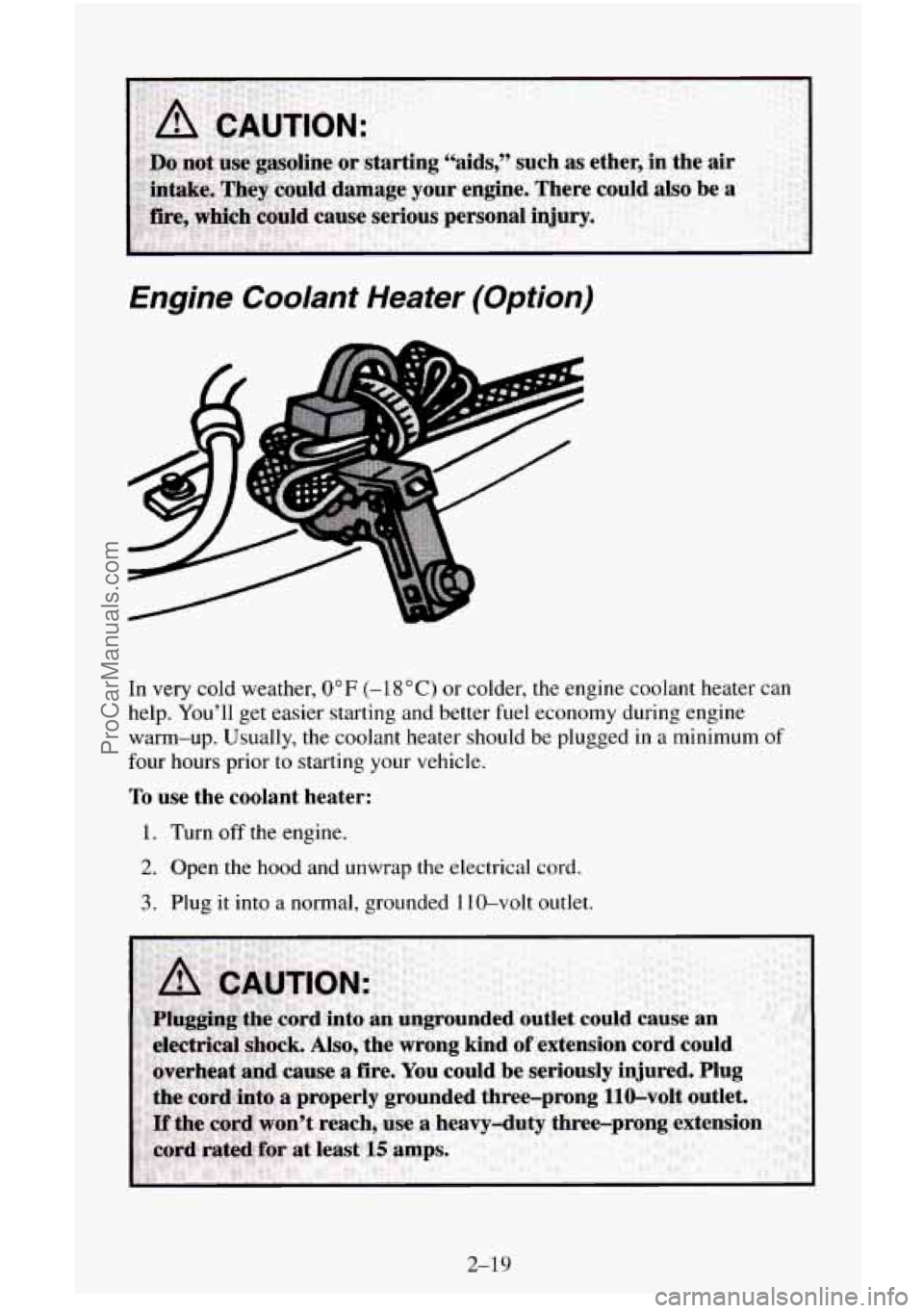
Engine Coolant Heater (Option)
4
m
In very cold weather, 0°F (-1 8 "C) or colder, the engine coolant heater can
help. You'll get easier starting and better fuel economy during engine
warm-up. Usually, the coolant heater should be plugged in
a minimum of
four hours prior
to starting your vehicle.
To use the coolant heater:
1. Turn off the engine.
2. Open the hood and unwrap the electrical cord.
3. Plug it into a normal, grounded 1 IO-volt outlet.
ProCarManuals.com
Page 87 of 486

NOTICE:
After you’ve used the coolant heater, be sure to store the \
cord as
it
was before to keep it away from moving engine parts. If you
don’t, it could be damaged.
How long should you keep the coolant heater plugged in‘? The answer
depends on the weather, the kind of oil
you have, and some other things.
Instead of trying
to list everything here, we ask that you contact your GM
dealer in the area where you’ll be parking your vehicle. The dealer can give
you the best advice for that particular area.
Automatic Transmission
T
There are several different positions for your shift lever.
If your vehicle is equipped with an automatic transmission, it now features
an electronic shift position indicator within
the instrument cluster. This
display must be powered anytime the shift lever
is capable of being moved
out
of the PARK (P) position. This means that if your key is in the OFF
position, but not locked, there will be a small current drain on your battery
which could discharge your battery over a period of time. If you have a need
to leave your key
in the ignition in the OFF position for an extended period
for any reason,
it is recommended that you disconnect the battery cable
from the battery to prevent discharging your battery.
PARK (P) -This locks your rear wheels. It’s the best position to use
when you start your engine because your vehicle can’t move easily.
2-20
ProCarManuals.com
Page 88 of 486
Your vehicle has a brake-transmission shift interlock. With the ignition in
the RUN position, you must fully apply your regular brakes before you can
shift from PARK (P).
If you cannot shift out
of PARK (P), ease pressure on the shift lever and
push the shift lever
all the way into PARK (P) as you continue pressing the
brake pedal. Then move the shift lever
into the gear you want. If you still
cannot shift the shift lever out of PARK (P), see “Shifting Out of PARK (P)”
later in this section.
REVERSE (R) - Use this gear to back up.
NOTICE:
Shifting to REVERSE (R) while your vehicle is moving forward \
could damage your transmission. Shift to REVERSE (R) only
after your vehicle
is stopped.
To rock your vehicle back and forth to get out’of snow, ice or sand
without damaging your transmission, see “If You’re Stuck: In Sand,
Mud, Ice or Snow” in the Index.
0 NEUTRAL (N) - In this position, your engine doesn’t connect with
the wheels. To restart when you’re already moving, use NEUTRAL
(N)
only. Also, use NEUTRAL (N) when your vehicle is being towed.
2-21
ProCarManuals.com
Page 89 of 486
NOTICE:
Damage to your transmission caused by shifting out of PARK
(P) or NEUTRAL (N) with the engine racing isn’t covered by
your warranty.
0 AUTOMATIC OVERDRIVE (@) - This position is for normal
driving. If you need more power for passing, and you’re:
- Going less than about 35 mph (56 km/h), push your accelerator
pedal about halfway down.
- Going about 35 mph (56 km/h) or more, push the accelerator all
the way down.
You’ll shift down
to the next gear and have more power.
@ should not be used when towing a trailer, carrying a heavy load,
driving on steep hills, or for off-road driving. Select THIRD
GEAR
(3) when operating the vehicle under any of these
conditions.
0 THIRD GEAR (3) - This is like @, but you never go into Overdrive.
You should use THIRD GEAR (3) when towing a trailer, carrying a
heavy load, driving on steep hills, or for off-road driving.
0 SECOND GEAR (2) - This position gives you more power but lower
fuel economy. You can use SECOND GEAR (2) on hills. It can help
control your speed
as you go down steep mountain roads, but then you
would also want to use your brakes off and on.
If you manually select
SECOND GEAR (2), the transmission will drive
in second gear. You may use this feature for reducing torque to the rear
wheels when
you are trying to start your vehicle from a stop on
slippery road surfaces.
2-22
ProCarManuals.com
Page 91 of 486
0
0
0
0
THIRD GEAR (3), FOURTH GEAR (4) and FIFTH GEAR (5) -
Shift into THIRD GEAR (3), FOURTH GEAR (4) and FIFTH GEAR
(5) the same way you do for SECOND GEAR (2). Slowly let up on the
clutch pedal
as you press the accelerator pedal.
To Stop - Let up on the accelerator pedal and press the brake pedal.
Just before the vehicle stops, press the clutch pedal and the brake pedal,
and shift to NEUTRAL
(N).
NEUTRAL (N) - Use this position when you start or idle your
engine.
REVERSE (R) - To back up, first press down the clutch pedal. Wait
about
5 seconds for the internal parts to stop spinning and then, shift
into REVERSE (R). Let up on the clutch pedal slowly while pressing
the accelerator pedal.
NOTICE:
Shift to REVERSE (R) only after your vehicle is stopped.
Shifting to REVERSE
(R) while your vehicle is moving could
damage your transmission.
Also, use REVERSE (R), along with the parking brake, when turning
off your engine and parking your vehicle.
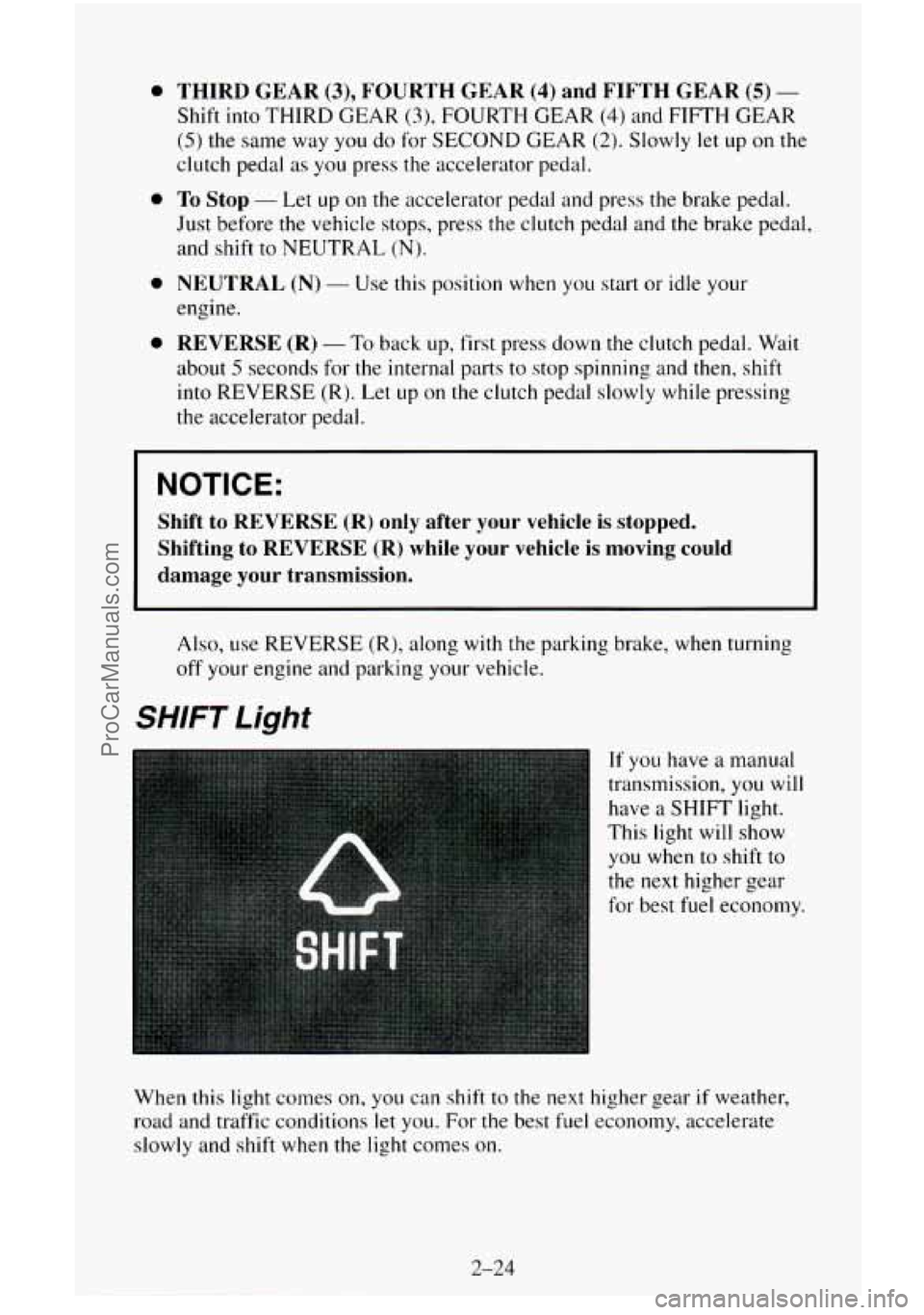
SHIFT Light
If you have a manual
transmission, you will
have a
SHIFT light.
This light will show
you when to shift to
the
next higher gear
for best fuel economy.
When
this light comes on, you can shift to the next higher gear if weather,
road and traffic conditions let you.
For the best fuel economy, accelerate
slowly and shift when the light comes on.
2-24
ProCarManuals.com
Page 92 of 486
While you accelerate, it is normal for the light to go on and off if you
quickly change
the position of the accelerator. Ignore the SHIFT light when
you downshift.
Four-Wheel-Drive Vehicles Only: If your vehicle has four-wheel drive
and
is equipped with a manual transmission, disregard the SHIFT light
when the transfer case
is in 4-LOW.
Manual Transmission Shift Speeds
If your speed drops below 20 mph (32 km/h), or if the engine is not running
smoothly,
you should downshift to the next lower gear. You may have to
downshift two or more gears
to keep the engine running smoothly or for
good performance.
A CAUTION:
If you skip more ;than one gear when you downshift, you could
lose control of your vehicle. And you could injure yourself or
others. Don’t shift down more than one gear when you
downshift.
NOTICE:
If you skip more than one gear when you downshift, or if you
race the engine when you downshift, you can damage the engine,
clutch or transmission.
Locking Rear Axle
If you have this feature, your rear axle can give you additional traction on
snow, mud, ice, sand or gravel. It works like a standard axle most of the
time, but when
one of the rear wheels has no traction and the other does, the
locking feature will allow the wheel with traction to move the vehicle.
2-25
ProCarManuals.com
Page 95 of 486
3. If you have four-wheel drive, be sure the transfer case is in a drive gear
4. Move the ignition key to LOCK.
-not in NEUTRAL (N)
5. Remove the key and take it with you. If you can walk away from your
vehicle with the ignition key
in your hand, your vehicle is in PARK (P).
Shifting Out of PARK (P)
Your vehicle has a brake-transmission shift interlock system. You have to
fully apply your regular brakes before you can shift from PARK (P). See
“Automatic Transmission”
in the Index.
If
you cannot shift out of PARK (P), ease pressure on the shift lever and
push the shift lever all the way up into PARK
(P) as you maintain brake
application. Then, move the shift lever into the gear you want.
If
you ever hold the brake pedal down but still can’t shift out of PARK (P),
try this:
1. Turn the key to OFF.
2. Apply and hold the brake until the end of Step 4.
3. Shift to NEUTRAL (N).
4. Start the vehicle and then shift to the drive gear you want.
5. Have the brake-transmission shift interlock system fixed as soon as
you can.
Leaving Your Vehicle With the Engine Running
(Automatic Transmission
Models Only)
It can be dangerous to leave your vehicle with the engine
running. Your vehicle could move suddenly if the shift lever
is
not fully in PARK (P) with the parking brake firmly set. If you
have four-wheel drive with
a manual transfer case shift lever
and your transfer case
is in NEUTRAL (N), your vehicle will be
free to roll, even if your shift lever
is in PARK (P). So be sure the
transfer case is in
a drive gear - not in NEUTRAL (N). And, if
you leave the vehicle with the engine running, it could overheat
and even catch
fire. You or others could be injured. Don’t leave
your vehicle with the engine running unless you have to.
2-28
ProCarManuals.com
Page 97 of 486
Parking Your Vehicle (Manual Transmission
Models Only)
Before you get out of your vehicle, put your manual transmission in
REVERSE (R), turn off the engine, and firmly apply the parking brake.
If you have four-wheel drive, be sure your transfer case is in a drive gear.
Your vehicle could roll if it isn’t.
If you are parking on a hill, or if your pulling a trailer, see “Parking on
Hills” or “Towing a Trailer” in the Index.
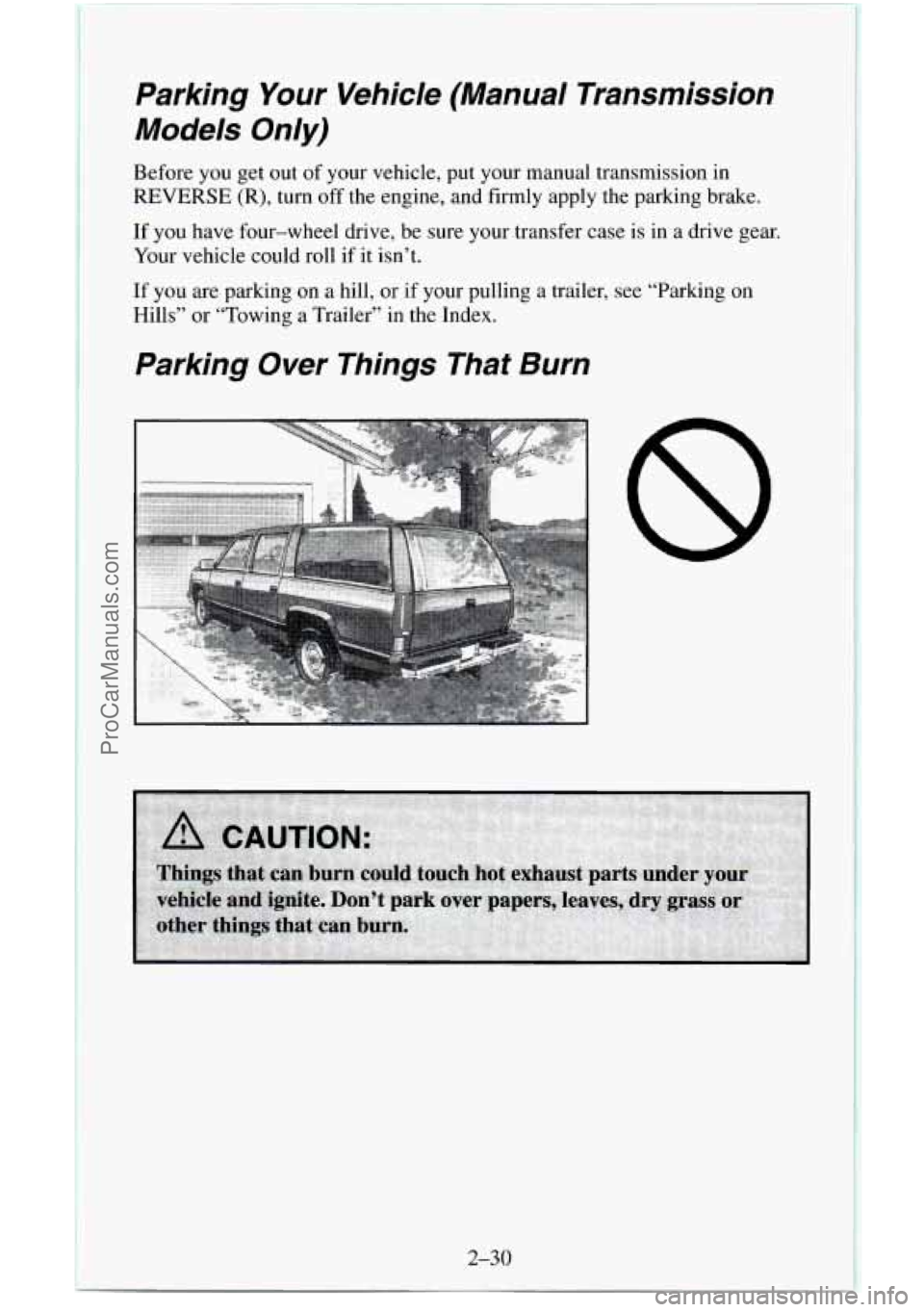
Parking Over Things That Burn
8
2-30
ProCarManuals.com
Page 98 of 486
Engine Exhaust
2-3 1
ProCarManuals.com
Page 99 of 486
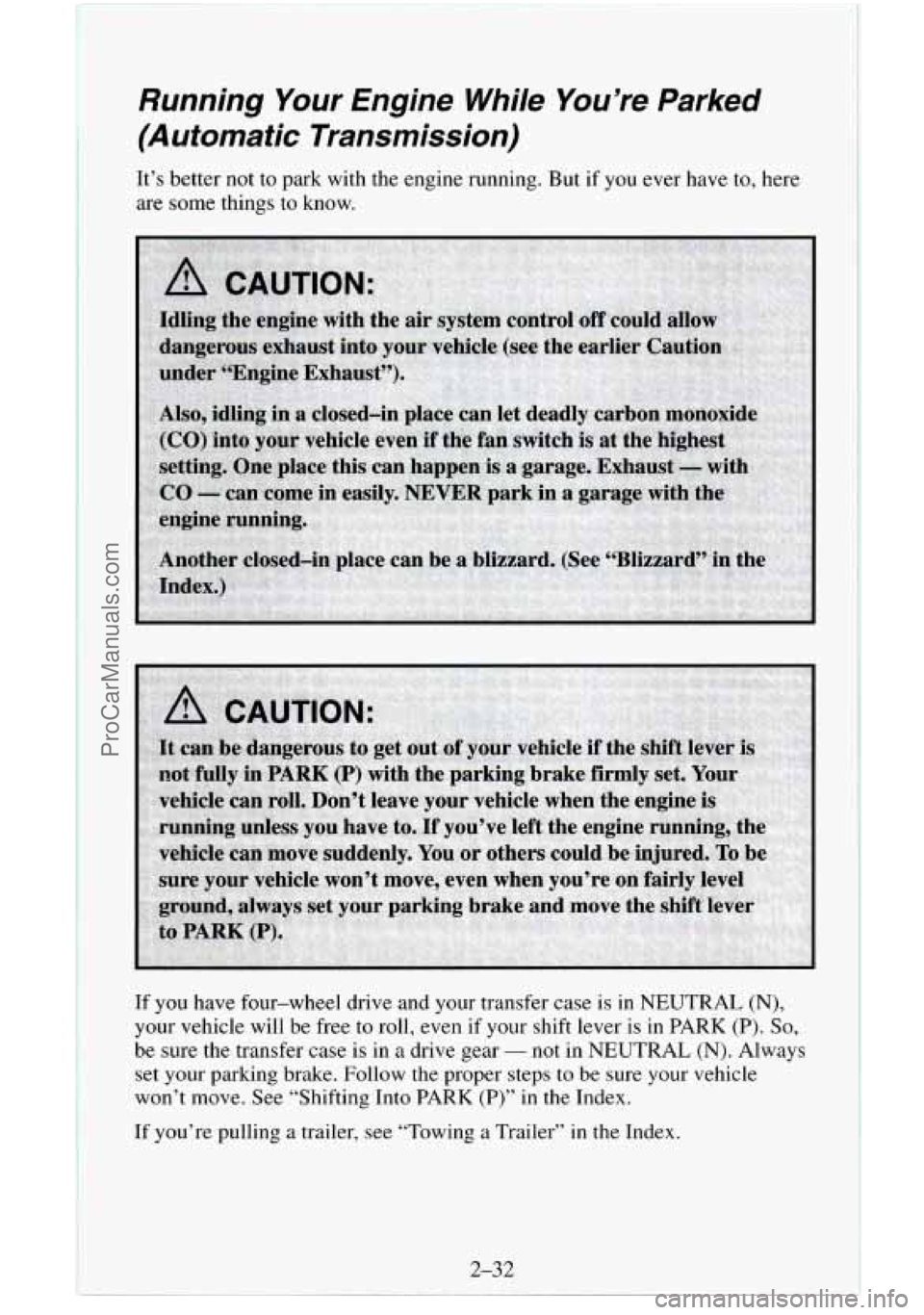
Running Your Engine While You’re Parked
(Automatic Transmission)
It’s better not to park with the engine running. But if you ever have to, here
are some things to know.
If you have four-wheel drive and your transfer case is
in NEUTRAL (N),
your vehicle will be free
to roll, even if your shift lever is in PARK (P). So,
be sure the transfer case is in a drive gear - not in NEUTRAL (N). Always
set your parking brake. Follow the proper steps
to be sure your vehicle
won’t move. See “Shifting Into
PARK (P)” in the Index.
If you’re pulling a trailer, see “Towing a Trailer” in the Index.
2-32 I
ProCarManuals.com