engine CHEVROLET SUBURBAN 1995 Owner's Manual
[x] Cancel search | Manufacturer: CHEVROLET, Model Year: 1995, Model line: SUBURBAN, Model: CHEVROLET SUBURBAN 1995Pages: 486, PDF Size: 26.58 MB
Page 100 of 486
Four- Wheel Drive
If your vehicle has four-wheel drive, you can send your engine’s driving
power to all four wheels for extra traction.
To get the most satisfaction out
of four-wheel drive, you must be familiar with its operation. Read the part
that follows before using four-wheel drive. You should use 2-WHEEL
HIGH (2H) for most normal driving conditions.
NOTICE:
Driving in the 4-WHEEL HIGH (4H) or &WHEEL LOW (4L)
positions for a long time on dry or wet pavement could shorten
the life of your vehicle’s drivetrain.
I NOTICE:
Changing your vehicle’s body height can damage your vehicle’s
suspension, drivetrain, or other vehicle components.
It may also
affect the way your vehicle handles, and the function of your
vehicle’s safety features. Do not change your vehicle’s height
from the original design specifications.
Transfer Case
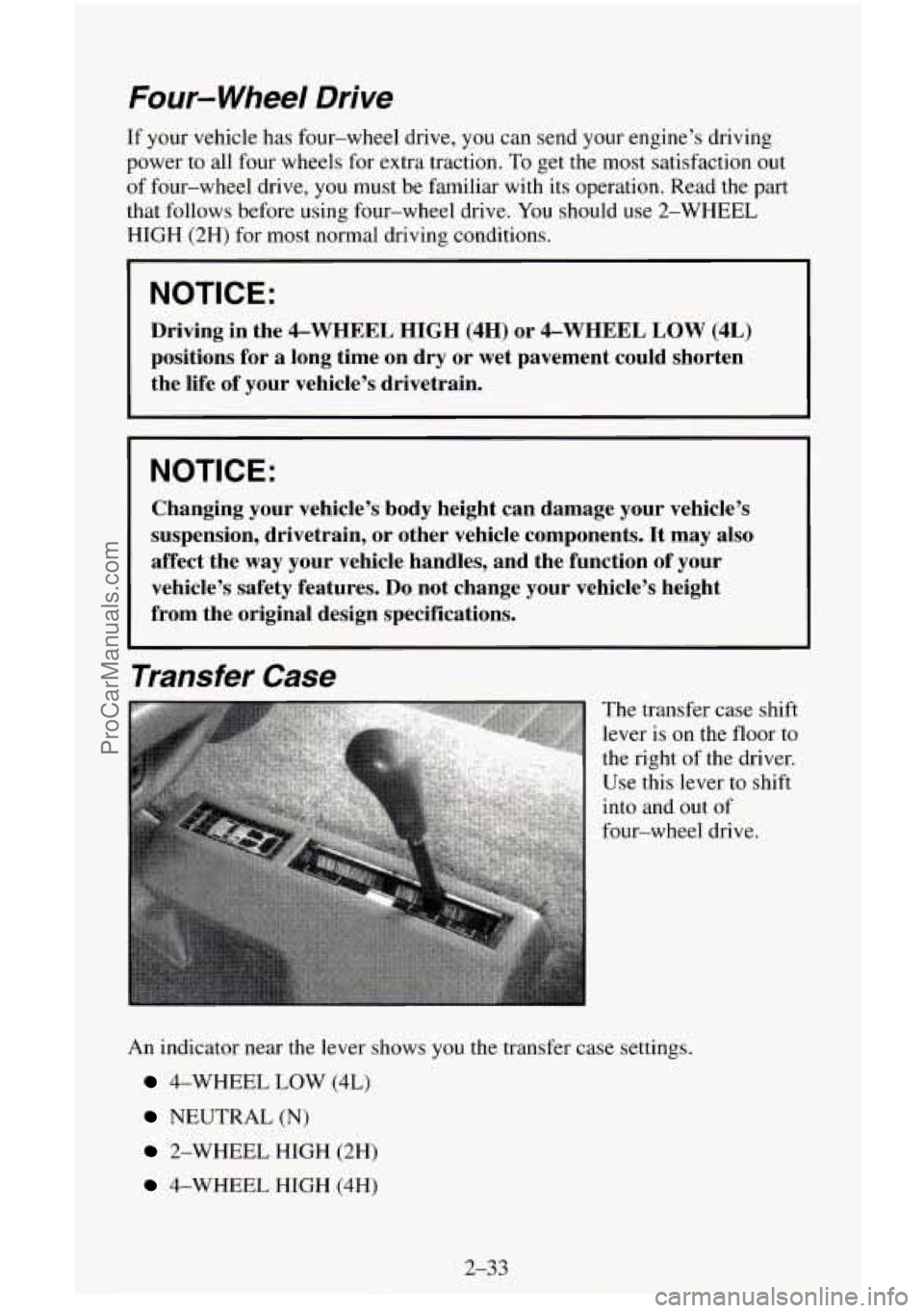
The transfer case shift
lever is on the floor to
the right of the driver.
Use this lever to shift
into and out
of
four-wheel drive.
An indicator near the lever shows you the transfer case settings.
4-WHEEL LOW (4L)
NEUTRAL (N)
2-WHEEL HIGH (2H)
4-WHEEL HIGH (4H)
2-33
ProCarManuals.com
Page 118 of 486
Underhood Reel Lamp
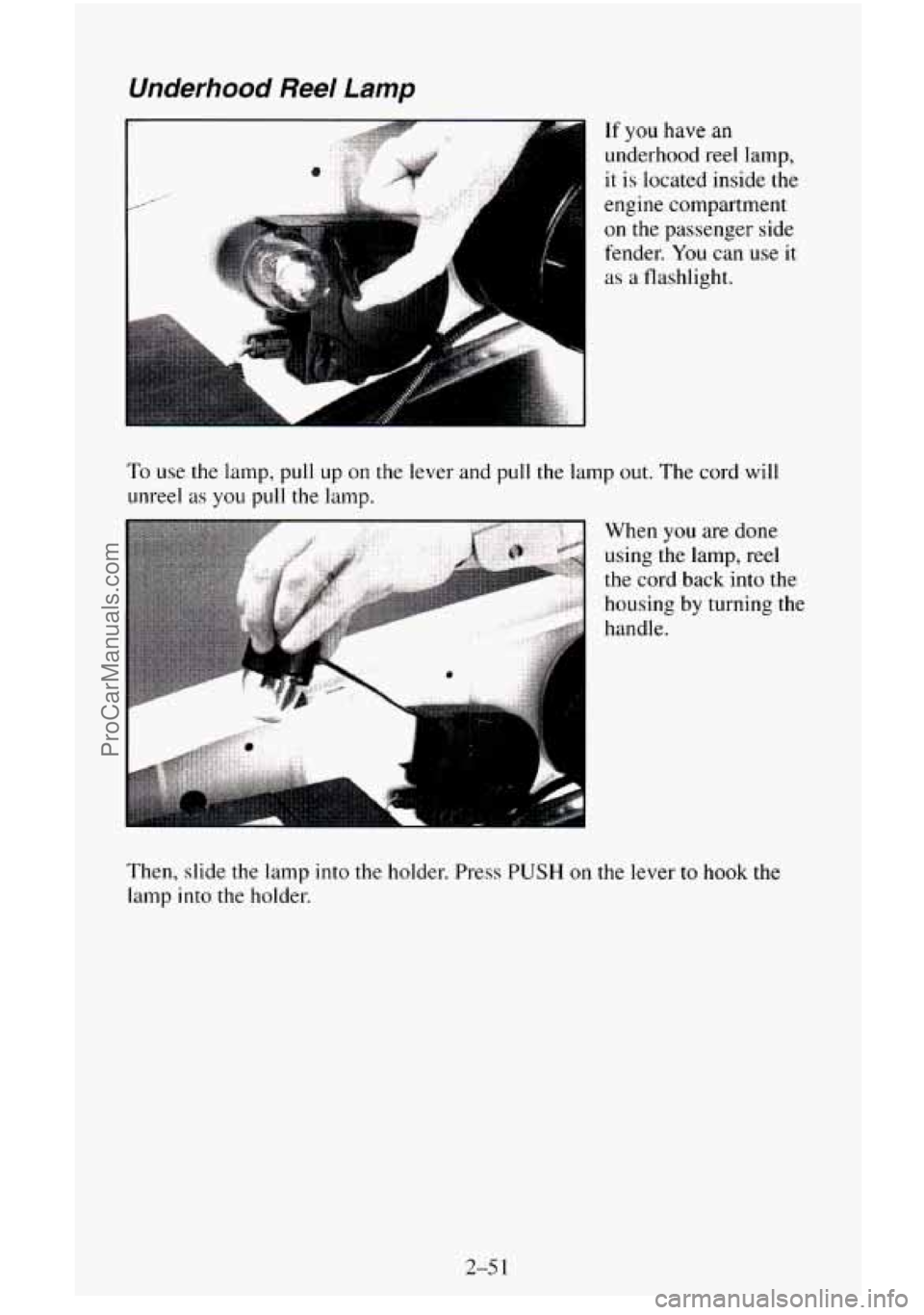
If you have an
underhood reel lamp,
it is located inside
the
engine compartment
on the passenger side
fender.
You can use it
as
a flashlight.
To use the lamp, pull up on the lever and pull the lamp out. The cord will
unreel
as you pull the lamp.
When
you are done
using the lamp, reel
the cord back into the
housing by turning the
handle.
Then, slide the lamp into the holder. Press
PUSH on the lever to hook the
lamp into the holder.
2-5 1
ProCarManuals.com
Page 136 of 486
Tachometer
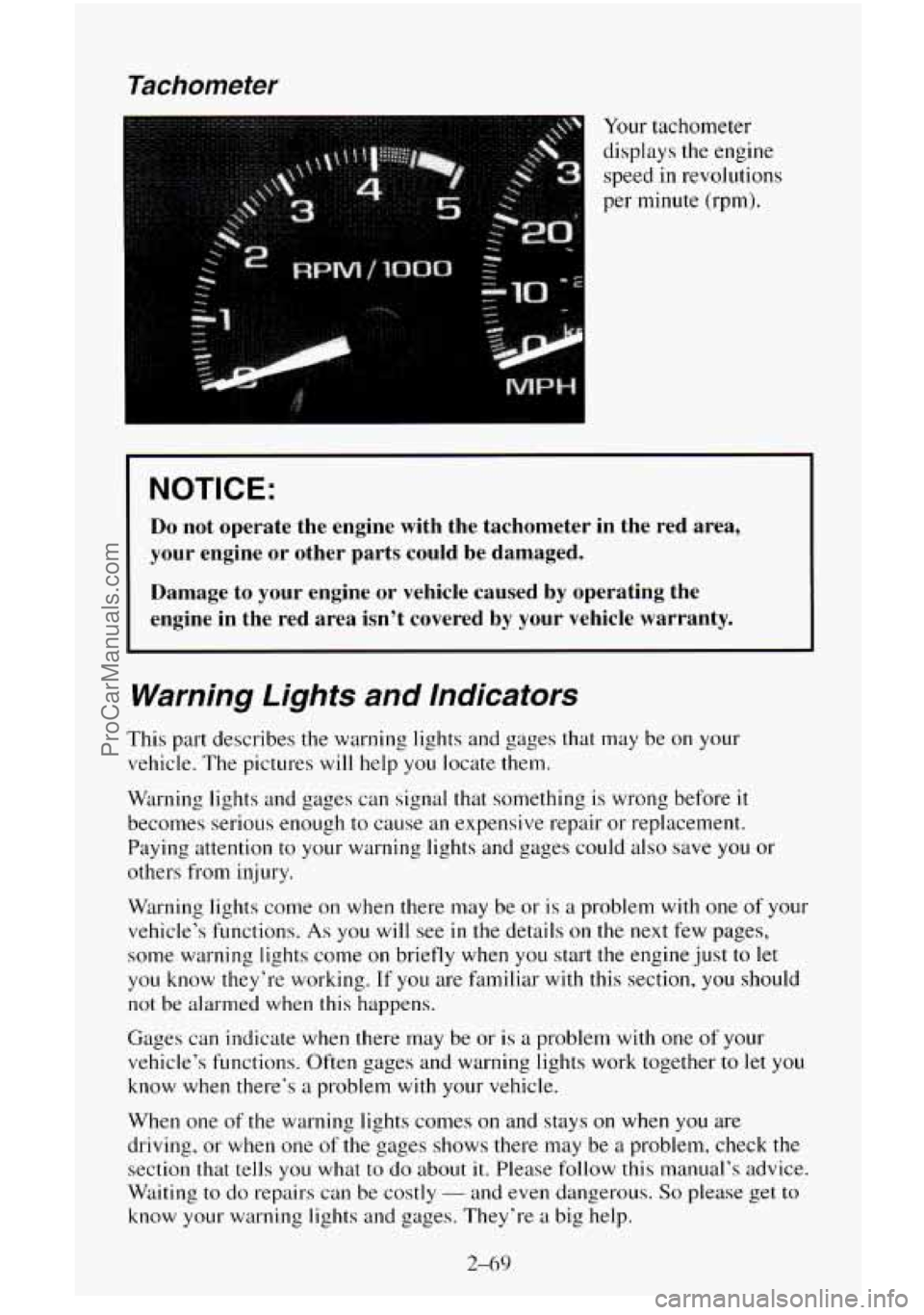
Your tachometer
displays the engine
speed in revolutions
per minute (rpm).
I NOTICE:
Do not operate the engine with the tachometer in the red area,
your engine or other parts could be damaged.
Damage to your engine
or vehicle caused by operating the
engine in the red area isn’t covered
by your vehicle warranty.
Warning Lights and Indicators
This part describes the warning lights and gages that may be on your
vehicle. The pictures will help
you locate them.
Warning lights and gages
can signal that something is wrong before it
becomes serious enough to cause an expensive repair or replacement.
Paying attention
to your warning lights and gages could also save you or
others from injury.
Warning lights come on when there may be or is a problem with
one of your
vehicle’s functions.
As you will see in the details on the next few pages,
some warning lights come
on briefly when you start the engine just to let
you know they’re working. If you are familiar with this section, you should
not be alarmed when
this happens.
Gages can indicate when there may be
or is a problem with one of your
vehicle’s functions. Often gages and warning lights work together
to let you
know when there’s a problem with your vehicle.
When one
of the warning lights comes on and stays on when you are
driving, or when one of the gages shows there may be a problem, check the
section that tells
you what to do about it. Please follow this manual’s advice.
Waiting
to do repairs can be costly - and even dangerous. So please get to
know your warning lights and gages. They‘re a big help.
2-69
ProCarManuals.com
Page 139 of 486
The brake system warning light will also come on when you set your
parking brake, and it will stay on if your parking brake doesn’t release fully.
If it stays on after your parking brake is fully released, it means you have a
brake problem.
Anti4 ock Brake System Warning Light
ANTI-
LOCK
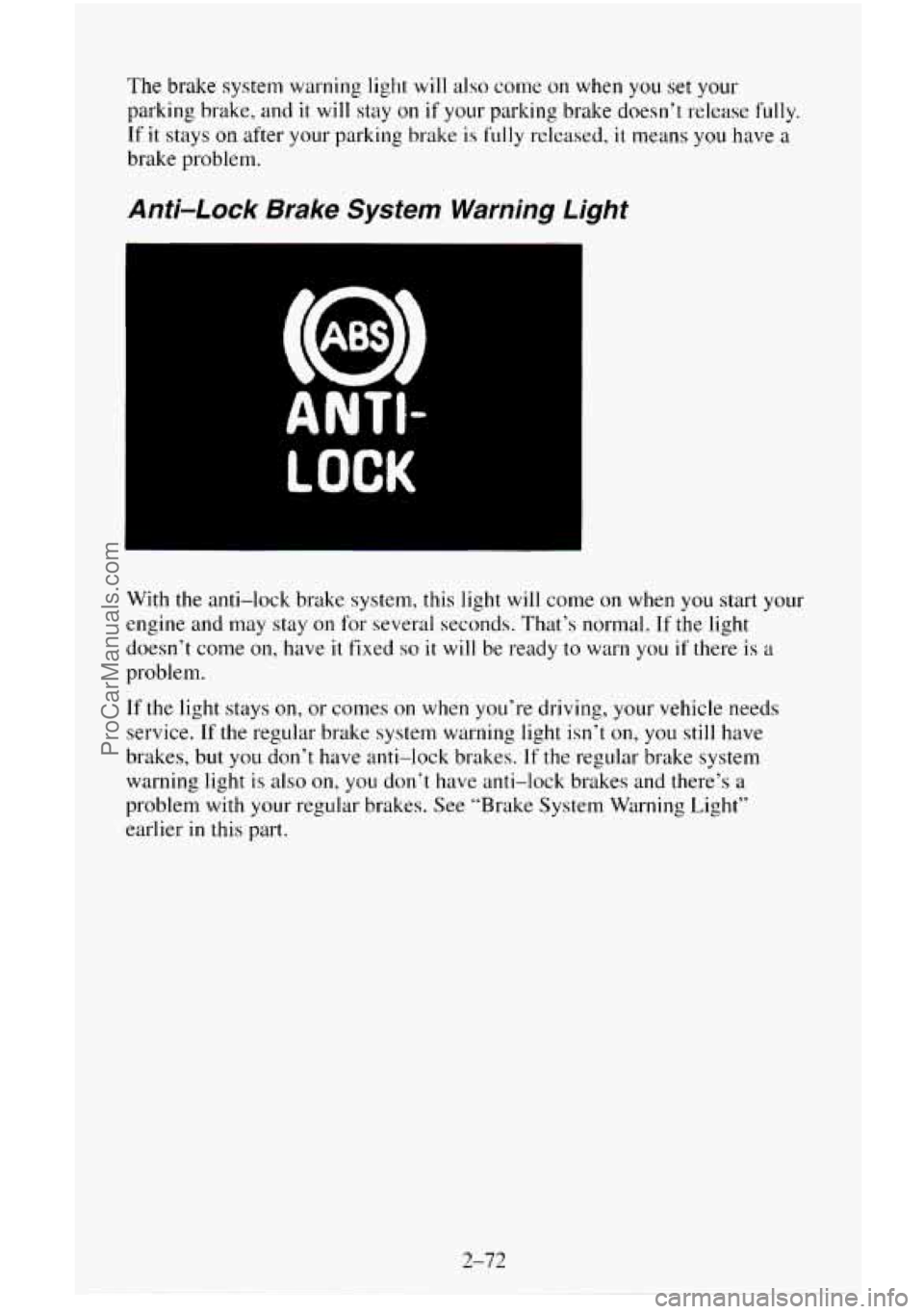
With the anti-lock brake system, this light will come on when you start your
engine and may stay on for several seconds. That’s normal.
If the light
doesn’t come on, have
it fixed so it will be ready to warn you if there is a
problem.
If the light stays on, or comes on when you’re driving, your vehicle needs
service.
If the regular brake system warning light isn’t on, you still have
brakes, but
you don’t have anti-lock brakes. If the regular brake system
warning light
is also on, you don’t have anti-lock brakes and there’s a
problem with your regular brakes. See “Brake System Warning Light”
earlier
in this part.
2-72
.~
ProCarManuals.com
Page 140 of 486
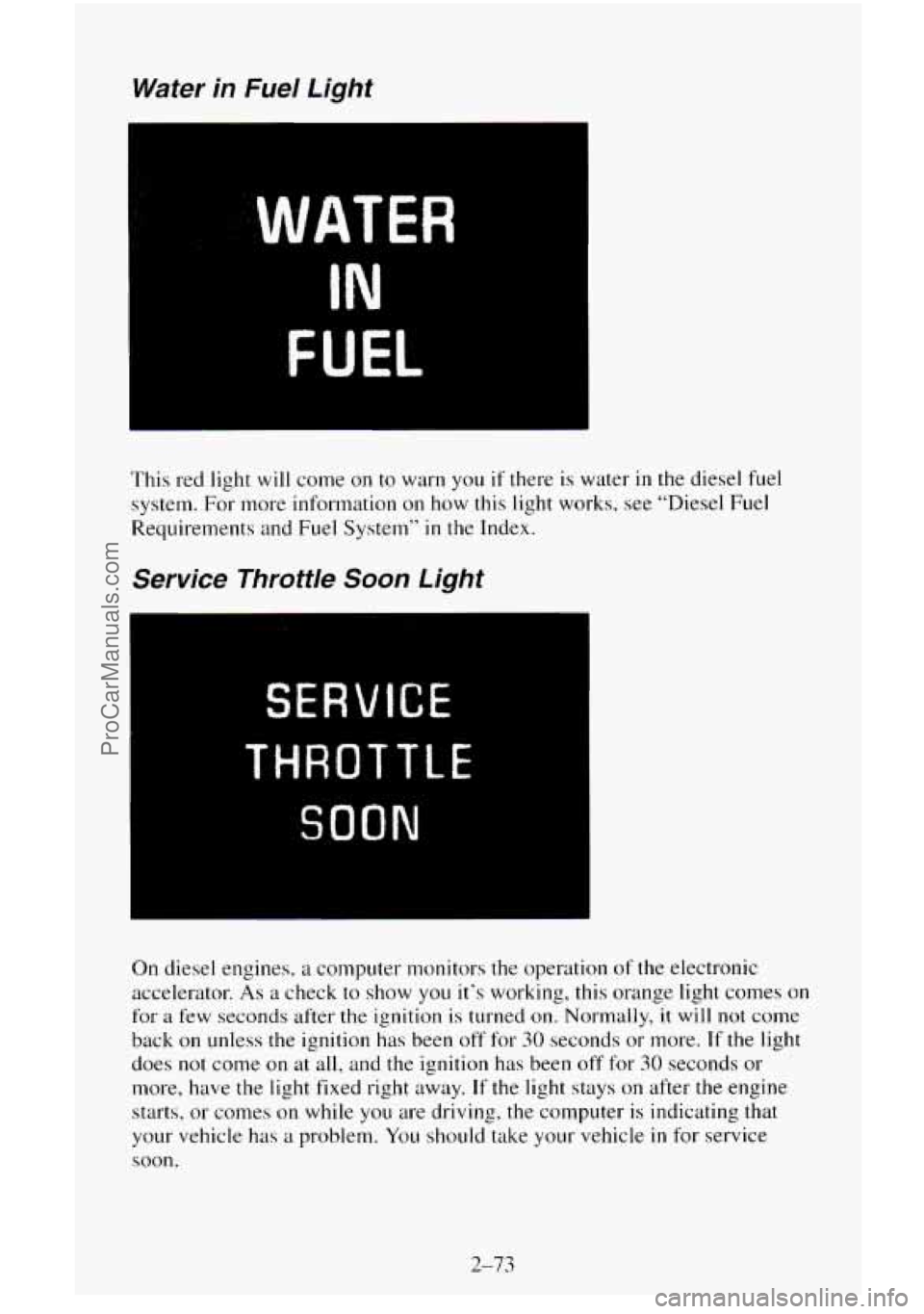
Water in Fuel Light
WATER
IN
FUEL
This red light will come on to warn you if there is water in the diesel fuel
system. For more information
on how this light works, see “Diesel Fuel
Requirements and Fuel System” in the Index.
Service Throttle Soon Light
SERVICE
THROTTLE
SOON
On diesel engines, a computer monitors the operation of the electronic
accelerator.
As a check to show you it’s working, this orange light comes on
for a few seconds after the ignition is turned on. Normally, it will not come
back on unless the ignition has been off for 30 seconds or more. If the light
does not come on at
all, and the ignition has been off for 30 seconds or
more, have the light fixed right away.
If the light stays on after the engine
starts, or comes on while
you are driving, the computer is indicating that
your vehicle
has a problem. You should take your vehicle in for service
soon.
2-73
ProCarManuals.com
Page 141 of 486
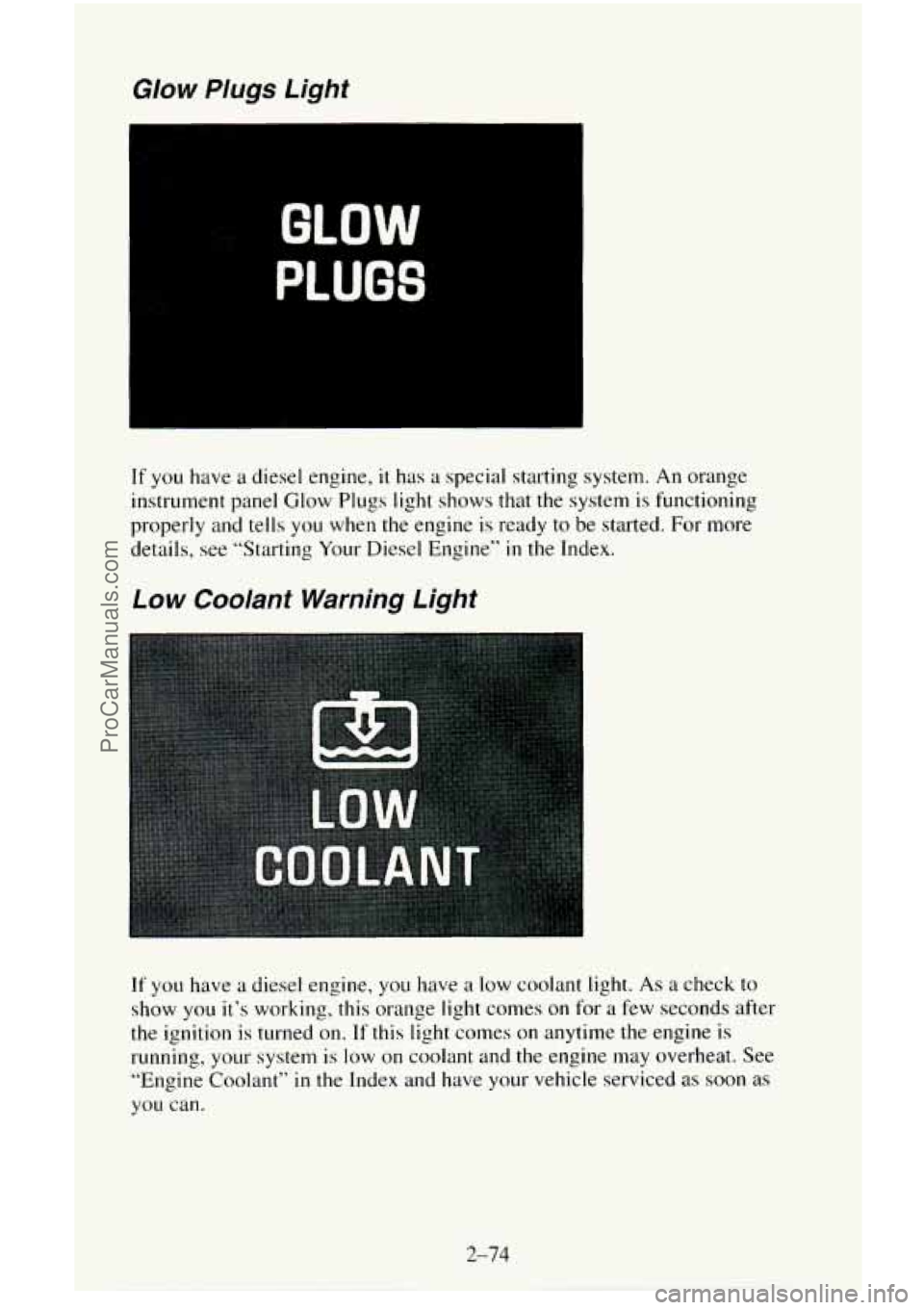
Glow Plugs Light
GLOW
PLUGS
If you have a diesel engine, it has a special starting system. An orange
instrument panel Glow Plugs light shows that the system is functioning
properly and tells you when the engine is ready to be started. For more
details, see “Starting Your Diesel Engine”
in the Index.
Low Coolant Warning Light
If you have a diesel engine, you have a low coolant light. As a check to
show you it’s working, this orange light comes on for a few seconds after
the ignition
is turned on. If this light comes on anytime the engine is
running,
your system is low on coolant and the engine may overheat. See
“Engine
Coolant” in the Index and have your vehicle serviced as soon as
you can.
2-74
ProCarManuals.com
Page 142 of 486
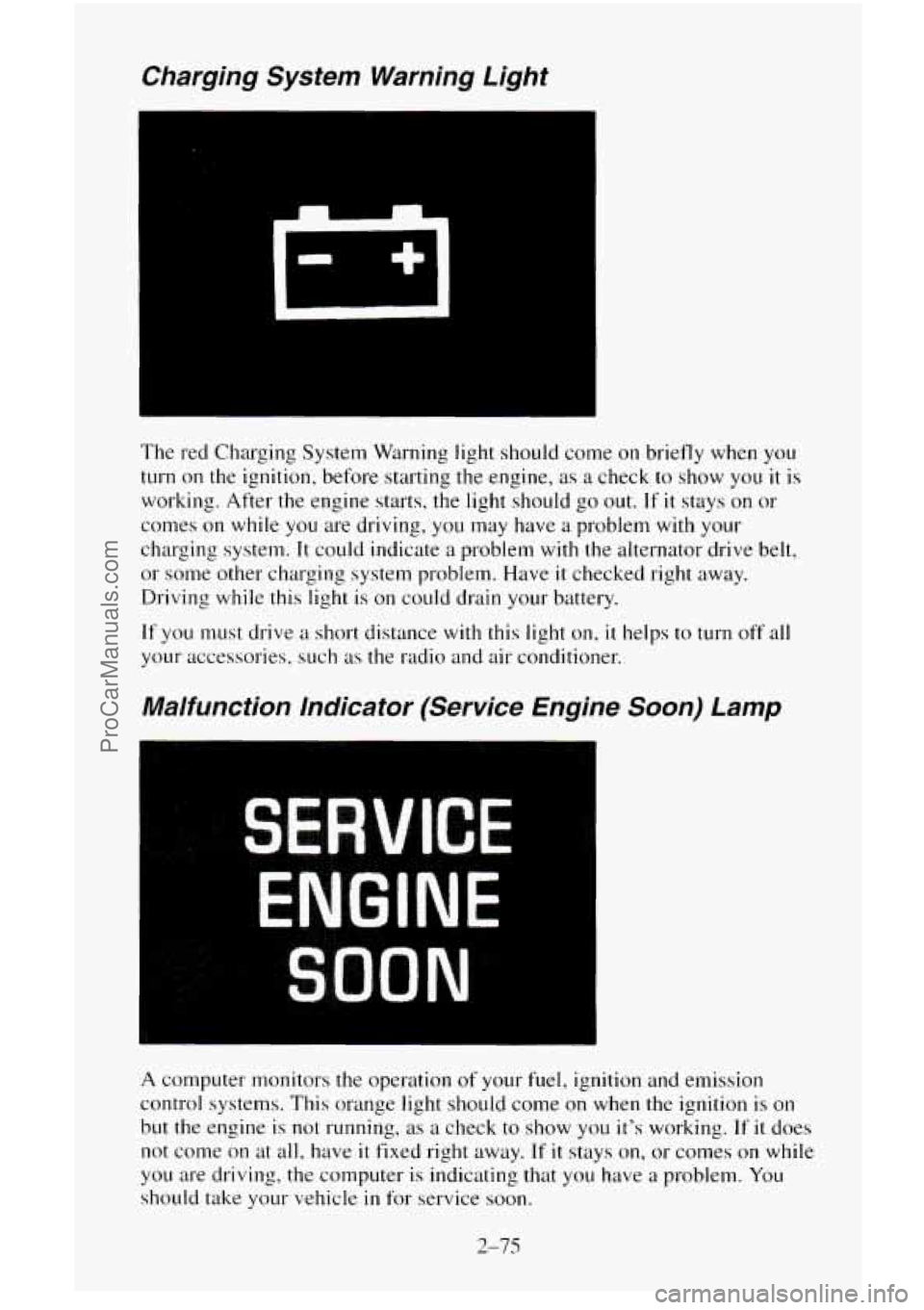
Charging System Warning Light
The red Charging System Warning light should come on briefly when you
turn on the ignition, before starting the engine, as a check to show you it is
working. After the engine starts, the light should go out. If it stays on or
conles on while you are driving, you may have a problem with your
charging system.
It could indicate a problem with the alternator drive belt,
or some other charging system problem. Have
it checked right away.
Driving while this light is on could drain your battery.
If you must drive a short distance with this light on, it helps to turn off all
your accessories, such
as the radio and air conditioner.
Malfunction indicator (Service Engine Soon) Lamp
A computer monitors the operation of your fuel, ignition and emission
control systems.
This orange light should come on when the ignition is on
but the engine is
not running, as a check to show you it’s working. If it does
not come on at all, have
it fixed right away. If it stays on, or comes on while
you are driving, the computer is indicating that you have a problem. You
should take your vehicle in for service soon.
2-75
ProCarManuals.com
Page 143 of 486

NOTICE:
If’ you keep driving your vehicle with this light on, after a whi\
le
the emission controls won’t work as well, your
fuel economy
won’t be as
good, and your engine may not run as smoothly.
This could lead to costly repairs not covered by your warranty\
.
Check Gages Light
This orange light will come on briefly when you are starting the engine. If
the light comes on and stays on while you are driving, it could indicate a
problem
with your vehicle. It could be a problem with your oil pressure,
coolant temperature, or some other problem. Check your various gages to
see
if they are in the warning zones. If they are, have your vehicle serviced
right away.
Daytime Running Lamps (DRL) Indicator Light
2-76
ProCarManuals.com
Page 145 of 486
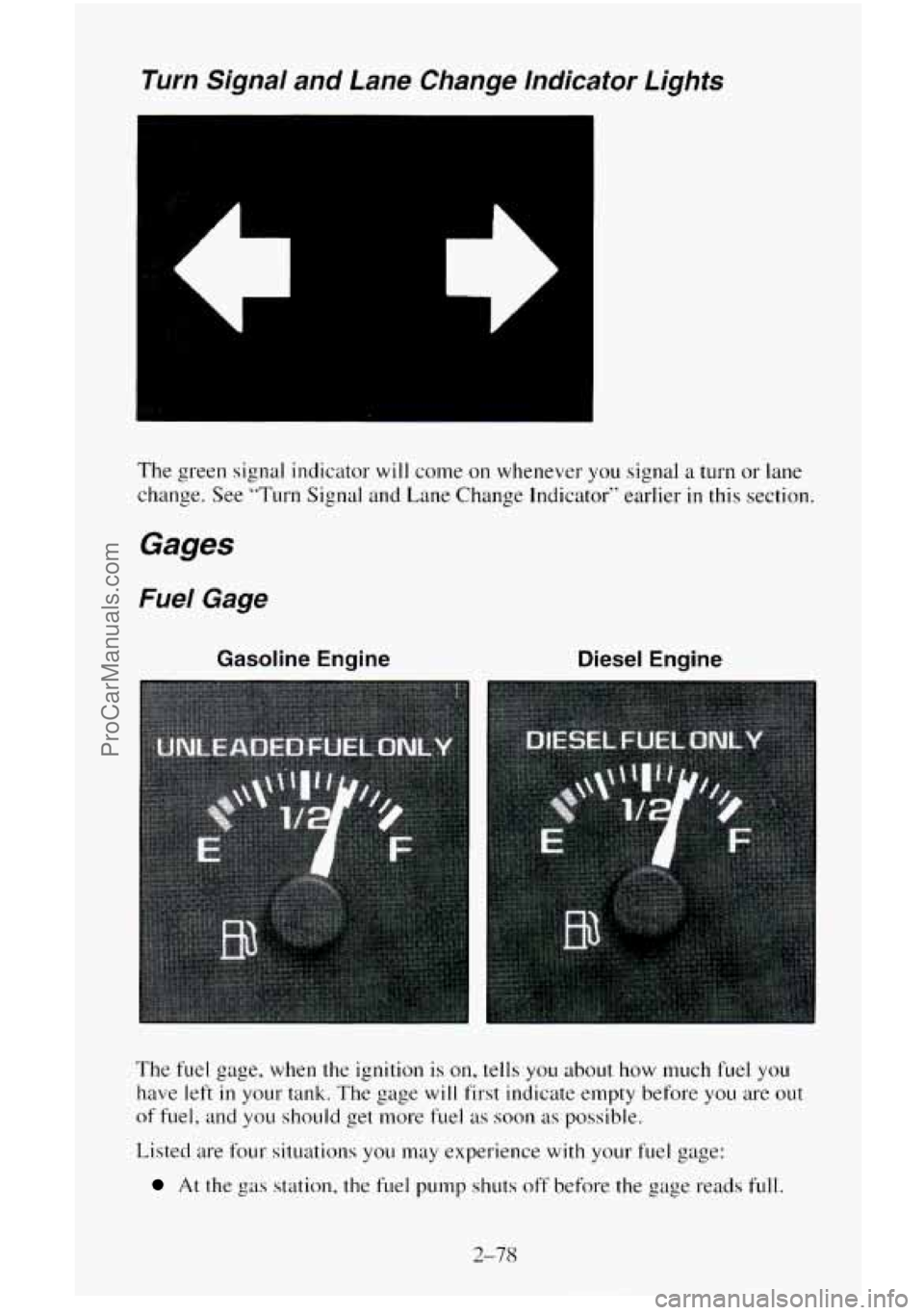
Turn Signal and Lane Change lndicator Lights
The green signal indicator will come on whenever you signal a turn or lane
change. See
“Turn Signal and Lane Change Indicator’‘ earlier in this section.
Gages
Fuel Gage
Gasoline Engine Diesel Engine
The fuel gage, when the ignition is on, tells you about how much fuel YOLI
have left in your tank. The gage will first indicate empty before you are out
of fuel,
and you should get more fuel as soon as possible.
Listed are
four situations you may experience with your fuel ea tracre:
At the gas station, the fuel pump shuts off before the gage reads ~LIII.
2-78
ProCarManuals.com
Page 146 of 486
It takes a little more or less fuel to fill up than the fuel gage indicated.
For example, the gage may have indicated the tank was half
full, but it
actually took a little more or less than half the tank’s capacity to fill the
tank.
The gage moves a little when you turn a corner or speed up.
0 The gage doesn’t go back to empty when you turn off the ignition.
None of these indicate a problem with the fuel gage.
For information on how to fill your fuel tank, see “Fuel
- Filling Your
Tank”
in the Index.
For your
fuel tank capacity, see “Fuel -Tank Capacity” in the Index.
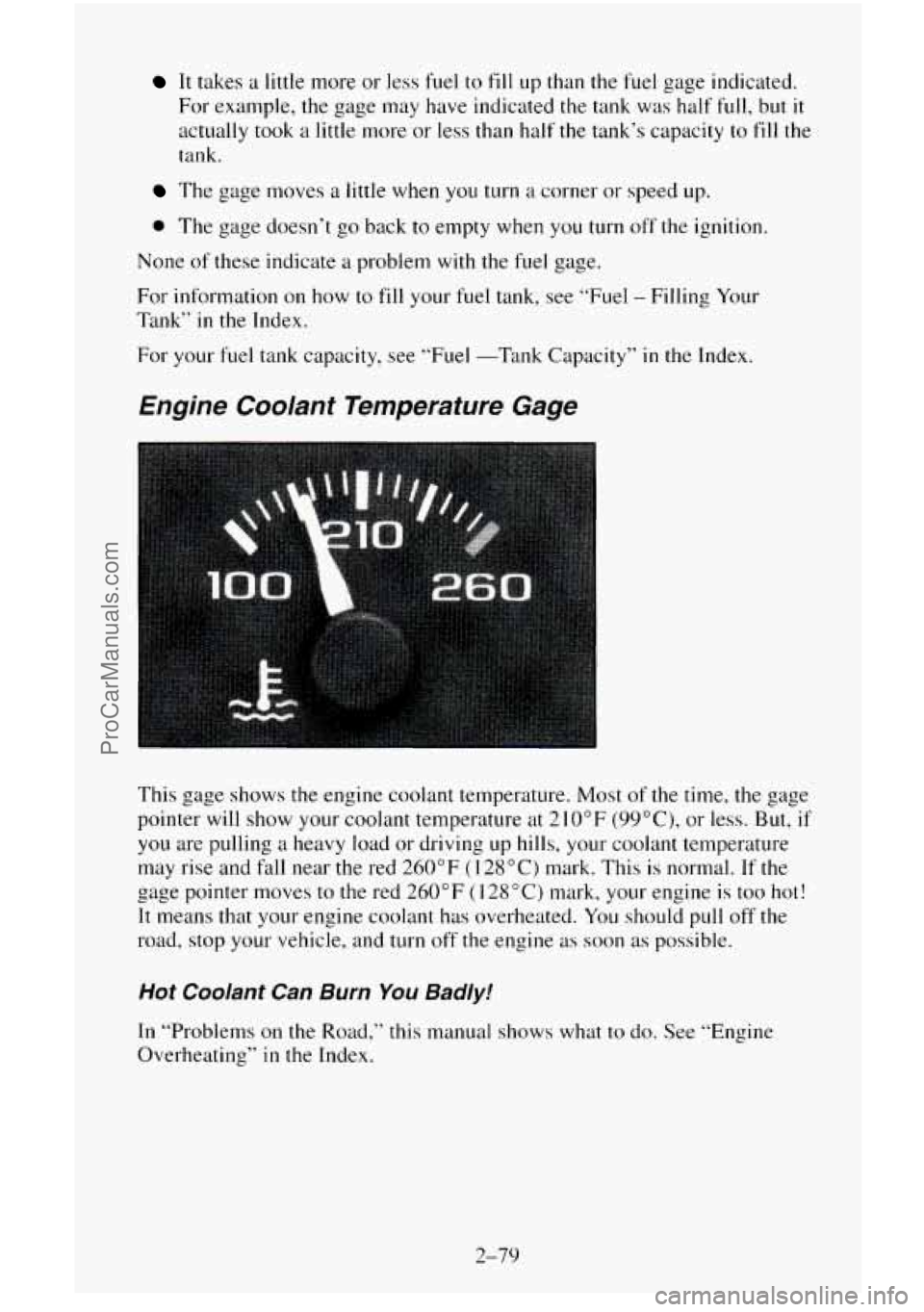
Engine Coolant Temperature Gage
This gage shows the engine coolant temperature. Most of the time, the gage
pointer will show your coolant temperature at 210°F (99”C), or less. But,
if
you are pulling a heavy load or driving up hills, your coolant temperature
may rise and fall near
the red 260°F (1 28°C) mark. This is normal. If the
gage pointer moves
to the red 260°F (1 28°C) mark, your engine is too hot!
It means that your engine coolant has overheated. You should pull off the
road, stop
your vehicle, and turn off the engine as soon as possible.
Hot Coolant Can Burn You Badly!
In “Problems on the Road,” this manual shows what to do. See “Engine
Overheating”
in the Index.
2-79
ProCarManuals.com