engine CHEVROLET SUBURBAN 1995 Repair Manual
[x] Cancel search | Manufacturer: CHEVROLET, Model Year: 1995, Model line: SUBURBAN, Model: CHEVROLET SUBURBAN 1995Pages: 486, PDF Size: 26.58 MB
Page 246 of 486

NOTICE:
In cold weather, water can freeze and crack the engine, radiat\
or.
heater core and other parts. Use the recommended coolant.
E
When the coolant in the coolant recovery tank is at or above the COLD
mark, start your vehicle.
5-13
ProCarManuals.com
Page 250 of 486
I
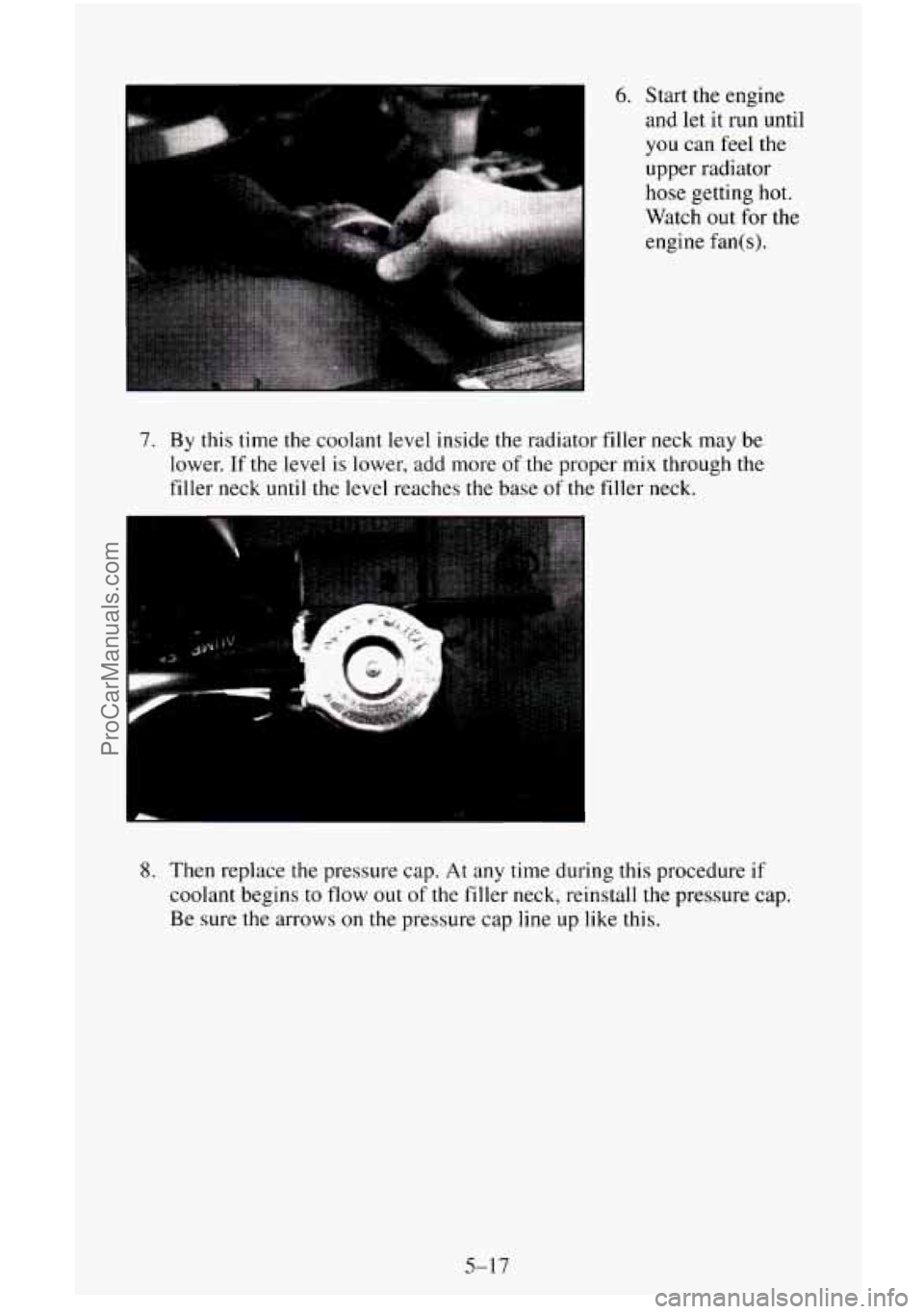
6. Start the engine
and let it run until
you can feel the
upper radiator
hose getting hot.
Watch
out for the
engine fan(s).
7. By this time the coolant level inside the radiator filler neck may be
lower. If the level
is lower, add more of the proper mix through the
filler neck until the level reaches the base of the filler neck.
8. Then replace the pressure cap. At any time during this procedure if
coolant begins to flow out of the filler neck, reinstall the pressure cap.
Be sure the arrows
on the pressure cap line up like this.
5-1 7
ProCarManuals.com
Page 251 of 486
Cooling System - Diesel Engines
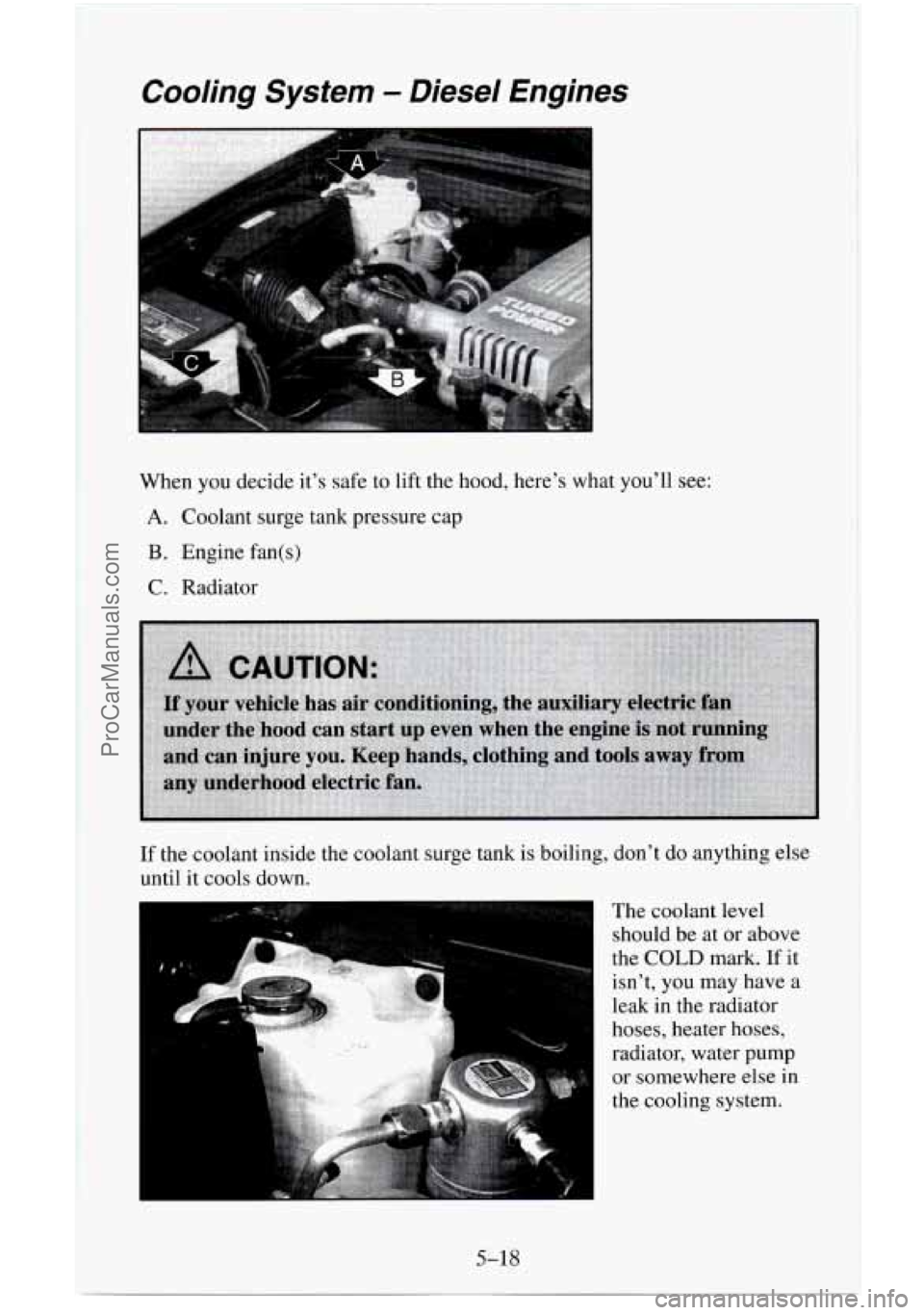
When you decide it’s safe to lift the hood, here’s what you’ll see:
A. Coolant surge tank pressure cap
B. Engine fan(s)
C. Radiator
If the coolant inside the coolant surge tank is boiling, don’t do anything else
until
it cools down.
The coolant level
should be at or above
the
COLD mark. If it
isn’t,
you may have a
leak in the radiator
hoses, heater hoses,
radiator, water pump
1 or somewhere else in
the cooling system.
5-18
ProCarManuals.com
Page 252 of 486

NOTICE:
Engine damage from running your engine without coolant isn’t \
covered by your warranty.
If there seems to be no leak, start the engine again. See if the fan speed
increases
when idle speed is doubled by pushing the accelerator pedal down.
If it doesn’t, your vehicle needs service. Turn
off the engine.
How to Add Coolant to the Coolant Surge Tank
NOTICE:
The diesel engine has a specific coolant fill procedure. Failur\
e to
follow this procedure could cause your engine to overheat and \
be
severely damaged.
If you haven’t found a problem yet, but the coolant level isn’t at the COLD
mark, add a 50/50 mixture of clean water (preferably distilled) and a proper
antifreeze at the coolant surge tank, but be sure the cooling system,
including the coolant surge tank pressure cap, is cool before you do it. (See
“Engine Coolant” in the Index for more information about the proper
coolant mix.)
5-19
ProCarManuals.com
Page 254 of 486

NOTICE:
In cold weather, water can freeze and crack the engine, radiat\
or,
heater core and other parts.
So use the recommended coolant.
1. You can remove the coolant surge tank pressure cap when the cooling
system, including the coolant surge tank pressure cap and upper
radiator hose, is no longer hot. Turn the pressure cap slowly to the left
until
it first stops. (Don’t press down while turning the pressure cap.)
If you hear a hiss, wait for that
to stop. A hiss means there is still some
pressure left.
5-21
ProCarManuals.com
Page 255 of 486
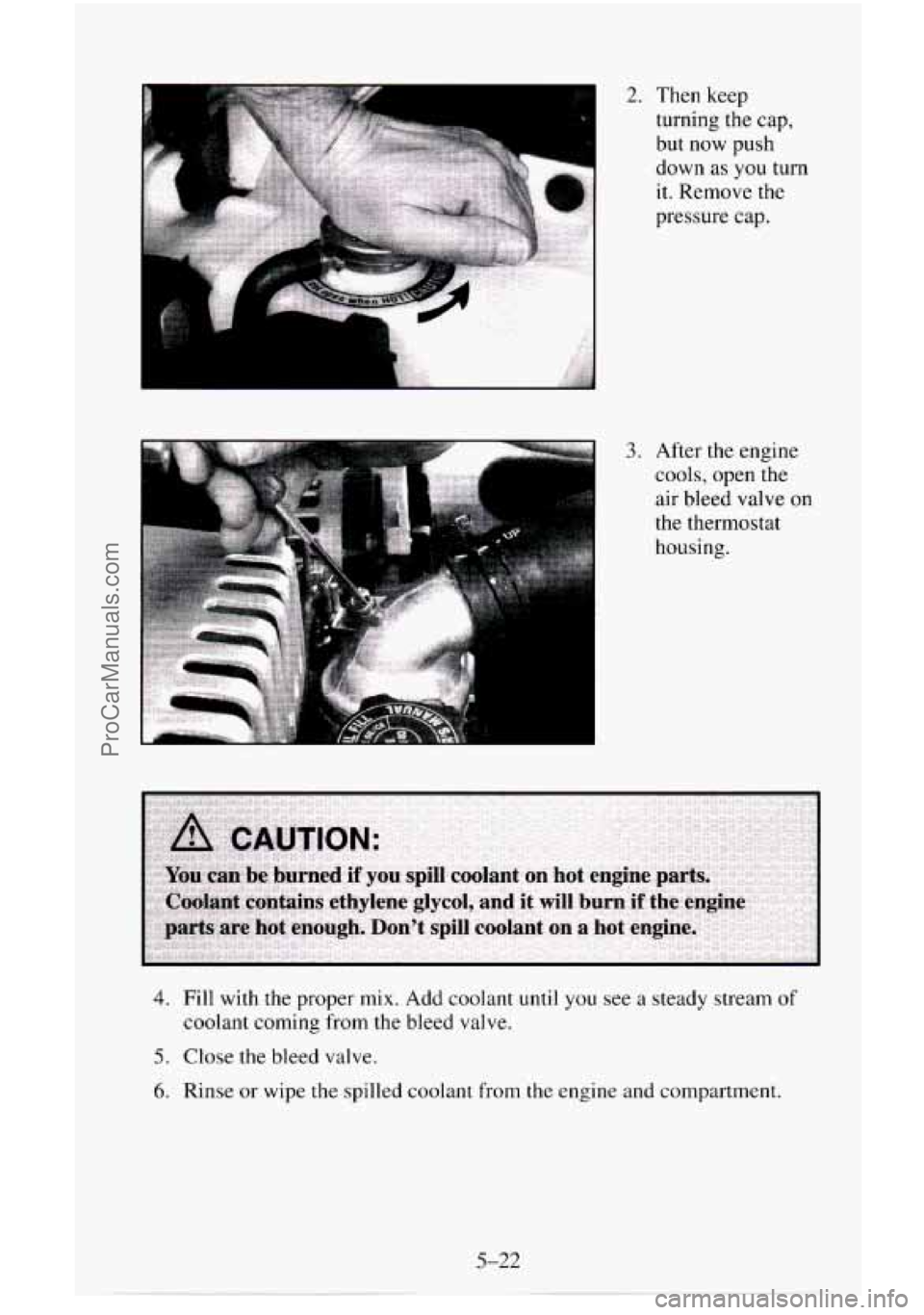
2. Then keep
turning the cap,
but now push
down
as you turn
it. Remove the
pressure cap.
3. After the engine
cools, open the
air bleed valve on
the thermostat
housing.
4. Fill with the proper mix. Add coolant until you see a steady stream of
5. Close the bleed valve. coolant coming
from the bleed valve.
6. Rinse or wipe the spilled coolant from the engine and compartment.
ProCarManuals.com
Page 256 of 486
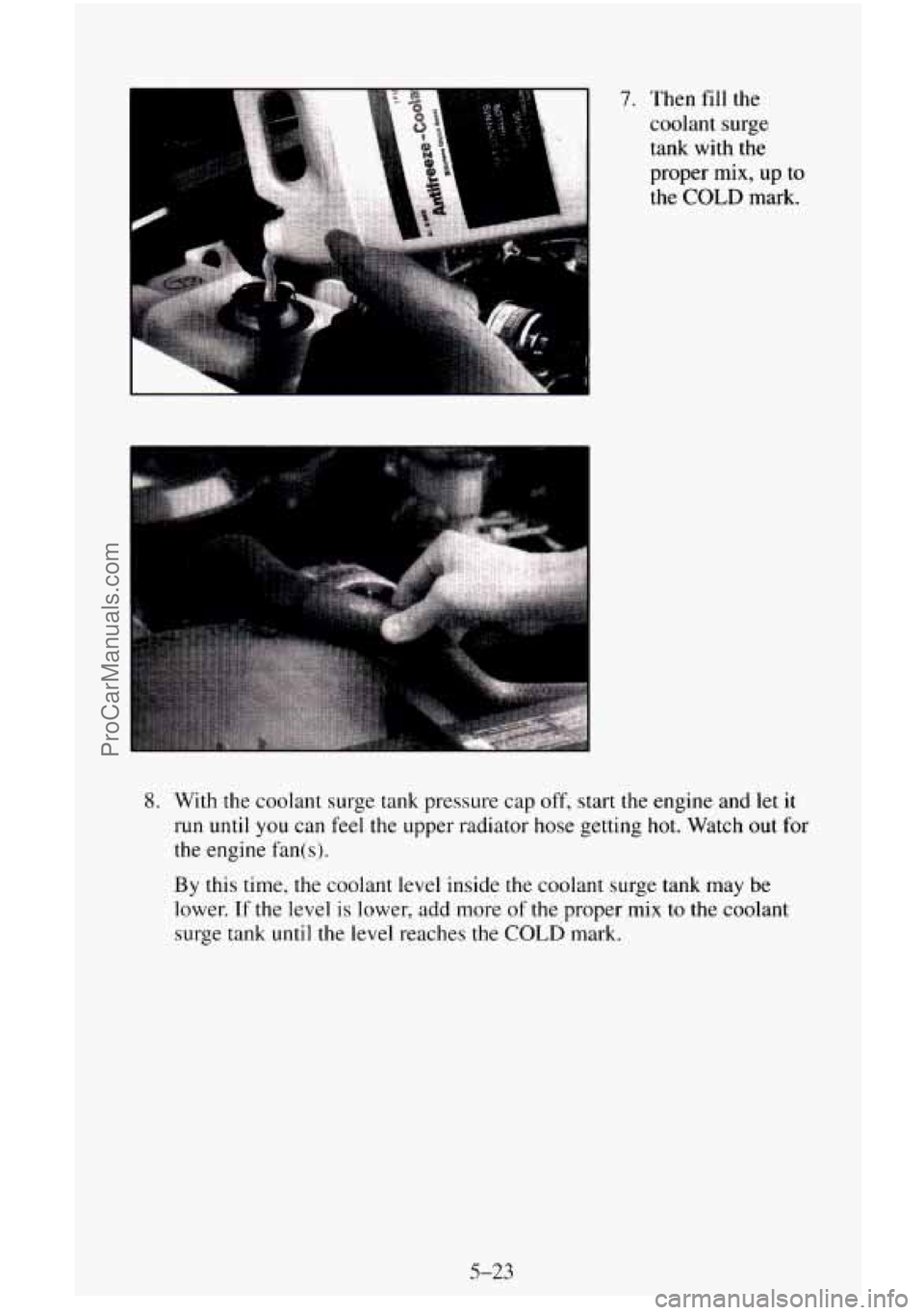
7. Then fill the coolant
surge
tank with the
proper mix, up to
the COLD mark.
8. With the coolant surge tank pressure cap off, start the engine and let it
run until you can feel the upper radiator hose getting hot. Watch out for
the engine fan(s).
By this time, the coolant level inside
the coolant surge tank may be
lower. If the level is lower, add more of the proper mix to the coolant
surge tank until the level reaches the
COLD mark.
5-23
ProCarManuals.com
Page 257 of 486
h
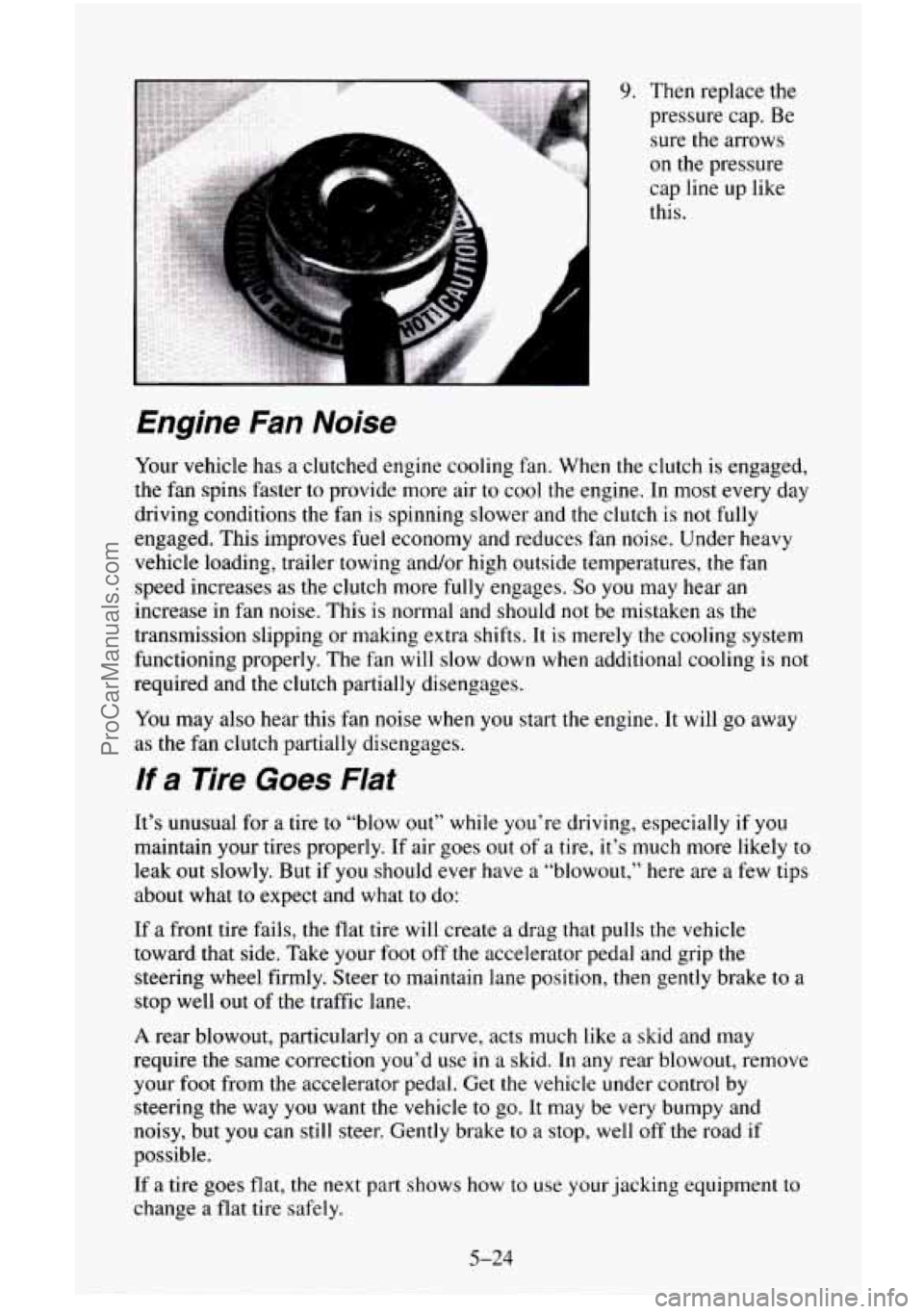
9. Then replace the
pressure cap. Be
sure the arrows
on the pressure
cap line up like
this.
Engine Fan Noise
Your vehicle has a clutched engine cooling fan. When the clutch is engaged,
the fan spins faster to provide more air to cool the engine. In most every day
driving conditions the fan
is spinning slower and the clutch is not fully
engaged. This improves fuel economy and reduces fan noise. Under heavy
vehicle loading, trailer towing and/or high outside temperatures,
the fan
speed increases as the clutch more
fully engages. So you may hear an
increase in fan noise. This is normal and should not be mistaken as the
transmission slipping
or making extra shifts. It is merely the cooling system
functioning properly. The fan will slow down when additional cooling is not
required and the clutch partially disengages.
You may also hear this fan noise when you start the engine. It will go away
as the fan clutch partially disengages.
If a Tire Goes Flat
It’s unusual for a tire to “blow out” while you’re driving, especially if you
maintain your tires properly. If air goes out of a tire, it’s much more likely to
leak out slowly. But if you should ever have a “blowout,” here are a few tips
about what
to expect and what to do:
If a front tire fails, the flat tire will create a drag that pulls the vehicle
toward that side. Take your foot off the accelerator pedal and grip the
steering wheel firmly. Steer
to maintain lane position, then gently brake to a
stop well out of the traffic lane.
A rear blowout, particularly on a curve, acts much like a skid and may
require the same correction you’d
use in a skid. In any rear blowout, remove
your foot from
the accelerator pedal. Get the vehicle under control by
steering the way
you want the vehicle to go. It may be very bumpy and
noisy, but you can still steer. Gently brake to a stop, well
off the road if
possible.
If a tire goes flat, the next part shows how to use your jacking equipment to
change a flat tire safely.
5-24
ProCarManuals.com
Page 279 of 486
You should keep a record with all parts receipts and list the mileage and the
date
of any servi-work you perform. See “Maintenance Record” in the
Index.
NOTICE:
If you try to do your own service work without knowing enough
about it, your vehicle could be damaged.
Maintenance Schedule
Section 7 of this manual, “Scheduled Maintenance Services”, explains the
maintenance your
new vehicle needs, and when it should be done. It also
has a form that
you can use to record the maintenance work done on your
vehicle. Be sure
to read this information.
Fuel (Gasoline Engine)
If your vehicle has a diesel engine, see “Diesel Fuel Requirements and Fuel
System”
in this Section. For vehicles with gasoline engines, please read this.
Use regular unleaded gasoline rated at 87 octane or higher. It should meet
specifications ASTM D48 14
in the United States and CGSB 3.5-92 in
Canada. These fuels should have the proper additives, so you should not
have to add anything to the fuel.
In
the United States and Canada, it’s easy to be sure you get the right kind
of gasoline (unleaded). You’ll see UNLEADED right on the pump. And
only unleaded nozzles will fit into your vehicle’s filler neck.
6-2
ProCarManuals.com
Page 280 of 486
Be sure the posted octane is at least 87. If the octane is less than 87, you
may get a heavy knocking noise when you drive.
If it’s bad enough, it can
damage your engine.
If you’re using
fuel rated at 87 octane or higher and you still hear heavy
knocking, your engine needs service. But don’t worry
if you hear a little
pinging noise when you’re accelerating or driving up a hill. That’s normal
and
you don’t have to buy a higher octane fuel to get rid of pinging. It’s the
heavy, constant knock that means
you have a problem.
What about gasoline
with blending materials that contain oxygen
(oxygenates), such as MTBE or alcohol?
MTBE is “methyl tertiary-butyl ether.’’ Fuel that is no more than 15%.
MTBE is fine for your vehicle.
Ethanol is ethyl or grain alcohol. Properly-blended fuel that is no more than
10% ethanol is fine for your vehicle.
Methnrzol is methyl or wood alcohol.
~
NOTICE:
Fuel that is more than 5% methanol is bad for your vehicle.
Don’t use it.
It can corrode metal parts in your fuel system and
also damage plastic and rubber parts. That damage wouldn’t be
covered under your warranty. And even at
5% or less, there
must be “cosolvents” and corrosion preventers in this fuel to
help avoid these problems.
Gasolines for Cleaner Air
Your use of gasoline with deposit control additives will help prevent
deposits from forming
in your engine and fuel system. That helps keep your
engine
in tune and your emission control system working properly. It’s good
for
your vehicle, and you’ll be doing your part for cleaner air.
Many gasolines are now blended with oxygenates. General Motors
recommends that you use gasolines with these blending materials, such as
MTBE and ethanol. By doing so,
you can help clean the air, especially in
those parts of the country that have high carbon monoxide levels.
In addition, some gasoline suppliers are now producing reformulated
gasolines. These gasolines are specially designed
to reduce vehicle
emissions. General Motors recommends that
you use reformulated gasoline.
By doing
so, you can help clean the air, especially in those parts of the
country that have high ozone levels.
6-3
ProCarManuals.com