wheel CHEVROLET SUBURBAN 1995 Manual PDF
[x] Cancel search | Manufacturer: CHEVROLET, Model Year: 1995, Model line: SUBURBAN, Model: CHEVROLET SUBURBAN 1995Pages: 486, PDF Size: 26.58 MB
Page 339 of 486
Tire Chains
NOTICE:
If your vehicle has LT265/75R16 size tires, don't use tire chains;
they can damage your vehicle.
If you have
a tire size other than LT26975R16, use tire chains
only where legal and only when you must. Use chains that are
the proper size for your tires. Install them on the tires
of the rear
axle.
Don't
use chains on the tires of the front axle.
Tighten them as tightly as possible with the ends securely
fastened. Drive slowly and follow the chain manufacturer's
instructions. If you can hear the chains contacting your vehicle,
stop and retighten them. If the contact continues, slow down
until it stops. Driving too fast or spinning the wheels with chains
on will damage your vehicle.
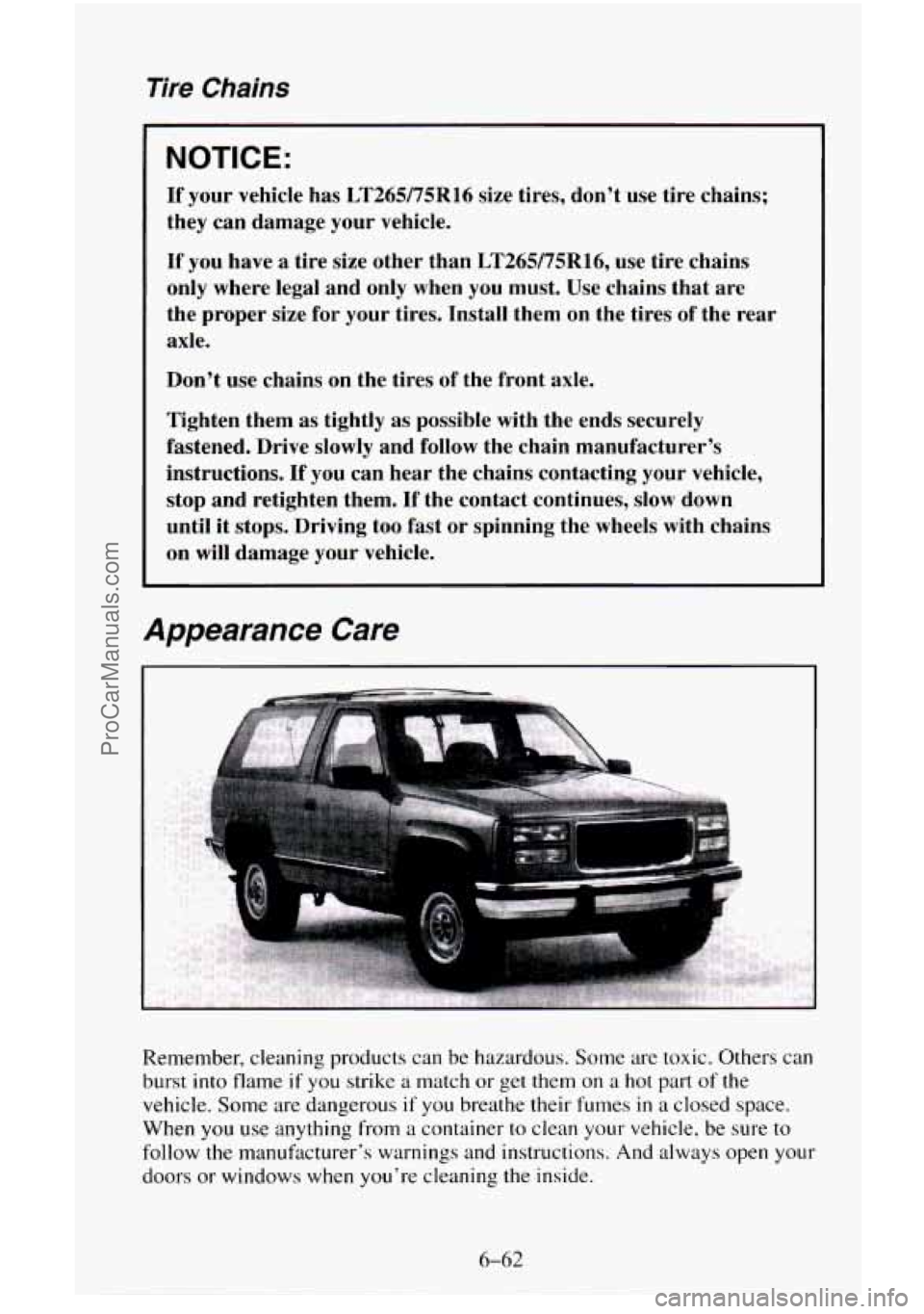
Appearance Care
. ..
. ..
Remember, cleaning products can be hazardous. Some are toxic. Others can
burst into flame if
you strike a match or get them on a hot part of the
vehicle. Some are dangerous
if you breathe their fumes in a closed space.
When
you use anything from a container to clean your vehicle, be sure to
follow the manufxturer's warnings and instructions. And always open your
doors or windows when you're cleaning
the inside.
6-62
ProCarManuals.com
Page 346 of 486
Protecting Exterior Bright Metal Parts
Bright metal parts should be cleaned regularly to keep their luster. Washing
with water
is all that is usually needed. However, you may use GM Chrome
Polish
on chrome or stainless steel trim, if necessary.
Use special care with aluminum trim.
To avoid damaging protective trim,
never use auto or chrome polish, steam or caustic soap
to clean aluminum.
A coating of wax, rubbed to high polish, is recommended for all bright
metal parts.
Aluminum Wheels (If So Equipped)
Your aluminum wheels have a protective coating similar to the painted
surface
of your vehicle. Don’t use strong soaps, chemicals, chrome polish,
abrasive cleaners or abrasive cleaning brushes on them because
you could
damage this coating. After rinsing thoroughly,
a wax may be applied.
NOTICE:
If you have aluminum wheels, don’t use an automatic car wash
that has hard silicon carbide cleaning brushes. These brushes
can take the protective coating
off your aluminum wheels.
Tires
To clean your tires, use a stiff brush with a tire cleaner.
When applying
a tire dressing always take care to wipe off any overspray or
splash from painted surfaces. Petroleum-based products may damage the
paint
finish.
Sheet Metal Damage
If your vehicle is damaged and requires sheet metal repair or replacement,
make sure the body repair shop applies anti-corrosion material to
the parts
repaired or replaced
to restore corrosion protection.
Foreign Material
Calcium chloride and other salts, ice melting agents, road oil and tar, tree
sap, bird droppings, chemicals from industrial chimneys, and other foreign
matter can damage your vehicle’s finish if they remain
on painted surfaces.
Use cleaners that are marked safe
for painted surfaces to remove foreign
matter.
6-69
ProCarManuals.com
Page 354 of 486
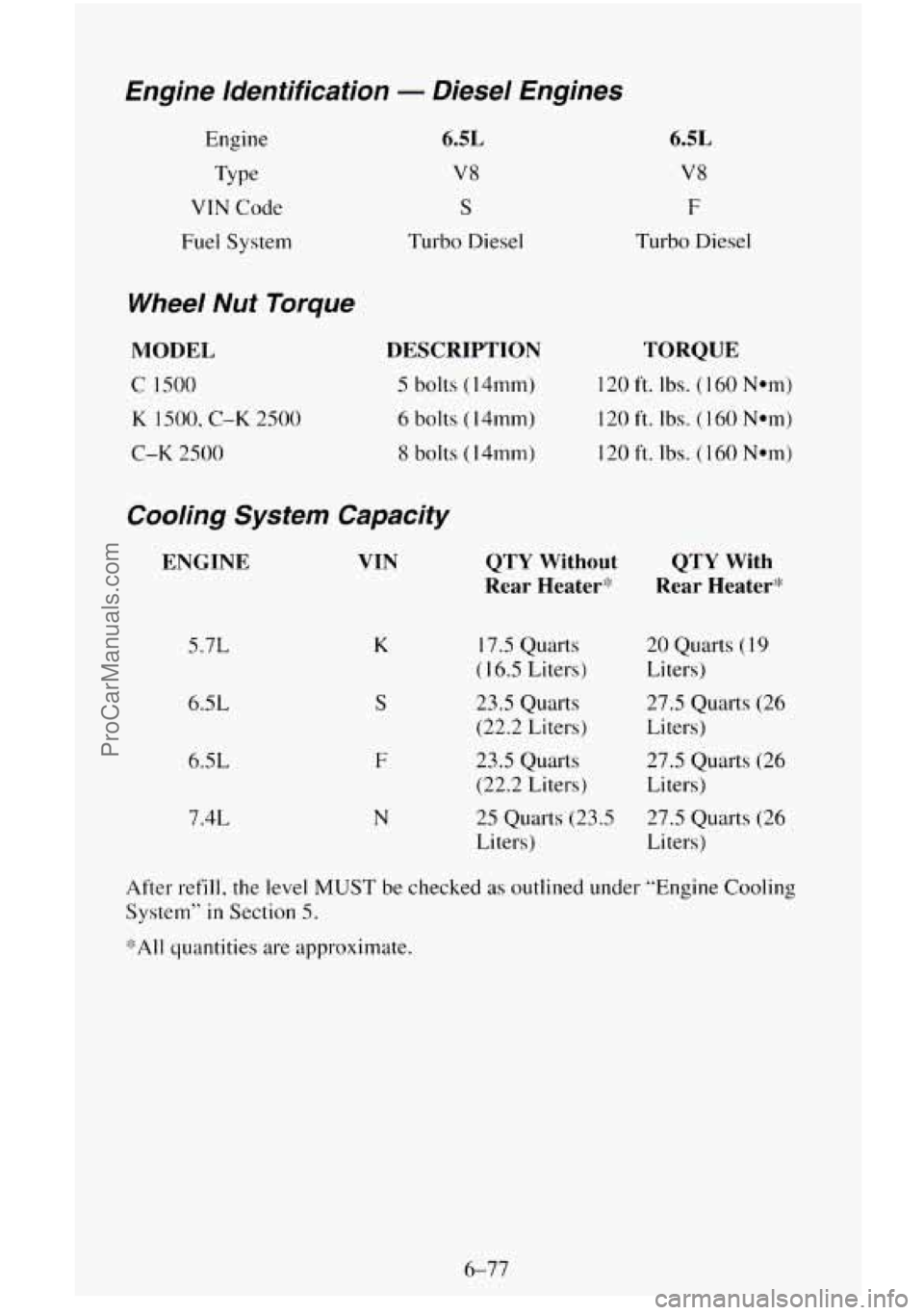
Engine Identification - Diesel Engines
Engine Type
VTN Code
Fuel System
Wheel Nut Torque
MODEL
C 1500
K 1500, C-K 2500
C-K 2500
6.5L
V8
S
Turbo Diesel
DESCRIPTION
5 bolts (14mm)
6 bolts
(1 4mm)
8 bolts ( 14mm)
Cooling System Capacity
ENGINE
5.7L
6.5L
6.5L 7.4L
VIN
K
S
F
N
6.5L
V8
F
Turbo Diesel
TORQUE
120 ft. Ibs. ( 160 N*m)
120 ft. Ibs. (1 60 Nom)
I20
ft. lbs. ( 160 Nom)
QTY Without
Rear Heater*
1 7.5 Quarts
( 16.5 Liters)
23.5 Quarts (22.2 Liters)
23.5 Quarts
(22.2 Liters)
25 Quarts
(23.5
Liters)
QTY With
Rear Heater4’
20 Quarts (1 9
Liters)
27.5 Quarts (26
Liters)
27.5 Quarts (26
Liters)
27.5 Quarts (26
Li ters)
After refill. the level MUST be checked
as outlined under “Engine Cooling
System” in Section 5.
‘$All quantities are approximate.
6-77
ProCarManuals.com
Page 355 of 486
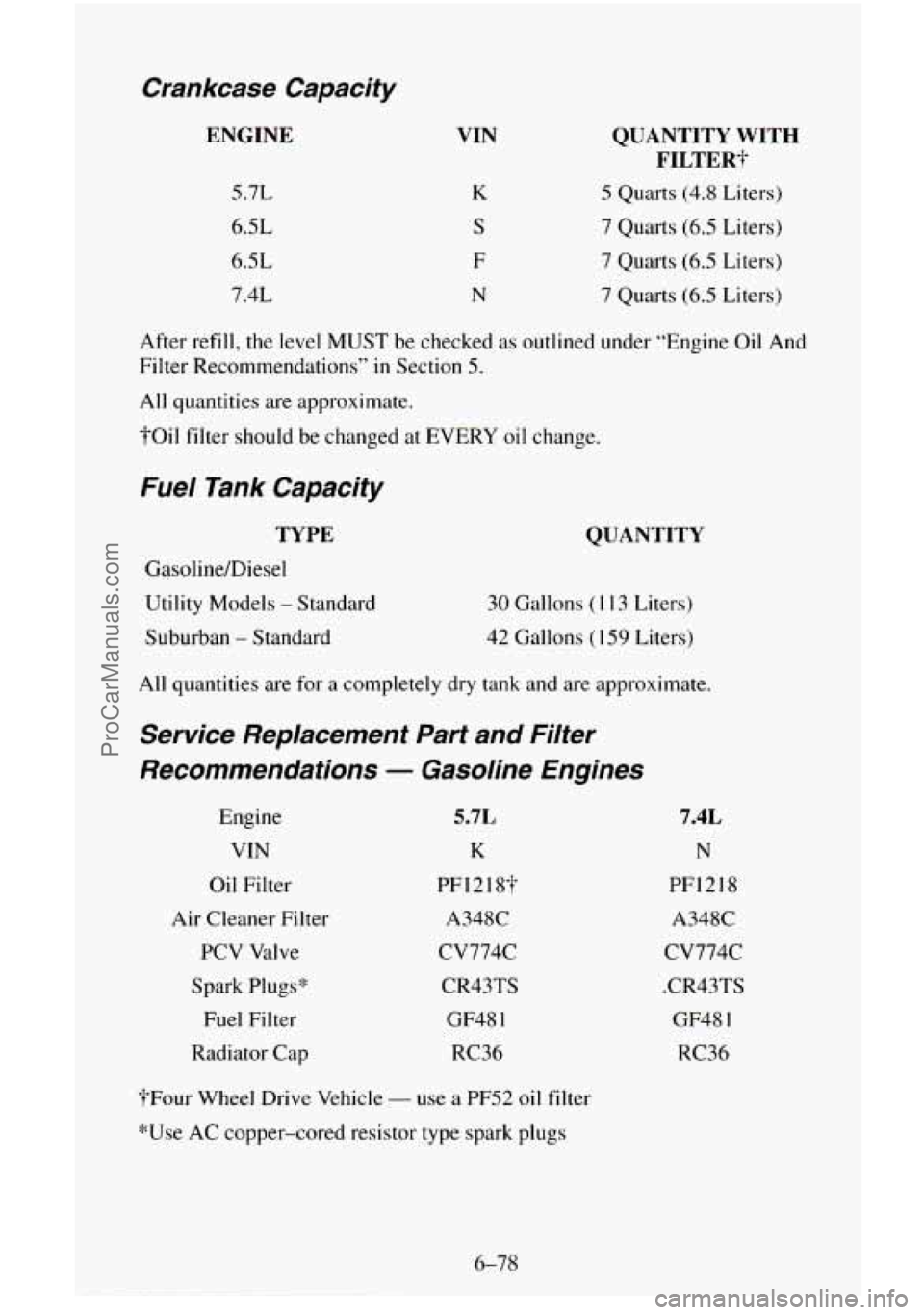
Crankcase Capacity
ENGINE
5.7L
6.5L
6.5L
7.4L
VIN
K
S
F
N
QUANTITY WITH
FILTER?
5 Quarts (4.8 Liters)
7 Quarts (6.5 Liters)
7 Quarts (6.5 Liters)
7 Quarts (6.5 Liters)
After refill, the level
MUST be checked as outlined under “Engine Oil And
Filter Recommendations”
in Section 5.
All quantities are approximate.
?Oil filter should be changed at EVERY oil change.
Fuel Tank Capacity
TYPE
Gasoline/Diesel
Utility Models - Standard
Suburban
- Standard
QUANTITY
30 Gallons ( I 1 3 Liters)
42 Gallons
( I59 Liters)
All quantities are for a completely dry tank and are approximate.
Service Replacement Part and Filter
Recommendations
- Gasoline Engines
Engine
VIN
Oil Filter
Air Cleaner Filter
PCV Valve
Spark Plugs”
Fuel Filter
Radiator Cap
5.7L
K
PF1218T A348C
cv774c
CR43TS
GF48 1
RC36
?Four Wheel Drive Vehicle
- use a PF52 oil filter
*Use AC copper-cored resistor type spark plugs
7.4L
N
PF1218
A348C
cv774c
.CR43TS GF48
1
RC36
ProCarManuals.com
Page 360 of 486
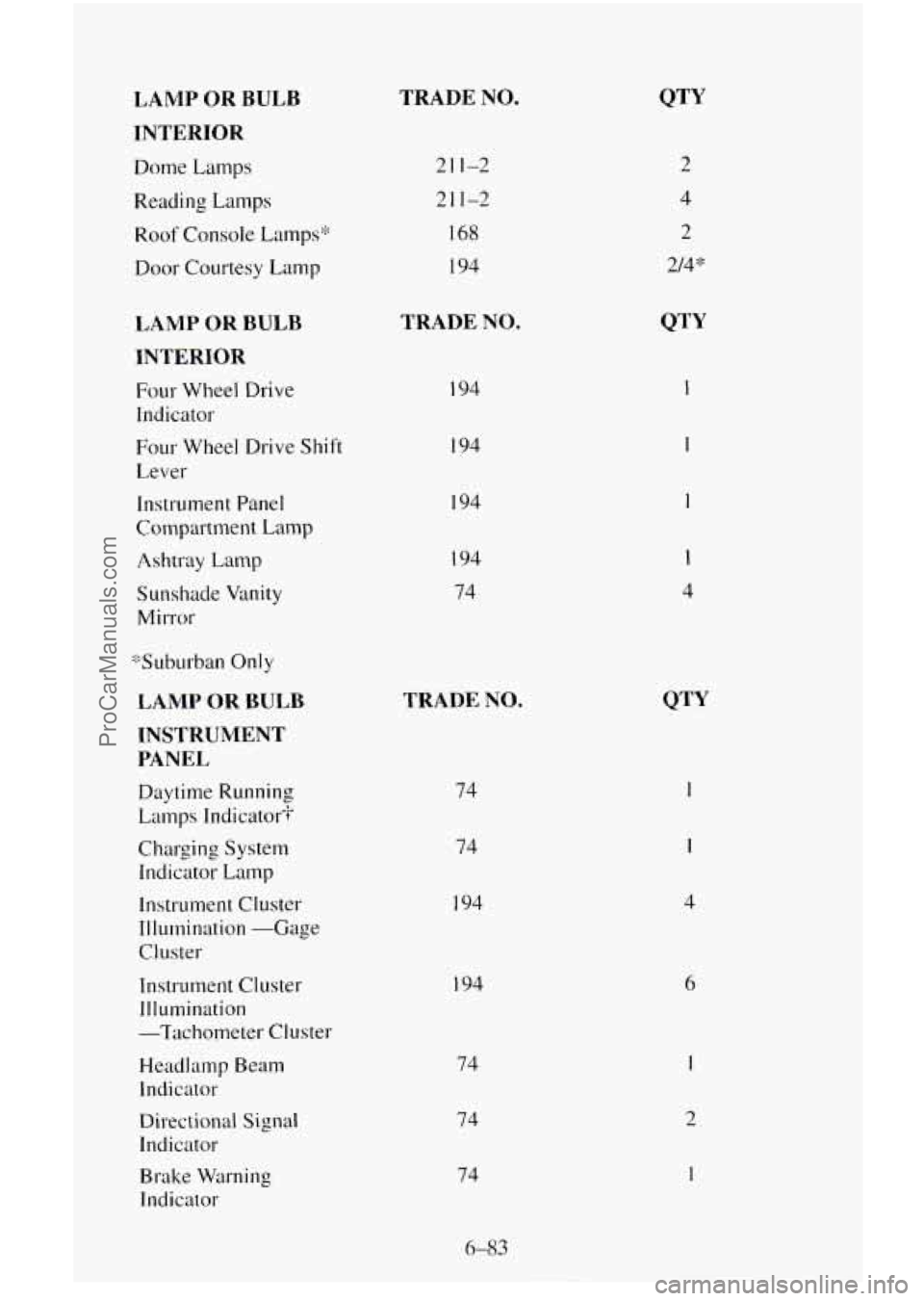
LAMP OR BULB
INTERIOR
Dome Lamps
Reading
Lamps
Roof Console Lamps'$
Door Courtesy Lamp
LAMP OR BULB
INTERIOR
Four Wheel Drive
Indicator
Four Wheel Drive Shift
Lever
Instrument Panel
Compartment
Lamp
Ashtray Lamp
Sunshade Vmity
Mirror
'$Suburban Only
LAMP OR BULB
INSTRUMENT
PANEL
Daytime Running Lamps Indicator?
Charging System Indicator Lamp
Instrument Cluster
Illurnination -Gage
Cluster
Instrument Cluster
Illumination
-Tachometer Cluster
Headlamp Beam
Indicator
Directional Signal
Indicator
Brake Warning Indicator
TRADE NO.
21 1-2
21 1-2
168
I94
TRADE NO.
194
I94 194
194
74
TRADE NO.
74
74
194
194
74
74 74
2
4
2
2/4*
QTY
1
I
1
1
4
I
1
4
6
I
2
1
6-83
ProCarManuals.com
Page 366 of 486
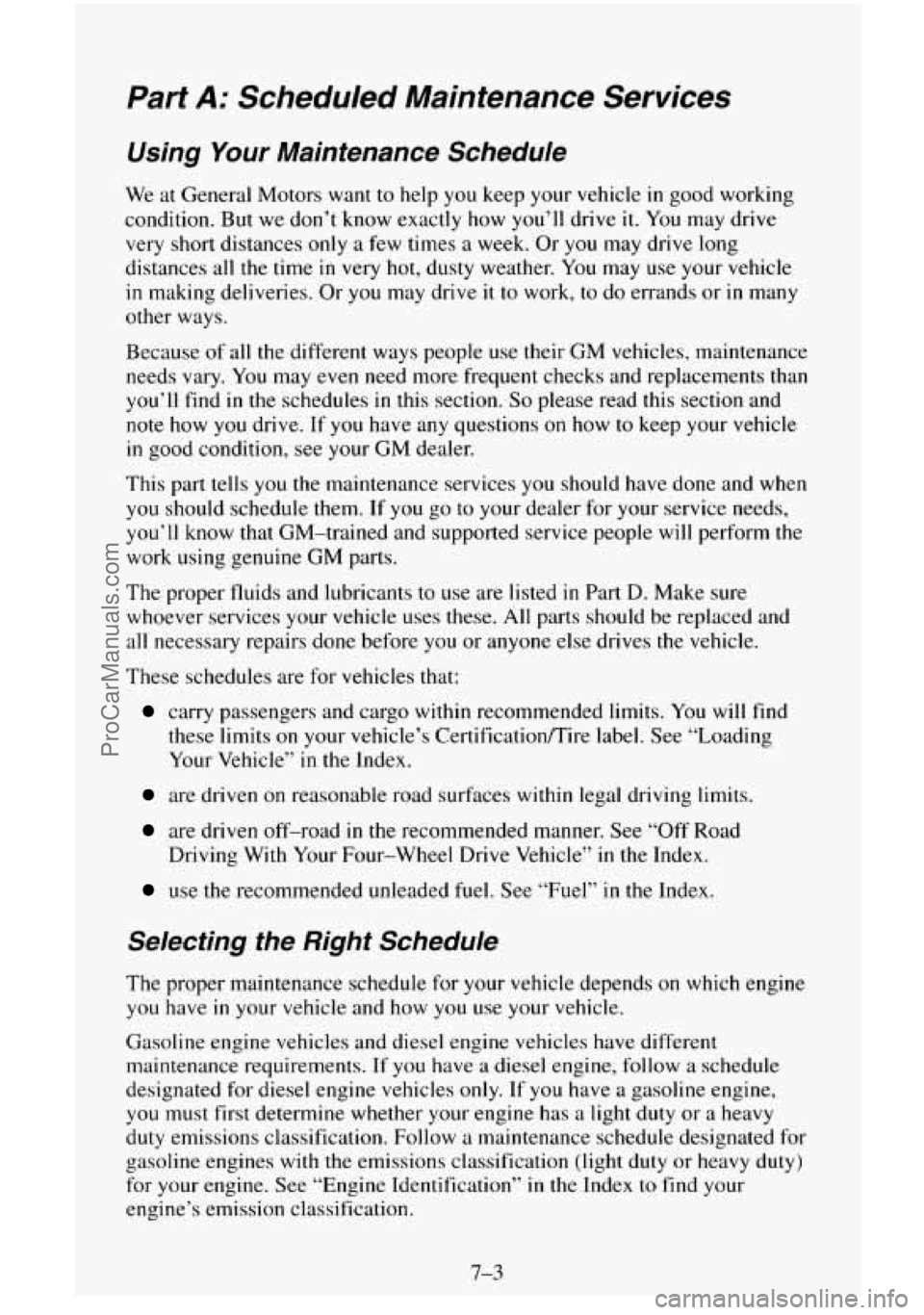
Part A: Scheduled Maintenance Services
Using Your Maintenance Schedule
We at General Motors want to help you keep your vehicle in good working
condition. But we don’t know exactly how
you’ll drive it. You may drive
very short distances
only a few times a week. Or you may drive long
distances all the time
in very hot, dusty weather. You may use your vehicle
in making deliveries. Or you may drive it to work, to do errands or in many
other ways.
Because of all the different ways people use their GM vehicles, maintenance
needs vary. You may
even need more frequent checks and replacements than
you’ll find
in the schedules in this section. So please read this section and
note how
you drive. If you have any questions on how to keep your vehicle
in good condition, see your GM dealer.
This part tells you the maintenance services
you should have done and when
you should schedule them. If you go to your dealer for your service needs,
you’ll know that GM-trained and supported service people will perform the
work using genuine GM parts.
The proper fluids and lubricants to use are listed in Part D. Make sure
whoever services your vehicle uses these. All parts should be replaced and
all necessary repairs done before you or anyone else drives the vehicle.
These schedules are
for vehicles that:
carry passengers and cargo within recommended limits. You will find
these limits on your vehicle’s CertificatiodTire label. See “Loading
Your Vehicle”
in the Index.
are driven on reasonable road surfaces within legal driving limits.
are driven off-road in the recommended manner. See “Off Road
Driving With Your Four-wheel Drive Vehicle”
in the Index.
use the recommended unleaded fuel. See “Fuel” in the Index.
Selecting the Right Schedule
The proper maintenance schedule for your vehicle depends on which engine
you have in your vehicle and how you use your vehicle.
Gasoline engine vehicles and diesel engine vehicles have different
maintenance requirements. If you have a diesel engine, follow
a schedule
designated for diesel engine vehicles
only. If you have a gasoline engine,
you must first determine whether your engine has a light duty or a heavy
duty emissions classification. Follow a maintenance schedule designated for
gasoline engines with the emissions classification (light duty or heavy duty)
for your engine. See “Engine Identification”
in the Index to find your
engine’s emission classification.
7-3
ProCarManuals.com
Page 367 of 486
If your engine has more than one emissions classification, the classification
is determined by the Gross Vehicle Weight Rating (GVWR) of your vehicle
as shown on the Certification Label. See “Loading Your Vehicle” in the
Index.
Once you’ve determined your engine type and,
if necessary, emissions
classification, you’ll need
to decide which of the two schedules is right for
your vehicle. See Definitions for Maintenance Schedule I and Maintenance
Schedule I1 following.
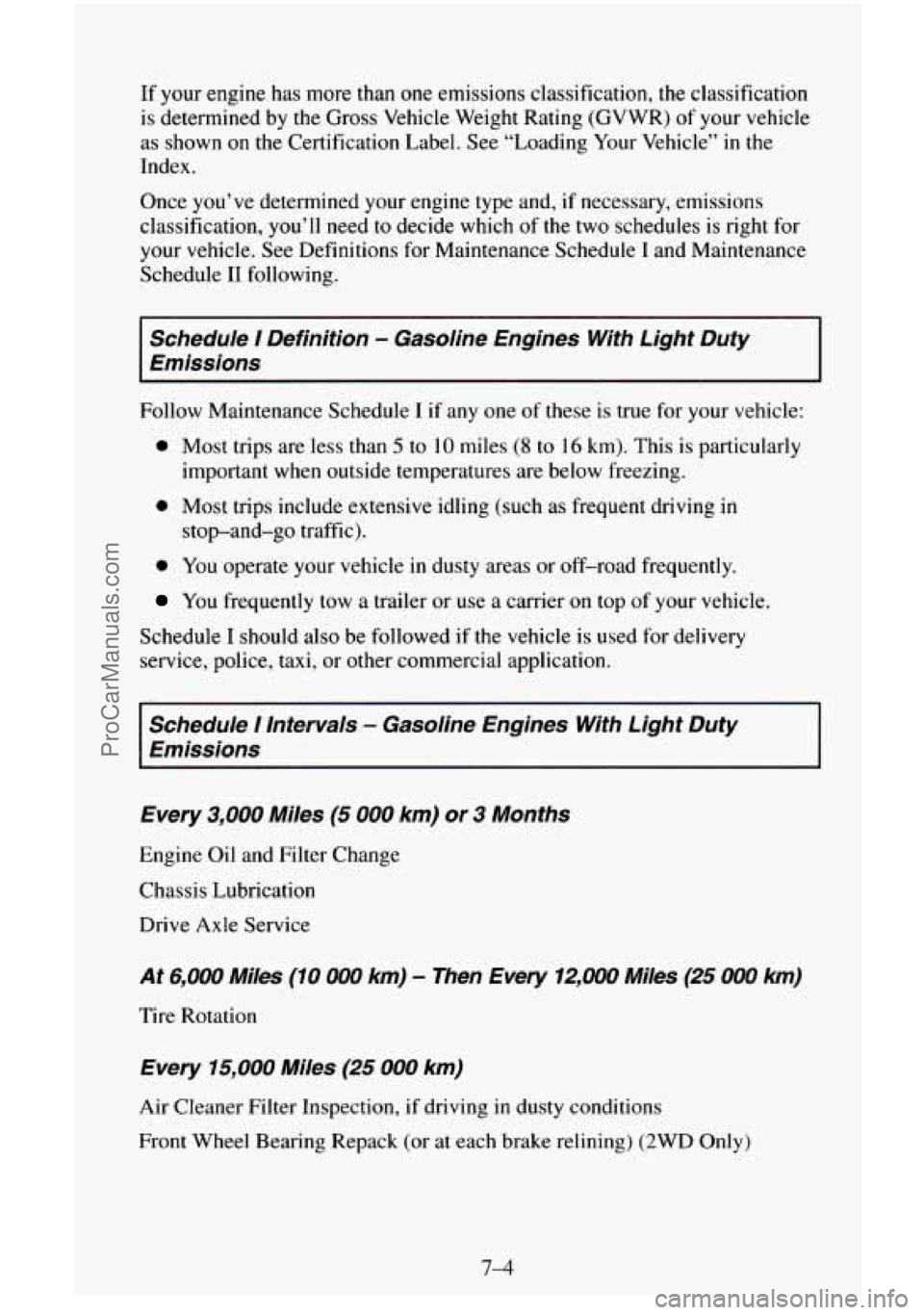
Schedule I Definition - Gasoline Engines With Light Duty
Emissions
Follow Maintenance Schedule I if any one of these is true for your vehicle:
0 Most trips are less than 5 to 10 miles (8 to 16 km). This is particularly
important when outside temperatures are below freezing.
stop-and-go traffic).
0 Most trips include extensive idling (such as frequent driving in
0 You operate your vehicle in dusty areas or off-road frequently.
You frequently tow a trailer or use a carrier on top of your vehicle.
Schedule
I should also be followed if the vehicle is used for delivery
service, police, taxi, or other commercial application.
Schedule I Intervals - Gasoline Engines With Light Duty
Emissions
Every
3,000 Miles (5 000 km) or 3 Months
Engine Oil and Filter Change
Chassis Lubrication
Drive Axle Service
At 6,000 Miles (10 000 km) - Then Every 12,000 Miles (25 000 km)
Tire Rotation
Every 15,000 Miles (25 000 km)
Air Cleaner Filter Inspection, if driving in dusty conditions
Front Wheel Bearing Repack (or at each brake relining)
(2WD Only)
7-4
ProCarManuals.com
Page 369 of 486
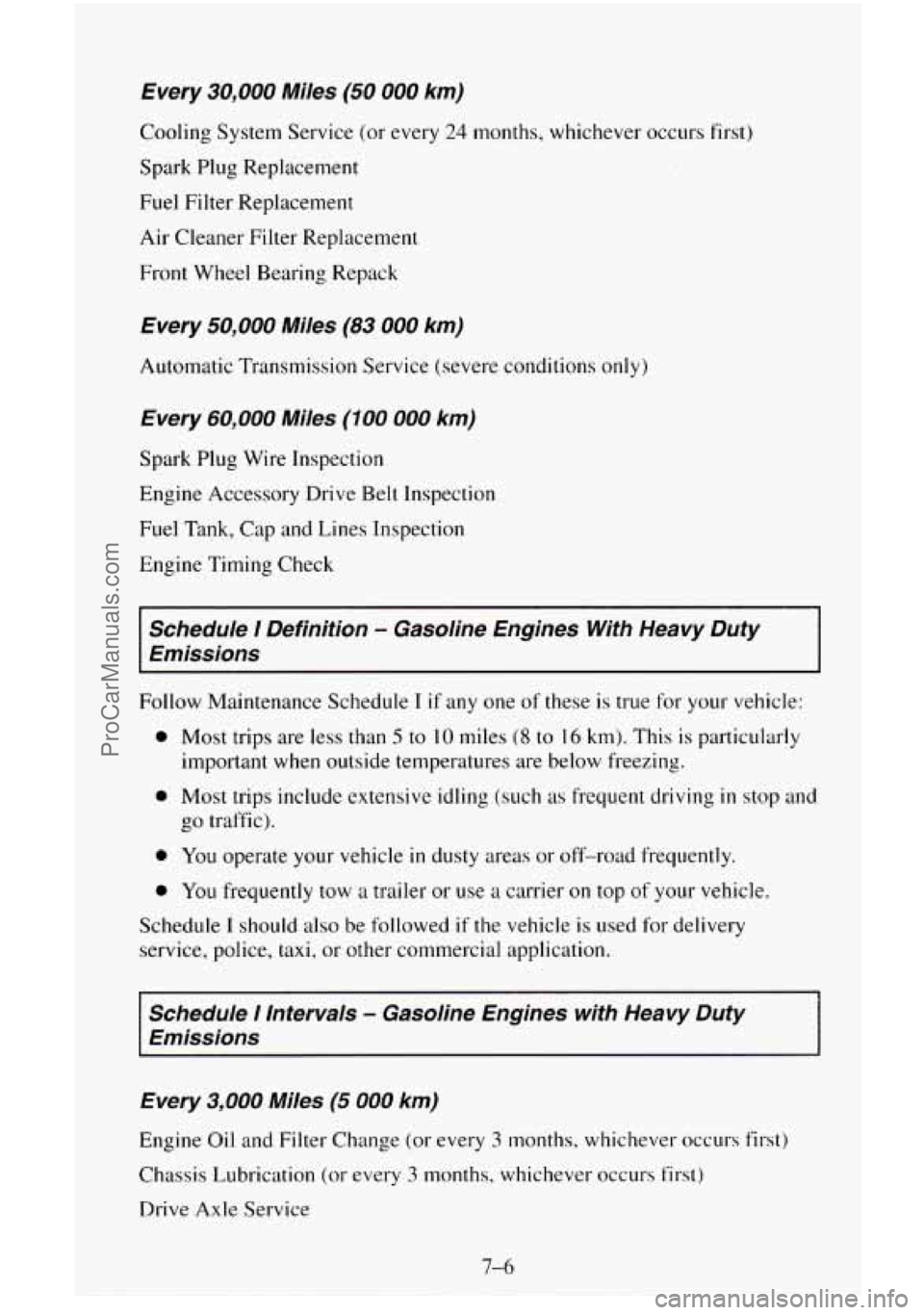
Every 30,000 Miles (50 000 km)
Cooling System Service (or every 24 months, whichever occurs first)
Spark Plug Replacement
Fuel Filter Replacement
Air Cleaner Filter Replacement Front Wheel Bearing Repack
Every 50,000 Miles (83 000 km)
Automatic Transmission Service (severe conditions only)
Every 60,000 Miles (100 000 km)
Spark Plug Wire Inspection
Engine Accessory Drive Belt Inspection
Fuel Tank, Cap and Lines Inspection
Engine Timing Check
Schedule 1 Definition - Gasoline Engines With Heavy Duty
Emissions
Follow Maintenance Schedule I if any one of these is true for your vehicle:
e
e
e
e
Most trips are less than 5 to 10 miles (8 to 16 km). This is particularly
important when outside temperatures are below freezing.
Most trips include extensive idling (such as frequent driving
in stop and
go traffic).
You operate
your vehicle in dusty areas or off-road frequently.
You frequently tow
a trailer or use a carrier on top of your vehicle.
Schedule
I should also be followed if the vehicle is used for delivery
service, police, taxi, or other commercial application.
Schedule I Intervals - Gasoline Engines with Heavy Duty
Emissions
Every
3,000 Miles (5 000 km)
Engine Oil and Filter Change (or every 3 months, whichever occurs first)
Chassis Lubrication (or every
3 months, whichever occurs first)
Drive Axle Service
7-6
ProCarManuals.com
Page 370 of 486
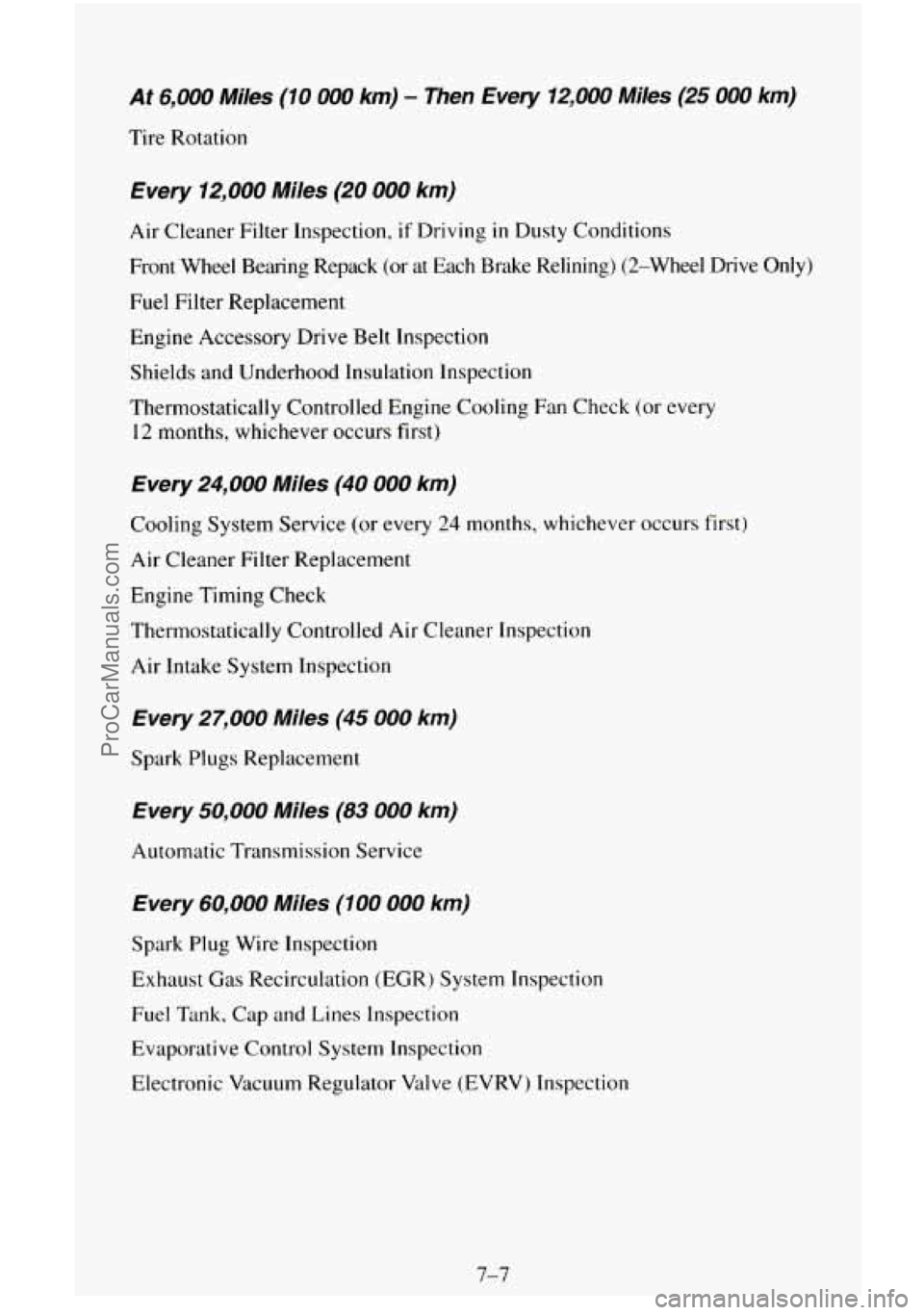
At 6,000 Miles (10 000 km) - Then Every 12,000 Miles (25 000 km)
Tire Rotation
Every 12,000 Miles (20 000 km)
Air Cleaner Filter Inspection, if Driving in Dusty Conditions
Front Wheel Bearing Repack (or at Each Brake Relining) (2-Wheel Drive Only)
Fuel Filter Replacement
Engine Accessory Drive Belt Inspection
Shields and Underhood Insulation Inspection
Thermostatically Controlled Engine Cooling Fan Check (or every
12 months, whichever occurs first)
Every 24,000 Miles (40 000 km)
Cooling System Service (or every 24 months, whichever occurs first)
Air Cleaner Filter Replacement
Engine Timing Check
Thermostatically Controlled Air Cleaner Inspection
Air Intake System Inspection
Every 27,000 Miles (45 000 km)
Spark Plugs Replacement
Every 50,000 Miles (83 000 km)
Automatic Transmission Service
Every 60,000 Miles (100 000 km)
Spark Plug Wire Inspection
Exhaust
Gas Recirculation (EGR) System Inspection
Fuel
Tmk, Cap and Lines Inspection
Evaporative Control System Inspection
Electronic Vacuum Regulator Valve (EVRV) Inspection
7-7
ProCarManuals.com
Page 371 of 486
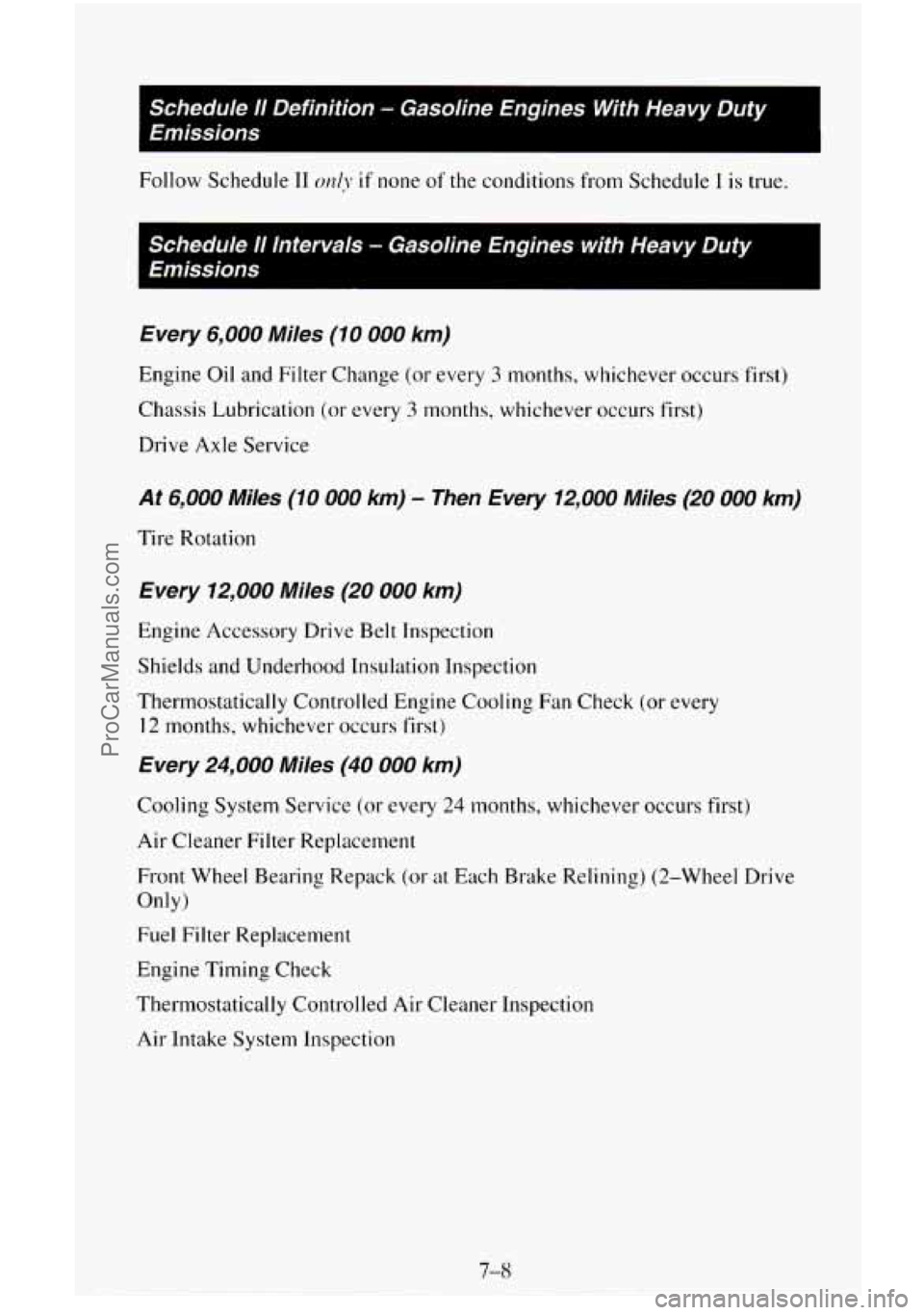
Schedule I1 Definition - Gasoline Engines With Heavy Duty
Emissions
Follow Schedule I1 O~IIJ- if none of the conditions from Schedule 1 is true.
Schedule 11 Intervals - Gasoline Engines with Heavy Duty
Emissions
Every
6,000 Miles (10 000 km)
Engine Oil and Filter Change (or every 3 months, whichever occurs first)
Chassis Lubrication (or every
3 months, whichever occurs first)
Drive Axle Service
At 6,000 Miles (10 000 km) - Then Every 12,000 Miles (20 000 km)
Tire Rotation
Every 12,000 Miles (20 000 km)
Engine Accessory Drive Belt Inspection
Shields and Underhood Insulation Inspection
Thermostatically Controlled Engine Cooling Fan Check (or every
12 months, whichever occurs first)
Every 24,000 Miles (40 000 km)
Cooling System Service (or every 24 months, whichever occurs first)
Air Cleaner Filter Replacement
Front Wheel Bearing Repack (or at Each Brake Relining) (2-Wheel Drive
Only
1
Fuel Filter Replacement
Engine Timing Check
Thermostatically Controlled Air Cleaner Inspection
Air Intake System Inspection
ProCarManuals.com