service CHEVROLET TRACKER 1993 User Guide
[x] Cancel search | Manufacturer: CHEVROLET, Model Year: 1993, Model line: TRACKER, Model: CHEVROLET TRACKER 1993Pages: 339, PDF Size: 15.75 MB
Page 159 of 339
After Off-Road Driving
Remove any brush or debris that has
collected on the underbody, chassis or
under the hood. These accumulations
can be a fire hazard.
After operation in mud or sand, have the
brake linings cleaned and checked.
These substances can cause glazing and
uneven braking. Check the body
structure, steering, suspension, wheels,
tires, and exhaust system for damage.
Also, check the fuel lines and cooling
system for any leakage.
Your vehicle will require more frequent
service due to off-road use. Refer
to the
Maintenance Schedule for additional
information.
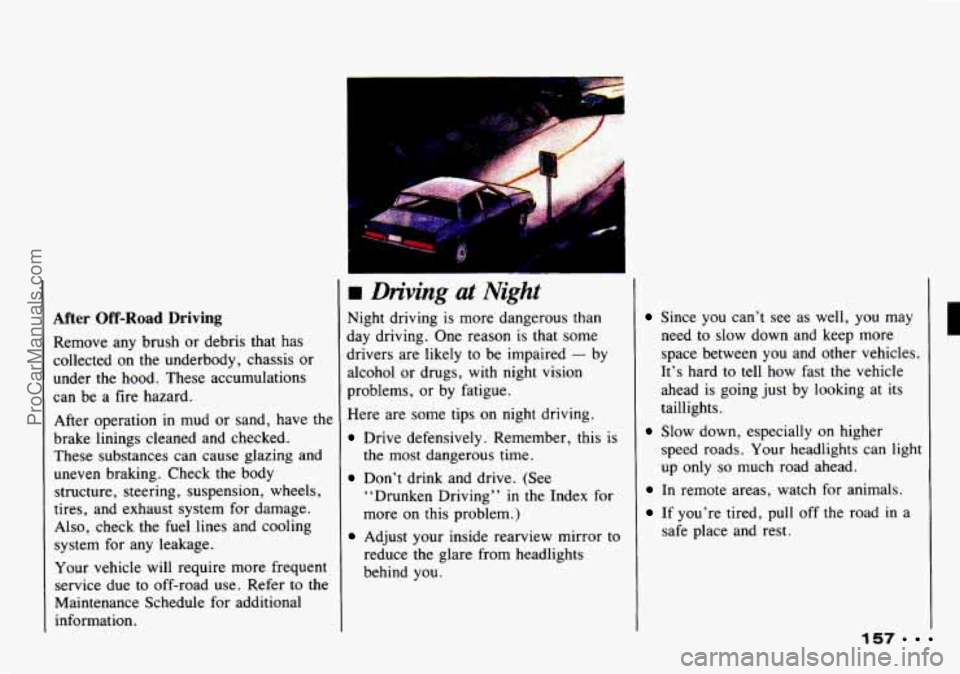
rn Driving at Night
Night driving is more dangerous than
day driving. One reason is that some
drivers are likely to be impaired
- by
alcohol or drugs, with night vision
problems, or by fatigue.
Here are some tips
on night driving.
Drive defensively. Remember, this is
the most dangerous time.
Don’t drink and drive. (See
“Drunken Driving” in the Index for
more on this problem.)
Adjust your inside rearview mirror to
reduce the glare from headlights
behind you.
Since you can’t see as well, you may
need to slow down and keep more
space between you and other vehicles.
It’s hard to tell how fast the vehicle
ahead is going just by looking at its
taillights.
Slow down, especially on higher
speed roads.
Your headlights can light
up only so much road ahead.
In remote areas, watch for animals.
If you’re tired, pull off the road in a
safe place and rest.
157
ProCarManuals.com
Page 160 of 339
Your Driving and the Road
Night Vision
No one can see as well at night as in the
daytime. But as we get older these
differences increase.
A 50-year-old
driver may require at least twice as
much light to see the same thing at night
as a 20-year-old.
What you do in the daytime can also
affect your night vision. For example, if
you spend the day
in bright sunshine
you are wise to wear sunglasses. Your
eyes will have less trouble adjusting to
night.
= = 158
But if you’re driving, don’t wear
sunglasses at night. They may cut down
on glare from headlights, but
they also
make a lot of things invisible
that should
remain visible - such as parked cars,
obstacles, pedestrians, or even trains
blocking railway crossings.
You may
want to put on your sunglasses after you
have pulled into a brightly-lighted
service or refreshment area. Eyes
shielded from that glare may adjust
more quickly to darkness back on
the
road. But be sure to remove your
sunglasses before you leave the service
area.
You can be temporarily blinded by
approaching lights. It can take a second
or two, or even several seconds, for
your eyes to readjust
to the dark. When
you are faced with severe glare (as from
a driver who doesn’t lower the high
beams, or a vehicle with misaimed
headlights), slow down a little. Avoid
staring directly into the approaching
lights. If there is a line of opposing
traffic, make occasional glances over the
line of headlights to make certain that
one of the vehicles isn’t starting to move
into your lane. Once you are past the
bright lights, give your eyes time to
readjust before resuming speed.
ProCarManuals.com
Page 169 of 339
I Driving a Long
Distunce
Although most long trips today are made
on freeways, there are still many made
on regular highways.
Long-distance driving on freeways and
regular highways is the same in some
ways. The trip has
to be planned and the
vehicle prepared, you drive at
higher-than-city speeds, and there are
longer turns behind the wheel. You’ll
l enjoy your trip more if you and your
vehicle are in good shape. Here are
some tips for a successful long trip.
Before Leaving on a Long Trip
Make sure you’re ready. Try to be well
rested. If you must start when you’re
not fresh
- such as after a day’s work
- don’t plan to make too many miles
that first part
of the journey. Wear
comfortable clothing and shoes you can
easily drive in.
Is your vehicle ready for a long trip? If
you keep it serviced and maintained, it’s
ready to go.
If it needs service, have it
done before starting out. Of course,
you’ll find experienced and able service
experts in Geo dealerships all across
North America. They’ll be ready and
willing to help
if you need it. Here
are some things you can check
before a trip:
Windshield Washer Fluid: Is the
reservoir full? Are all windows clean
inside and outside?
Wiper Blades: Are they in good
shape?
Fuel, Engine Oil, Other Fluids:
Have you checked all levels?
Lights: Are they all working? Are the
lenses clean?
Tires: They are vitally important to a
safe, trouble-free trip. Is the tread
good enough
for long-distance
driving? Are the tires all inflated
to
the recommended pressure?
167-9.
ProCarManuals.com
Page 171 of 339
What can you do about highway
hypnosis? First, be aware that it can
happen.
Then here are some tips:
Make sure your vehicle is well
ventilated, with a comfortably cool
interior.
Keep your eyes moving. Scan the
road ahead and to the sides. Check
your rearview mirrors frequently and
your instruments from time
to time.
This can help you avoid a fixed stare.
Wear good sunglasses in bright light.
Glare can cause drowsiness. But don’t
wear sunglasses at night. They will drastically reduce your overall
vision
at the very time you need all the
seeing power you have.
If you get sleepy, pull off the road
into a rest, service or parking area
and take a nap, get some exercise, or
both. For safety, treat drowsiness on
the highway as an emergency.
As in any driving situation, keep pace
with traffic and allow adequate
following distances.
--
A
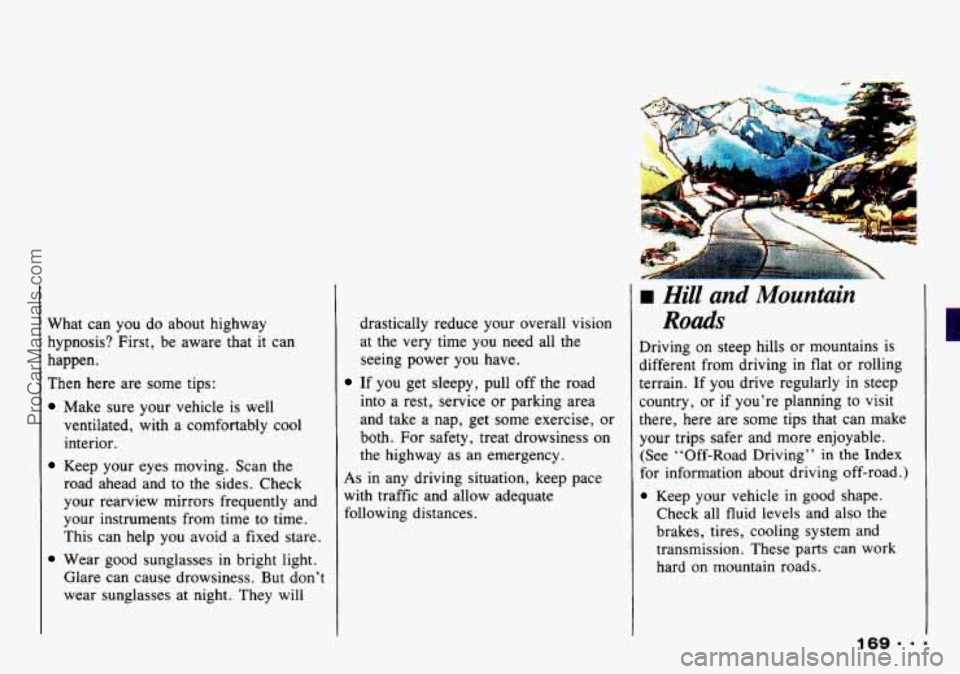
Driving on steep hills or mountains is
different from driving in flat or rolling
terrain. If you drive regularly
in steep
country, or if you’re planning
to visit
there, here are some tips that can make
your trips safer and more enjoyable.
(See “Off-Road Driving’’
in the Index
for information about driving off-road.)
Keep your vehicle in good shape.
Check all fluid levels and also the
brakes, tires, cooling system and
transmission. These ‘parts can work
hard on mountain roads.
ProCarManuals.com
Page 187 of 339
J
It be dangerous tu get out
of your vehicle if the shift lever
is not fully in P (Park) with the
parking brake firmly set.
If you have left the engine running,
the veficle can
move suddenly. You
or others could be injured. To be
sure your vehicle won’t move, when
you’re
on fairly level ground, use
the steps that follow.
If you have four-wheel drive, and
your transfer
case is in N (NeutraI) ,
your vehicle will be free to roll,
even
if your shift lever is in
P (Park). So, be sure the transfer
case is in a drive gear - not in
N (Neutral).
If you are parking on a hill, or if
you’re pulling a trailer; also see
“Parking On Hills” in the Index.
6. Release the regular brakes.
When You Are Ready to Leave after
Parking on a
Hill
1. Apply your regular brakes and hold
the pedal down while you:
Start your engine;
Shift into a gear; and
Release the parking brake.
2. Let up on the brake pedal.
3. Drive slowly until the trailer is clear
4. Stop and have someone pick up and
of the chocks.
store
the chocks.
Maintenance When Trailer Towing
Your vehicle will need service more
often when you’re pulling a trailer.
See
the Maintenance Schedule for more on
this. Things that are especially important
in trailer operation are automatic
transmission fluid (don’t overfill),
engine oil, axle lubricant, belts, cooling
system, and brake adjustment. Each
of
these is covered in this manual, and the
Index will help you find them quickly.
If
you’re trailering, it’s a good idea to
review these sections before you start
your trip.
Check periodically
to see that all hitch
nuts and bolts are tight.
185 9 =
ProCarManuals.com
Page 198 of 339
Problems on the Road
10. Now start the vehicle with the good
battery and
run the engine for
awhile.
dead battery.
If it won't start after a few tries, it
probably needs service.
11. Try to start the vehicle with the
I
I-
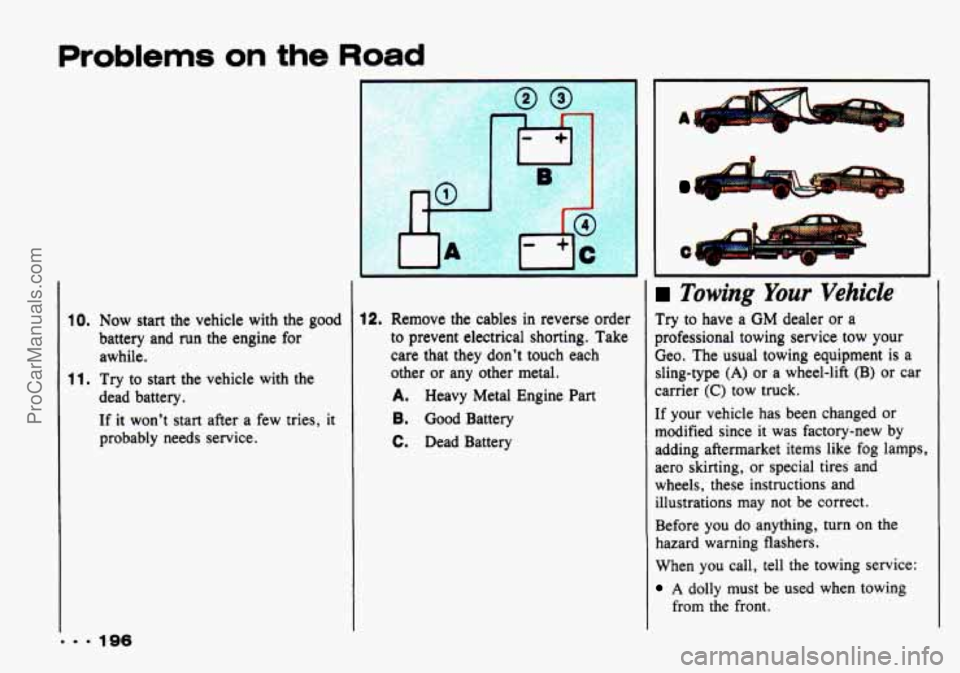
12. Remove the cables in reverse order
to prevent electrical shorting. Take
care that they don't touch each
other or any other metal.
A. Heavy Metal Engine Part
B. Good Battery
C. Dead Battery
r
L
Towing Your Vehicle
Try to have a GM dealer or a
professional towing service tow your
Geo. The usual towing equipment is
a
sling-type (A) or a wheel-lift (B) or car
carrier
(C) tow truck.
If your vehicle has been changed or
modified since it was factory-new by
adding aftermarket items like fog lamps,
aero skirting, or special tires and
wheels, these instructions and
illustrations may not be correct.
Before you
do anything, turn on the
hazard warning flashers.
When you call, tell the towing service:
A dolly must be used when towing
from the front.
ProCarManuals.com
Page 199 of 339
That your vehicle has rear-wheel
drive, or that
it has the
four-wheel-drive option.
vehicle.
The make, model, and year of your
Whether you can still move the shift
levers for the transmission and
transfer case,
if you have one.
If there was an accident, what was
damaged.
When the towing service arrives, let the
tow operator know that this manual
contains detailed towing instructions and
illustrations. The operator may want to
see them.
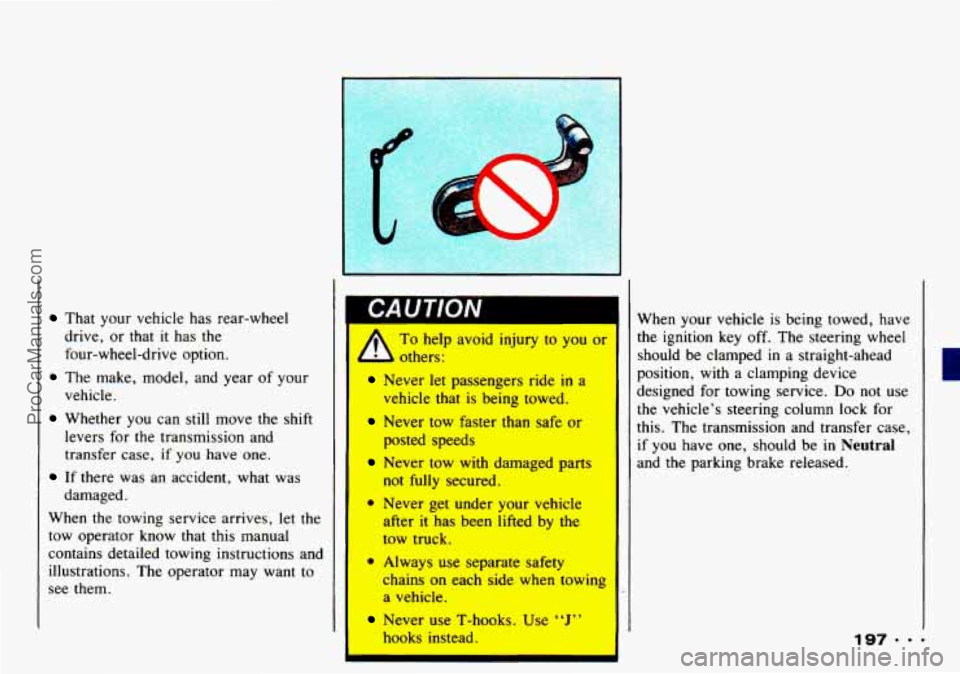
* T- help avoid injury to you or
Never let passengers ride in a
vehicle that is being towed.
Never tow faster than safe or
posted speeds
Never tow with damaged parts
not fully secured.
0 Never get under your vehicle
after it
has been lifted by the
tow truck.
chains on each side when towing
a vehicle.
hooks instead.
* Always use separate safety
Never use T-hooks. Use “J”
When your vehicle is being towed, have
the ignition key off. The steering wheel
should be clamped
in a straight-ahead
position, with
a clamping device
designed for towing service.
Do not use
the vehicle’s steering column lock for
this. The transmission and transfer case,
if you have one, should be in Neutral
and the parking brake released.
ProCarManuals.com
Page 204 of 339
Problems on the Road
... 202
If No Steam Is Coming from Your
Engine:
If you get the overheat warning but see
or hear no steam,
the problem may not
be too serious. Sometimes the engine
can get a little too hot when you:
Climb a long hill on a hot day.
Stop after high speed driving.
Idle for long periods in traffic.
Tow a trailer. If you
get the overheat warning with no
sign of steam, try this for
a minute or
1. If you have an air conditioner, turn it
2. Turn on your heater to full hot at the
so:
off.
highest fan speed and open
the
window as necessary.
3. If you’re in a traffic jam, shift to
N (Neutral).
If
you no longer have the overheat
warning, you can drive. Just to be safe,
drive slower for about ten minutes. If
the warning doesn’t come back on, you
can drive normally.
If the warning continues, pull over,
stop, and park your vehicle right away.
If there’s still no sign of steam, you can
idle the engine for two
or three minutes
while you’re parked, to see if the
warning stops. But then, if you still have
the warning, TURN OFF THE
ENGINE AND GET EVERYONE OUT
OF THE VEHICLE until it cools down.
You may decide not to lift the hood but
to get service help right away.
ProCarManuals.com
Page 206 of 339
Problems on the Road
c
Engine damage from running yollr I
engine without coolant isn’t
covered by your warranty.
I
If there seems to be no leak, check to
see if the electric engine fan
is running.
If
the engine is overheating, the fan
should be running. If it isn’t, your
vehicle needs service.
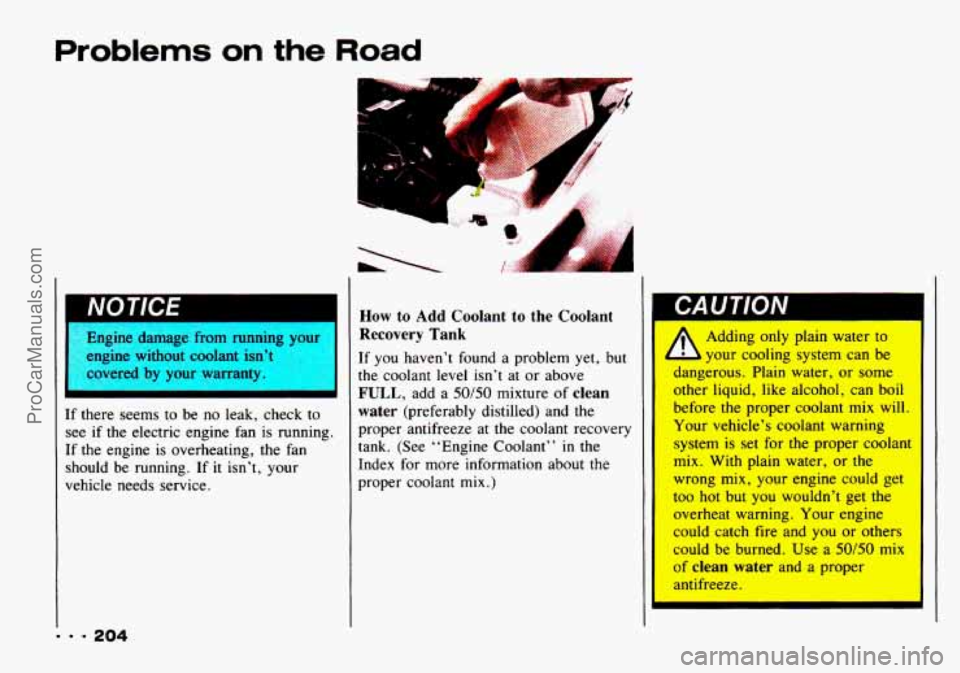
How to Add Coolant to the Coolant
Recovery
Tank
If you haven’t found a problem yet, but
the coolant level isn’t at or above
FULL, add a 50/50 mixture of clean
water
(preferably distilled) and the
proper antifreeze at the coolant recovery
tank. (See “Engine Coolant”
in the
Index for more information about the
proper coolant mix.)
A Adding only plain water to
L your cooling system can be
dangerous. Plain water, or some
other liquid, like alcohol, can boil
before the proper coolant mix will.
Your vehicle’s coolant warning
system is set for the proper coolant
mix. With plain water, or the
wrong mix, your engine could get
too hot but you wouldn’t get the
overheat warning. Your engine
could catch fire and you or others
could be burned. Use a 50/50 mix
of clean water and a proper
antifreeze.
ProCarManuals.com
Page 223 of 339
Part 6
Here you wit1 find information
about the care of your Geo
. This
part begins with service and fuel
information. and then it shows
how to check important fluid and
lubricant levels
. There is also
technical information about your
vehicle. and
a section devoted to
its appearance care
.
ii iervice & Appearance Care
Service ............................................................. 222
Fuel ............................................................... 223
Checking Things under the Hood ........................................ 227 .
HoodRelease 227
Engineoil ........................................................ 229
Aircleaner ........................................................ 233
Automatic Transmission Fluid ........................................ 234
Manual Transmission Fluid ........................................... 237
Clutch Adjustment .................................................. 238
RearAxle ......................................................... 238
Four-WheelDrive .................................................. 239
Enginecoolant ..................................................... 240
Power Steering Fluid ................................................ 243
Windshield Washer Fluid ............................................ 244
Brake Master Cylinder ............................................... 245
Battery ........................................................... 247
Bulb Replacement .................................................... 248
LoadingYourVehicle ................................................. 252
Tires ............................................................... 253
Appearancecare ..................................................... 261
Appearance Care and Maintenance Materials .............................. 271
Vehicle Identification Number .......................................... 272
Service Parts Identification Label ........................................ 272
Add-on Electrical Equipment ........................................... 272
Fuses and Circuit Breakers ............................................. 273
ReplacementBulbs ................................................... 276
Capacities and Specifications ........................................... 277
221 .
.
......................................................
ProCarManuals.com