lock CHEVROLET VEGA 1976 1.G User Guide
[x] Cancel search | Manufacturer: CHEVROLET, Model Year: 1976, Model line: VEGA, Model: CHEVROLET VEGA 1976 1.GPages: 87, PDF Size: 32.36 MB
Page 33 of 87
Downloaded from www.Manualslib.com manuals search engine especially useful when driving on
dark roads since they provide ex
cellent long range illumination. The
headlight beam indicator will be on
whenever the high beams or
"brights" are in use. The Headlight
Beam
Switch controls the headlight
beams (see Page
2-12).
Light Switch
The three position light switch
controls the headlights, taillights,
parking lights, side marker lights,
instrument lights and dome lights
as shown. The headlamp circuit
is protected by a circuit breaker in
the light switch.
An overload on
the breaker will cause the lamps to
"flicker" on and off. If this condi
tion develops, have your headlamp
wiring checked immediately.
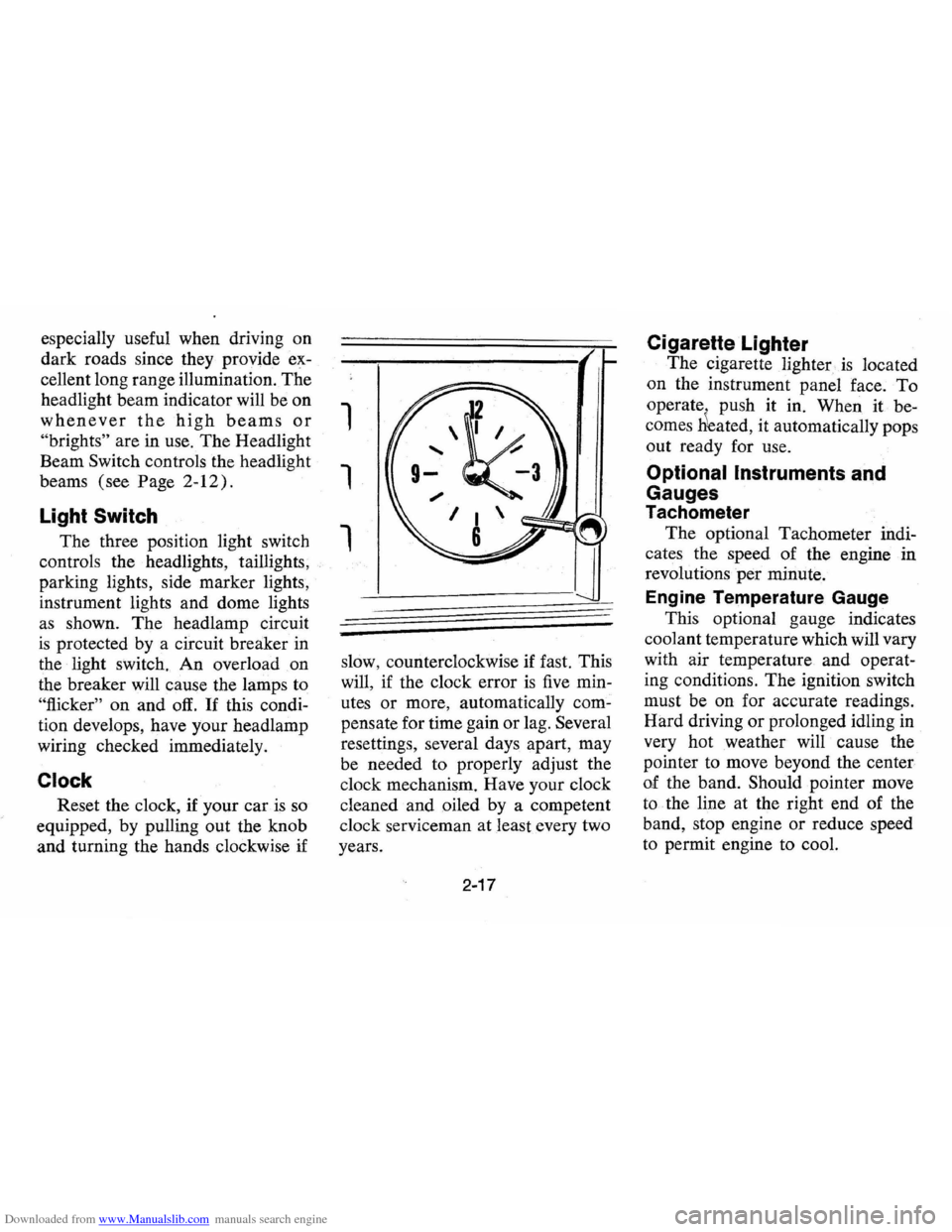
Clock
Reset the clock, if your car is so
equipped, by pulling out the knob
and turning the hands clockwise if
1
1
1
slow, counterclockwise if fast. This
will,
if the clock error is five min
utes
or more, automatically com
pensate for time gain or lag. Several
resettings, several days apart, may
be needed to properly adjust the
clock mechanism. Have your clock
cleaned and oiled by a competent
clock serviceman at least every two
years.
2-17
Cigarette Lighter
The cigarette lighter is located
on the instrument panel
face. To
operate . push it in. When it be
comes
Heated, it automatically pops
out ready for use.
Optional Instruments and
Gauges
Tachometer
The optional Tachometer indi
cates the speed of the engine in
revolutions
per minute.
Engine Temperature Gauge
This optional gauge indicates
coolant temperature which will vary
with air temperature and operat
ing conditions.
The ignition switch
must be on for accurate readings.
Hard driving
or prolonged idling in
very hot weather will cause the
pointer to move beyond the center
of the band. Should pointer move
to the line at the right end of the
band, stop engine or reduce speed
to permit engine to cool.
Page 36 of 87
Downloaded from www.Manualslib.com manuals search engine ventilation comfort, made possible
by the addition of air vent provi
sions in each quarter panel on sta
tion wagon and panel express
models and each rear lock pillar
on notchback and hatchback mod
els. Another feature of the system
is continuous low-speed operation
of the heater and air conditioner
blower, resulting in an uninter
rupted supply of outside air
flow
into the car whenever the ignition
switch
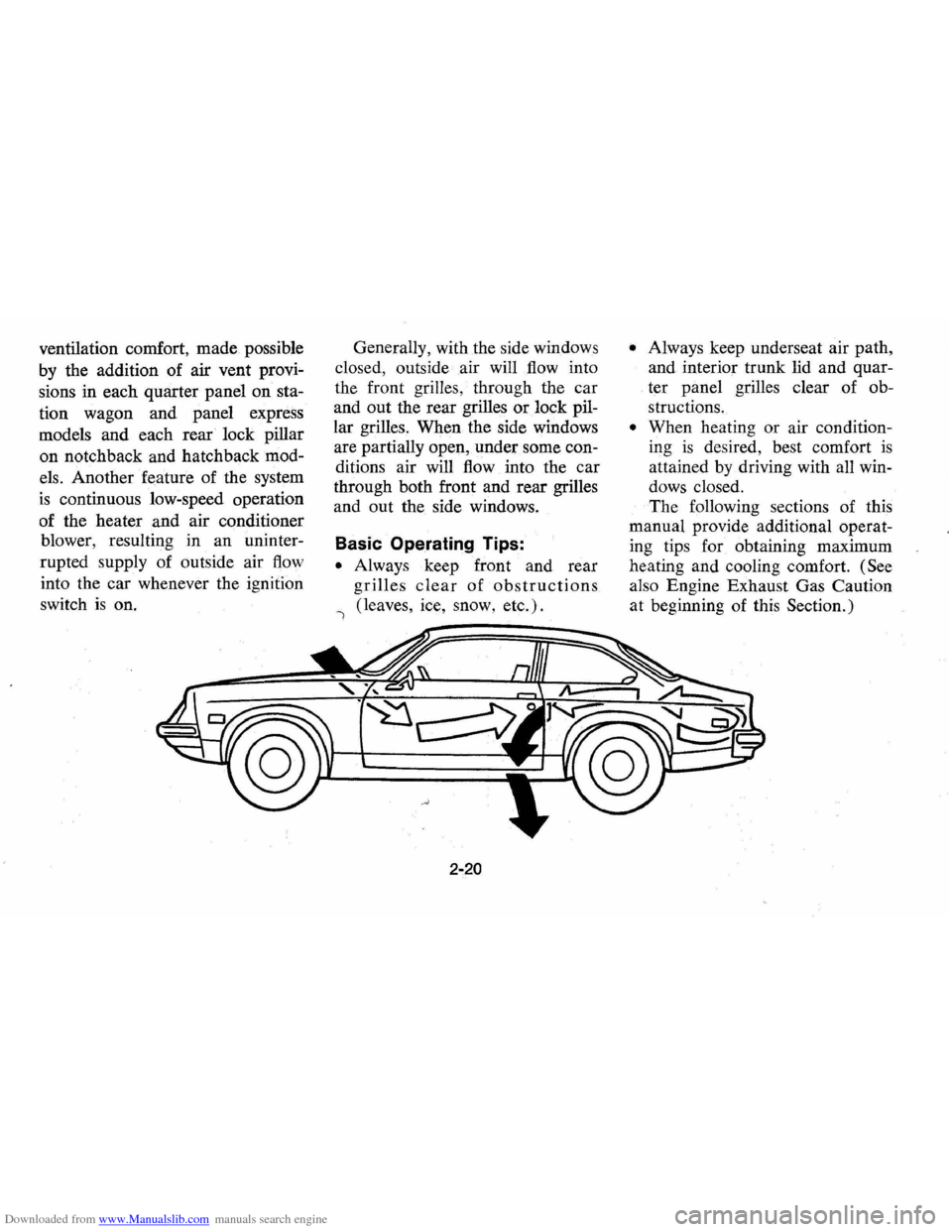
is on. Generally,
with the side windows
closed, outside· air will
flow into
the front grilles, through the car
and out the rear grilles
or lock pil
lar grilles. When the side windows
are partially open, under some con
ditions air will
flow into the car
through both front and rear grilles
and out the side windows.
Basic Operating Tips:
• Always keep front and rear
grilles clear of obstructions
, (leaves, ice, snow, etc.).
2-20
• Always keep underseat air path,
and interior trunk lid and quar
ter panel grilles clear of ob
structions.
• When heating or air condition
ing
is desired, best comfort is
attained by driving with all win
dows closed.
The following sections of this
manual provide additional operat
ing tips for obtaining maximum
heating and cooling comfort.
(See
also Engine Exhaust Gas Caution
at beginning of this Section.)
Page 38 of 87
Downloaded from www.Manualslib.com manuals search engine Heater Operating Tips
• Clear snow and ice from hood
and air inlet in front of wind
shield and air vent grille in rear
fender,
or roof side panel to im
prove heater and defroster
effi
ciency and reduce the probability
of fogging on inside of wind
shield.
• Clear windshield, rear window,
outside m.irrors and all side win
dows of ice and snow before
driving vehicle.
• Operate blower on "HIGH" for
a
few seconds before moving the
vehicle, to help clear the intake
ducts of snow to further reduce
the possibility of fogging on in
side of windshield.
• Keep all windows and vents
closed to reduce dust, road and wind
noise and uncomfortable
drafts.
• For most satisfactory heater
operation and air circulation,
operate fan on low or medium
speeds for normal operation and
high speeds for quick warm-up
and during extremely low tem
peratures.
• For adequate rear seat heating,
the area beneath the front seat
must not be blocked by carpet
ing, rags, paper or other material
and fan should operate on high
blower.
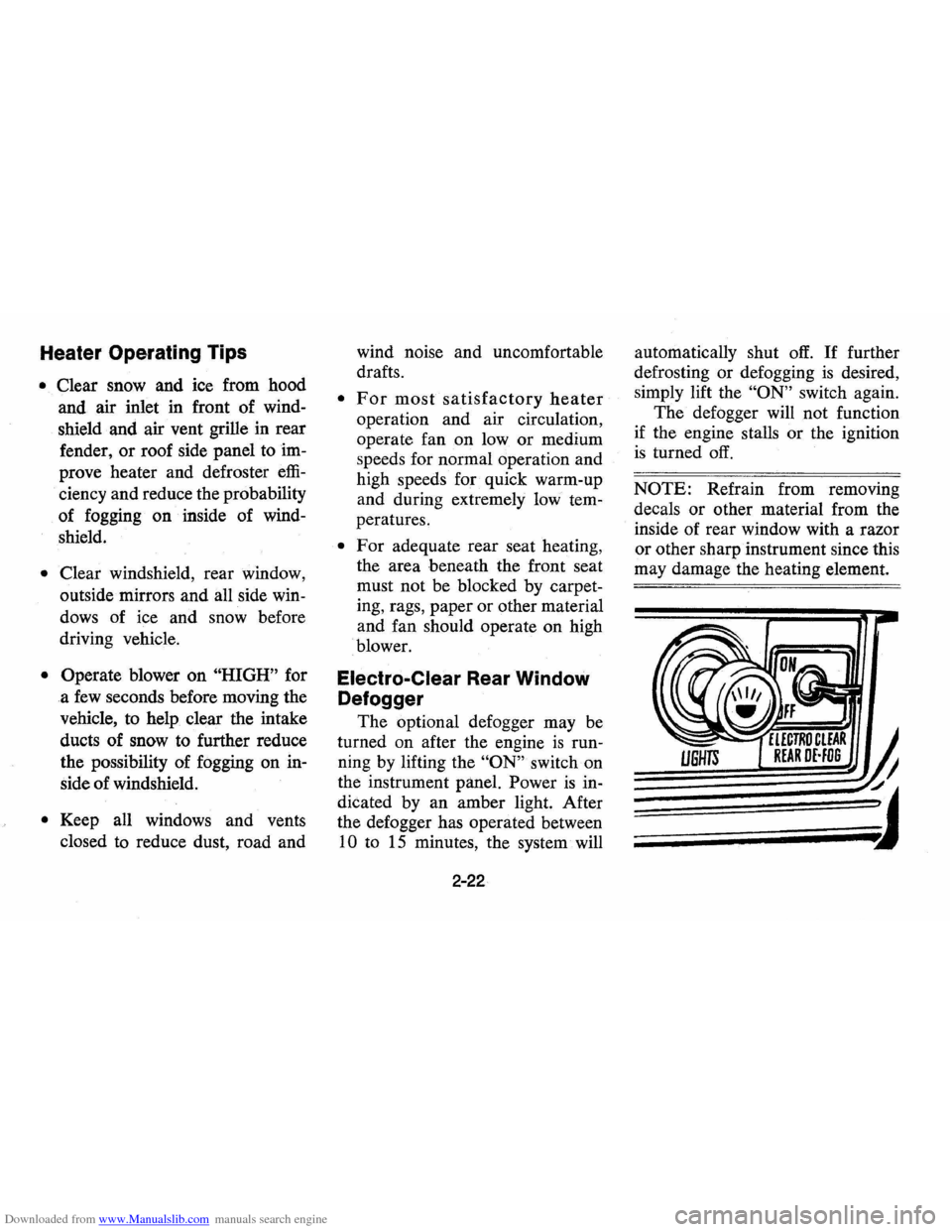
Electro-Clear Rear Window
Defogger
The optional defogger may be
turned on after the engine
is run
ning by lifting the
"ON" switch on
the instrument panel. Power
is in
dicated by an amber light. After
the defogger has operated between
10 to 15 minutes, the system will
2-22
automatically shut off. If further
defrosting or defogging
is desired,
simply lift the
"ON" switch again.
The defogger will not function
if the engine stalls or the ignition
is turned off.
NOTE: Refrain from removing
decals
or other material from the
inside of rear window with a razor
or other sharp instrument since this
may damage the heating element.
Page 41 of 87
Downloaded from www.Manualslib.com manuals search engine Chevrolet II All Transistor" Radio
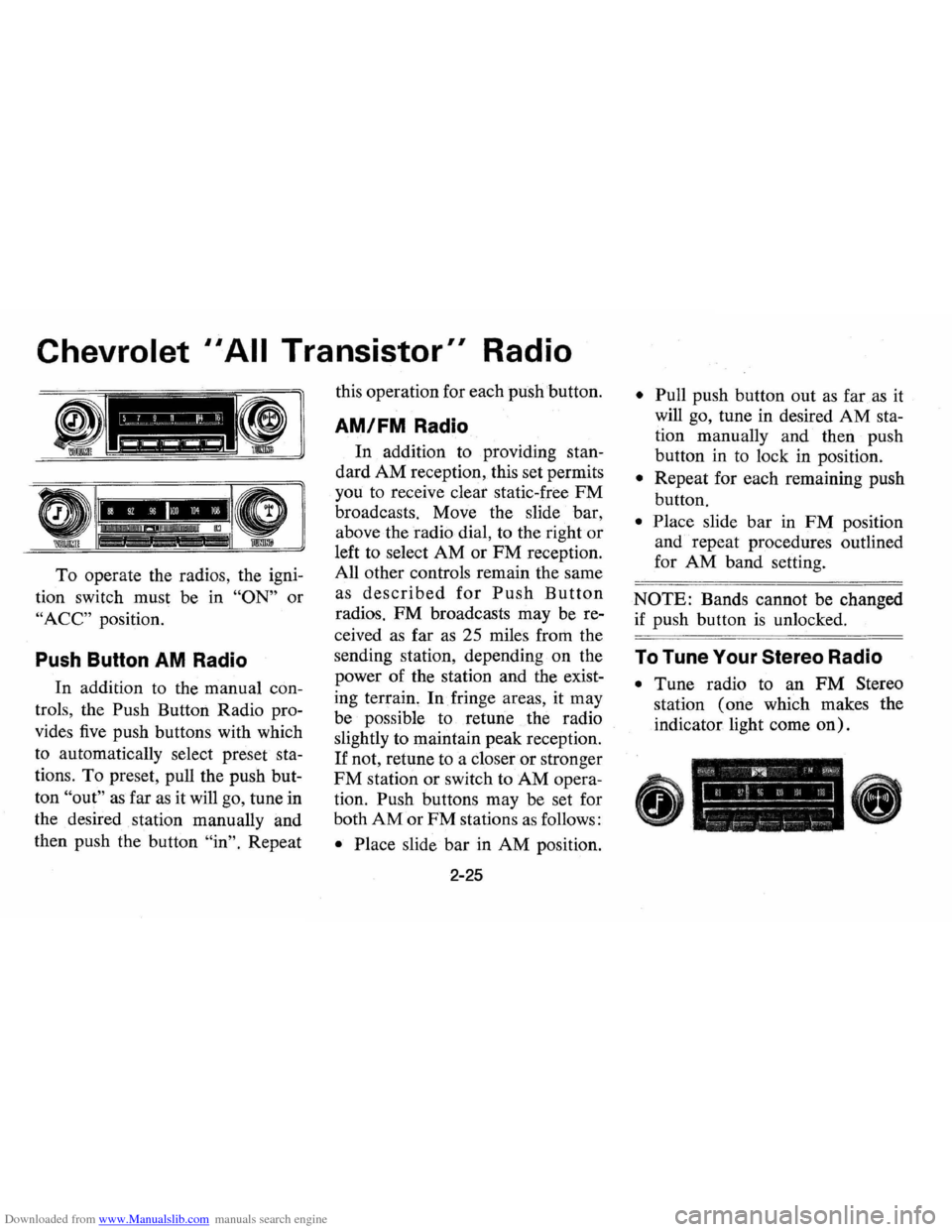
To operate the radios, the igni
tion switch must be in
"ON" or
"ACC" position.
Push Button AM Radio
In addition to the manual con
trols, the Push Button Radio pro
vides
five push buttons with which
to automatically select preset sta
tions . To preset, pull the push but
ton
"out" as far as it will go, tune in
the desired station manually and
then push the button
"in". Repeat this
operation for each push 'button.
AM/FM Radio
In addition to providing stan
dard
AM reception, this set permits
you to receive clear static-free
FM
broadcasts. Move the slide bar,
above the radio dial, to the right
or
left to select AM or FM reception.
All other controls remain the same
as
described for Push Button
radios. FM broadcasts may be re
ceived
as far as 25 miles from the
sending station, depending on the
power of the station and the exist
ing terrain.
In fringe areas, it may
be possible to
retune the radio
slightly to maintain peak reception.
If not, retune to a closer or stronger
FM station or switch to AM opera
tion. Push buttons may be set for
both
AM or FM stations as follows:
• Place slide bar in AM position.
2-25
• Pull push button out as far as it
will go, tune in desired
AM sta
tion manually and then push
button in to lock in position.
• Repeat for each remaining push
button.
• Place slide bar in FM position
and repeat procedures outlined
for
AM band setting.
NOTE: Bands cannot be changed
if push button
is unlocked.
To Tune Your Stereo Radio
• Tune radio to an FM Stereo
station (one which makes the
indicator light come
on).
Page 43 of 87
Downloaded from www.Manualslib.com manuals search engine OTHER CONTROLS AND FEATURES
Positraction Rear Axle
The optional Positraction axle
can provide additional traction
on
snow, ice, mud, sand, gravel, etc.
Normally, the
Positraction unit
functions as a standard axle. How
ever, when either drive wheel en
counters a slippery enough surface,
the
Positraction can continue to
provide driving forc'e to the wheel
having the greater traction, instead
of merely spinning the wheel which
has the least traction.
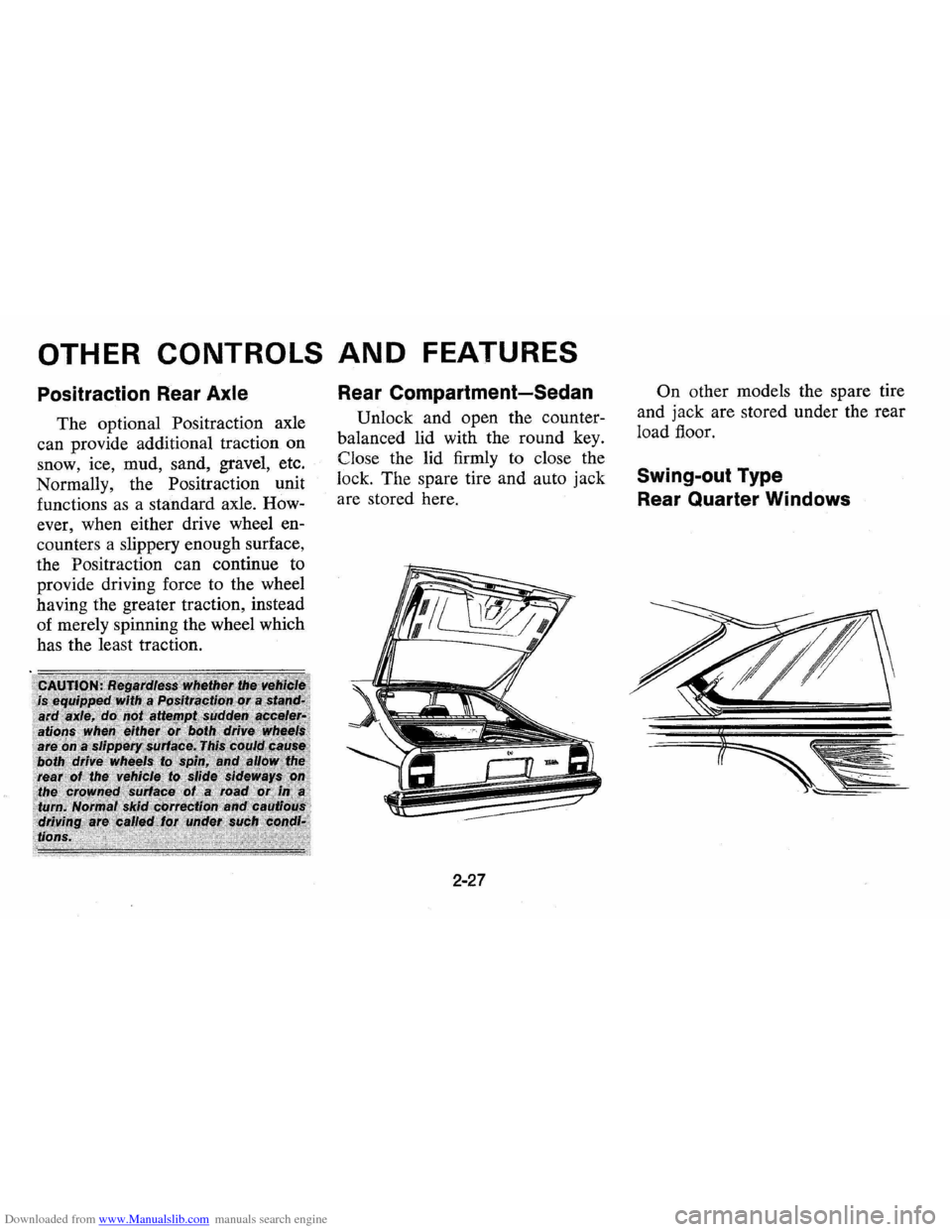
Rear Compartment-Sedan
Unlock and open the counter
balanced lid with the round key.
Close the lid firmly to close the
lock. The spare tire and auto jack
are stored here.
2-27
On other models the spare tire
and jack are stored under the rear
load floor.
Swing-out Type
Rear Quarter Windows
Page 44 of 87
Downloaded from www.Manualslib.com manuals search engine The optional rear quarter win
dows of the sedan and Hatchback
coupe models may be opened or
closed with finger operated
swing
ing latches.
Headlamp Reminder Buzzer
The optional headlamp reminder
buzzer provides an audible warning
that the main light switch
is in one
of the
"on" positions, either park
ing lights or headlights.
The reminder buzzer
is actuated
only when the ignition switch
is
turned to "OFF" or "LOCK" posi
tion.
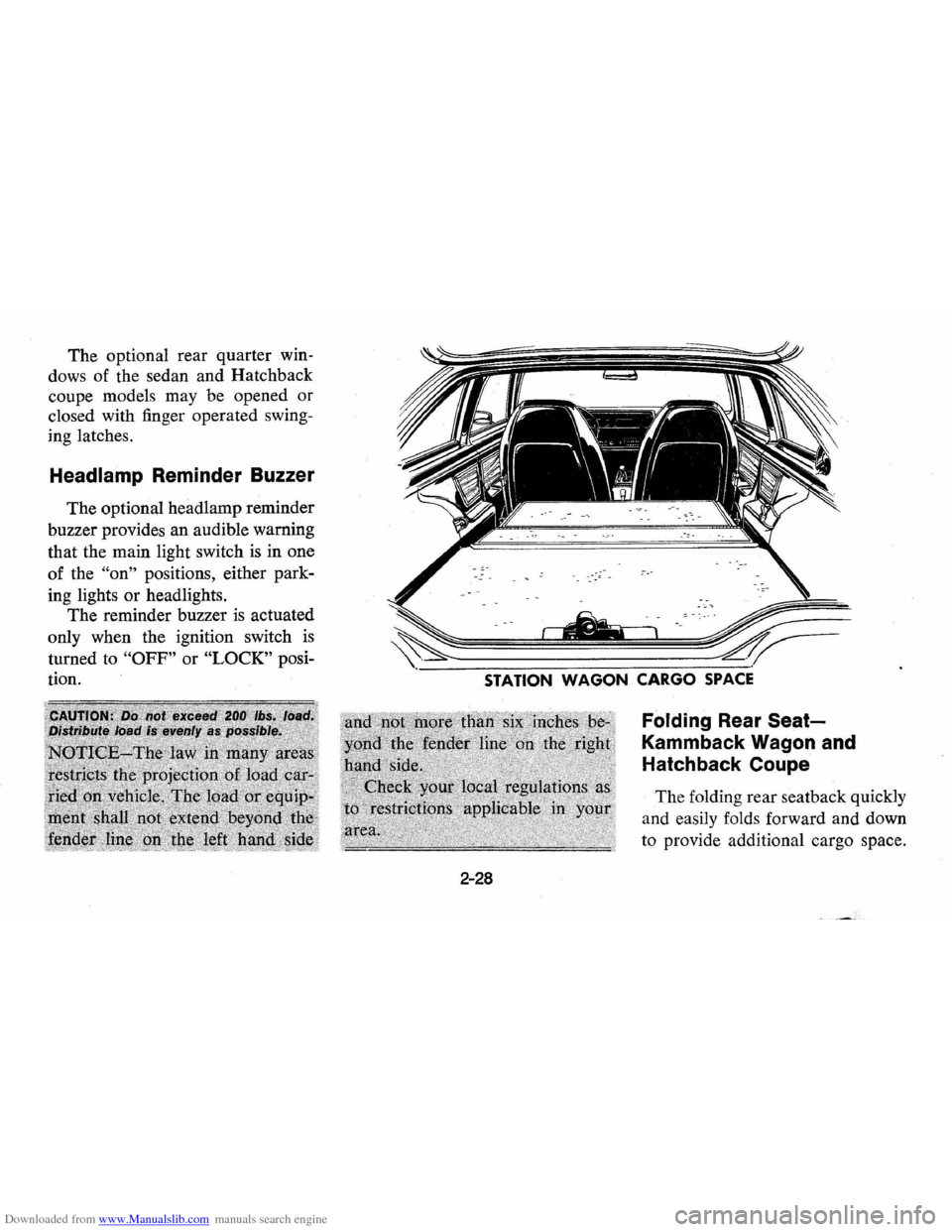
STATION WAGON CARGO SPACE
2-28
Folding Rear Seat
Kammback Wagon and
Hatchback Coupe
The folding rear seatback quickly
and easily folds forward and down
to provide additional cargo space.
Page 45 of 87
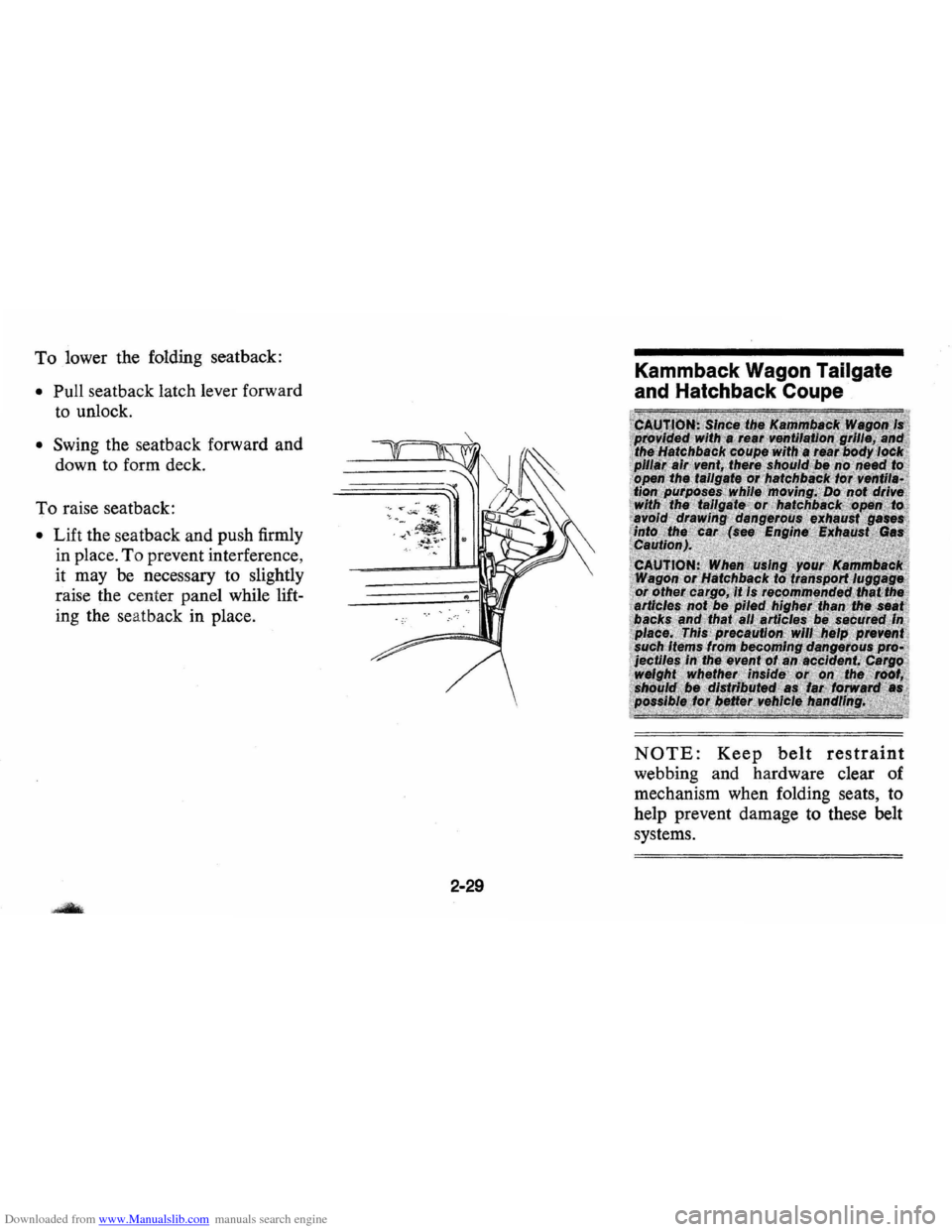
Downloaded from www.Manualslib.com manuals search engine To lower the folding seatback:
• Pull seatback latch lever forward
to unlock.
• Swing the seatback forward and
down to form deck.
To raise seatback:
• Lift the seatback and push firmly
in place . To prevent interference,
it may be necessary to slightly
raise the center panel while lift
ing the seatback in place.
2-29
Kammback Wagon Tailgate
and Hatchback Coupe
NOTE: Keep belt restraint
webbing and hardware clear of
mechanism when folding seats, to
help prevent damage to these belt
systems.
Page 47 of 87
Downloaded from www.Manualslib.com manuals search engine 35 mph, for distances up to 50
miles, provided the driveline, axle,
transmission, and steering system
are otherwise normally operable.
Use only towing equipment specifi
cally designed for
this purpose
following the instructions of the
towing equipment manufacturer.
A separate safety chain system
must
be used for such towing and
steering must be unlocked, trans
mission in neutral and the parking
brake released. Attachments must
be made to main structural mem
bers of the car. Do not attach to
bumpers or associated brackets.
Remember that power brake and
power steering assist will not be
available when engine
is inopera
tive.
Recreational Towing
Vega models with a manual 3-
or 4-speed transmission may be
towed (with propshaft installed) be-hind
another vehicle
as a "dinghy"
at freeway speeds if additional SAE
80
or SAE 90 Gear Lubricant is
added to the transmission. This can
be accomplished · by removing the
filler plug and installing a
900-;.2
inch pipe street elbow fitting and
adding one quart
(2 lbs.) of SAE
80
or 90 Gear Lubricant. Use the
filler plug to cap the elbow fitting.
The additional lubricant will have
no adverse affect to the transmis
sion during normal use of the
ve
hicle and may be left in the trans
mission.
EMERGENCY STARTING
A car with a discharged battery
may
be started by using energy
3-2
from a battery in another car
called "jump starting".
NOTICE: Do not push or tow this
vehicle
to start. Damage to the cata
lytic converter and/or to other parts
of the vehicle may result.
Jump Starting
Jump starting may be dangerous
and should
be attempted only if, the
following three conditions are met.
If they are not,we strongly recom
mend that you leave the starting to
a competent mechanic.
• The battery in the OTHER vehi
cle must
be 12 volt and nega
tively grounded,
like the one in
THIS car. (Check the other car's
owner's manual to
see if it is.)
• The battery in THIS car must be
equipped with flame arrestor
vents (like the original-equip
ment Delco Freedom battery)
Page 48 of 87
Downloaded from www.Manualslib.com manuals search engine or flame arrestor type filler/
vent caps.
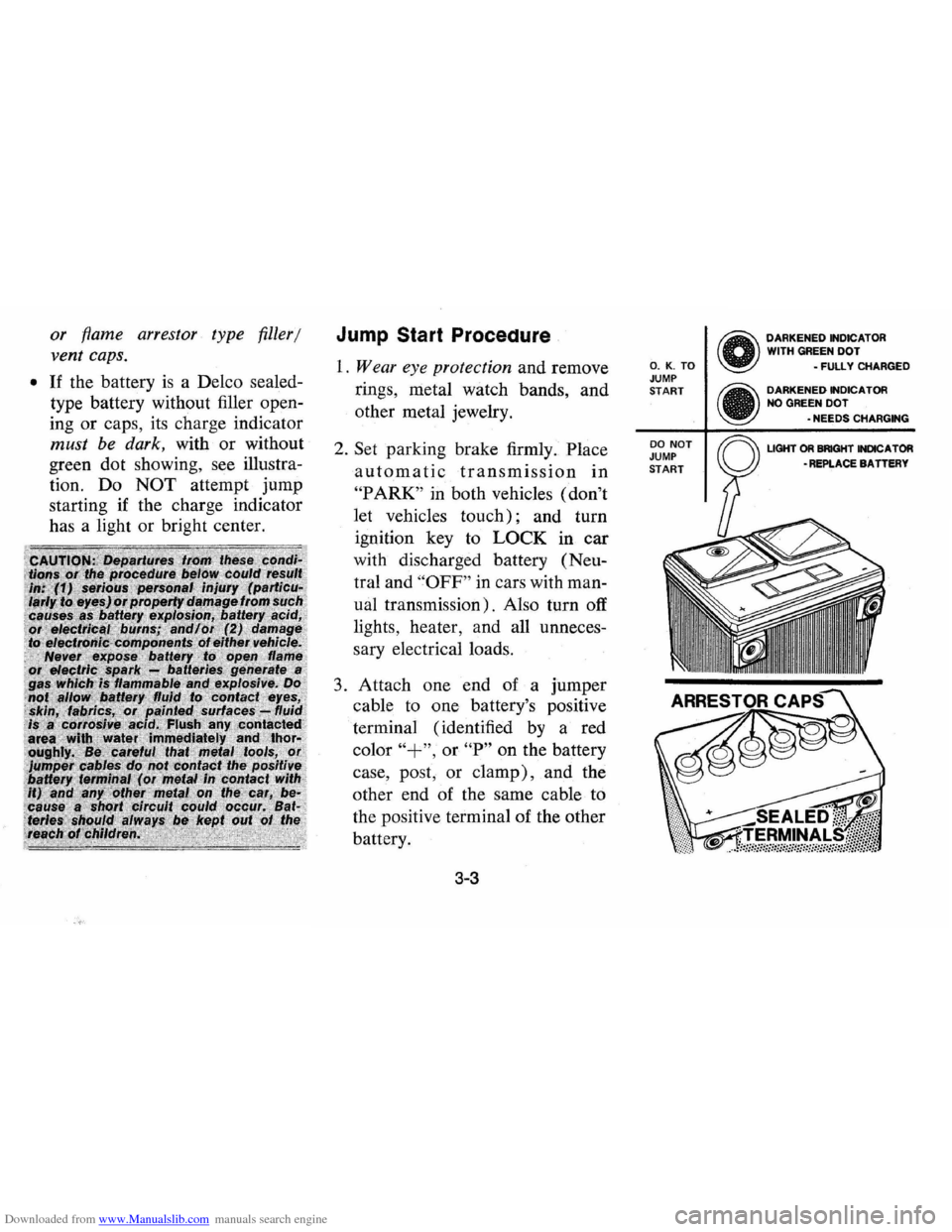
• If the battery is a Delco sealed
type battery without filler open
ing
or caps, its charge indicator
must be dark, with or without
green dot showing, see illustra
tion. Do
NOT attempt jump
starting if the charge indicator
has a light or bright center.
Jump Start Procedure
1. Wear eye protection and remove
rings, metal
watch bands, and
other metal jewelry.
2. Set parking brake firmly. Place
automatic transmission in
"P ARK" in both vehicles (don't
let vehicles
touch); and turn
ignition key to
LOCK in car
with discharged battery (Neu
tral and
"OFF" in cars with man
ual transmission). Also turn off
lights, heater, and all unneces
sary electrical loads.
3. Attach one end of a jumper
cable to one battery's positive
terminal (identified
by a· red
color
"+", or "P" on the battery
case , post , or
clamp), and the
other end of the same cable to
the positive terminal of the other
battery.
3-3
O. K . TO JUMP START
DO NOT JUMP START
o DARKENED INDICATOR
WITH GREEN DOT - FULLY CHARGED
• DARKENED INDICATOR
NO GREEN DOT
-NEEDS CHARGING
LIGHT
OR BRIGHT INDICA TOR -REPLACE BA TTERY
Page 49 of 87
Downloaded from www.Manualslib.com manuals search engine 4. Attach the remammg jumper Engine Coolant
cable FIRST to the negative ter
minal (black color,
"-" or "N")
of the OTHER vehicle's battery,
(regardless of which vehicle has
the discharged
battery) and
THEN to the negative terminal
of the battery in THIS
car-thus
taking advantage of the flame
arrestor feature on the battery in
THIS car, should a spark occur.
5. Start engine in the vehicle that is
providing the jump start (if it
was not running). Let run a few
minutes, then start the engine in Jacking Instructions
the car that has the discharged
battery.
6. Reverse the above sequence
EXACTL Y when removing the
jumper cables, taking care to re
move the cable from
[he negative
terminal of the battery in THIS
car
as the FIRST step.
3-4
Preparation
• Park on level surface and set
parking brake firmly.
• Set automatic transmission in
park (manual transmission in
reverse).
• Activate hazard warning flasher.
Instructions
1. After removing spare wheel
and tire, jack, jack base, and
jack handle (wheel nut
wrench), proceed with chang
ing the wheel
as follows:
2. Remove hub cap or wheel
cover with flat end of wheel
nut wrench and loosen, but do
not remove nuts, by turning
counterclockwise.
3. With column assembly seated
in base and lever in
"UP" posi
tion, insert jack hook in bum
per slot.
4. Base must sit flat with top of
column angled slightly away
from vehicle,
as shown in illus
tration.
5. Always operate jack with slow