door lock CHEVROLET VOLT 2011 Owner's Guide
[x] Cancel search | Manufacturer: CHEVROLET, Model Year: 2011, Model line: VOLT, Model: CHEVROLET VOLT 2011Pages: 516, PDF Size: 6.61 MB
Page 48 of 516
Black plate (12,1)Chevrolet Volt Owner Manual - 2011
2-12 Keys, Doors and Windows
Safety Locks
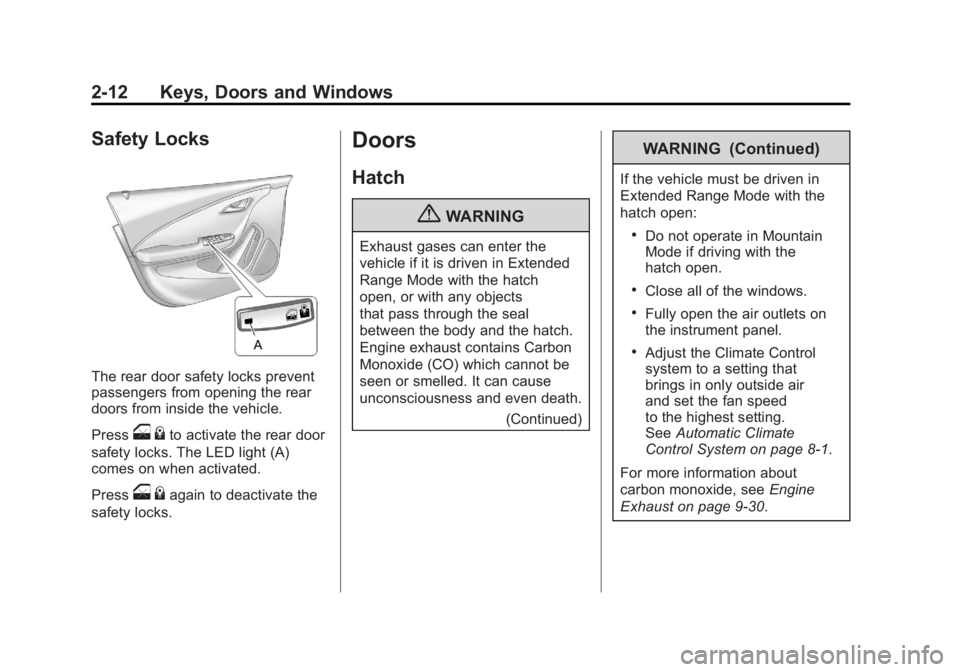
The rear door safety locks prevent
passengers from opening the rear
doors from inside the vehicle.
Press
o{to activate the rear door
safety locks. The LED light (A)
comes on when activated.
Press
o {again to deactivate the
safety locks.
Doors
Hatch
{WARNING
Exhaust gases can enter the
vehicle if it is driven in Extended
Range Mode with the hatch
open, or with any objects
that pass through the seal
between the body and the hatch.
Engine exhaust contains Carbon
Monoxide (CO) which cannot be
seen or smelled. It can cause
unconsciousness and even death.
(Continued)
WARNING (Continued)
If the vehicle must be driven in
Extended Range Mode with the
hatch open:
.Do not operate in Mountain
Mode if driving with the
hatch open.
.Close all of the windows.
.Fully open the air outlets on
the instrument panel.
.Adjust the Climate Control
system to a setting that
brings in only outside air
and set the fan speed
to the highest setting.
SeeAutomatic Climate
Control System on page 8‑1.
For more information about
carbon monoxide, see Engine
Exhaust on page 9‑30.
Page 49 of 516
Black plate (13,1)Chevrolet Volt Owner Manual - 2011
Keys, Doors and Windows 2-13
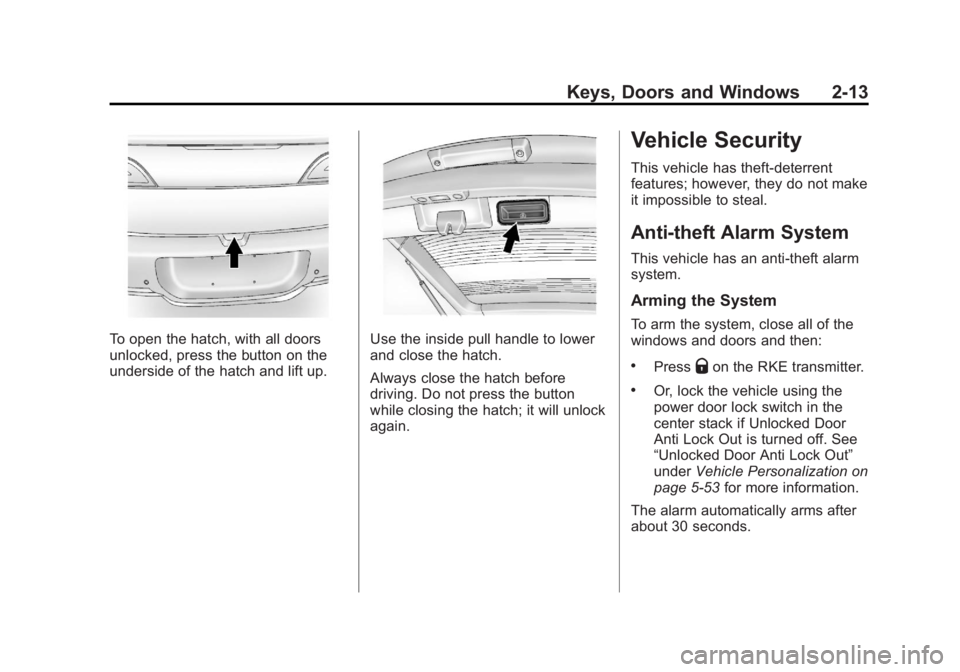
To open the hatch, with all doors
unlocked, press the button on the
underside of the hatch and lift up.Use the inside pull handle to lower
and close the hatch.
Always close the hatch before
driving. Do not press the button
while closing the hatch; it will unlock
again.
Vehicle Security
This vehicle has theft-deterrent
features; however, they do not make
it impossible to steal.
Anti-theft Alarm System
This vehicle has an anti-theft alarm
system.
Arming the System
To arm the system, close all of the
windows and doors and then:
.PressQon the RKE transmitter.
.Or, lock the vehicle using the
power door lock switch in the
center stack if Unlocked Door
Anti Lock Out is turned off. See
“Unlocked Door Anti Lock Out”
underVehicle Personalization on
page 5‑53 for more information.
The alarm automatically arms after
about 30 seconds.
Page 50 of 516
Black plate (14,1)Chevrolet Volt Owner Manual - 2011
2-14 Keys, Doors and Windows
PressingQon the RKE transmitter
a second time will bypass the
30-second delay and immediately
arm the system.
Disarming the System
To disarm the system, pressKon
the RKE transmitter.
Turning off the System Alarm
If there is an attempt to open the
doors, hatch, or hood without first
pressing
Kon the RKE transmitter,
the system alarm will be activated.
The exterior lamps will flash and
the horn will sound for about
30 seconds.
To turn off the system alarm:
.PressKon the RKE transmitter.
.Or, start the vehicle by pressing
POWER
Oon the center stack
with the brake pedal applied
and the RKE transmitter in the
vehicle.
Charge Cord Theft Alert
To arm or disarm the charge cord
theft alert, lock or unlock the vehicle
with the RKE transmitter.
If there is an attempt to remove
the charge cord while the vehicle
is locked, the system alarm will be
activated. To turn off the system
alarm, press
Kon the RKE
transmitter.
Immobilizer
See Radio Frequency
Statement on page 13‑28 for
information regarding Part 15
of the Federal Communications
Commission (FCC) rules and
Industry Canada Standards
RSS-210/220/310.
Immobilizer Operation
This vehicle has a passive
theft-deterrent system.
The system does not have to be
manually armed or disarmed.
The vehicle is automatically
immobilized when the vehicle
is turned off.
The system is automatically
disarmed when the vehicle is
started with a valid RKE transmitter
in the vehicle. The RKE transmitter
uses electronic coding that matches
an immobilizer control unit in
the vehicle and automatically
disarms the system. Only a
correct transmitter can be
used to turn the vehicle on.
Page 53 of 516
Black plate (17,1)Chevrolet Volt Owner Manual - 2011
Keys, Doors and Windows 2-17
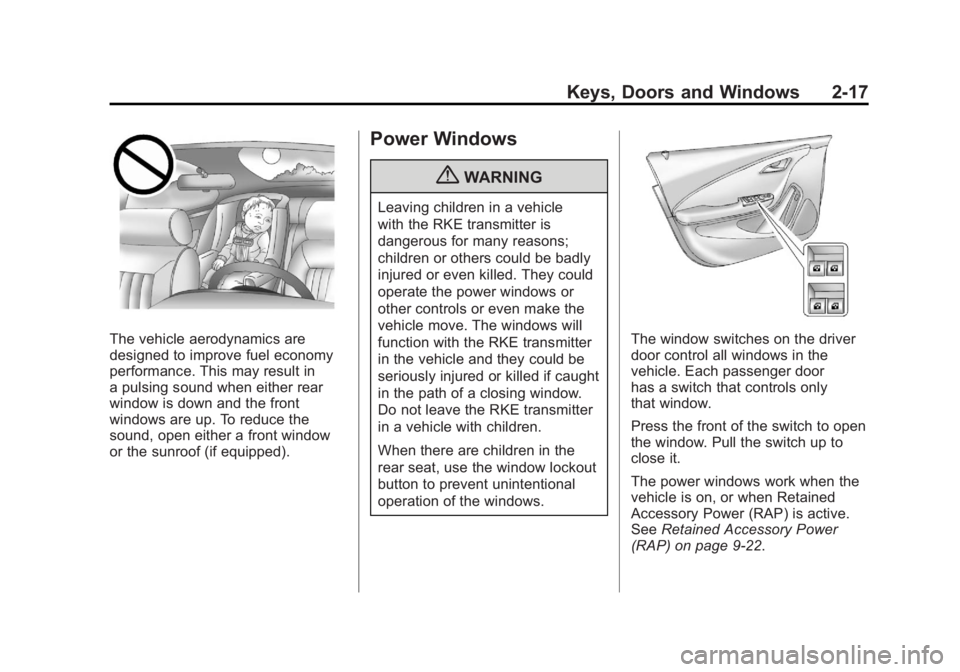
The vehicle aerodynamics are
designed to improve fuel economy
performance. This may result in
a pulsing sound when either rear
window is down and the front
windows are up. To reduce the
sound, open either a front window
or the sunroof (if equipped).
Power Windows
{WARNING
Leaving children in a vehicle
with the RKE transmitter is
dangerous for many reasons;
children or others could be badly
injured or even killed. They could
operate the power windows or
other controls or even make the
vehicle move. The windows will
function with the RKE transmitter
in the vehicle and they could be
seriously injured or killed if caught
in the path of a closing window.
Do not leave the RKE transmitter
in a vehicle with children.
When there are children in the
rear seat, use the window lockout
button to prevent unintentional
operation of the windows.
The window switches on the driver
door control all windows in the
vehicle. Each passenger door
has a switch that controls only
that window.
Press the front of the switch to open
the window. Pull the switch up to
close it.
The power windows work when the
vehicle is on, or when Retained
Accessory Power (RAP) is active.
SeeRetained Accessory Power
(RAP) on page 9‑22.
Page 55 of 516
Black plate (19,1)Chevrolet Volt Owner Manual - 2011
Keys, Doors and Windows 2-19
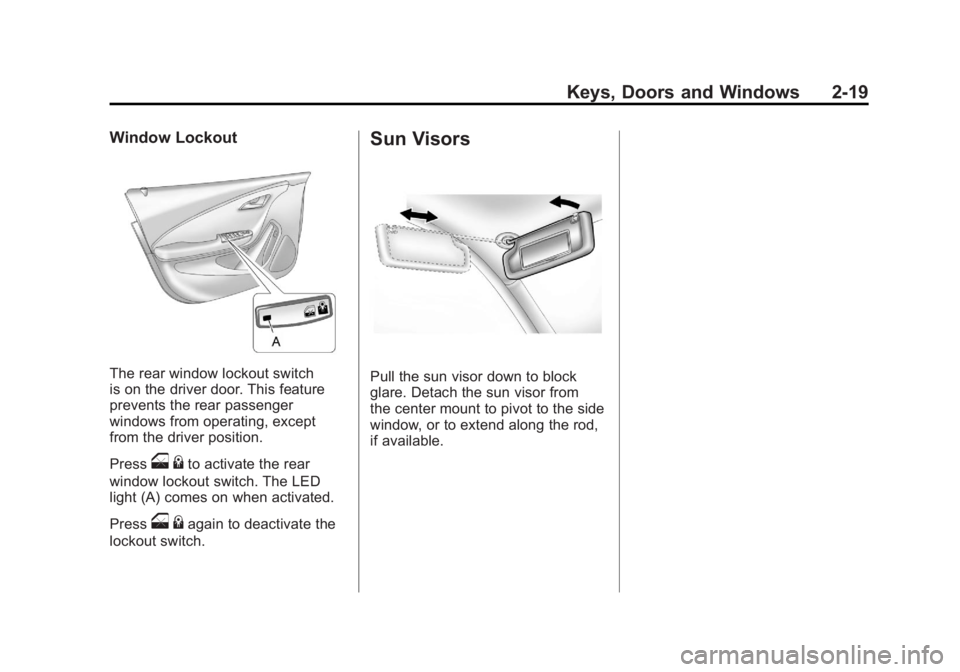
Window Lockout
The rear window lockout switch
is on the driver door. This feature
prevents the rear passenger
windows from operating, except
from the driver position.
Press
o{to activate the rear
window lockout switch. The LED
light (A) comes on when activated.
Press
o {again to deactivate the
lockout switch.
Sun Visors
Pull the sun visor down to block
glare. Detach the sun visor from
the center mount to pivot to the side
window, or to extend along the rod,
if available.
Page 84 of 516
Black plate (28,1)Chevrolet Volt Owner Manual - 2011
3-28 Seats and Restraints
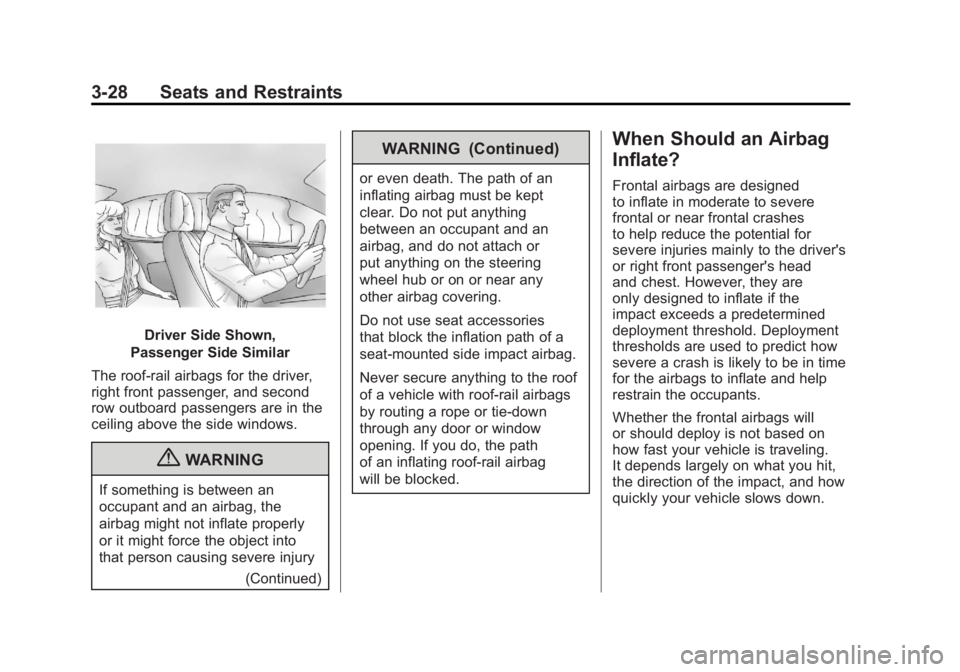
Driver Side Shown,
Passenger Side Similar
The roof-rail airbags for the driver,
right front passenger, and second
row outboard passengers are in the
ceiling above the side windows.
{WARNING
If something is between an
occupant and an airbag, the
airbag might not inflate properly
or it might force the object into
that person causing severe injury (Continued)
WARNING (Continued)
or even death. The path of an
inflating airbag must be kept
clear. Do not put anything
between an occupant and an
airbag, and do not attach or
put anything on the steering
wheel hub or on or near any
other airbag covering.
Do not use seat accessories
that block the inflation path of a
seat-mounted side impact airbag.
Never secure anything to the roof
of a vehicle with roof-rail airbags
by routing a rope or tie‐down
through any door or window
opening. If you do, the path
of an inflating roof-rail airbag
will be blocked.
When Should an Airbag
Inflate?
Frontal airbags are designed
to inflate in moderate to severe
frontal or near frontal crashes
to help reduce the potential for
severe injuries mainly to the driver's
or right front passenger's head
and chest. However, they are
only designed to inflate if the
impact exceeds a predetermined
deployment threshold. Deployment
thresholds are used to predict how
severe a crash is likely to be in time
for the airbags to inflate and help
restrain the occupants.
Whether the frontal airbags will
or should deploy is not based on
how fast your vehicle is traveling.
It depends largely on what you hit,
the direction of the impact, and how
quickly your vehicle slows down.
Page 87 of 516
Black plate (31,1)Chevrolet Volt Owner Manual - 2011
Seats and Restraints 3-31
Rollover capable roof‐rail airbags
are designed to help contain the
head and chest of occupants in
the outboard seating positions
in the first and second rows.
The rollover capable roof‐rail
airbags are designed to help
reduce the risk of full or partial
ejection in rollover events, although
no system can prevent all such
ejections.
But airbags would not help in
many types of collisions, primarily
because the occupant's motion
is not toward those airbags. See
When Should an Airbag Inflate? on
page 3‑28for more information.
Airbags should never be regarded
as anything more than a supplement
to safety belts.What Will You See after
an Airbag Inflates?
After the frontal airbags and
seat-mounted side impact airbags
inflate, they quickly deflate, so
quickly that some people may not
even realize an airbag inflated.
Roof-rail airbags may still be at least
partially inflated for some time after
they deploy. Some components of
the airbag module may be hot for
several minutes. For location of the
airbag modules, see What Makes
an Airbag Inflate? on page 3‑30.
The parts of the airbag that come
into contact with you may be warm,
but not too hot to touch. There may
be some smoke and dust coming
from the vents in the deflated
airbags. Airbag inflation does not
prevent the driver from seeing out
of the windshield or being able to
steer the vehicle, nor does it prevent
people from leaving the vehicle.
{WARNING
When an airbag inflates, there
may be dust in the air. This dust
could cause breathing problems
for people with a history of
asthma or other breathing trouble.
To avoid this, everyone in the
vehicle should get out as soon
as it is safe to do so. If you have
breathing problems but cannot
get out of the vehicle after an
airbag inflates, then get fresh air
by opening a window or a door.
If you experience breathing
problems following an airbag
deployment, you should seek
medical attention.
The vehicle has a feature that may
automatically unlock the doors, turn
on the interior lamps and hazard
warning flashers, and shut off the
fuel system after the airbags inflate.
Page 88 of 516
Black plate (32,1)Chevrolet Volt Owner Manual - 2011
3-32 Seats and Restraints
You can lock the doors, turn off the
interior lamps and hazard warning
flashers by using the controls for
those features.
{WARNING
A crash severe enough to
inflate the airbags may have
also damaged important functions
in the vehicle, such as the fuel
system, brake and steering
systems, etc. Even if the vehicle
appears to be drivable after a
moderate crash, there may be
concealed damage that could
make it difficult to safely operate
the vehicle.
Use caution if attempting to
restart the vehicle after a crash
has occurred.In many crashes severe enough to
inflate the airbag, windshields are
broken by vehicle deformation.
Additional windshield breakage
may also occur from the right
front passenger airbag..Airbags are designed to inflate
only once. After an airbag
inflates, you will need some
new parts for the airbag system.
If you do not get them, the
airbag system will not be there
to help protect you in another
crash. A new system will include
airbag modules and possibly
other parts. The service manual
for your vehicle covers the need
to replace other parts.
.The vehicle has a crash
sensing and diagnostic module
which records information
after a crash. See
Vehicle Data
Recording and Privacy on
page 13‑26 andEvent Data
Recorders on page 13‑26.
.Let only qualified technicians
work on the airbag systems.
Improper service can mean that
an airbag system will not work
properly. See your dealer for
service.
Page 121 of 516
Black plate (1,1)Chevrolet Volt Owner Manual - 2011
Instruments and Controls 5-1
Instruments and
Controls
Instrument Panel Overview
Instrument Panel Overview . . . . 5-4
Controls
Steering Wheel Adjustment . . . 5-6
Steering Wheel Controls . . . . . . 5-6
Horn . . . . . . . . . . . . . . . . . . . . . . . . . . 5-7
Windshield Wiper/Washer . . . . . 5-7
Power Outlets . . . . . . . . . . . . . . . . . 5-8
Warning Lights, Gauges, and
Indicators
Warning Lights, Gauges, andIndicators . . . . . . . . . . . . . . . . . . . . 5-9
Instrument Cluster . . . . . . . . . . . . 5-9
Speedometer . . . . . . . . . . . . . . . . 5-15
Odometer . . . . . . . . . . . . . . . . . . . . 5-15
Trip Odometer . . . . . . . . . . . . . . . 5-15
Compass . . . . . . . . . . . . . . . . . . . . 5-16 Battery Gauge (High
Voltage) . . . . . . . . . . . . . . . . . . . . 5-16
Fuel Gauge . . . . . . . . . . . . . . . . . . 5-16
Driver Efficiency Gauge . . . . . . 5-17
Total Vehicle Range . . . . . . . . . 5-17
Safety Belt Reminders . . . . . . . 5-18
Airbag Readiness Light . . . . . . 5-19
Passenger Airbag Status Indicator . . . . . . . . . . . . . . . . . . . . 5-20
Charging System Light (12-Volt Battery) . . . . . . . . . . . . 5-21
Malfunction Indicator Lamp . . . . . . . . . . . . . 5-21
Brake System Warning Light . . . . . . . . . . . . . . . . . . . . . . . 5-24
Electric Parking Brake Light . . . . . . . . . . . . . . . . . . . . . . . 5-25
Service Electric Parking Brake Light . . . . . . . . . . . . . . . . . . . . . . . 5-25
Antilock Brake System (ABS) Warning Light . . . . . . . . . . . . . . 5-26
Sport Mode Light . . . . . . . . . . . . 5-26
Mountain Mode Light . . . . . . . . 5-26 Traction Control System
(TCS)/StabiliTrak
®Light . . . . 5-27
Engine Coolant Temperature Warning Light . . . . . . . . . . . . . . 5-27
Tire Pressure Light . . . . . . . . . . 5-27
Engine Oil Pressure Light . . . . 5-28
Low Fuel Warning Light . . . . . . 5-28
Security Light . . . . . . . . . . . . . . . . 5-29
High-Beam On Light . . . . . . . . . 5-29
Lamps On Reminder . . . . . . . . . 5-29
Cruise Control Light . . . . . . . . . 5-29
Door, Hood, or Hatch Open
Light . . . . . . . . . . . . . . . . . . . . . . . 5-30
Information Displays
Center Stack Display . . . . . . . . 5-31
Power Flows . . . . . . . . . . . . . . . . . 5-31
Charging . . . . . . . . . . . . . . . . . . . . . 5-33
Energy Information . . . . . . . . . . 5-41
Clock . . . . . . . . . . . . . . . . . . . . . . . . 5-42
Driver InformationCenter (DIC) . . . . . . . . . . . . . . . 5-43
Page 122 of 516

Black plate (2,1)Chevrolet Volt Owner Manual - 2011
5-2 Instruments and Controls
Vehicle Messages
Vehicle Messages . . . . . . . . . . . 5-45
Battery and ChargingMessages . . . . . . . . . . . . . . . . . . 5-45
Brake System Messages . . . . 5-46
Cruise Control Messages . . . . 5-46
Door Ajar Messages . . . . . . . . . 5-46
Drive Mode Messages . . . . . . . 5-47
Electric Drive Unit Messages . . . . . . . . . . . . . . . . . . 5-47
Engine Cooling System Messages . . . . . . . . . . . . . . . . . . 5-47
Engine Oil Messages . . . . . . . . 5-48
Fuel System Messages . . . . . . 5-48
Key and Lock Messages . . . . . 5-48
Lamp Messages . . . . . . . . . . . . . 5-49
Object Detection System Messages . . . . . . . . . . . . . . . . . . 5-49
Propulsion Power Messages . . . . . . . . . . . . . . . . . . 5-50 Ride Control System
Messages . . . . . . . . . . . . . . . . . . 5-50
Airbag System Messages . . . . 5-51
Anti-theft Alarm System Messages . . . . . . . . . . . . . . . . . . 5-51
Service Vehicle Messages . . . 5-51
Starting the Vehicle Messages . . . . . . . . . . . . . . . . . . 5-52
Tire Messages . . . . . . . . . . . . . . . 5-52
Vehicle Speed Messages . . . . 5-53
Washer Fluid Messages . . . . . 5-53
Vehicle Personalization
Vehicle Personalization . . . . . . 5-53
Universal Remote System
Universal Remote System . . . 5-60
Universal Remote System Programming . . . . . . . . . . . . . . . 5-60
Universal Remote System Operation . . . . . . . . . . . . . . . . . . 5-63