airbag CHEVROLET VOLT 2011 Service Manual
[x] Cancel search | Manufacturer: CHEVROLET, Model Year: 2011, Model line: VOLT, Model: CHEVROLET VOLT 2011Pages: 516, PDF Size: 6.61 MB
Page 322 of 516
Black plate (20,1)Chevrolet Volt Owner Manual - 2011
9-20 Driving and Operating
2. Shift the vehicle to N (Neutral).This can be done while the
vehicle is moving. After shifting
to N (Neutral), firmly apply the
brakes and steer the vehicle
to a safe location.
3. Come to a complete stop, shift to P (Park), and turn the
vehicle to OFF by pushing the
POWER
Obutton.
4. Set the parking brake. See Electric Parking Brake on
page 9‑35.
{WARNING
Turning off the vehicle while
moving may disable the airbags.
While driving, only shut the
propulsion system off in an
emergency. 5. If the vehicle must be stopped
while driving, press and hold
the POWER
Obutton for
either longer than two seconds,
or press twice in five seconds.
Starting and Stopping the
Vehicle
Starting Procedure
Move the shift lever to P (Park) or
N (Neutral). The propulsion system
will not start in any other position.
Notice: Do not try to shift to
P (Park) if the vehicle is moving
or the electric drive unit could be
damaged. Shift to P (Park) only
when the vehicle is stopped. Notice:
The vehicle is designed
to work with the electronics in
the vehicle. If you add electrical
parts or accessories, you could
change the way the vehicle
operates. Before adding electrical
equipment, check with your
dealer. If you do not, the vehicle
might not perform properly. Any
resulting damage would not be
covered by the vehicle warranty.
Page 365 of 516
Black plate (63,1)Chevrolet Volt Owner Manual - 2011
Driving and Operating 9-63
Conversions and
Add-Ons
Add-On Electrical
Equipment
Notice:Do not add anything
electrical to the vehicle unless
you check with your dealer first.
Some electrical equipment can
damage the vehicle and the
damage would not be covered
by the vehicle's warranty. Some
add-on electrical equipment can
keep other components from
working as they should. Add-on equipment can drain the
vehicle's 12‐volt battery, even if the
vehicle is not operating.
The vehicle has an airbag system.
Before attempting to add anything
electrical to the vehicle, see
Servicing the Airbag-Equipped
Vehicle on page 3‑38
andAdding
Equipment to the Airbag-Equipped
Vehicle on page 3‑38.
Page 369 of 516
Black plate (3,1)Chevrolet Volt Owner Manual - 2011
Vehicle Care 10-3
General Information
For service and parts needs,
visit your dealer. You will receive
genuine GM parts and GM-trained
and supported service people.
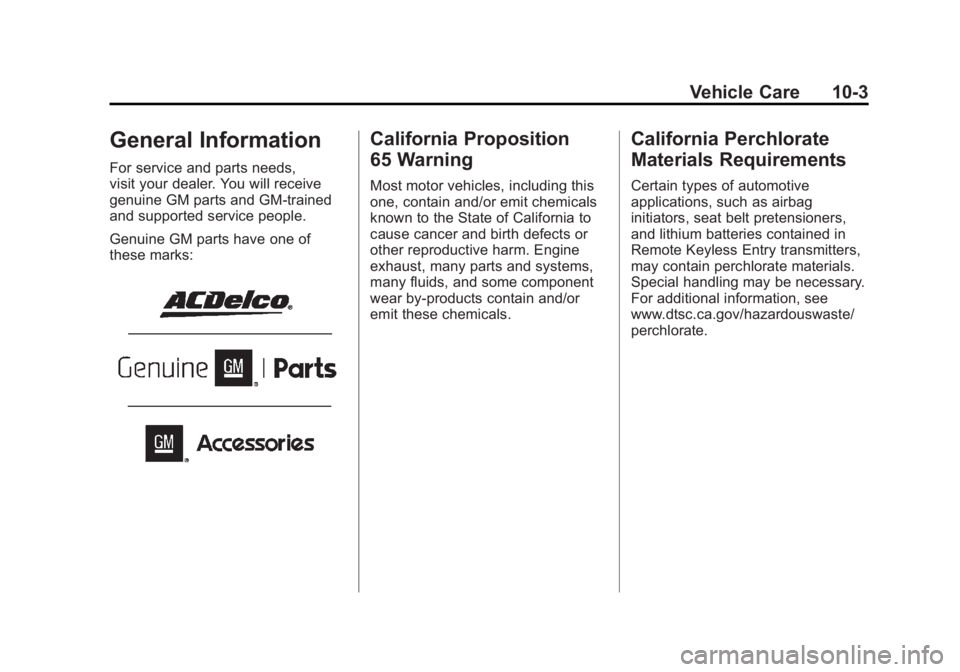
Genuine GM parts have one of
these marks:
California Proposition
65 Warning
Most motor vehicles, including this
one, contain and/or emit chemicals
known to the State of California to
cause cancer and birth defects or
other reproductive harm. Engine
exhaust, many parts and systems,
many fluids, and some component
wear by-products contain and/or
emit these chemicals.
California Perchlorate
Materials Requirements
Certain types of automotive
applications, such as airbag
initiators, seat belt pretensioners,
and lithium batteries contained in
Remote Keyless Entry transmitters,
may contain perchlorate materials.
Special handling may be necessary.
For additional information, see
www.dtsc.ca.gov/hazardouswaste/
perchlorate.
Page 370 of 516
Black plate (4,1)Chevrolet Volt Owner Manual - 2011
10-4 Vehicle Care
Accessories and
Modifications
Adding non‐dealer accessories or
making modifications to the vehicle
can affect vehicle performance and
safety, including such things as
airbags, braking, stability, ride
and handling, emissions systems,
aerodynamics, durability, and
electronic systems like antilock
brakes, traction control, and stability
control. These accessories or
modifications could even cause
malfunction or damage not
covered by the vehicle warranty.Damage to vehicle components
resulting from modifications or
the installation or use of non‐GM
certified parts, including control
module or software modifications,
is not covered under the terms of
the vehicle warranty and may affect
remaining warranty coverage for
affected parts.
GM Accessories are designed to
complement and function with other
systems on the vehicle. Your GM
dealer can accessorize the vehicle
using genuine GM Accessories.
When you go to your GM dealer
and ask for GM Accessories,
you will know that GM-trained and
supported service technicians will
perform the work using genuine
GM Accessories.
Also, see
Adding Equipment to
the Airbag-Equipped Vehicle on
page 3‑38.
Page 374 of 516
Black plate (8,1)Chevrolet Volt Owner Manual - 2011
10-8 Vehicle Care
Vehicle Checks
Doing Your Own
Service Work
{WARNING
Never try to do your own
service on high voltage battery
components. You can be injured
and the vehicle can be damaged
if you try to do your own service
work. Service and repair of these
high voltage battery components
should only be performed by a
trained service technician with
the proper knowledge and tools.
Exposure to high voltage
can cause shock, burns, and
even death. The high voltage
components in the vehicle can
only be serviced by technicians
with special training.(Continued)
WARNING (Continued)
High voltage components are
identified by labels. Do not
remove, open, take apart,
or modify these components.
High voltage cable or wiring has
orange covering. Do not probe,
tamper with, cut, or modify high
voltage cable or wiring.
{WARNING
You can be injured and the
vehicle could be damaged if you
try to do service work on a vehicle
without knowing enough about it.
.Be sure you have sufficient
knowledge, experience,
the proper replacement
parts, and tools before
attempting any vehicle
maintenance task.(Continued)
WARNING (Continued)
.Be sure to use the proper
nuts, bolts, and other
fasteners. Metric and
English fasteners can be
easily confused. If the wrong
fasteners are used, parts
can later break or fall off.
You could be hurt.
If doing some of your own service
work, use the proper service
manual. It tells you much more
about how to service the vehicle
than this manual can. To order the
proper service manual, see Service
Publications Ordering Information
on page 13‑12.
This vehicle has an airbag system.
Before attempting to do your own
service work, see Airbag System
Check on page 3‑40.
Page 394 of 516
Black plate (28,1)Chevrolet Volt Owner Manual - 2011
10-28 Vehicle Care
Battery
This vehicle has a high voltage
battery and a standard 12‐volt
battery.
If the vehicle is in a crash, the
sensing system may shut down
the high voltage system. When this
occurs, the high voltage battery is
disconnected and the vehicle will
not start. The SERVICE VEHICLE
SOON message in the Driver
Information Center (DIC), will be
displayed. Before the vehicle can
be operated again, it must be
serviced at your dealer.
See“If a Crash Occurs” under
Collision Damage Repair on
page 13‑10 for additional
information. If an airbag has
inflated, see What Will You See
after an Airbag Inflates? on
page 3‑31. Only a trained service technician
with the proper knowledge and
tools should inspect, test, or replace
the high voltage battery. See your
dealer if the high voltage battery
needs service. The dealer has
information on how to recycle
the high voltage battery. There
is also information available at
http://www.recyclemybattery.com.
Keep the vehicle plugged in, even
when fully charged, to keep the high
voltage battery temperature ready
for the next drive. This is important
when outside temperatures are
extremely hot or cold.
A vehicle cover, which can reduce
sun loading on the vehicle and
improve high voltage battery life,
is available from your dealer.
Refer to the replacement number
shown on the original battery label
when a new 12‐volt battery is
needed.{DANGER
Battery posts, terminals, and
related accessories contain lead
and lead compounds, chemicals
known to the State of California
to cause cancer and reproductive
harm. Wash hands after handling.
Vehicle Storage
{WARNING
12‐volt batteries have acid that
can burn you and gas that can
explode. You can be badly hurt
if you are not careful. See
Jump
Starting on page 10‑79 for tips on
working around a battery without
getting hurt.
Page 407 of 516

Black plate (41,1)Chevrolet Volt Owner Manual - 2011
Vehicle Care 10-41
Mini Fuses Usage53 Traction
Power Inverter
Module
–Run/Crank
54 Run/Crank for Air
Conditioning Control
Module/Instrument
Cluster/Passenger
Airbag Display/
Accessory Power
Module
J‐Case Fuses Usage
16 Empty
18 Empty
19 Power
Window
–Front
20 Empty
21 Antilock Brake
System Electronic
Control Unit J‐Case
Fuses Usage
23 Charge Port Door
27 Empty
28 Empty
29 Empty
30 Antilock Brake
System Motor
42 Cooling Fan –Right
43 Front Wipers
44 Charger
45 Empty
48 Cooling Fan –Left
Mini Relays Usage 3 Powertrain
4 Rear Defog (Lower
Grid)/Heated Mirrors
7 Empty Mini Relays Usage
9 Empty
11 Empty
12 Empty
13 Empty
14 Run/Crank
Micro
Relays Usage
1 Empty
2 Empty
6 Empty
8 Empty
10 Empty
Ultra Micro Relays Usage
5 Charge Port Door
Page 408 of 516

Black plate (42,1)Chevrolet Volt Owner Manual - 2011
10-42 Vehicle Care
Instrument Panel Fuse
Block (Left Side)
The instrument panel fuse block
is on the driver side end of the
instrument panel. To access the
fuses, open the fuse panel door
by pulling out.
To reinstall the door, insert the
bottom tab first, then push the
door back into its original location.
Instrument Panel Fuse Block
A fuse puller is located in the engine
compartment fuse block.
The vehicle may not be equipped
with all of the fuses, relays, and
features shown. Fuses Usage
F1 Power Outlet
–Top
of IP Storage Bin
F2 Radio
F3 Instrument Cluster
F4 Infotainment Display Fuses Usage
F5 Heating, Ventilation
& Air Conditioning/
Integrated Center
Stack Switches
F6 Airbag (Sensing
Diagnostic Module/
Passenger Sensing
Module)
F7 Data Link
Connector 1/Data
Link Connector 2
Page 431 of 516
Black plate (65,1)Chevrolet Volt Owner Manual - 2011
Vehicle Care 10-65
The Tire and Loading Information
Label indicates the original
equipment tires on the vehicle.
SeeVehicle Load Limits on
page 9‑14, for the label location
and more information about the
Tire and Loading Information label.
Different Size Tires and
Wheels
If wheels or tires are installed that
are a different size than the original
equipment wheels and tires, vehicle
performance, including its braking,
ride and handling characteristics,
stability, and resistance to rollover
may be affected. If the vehicle has
electronic systems such as antilock
brakes, rollover airbags, traction
control, and electronic stability
control, the performance of these
systems can also be affected.
{WARNING
If different sized wheels are used,
there may not be an acceptable
level of performance and safety
if tires not recommended for
those wheels are selected.
This increases the chance
of a crash and serious injury.
Only use GM specific wheel
and tire systems developed
for the vehicle, and have them
properly installed by a GM
certified technician.
See Buying New Tires on
page 10‑63 andAccessories
and Modifications on page 10‑4
for additional information.
Uniform Tire Quality
Grading
Quality grades can be found
where applicable on the tire
sidewall between tread shoulder
and maximum section width.
For example:
Treadwear 200 Traction AA
Temperature A
The following information relates
to the system developed by the
United States National Highway
Traffic Safety Administration
(NHTSA), which grades tires
by treadwear, traction, and
temperature performance.
This applies only to vehicles
sold in the United States.
Page 487 of 516
Black plate (11,1)Chevrolet Volt Owner Manual - 2011
Customer Information 13-11
Some insurance companies will
not specify aftermarket collision
parts. When purchasing insurance,
we recommend that you ensure that
the vehicle will be repaired with GM
original equipment collision parts.
If such insurance coverage is
not available from your current
insurance carrier, consider switching
to another insurance carrier.
If the vehicle is leased, the leasing
company may require you to have
insurance that ensures repairs with
Genuine GM Original Equipment
Manufacturer (OEM) parts or
Genuine Manufacturer replacement
parts. Read the lease carefully, as
you may be charged at the end of
the lease for poor quality repairs.If a Crash Occurs
If there has been an injury, call
emergency services for help. Do not
leave the scene of a crash until all
matters have been taken care of.
Move the vehicle only if its position
puts you in danger, or you are
instructed to move it by a police
officer.
Give only the necessary information
to police and other parties involved
in the crash.
For emergency towing see
Roadside Assistance Program on
page 13‑6.
Gather the following information:
.Driver name, address, and
telephone number.
.Driver license number.
.Owner name, address, and
telephone number.
.Vehicle license plate number.
.Vehicle make, model, and
model year.
.Vehicle Identification
Number (VIN).
.Insurance company and policy
number.
.General description of the
damage to the other vehicle.
Choose a reputable repair facility
that uses quality replacement parts.
See “Collision Parts” earlier in this
section.
In a crash, the sensing system may
shut down the high voltage system.
See Battery on page 10‑28 for
important safety information. If an
airbag has inflated, see What Will
You See after an Airbag Inflates? on
page 3‑31.