service CHRYSLER ASPEN 2009 2.G Workshop Manual
[x] Cancel search | Manufacturer: CHRYSLER, Model Year: 2009, Model line: ASPEN, Model: CHRYSLER ASPEN 2009 2.GPages: 481, PDF Size: 9.28 MB
Page 400 of 481
inspect the exhaust system each time the vehicle is raised
for lubrication or oil change. Replace as required.
WARNING!
Exhaust gases can injure or kill. They contain carbon
monoxide (CO) which is colorless and odorless.
Breathing it can make you unconscious and can
eventually poison you. To avoid breathing CO, fol-
low the preceding safety tips.
The catalytic converter requires the use of unleaded fuel
only. Leaded gasoline will destroy the effectiveness of the
catalyst as an emission control device.
Under normal operating conditions, the catalytic con-
verter will not require maintenance. However, it is im-
portant to keep the engine properly tuned to assure
proper catalyst operation and prevent possible catalyst
damage.
CAUTION!
Damage to the catalytic converter can result if your
vehicle is not kept in proper operating condition. In
the event of engine malfunction, particularly involv-
ing engine misfire or other apparent loss of perfor-
mance, have your vehicle serviced promptly. Contin-
ued operation of your vehicle with a severe
malfunction could cause the converter to overheat,
resulting in possible damage to the converter and the
vehicle.
NOTE:Intentional tampering with emissions control
systems can result in civil penalties being assessed
against you.
398 MAINTAINING YOUR VEHICLE
Page 401 of 481
WARNING!
A hot exhaust system can start a fire if you park over
materials that can burn. Such materials might be
grass or leaves coming into contact with your exhaust
system. Do not park or operate your vehicle in areas
where your exhaust system can contact anything that
can burn.
In unusual situations involving grossly malfunctioning
engine operation, a scorching odor may indicate severe
and abnormal catalyst overheating. If this occurs, the
vehicle should be stopped, the engine shut off and the
vehicle allowed to cool. Thereafter, service, including a
tune-up to manufacturer's specifications, should be ob-
tained immediately.To minimize the possibility of catalyst damage:²Do not shut off the engine or interrupt the ignition
when the transmission is in gear and the vehicle is in
motion.
²Do not try to start engine by pushing or towing the
vehicle.
²Do not idle the engine with any spark plug wires
disconnected or removed, such as when diagnostic
testing, or for prolonged periods during very rough
idling or malfunctioning operating conditions.
MAINTAINING YOUR VEHICLE 399
7
Page 405 of 481
WARNING!
²The warning words ªDO NOT OPEN HOTº on
the cooling system pressure cap are a safety pre-
caution. Never add coolant when the engine is
overheated. Do not loosen or remove the cap to
cool an overheated engine. Heat causes pressure to
build up in the cooling system. To prevent scald-
ing or injury, do not remove the pressure cap while
the system is hot or under pressure.
²Do not use a pressure cap other than the one
specified for your vehicle. Personal injury or en-
gine damage may result.
Disposal of Used Engine Coolant
Used ethylene glycol-based engine coolant is a regulated
substance requiring proper disposal. Check with your
local authorities to determine the disposal rules for your
community. To prevent ingestion by animals or childrendo not store ethylene glycol-based engine coolant in open
containers or allow it to remain in puddles on the
ground. If ingested by a child, contact a physician
immediately. Clean up any ground spills immediately.
Coolant Level
The coolant bottle provides a quick visual method for
determining that the coolant level is adequate. With the
engine cold, the level of the coolant in the coolant
recovery bottle should be between the ranges indicated
on the bottle dipstick.
The radiator normally remains completely full, so there is
no need to remove the radiator cap unless checking for
coolant freeze point or replacing coolant. Advise your
service attendant of this. As long as the engine operating
temperature is satisfactory, the coolant bottle need only
be checked once a month.
MAINTAINING YOUR VEHICLE 403
7
Page 407 of 481
²Do not change the thermostat for Summer or Winter
operation. If replacement is ever necessary, install
ONLY the correct type thermostat. Other designs may
result in unsatisfactory coolant performance, poor gas
mileage, and increased emissions.
Brake System
Brake Master Cylinder
The fluid level in the master cylinder should be checked
whenever the vehicle is serviced, or immediately if the
brake system warning light is on. If necessary, add fluid
to bring level to the full mark on the side of the reservoir
of the brake master cylinder. Be sure to clean the top of
the master cylinder area before removing the cap. With
disc brakes, fluid level can be expected to fall as the brake
pads wear. Brake fluid level should be checked when
pads are replaced. If the brake fluid level is abnormally
low, check system for leaks.For correct fluid type, refer to ºBrake Master Cylinderº
under ªFluids, Lubricants and Genuine Partsº in this
section.
WARNING!
²Use of brake fluid that may have a lower initial
boiling point, or is unidentified as to specifica-
tions may result in sudden brake failure during
hard prolonged braking. You could have an acci-
dent.
²Overfilling the brake fluid reservoir can result in
spilling brake fluid on hot engine parts and the
brake fluid catching on fire.
Use only brake fluid that has been in a tightly closed
container to avoid contamination from foreign matter or
moisture.
MAINTAINING YOUR VEHICLE 405
7
Page 410 of 481
Selection of Lubricant
It is important that the proper lubricant is used in the
transmission to assure optimum transmission perfor-
mance. Use only manufacturer 's recommended transmis-
sion fluid; for correct fluid type, refer to ªAutomatic
Transmissionº under ªFluids, Lubricants and Genuine
Partsº in this section. It is important that the transmission
fluid be maintained at the prescribed level using the
recommended fluid.
Special Additives
Automatic Transmission Fluid (ATF) is an engineered
product and its performance may be impaired by supple-
mental additives. Therefore, do not add any fluid addi-
tives to the transmission. The only exception to this
policy is the use of special dyes to aid in detecting fluid
leaks. In addition, avoid using transmission sealers as
they may adversely affect seals.
CAUTION!
Using a transmission fluid other than the manufac-
turer's recommended fluid may cause deterioration
in transmission shift quality and/or torque converter
shudder. Using a transmission fluid other than the
manufacturer's recommended fluid will result in
more frequent fluid and filter changes. For correct
fluid type, refer to ªAutomatic Transmissionº under
ªFluids, Lubricants and Genuine Partsº in this
section.
Transfer Case
Inspect the transfer case for fluid leaks. If a fluid leak is
evident the transfer case fluid level may be low. Have the
transfer case serviced immediately.
408 MAINTAINING YOUR VEHICLE
Page 411 of 481
CAUTION!
Damage may result from operation of the vehicle
with low transfer case fluid.
Drain And Refill
Follow the Maintenance Schedule in Section 8 for recom-
mended transfer case fluid change intervals.
Lubricant Selection
For correct fluid type, refer to ºTransfer Caseº under
ªFluids, Lubricants and Genuine Partsº in this section.
Axles
For correct fluid type, refer to ºFront or Rear Axleº under
ªFluids, Lubricants and Genuine Partsº in this section.
Drain And Refill
Follow the Maintenance Schedule in Section 8 for recom-
mended axle fluid change intervals.NOTE:The presence of water in the gear lubricant will
result in corrosion and possible failure of differential
components. Operation of the vehicle in water, as may be
encountered in some off-highway types of service, will
require draining and refilling the axle to avoid damage.
Rear Axle
Rear Axle fluid levels should be 7/8 in (22 mm) +/- 1/4
in (6 mm) below the fill hole for 8 1/4 in (21 cm) and 9
1/4 (23 cm) in axles should be 1 5/8 in (31 mm) +/- 1/4
in (6 mm)
Front Axle
Front axle fluid level should be 3/4 in (20 mm) +/- 1/4 in
(6 mm) below the level of the fill hole.
MAINTAINING YOUR VEHICLE 409
7
Page 425 of 481
VEHICLE STORAGE
If you are storing your vehicle for more than 21 days, we
recommend that you take the following steps to mini-
mize the drain on your vehicle's battery:
²Disconnect the Ignition Off Draw (I.O.D.) fuses located
in the Power Distribution Center (PDC). The I.O.D.
cavity includes a snap-in retainer that allows the fuse
to be disconnected without removing it from the fuse
block.
²The transfer case should be placed in the 4HI mode
and kept in this position to minimize the battery drain.
²As an alternative to the above steps you may discon-
nect the negative cable from the battery.
REPLACEMENT LIGHT BULBS
LIGHT BULBS Ð Interior Bulb No.
Dome Light.................... NotServiceable
Liftgate Lamp........................... 567
Overhead Console Lights........... NotServiceable
Reading Light................... NotServiceable
Visor Vanity Lights............... NotServiceable
LIGHT BULBS Ð Exterior Bulb No.
Headlight............................. H13
Front Park/Turn......................3457AK
Backup...............................3057
Center High-Mounted Stop Light............. 921
Front Side Marker........................ 168
Fog Lamp.............................9145
License Plate Light....................... 168
Rear Tail, Stop, Turn Signal and Side Marker....3057
MAINTAINING YOUR VEHICLE 423
7
Page 438 of 481
EMISSIONS CONTROL SYSTEM MAINTENANCE
The Scheduled Maintenance services listed inbold type,
must be done at the times or mileages specified to ensure
the continued proper functioning of the Emissions Con-
trol System. These, and all other maintenance services
included in this manual, should be done to provide best
vehicle performance and reliability. More frequent main-
tenance may be needed for vehicles in severe operating
conditions, such as dusty areas and very short trip
driving.
Inspection and service should also be done anytime a
malfunction is suspected.
NOTE:Maintenance, replacement, or repair of the emis-
sions control devices and systems on your vehicle may be
performed by any automotive repair establishment or
individual using any automotive part that has been
certified pursuant to U.S. EPA or in the State of Califor-
nia, California Air Resources Board regulations.
MAINTENANCE SCHEDULE
The oil change indicator system will remind you that it is
time to take your vehicle in for scheduled maintenance.
On Electronic Vehicle Information Center (EVIC)
equipped vehicles ªOil Change Requiredº will be dis-
played in the EVIC and a single chime will sound,
indicating that an oil change is necessary.
On non-EVIC equipped vehicles ªChange Oilº will flash
in the instrument cluster odometer and a single chime
will sound, indicating that an oil change is necessary.
Based on engine operation conditions the oil change
indicator message will illuminate, this means that service
is required for your vehicle. Have your vehicle serviced
as soon as possible, within the next 500 miles (805 km).
436 MAINTENANCE SCHEDULES
8
M
A
I
N
T
E
N
A
N
C
E
S
C
H
E
D
U
L
E
S
Page 441 of 481
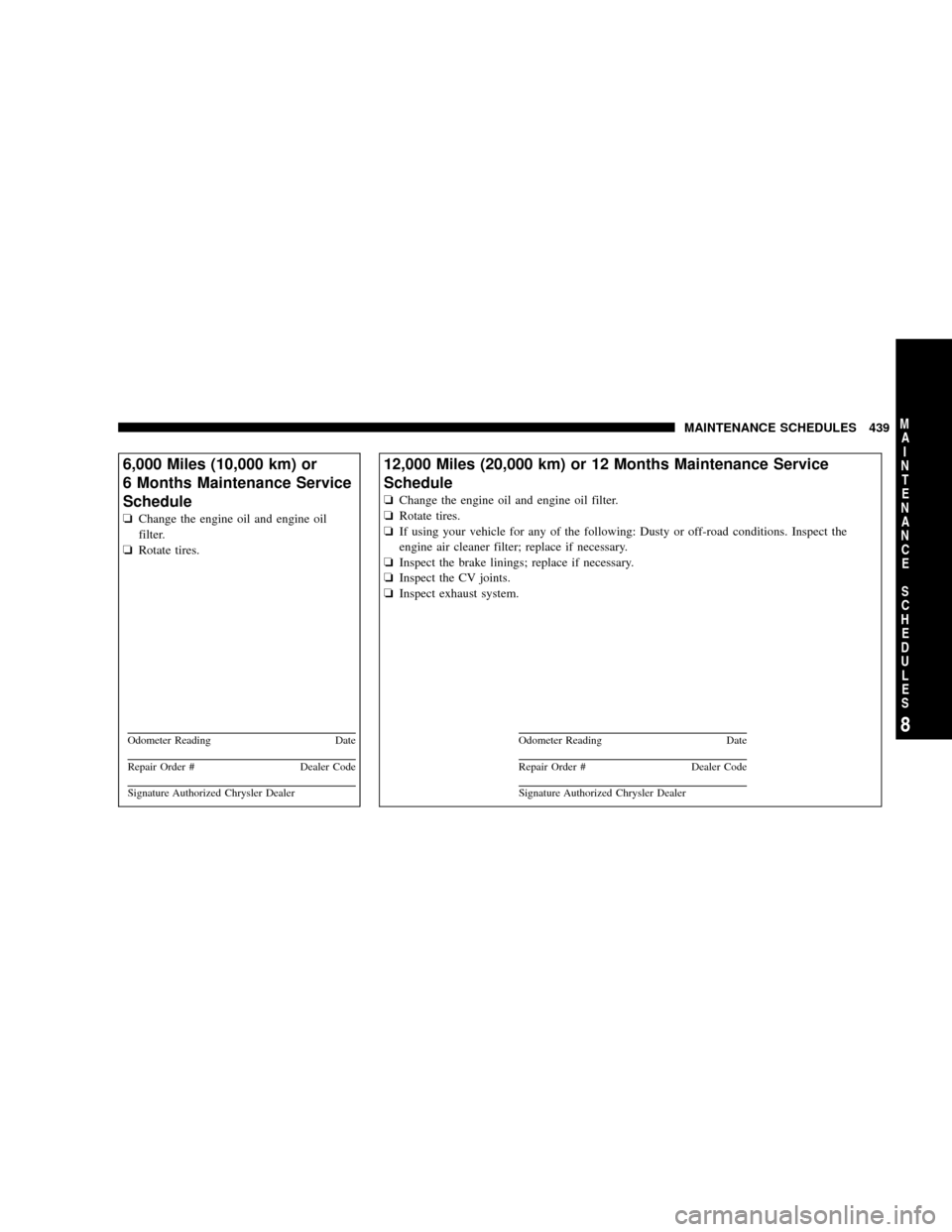
6,000 Miles (10,000 km) or
6 Months Maintenance Service
Schedule
oChange the engine oil and engine oil
filter.
oRotate tires.
Odometer Reading Date
Repair Order # Dealer Code
Signature Authorized Chrysler Dealer
12,000 Miles (20,000 km) or 12 Months Maintenance Service
Schedule
oChange the engine oil and engine oil filter.
oRotate tires.
oIf using your vehicle for any of the following: Dusty or off-road conditions. Inspect the
engine air cleaner filter; replace if necessary.
oInspect the brake linings; replace if necessary.
oInspect the CV joints.
oInspect exhaust system.
Odometer Reading Date
Repair Order # Dealer Code
Signature Authorized Chrysler Dealer
MAINTENANCE SCHEDULES 439
8
M
A
I
N
T
E
N
A
N
C
E
S
C
H
E
D
U
L
E
S
Page 442 of 481
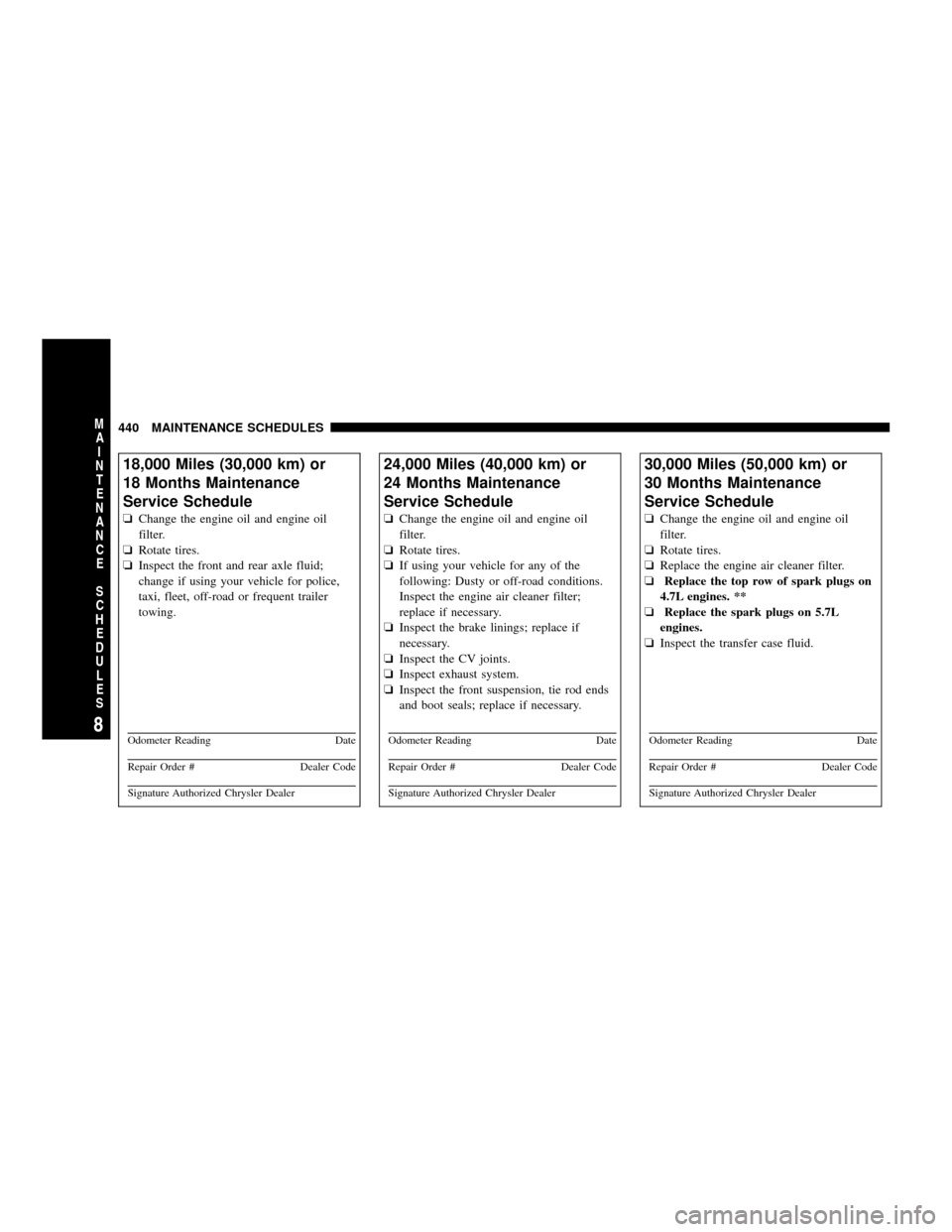
18,000 Miles (30,000 km) or
18 Months Maintenance
Service Schedule
oChange the engine oil and engine oil
filter.
oRotate tires.
oInspect the front and rear axle fluid;
change if using your vehicle for police,
taxi, fleet, off-road or frequent trailer
towing.
Odometer Reading Date
Repair Order # Dealer Code
Signature Authorized Chrysler Dealer
24,000 Miles (40,000 km) or
24 Months Maintenance
Service Schedule
oChange the engine oil and engine oil
filter.
oRotate tires.
oIf using your vehicle for any of the
following: Dusty or off-road conditions.
Inspect the engine air cleaner filter;
replace if necessary.
oInspect the brake linings; replace if
necessary.
oInspect the CV joints.
oInspect exhaust system.
oInspect the front suspension, tie rod ends
and boot seals; replace if necessary.
Odometer Reading Date
Repair Order # Dealer Code
Signature Authorized Chrysler Dealer
30,000 Miles (50,000 km) or
30 Months Maintenance
Service Schedule
oChange the engine oil and engine oil
filter.
oRotate tires.
oReplace the engine air cleaner filter.
oReplace the top row of spark plugs on
4.7L engines. **
oReplace the spark plugs on 5.7L
engines.
oInspect the transfer case fluid.
Odometer Reading Date
Repair Order # Dealer Code
Signature Authorized Chrysler Dealer
440 MAINTENANCE SCHEDULES
8
M
A
I
N
T
E
N
A
N
C
E
S
C
H
E
D
U
L
E
S