ABS CHRYSLER CARAVAN 2003 Service Manual
[x] Cancel search | Manufacturer: CHRYSLER, Model Year: 2003, Model line: CARAVAN, Model: CHRYSLER CARAVAN 2003Pages: 2177, PDF Size: 59.81 MB
Page 2113 of 2177

The following is a list of the monitored compo-
nents:
²Comprehensive Components
²Oxygen Sensor Monitor
²Oxygen Sensor Heater Monitor
²Catalyst Monitor
COMPREHENSIVE COMPONENTS
Along with the major monitors, OBD II requires
that the diagnostic system monitor any component
that could affect emissions levels. In many cases,
these components were being tested under OBD I.
The OBD I requirements focused mainly on testing
emissions-related components for electrical opens and
shorts.
However, OBD II also requires that inputs from
powertrain components to the PCM be tested for
rationality, and that outputs to powertrain compo-
nents from the PCM be tested forfunctionality.
Methods for monitoring the various Comprehensive
Component monitoring include:
(1) Circuit Continuity
²Open
²Shorted high
²Shorted to ground
(2) Rationality or Proper Functioning
²Inputs tested for rationality
²Outputs tested for functionality
NOTE: Comprehensive component monitors are
continuous. Therefore, enabling conditions do not
apply.
Input RationalityÐWhile input signals to the
PCM are constantly being monitored for electrical
opens and shorts, they are also tested for rationality.
This means that the input signal is compared against
other inputs and information to see if it makes sense
under the current conditions.
PCM sensor inputs that are checked for rationality
include:
²Manifold Absolute Pressure (MAP) Sensor
²Oxygen Sensor (O2S)
²Engine Coolant Temperature (ECT) Sensor
²Camshaft Position (CMP) Sensor
²Vehicle Speed Sensor
²Crankshaft Position (CKP) Sensor
²Intake/inlet Air Temperature (IAT) Sensor
²Throttle Position (TPS) Sensor
²Ambient Temperature Sensors
²Power Steering Switch
²Oxygen Sensor Heater
²Brake Switch
²Leak Detection Pump Switch or NVLD switch (if
equipped)
²P/N SwitchOutput FunctionalityÐPCM outputs are tested
for functionality in addition to testing for opens and
shorts. When the PCM provides a voltage to an out-
put component, it can verify that the command was
carried out by monitoring specific input signals for
expected changes. For example, when the PCM com-
mands the Idle Air Control (IAC) Motor to a specific
position under certain operating conditions, it expects
to see a specific (target) idle speed (RPM). If it does
not, it stores a DTC.
PCM outputs monitored for functionality include:
²Fuel Injectors
²Ignition Coils
²Idle Air Control
²Purge Solenoid
²EGR Solenoid (if equipped)
²LDP Solenoid or NVLD solenoid (if equipped)
²Radiator Fan Control
²Trans Controls
OXYGEN SENSOR (O2S) MONITOR
DESCRIPTIONÐEffective control of exhaust
emissions is achieved by an oxygen feedback system.
The most important element of the feedback system
is the O2S. The O2S is located in the exhaust path.
Once it reaches operating temperature 300É to 350ÉC
(572É to 662ÉF), the sensor generates a voltage that
is inversely proportional to the amount of oxygen in
the exhaust. When there is a large amount of oxygen
in the exhaust caused by a lean condition, the sensor
produces a low voltage, below 450 mV. When the oxy-
gen content is lower, caused by a rich condition, the
sensor produces a higher voltage, above 450mV (volt-
ages are offset by 2.5 volts on NGC vehicles).
The information obtained by the sensor is used to
calculate the fuel injector pulse width. The PCM is
programmed to maintain the optimum air/fuel ratio.
At this mixture ratio, the catalyst works best to
remove hydrocarbons (HC), carbon monoxide (CO)
and nitrous oxide (NOx) from the exhaust.
The O2S is also the main sensing element for the
EGR (if equipped), Catalyst and Fuel Monitors.
The O2S may fail in any or all of the following
manners:
²Slow response rate (Big Slope)
²Reduced output voltage (Half Cycle)
²Heater Performance
Slow Response Rate (Big Slope)ÐResponse rate
is the time required for the sensor to switch from
lean to rich signal output once it is exposed to a
richer than optimum A/F mixture or vice versa. As
the PCM adjusts the air/fuel ratio, the sensor must
be able to rapidly detect the change. As the sensor
ages, it could take longer to detect the changes in the
oxygen content of the exhaust gas. The rate of
change that an oxygen sensor experiences is called
25 - 2 EMISSIONS CONTROLRS
EMISSIONS CONTROL (Continued)
ProCarManuals.com
Page 2115 of 2177
OPERATIONÐThe Oxygen Sensor Heater Moni-
tor begins after the ignition has been turned OFF.
The PCM sends a 5 volt bias to the oxygen sensor
every 1.6 seconds. The PCM keeps it biased for 35
ms each time. As the sensor cools down, the resis-
tance increases and the PCM reads the increase in
voltage. Once voltage has increased to a predeter-
mined amount, higher than when the test started,
the oxygen sensor is cool enough to test heater oper-
ation.
When the oxygen sensor is cool enough, the PCM
energizes the ASD relay. Voltage to the O2 sensor
begins to increase the temperature. As the sensor
temperature increases, the internal resistance
decreases. The PCM continues biasing the 5 volt sig-
nal to the sensor. Each time the signal is biased, the
PCM reads a voltage decrease. When the PCM
detects a voltage decrease of a predetermined value
for several biased pulses, the test passes.
The heater elements are tested each time the
engine is turned OFF if all the enabling conditions
are met. If the monitor fails, the PCM stores a
maturing fault and a Freeze Frame is entered. If two
consecutive tests fail, a DTC is stored. Because the
ignition is OFF, the MIL is illuminated at the begin-
ning of the next key cycle.
Enabling ConditionsÐThe following conditions
must be met for the PCM to run the oxygen sensor
heater test:
²Engine run time of at least 3 minutes
²Engine run time at a predetermined speed
and throttle opening.
²Key OFF power down
²Battery voltage of at least 10 volts
²Sufficient Oxygen Sensor cool down
Pending ConditionsÐThere are not conditions or
situations that prompt conflict or suspension of test-
ing. The oxygen sensor heater test is not run pending
resolution of MIL illumination due to oxygen sensor
failure.
SuspendÐThere are no conditions which exist for
suspending the Heater Monitor.
CATALYST MONITOR
To comply with clean air regulations, vehicles are
equipped with catalytic converters. These converters
reduce the emission of hydrocarbons, oxides of nitro-
gen and carbon monoxide.
Normal vehicle miles or engine misfire can cause a
catalyst to decay. A meltdown of the ceramic core can
cause a reduction of the exhaust passage. This can
increase vehicle emissions and deteriorate engine
performance, driveability and fuel economy.
The catalyst monitor uses dual oxygen sensors
(O2S's) to monitor the efficiency of the converter. The
dual O2S strategy is based on the fact that as a cat-alyst deteriorates, its oxygen storage capacity and its
efficiency are both reduced. By monitoring the oxy-
gen storage capacity of a catalyst, its efficiency can
be indirectly calculated. The upstream O2S is used to
detect the amount of oxygen in the exhaust gas
before the gas enters the catalytic converter. The
PCM calculates the A/F mixture from the output of
the O2S. A low voltage indicates high oxygen content
(lean mixture). A high voltage indicates a low content
of oxygen (rich mixture).
When the upstream O2S detects a lean condition,
there is an abundance of oxygen in the exhaust gas.
A functioning converter would store this oxygen so it
can use it for the oxidation of HC and CO. As the
converter absorbs the oxygen, there will be a lack of
oxygen downstream of the converter. The output of
the downstream O2S will indicate limited activity in
this condition.
As the converter loses the ability to store oxygen,
the condition can be detected from the behavior of
the downstream O2S. When the efficiency drops, no
chemical reaction takes place. This means the con-
centration of oxygen will be the same downstream as
upstream. The output voltage of the downstream
O2S copies the voltage of the upstream sensor. The
only difference is a time lag (seen by the PCM)
between the switching of the O2S's.
To monitor the system, the number of lean-to-rich
switches of upstream and downstream O2S's is
counted. The ratio of downstream switches to
upstream switches is used to determine whether the
catalyst is operating properly. An effective catalyst
will have fewer downstream switches than it has
upstream switches i.e., a ratio closer to zero. For a
totally ineffective catalyst, this ratio will be one-to-
one, indicating that no oxidation occurs in the device.
The system must be monitored so that when cata-
lyst efficiency deteriorates and exhaust emissions
increase to over the legal limit, the MIL (check
engine lamp) will be illuminated.
Monitor OperationÐTo monitor catalyst effi-
ciency, the PCM expands the rich and lean switch
points of the heated oxygen sensor. With extended
switch points, the air/fuel mixture runs richer and
leaner to overburden the catalytic converter. Once
the test is started, the air/fuel mixture runs rich and
lean and the O2 switches are counted. A switch is
counted when an oxygen sensor signal goes from
below the lean threshold to above the rich threshold.
The number of Rear O2 sensor switches is divided by
the number of Front O2 sensor switches to determine
the switching ratio.
The test runs for 20 seconds. As catalyst efficiency
deteriorated over the life of the vehicle, the switch
rate at the downstream sensor approaches that of the
upstream sensor. If at any point during the test
25 - 4 EMISSIONS CONTROLRS
EMISSIONS CONTROL (Continued)
ProCarManuals.com
Page 2118 of 2177
Effective control of exhaust emissions is achieved
by an oxygen feedback system. The most important
element of the feedback system is the O2S. The O2S
is located in the exhaust path. Once it reaches oper-
ating temperatures of 300É to 350ÉC (572 É to 662ÉF),
the sensor generates a voltage that is inversely pro-
portional to the amount of oxygen in the exhaust.
The information obtained by the sensor is used to
calculate the fuel injector pulse width. This main-
tains a 14.7 to 1 Air Fuel (A/F) ratio. At this mixture
ratio, the catalyst works best to remove hydrocarbons
(HC), carbon monoxide (CO) and nitrogen oxide
(NOx) from the exhaust.
The voltage readings taken from the O2S are very
temperature sensitive. The readings are not accurate
below 300ÉC. Heating of the O2S is done to allow the
engine controller to shift to closed loop control as
soon as possible. The heating element used to heat
the O2S must be tested to ensure that it is heating
the sensor properly.
The O2S circuit is monitored for a drop in voltage.
The sensor output is used to test the heater by iso-
lating the effect of the heater element on the O2S
output voltage from the other effects.
EGR MONITOR (if equipped)
The Powertrain Control Module (PCM) performs
an on-board diagnostic check of the EGR system.
The EGR monitor is used to test whether the EGR
system is operating within specifications. The diag-
nostic check activates only during selected engine/
driving conditions. When the conditions are met, the
EGR is turned off (solenoid energized) and the O2S
compensation control is monitored. Turning off the
EGR shifts the air fuel (A/F) ratio in the lean direc-
tion. The O2S data should indicate an increase in the
O2 concentration in the combustion chamber when
the exhaust gases are no longer recirculated. While
this test does not directly measure the operation of
the EGR system, it can be inferred from the shift in
the O2S data whether the EGR system is operating
correctly. Because the O2S is being used, the O2S
test must pass its test before the EGR test. Also
looks at EGR linear potentiometer for feedback.
MISFIRE MONITOR
Excessive engine misfire results in increased cata-
lyst temperature and causes an increase in HC emis-
sions. Severe misfires could cause catalyst damage.
To prevent catalytic convertor damage, the PCM
monitors engine misfire.
The Powertrain Control Module (PCM) monitors
for misfire during most engine operating conditions
(positive torque) by looking at changes in the crank-
shaft speed. If a misfire occurs the speed of the
crankshaft will vary more than normal.FUEL SYSTEM MONITOR
To comply with clean air regulations, vehicles are
equipped with catalytic converters. These converters
reduce the emission of hydrocarbons, oxides of nitro-
gen and carbon monoxide. The catalyst works best
when the air fuel (A/F) ratio is at or near the opti-
mum of 14.7 to 1.
The PCM is programmed to maintain the optimum
air/fuel ratio. This is done by making short term cor-
rections in the fuel injector pulse width based on the
O2S output. The programmed memory acts as a self
calibration tool that the engine controller uses to
compensate for variations in engine specifications,
sensor tolerances and engine fatigue over the life
span of the engine. By monitoring the actual air-fuel
ratio with the O2S (short term) and multiplying that
with the program long-term (adaptive) memory and
comparing that to the limit, it can be determined
whether it will pass an emissions test. If a malfunc-
tion occurs such that the PCM cannot maintain the
optimum A/F ratio, then the MIL will be illuminated.
CATALYST MONITOR
To comply with clean air regulations, vehicles are
equipped with catalytic converters. These converters
reduce the emission of hydrocarbons, oxides of nitro-
gen and carbon monoxide.
Normal vehicle miles or engine misfire can cause a
catalyst to decay. A meltdown of the ceramic core can
cause a reduction of the exhaust passage. This can
increase vehicle emissions and deteriorate engine
performance, driveability and fuel economy.
The catalyst monitor uses dual oxygen sensors
(O2S's) to monitor the efficiency of the converter. The
dual O2S's strategy is based on the fact that as a cat-
alyst deteriorates, its oxygen storage capacity and its
efficiency are both reduced. By monitoring the oxy-
gen storage capacity of a catalyst, its efficiency can
be indirectly calculated. The upstream O2S is used to
detect the amount of oxygen in the exhaust gas
before the gas enters the catalytic converter. The
PCM calculates the A/F mixture from the output of
the O2S. A low voltage indicates high oxygen content
(lean mixture). A high voltage indicates a low content
of oxygen (rich mixture).
When the upstream O2S detects a lean condition,
there is an abundance of oxygen in the exhaust gas.
A functioning converter would store this oxygen so it
can use it for the oxidation of HC and CO. As the
converter absorbs the oxygen, there will be a lack of
oxygen downstream of the converter. The output of
the downstream O2S will indicate limited activity in
this condition.
As the converter loses the ability to store oxygen,
the condition can be detected from the behavior of
the downstream O2S. When the efficiency drops, no
RSEMISSIONS CONTROL25-7
EMISSIONS CONTROL (Continued)
ProCarManuals.com
Page 2125 of 2177
ORVR
OPERATION
The emission control principle used in the ORVR
system is that the fuel flowing into the filler tube
(appx. 1º I.D.) creates an aspiration effect which
draws air into the fill tube (Fig. 9). During refueling,
the fuel tank is vented to the vapor canister to cap-
ture escaping vapors. With air flowing into the filler
tube, there are no fuel vapors escaping to the atmo-
sphere. Once the refueling vapors are captured by
the canister, the vehicle's computer controlled purge
system draws vapor out of the canister for the engine
to burn. The vapors flow is metered by the purge
solenoid so that there is no or minimal impact on
driveability or tailpipe emissions.
As fuel starts to flow through the fill tube, it opens
the normally closed check valve and enters the fuel
tank. Vapor or air is expelled from the tank through
the control valve to the vapor canister. Vapor is
absorbed in the canister until vapor flow in the lines
stops, either following shut-off or by having the fuel
level in the tank rise high enough to close the control
valve. The control valve(Refer to 14 - FUEL SYS-
TEM/FUEL DELIVERY/FUEL TANK - OPERATION)
contains a float that rises to seal the large diameter
vent path to the canister. At this point in the fueling
of the vehicle, the tank pressure increases, the check
valve closes (preventing tank fuel from spitting back
at the operator), and fuel then rises up the filler tube
to shut-off the dispensing nozzle.
If the engine is shut-off while the On-Board diag-
nostics test is running, low level tank pressure can
be trapped in the fuel tank and fuel can not be added
to the tank until the pressure is relieved. This is due
to the leak detection pump closing the vapor outlet
from the top of the tank and the one-way check valve
not allowing the tank to vent through the fill tube to
atmosphere. Therefore, when fuel is added, it will
back-up in the fill tube and shut off the dispensing
nozzle. The pressure can be eliminated in two ways:
1. Vehicle purge must be activated and for a long
enough period to eliminate the pressure. 2. Removing
the fuel cap and allowing enough time for the system
to vent thru the recirulation tube.
Fig. 7 LDP LOCATION
Fig. 8 LDP REMOVAL/INSTALLATION
25 - 14 EVAPORATIVE EMISSIONSRS
LEAK DETECTION PUMP (Continued)
ProCarManuals.com
Page 2137 of 2177
Alternate Good Trip
Alternate Good Trips are used in place of Global
Good Trips for Comprehensive Components and
Major Monitors. If the Task Manager cannot run a
Global Good Trip because a component fault is stop-
ping the monitor from running, it will attempt to
count an Alternate Good Trip.
The Task Manager counts an Alternate Good Trip
for Comprehensive components when the following
conditions are met:
²Two minutes of engine run time, idle or driving
²No other faults occur
The Task Manager counts an Alternate Good Trip
for a Major Monitor when the monitor runs and
passes. Only the Major Monitor that failed needs to
pass to count an Alternate Good Trip.
Warm-Up Cycles
Once the MIL has been extinguished by the Good
Trip Counter, the PCM automatically switches to a
Warm-Up Cycle Counter that can be viewed on the
DRBIIIt. Warm-Up Cycles are used to erase DTCs
and Freeze Frames. Forty Warm-Up cycles must
occur in order for the PCM to self-erase a DTC and
Freeze Frame. A Warm-Up Cycle is defined as fol-
lows:
²Engine coolant temperature must start below
and rise above 160É F
²Engine coolant temperature must rise by 40É F
²No further faults occur
Freeze Frame Data Storage
Once a failure occurs, the Task Manager records
several engine operating conditions and stores it in a
Freeze Frame. The Freeze Frame is considered one
frame of information taken by an on-board data
recorder. When a fault occurs, the PCM stores the
input data from various sensors so that technicians
can determine under what vehicle operating condi-
tions the failure occurred.
The data stored in Freeze Frame is usually
recorded when a system fails the first time for two
trip faults. Freeze Frame data will only be overwrit-
ten by a different fault with a higher priority.
CAUTION: Erasing DTCs, either with the DRBIIIT;or
by disconnecting the battery, also clears all Freeze
Frame data.
Similar Conditions Window
The Similar Conditions Window displays informa-
tion about engine operation during a monitor. Abso-
lute MAP (engine load) and Engine RPM are stored
in this window when a failure occurs. There are two
different Similar conditions Windows: Fuel System
and Misfire.FUEL SYSTEM
²Fuel System Similar Conditions WindowÐ
An indicator that 'Absolute MAP When Fuel Sys Fail'
and 'RPM When Fuel Sys Failed' are all in the same
range when the failure occurred. Indicated by switch-
ing from 'NO' to 'YES'.
²Absolute MAP When Fuel Sys FailÐ The
stored MAP reading at the time of failure. Informs
the user at what engine load the failure occurred.
²Absolute MAPÐ A live reading of engine load
to aid the user in accessing the Similar Conditions
Window.
²RPM When Fuel Sys FailÐ The stored RPM
reading at the time of failure. Informs the user at
what engine RPM the failure occurred.
²Engine RPMÐ A live reading of engine RPM
to aid the user in accessing the Similar Conditions
Window.
²Adaptive Memory FactorÐ The PCM utilizes
both Short Term Compensation and Long Term Adap-
tive to calculate the Adaptive Memory Factor for
total fuel correction.
²Upstream O2S VoltsÐ A live reading of the
Oxygen Sensor to indicate its performance. For
example, stuck lean, stuck rich, etc.
²SCW Time in Window (Similar Conditions
Window Time in Window)Ð A timer used by the
PCM that indicates that, after all Similar Conditions
have been met, if there has been enough good engine
running time in the SCW without failure detected.
This timer is used to increment a Good Trip.
²Fuel System Good Trip CounterÐATrip
Counter used to turn OFF the MIL for Fuel System
DTCs. To increment a Fuel System Good Trip, the
engine must be in the Similar Conditions Window,
Adaptive Memory Factor must be less than cali-
brated threshold and the Adaptive Memory Factor
must stay below that threshold for a calibrated
amount of time.
²Test Done This TripÐ Indicates that the
monitor has already been run and completed during
the current trip.
MISFIRE
²Same Misfire Warm-Up StateÐ Indicates if
the misfire occurred when the engine was warmed up
(above 160É F).
²In Similar Misfire WindowÐ An indicator
that 'Absolute MAP When Misfire Occurred' and
'RPM When Misfire Occurred' are all in the same
range when the failure occurred. Indicated by switch-
ing from 'NO' to 'YES'.
²Absolute MAP When Misfire OccurredÐ
The stored MAP reading at the time of failure.
Informs the user at what engine load the failure
occurred.
25 - 26 ON-BOARD DIAGNOSTICSRS
TASK MANAGER (Continued)
ProCarManuals.com
Page 2138 of 2177
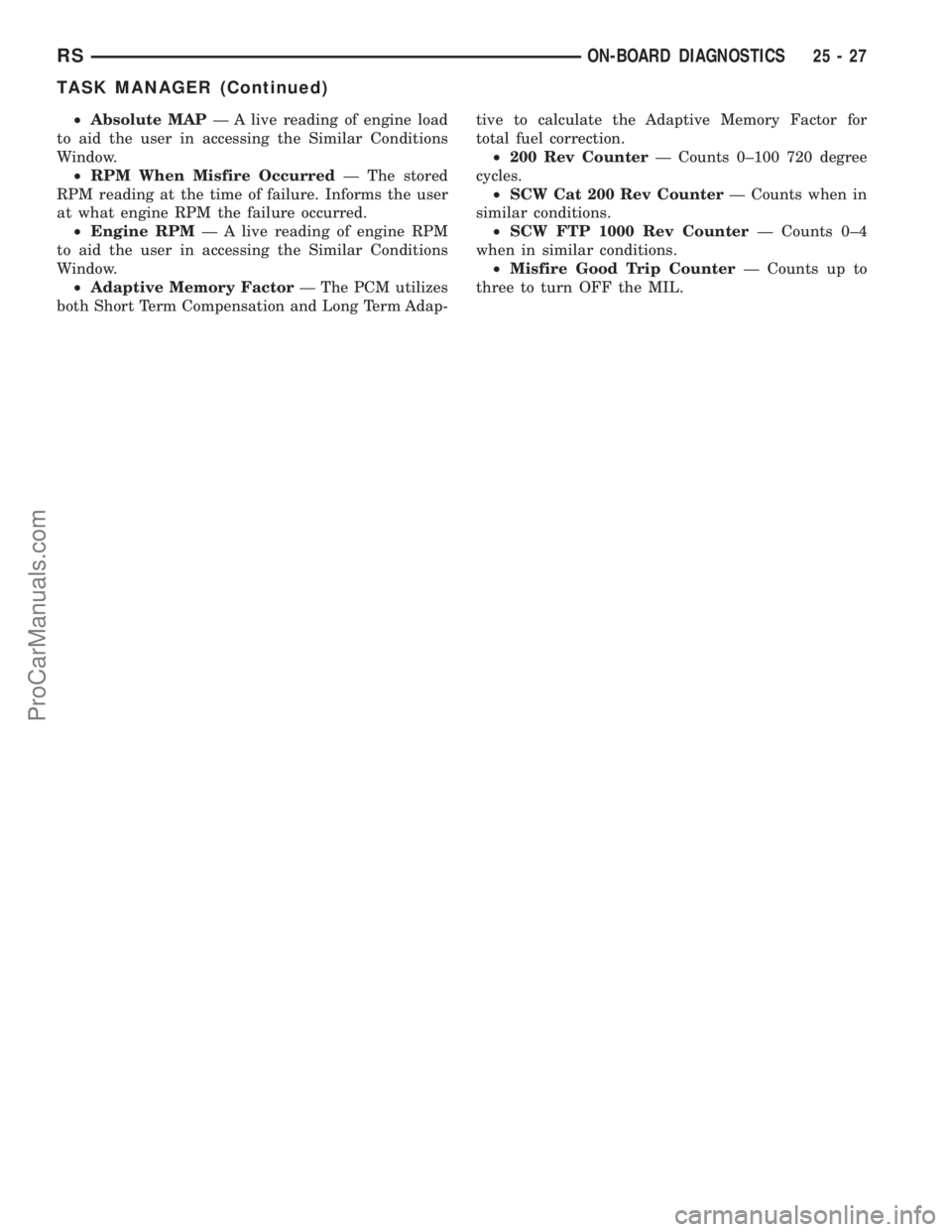
²Absolute MAPÐ A live reading of engine load
to aid the user in accessing the Similar Conditions
Window.
²RPM When Misfire OccurredÐ The stored
RPM reading at the time of failure. Informs the user
at what engine RPM the failure occurred.
²Engine RPMÐ A live reading of engine RPM
to aid the user in accessing the Similar Conditions
Window.
²Adaptive Memory FactorÐ The PCM utilizes
both Short Term Compensation and Long Term Adap-tive to calculate the Adaptive Memory Factor for
total fuel correction.
²200 Rev CounterÐ Counts 0±100 720 degree
cycles.
²SCW Cat 200 Rev CounterÐ Counts when in
similar conditions.
²SCW FTP 1000 Rev CounterÐ Counts 0±4
when in similar conditions.
²Misfire Good Trip CounterÐ Counts up to
three to turn OFF the MIL.
RSON-BOARD DIAGNOSTICS25-27
TASK MANAGER (Continued)
ProCarManuals.com
Page 2140 of 2177
ABS FASTENER TORQUE,
SPECIFICATIONS......................5-79
ABSORBER - DESCRIPTION, SHOCK.......2-36
ABSORBER - INSTALLATION, SHOCK......2-38
ABSORBER - OPERATION, SHOCK........2-36
ABSORBER - REMOVAL, SHOCK..........2-36
ABSORBER (UPPER BUSHING) -
ASSEMBLY, SHOCK....................2-37
ABSORBER (UPPER BUSHING) -
DISASSEMBLY, SHOCK.................2-36
A/C COMPRESSOR - DESCRIPTION......24-63
A/C COMPRESSOR - OPERATION........24-63
A/C COOL DOWN TEST - DIAGNOSIS
AND TESTING........................24-4
A/C DISTRIBUTION DUCT -
INSTALLATION.......................24-53
A/C DISTRIBUTION DUCT - REMOVAL....24-53
A/C HEATER CONTROL - INSTALLATION....24-9
A/C HEATER CONTROL - REMOVAL.......24-9
A/C PERFORMANCE TEST - DIAGNOSIS
AND TESTING........................24-5
A/C PLUMBING - CAUTION.............24-61
A/C PLUMBING - WARNING............24-61
A/C PRESSURE TRANSDUCER -
DESCRIPTION.......................24-10
A/C PRESSURE TRANSDUCER -
DIAGNOSIS AND TESTING.............24-10
A/C PRESSURE TRANSDUCER -
INSTALLATION.......................24-11
A/C PRESSURE TRANSDUCER -
OPERATION.........................24-10
A/C PRESSURE TRANSDUCER -
REMOVAL..........................24-10
ACCELERATOR PEDAL - INSTALLATION . . . 14-24
ACCELERATOR PEDAL - REMOVAL.......14-23
ACCESSORY DRIVE BELT - DIAGNOSIS
AND TESTING.........................7-7
ACCESSORY DRIVE BELT TENSION,
SPECIFICATIONS.......................7-5
ACCESSORY RELAY - DESCRIPTION . . . 8W-97-2
ACCESSORY RELAY - DIAGNOSIS &
TESTING.........................8W-97-2
ACCESSORY RELAY - OPERATION.....8W-97-2
ACCUMULATOR - DESCRIPTION........21-188
ACCUMULATOR - OPERATION..........21-189
A/C-HEATER CONTROL - INSTALLATION . . . 24-29
A/C-HEATER CONTROL - REMOVAL......24-29
ACTUATOR - DESCRIPTION, BLEND
DOOR........................24-11,24-30
ACTUATOR - DESCRIPTION, ENGAGE.....8N-10
ACTUATOR - DESCRIPTION, LATCH......8N-14
ACTUATOR - DESCRIPTION, MODE
DOOR.............................24-24
ACTUATOR - DESCRIPTION,
RECIRCULATION DOOR................24-27
ACTUATOR - INSTALLATION, BLEND
DOOR........................24-12,24-31
ACTUATOR - INSTALLATION, ENGAGE....8N-11
ACTUATOR - INSTALLATION, LATCH.....8N-14
ACTUATOR - INSTALLATION, MODE
DOOR........................24-25,24-36
ACTUATOR - INSTALLATION,
RECIRCULATION DOOR................24-28
ACTUATOR - OPERATION, BLEND DOOR . . 24-11,
24-30
ACTUATOR - OPERATION, ENGAGE......8N-11
ACTUATOR - OPERATION, LATCH........8N-14
ACTUATOR - OPERATION, MODE DOOR . . . 24-24
ACTUATOR - OPERATION,
RECIRCULATION DOOR................24-27
ACTUATOR - REMOVAL, BLEND DOOR . . . 24-12,
24-31
ACTUATOR - REMOVAL, ENGAGE........8N-11
ACTUATOR - REMOVAL, LATCH.........8N-14
ACTUATOR - REMOVAL, MODE DOOR....24-25,
24-36
ACTUATOR - REMOVAL, RECIRCULATION
DOOR.............................24-27
ADAPTER - INSTALLATION, FRONT DISC
BRAKE CALIPER......................5-31
ADAPTER - INSTALLATION, OIL FILTER
. . . 9-139
ADAPTER - REMOVAL, FRONT DISC
BRAKE CALIPER
......................5-31
ADAPTER - REMOVAL, OIL FILTER
.......9-139
ADAPTIVE MEMORIES, OPERATION -
FUEL CORRECTION OR
................14-20
ADDING ADDITIONAL COOLANT -
STANDARD PROCEDURE
.................7-5ADDITIONAL COOLANT - STANDARD
PROCEDURE, ADDING...................7-5
ADHESIVE ATTACHED - INSTALLATION,
EXTERIOR NAME PLATES..............23-50
ADHESIVE ATTACHED - REMOVAL,
EXTERIOR NAME PLATES..............23-50
ADHESIVE LOCATIONS -
SPECIFICATIONS, STRUCTURAL........23-153
ADJUSTER-BORC-PILLAR -
INSTALLATION, SEAT BELT HEIGHT......8O-12
ADJUSTER-BORC-PILLAR -
REMOVAL, SEAT BELT HEIGHT..........8O-12
ADJUSTER - DIAGNOSIS AND TESTING,
DRUM BRAKE AUTOMATIC..............5-13
ADJUSTER - INSTALLATION, FRONT
SEAT TRACK MANUAL................23-94
ADJUSTER - INSTALLATION, FRONT
SEAT TRACK POWER.................23-94
ADJUSTER - REMOVAL, FRONT SEAT
TRACK MANUAL.....................23-94
ADJUSTER - REMOVAL, FRONT SEAT
TRACK POWER......................23-94
ADJUSTER KNOB - INSTALLATION, SEAT
BELT HEIGHT.......................8O-13
ADJUSTER KNOB - REMOVAL, SEAT
BELT HEIGHT.......................8O-13
ADJUSTER NOISE DIAGNOSIS -
DIAGNOSIS AND TESTING, HYDRAULIC
LASH...............................9-34
ADJUSTER TENSION RELEASE -
STANDARD PROCEDURE, PARKING
BRAKE AUTOMATIC....................5-58
ADJUSTER TENSION RESET -
STANDARD PROCEDURE, PARKING
BRAKE AUTOMATIC.....................5-59
ADJUSTERS - INSTALLATION,
HYDRAULIC LASH.....................9-34
ADJUSTERS - REMOVAL, HYDRAULIC
LASH...............................9-34
AERATION - DIAGNOSIS AND TESTING,
COOLING SYSTEM.....................7-3
AFTER AN AIRBAG DEPLOYMENT -
STANDARD PROCEDURE, SERVICE.......8O-3
AIR CLEANER ELEMENT - INSTALLATION . . 9-24,
9-98
AIR CLEANER ELEMENT - REMOVAL . . 9-24,9-98
AIR CLEANER HOUSING - INSTALLATION . . 9-24,
9-99
AIR CLEANER HOUSING - REMOVAL . . 9-24,9-99
AIR CONDITIONING LINES -
INSTALLATION, REAR................24-105
AIR CONDITIONING LINES - REMOVAL,
REAR.............................24-104
AIR CONTROL MOTOR - DESCRIPTION,
IDLE...............................14-28
AIR CONTROL MOTOR - INSTALLATION,
IDLE...............................14-29
AIR CONTROL MOTOR - OPERATION,
IDLE...............................14-28
AIR CONTROL MOTOR - REMOVAL, IDLE . . 14-29
AIR EXHAUSTER - DESCRIPTION, REAR
QUARTER PANEL/FENDER..............23-56
AIR EXHAUSTER - INSTALLATION, REAR
QUARTER PANEL/FENDER..............23-57
AIR EXHAUSTER - REMOVAL, REAR
QUARTER PANEL/FENDER..............23-56
AIR FILTER - DESCRIPTION............24-39
AIR FILTER - INSTALLATION............24-40
AIR FILTER - REMOVAL...............24-39
AIR GAP - STANDARD PROCEDURE,
COMPRESSOR CLUTCH...............24-17
AIR GAP, SPECIFICATIONS - WHEEL
SPEED SENSOR.......................5-79
AIR INTAKE PIPE - INSTALLATION......24-113
AIR INTAKE PIPE - REMOVAL..........24-112
AIR OUTLETS - DESCRIPTION.....24-40,24-52
AIR OUTLETS - INSTALLATION..........24-52
AIR OUTLETS - REMOVAL.............24-52
AIR PRESSURE TESTS - DIAGNOSIS
AND TESTING, CLUTCH...............21-122
AIR TEMPERATURE SENSOR -
DESCRIPTION, INLET.................14-29
AIR TEMPERATURE SENSOR -
OPERATION, INLET
...................14-29
AIRBAG - DESCRIPTION, DRIVER
........8O-5
AIRBAG - DESCRIPTION, PASSENGER
.....8O-7
AIRBAG - DESCRIPTION, SEAT
..........8O-10
AIRBAG - INSTALLATION, DRIVER
........8O-6AIRBAG - INSTALLATION, PASSENGER....8O-9
AIRBAG - OPERATION, DRIVER..........8O-5
AIRBAG - OPERATION, PASSENGER.......8O-8
AIRBAG - OPERATION, SEAT...........8O-11
AIRBAG - REMOVAL, DRIVER............8O-5
AIRBAG - REMOVAL, PASSENGER........8O-8
AIRBAG CONTROL MODULE -
DESCRIPTION, SIDE IMPACT...........8O-17
AIRBAG CONTROL MODULE -
INSTALLATION, SIDE IMPACT...........8O-17
AIRBAG CONTROL MODULE -
OPERATION, SIDE IMPACT.............8O-17
AIRBAG CONTROL MODULE - REMOVAL,
SIDE IMPACT.......................8O-17
AIRBAG DEPLOYMENT - STANDARD
PROCEDURE, SERVICE AFTER AN........8O-3
AIRBAG SYSTEM - DIAGNOSIS AND
TESTING............................8O-2
AIRBAG TRIM COVER - INSTALLATION,
DRIVER.............................8O-7
AIRBAG TRIM COVER - REMOVAL,
DRIVER.............................8O-6
AIRBAGS - STANDARD PROCEDURE,
HANDLING..........................8O-3
AJAR SWITCH - EXPORT -
INSTALLATION, HOOD.................8Q-3
AJAR SWITCH - EXPORT - REMOVAL,
HOOD..............................8Q-3
ALIGNMENT - DESCRIPTION, WHEEL......2-46
ALIGNMENT - EXPORT - STANDARD
PROCEDURE, FRONT FOG LAMP UNIT.....8L-9
ALIGNMENT - EXPORT - STANDARD
PROCEDURE, HEADLAMP UNIT.........8L-17
ALIGNMENT - STANDARD PROCEDURE,
FRONT FOG LAMP UNIT................8L-9
ALIGNMENT - STANDARD PROCEDURE,
FRONT WIPER ARM...................8R-8
ALIGNMENT - STANDARD PROCEDURE,
HEADLAMP UNIT.....................8L-17
ALIGNMENT - STANDARD PROCEDURE,
WHEEL.............................2-51
ALIGNMENT, SPECIFICATIONS - WHEEL....2-55
ALUMINUM WHEEL CARE - CLEANING . . . 22-18
AMBIENT TEMP SENSOR - DESCRIPTION . 8M-11
AMBIENT TEMP SENSOR - OPERATION . . 8M-11
AMBIENT TEMPERATURE SENSOR -
DIAGNOSIS AND TESTING.............8M-12
AMBIENT TEMPERATURE SENSOR
CIRCUIT - DIAGNOSIS AND TESTING....8M-12
AN AIRBAG DEPLOYMENT - STANDARD
PROCEDURE, SERVICE AFTER...........8O-3
ANTENNA - EXPORT - DESCRIPTION,
QUARTER GLASS INTEGRAL............8A-9
ANTENNA - EXPORT - DIAGNOSIS AND
TESTING, QUARTER GLASS INTEGRAL....8A-9
ANTENNA - EXPORT - OPERATION,
QUARTER GLASS INTEGRAL............8A-9
ANTENNA BODY AND CABLE -
DESCRIPTION........................8A-4
ANTENNA BODY AND CABLE -
DIAGNOSIS AND TESTING..............8A-4
ANTENNA BODY AND CABLE -
INSTALLATION.......................8A-6
ANTENNA BODY AND CABLE -
OPERATION..........................8A-4
ANTENNA BODY AND CABLE - REMOVAL . . 8A-5
ANTENNA CABLE - INSTALLATION,
INSTRUMENT PANEL..................8A-9
ANTENNA CABLE - REMOVAL,
INSTRUMENT PANEL..................8A-8
ANTENNA MODULE - EXPORT -
DESCRIPTION........................8A-6
ANTENNA MODULE - EXPORT -
DIAGNOSIS AND TESTING..............8A-7
ANTENNA MODULE - EXPORT -
INSTALLATION.......................8A-7
ANTENNA MODULE - EXPORT -
OPERATION..........................8A-6
ANTENNA MODULE - EXPORT -
REMOVAL
...........................8A-7
ANTILOCK BRAKE - DESCRIPTION,
CONTROLLER
........................8E-5
ANTILOCK BRAKE - INSTALLATION,
CONTROLLER
........................8E-6
ANTILOCK BRAKE - OPERATION,
CONTROLLER
........................8E-5
ANTILOCK BRAKE - REMOVAL,
CONTROLLER
........................8E-6
RSINDEX1
Description Group-Page Description Group-Page Description Group-Page
ProCarManuals.com
Page 2142 of 2177
BELT - DIAGNOSIS AND TESTING,
ACCESSORY DRIVE.....................7-7
BELT - INSTALLATION, TIMING...........9-65
BELT - REMOVAL, TIMING..............9-63
BELT & RETRACTOR - FIRST ROW -
OUTBOARD - INSTALLATION, SEAT......8O-13
BELT & RETRACTOR - FIRST ROW -
OUTBOARD - REMOVAL, SEAT..........8O-13
BELT & RETRACTOR - OUTBOARD -
FRONT - INSTALLATION, SEAT..........8O-13
BELT & RETRACTOR - OUTBOARD -
FRONT - REMOVAL, SEAT..............8O-13
BELT & RETRACTOR - SECOND ROW -
LEFT OUTBOARD - INSTALLATION,
SEAT ..............................8O-16
BELT & RETRACTOR - SECOND ROW -
LEFT OUTBOARD - REMOVAL, SEAT.....8O-16
BELT & RETRACTOR - SECOND ROW -
RIGHT OUTBOARD - INSTALLATION,
SEAT ..............................8O-14
BELT & RETRACTOR - SECOND ROW -
RIGHT OUTBOARD - REMOVAL, SEAT....8O-14
BELT & RETRACTOR - SECOND ROW -
RIGHT OUTBOARD WITH REAR HVAC -
LWB - INSTALLATION, SEAT............8O-15
BELT & RETRACTOR - SECOND ROW -
RIGHT OUTBOARD WITH REAR HVAC -
LWB - REMOVAL, SEAT...............8O-15
BELT BUCKLE - FIRST ROW - BENCH -
INSTALLATION, SEAT.................8O-12
BELT BUCKLE - FIRST ROW - BENCH -
REMOVAL, SEAT.....................8O-12
BELT BUCKLE - FIRST ROW INBOARD -
QUAD BUCKET - INSTALLATION, SEAT....8O-11
BELT BUCKLE - FIRST ROW INBOARD -
QUAD BUCKET - REMOVAL, SEAT.......8O-11
BELT BUCKLE - FRONT INBOARD -
INSTALLATION, SEAT.................8O-11
BELT BUCKLE - FRONT INBOARD -
REMOVAL, SEAT.....................8O-11
BELT BUCKLE - SECOND ROW - THREE
PASSENGER BENCH - INSTALLATION,
SEAT ..............................8O-14
BELT BUCKLE - SECOND ROW - THREE
PASSENGER BENCH - REMOVAL, SEAT . . . 8O-14
BELT BUCKLE - SECOND ROW INBOARD
- 50/50 BENCH - INSTALLATION, SEAT . . . 8O-12
BELT BUCKLE - SECOND ROW INBOARD
- 50/50 BENCH - REMOVAL, SEAT.......8O-12
BELT COVER(S) - INSTALLATION,
TIMING.............................9-62
BELT COVER(S) - REMOVAL, TIMING......9-61
BELT HEIGHT ADJUSTER-BOR
C-PILLAR - INSTALLATION, SEAT........8O-12
BELT HEIGHT ADJUSTER-BOR
C-PILLAR - REMOVAL, SEAT...........8O-12
BELT HEIGHT ADJUSTER KNOB -
INSTALLATION, SEAT.................8O-13
BELT HEIGHT ADJUSTER KNOB -
REMOVAL, SEAT.....................8O-13
BELT MOLDING - INSTALLATION, FRONT
DOOR INNER.......................23-112
BELT MOLDING - INSTALLATION, FRONT
DOOR OUTER......................23-110
BELT MOLDING - REMOVAL, FRONT
DOOR INNER.......................23-112
BELT MOLDING - REMOVAL, FRONT
DOOR OUTER......................23-110
BELT TENSION - STANDARD
PROCEDURE, CHECKING POWER
STEERING............................7-8
BELT TENSION, SPECIFICATIONS -
ACCESSORY DRIVE.....................7-5
BELT TENSIONER - 2.4L - INSTALLATION . . 7-10
BELT TENSIONER - 2.4L - REMOVAL......7-10
BELT TENSIONER - 3.3/3.8L -
INSTALLATION........................7-12
BELT TENSIONER - 3.3/3.8L - REMOVAL . . . 7-12
BELT TENSIONER - DESCRIPTION, SEAT . . 8O-16
BELT TENSIONER - OPERATION, SEAT....8O-16
BELT TENSIONER & PULLEY -
INSTALLATION, TIMING.................9-69
BELT TENSIONER & PULLEY -
REMOVAL, TIMING
....................9-68
BELTS - 2.4L - ADJUSTMENTS, DRIVE
.....7-10
BELTS - 2.4L - CLEANING, DRIVE
..........7-9
BELTS - 2.4L - INSPECTION, DRIVE
........7-9
BELTS - 2.4L - INSTALLATION, DRIVE
.....7-10BELTS - 2.4L - REMOVAL, DRIVE..........7-8
BELTS - 3.3/3.8L - CLEANING, DRIVE......7-11
BELTS - 3.3/3.8L - INSPECTION, DRIVE....7-11
BELTS - 3.3/3.8L - INSTALLATION, DRIVE . . 7-12
BELTS - 3.3/3.8L - REMOVAL, DRIVE......7-11
BENCH - INSTALLATION, SEAT BACK
HINGE COVERS - QUAD BUCKET, 50/50
SPLIT.............................23-100
BENCH - INSTALLATION, SEAT BELT
BUCKLE - FIRST ROW................8O-12
BENCH - INSTALLATION, SEAT BELT
BUCKLE - SECOND ROW - THREE
PASSENGER........................8O-14
BENCH - INSTALLATION, SEAT BELT
BUCKLE - SECOND ROW INBOARD -
50/50..............................8O-12
BENCH - INSTALLATION, SEAT CUSHION
COVER - QUAD BUCKET, 50/50 SPLIT....23-99
BENCH - REMOVAL, SEAT BACK HINGE
COVERS - QUAD BUCKET, 50/50 SPLIT . . 23-100
BENCH - REMOVAL, SEAT BELT BUCKLE
- FIRST ROW.......................8O-12
BENCH - REMOVAL, SEAT BELT BUCKLE
- SECOND ROW - THREE PASSENGER....8O-14
BENCH - REMOVAL, SEAT BELT BUCKLE
- SECOND ROW INBOARD - 50/50.......8O-12
BENCH - REMOVAL, SEAT CUSHION
COVER - QUAD BUCKET, 50/50 SPLIT....23-98
BENCH SEAT - REMOVAL, CHILD SEAT
MODULE...........................23-86
BENCH SEAT BACK - INSTALLATION.....23-101
BENCH SEAT BACK - REMOVAL........23-101
BENCH SEAT BACK COVER -
INSTALLATION......................23-102
BENCH SEAT BACK COVER - REMOVAL . . 23-102
BENCH SEAT BACK HINGE - REMOVAL . . 23-100
BENCH SEAT RISER - 50/50 SPLIT -
INSTALLATION.......................23-99
BENCH SEAT RISER - 50/50 SPLIT -
REMOVAL..........................23-99
BENCH SEAT RISER - SECOND ROW -
INSTALLATION......................23-100
BENCH SEAT RISER - SECOND ROW -
REMOVAL..........................23-99
BENCH SEAT RISER - THIRD ROW -
INSTALLATION......................23-100
BENCH SEAT RISER - THIRD ROW -
REMOVAL.........................23-100
BENCH SEAT TRACK - INSTALLATION . . . 23-102
BENCH SEAT TRACK - REMOVAL.......23-102
BENCH SEATBACK PANEL -
INSTALLATION.......................23-98
BENCH SEATBACK PANEL - REMOVAL....23-98
BEZEL - INSTALLATION, CLUSTER.......23-62
BEZEL - INSTALLATION, INSTRUMENT
PANEL CENTER......................23-67
BEZEL - INSTALLATION, SLIDING DOOR
STOP BUMPER......................23-25
BEZEL - REMOVAL, CLUSTER...........23-62
BEZEL - REMOVAL, INSTRUMENT PANEL
CENTER............................23-67
BEZEL - REMOVAL, SLIDING DOOR
STOP BUMPER......................23-25
BEZEL OUTLETS - INSTALLATION,
CENTER............................24-42
BEZEL OUTLETS - REMOVAL, CENTER....24-40
BI-DIRECTIONAL OVERRUNNING
CLUTCH - DESCRIPTION................3-34
BI-DIRECTIONAL OVERRUNNING
CLUTCH - OPERATION.................3-36
BIN - INSTALLATION, UNDER SEAT
STORAGE..........................23-103
BIN - REMOVAL, UNDER SEAT STORAGE . 23-103
BIN GUIDE - INSTALLATION, UNDER
SEAT STORAGE.....................23-104
BIN GUIDE - REMOVAL, UNDER SEAT
STORAGE..........................23-104
BIN LOCK/LATCH - INSTALLATION,
UNDER SEAT STORAGE...............23-104
BIN LOCK/LATCH - REMOVAL, UNDER
SEAT STORAGE.....................23-104
BLADES - CLEANING, WIPER
...........8R-17
BLADES - INSTALLATION, WIPER
........8R-17
BLADES - REMOVAL, WIPER
...........8R-17
BLEEDING - STANDARD PROCEDURE,
ANTILOCK BRAKE SYSTEM
..............5-78
BLEEDING - STANDARD PROCEDURE,
BASE BRAKE
..........................5-7BLEEDING - STANDARD PROCEDURE,
MASTER CYLINDER...................5-35
BLEND DOOR ACTUATOR -
DESCRIPTION..................24-11,24-30
BLEND DOOR ACTUATOR -
INSTALLATION..................24-12,24-31
BLEND DOOR ACTUATOR - OPERATION . . 24-11,
24-30
BLEND DOOR ACTUATOR - REMOVAL....24-12,
24-31
BLOCK - CLEANING, ENGINE.......9-112,9-36
BLOCK - DESCRIPTION, ENGINE.....9-112,9-35
BLOCK - DESCRIPTION, NON-ABS
JUNCTION...........................5-33
BLOCK - INSPECTION, ENGINE......9-112,9-36
BLOCK - INSTALLATION, NON-ABS
JUNCTION...........................5-33
BLOCK - OPERATION, NON-ABS
JUNCTION...........................5-33
BLOCK - REMOVAL, NON-ABS JUNCTION . . 5-33
BLOCK HEATER - DESCRIPTION, ENGINE . . . 7-20
BLOCK HEATER - INSTALLATION,
ENGINE.............................7-20
BLOCK HEATER - OPERATION, ENGINE....7-20
BLOCK HEATER - REMOVAL, ENGINE......7-20
BLOCK HEATER TESTING - DIAGNOSIS
AND TESTING, ENGINE.................7-20
BLOCKER LATCH - INSTALLATION, FUEL
FILL DOOR.........................23-52
BLOCKER LATCH - REMOVAL, FUEL FILL
DOOR.............................23-52
BLOCKER LATCH STRIKER -
INSTALLATION, FUEL FILL DOOR........23-52
BLOCKER LATCH STRIKER - REMOVAL,
FUEL FILL DOOR.....................23-52
BLOCKER LOCKOUT LINK -
INSTALLATION, FUEL FILL DOOR........23-53
BLOCKER LOCKOUT LINK - REMOVAL,
FUEL FILL DOOR.....................23-52
BLOWER MOTOR - DESCRIPTION . . 24-43,24-53
BLOWER MOTOR - DIAGNOSIS AND
TESTING......................24-43,24-54
BLOWER MOTOR - INSTALLATION . . 24-46,24-56
BLOWER MOTOR - OPERATION....24-43,24-54
BLOWER MOTOR - REMOVAL......24-46,24-56
BLOWER MOTOR RELAY - DESCRIPTION . 24-13,
24-32
BLOWER MOTOR RELAY - DIAGNOSIS
AND TESTING..................24-14,24-33
BLOWER MOTOR RELAY -
INSTALLATION..................24-14,24-33
BLOWER MOTOR RELAY - OPERATION . . . 24-13,
24-32
BLOWER MOTOR RELAY - REMOVAL....24-14,
24-33
BLOWER MOTOR RESISTOR -
DESCRIPTION..................24-14,24-34
BLOWER MOTOR RESISTOR -
DIAGNOSIS AND TESTING........24-15,24-34
BLOWER MOTOR RESISTOR -
INSTALLATION..................24-16,24-35
BLOWER MOTOR RESISTOR -
OPERATION....................24-15,24-34
BLOWER MOTOR RESISTOR - REMOVAL . 24-16,
24-35
BODY - ASSEMBLY, VALVE............21-257
BODY - DESCRIPTION, THROTTLE.......14-34
BODY - DESCRIPTION, VALVE..........21-250
BODY - DISASSEMBLY, VALVE.........21-252
BODY - INSTALLATION, THROTTLE.......14-35
BODY - INSTALLATION, VALVE.........21-262
BODY - OPERATION, THROTTLE.........14-34
BODY - OPERATION, VALVE...........21-250
BODY - REMOVAL, THROTTLE..........14-35
BODY - REMOVAL, VALVE.............21-251
BODY AND CABLE - DESCRIPTION,
ANTENNA...........................8A-4
BODY AND CABLE - DIAGNOSIS AND
TESTING, ANTENNA...................8A-4
BODY AND CABLE - INSTALLATION,
ANTENNA
...........................8A-6
BODY AND CABLE - OPERATION,
ANTENNA
...........................8A-4
BODY AND CABLE - REMOVAL,
ANTENNA
...........................8A-5
BODY CODE PLATE - DESCRIPTION
.....Intro.-1
BODY CONTROL MODULE -
DESCRIPTION
........................8E-3
RSINDEX3
Description Group-Page Description Group-Page Description Group-Page
ProCarManuals.com
Page 2151 of 2177

EXHAUSTER - REMOVAL, REAR
QUARTER PANEL/FENDER AIR..........23-56
EXPANSION VALVE - DESCRIPTION . 24-72,24-96
EXPANSION VALVE - DIAGNOSIS AND
TESTING......................24-72,24-97
EXPANSION VALVE - INSTALLATION . 24-74,24-98
EXPANSION VALVE - OPERATION . . . 24-72,24-97
EXPANSION VALVE - REMOVAL....24-73,24-97
EXPORT - BRAKE ROTOR...............5-55
EXPORT - DESCRIPTION................5-58
EXPORT - DESCRIPTION................2-10
EXPORT - DESCRIPTION, ANTENNA
MODULE............................8A-6
EXPORT - DESCRIPTION, DIESEL
SUPPLEMENTAL HEATER - DCHA.......24-106
EXPORT - DESCRIPTION, HEADLAMP
LEVELING SWITCH...................8L-15
EXPORT - DESCRIPTION, HEADLAMP
WASHERS..........................8R-10
EXPORT - DESCRIPTION, POWER
FOLDAWAY MIRROR SWITCH..........8N-48
EXPORT - DESCRIPTION, QUARTER
GLASS INTEGRAL ANTENNA.............8A-9
EXPORT - DESCRIPTION, REAR FOG
LAMP..............................8L-22
EXPORT - DIAGNOSIS AND TESTING,
ANTENNA MODULE....................8A-7
EXPORT - DIAGNOSIS AND TESTING,
HEADLAMP LEVELING MOTOR..........8L-14
EXPORT - DIAGNOSIS AND TESTING,
HEADLAMP LEVELING SWITCH.........8L-15
EXPORT - DIAGNOSIS AND TESTING,
HEADLAMP SWITCH..................8L-16
EXPORT - DIAGNOSIS AND TESTING,
HEADLAMP WASHERS................8R-10
EXPORT - DIAGNOSIS AND TESTING,
QUARTER GLASS INTEGRAL ANTENNA....8A-9
EXPORT - INSTALLATION...............2-12
EXPORT - INSTALLATION, ANTENNA
MODULE............................8A-7
EXPORT - INSTALLATION, FRONT FOG
LAMP...............................8L-9
EXPORT - INSTALLATION, FRONT
POSITION LAMP.....................8L-10
EXPORT - INSTALLATION, HEADLAMP....8L-13
EXPORT - INSTALLATION, HEADLAMP
LEVELING MOTOR....................8L-15
EXPORT - INSTALLATION, HEADLAMP
UNIT..............................8L-20
EXPORT - INSTALLATION, HEADLAMP
WASHER HOSE......................8R-12
EXPORT - INSTALLATION, HEADLAMP
WASHER PUMP MOTOR...............8R-13
EXPORT - INSTALLATION, HEADLAMP
WASHERS..........................8R-12
EXPORT - INSTALLATION, HOOD AJAR
SWITCH............................8Q-3
EXPORT - INSTALLATION, PARK/TURN
SIGNAL LAMP.......................8L-22
EXPORT - INSTALLATION, POWER
FOLDAWAY MIRROR SWITCH..........8N-49
EXPORT - INSTALLATION, REPEATER
LAMP..............................8L-22
EXPORT - INSTALLATION, TAIL LAMP....8L-23
EXPORT - OPERATION, ANTENNA
MODULE............................8A-6
EXPORT - OPERATION, HEADLAMP
WASHERS
..........................8R-10
EXPORT - OPERATION, POWER
FOLDAWAY MIRROR SWITCH
..........8N-48
EXPORT - OPERATION, QUARTER GLASS
INTEGRAL ANTENNA
...................8A-9
EXPORT - REMOVAL
...................2-11
EXPORT - REMOVAL, ANTENNA MODULE
. . 8A-7
EXPORT - REMOVAL, FRONT FOG LAMP
. . . 8L-9
EXPORT - REMOVAL, FRONT POSITION
LAMP
..............................8L-10
EXPORT - REMOVAL, HEADLAMP
........8L-13
EXPORT - REMOVAL, HEADLAMP
LEVELING MOTOR
....................8L-14
EXPORT - REMOVAL, HEADLAMP UNIT
. . . 8L-20
EXPORT - REMOVAL, HEADLAMP
WASHER HOSE
......................8R-12
EXPORT - REMOVAL, HEADLAMP
WASHER PUMP MOTOR
...............8R-12
EXPORT - REMOVAL, HEADLAMP
WASHERS
..........................8R-12EXPORT - REMOVAL, HOOD AJAR
SWITCH............................8Q-3
EXPORT - REMOVAL, PARK/TURN
SIGNAL LAMP.......................8L-22
EXPORT - REMOVAL, POWER
FOLDAWAY MIRROR SWITCH..........8N-48
EXPORT - REMOVAL, REPEATER LAMP . . . 8L-22
EXPORT - REMOVAL, TAIL LAMP........8L-23
EXPORT - STANDARD PROCEDURE,
FRONT FOG LAMP UNIT ALIGNMENT......8L-9
EXPORT - STANDARD PROCEDURE,
HEADLAMP UNIT ALIGNMENT..........8L-17
EXTENSION - INSTALLATION,
EVAPORATOR LINE...................24-96
EXTENSION - REMOVAL, EVAPORATOR
LINE...............................24-95
EXTENSION TRIM - INSTALLATION,
A-PILLAR LOWER....................23-73
EXTENSION TRIM - REMOVAL, A-PILLAR
LOWER............................23-73
EXTENSION TUBES - INSTALLATION,
HEATER CORE.......................24-77
EXTENSION TUBES - REMOVAL, HEATER
CORE..............................24-75
EXTERIOR - DESCRIPTION, LAMPS/
LIGHTING...........................8L-2
EXTERIOR - OPERATION, LAMPS/
LIGHTING...........................8L-3
EXTERIOR - WARNING, LAMPS/
LIGHTING...........................8L-4
EXTERIOR HANDLE - INSTALLATION.....23-22,
23-39
EXTERIOR HANDLE - REMOVAL.....23-22,23-39
EXTERIOR HANDLE SWITCH -
DESCRIPTION.......................8N-11
EXTERIOR HANDLE SWITCH -
INSTALLATION......................8N-12
EXTERIOR HANDLE SWITCH -
OPERATION.........................8N-11
EXTERIOR HANDLE SWITCH - REMOVAL . . 8N-11
EXTERIOR LAMPS, SPECIFICATIONS......8L-4
EXTERIOR NAME PLATES - ADHESIVE
ATTACHED - INSTALLATION............23-50
EXTERIOR NAME PLATES - ADHESIVE
ATTACHED - REMOVAL................23-50
EXTERIOR NAME PLATES - TAPE
ATTACHED - INSTALLATION............23-50
EXTERIOR NAME PLATES - TAPE
ATTACHED - REMOVAL................23-50
FACTOR SETTING - STANDARD
PROCEDURE, PINION............8E-15,8E-23
FAILED PARK SWITCH - DIAGNOSIS AND
TESTING............................8R-2
FAN - DESCRIPTION, RADIATOR..........7-28
FAN - INSTALLATION, RADIATOR.........7-30
FAN - OPERATION, RADIATOR...........7-29
FAN - REMOVAL, RADIATOR.............7-30
FAN MOTOR - DIAGNOSIS AND
TESTING, RADIATOR...................7-29
FAN RELAY - DESCRIPTION, RADIATOR....7-30
FAN RELAY - INSTALLATION, RADIATOR . . . 7-30
FAN RELAY - OPERATION, RADIATOR......7-30
FAN RELAY - REMOVAL, RADIATOR.......7-30
FASCIA - INSTALLATION, FRONT.........13-1
FASCIA - INSTALLATION, REAR..........13-2
FASCIA - REMOVAL, FRONT.............13-1
FASCIA - REMOVAL, REAR..............13-2
FASCIA - SCUFF PAD - INSTALLATION,
REAR...............................13-4
FASCIA - SCUFF PAD - REMOVAL, REAR . . . 13-3
FASTENER IDENTIFICATION -
DESCRIPTION......................Intro.-2
FASTENER TORQUE, SPECIFICATIONS -
ABS ................................5-79
FASTENER TORQUE, SPECIFICATIONS -
BRAKE...............................5-9
FASTENER TORQUE, SPECIFICATIONS -
FRONT SUSPENSION...................2-3
FASTENER TORQUE, SPECIFICATIONS -
POWER STEERING....................19-9
FASTENER TORQUE, SPECIFICATIONS -
REAR SUSPENSION
...................2-27
FASTENER USAGE - DESCRIPTION
......Intro.-5
FEED CIRCUIT RESISTANCE TEST -
DIAGNOSIS AND TESTING
..............8F-32
FEED CIRCUIT TEST - DIAGNOSIS AND
TESTING
...........................8F-33
FENDER - INSTALLATION, FRONT
........23-51FENDER - REMOVAL, FRONT...........23-51
FFV REPLACEMENT PARTS -
DESCRIPTION........................14-2
FILL - DIAGNOSIS AND TESTING,
VEHICLE DOES NOT..................25-16
FILL - STANDARD PROCEDURE, FLUID
DRAIN.............................21-71
FILL DOOR - INSTALLATION, FUEL.......23-51
FILL DOOR - REMOVAL, FUEL..........23-51
FILL DOOR BLOCKER LATCH -
INSTALLATION, FUEL.................23-52
FILL DOOR BLOCKER LATCH -
REMOVAL, FUEL.....................23-52
FILL DOOR BLOCKER LATCH STRIKER -
INSTALLATION, FUEL.................23-52
FILL DOOR BLOCKER LATCH STRIKER -
REMOVAL, FUEL.....................23-52
FILL DOOR BLOCKER LOCKOUT LINK -
INSTALLATION, FUEL.................23-53
FILL DOOR BLOCKER LOCKOUT LINK -
REMOVAL, FUEL.....................23-52
FILL/CHECK LOCATIONS - DESCRIPTION,
FLUID...............................0-7
FILLER CAP - DESCRIPTION, FUEL.......25-12
FILLER CAP - OPERATION, FUEL........25-12
FILLER NECK SEAL - DIAGNOSIS AND
TESTING, RADIATOR CAP TO............7-27
FILLER TUBE - INSTALLATION, FUEL
TANK ..............................14-12
FILLER TUBE - REMOVAL, FUEL TANK....14-12
FILLING - STANDARD PROCEDURE,
COOLING SYSTEM.......................7-5
FILLING - STANDARD PROCEDURE,
HEATER CORE.......................24-98
FILTER - DESCRIPTION, AIR............24-39
FILTER - DESCRIPTION, OIL.............9-53
FILTER - INSTALLATION, AIR...........24-40
FILTER - INSTALLATION, FUEL...........14-4
FILTER - INSTALLATION, INLET..........14-13
FILTER - INSTALLATION, OIL.......9-139,9-53
FILTER - REMOVAL, AIR...............24-39
FILTER - REMOVAL, FUEL...............14-4
FILTER - REMOVAL, INLET.............14-13
FILTER - REMOVAL, OIL...........9-139,9-53
FILTER ADAPTER - INSTALLATION, OIL . . . 9-139
FILTER ADAPTER - REMOVAL, OIL.......9-139
FILTER CHANGE - STANDARD
PROCEDURE, ENGINE OIL..........9-137,9-53
FILTER SERVICE - STANDARD
PROCEDURE, FLUID.................21-203
FINAL DRIVE - ASSEMBLY............21-195
FINAL DRIVE - DISASSEMBLY.........21-190
FINESSE SANDING/BUFFING &
POLISHING - DESCRIPTION............23-84
FINISH - DESCRIPTION, BASE
COAT/CLEARCOAT....................23-84
FIRING ORDER, SPECIFICATIONS.........8I-3
FIRST ROW - BENCH - INSTALLATION,
SEAT BELT BUCKLE..................8O-12
FIRST ROW - BENCH - REMOVAL, SEAT
BELT BUCKLE.......................8O-12
FIRST ROW - OUTBOARD -
INSTALLATION, SEAT BELT &
RETRACTOR........................8O-13
FIRST ROW - OUTBOARD - REMOVAL,
SEAT BELT & RETRACTOR.............8O-13
FIRST ROW INBOARD - QUAD BUCKET -
INSTALLATION, SEAT BELT BUCKLE......8O-11
FIRST ROW INBOARD - QUAD BUCKET -
REMOVAL, SEAT BELT BUCKLE.........8O-11
FITTING - CONNECTING ROD............9-45
FITTING - PISTON RING................9-45
FITTING - STANDARD PROCEDURE,
MAIN BEARING......................9-123
FITTING - STANDARD PROCEDURE,
PISTON RING.......................9-121
FITTING - STANDARD PROCEDURE,
PISTON TO CYLINDER BORE............9-42
FITTING CONNECTING RODS -
STANDARD PROCEDURE...............9-116
FITTING PISTONS - STANDARD
PROCEDURE........................9-117
FITTINGS - STANDARD PROCEDURE,
QUICK-CONNECT
.....................14-13
FLANGE SEAL - INSTALLATION, INPUT
....3-45
FLANGE SEAL - INSTALLATION, OUTPUT
. . . 3-46
FLANGE SEAL - REMOVAL, INPUT
........3-44
FLANGE SEAL - REMOVAL, OUTPUT
.......3-45
12 INDEXRS
Description Group-Page Description Group-Page Description Group-Page
ProCarManuals.com
Page 2156 of 2177
INPUT - OPERATION, DATA BUS
COMMUNICATION RECEIVE - PCM.......8E-15
INPUT - OPERATION, IGNITION SENSE -
PCM...............................8E-15
INPUT - OPERATION, SENSOR RETURN -
PCM...............................8E-15
INPUT - OPERATION, SPEED SENSOR . . . 21-240
INPUT - REMOVAL, SPEED SENSOR.....21-240
INPUT CLUTCH ASSEMBLY - ASSEMBLY . 21-216
INPUT CLUTCH ASSEMBLY -
DISASSEMBLY......................21-208
INPUT FLANGE SEAL - INSTALLATION.....3-45
INPUT FLANGE SEAL - REMOVAL.........3-44
INPUT SHAFT - ASSEMBLY.............21-96
INPUT SHAFT - DESCRIPTION..........21-93
INPUT SHAFT - DISASSEMBLY..........21-93
INPUT SHAFT COVER SEAL -
INSTALLATION.......................21-14
INPUT SHAFT COVER SEAL - REMOVAL . . . 21-13
INPUT SHAFT END SEAL -
INSTALLATION.......................21-16
INPUT SHAFT END SEAL - REMOVAL.....21-15
INPUT SHAFT SEAL - INSTALLATION.....21-18
INPUT SHAFT SEAL - REMOVAL.........21-17
INSIDE HANDLE CABLE - INSTALLATION . . 23-37
INSIDE HANDLE CABLE - REMOVAL......23-37
INSIDE LATCH HANDLE - INSTALLATION . . 23-33
INSIDE LATCH HANDLE - REMOVAL......23-33
INSPECT, INSPECTION...............21-114
INSTRUMENT CLUSTER - DESCRIPTION . . . 8J-1
INSTRUMENT CLUSTER - OPERATION.....8J-1
INSTRUMENT PANEL - INSTALLATION,
LOWER............................23-68
INSTRUMENT PANEL - REMOVAL,
LOWER............................23-68
INSTRUMENT PANEL ANTENNA CABLE -
INSTALLATION.......................8A-9
INSTRUMENT PANEL ANTENNA CABLE -
REMOVAL...........................8A-8
INSTRUMENT PANEL ASSEMBLY -
INSTALLATION.......................23-65
INSTRUMENT PANEL ASSEMBLY -
REMOVAL..........................23-64
INSTRUMENT PANEL CENTER BEZEL -
INSTALLATION.......................23-67
INSTRUMENT PANEL CENTER BEZEL -
REMOVAL..........................23-67
INSTRUMENT PANEL END CAP -
INSTALLATION.......................23-67
INSTRUMENT PANEL END CAP -
REMOVAL..........................23-67
INSTRUMENT PANEL OUTLET -
INSTALLATION.......................24-42
INSTRUMENT PANEL OUTLET -
REMOVAL..........................24-42
INSTRUMENT PANEL TOP COVER -
INSTALLATION.......................23-67
INSTRUMENT PANEL TOP COVER -
REMOVAL..........................23-67
INSTRUMENT PANEL TOP PAD
ASSEMBLY - INSTALLATION............23-70
INSTRUMENT PANEL TOP PAD
ASSEMBLY - REMOVAL................23-70
INTAKE MANIFOLD - DESCRIPTION . . 9-144,9-58
INTAKE MANIFOLD - INSTALLATION,
LOWER............................9-149
INTAKE MANIFOLD - INSTALLATION,
UPPER.............................9-147
INTAKE MANIFOLD - LOWER -
CLEANING..........................9-148
INTAKE MANIFOLD - LOWER -
INSPECTION....................9-148,9-60
INTAKE MANIFOLD - LOWER -
INSTALLATION........................9-60
INTAKE MANIFOLD - LOWER - REMOVAL . . 9-60
INTAKE MANIFOLD - REMOVAL, LOWER . . 9-148
INTAKE MANIFOLD - REMOVAL, UPPER . . . 9-145
INTAKE MANIFOLD - UPPER -
INSPECTION.........................9-59
INTAKE MANIFOLD - UPPER -
INSTALLATION........................9-59
INTAKE MANIFOLD - UPPER - REMOVAL
. . . 9-58
INTAKE MANIFOLD LEAKS - DIAGNOSIS
AND TESTING
...................9-145,9-58
INTAKE MANIFOLD VACUUM PORT
REPAIR - STANDARD PROCEDURE
.......9-145
INTAKE PIPE - INSTALLATION, AIR
......24-113
INTAKE PIPE - REMOVAL, AIR
.........24-112INTAKE/EXHAUST VALVES & SEATS -
CLEANING......................9-105,9-32
INTAKE/EXHAUST VALVES & SEATS -
DESCRIPTION...................9-104,9-32
INTAKE/EXHAUST VALVES & SEATS -
INSPECTION........................9-105
INTAKE/EXHAUST VALVES & SEATS -
INSTALLATION.......................9-106
INTAKE/EXHAUST VALVES & SEATS -
OPERATION.........................9-104
INTAKE/EXHAUST VALVES & SEATS -
REMOVAL..........................9-105
INTEGRAL ANTENNA - EXPORT -
DESCRIPTION, QUARTER GLASS.........8A-9
INTEGRAL ANTENNA - EXPORT -
DIAGNOSIS AND TESTING, QUARTER
GLASS..............................8A-9
INTEGRAL ANTENNA - EXPORT -
OPERATION, QUARTER GLASS...........8A-9
INTEGRATED POWER MODULE -
DESCRIPTION.....................8W-97-3
INTEGRATED POWER MODULE -
INSTALLATION....................8W-97-4
INTEGRATED POWER MODULE -
OPERATION.......................8W-97-3
INTEGRATED POWER MODULE -
REMOVAL........................8W-97-4
INTERACTIVE SPEED CONTROL (4
SPEED EATX ONLY) - OPERATION........8P-2
INTERFACE (PCI) BUS, OPERATION -
PROGRAMMABLE COMMUNICATIONS....14-21
INTERIOR LAMPS, SPECIFICATIONS......8L-25
INTERLOCK - DESCRIPTION, IGNITION....19-17
INTERLOCK SOLENOID - DESCRIPTION,
SHIFT.............................21-233
INTERLOCK SOLENOID - DIAGNOSIS
AND TESTING, BRAKE/TRANSMISSION
SHIFT.............................21-235
INTERLOCK SOLENOID - INSTALLATION,
SHIFT.............................21-236
INTERLOCK SOLENOID - OPERATION,
SHIFT.............................21-233
INTERLOCK SOLENOID - REMOVAL,
SHIFT.............................21-235
INTERLOCK SWITCH - INSTALLATION,
CLUTCH PEDAL.......................6-14
INTERLOCK SWITCH - REMOVAL,
CLUTCH PEDAL.......................6-13
INTERMEDIATE SHAFT - ASSEMBLY.....21-107
INTERMEDIATE SHAFT - DESCRIPTION . . 21-100
INTERMEDIATE SHAFT - DISASSEMBLY . . 21-100
INTERNATIONAL SYMBOLS -
DESCRIPTION......................Intro.-5
INTERNATIONAL SYMBOLS -
DESCRIPTION.........................0-1
INTRODUCTION - DIAGNOSIS AND
TESTING, ENGINE DIAGNOSIS........9-3,9-76
IOD FUSE - DESCRIPTION...........8W-97-4
IOD FUSE - INSTALLATION...........8W-97-5
IOD FUSE - OPERATION.............8W-97-5
IOD FUSE - REMOVAL..............8W-97-5
JOINT - DESCRIPTION, LOWER BALL......2-10
JOINT - DIAGNOSIS AND TESTING,
LOWER BALL........................2-10
JOINT - OPERATION, LOWER BALL.......2-10
JOINT MOLDING - INSTALLATION, ROOF . . 23-57
JOINT MOLDING - REMOVAL, ROOF......23-57
JOINT SEAL BOOT - INSTALLATION,
BALL
...............................2-11
JOINT SEAL BOOT - REMOVAL, BALL
.....2-11
JOUNCE BUMPER - DESCRIPTION
........2-35
JOUNCE BUMPER - OPERATION
..........2-35
JUMP STARTING - STANDARD
PROCEDURE
.........................0-15
JUNCTION BLOCK - DESCRIPTION,
NON-ABS
............................5-33
JUNCTION BLOCK - INSTALLATION,
NON-ABS
............................5-33
JUNCTION BLOCK - OPERATION,
NON-ABS
............................5-33
JUNCTION BLOCK - REMOVAL, NON-ABS
. . 5-33
KEY - DESCRIPTION, TRANSPONDER
.....8Q-3
KEY - OPERATION, TRANSPONDER
.......8Q-3
KEY IMMOBILIZER MODULE -
DESCRIPTION, SENTRY
................8E-18
KEY IMMOBILIZER MODULE -
INSTALLATION, SENTRY
...............8E-19KEY IMMOBILIZER MODULE -
OPERATION, SENTRY.................8E-18
KEY IMMOBILIZER MODULE - REMOVAL,
SENTRY............................8E-18
KEY IMMOBILIZER SYSTEM -
DIAGNOSIS AND TESTING, SENTRY.......8Q-3
KEYLESS ENTRY MODULE -
DESCRIPTION, REMOTE...............8N-43
KEYLESS ENTRY MODULE - DIAGNOSIS
AND TESTING, REMOTE...............8N-43
KEYLESS ENTRY MODULE -
INSTALLATION, REMOTE..............8N-44
KEYLESS ENTRY MODULE - OPERATION,
REMOTE...........................8N-43
KEYLESS ENTRY MODULE - REMOVAL,
REMOTE...........................8N-44
KEYLESS ENTRY TRANSMITTER -
DIAGNOSIS AND TESTING.............8N-42
KEY/LOCK CYLINDER - DESCRIPTION....19-20
KEY/LOCK CYLINDER - INSTALLATION....19-20
KEY/LOCK CYLINDER - OPERATION......19-20
KEY/LOCK CYLINDER - REMOVAL.......19-20
KNOB - INSTALLATION, GEARSHIFT......21-87
KNOB - INSTALLATION, SEAT BELT
HEIGHT ADJUSTER...................8O-13
KNOB - REMOVAL, GEARSHIFT..........21-87
KNOB - REMOVAL, SEAT BELT HEIGHT
ADJUSTER.........................8O-13
KNOCK SENSOR - DESCRIPTION..........8I-8
KNOCK SENSOR - OPERATION...........8I-8
KNUCKLE - DESCRIPTION.................2-6
KNUCKLE - INSPECTION, STEERING........2-9
KNUCKLE - INSTALLATION, STEERING......2-9
KNUCKLE - OPERATION.................2-7
KNUCKLE - REMOVAL, STEERING.........2-7
LABEL - DESCRIPTION, E-MARK......Intro.-11
LABEL - DESCRIPTION, VECI.........Intro.-11
LABEL - DESCRIPTION, VEHICLE
EMISSION CONTROL INFORMATION.......25-1
LABEL - DESCRIPTION, VEHICLE SAFETY
CERTIFICATION....................Intro.-11
LAMP - DESCRIPTION, VTSS/SKIS
INDICATOR..........................8Q-5
LAMP - DIAGNOSIS AND TESTING,
FRONT FOG..........................8L-7
LAMP - EXPORT - DESCRIPTION, REAR
FOG ...............................8L-22
LAMP - EXPORT - INSTALLATION,
FRONT FOG..........................8L-9
LAMP - EXPORT - INSTALLATION,
FRONT POSITION....................8L-10
LAMP - EXPORT - INSTALLATION,
PARK/TURN SIGNAL..................8L-22
LAMP - EXPORT - INSTALLATION,
REPEATER..........................8L-22
LAMP - EXPORT - INSTALLATION, TAIL . . . 8L-23
LAMP - EXPORT - REMOVAL, FRONT
FOG ................................8L-9
LAMP - EXPORT - REMOVAL, FRONT
POSITION..........................8L-10
LAMP - EXPORT - REMOVAL,
PARK/TURN SIGNAL..................8L-22
LAMP - EXPORT - REMOVAL, REPEATER . . 8L-22
LAMP - EXPORT - REMOVAL, TAIL.......8L-23
LAMP - INSTALLATION, CENTER HIGH
MOUNTED STOP......................8L-6
LAMP - INSTALLATION, COURTESY......8L-26
LAMP - INSTALLATION, DOME/CARGO....8L-26
LAMP - INSTALLATION, FRONT FOG.......8L-9
LAMP - INSTALLATION, LICENSE........8L-20
LAMP - INSTALLATION, LIFTGATE.......8L-27
LAMP - INSTALLATION, PARK/TURN
SIGNAL............................8L-21
LAMP - INSTALLATION, READING........8L-28
LAMP - INSTALLATION, TAIL...........8L-22
LAMP - INSTALLATION, VANITY.........8L-28
LAMP - OPERATION, VTSS/SKIS
INDICATOR..........................8Q-5
LAMP - REMOVAL, CENTER HIGH
MOUNTED STOP......................8L-6
LAMP - REMOVAL, COURTESY..........8L-26
LAMP - REMOVAL, DOME/CARGO.......8L-26
LAMP - REMOVAL, FRONT FOG..........8L-9
LAMP - REMOVAL, LICENSE
............8L-20
LAMP - REMOVAL, LIFTGATE
...........8L-27
LAMP - REMOVAL, PARK/TURN SIGNAL
. . 8L-21
LAMP - REMOVAL, READING
...........8L-27
LAMP - REMOVAL, TAIL
...............8L-22
RSINDEX17
Description Group-Page Description Group-Page Description Group-Page
ProCarManuals.com