warning CHRYSLER CROSSFIRE 2007 1.G Owners Manual
[x] Cancel search | Manufacturer: CHRYSLER, Model Year: 2007, Model line: CROSSFIRE, Model: CHRYSLER CROSSFIRE 2007 1.GPages: 299, PDF Size: 8.26 MB
Page 242 of 299
Insure nylon tubing in these areas has not melted or
collapsed. Inspect all hose connections such as clamps
and couplings to make sure they are secure and no leaks
are present. Components should be replaced immedi-
ately if there is any evidence of degradation that could
cause failure.
Brakes
In order to assure brake system performance, all brake
system components should be inspected periodically.
Suggested service intervals can be found in the Mainte-
nance section.
WARNING!
Riding the brakes can lead to brake failure and
possibly an accident. Driving with your foot resting
or riding on the brake pedal can result in abnormally
high brake temperatures, excessive lining wear, and
possible brake damage. You wouldn't have your full
braking capacity in an emergency.
Brake and Power Steering System Hoses
When servicing the vehicle for scheduled maintenance,
inspect surface of hoses and nylon tubing for evidence of
heat and mechanical damage. Hard and brittle rubber,
cracking, checking, tears, cuts, abrasions, and excessive
swelling suggest deterioration of the rubber. Particular
attention should be made to examining those hose sur-
faces nearest to high heat sources, such as the exhaust
manifold.
Inspect all hose clamps and couplings to make sure they
are secure and no leaks are present.
Insure nylon tubing in these areas has not melted or
collapsed.
NOTE:Often, fluids such as oil, power steering fluid,
and brake fluid are used during assembly plant opera-
tions to ease the assembly of hoses to couplings. There-
fore, oil wetness at the hose-coupling area is not neces-
sarily an indication of leakage. Actual dripping of hot
fluid when systems are under pressure (during vehicle
operation) should be noted before a hose is replaced
based on leakage.
242 MAINTAINING YOUR VEHICLE
Page 243 of 299
NOTE:Inspection of brake hoses should be done
whenever the brake system is serviced and at every
engine oil change.
WARNING!
Worn brake hoses can burst and cause brake failure.
You could have an accident. If you see any signs of
cracking, scuffing, or worn spots, have the brake
hoses replaced immediately.
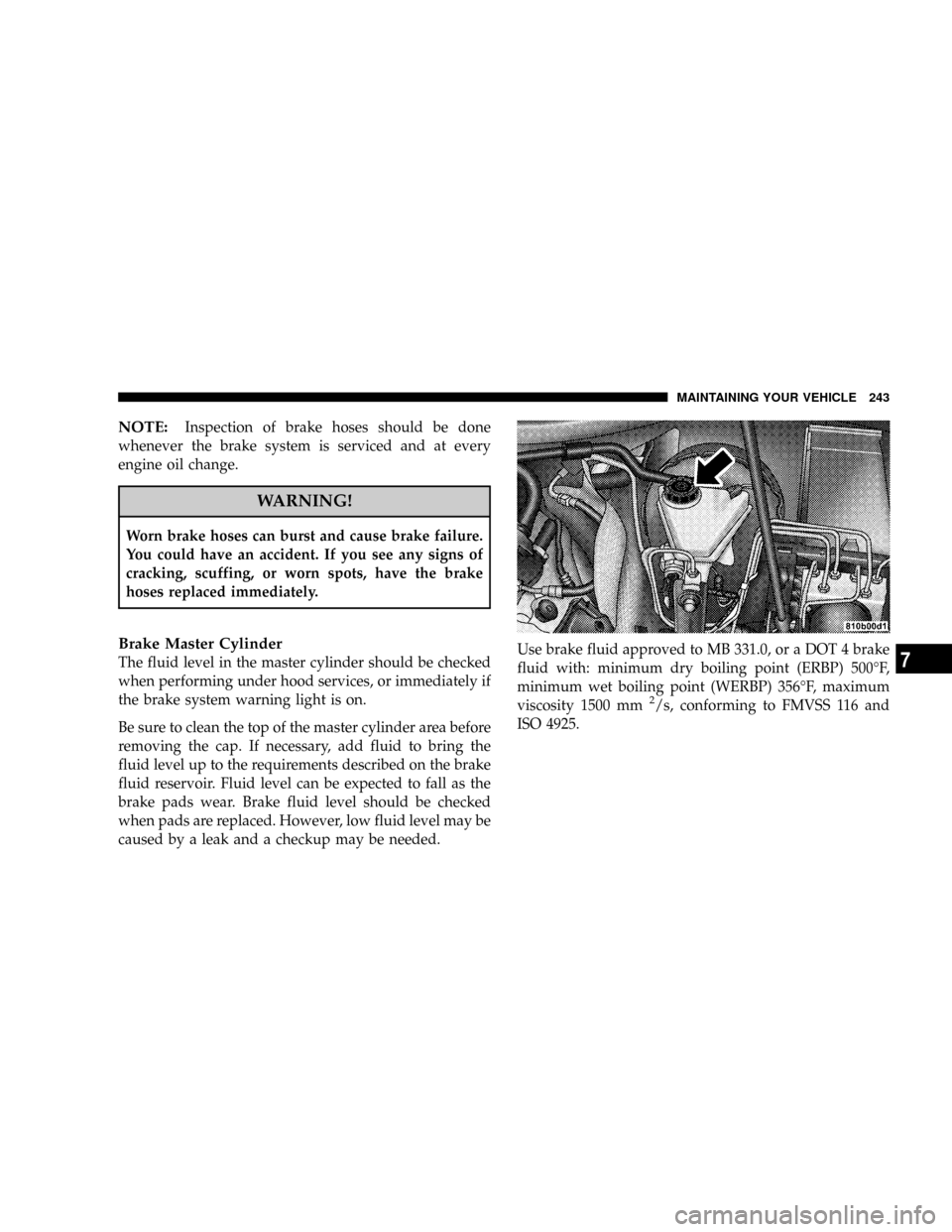
Brake Master Cylinder
The fluid level in the master cylinder should be checked
when performing under hood services, or immediately if
the brake system warning light is on.
Be sure to clean the top of the master cylinder area before
removing the cap. If necessary, add fluid to bring the
fluid level up to the requirements described on the brake
fluid reservoir. Fluid level can be expected to fall as the
brake pads wear. Brake fluid level should be checked
when pads are replaced. However, low fluid level may be
caused by a leak and a checkup may be needed.Use brake fluid approved to MB 331.0, or a DOT 4 brake
fluid with: minimum dry boiling point (ERBP) 500ÉF,
minimum wet boiling point (WERBP) 356ÉF, maximum
viscosity 1500 mm
2/s, conforming to FMVSS 116 and
ISO 4925.
MAINTAINING YOUR VEHICLE 243
7
Page 244 of 299
WARNING!
Use of a brake fluid that may have a lower initial
boiling point or unidentified as to specification, may
result in sudden brake failure during hard prolonged
braking. You could have an accident.
WARNING!
Use only brake fluid that has been in a tightly closed
container to avoid contamination from foreign mat-
ter. Use of contaminated fluid may result in reduced
brake performance or a sudden brake failure. You
could have an accident.
CAUTION!
Do not allow petroleum-based fluid to contaminate
the brake fluid as seal damage will result!
Automatic Transmission
The fluid in the automatic transmission should be
changed at 80,000 miles (129,000 km), along with the
transmission fluid filter. After that, the transmission fluid
is filled for life.
Selection of Lubricant
It is important that the proper lubricant is used in the
transmission to assure optimum transmission perfor-
mance. Use only ATF approved to MB 236.10, MB 236.12.
Synthetic Dexron IIItAutomatic Transmission Fluid may
be substituted. Refer to the Recommended Fluids, Lubri-
cants and Genuine Parts section for the correct fluid type.
It is important that the transmission fluid be maintained
at the prescribed level using the recommended fluid.
244 MAINTAINING YOUR VEHICLE
Page 249 of 299
CAUTION!
Many wheel cleaners contain acids that may harm the
wheel surface.
Interior Care
Use MopartFabric Cleaner to clean fabric upholstery
and carpeting.
Use MopartVinyl Cleaner to clean vinyl upholstery.
MopartVinyl Cleaner is specifically recommended for
vinyl trim.
Leather Seat Care and Cleaning
Leather is best preserved by regular cleaning with a
damp soft cloth. Small particles of dirt can act as an
abrasive and damage the leather surface and should be
removed immediately with a damp cloth. Stubborn soils
can be removed easily with a soft cloth and MopartTotal
Clean. Care should be taken to avoid soaking your
leather upholstery with any liquid. Please do not use
polishes, oils, cleaning fluids, solvents, detergents, orammonia based cleaners to clean your leather upholstery.
Application of a leather conditioner is not required to
maintain the original condition.
CAUTION!
The use of vinyl, leather or plastic protectants may
cause excessive gloss and/or discoloration of interior
trim parts.
WARNING!
Do not use volatile solvents for cleaning purposes.
Many are potentially flammable, and if used in
closed areas they may cause respiratory harm.
Cleaning Headlights
Your vehicle has plastic headlights that are lighter and
less susceptible to stone breakage than glass headlights.
Plastic is not as scratch resistant as glass and therefore
different lens cleaning procedures must be followed.
MAINTAINING YOUR VEHICLE 249
7
Page 256 of 299
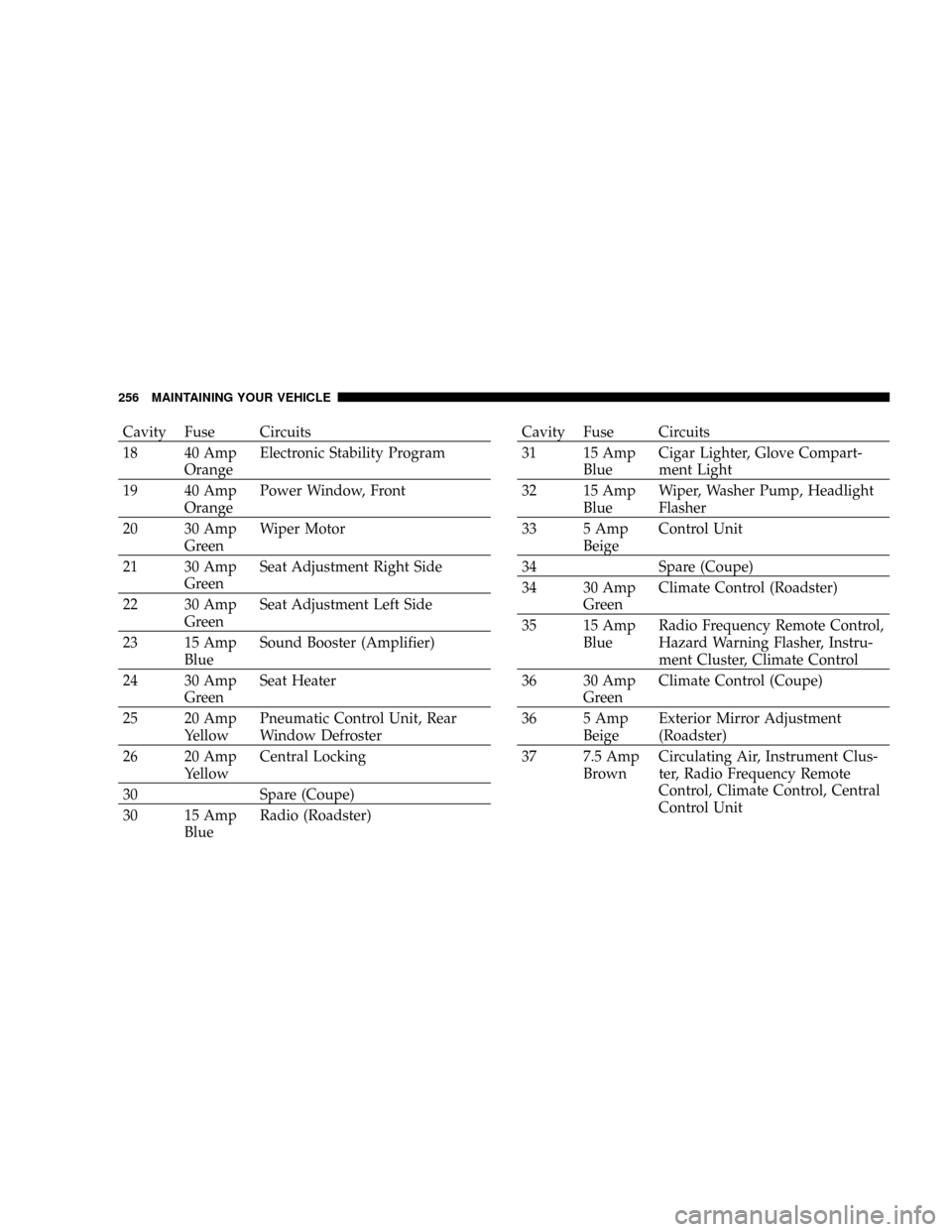
Cavity Fuse Circuits
18 40 Amp
OrangeElectronic Stability Program
19 40 Amp
OrangePower Window, Front
20 30 Amp
GreenWiper Motor
21 30 Amp
GreenSeat Adjustment Right Side
22 30 Amp
GreenSeat Adjustment Left Side
23 15 Amp
BlueSound Booster (Amplifier)
24 30 Amp
GreenSeat Heater
25 20 Amp
YellowPneumatic Control Unit, Rear
Window Defroster
26 20 Amp
YellowCentral Locking
30 Spare (Coupe)
30 15 Amp
BlueRadio (Roadster)Cavity Fuse Circuits
31 15 Amp
BlueCigar Lighter, Glove Compart-
ment Light
32 15 Amp
BlueWiper, Washer Pump, Headlight
Flasher
33 5 Amp
BeigeControl Unit
34 Spare (Coupe)
34 30 Amp
GreenClimate Control (Roadster)
35 15 Amp
BlueRadio Frequency Remote Control,
Hazard Warning Flasher, Instru-
ment Cluster, Climate Control
36 30 Amp
GreenClimate Control (Coupe)
36 5 Amp
BeigeExterior Mirror Adjustment
(Roadster)
37 7.5 Amp
BrownCirculating Air, Instrument Clus-
ter, Radio Frequency Remote
Control, Climate Control, Central
Control Unit
256 MAINTAINING YOUR VEHICLE
Page 260 of 299
EXTERIOR LIGHT BULB SERVICE
Headlights
WARNING!
Halogen lamps contain pressurized gas. A bulb can
explode if you:
²Touch or move it when hot
²Drop the bulb
²Scratch the bulb
Wear eye and hand protection.
NOTE:To prevent a possible electrical short circuit,
switch off light prior to replacing a bulb.
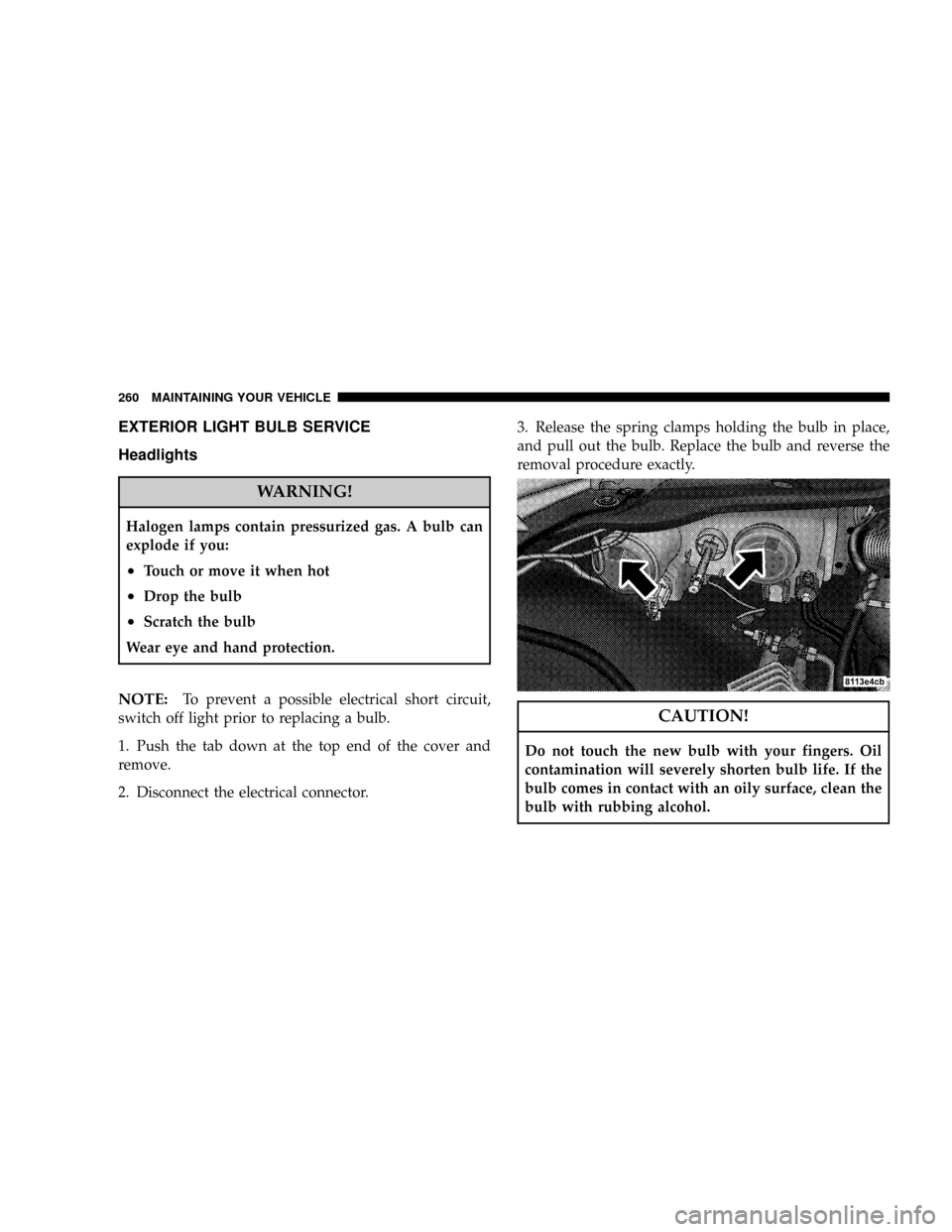
1. Push the tab down at the top end of the cover and
remove.
2. Disconnect the electrical connector.3. Release the spring clamps holding the bulb in place,
and pull out the bulb. Replace the bulb and reverse the
removal procedure exactly.
CAUTION!
Do not touch the new bulb with your fingers. Oil
contamination will severely shorten bulb life. If the
bulb comes in contact with an oily surface, clean the
bulb with rubbing alcohol.
260 MAINTAINING YOUR VEHICLE
Page 274 of 299
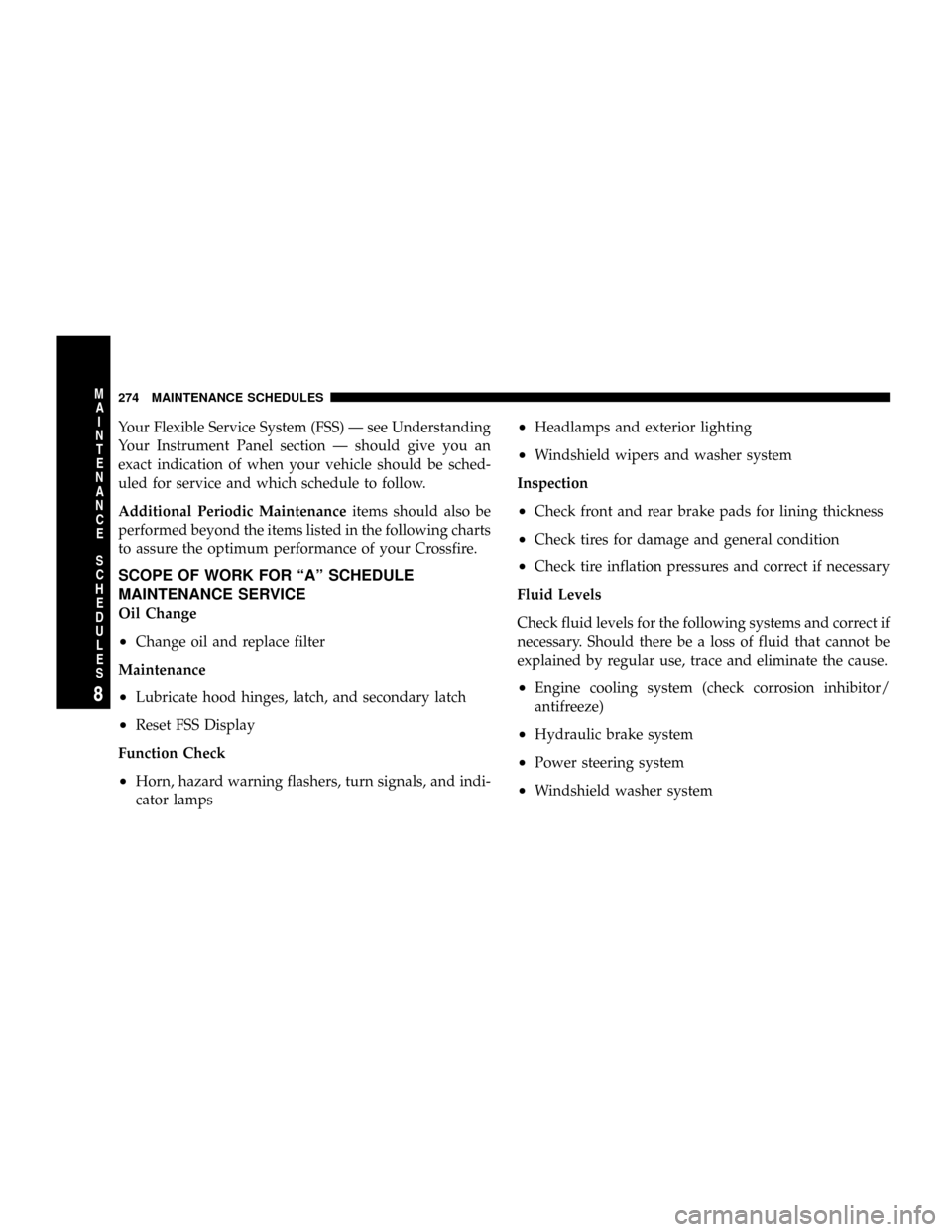
Your Flexible Service System (FSS) Ð see Understanding
Your Instrument Panel section Ð should give you an
exact indication of when your vehicle should be sched-
uled for service and which schedule to follow.
Additional Periodic Maintenanceitems should also be
performed beyond the items listed in the following charts
to assure the optimum performance of your Crossfire.
SCOPE OF WORK FOR ªAº SCHEDULE
MAINTENANCE SERVICE
Oil Change
²Change oil and replace filter
Maintenance
²Lubricate hood hinges, latch, and secondary latch
²Reset FSS Display
Function Check
²Horn, hazard warning flashers, turn signals, and indi-
cator lamps
²Headlamps and exterior lighting
²Windshield wipers and washer system
Inspection
²Check front and rear brake pads for lining thickness
²Check tires for damage and general condition
²Check tire inflation pressures and correct if necessary
Fluid Levels
Check fluid levels for the following systems and correct if
necessary. Should there be a loss of fluid that cannot be
explained by regular use, trace and eliminate the cause.
²Engine cooling system (check corrosion inhibitor/
antifreeze)
²Hydraulic brake system
²Power steering system
²Windshield washer system
274 MAINTENANCE SCHEDULES
8
M
A
I
N
T
E
N
A
N
C
E
S
C
H
E
D
U
L
E
S
Page 275 of 299

SCOPE OF WORK FOR ªBº SCHEDULE
MAINTENANCE SERVICE
Oil Change
²Change oil and replace filter
Maintenance
²Rotate tires
²Replace dust filter (if equipped)
²Lubricate hood hinges, latch, and secondary latch
²Reset FSS Display
Function Check
²Horn, hazard warning flashers, turn signals, and indi-
cator lamps
²Headlamps and exterior lighting
²Windshield wipers and washer system
²Check seat belts for damage and proper function
²Test hydraulic brakes and check parking brake func-
tionInspection
²Check front and rear brake pads for lining thickness
²Check condition of front and rear brake discs
²Check tires for damage and general condition
²Check tire inflation pressures and correct if necessary
²Check major underbody components for leakage or
damage (if there are signs of leakage, determine cause
and repair)
²Check condition of front axle ball joints and rubber
boots
²Check condition of steering components and rubber
boots
²Check underhood components for leakage or damage
(if there are signs of leakage determine cause and
repair)
²Check condition of accessory drive belt
²Check headlamp aiming, adjust if necessary
²Check windshield wiper blades, replace if necessary
MAINTENANCE SCHEDULES 275
8
M
A
I
N
T
E
N
A
N
C
E
S
C
H
E
D
U
L
E
S
Page 279 of 299
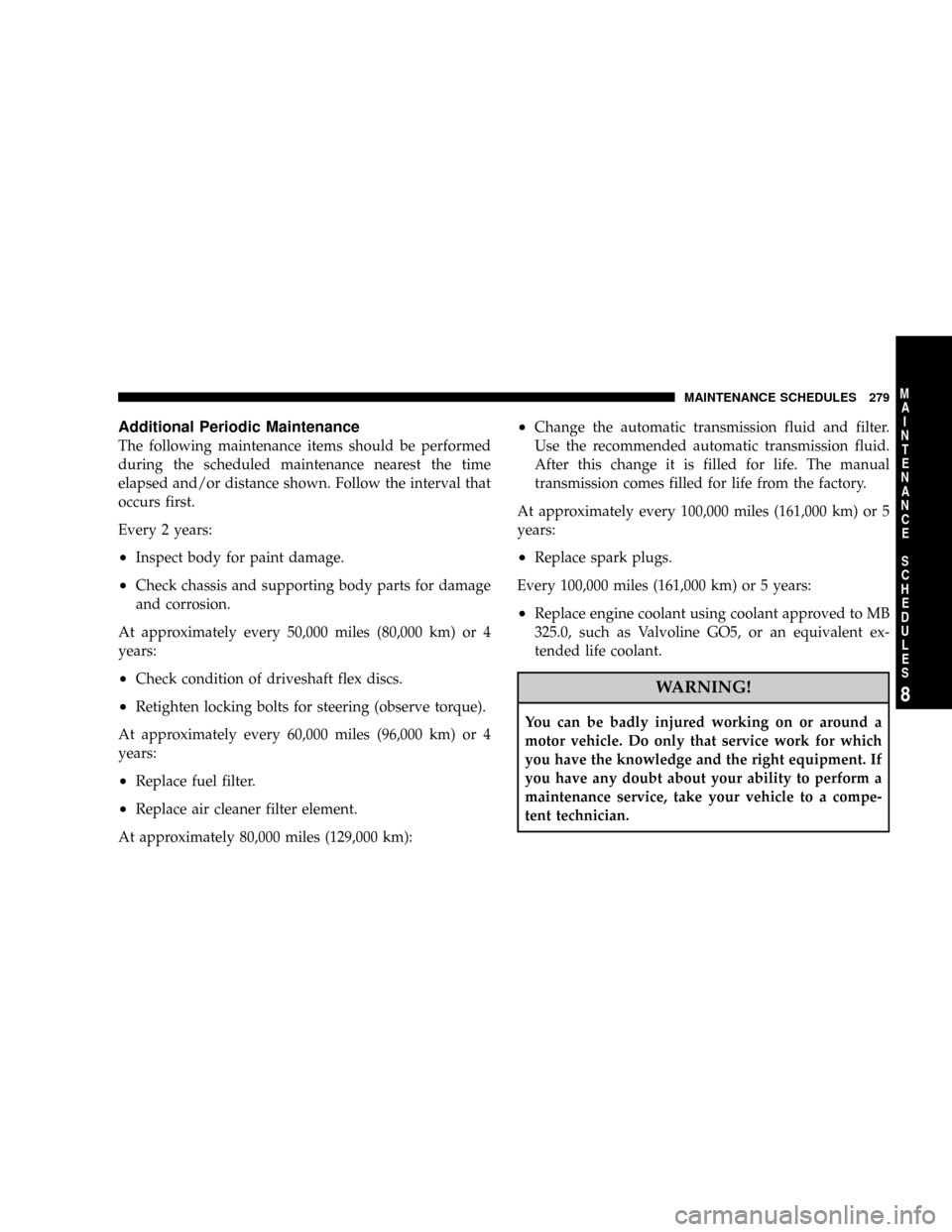
Additional Periodic Maintenance
The following maintenance items should be performed
during the scheduled maintenance nearest the time
elapsed and/or distance shown. Follow the interval that
occurs first.
Every 2 years:
²Inspect body for paint damage.
²Check chassis and supporting body parts for damage
and corrosion.
At approximately every 50,000 miles (80,000 km) or 4
years:
²Check condition of driveshaft flex discs.
²Retighten locking bolts for steering (observe torque).
At approximately every 60,000 miles (96,000 km) or 4
years:
²Replace fuel filter.
²Replace air cleaner filter element.
At approximately 80,000 miles (129,000 km):
²Change the automatic transmission fluid and filter.
Use the recommended automatic transmission fluid.
After this change it is filled for life. The manual
transmission comes filled for life from the factory.
At approximately every 100,000 miles (161,000 km) or 5
years:
²Replace spark plugs.
Every 100,000 miles (161,000 km) or 5 years:
²Replace engine coolant using coolant approved to MB
325.0, such as Valvoline GO5, or an equivalent ex-
tended life coolant.
WARNING!
You can be badly injured working on or around a
motor vehicle. Do only that service work for which
you have the knowledge and the right equipment. If
you have any doubt about your ability to perform a
maintenance service, take your vehicle to a compe-
tent technician.
MAINTENANCE SCHEDULES 279
8
M
A
I
N
T
E
N
A
N
C
E
S
C
H
E
D
U
L
E
S
Page 287 of 299
DEPARTMENT OF TRANSPORTATION UNIFORM
TIRE QUALITY GRADES
The following describes the tire grading categories estab-
lished by the National highway Traffic Safety Adminis-
tration. The specific grade rating assigned by the tire's
manufacturer in each category is shown on the sidewall
of the tires on your car.
All Passenger Car Tires Must Conform to Federal Safety
Requirements in Addition to These Grades.
Treadwear
The treadwear grade is a comparative rating based on the
wear rate of the tire when tested under controlled con-
ditions on a specified government test course. For ex-
ample, a tire graded 150 would wear one and a half (1
1/2) times as well on the government course as a tire
graded 100. The relative performance of tires depends
upon the actual conditions of their use, however, and
may depart significantly from the norm due to variations
in driving habits, service practices and differences in road
characteristics and climate.
Traction Grades
The traction grades, from highest to lowest, are AA, A, B,
and C. Those grades represent the tire's ability to stop on
wet pavement as measured under controlled conditions
on specified government test surfaces of asphalt and
concrete. A tire marked C may have poor traction perfor-
mance.
WARNING!
The traction grade assigned to this tire is based on
straight-ahead braking traction tests, and does not
include acceleration, cornering, hydroplaning, or
peak traction characteristics.
IF YOU NEED CONSUMER ASSISTANCE 287
9